


Romans 1:30
- καταλάλουςkatalalousslanderersG2637A-APMAdjective Accusative Plural Masculine
- θεοστυγεῖςtheostugeishateful to GodG2319A-APMAdjective Accusative Plural Masculine
- ὑβριστάςhubristasinsolentG5197N-APMNoun Accusative Plural Masculine
- ὑπερηφάνουςhuperēphanousarrogantG5244A-APMAdjective Accusative Plural Masculine
- ἀλαζόναςalazonasboastfulG213N-APMNoun Accusative Plural Masculine
- ἐφευρετὰςepheuretasinventorsG2182N-APMNoun Accusative Plural Masculine
- κακῶνkakōnof evil thingsG2556A-GPNAdjective Genitive Plural Neuter
- γονεῦσινgoneusinto parentsG1118N-DPMNoun Dative Plural Masculine
- ἀπειθεῖςapeitheisdisobedientG545A-APMAdjective Accusative Plural Masculine
English is a literal word-by-word gloss of the Greek, not the KJV's wording. Why?
This is the original text the KJV's translators worked from — each Greek word with its own literal English meaning in this verse, prepared by scholars at Tyndale House, Cambridge. The KJV translates whole sentences, not word by word, so its wording differs: one Greek word can become several English words, and the KJV may choose “charity” where the gloss reads “love”. Both are faithful — they answer different questions. For the KJV's own rendering, switch to the KJV text.
Details
See on the biblical-era map
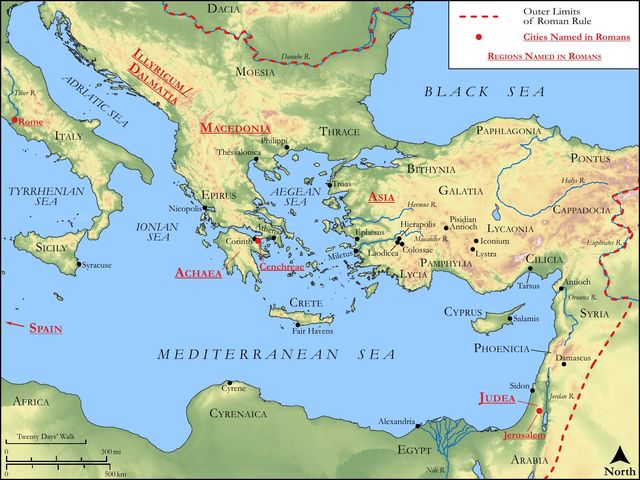

Study this verse
Public-domain commentary
Matthew Henry
From his Commentary on the Whole Bible. Henry comments on passages, not single verses — this entry covers Romans 1:19–32. His four-level outline is real structure in the source text, so it is rendered as structure.
In this last part of the chapter the apostle applies what he had said particularly to the Gentile world, in which we may observe,
I.The means and helps they had to come to the knowledge of God.
Though they had not such a knowledge of his law as Jacob and Israel had (Psa 147:20), yet among them he left not himself without witness (Act 14:17): For that which may be known, etc., Rom 1:19, Rom 1:20. Observe,
1.What discoveries they had: That which may be known of God is manifest, en autois - among them; that is, there were some even among them that had the knowledge of God, were convinced of the existence of one supreme Numen. The philosophy of Pythagoras, Plato, and the Stoics, discovered a great deal of the knowledge of God, as appears by abundance of testimonies. That which may be known, which implies that there is a great deal which may not be known. The being of God may be apprehended, but cannot be comprehended. We cannot by searching find him out, Job 11:7-9. Finite understandings cannot perfectly know an infinite being; but, blessed be God, there is that which may be known, enough to lead us to our chief end, the glorifying and enjoying of him; and these things revealed belong to us and to our children, while secret things are not to be pried into, Deu 29:29.
2.Whence they had these discoveries: God hath shown it to them. Those common natural notions which they had of God were imprinted upon their hearts by the God of nature himself, who is the Father of lights. This sense of a Deity, and a regard to that Deity, are so connate with the human nature that some think we are to distinguish men from brutes by these rather than by reason.
3.By what way and means these discoveries and notices which they had were confirmed and improved, namely, by the work of creation (Rom 1:20); For the invisible things of God, etc.
(1.)Observe what they knew: The invisible things of him, even his eternal power and Godhead. Though God be not the object of sense, yet he hath discovered and made known himself by those things that are sensible. The power and Godhead of God are invisible things, and yet are clearly seen in their products. He works in secret (Job 23:8, Job 23:9; Psa 139:15; Ecc 11:5), but manifests what he has wrought, and therein makes known his power and Godhead, and others of his attributes which natural light apprehends in the idea of a God. They could not come by natural light to the knowledge of the three persons in the Godhead (though some fancy they have found footsteps of this in Plato's writings), but they did come to the knowledge of the Godhead, at least so much knowledge as was sufficient to have kept them from idolatry. This was that truth which they held in unrighteousness.
(2.)How they knew it: By the things that are made, which could not make themselves, nor fall into such an exact order and harmony by any casual hits; and therefore must have been produced by some first cause or intelligent agent, which first cause could be no other than an eternal powerful God. See Psa 19:1; Isa 40:26; Act 17:24. The workman is known by his work. The variety, multitude, order, beauty, harmony, different nature, and excellent contrivance, of the things that are made, the direction of them to certain ends, and the concurrence of all the parts to the good and beauty of the whole, do abundantly prove a Creator and his eternal power and Godhead. Thus did the light shine in the darkness. And this from the creation of the world. Understand it either,
[1.]As the topic from which the knowledge of them is drawn. To evince this truth, we have recourse to the great work of creation. And some think this ktisis kosmou, this creature of the world (as it may be read), is to be understood of man, the ktisis kat' exochēn - the most remarkable creature of the lower world, called ktisis, Mar 16:15. The frame and structure of human bodies, and especially the most excellent powers, faculties, and capacities of human souls, do abundantly prove that there is a Creator, and that he is God. Or,
[2.]As the date of the discovery. It as old as the creation of the world. In this sense apo ktiseōs is most frequently used in scripture. These notices concerning God are not any modern discoveries, hit upon of late, but ancient truths, which were from the beginning. The way of the acknowledgement of God is a good old way; it was from the beginning. Truth got the start of error.
II.Their gross idolatry, notwithstanding these discoveries that God made to them of himself; described here, Rom 1:21-23, Rom 1:25.
We shall the less wonder at the inefficacy of these natural discoveries to prevent the idolatry of the Gentiles if we remember how prone even the Jews, who had scripture light to guide them, were to idolatry; so miserably are the degenerate sons of men plunged in the mire of sense. Observe,
1.The inward cause of their idolatry, Rom 1:21, Rom 1:22. They are therefore without excuse, in that they did know God, and from what they knew might easily infer that it was their duty to worship him, and him only. Though some have greater light and means of knowledge than others, yet all have enough to leave them inexcusable. But the mischief of it was that,
(1.)They glorified him not as God. Their affections towards him, and their awe and adoration of him, did not keep pace with their knowledge. To glorify him as God is to glorify him only; for there can be but one infinite: but they did not so glorify him, for they set up a multitude of other deities. To glorify him as God is to worship him with spiritual worship; but they made images of him. Not to glorify God as God is in effect not to glorify him at all; to respect him as a creature is not to glorify him, but to dishonour him.
(2.)Neither were they thankful; not thankful for the favours in general they received from God (insensibleness of God's mercies is at the bottom of our sinful departures from him); not thankful in particular for the discoveries God was pleased to make of himself to them. Those that do not improve the means of knowledge and grace are justly reckoned unthankful for them.
(3.)But they became vain in their imaginations, en tois dialogismois - in their reasonings, in their practical inferences. They had a great deal of knowledge of general truths (Rom 1:19), but no prudence to apply them to particular cases. Or, in their notions of God, and the creation of the world, and the origination of mankind, and the chief good; in these things, when they quitted the plain truth, they soon disputed themselves into a thousand vain and foolish fancies. The several opinions and hypotheses of the various sects of philosophers concerning these things were so many vain imaginations. When truth is forsaken, errors multiply in infinitum - infinitely.
(4.)And their foolish heart was darkened. The foolishness and practical wickedness of the heart cloud and darken the intellectual powers and faculties. Nothing tends more to the blinding and perverting of the understanding than the corruption and depravedness of the will and affections.
(5.)Professing themselves to be wise, they became fools, Rom 1:22. This looks black upon the philosophers, the pretenders to wisdom and professors of it. Those that had the most luxuriant fancy, in framing to themselves the idea of a God, fell into the most gross and absurd conceits: and it was the just punishment of their pride and self-conceitedness. It has been observed that the most refined nations, that made the greatest show of wisdom, were the arrantest fools in religion. The barbarians adored the sun and moon, which of all others was the most specious idolatry; while the learned Egyptians worshipped an ox and an onion. The Grecians, who excelled them in wisdom, adored diseases and human passions. The Romans, the wisest of all, worshipped the furies. And at this day the poor Americans worship the thunder; while the ingenious Chinese adore the devil. Thus the world by wisdom knew not God, Co1 1:21. As a profession of wisdom is an aggravation of folly, so a proud conceit of wisdom is the cause of a great deal of folly. Hence we read of few philosophers who were converted to Christianity; and Paul's preaching was no where so laughed at and ridiculed as among the learned Athenians, Act 17:18-32. Phaskontes einai - conceiting themselves to be wise. The plain truth of the being of God would not content them; they thought themselves above that, and so fell into the greatest errors.
2.The outward acts of their idolatry, Rom 1:23-25.
(1.)Making images of God (Rom 1:23), by which, as much as in them lay, they changed the glory of the incorruptible God. Compare Psa 106:20; Jer 2:11. They ascribed a deity to the most contemptible creatures, and by them represented God. It was the greatest honour God did to man that he made man in the image of God; but it is the greatest dishonour man has done to God that he has made God in the image of man. This was what God so strictly warned the Jews against, Deu 4:15, etc. This the apostle shows the folly of in his sermon at Athens, Act 17:29. See Isa 40:18, etc.; Isa 44:10, etc. This is called (Rom 1:25) changing the truth of God into a lie. As it did dishonour his glory, so it did misrepresent his being. Idols are called lies, for they belie God, as if he had a body, whereas he is a Spirit, Jer 23:14; Hos 7:1. Teachers of lies, Hab 2:18.
(2.)Giving divine honour to the creature: Worshipped and served the creature, para ton ktisanta - besides the Creator. They did own a supreme Numen in their profession, but they did in effect disown him by the worship they paid to the creature; for God will be all or none. Or, above the Creator, paying more devout respect to their inferior deities, stars, heroes, demons, thinking the supreme God inaccessible, or above their worship. The sin itself was their worshipping the creature at all; but this is mentioned as an aggravation of the sin, that they worshipped the creature more than the Creator. This was the general wickedness of the Gentile world, and became twisted in with their laws and government; in compliance with which even the wise men among them, who knew and owned a supreme God and were convinced of the nonsense and absurdity of their polytheism and idolatry, yet did as the rest of their neighbours did. Seneca, in his book De Superstitione, as it is quoted by Aug. de Civit. Dei, lib. 6, cap. 10 (for the book itself is lost), after he had largely shown the great folly and impiety of the vulgar religion, in divers instances of it, yet concludes, Quae omnia sapiens servabit tanquam legibus jussa, non tanquam diis grata - All which a wise man will observe as established by law, not imagining them grateful to the gods. And afterwards, Omnem istam ignobilem deorum turbam, quam longo aevo longa superstitio congessit, sic adorabimus, ut meminerimus cultum ejus magis ad morem quam ad rem pertinere - All this ignoble rout of gods, which ancient superstition has amassed together by long prescription, we will so adore as to remember that the worship of them is rather a compliance with custom than material in itself. Upon which Augustine observes, Colebat quod reprehendebat, agebat quod arguebat, quod culpabat adorabat - He worshipped that which he censured, he did that which he had proved wrong, and he adored what he found fault with. I mention this thus largely because methinks it doth fully explain that of the apostle here (Rom 1:18): Who hold the truth in unrighteousness. It is observable that upon the mention of the dishonour done to God by the idolatry of the Gentiles the apostle, in the midst of his discourse, expresses himself in an awful adoration of God: Who is blessed for ever. Amen. When we see or hear of any contempt cast upon God or his name, we should thence take occasion to think and speak highly and honourably of him. In this, as in other things, the worse others are, the better we should be. Blessed for ever, notwithstanding these dishonours done to his name: though there are those that do not glorify him, yet he is glorified, and will be glorified to eternity.
III.The judgments of God upon them for this idolatry; not many temporal judgments (the idolatrous nations were the conquering ruling nations of the world), but spiritual judgments, giving them up to the most brutish and unnatural lusts. Paredōken autous - He gave them up; it is thrice repeated here, Rom 1:24, Rom 1:26, Rom 1:28. Spiritual judgments are of all judgments the sorest, and to be most dreaded. Observe,
1.By whom they were given up. God gave them up, in a way of righteous judgment, as the just punishment of their idolatry - taking off the bridle of restraining grace - leaving them to themselves - letting them alone; for his grace is his own, he is debtor to no man, he may give or withhold his grace at pleasure. Whether this giving up be a positive act of God or only privative we leave to the schools to dispute: but this we are sure of that it is no new thing for God to give men up to their own hearts' lusts, to send them strong delusions, to let Satan loose upon them, nay, to lay stumbling-blocks before them. And yet God is not the author of sin, but herein infinitely just and holy; for, though the greatest wickedness follow upon this giving up, the fault of that is to be laid upon the sinner's wicked heart. If the patient be obstinate, and will not submit to the methods prescribed, but wilfully takes and does that which is prejudicial to him, the physician is not to be blamed if he give him up as in a desperate condition; and all the fatal symptoms that follow are not to be imputed to the physician, but to the disease itself and to the folly and wilfulness of the patient.
2.To what they were given up.
(1.)To uncleanness and vile affections, Rom 1:24, Rom 1:26, Rom 1:27. Those that would not entertain the more pure and refined notices of natural light, which tend to preserve the honour of God, justly forfeited those more gross and palpable sentiments which preserve the honour of human nature. Man being in honour, and refusing to understand the God that made him, thus becomes worse than the beasts that perish, Psa 49:20. Thus one, by the divine permission, becomes the punishment of another; but it is (as it said here) through the lusts of their own hearts - there all the fault is to be laid. Those who dishonoured God were given up to dishonour themselves. A man cannot be delivered up to a greater slavery than to be given up to his own lusts. Such are given over, like the Egyptians (Isa 19:4), into the hand of a cruel lord. The particular instances of their uncleanness and vile affections are their unnatural lusts, for which many of the heathen, even of those among them who passed for wise men, as Solon and Zeno, were infamous, against the plainest and most obvious dictates of natural light. The crying iniquity of Sodom and Gomorrah, for which God rained hell from heaven upon them, became not only commonly practised, but avowed, in the pagan nations. Perhaps the apostle especially refers to the abominations that were committed in the worship of their idol-gods, in which the worst of uncleannesses were prescribed for the honour of their gods; dunghill service for dunghill gods: the unclean spirits delight in such ministrations. In the church of Rome, where the pagan idolatries are revived, images worshipped, and saints only substituted in the room of demons, we hear of these same abominations going barefaced, licensed by the pope (Fox's Acts and Monuments, vol. 1, p. 808), and not only commonly perpetrated, but justified and pleaded for by some of their cardinals: the same spiritual plagues for the same spiritual wickednesses. See what wickedness there is in the nature of man. How abominable and filthy is man! Lord, what is man? says David; what a vile creature is he when left to himself! How much are we beholden to the restraining grace of God for the preserving any thing of the honour and decency of the human nature! For, were it not for this, man, who was made but little lower than the angels, would make himself a great deal lower than the devils. This is said to be that recompence of their error which was meet. The Judge of all the earth does right, and observes a meetness between the sin and the punishment of it.
(2.)To a reprobate mind in these abominations, Rom 1:28.
[1.]They did not like to retain God in their knowledge. The blindness of their understandings was caused by the wilful aversion of their wills and affections. They did not retain God in their knowledge, because they did not like it. They would neither know nor do any thing but just what pleased themselves. It is just the temper of carnal hearts; the pleasing of themselves is their highest end. There are many that have God in their knowledge, they cannot help it, the light shines so fully in their faces; but they do not retain him there. They say to the Almighty, Depart (Job 21:14), and they therefore do not retain God in their knowledge because it thwarts and contradicts their lusts; they do not like it. In their knowledge - en epignōsei. There is a difference between gnōsis and epignōsis, the knowledge and the acknowledgement of God; the pagans knew God, but did not, would not, acknowledge him.
[2.]Answerable to this wilfulness of theirs, in gainsaying the truth, God gave them over to a wilfulness in the grossest sins, here called a reprobate mind - eis adokimon noun, a mind void of all sense and judgment to discern things that differ, so that they could not distinguish their right hand from their left in spiritual things. See whither a course of sin leads, and into what a gulf it plunges the sinner at last; hither fleshly lusts have a direct tendency. Eyes full of adultery cannot cease from sin, Pe2 2:14. This reprobate mind was a blind scared conscience, past feeling, Eph 4:19. When the judgment is once reconciled to sin, the man is in the suburbs of hell. At first Pharaoh hardened his heart, but afterwards God hardened Pharaoh's heart. Thus wilful hardness is justly punished with judicial hardness. - To do those things which are not convenient. This phrase may seem to bespeak a diminutive evil, but here it is expressive of the grossest enormities; things that are not agreeable to men, but contradict the very light and law of nature. And here he subjoins a black list of those unbecoming things which the Gentiles were guilty of, being delivered up to a reprobate mind. No wickedness so heinous, so contrary to the light of nature, to the law of nations, and to all the interests of mankind, but a reprobate mind will comply with it. By the histories of those times, especially the accounts we have of the then prevailing dispositions and practices of the Romans when the ancient virtue of that commonwealth was so degenerated, it appears that these sins here mentioned were then and there reigning national sins. No fewer than twenty-three several sorts of sins and sinners are here specified, Rom 1:29-31. Here the devil's seat is; his name is legion, for they are many. It was time to have the gospel preached among them, for the world had need of reformation.
First, Sins against the first table: Haters of God. Here is the devil in his own colours, sin appearing sin. Could it be imagined that rational creatures should hate the chief good, and depending creatures abhor the fountain of their being? And yet so it is. Every sin has in it a hatred of God; but some sinners are more open and avowed enemies to him than others, Zac 11:8. Proud men and boasters cope with God himself, and put those crowns upon their own heads which must be cast before his throne.
Secondly, Sins against the second table. These are especially mentioned, because in these things they had a clearer light. In general here is a charge of unrighteousness. This is put first, for every sin is unrighteousness; it is withholding that which is due, perverting that which is right; it is especially put for second-table sins, doing as we would not be done by. Against the fifth commandment: Disobedient to parents, and without natural affection - astorgous, that is parents unkind and cruel to their children. Thus, when duty fails on one side, it commonly fails on the other. Disobedient children are justly punished with unnatural parents; and, on the contrary, unnatural parents with disobedient children. Against the sixth commandment: Wickedness (doing mischief for mischief's sake), maliciousness, envy, murder, debate (eridos - contention), malignity, despiteful, implacable, unmerciful; all expressions of that hatred of our brother which is heart-murder. Against the seventh commandment: Fornication; he mentions no more, having spoken before of other uncleannesses. Against the eighth commandment: Unrighteousness, covetousness. Against the ninth commandment: Deceit, whisperers, back-biters, covenant-breakers, lying and slandering. Here are two generals not before mentioned - inventors of evil things, and without understanding; wise to do evil, and yet having no knowledge to do good. The more deliberate and politic sinners are in inventing evil things, the greater is their sin: so quick of invention in sin, and yet without understanding (stark fools) in the thoughts of God. Here is enough to humble us all, in the sense of our original corruption; for every heart by nature has in it the seed and spawn of all these sins. In the close he mentions the aggravations of the sins, Rom 1:32. 1. They knew the judgment of God; that is, (1.) They knew the law. The judgment of God is that which his justice requires, which, because he is just, he judgeth meet to be done. (2.) They knew the penalty; so it is explained here: They knew that those who commit such things were worthy of death, eternal death; their own consciences could not but suggest this to them, and yet they ventured upon it. It is a great aggravation of sin when it is committed against knowledge (Jam 4:17), especially against the knowledge of the judgment of God. It is daring presumption to run upon the sword's point. It argues the heart much hardened, and very resolutely set upon sin. 2. They not only do the same, but have pleasure in those that do them. The violence of some present temptation may hurry a man into the commission of such sins himself in which the vitiated appetite may take a pleasure; but to be pleased with other people's sins is to love sin for sin's sake: it is joining in a confederacy for the devil's kingdom and interest. Suneudokousi: they do not only commit sin, but they defend and justify it, and encourage others to do the like. Our own sins are much aggravated by our concurrence with, and complacency in, the sins of others.
Now lay all this together, and then say whether the Gentile world, lying under so much guilt and corruption, could be justified before God by any works of their own.
Historical interpretation
Two Centuries of Reception
4 surviving comments on this verse. Each one is dated, so this reads as a timeline rather than a list.
Select a marker to jump to its quote. Markers stagger vertically where authors wrote within a few decades of each other.
Wherefore, although there have been found: some among our colleagues, dearest brethren, who think that the godly discipline may be neglected, and who rashly hold communion with Basilides and Martialis, such a thing as this ought not to trouble our faith, since the Holy Spirit threatens such in the Psalms, saying, "But thou hatest instruction, and castedst my words behind thee: when thou sawest a thief, thou consentedst unto him, and hast been partaker with adulterers." He shows that they become sharers and partakers of other men's sins who are associated with the delinquents. And besides, Paul the apostle writes, and says the same thing: "Whisperers, backbiters, haters of God, injurious, proud, boasters of themselves, inventors of evil things, who, although they knew the judgment of God, did not understand that they which commit such things are worthy of death, not only they which commit those things, but they also which consent unto those who do these things." Since they, says he, who do such things are worthy of death, he makes manifest and proves that not only they are worthy of death, and come into punishment who do evil things, but also those who consent unto those who do such things-who, while they are mingled in unlawful communion with the evil and sinners, and the unrepenting, are polluted by the contact of the guilty, and, being joined in the fault, are thus not separated in its penalty. For which reason we not only approve, but applaud, dearly beloved brethren, the religious solicitude of your integrity and faith, and exhort you as much as we can by our letters, not to mingle in sacrilegious communion with profane and polluted priests, but maintain the sound and sincere constancy of your faith with religious fear.
Because these things were displeasing to God, Paul says that they were hateful to God, and because they are also displeasing to men, he adds that they are insolent, haughty, boastful and inventors of evil, not just followers of it. For, becoming true imitators of their father the devil, they invented the evil of idolatry, through which all the vices in the world originated, as well as the greatest perdition. For the devil, whom Scripture says was a sinner from the beginning, although he gloried in his tyrannical presumption, never dared go so far as to call himself God. For among other things he says to God: “All these things have been given to me,” not: “All these things are from me.” In the book of Job the devil asks for power to be given to him, and in the prophet Zechariah he thinks that he can contradict the priest but does not claim power for himself. For this reason the idolaters are even worse, because they proclaim the divinity not only of the elements but also of imaginary things.They were seized with such insolence that they did not even acknowledge their parents, who had given them birth! They rejoiced in their children but despised those by whom they had come into being.
"Whisperers, backbiters, haters of God, despiteful," and classing things which to many seem indifferent among his charges, he further strengthens his accusation, going up to the stronghold of their wickednesses, and styles them "boasters." For even worse than sinning is it, even though sinning to be haughty-minded. Wherefore also he charges the Corinthians with it, saying, "Ye are puffed up." (1 Cor. v. 2.) For if in a good action he that puffs himself up loseth all, if any one do so among his sins, what vengeance is there of which he is not worthy, since such an one cannot repent any more? Next, he says, "inventors of evil things;" showing that they were not content with those already existing, but even invented others. And this again is like men that are full purposed and in earnest, not those that are hurried away and forced out of their course; and after mentioning the several kinds of maliciousness, and showing that here too they stood against nature itself (for he says, "disobedient to parents"), he then goes on to the root of the great pestilence, calling them,
The Scriptures link slander to idolatry by stipulating the same penalty for it—destruction. The haughty are those who want to be more than they are. The devil was like this, and so destroyed himself. For one who seeks to lord it over others will end up beneath them.
Continue studying Romans 1:30 across the web’s major study libraries — every link below opens this exact verse, chapter, or book on the destination site.
Read & Compare
 BibleGatewayThis verse in more than 200 translations and 70 languages.
 Bible.comThe YouVersion reader — hundreds of translations, reading plans, and highlights.
 ESV.orgCrossway's official English Standard Version reader.
 NET BibleThe NET translation with 60,000+ translators' notes on every rendering decision.
 STEP BibleTyndale House's free study tool — original text, vocabulary, and scholarly resources.
 BibliaLogos Bible Software's free web reader.
 USCCBThe New American Bible (Revised Edition) with the U.S. bishops' study notes.
Commentaries
 BibleHub CommentariesDozens of classic commentaries on this verse, gathered on one page.
 StudyLightMore than 100 commentary sets — the largest collection on the web.
 BibleRefPlain-English commentary on what this verse means, verse by verse.
 Enduring WordDavid Guzik's free commentary on this chapter, widely used by Bible teachers.
 Bible Study ToolsVerse commentary alongside Greek and Hebrew study aids.
Original Language & Research
- BibleHub InterlinearThe verse word by word — original language, transliteration, and English.
- BibleHub LexiconEvery word's original-language definition and Strong's entry.
 Blue Letter BibleDeep-study tools — Strong's numbers, concordance, and word studies.
 CNTR CollationThe earliest Greek manuscripts of this verse, collated letter by letter.
Sermons, Hymns & Audio


TrulyRandomVerse is not affiliated with these sites and doesn’t control their content. They’re linked because they’re genuinely useful.
Summary
Romans 1:30 is a stark continuation of Paul's indictment against humanity's moral degradation, detailing a catalogue of vices that manifest when people suppress the truth of God and are given over to their sinful desires. This verse highlights specific behaviors—ranging from social malice and arrogance to active rebellion against God and fundamental familial order—that characterize a society alienated from its Creator, underscoring the pervasive nature of sin and the universal need for divine intervention and righteousness.
Context
ShowHideLiterary Context
Romans 1:30 is embedded within a comprehensive and powerful theological argument presented by the Apostle Paul in his letter to the Romans. Specifically, it forms part of a lengthy and damning list of sins found in Romans 1:29-31, which illustrates the consequences of humanity's willful rejection of God. Having established that God's invisible attributes and eternal power are clearly seen in creation (Romans 1:19-20), Paul argues that humanity is without excuse because they "exchanged the truth of God for a lie, and worshiped and served the creature rather than the Creator" (Romans 1:25). This spiritual rebellion leads God to "give them over" to various forms of depravity—first to impurity (Romans 1:24), then to degrading passions (Romans 1:26), and finally to a depraved mind (Romans 1:28). The list in Romans 1:29-31 serves as empirical evidence of this "depraved mind," demonstrating the full spectrum of moral decay that results from a fundamental alienation from God. It sets the stage for Paul's grand declaration of the gospel as the power of God for salvation to everyone who believes (Romans 1:16-17).
Historical & Cultural Context
Paul's letter to the Romans was written to a diverse church in the heart of the Roman Empire, a society characterized by its vastness, power, and also its moral complexities. The vices listed in Romans 1:29-31 were not unique to first-century Rome but were prevalent across the Greco-Roman world. While Roman society valued order, justice (according to their laws), and public virtue, private morality often diverged sharply. Pagan worship, with its pantheon of gods and goddesses, frequently involved practices that Christians considered immoral, and philosophical schools offered various ethical frameworks, none of which universally upheld the moral standards of biblical revelation. The concept of "haters of God" would have resonated in a context where imperial cults demanded worship, and those who rejected the state gods (like Christians) were often seen as impious or atheistic. "Disobedient to parents" was particularly egregious in a society that emphasized the patria potestas (father's power) and the foundational role of the family unit. Paul's list, therefore, serves not only as a theological indictment but also as a mirror reflecting the moral realities of the world he was addressing, highlighting the universal human condition apart from God's grace.
Key Themes
ShowHideRomans 1:30 significantly contributes to several overarching themes in the chapter and the broader book. A primary theme is the universality of human sin and depravity. Paul systematically demonstrates that both Gentiles (as seen in this list) and Jews (Romans 2:1-3:20) are under the power of sin, leading to the conclusion that "all have sinned and fall short of the glory of God" (Romans 3:23). Another key theme is divine judgment and the consequences of rejecting God. The phrase "God gave them over" (Romans 1:24, Romans 1:26, Romans 1:28) is a recurring motif, illustrating that God's wrath is not merely an emotional outburst but a just consequence of humanity's persistent rebellion, allowing them to experience the full destructive power of their chosen path. The verse also underscores the breakdown of order and relationships—both vertical (with God) and horizontal (with fellow humans and family)—as a direct result of spiritual rebellion. Ultimately, this comprehensive depiction of human sinfulness serves to magnify the necessity and glory of God's righteousness revealed through faith in Jesus Christ, which is the solution to humanity's desperate condition and the central message of Romans (Romans 3:21-26).
Exposition and Analysis
ShowHideKey Word Analysis
ShowHideThis compound word, derived from "God" (theos) and a root meaning "hateful," can be interpreted as either "hated by God" or "hating God." Given the preceding context of humanity's active suppression of truth and exchange of God's glory for idols, the latter interpretation, "hating God," is overwhelmingly favored by scholars. It describes an impious disposition, not merely indifference but active hostility toward the divine, reflecting a profound spiritual rebellion.
From a compound meaning "to find upon" or "to discover," this word describes someone who is a "contriver" or "discoverer." When paired with "evil things," it suggests a perverse ingenuity. This is not merely falling into sin out of weakness but actively devising, creating, or seeking out new forms of wickedness, demonstrating a deliberate and creative pursuit of depravity.
This term refers to something intrinsically worthless, depraved, or injurious. It describes the inherent badness or wickedness of the "things" that are invented. Unlike ponērós (which often refers to the effects of evil), kakós denotes the internal corruption or moral rottenness of the actions themselves.
This word signifies being "unpersuadable" or "contumacious," indicating a willful refusal to be convinced or obey. It describes a stubborn, rebellious attitude, particularly in the context of authority.
This straightforward term refers to one's father or mother, the immediate progenitors. The pairing of "disobedient" with "parents" highlights a fundamental breakdown of the most basic and foundational social unit, violating a command central to both the Mosaic Law and natural order.
Verse Breakdown
ShowHide"Backbiters"
This refers to those who slander others, speaking evil behind their backs. It denotes a malicious use of speech that undermines reputations and destroys trust within communities, revealing a heart that delights in denigrating others.
"haters of God"
This is a profound and disturbing descriptor, indicating not merely a lack of belief or indifference, but an active, hostile aversion to God Himself. It represents the ultimate rebellion of the creature against the Creator, a deliberate antagonism toward divine authority and holiness.
"despiteful"
This term describes individuals who are insolent, abusive, or violent, often acting out of arrogance or contempt for others. It denotes a readiness to inflict harm or humiliation, driven by a sense of superiority or a desire to assert dominance.
"proud"
This refers to those who are haughty, arrogant, and self-exalting. It signifies an inflated sense of self-importance that leads to disdain for others and an unwillingness to acknowledge dependence on God or anyone else.
"boasters"
These are individuals who brag excessively about themselves, their achievements, or their possessions, often with an air of empty conceit. Their self-aggrandizement is a symptom of insecurity and a desire for human praise rather than divine approval.
"inventors of evil things"
This phrase points to a perverse creativity, where individuals actively devise new forms of wickedness, mischief, or harm. It goes beyond merely committing existing sins to actively innovating in depravity, demonstrating a profound moral corruption and a mind given over to darkness.
"disobedient to parents"
This highlights a fundamental breakdown of familial and social order. Disobedience to parents, a sin explicitly condemned in the Ten Commandments (Exodus 20:12), signifies a rebellion against foundational authority and a disregard for the very structure of society, indicating a widespread moral decay that even undermines the most basic human relationships.
Literary Devices
ShowHidePaul employs several potent literary devices in Romans 1:30 to underscore the depth of human depravity. The most prominent is Enumeration or Catalog, as he presents a lengthy list of distinct vices. This cumulative effect emphasizes the pervasive and multifaceted nature of sin, demonstrating that it is not confined to a single area but infects every aspect of human behavior and relationships. Furthermore, there is an implicit Progression or Degradation within the broader list of Romans 1:29-31. While not strictly sequential in a cause-and-effect manner, the vices move from social offenses ("backbiters," "boasters") to profound spiritual rebellion ("haters of God") and the subversion of fundamental societal structures ("disobedient to parents," "inventors of evil things"). This progression illustrates the downward spiral that occurs when humanity rejects God, leading to increasingly severe and pervasive moral decay. Finally, the starkness of terms like "haters of God" and "inventors of evil things" incorporates elements of Hyperbole or Intensification, not to exaggerate beyond truth, but to vividly capture the extreme nature of human rebellion and the profound moral darkness that results from a mind given over to sin.
Theological and Thematic Connections
ShowHideRomans 1:30 serves as a powerful theological statement on the nature of sin and its comprehensive impact on humanity. It underscores that sin is not merely a collection of isolated bad acts but a fundamental rebellion against God that corrupts every facet of human existence—our thoughts, words, and relationships. The inclusion of "haters of God" is particularly significant, revealing that at the root of all these outward manifestations of depravity is a heart alienated from and hostile toward its Creator. This list demonstrates the profound spiritual illness that afflicts humanity, making clear that human efforts alone are insufficient to remedy the problem. It sets the stage for Paul's grand argument that the only solution to this pervasive sinfulness is God's righteousness, freely given through faith in Jesus Christ. The very existence of such a comprehensive list of vices highlights the urgent need for divine intervention and transformation.
Reflection and Application
ShowHideRomans 1:30, though a sobering indictment of humanity's fallen state, offers profound opportunities for personal and corporate reflection. It challenges us to look beyond superficial morality and examine the deeper inclinations of our hearts. Do we, perhaps subtly, harbor pride, boastfulness, or a tendency to speak ill of others? Is there any area where we are "inventors of evil things," perhaps devising clever ways to justify our own sin or to harm others, even if not physically? The inclusion of "disobedient to parents" serves as a timeless reminder of the importance of honoring authority, beginning with the foundational unit of the family. This verse calls us to a radical self-assessment: are we truly "haters of God" in our actions or attitudes, even if we claim to believe in Him? Recognizing these traits within ourselves should not lead to despair but to a deeper understanding of our desperate need for God's grace. It compels us to confess our sins, repent, and cling to the transforming power of the Gospel, allowing the Holy Spirit to cultivate in us the opposite virtues—humility, love, obedience, and reverence for God. Furthermore, it reminds us of the profound brokenness of the world around us and strengthens our resolve to share the liberating truth of Christ with those still caught in sin's pervasive grip.
Questions for Reflection
ShowHideFAQ
ShowHideWhat does it mean to be "haters of God" in this context?
ShowHideThe phrase "haters of God" (Greek: theostygḗs) in Romans 1:30 refers to those who are actively hostile toward God, not merely indifferent or ignorant. In the context of Romans 1, Paul describes humanity's willful suppression of the truth about God, leading them to exchange His glory for idols and pursue His own sinful desires. This active rejection and defiance of God's authority and character results in a disposition of antagonism and animosity towards Him. It's a profound spiritual rebellion, indicating a heart that is not only disobedient but fundamentally opposed to the divine.
Why are "inventors of evil things" specifically mentioned?
ShowHideThe inclusion of "inventors of evil things" (Greek: epheuretḗs kakón) is particularly striking because it goes beyond merely committing existing sins. It implies a perverse creativity and deliberate ingenuity in devising new forms of wickedness or mischief. This phrase highlights the depth of human depravity when a mind is "given over" to sin (Romans 1:28). It suggests a proactive and intentional pursuit of evil, where individuals are not just falling into temptation but are actively seeking out and developing novel ways to transgress, cause harm, or exploit others. It underscores the profound corruption of a heart and mind alienated from God.
How does "disobedient to parents" fit into such a severe list of sins?
ShowHideWhile seemingly less "severe" than "haters of God," the inclusion of "disobedient to parents" in this list is highly significant. It points to the breakdown of fundamental societal structures and the most basic unit of human relationships—the family. Honoring parents was a cornerstone of both Jewish law (Exodus 20:12) and Greco-Roman societal values. Disobedience to parents signifies a rebellion against natural authority, a disregard for foundational order, and a rejection of the very fabric of healthy community. Its presence here demonstrates that the moral decay resulting from the rejection of God is comprehensive, affecting not only one's relationship with the divine but also the most intimate and foundational human bonds.
Christ-Centered Fulfillment
ShowHideRomans 1:30, with its grim catalogue of human depravity, powerfully underscores the desperate need for a Savior, pointing implicitly to Christ as the ultimate fulfillment of God's redemptive plan. The vices listed—from social malice to active hatred of God and familial rebellion—are all symptoms of a heart alienated from its Creator, a condition that no human effort or law can rectify. Jesus Christ, however, perfectly embodies the antithesis of every vice mentioned: He was humble, not proud (Philippians 2:5-8); He spoke truth and grace, never backbiting (John 1:14); He perfectly loved God and obeyed His Father in all things (John 14:31). More profoundly, Christ entered into this world of sin to bear its full weight, becoming the atoning sacrifice for those who were "haters of God" and "inventors of evil things" (Romans 5:8). Through His death and resurrection, He offers forgiveness and transformation, enabling those who were once characterized by these vices to be "conformed to the image of his Son" (Romans 8:29). The gospel of Christ is the power of God that breaks the dominion of sin, transforming the proud into the humble, the backbiters into those who speak words of life, and the disobedient into obedient children of God, thereby fulfilling the ultimate purpose of God's righteousness.