


Colossians 1:16
Bible text: King James Version (1769 Blayney text) · Public domain
Bible text: King James Version with Strong's numbers · Public domain
Bible text: Berean Standard Bible · Public domain
Bible text: American Standard Version (1901) · Public domain
Bible text: World English Bible, Messianic edition · Public domain
Bible text: Geneva Bible (1599) · Public domain
Bible text: Young's Literal Translation · Public domain
- ὅτιhotibecauseG3754CONJConjunction
- ἐνeninG1722PREPPreposition
- αὐτῷautōHimG846P-DSMPersonal pronoun Dative Singular Masculine
- ἐκτίσθηektisthēwere createdG2936V-API-3SVerb Aorist Passive Indicative 3rd Singular
- τὰta<the>G3588T-NPNDefinite article Nominative Plural Neuter
- πάνταpantaall thingsG3956A-NPNAdjective Nominative Plural Neuter
- τὰtawhich [are]G3588T-NPNDefinite article Nominative Plural Neuter
- ἐνeninG1722PREPPreposition
- τοῖςtoistheG3588T-DPMDefinite article Dative Plural Masculine
- οὐρανοῖςouranoisheavensG3772N-DPMNoun Dative Plural Masculine
- καὶkaiandG2532CONJConjunction
- τὰta<the>G3588T-NPNDefinite article Nominative Plural Neuter
- ἐπὶepiuponG1909PREPPreposition
- τῆςtēstheG3588T-GSFDefinite article Genitive Singular Feminine
- γῆςgēsearthG1093N-GSFNoun Genitive Singular Feminine
- τὰtatheG3588T-NPNDefinite article Nominative Plural Neuter
- ὁρατὰhoratavisibleG3707A-NPNAdjective Nominative Plural Neuter
- καὶkaiandG2532CONJConjunction
- τὰtatheG3588T-NPNDefinite article Nominative Plural Neuter
- ἀόραταaoratainvisibleG517A-NPNAdjective Nominative Plural Neuter
- εἴτεeitewhetherG1535CONDConjunction
- θρόνοιthronoithronesG2362N-NPMNoun Nominative Plural Masculine
- εἴτεeiteorG1535CONDConjunction
- κυριότητεςkuriotētesdominionsG2963N-NPFNoun Nominative Plural Feminine
- εἴτεeiteorG1535CONDConjunction
- ἀρχαὶarchairulersG746N-NPFNoun Nominative Plural Feminine
- εἴτεeiteorG1535CONDConjunction
- ἐξουσίαι·exousiaiauthoritiesG1849N-NPFNoun Nominative Plural Feminine
- τὰta<the>G3588T-NPNDefinite article Nominative Plural Neuter
- πάνταpantaall thingsG3956A-NPNAdjective Nominative Plural Neuter
- δι᾽di᾽throughG1223PREPPreposition
- αὐτοῦautouHimG846P-GSMPersonal pronoun Genitive Singular Masculine
- καὶkaiandG2532CONJConjunction
- εἰςeisuntoG1519PREPPreposition
- αὐτὸνautonHimG846P-ASMPersonal pronoun Accusative Singular Masculine
- ἔκτισταιektistaihave been createdG2936V-RPI-3SVerb Perfect Passive Indicative 3rd Singular
English is a literal word-by-word gloss of the Greek, not the KJV's wording. Why?
This is the original text the KJV's translators worked from — each Greek word with its own literal English meaning in this verse, prepared by scholars at Tyndale House, Cambridge. The KJV translates whole sentences, not word by word, so its wording differs: one Greek word can become several English words, and the KJV may choose “charity” where the gloss reads “love”. Both are faithful — they answer different questions. For the KJV's own rendering, switch to the KJV text.
Details
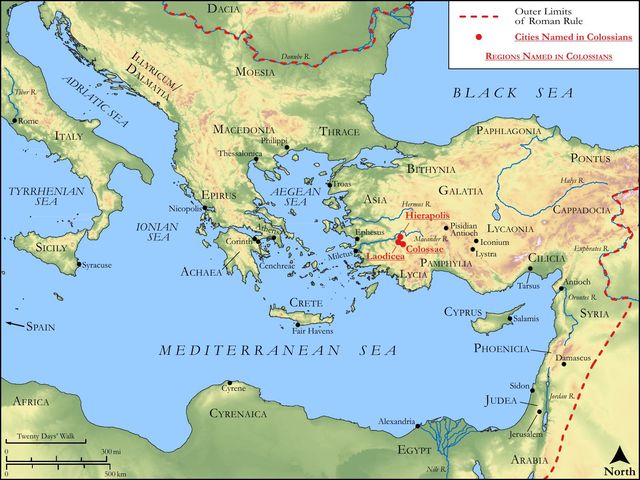
See on the biblical-era maps

Study this verse
Public-domain commentary
Matthew Henry
From his Commentary on the Whole Bible. Henry comments on passages, not single verses — this entry covers Colossians 1:12–29. His four-level outline is real structure in the source text, so it is rendered as structure.
Here is a summary of the doctrine of the gospel concerning the great work of our redemption by Christ. It comes in here not as the matter of a sermon, but as the matter of a thanksgiving; for our salvation by Christ furnishes us with abundant matter of thanksgiving in every view of it: Giving thanks unto the Father, Col 1:12. He does not discourse of the work of redemption in the natural order of it; for then he would speak of the purchase of it first, and afterwards of the application of it. But here he inverts the order, because, in our sense and feeling of it, the application goes before the purchase. We first find the benefits of redemption in our hearts, and then are led by those streams to the original and fountain-head. The order and connection of the apostle's discourse may be considered in the following manner: -
I.He speaks concerning the operations of the Spirit of grace upon us.
We must give thanks for them, because by these we are qualified for an interest in the mediation of the Son: Giving thanks to the Father, etc., Col 1:12, Col 1:13. It is spoken of as the work of the Father, because the Spirit of grace is the Spirit of the Father, and the Father works in us by his Spirit. Those in whom the work of grace is wrought must give thanks unto the Father. If we have the comfort of it, he must have the glory of it. Now what is it which is wrought for us in the application of redemption? 1. "He hath delivered us from the power of darkness, Col 1:13. He has rescued us from the state of heathenish darkness and wickedness. He hath saved us from the dominion of sin, which is darkness (Jo1 1:6), from the dominion of Satan, who is the prince of darkness (Eph 6:12), and from the damnation of hell, which is utter darkness," Mat 25:30. They are called out of darkness, Pe1 2:9. 2. "He hath translated us into the kingdom of his dear Son, brought us into the gospel-state, and made us members of the church of Christ, which is a state of light and purity." You were once darkness, but now are you light in the Lord, Eph 5:8. Who hath called you out of darkness into his marvellous light, Pe1 2:9. Those were made willing subjects of Christ who were the slaves of Satan. The conversion of a sinner is the translation of a soul into the kingdom of Christ out of the kingdom of the devil. The power of sin is shaken off, and the power of Christ submitted to. The law of the Spirit of life in Christ Jesus makes them free from the law of sin and death; and it is the kingdom of his dear Son, or the Son of his peculiar love, his beloved Son (Mat 3:17), and eminently the beloved, Eph 1:6. 3. "He hath not only done this, but hath made us meet to partake of the inheritance of the saints in light, Col 1:12. He hath prepared us for the eternal happiness of heaven, as the Israelites divided the promised land by lot; and has given us the earnest and assurance of it." This he mentions first because it is the first indication of the future blessedness, that by the grace of God we find ourselves in some measure prepared for it. God gives grace and glory, and we are here told what they both are. (1.) What that glory is. It is the inheritance of the saints in light. It is an inheritance, and belongs to them as children, which is the best security and the sweetest tenure: If children, then heirs, Rom 8:17. And it is an inheritance of the saints-proper to sanctified souls. Those who are not saints on earth will never be saints in heaven. And it is an inheritance in light; the perfection of knowledge, holiness, and joy, by communion with God, who is light, and the Father of lights, Jam 1:17; Joh 1:5. (2.) What this grace is. It is a meetness for the inheritance: "He hath made us meet to be partakers, that is, suited and fitted us for the heavenly state by a proper temper and habit of soul; and he makes us meet by the powerful influence of his Spirit." It is the effect of the divine power to change the heart, and make it heavenly. Observe, All who are designed for heaven hereafter are prepared for heaven now. As those who live and die unsanctified go out of the world with their hell about them, so those who are sanctified and renewed go out of the world with their heaven about them. Those who have the inheritance of sons have the education of sons and the disposition of sons: they have the Spirit of adoption, whereby they cry, Abba, Father. Rom 8:15. And, because you are sons, God hath sent forth the Spirit of his Son into your hearts, crying, Abba, Father, Gal 4:6. This meetness for heaven is the earnest of the Spirit in our heart, which is part of payment, and assures the full payment. Those who are sanctified shall be glorified (Rom 8:30), and will be for ever indebted to the grace of God, which hath sanctified them.
II.Concerning the person of the Redeemer.
Glorious things are here said of him; for blessed Paul was full of Christ, and took all occasions to speak honourably of him. He speaks of him distinctly as God, and as Mediator. 1. As God he speaks of him, Col 1:15-17. (1.) He is the image of the invisible God. Not as man was made in the image of God (Gen 1:27), in his natural faculties and dominion over the creatures: no, he is the express image of his person, Heb 1:3. He is so the image of God as the son is the image of his father, who has a natural likeness to him; so that he who has seen him has seen the Father, and his glory was the glory of the only-begotten of the Father, Joh 1:14; Joh 14:9. (2.) He is the first-born of every creature. Not that he is himself a creature; for it is prōtotokos pasēs ktiseōs - born or begotten before all the creation, or before any creature was made, which is the scripture-way of representing eternity, and by which the eternity of God is represented to us: I was set up from everlasting, from the beginning, or ever the earth was; when there was no depth, before the mountains were settled, while as yet he had not made the earth, Pro 8:23-26. It signifies his dominion over all things, as the first-born in a family is heir and lord of all, so he is the heir of all things, Heb 1:2. The word, with only the change of the accent, prōtotokos, signifies actively the first begetter or producer of all things, and so it well agrees with the following clause. Vid. Isidor. Peleus. epist. 30 lib. 3. (3.) He is so far from beginning himself a creature that he is the Creator: For by him were all things created, which are in heaven and earth, visible and invisible, Col 1:16. He made all things out of nothing, the highest angel in heaven, as well as men upon earth. He made the world, the upper and lower world, with all the inhabitants of both. All things were made by him, and without him was not any thing made which was made, Joh 1:3. He speaks here as if there were several orders of angels: Whether thrones, or dominions, or principalities, or powers, which must signify either different degrees of excellence or different offices and employments. Angels, authorities, and powers, Pe1 3:22. Christ is the eternal wisdom of the Father, and the world was made in wisdom. He is the eternal Word, and the world was made by the word of God. He is the arm of the Lord, and the world was made by that arm. All things are created by him and for him; di' autou kai eis auton. Being created by him, they were created for him; being made by his power, they were made according to his pleasure and for his praise. He is the end, as well as the cause of all things. To him are all things, Rom 11:36; eis auton ta panta. (4.) He was before all things. He had a being before the world was made, before the beginning of time, and therefore from all eternity. Wisdom was with the Father, and possessed by him in the beginning of his ways, before his works of old, Pro 8:22. And in the beginning the Word was with God and was God, Joh 1:1. He not only had a being before he was born of the virgin, but he had a being before all time. (5.) By him all things consist. They not only subsist in their beings, but consist in their order and dependences. He not only created them all at first, but it is by the word of his power that they are still upheld, Heb 1:3. The whole creation is kept together by the power of the Son of God, and made to consist in its proper frame. It is preserved from disbanding and running into confusion.
2.The apostle next shows what he is as Mediator, Col 1:18, Col 1:19.
(1.)He is the head of the body the church: not only a head of government and direction, as the king is the head of the state and has right to prescribe laws, but a head of vital influence, as the head in the natural body: for all grace and strength are derived from him: and the church is his body, the fulness of him who filleth all in all, Eph 1:22, Eph 1:23.
(2.)He is the beginning, the first-born from the dead, archē, prōtotokos - the principle, the first-born from the dead; the principle of our resurrection, as well as the first-born himself. All our hopes and joys take their rise from him who is the author of our salvation. Not that he was the first who ever rose from the dead, but the first and only one who rose by his own power, and was declared to be the Son of God, and Lord of all things. And he is the head of the resurrection, and has given us an example and evidence of our resurrection from the dead. He rose as the first-fruits, Co1 15:20.
(3.)He hath in all things the pre-eminence. It was the will of the Father that he should have all power in heaven and earth, that he might be preferred above angels and all the powers in heaven (he has obtained a more excellent name than they, Heb 1:4), and that in all the affairs of the kingdom of God among men he should have the pre-eminence. He has the pre-eminence in the hearts of his people above the world and the flesh; and by giving him the pre-eminence we comply with the Father's will, That all men should honour the Son even as they honour the Father, Joh 5:23.
(4.)All fulness dwells in him, and it pleased the Father it should do so (Col 1:19), not only a fulness of abundance for himself, but redundance for us, a fulness of merit and righteousness, of strength and grace. As the head is the seat and source of the animal spirits, so is Christ of all graces to his people. It pleased the Father that all fulness should dwell in him; and we may have free resort to him for all that grace for which we have occasion. He not only intercedes for it, but is the trustee in whose hands it is lodged to dispense to us: Of his fulness we receive, and grace for grace, grace in us answering to that grace which is in him (Joh 1:16), and he fills all in all, Eph 1:23.
III.Concerning the work of redemption.
He speaks of the nature of it, or wherein it consists; and of the means of it, by which it was procured.
1.Wherein it consists. It is made to lie in two things: - (1.) In the remission of sin: In whom we have redemption, even the forgiveness of sins, Col 1:14. It was sin which sold us, sin which enslaved us: if we are redeemed, we must be redeemed from sin; and this is by forgiveness, or remitting the obligation to punishment. So Eph 1:7, In whom we have redemption, the forgiveness of sins, according to the riches of his grace. (2.) In reconciliation to God. God by him reconciled all things to himself, Col 1:20. He is the Mediator of reconciliation, who procures peace as well as pardon for sinners, who brings them into a state of friendship and favour at present, and will bring all holy creatures, angels as well as men, into one glorious and blessed society at last: things in earth, or things in heaven. So Eph 1:10, He will gather together in one all things in Christ, both which are in heaven and which are on earth. The word is anakephalaiōsasthai - he will bring them all under one head. The Gentiles, who were alienated, and enemies in their minds by wicked works, yet now hath he reconciled, Col 1:21. Here see what was their condition by nature, and in their Gentile state-estranged from God, and at enmity with God: and yet this enmity is slain, and, notwithstanding this distance, we are now reconciled. Christ has laid the foundation for our reconciliation; for he has paid the price of it, has purchased the proffer and promise of it, proclaims it as a prophet, applies it as a king. Observe, The greatest enemies to God, who have stood at the greatest distance and bidden him defiance, may be reconciled, if it by not their own fault.
2.How the redemption is procured: it is through his blood (Col 1:14); he has made peace through the blood of his cross (Col 1:20), and it is in the body of his flesh through death, Col 1:22. It was the blood which made an atonement, for the blood is the life; and without the shedding of blood there is no remission, Heb 9:22. There was such a value in the blood of Christ that, on account of Christ's shedding it, God was willing to deal with men upon new terms to bring them under a covenant of grace, and for his sake, and in consideration of his death upon the cross, to pardon and accept to favour all who comply with them.
IV.Concerning the preaching of this redemption. Here observe,
1.To whom it was preached: To every creature under heaven (Col 1:23), that is, it was ordered to be preached to every creature, Mar 16:15. It may be preached to every creature; for the gospel excludes none who do not exclude themselves. More or less it has been or will be preached to every nation, though many have sinned away the light of it and perhaps some have never yet enjoyed it.
2.By whom it was preached: Whereof I Paul am made a minister. Paul was a great apostle; but he looks upon it as the highest of his titles of honour to be a minister of the gospel of Jesus Christ. Paul takes all occasions to speak of his office; for he magnified his office, Rom 11:13. And again in Col 1:25, Whereof I am made a minister. Observe here,
(1.)Whence Paul had his ministry: it was according to the dispensation of God which was given to him (Col 1:25), the economy or wise disposition of things in the house of God. He was steward and master-builder, and this was given to him: he did not usurp it, nor take it to himself; and he could not challenge it as a debt. He received it from God as a gift, and took it as a favour.
(2.)For whose sake he had his ministry: "It is for you, for your benefit: ourselves your servants for Jesus' sake, Co2 4:5. We are Christ's ministers for the good of his people, to fulfil the word of God (that is, fully to preach it), of which you will have the greater advantage. The more we fulfil our ministry, or fill up all the parts of it, the greater will be the benefit of the people; they will be the more filled with knowledge, and furnished for service."
(3.)What kind of preacher Paul was. This is particularly represented.
[1.]He was a suffering preacher: Who now rejoice in my sufferings for you, Col 1:24. He suffered in the cause of Christ, and for the good of the church. He suffered for preaching the gospel to them. And, while he suffered in so good a cause, he could rejoice in his sufferings, rejoice that he was counted worthy to suffer, and esteem it an honour to him. And fill up that which is behind of the afflictions of Christ in my flesh. Not that the afflictions of Paul, or any other, were expiations for sin, as the sufferings of Christ were. There was nothing wanting in them, nothing which needed to be filled up. They were perfectly sufficient to answer the intention of them, the satisfaction of God's justice, in order to the salvation of his people. But the sufferings of Paul and other good ministers made them conformable to Christ; and they followed him in his suffering state: so they are said to fill up what was behind of the sufferings of Christ, as the wax fills up the vacuities of the seal, when it receives the impression of it. Or it may be meant not of Christ's sufferings, but of his suffering for Christ. He filled that which was behind. He had a certain rate and measure of suffering for Christ assigned him; and, as his sufferings were agreeable to that appointment, so he was still filling up more and more what was behind, or remained of them to his share.
[2.]He was a close preacher: he preached not only in public, but from house to house, from person to person. Whom we preach, warning every man, and teaching every man in all wisdom, Col 1:28. Every man has need to be warned and taught, and therefore let every man have his share. Observe, First, When we warn people of what they do amiss, we must teach them to do better: warning and teaching must go together. Secondly, Men must be warned and taught in all wisdom. We must choose the fittest seasons, and use the likeliest means, and accommodate ourselves to the different circumstances and capacities of those we have to do with, and teach them as they are able to bear. That which he aimed at was to present every man perfect in Christ Jesus, teleios, either perfect in the knowledge of the Christian doctrine (Let us therefore, as many as are perfect, be thus minded, Phi 3:15; Ti2 3:17), or else crowned with a glorious reward hereafter, when he will present to himself a glorious church (Eph 5:27), and bring them to the spirits of just men made perfect, Heb 12:23. Observe, Ministers ought to aim at the improvement and salvation of every particular person who hears them. Thirdly, He was a laborious preacher, and one who took pains: he was no loiter, and did not do his work negligently (Col 1:29): Whereunto I also labour, striving according to his working, which worketh in me mightily. He laboured and strove, used great diligence and contended with many difficulties, according to the measure of grace afforded to him and the extraordinary presence of Christ which was with him. Observe, As Paul laid out himself to do much good, so he had this favour, that the power of God wrought in him the more effectually. The more we labour in the work of the Lord the greater measures of help we may expect from him in it (Eph 3:7): According to the gift of the grace of God given unto me, by the effectual working of his power.
3.The gospel which was preached. We have an account of this: Even the mystery which hath been hid from ages, and from generations, but is now made manifest to his saints, Col 1:26, Col 1:27. Observe,
(1.)The mystery of the gospel was long hidden: it was concealed from ages and generations, the several ages of the church under the Old Testament dispensation. They were in a state of minority, and training up for a more perfect state of things, and could not look to the end of those things which were ordained, Co2 3:13.
(2.)This mystery now, in the fulness of time, is made manifest to the saints, or clearly revealed and made apparent. The veil which was over Moses's face is done away in Christ, Co2 3:14. The meanest saint under the gospel understands more than the greatest prophets under the law. He who is least in the kingdom of heaven is greater than they. The mystery of Christ, which in other ages was not made known unto the sons of men, is now revealed unto his holy apostles and prophets by the Spirit, Eph 3:4, Eph 3:5. And what is this mystery? It is the riches of God's glory among the Gentiles. The peculiar doctrine of the gospel was a mystery which was before hidden, and is now made manifest and made known. But the great mystery here referred to is the breaking down of the partition-wall between the Jew and Gentile, and preaching the gospel to the Gentile world, and making those partakers of the privileges of the gospel state who before lay in ignorance and idolatry: That the Gentiles should be fellow-heirs, and of the same body, and partakers together of his promise in Christ by the gospel, Eph 3:6. This mystery, thus made known, is Christ in you (or among you) the hope of glory. Observe, Christ is the hope of glory. The ground of our hope is Christ in the word, or the gospel revelation, declaring the nature and methods of obtaining it. The evidence of our hope is Christ in the heart, or the sanctification of the soul, and its preparation for the heavenly glory.
4.The duty of those who are interested in this redemption: If you continue in the faith, grounded and settled, and be not moved away from the hope of the gospel which you have heard, Col 1:23. We must continue in the faith grounded and settled, and not be moved away from the hope of the gospel; that is, we must be so well fixed in our minds as not to be moved from it by any temptations. We must be stedfast and immovable (Co1 15:58) and hold fast the profession of our faith without wavering, Heb 10:23. Observe, We can expect the happy end of our faith only when we continue in the faith, and are so far grounded and settled in it as not to be moved from it. We must not draw back unto perdition, but believe unto the saving of the soul, Heb 10:39. We must be faithful to death, through all trials, that we may receive the crown of life, and receive the end of our faith, the salvation of our souls, Pe1 1:9.
Historical interpretation
Five Centuries of Reception
17 surviving comments on this verse. Each one is dated, so this reads as a timeline rather than a list.
Select a marker to jump to its quote. Markers stagger vertically where authors wrote within a few decades of each other.
And, "By Him were all things created that are in heaven, and on earth, visible and invisible; and He is before all things, and by Him all things consist."
The rule of truth which we hold, is, that there is one God Almighty, who made all things by His Word, and fashioned and formed, out of that which had no existence, all things which exist. Thus saith the Scripture, to that effect "By the Word of the Lord were the heavens established, and all the might of them, by the spirit of His mouth." And again, "All things were made by Him, and without Him was nothing made." There is no exception or deduction stated; but the Father made all things by Him, whether visible or invisible, objects of sense or of intelligence, temporal, on account of a certain character given them, or eternal; and these eternal things He did not make by angels, or by any powers separated from His Ennoea.
This being was endowed with all power by the Father, who placed everything under his authority, the Aeons doing so likewise, so that "by him were all things, visible and invisible, created, thrones, divinities, dominions." He then was sent to her along with his contemporary angels.
But who, except an heretical spirit, could ever bring his mind to believe that the invisible part of creation belongs to him who had previously displayed no visible thing, rather than to Him who, by His operation on the visible world, produced a belief in the invisible also, since it is far more reasonable to give one's assent after some samples (of a work) than after none? We shall see to what author even (your favourite) apostle attributes the invisible creation, when we come to examine him.
To her, therefore, he despatches Soter, (who must be the same as Jesus, to whom the Father imparted the supreme power over the whole body of the ¦ons, by subjecting them all to him, so that "by him," as the apostle says, "all things were created" ), with a retinue and cortege of contemporary angels, and (as one may suppose) with the dozen fasces.
Also Paul to the Colossians: "Who is the image of the invisible God, and the first-born of every creature."
But by Him also were all things created that are in heaven, and that are in earth, visible and invisible, whether they be thrones or dominions, or principalities, or powers; all things were created by Him, and for Him; and He is before all things."
There is no doubt that all things are through the Son, since, according to the apostle, “All things are through him and in him.” If all things are through him, and all things are from nothing, and nothing is except through him, I ask in what way does he lack the true nature of God, since he is not lacking either in the nature or the power of God? For he used the power of his nature that these things should exist which had no existence, and that these things should exist which pleased him.
For the Word of God was not made for us but rather we for him, and “in him all things were created.” For even if it had seemed good to God not to make things of determinate origin, still the Word would have been no less with God, and the Father in him. At the same time, things of determinate origin could not without the Word be brought to be; hence they were made through him—and with meaning and purpose. For since the Word is the Son of God by nature proper to his essence and is from him, as he said himself, the creatures could not have come to be, except through him. .
Before all things came to be, he was born. But Paul also says that all things were created “in him.” He is saying that the potency of all things may be believed to be in him, and since in fact all things came into existence through him. This last means that he is the head of every creature, since they began to exist only by virtue of existing with respect to him. .
Therefore Christ is the Onlybegotten Son of God and Maker of the World, for “he was in the world, and the world was made through him,” and “he came unto his own,” as the Gospel teaches us. But Christ is the Maker, at the bidding of the Father, not only of things visible but also things invisible. For, according to the apostle: “In him were created all things in the heavens or on the earth, things visible and things invisible, whether thrones, or dominations, or principalities, or powers. All things have been created through him and unto him, and he is before all creatures, and in him all things hold together.” Though you mention the worlds, Jesus Christ, at the bidding of the Father, is Maker of these too.
So, then, he himself who calls the Son of God the maker even of heavenly things, has also plainly said that all things were made in the Son, that in the renewal of His works He might by no means separate the Son from the Father, but unite Him to the Father. Paul, too, says: "For in Him were all things created in the heavens and in the earth, Visible and invisible."
If the Son, then, is not begotten within limits of time, we are free to judge that nothing can have existed before the Son, Whose being is not confined by time. If, indeed, there was anything in being before the Son, then it instantly follows that in Him were not created all things in heaven or in earth, and the Apostle is shown to have erred in so setting it down in his Epistle, whereas, if before He was begotten there was nothing, I see not wherefore He, before Whom none was, should be said to have been after any.
Next he proceeds to the doctrine itself. For that they may not think Him to be of more recent existence, because that in former times the approach was through Angels, but now through Him; he shows first, that they had no power (for else it had not been "out of darkness" that he brought), next, that He is also before them. And he uses as a proof of His being before them, this; that they were created by him. "For in Him," he saith, "were all things created." What say here the followers of Paul of Samosata? "The things in the heavens." What was in question, he has placed first; "and the things upon the earth." Then he says, "the visible and the invisible things"; invisible, such as soul, and all that has come to exist in heaven; visible, such as men, sun, sky. "Whether thrones." And what is granted, he lets alone, but what is doubted he asserts. "Whether thrones, or dominions, or principalities, or powers." The words "whether," "or," comprehend the whole of things; but by means of the greater things show it of the less also. But the Spirit is not amongst the "powers." "All things," he saith, "have been created through Him, and unto Him." Lo, "in Him," is "through Him," for having said "in Him," he added, "through Him." But what "unto Him"? It is this; the subsistence of all things depends on Him. Not only did He Himself bring them out of nothing into being, but Himself sustains them now, so that were they dissevered from His Providence, they were at once undone and destroyed. But He said not, "He continues them," which had been a grosser way of speaking, but what is more subtle, that "on" Him they depend. To have only a bearing on Him is enough to continue anything and bind it fast. So also the word "firstborn," in the sense of a foundation. But this doth not show the creatures to be consubstantial with Him; but that all things are through Him, and in Him are upheld. Since Paul also when he says elsewhere "I have laid a foundation," is speaking not concerning substance, but operation. For, that thou mayest not think Him to be a minister, he says that He continues them, which is not less than making them. Certainly, with us it is greater even: for to the former, art conducts us; but to the latter, not so, it does not even stay a thing in decay.
[Daniel 7:9] "I beheld until thrones were set up, and the Ancient of days took His seat. His garment was as white as snow, and the hair of His head was like pure wool. His throne was composed of fiery flames and its wheels were set on fire. From before His presence there issued forth a rushing, fiery stream." We read something similar in John's Apocalypse: "After these things I was immediately in the Spirit, and lo, a throne was set up in heaven, and one was seated upon the throne; and He who sat upon it had the likeness of jasper and sardine stone, and there was a rainbow round about the throne like the appearance of emerald. Around the throne there were twenty-four other thrones, and upon the twenty-four thrones there sat twenty-four elders, clothed in shining garments; upon their heads was a golden crown, and lightning flashes issued from the throne, and voices and thunder. And in front of the throne there were seven torches of burning fire, which were the seven spirits of God. And in front of the throne lay a glassy sea like unto crystal." (Revelation 4:2-6) And so the many thrones which Daniel saw seem to me to be what John called the twenty-four thrones. And the Ancient of days is the One who, according to John sits alone upon His throne. Likewise the Son of man, who came unto the Ancient of days, is the same as He who, according to John, is called the Lion of the tribe of Judah, the Root of David, and the titles of that sort (Revelation 5:5). I imagine that these thrones are the ones of which the Apostle Paul says, "Whether thrones or dominions..." (Colossians 1:16). And in the Gospel we read, "Ye yourselves shall sit upon twelve thrones, judging the twelve tribes of Israel" (Matthew 19:28). And God is called the One who sits and who is the Ancient of days, in order that His character as eternal Judge might be indicated. His garment is shining white like the snow, and the hair of His head is like pure wool. The Savior also, when He was transfigured on the mount and assumed the glory of His divine majesty, appeared in shining white garments (Matthew 17:2). And as for the fact that His hair is compared to perfectly pure wool, the even-handedness and uprightness of His judgment is shown forth, a judgment which shows no partiality in its exercise. Moreover He is described as an elderly man, in order that the ripeness of His judgment may be established. His throne consists of fiery flames, in order that sinners may tremble before the severity of the torments, and also that the just may be saved, but so as by fire. The wheels of the throne are set aflame, or else it is the wheels of His chariot which are aflame. In Ezekiel also God is ushered on the scene seated in a four-horse chariot (Ezekiel 1:4-28), and everything pertaining to God is of a fiery consistency. In another place also a statement is made on this subject: "God is a consuming fire" (Deuteronomy 4:24), that we might know that wood, hay and stubble are going to burn up in the day of judgment. And in the Psalms we read: "Fire goeth before Him, and He shall set aflame all His enemies round about Him" (Psalm 97:3). A rushing, fiery stream proceeded from before Him in order that it might carry sinners to hell (Gehenna).
“Before Abraham I am”; that’s what he said himself, the Gospel speaks. Listen to it, or read it. But that’s little enough, being the creator before Abraham; he’s the creator before Adam, creator before heaven and earth, before all the angels, and the whole spiritual creation, “thrones, dominions, principalities and powers,” creator before all things whatsoever.
We have said there are nine orders of angels, because we know from the testimony of sacred Scripture that there are angels, archangels, virtues, powers, principalities, dominations, thrones, cherubim, and seraphim. The apostle Paul also enumerates the names of four orders to the Ephesians, saying: "Above every principality, and power, and virtue, and domination." Writing again to the Colossians, he says: "Whether thrones, or powers, or principalities, or dominations." He had already described dominations, principalities, and powers when speaking to the Ephesians; but when about to say these things also to the Colossians, he added thrones, about which he had not yet said anything to the Ephesians. Therefore, when thrones are joined to those four which he mentioned to the Ephesians—that is, principalities, powers, virtues, and dominations—there are five orders that are specifically expressed. When angels and archangels, cherubim and seraphim are added to these, without doubt nine orders of angels are found to exist.
Continue studying Colossians 1:16 across the web’s major study libraries — every link below opens this exact verse, chapter, or book on the destination site.
Read & Compare
 BibleGatewayThis verse in more than 200 translations and 70 languages.
 Bible.comThe YouVersion reader — hundreds of translations, reading plans, and highlights.
 ESV.orgCrossway's official English Standard Version reader.
 NET BibleThe NET translation with 60,000+ translators' notes on every rendering decision.
 STEP BibleTyndale House's free study tool — original text, vocabulary, and scholarly resources.
 BibliaLogos Bible Software's free web reader.
 USCCBThe New American Bible (Revised Edition) with the U.S. bishops' study notes.
Commentaries
 BibleHub CommentariesDozens of classic commentaries on this verse, gathered on one page.
 StudyLightMore than 100 commentary sets — the largest collection on the web.
 BibleRefPlain-English commentary on what this verse means, verse by verse.
 Enduring WordDavid Guzik's free commentary on this chapter, widely used by Bible teachers.
 Bible Study ToolsVerse commentary alongside Greek and Hebrew study aids.
Original Language & Research
- BibleHub InterlinearThe verse word by word — original language, transliteration, and English.
- BibleHub LexiconEvery word's original-language definition and Strong's entry.
 Blue Letter BibleDeep-study tools — Strong's numbers, concordance, and word studies.
 CNTR CollationThe earliest Greek manuscripts of this verse, collated letter by letter.
Sermons, Hymns & Audio


TrulyRandomVerse is not affiliated with these sites and doesn’t control their content. They’re linked because they’re genuinely useful.
Summary
Colossians 1:16 is a profound declaration of the absolute supremacy of Jesus Christ over all things, asserting His singular role as the Creator of all things, both material and spiritual, visible and invisible. This verse establishes that the entire universe, including all celestial and terrestrial entities, and every level of angelic or demonic hierarchy, was brought into existence not only through Him but also for Him, underscoring His ultimate purpose and glory as the teleological end of all creation.
Context
ShowHideLiterary Context
Colossians 1:16 is an integral part of what scholars often refer to as the "Christ Hymn" or "Christological Hymn" found in Colossians 1:15-20. This section serves as the theological core of Paul's letter, presenting an exalted view of Christ's person and work. Coming immediately after Paul's prayer of thanksgiving and intercession for the Colossian believers, this hymn systematically lays out Christ's preeminence as the image of the invisible God, the firstborn over all creation, the head of the church, and the reconciler of all things. Verse 16 specifically focuses on Christ's role in creation, setting the stage for His supremacy over all things, including the very spiritual powers that some in Colossae might have been tempted to venerate or fear.
Historical & Cultural Context
Paul wrote to the church in Colossae to address a complex set of false teachings, often termed the "Colossian heresy." While the exact nature of this heresy is debated, it appears to have been a syncretistic blend of Jewish legalism, asceticism, philosophical speculation (perhaps early Gnosticism), and the worship or veneration of angelic beings. The emphasis on "thrones, or dominions, or principalities, or powers" in this verse directly confronts the Colossians' potential preoccupation with such spiritual entities. The heresy likely diminished the unique and supreme role of Christ, suggesting that spiritual intermediaries or human rituals were necessary for salvation or spiritual maturity. Paul's robust Christology in this hymn, particularly His assertion of Christ as the sole Creator and Sustainer of all things, including these spiritual powers, directly refutes any notion that Christ is insufficient or that other beings hold ultimate authority.
Key Themes
ShowHideThis verse powerfully contributes to several overarching themes in Colossians. Primarily, it champions the absolute supremacy and preeminence of Christ over all creation, a theme Paul introduces in Colossians 1:15. By declaring Christ as the Creator of "all things," Paul establishes His divine nature and authority, directly countering any Gnostic-like ideas that might have posited a lesser deity or an intermediary as the creator. Secondly, it underscores the unity and totality of creation under Christ's headship, encompassing both the visible, material world and the invisible, spiritual realms. This comprehensive scope ensures that no part of existence, including the "thrones, or dominions, or principalities, or powers," falls outside of Christ's creative power and ultimate dominion. This theme is further developed in Colossians 2:10, where Christ is declared the "head of all principality and power." Finally, the phrase "and for him" introduces the teleological purpose of creation, emphasizing that all things exist for Christ's glory and ultimate end, echoing the reach of God's plan over all things found in Romans 11:36.
Exposition and Analysis
ShowHideKey Word Analysis
ShowHideThis verb (G2936) means "to fabricate," "to found," or "to form originally." In the context of Colossians 1:16, it signifies that Jesus Christ is the direct agent who brought all things into existence from nothing. The use of this term unequivocally places Christ in the role of the divine Creator, distinguishing Him from anything that is created.
The preposition diá (G1223) denotes the "channel of an act" or "through." When used with the genitive case (as it is here with "him"), it indicates the instrumental cause or means by which something is accomplished. Thus, "by him" (specifically referring to Christ) means that Christ was the active, mediating agent in the creation of all things. It highlights His direct involvement and essential role in the creative act.
The preposition eis (G1519) indicates "to or into," often signifying purpose or result. In this verse, "for him" conveys the ultimate purpose or end goal of creation. It means that all things were created with Christ as their ultimate aim, for His glory, His dominion, and His redemptive plan. Creation is not an end in itself but serves the purposes of Christ.
Verse Breakdown
ShowHide"For by him were all things created,"
This foundational clause establishes Jesus Christ as the active, instrumental agent of creation. "All things" (Greek: pâs, G3956) is comprehensive, leaving no part of existence outside of His creative power. The perfect tense of "created" (Greek: ektistai) signifies a completed action with enduring results, emphasizing the ongoing reality of Christ's creative work.
"that are in heaven, and that are in earth,"
This phrase employs a merism, a literary device where two contrasting parts represent the whole. "Heaven and earth" encompass all creation, from the highest celestial realms to the terrestrial sphere, signifying the universality of Christ's creative activity.
"visible and invisible,"
This further clarifies the scope of "all things," ensuring that both the material world (visible) and the spiritual realm (invisible) are included. This directly addresses the potential Colossian error of elevating or fearing invisible spiritual entities, asserting that even these owe their existence to Christ.
"whether [they be] thrones, or dominions, or principalities, or powers:"
These terms (Greek: thrónos G2362, kyriótēs G2963, archḗ G746, exousía G1849) refer to various ranks or categories of spiritual beings, often understood as angelic or demonic hierarchies. By listing them, Paul explicitly includes these powerful, invisible entities within the scope of Christ's creation, thus subordinating them completely to Him and undermining any reason for their veneration or fear.
"all things were created by him, and for him:"
This concluding statement powerfully reiterates and expands upon the initial declaration. The repetition of "all things were created by him" provides emphatic reinforcement of Christ's role as the instrumental cause. The addition of "and for him" introduces the crucial teleological aspect, asserting that the entire creation exists not merely through Christ but ultimately for His glory, purpose, and ultimate reign.
Literary Devices
ShowHideColossians 1:16 masterfully employs several literary devices to convey its profound theological message. The use of Merism is evident in "heaven and earth" and "visible and invisible," which together comprehensively describe the totality of creation, leaving no realm or entity outside of Christ's creative scope. The verse also features powerful Anaphora through the repetition of "by him" and the parallel structure with "for him," which emphatically underscores Christ's dual role as both the efficient cause and the ultimate purpose of all existence. Furthermore, the listing of "thrones, or dominions, or principalities, or powers" functions as a Climax or Hierarchy, systematically dismantling any perceived authority of these spiritual entities by placing them firmly within the realm of Christ's creation and thus under His absolute dominion. This careful construction serves to elevate Christ to His rightful, supreme position over all things.
Theological and Thematic Connections
ShowHideColossians 1:16 stands as a cornerstone of Christian Christology, unequivocally affirming the deity of Jesus Christ by attributing to Him the exclusive work of creation. This verse demolishes any notion of Christ as a created being, instead presenting Him as the uncreated Creator through whom all things, visible and invisible, came into being. It underscores the profound truth that Christ is not merely a part of creation, but its very source and its ultimate end, establishing His sovereignty over all things. This divine prerogative of creation is consistently attributed to God throughout the Old Testament, and its application to Christ here highlights His co-equality and co-eternality with the Father, affirming the Trinitarian nature of God's creative work.
Reflection and Application
ShowHideColossians 1:16 offers profound implications for our daily lives, calling us to a deeper understanding of Christ's unparalleled authority and our place within His design for all creation. Knowing that "all things were created by him, and for him" provides an unshakable foundation for faith, reminding us that no power, visible or invisible, stands outside of Christ's sovereign control. This truth should inspire unwavering confidence in His ability to sustain us through every challenge and to ultimately triumph over every opposing force. It also reorients our perspective on purpose: if all of creation exists for Him, then our lives, talents, and resources find their ultimate meaning in glorifying Him and fulfilling His purposes. This perspective liberates us from the pursuit of fleeting earthly accolades or the fear of unseen spiritual adversaries, directing our worship and devotion solely to the One who made all things and for whom all things exist.
Questions for Reflection
ShowHideFAQ
ShowHideWhat does "thrones, or dominions, or principalities, or powers" refer to in this verse?
ShowHideThese terms (Greek: thrónos, kyriótēs, archḗ, exousía) refer to various categories or ranks of spiritual beings or authorities. In ancient Jewish and Hellenistic thought, there was often speculation about different levels of angelic or demonic hierarchies. Paul's inclusion of these specific terms here is significant because it directly addresses the "Colossian heresy," which may have involved the worship or undue veneration of such spiritual entities. By stating that even these powerful "thrones, dominions, principalities, and powers" were created by Christ and for Him, Paul emphatically asserts Christ's absolute supremacy over them. They are not independent powers to be feared or worshipped, but created beings who owe their existence and allegiance to the Son of God. This theme is further elaborated in Ephesians 1:21 and Ephesians 6:12, where these same terms are used to describe the spiritual forces against which believers contend, but always under the ultimate authority of Christ.
Christ-Centered Fulfillment
ShowHideColossians 1:16 serves as a foundational Christ-centered declaration, revealing Jesus not merely as a historical figure or a prophet, but as the very orchestrator of all existence, through whom and for whom all things were made. This verse profoundly establishes His divine identity and preeminence over all things, foreshadowing His ultimate role as the Head of the New Creation. Just as He was the agent of the first creation, bringing order out of chaos and life into being, so too is He the one through whom God is bringing about a new creation, reconciling all things to Himself through the cross, as detailed in Colossians 1:20. His creative power is intrinsically linked to His redemptive power; the One who spoke the universe into being is the same One who speaks life into dead souls and reconciles alienated humanity to God. This truth resonates with the New Testament's consistent portrayal of Jesus as the active agent of God's will, from the creation of the heaven and the earth to the redemption of humanity and the establishment of His eternal kingdom, ultimately culminating in the vision of a new heaven and a new earth where He reigns supreme, as depicted in Revelation 21:1-5.