


John 1:5
- καὶkaiAndG2532CONJConjunction
- τὸtotheG3588T-NSNDefinite article Nominative Singular Neuter
- φῶςphōsLightG5457N-NSNNoun Nominative Singular Neuter
- ἐνeninG1722PREPPreposition
- τῇtēatheG3588T-DSFDefinite article Dative Singular Feminine
- σκοτίᾳskotiadarknessG4653N-DSFNoun Dative Singular Feminine
- φαίνειphaineishinesG5316V-PAI-3SVerb Present Active Indicative 3rd Singular
- καὶkaiandG2532CONJConjunction
- ἡhētheG3588T-NSFDefinite article Nominative Singular Feminine
- σκοτίαskotiadarknessG4653N-NSFNoun Nominative Singular Feminine
- αὐτὸautoitG846P-ASNPersonal pronoun Accusative Singular Neuter
- οὐounotG3756PRT-NNegative Particle Negative
- κατέλαβενkatelabengrasped [it]G2638V-2AAI-3SVerb 2nd Aorist Active Indicative 3rd Singular
English is a literal word-by-word gloss of the Greek, not the KJV's wording. Why?
This is the original text the KJV's translators worked from — each Greek word with its own literal English meaning in this verse, prepared by scholars at Tyndale House, Cambridge. The KJV translates whole sentences, not word by word, so its wording differs: one Greek word can become several English words, and the KJV may choose “charity” where the gloss reads “love”. Both are faithful — they answer different questions. For the KJV's own rendering, switch to the KJV text.
Details
See on the biblical-era map
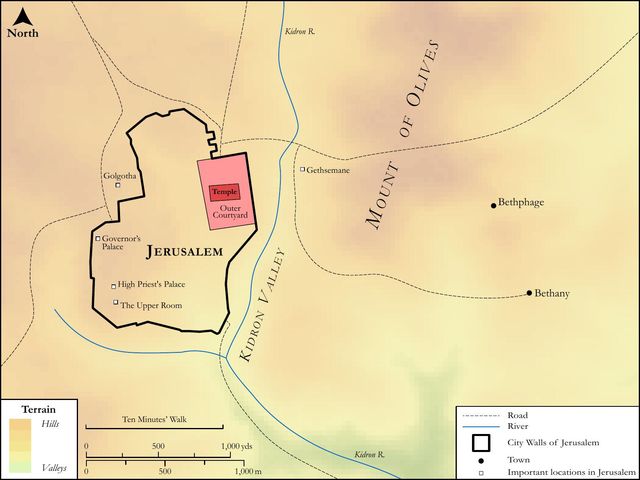
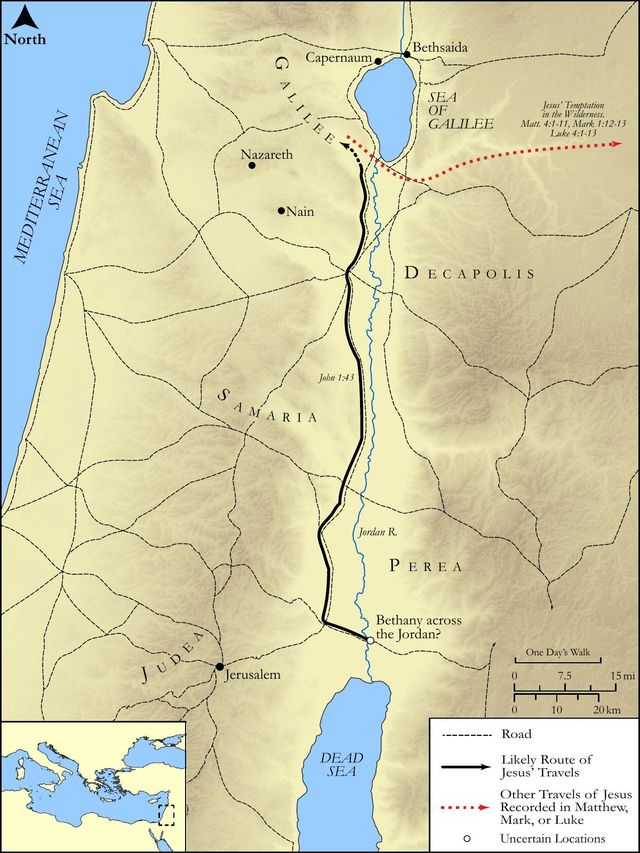
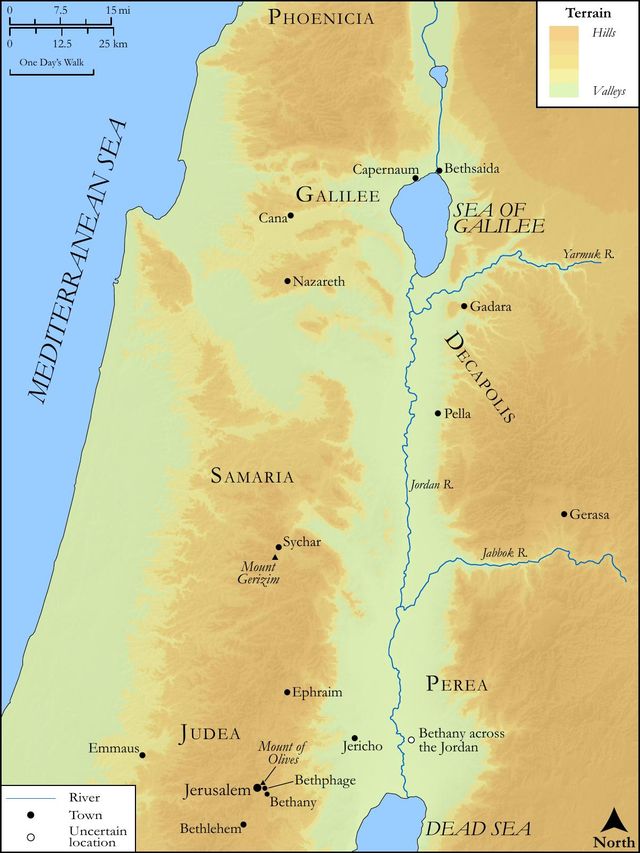
Study this verse
Public-domain commentary
Matthew Henry
From his Commentary on the Whole Bible. Henry comments on passages, not single verses — this entry covers John 1:1–5. His four-level outline is real structure in the source text, so it is rendered as structure.
Austin says (de Civitate Dei, lib. 10, cap. 29) that his friend Simplicius told him he had heard a Platonic philosopher say that these first verses of St. John's gospel were worthy to be written in letters of gold. The learned Francis Junius, in the account he gives of his own life, tells how he was in his youth infected with loose notions in religion, and by the grace of God was wonderfully recovered by reading accidentally these verses in a bible which his father had designedly laid in his way. He says that he observed such a divinity in the argument, such an authority and majesty in the style, that his flesh trembled, and he was struck with such amazement that for a whole day he scarcely knew where he was or what he did; and thence he dates the beginning of his being religious. Let us enquire what there is in those strong lines. The evangelist here lays down the great truth he is to prove, that Jesus Christ is God, one with the Father. Observe,
I.Of whom he speaks - The Word - ho logos.
This is an idiom peculiar to John's writings. See Jo1 1:1; Jo1 5:7; Rev 19:13. Yet some think that Christ is meant by the Word in Act 20:32; Heb 4:12; Luk 1:2. The Chaldee paraphrase very frequently calls the Messiah Memra - the Word of Jehovah, and speaks of many things in the Old Testament, said to be done by the Lord, as done by that Word of the Lord. Even the vulgar Jews were taught that the Word of God was the same with God. The evangelist, in the close of his discourse (Joh 1:18), plainly tells us why he calls Christ the Word - because he is the only begotten Son, who is in the bosom of the Father, and has declared him. Word is two-fold: logos endiathetos - word conceived; and logos prophorikos - word uttered. The logos ho esō and ho exō, ratio and oratio - intelligence and utterance.
1.There is the word conceived, that is, thought, which is the first and only immediate product and conception of the soul (all the operations of which are performed by thought), and it is one with the soul. And thus the second person in the Trinity is fitly called the Word; for he is the first-begotten of the Father, that eternal essential Wisdom which the Lord possessed, as the soul does its thought, in the beginning of his way, Pro 8:22. There is nothing we are more sure of than that we think, yet nothing we are more in the dark about than how we think; who can declare the generation of thought in the soul? Surely then the generations and births of the eternal mind may well be allowed to be great mysteries of godliness, the bottom of which we cannot fathom, while yet we adore the depth.
2.There is the word uttered, and this is speech, the chief and most natural indication of the mind. And thus Christ is the Word, for by him God has in these last days spoken to us (Heb 1:2), and has directed us to hear him, Mat 17:5. He has made known God's mind to us, as a man's word or speech makes known his thoughts, as far as he pleases, and no further. Christ is called that wonderful speaker (see notes on Dan 8:13), the speaker of things hidden and strange. He is the Word speaking from God to us, and to God for us. John Baptist was the voice, but Christ the Word: being the Word, he is the Truth, the Amen, the faithful Witness of the mind of God.
II.What he saith of him, enough to prove beyond contradiction that he is God. He asserts,
1.His existence in the beginning: In the beginning was the Word. This bespeaks his existence, not only before his incarnation, but before all time. The beginning of time, in which all creatures were produced and brought into being, found this eternal Word in being. The world was from the beginning, but the Word was in the beginning. Eternity is usually expressed by being before the foundation of the world. The eternity of God is so described (Psa 90:2), Before the mountains were brought forth. So Pro 8:23. The Word had a being before the world had a beginning. He that was in the beginning never began, and therefore was ever, achronos - without beginning of time. So Nonnus.
2.His co-existence with the Father: The Word was with God, and the Word was God. Let none say that when we invite them to Christ we would draw them from God, for Christ is with God and is God; it is repeated in Joh 1:2 : the same, the very same that we believe in and preach, was in the beginning with God, that is, he was so from eternity. In the beginning the world was from God, as it was created by him; but the Word was with God, as ever with him. The Word was with God,
(1.)In respect of essence and substance; for the Word was God: a distinct person or substance, for he was with God; and yet the same in substance, for he was God, Heb 1:3.
(2.)In respect of complacency and felicity. There was a glory and happiness which Christ had with God before the world was (Joh 17:5), the Son infinitely happy in the enjoyment of his Father's bosom, and no less the Father's delight, the Son of his love, Pro 8:30.
(3.)In respect of counsel and design. The mystery of man's redemption by this Word incarnate was hid in God before all worlds, Eph 3:9. He that undertook to bring us to God (Pe1 3:18) was himself from eternity with God; so that this grand affair of man's reconciliation to God was concerted between the Father and Son from eternity, and they understand one another perfectly well in it, Zac 6:13; Mat 11:27. He was by him as one brought up with him for this service, Pro 8:30. He was with God, and therefore is said to come forth from the Father.
3.His agency in making the world, Joh 1:3. This is here,
(1.)Expressly asserted: All things were made by him. He was with God, not only so as to be acquainted with the divine counsels from eternity, but to be active in the divine operations in the beginning of time. Then was I by him, Pro 8:30. God made the world by a word (Psa 33:6) and Christ was the Word. By him, not as a subordinate instrument, but as a co-ordinate agent, God made the world (Heb 1:2), not as the workman cuts by his axe, but as the body sees by the eye.
(2.)The contrary is denied: Without him was not any thing made that was made, from the highest angel to the meanest worm. God the Father did nothing without him in that work. Now,
[1.]This proves that he is God; for he that built all things is God, Heb 3:4. The God of Israel often proved himself to be God with this, that he made all things: Isa 40:12, Isa 40:28; Isa 41:4; and see Jer 10:11, Jer 10:12.
[2.]This proves the excellency of the Christian religion, that the author and founder of it is the same that was the author and founder of the world. How excellent must that constitution needs be which derives its institution from him who is the fountain of all excellency! When we worship Christ, we worship him to whom the patriarchs gave honour as the Creator of the world, and on whom all creatures depend.
[3.]This shows how well qualified he was for the work of our redemption and salvation. Help was laid upon one that was mighty indeed; for it was laid upon him that made all things; and he is appointed the author of our bliss who was the author of our being.
4.The original of life and light that is in him: In him was life, Joh 1:4. This further proves that he is God, and every way qualified for his undertaking; for,
(1.)He has life in himself; not only the true God, but the living God. God is life; he swears by himself when he saith, As I live.
(2.)All living creatures have their life in him; not only all the matter of the creation was made by him, but all the life too that is in the creation is derived from him and supported by him. It was the Word of God that produced the moving creatures that had life, Gen 1:20; Act 17:25. He is that Word by which man lives more than by bread, Mat 4:4.
(3.)Reasonable creatures have their light from him; that life which is the light of men comes from him. Life in man is something greater and nobler than it is in other creatures; it is rational, and not merely animal. When man became a living soul, his life was light, his capacities such as distinguished him fRom. and dignified him above, the beasts that perish. The spirit of a man is the candle of the Lord, and it was the eternal Word that lighted this candle. The light of reason, as well as the life of sense, is derived from him, and depends upon him. This proves him fit to undertake our salvation; for life and light, spiritual and eternal life and light, are the two great things that fallen man, who lies so much under the power of death and darkness, has need of. From whom may we better expect the light of divine revelation than from him who gave us the light of human reason? And if, when God gave us natural life, that life was in his Son, how readily should we receive the gospel-record, that he hath given us eternal life, and that life too is in his Son!
5.The manifestation of him to the children of men. It might be objected, If this eternal Word was all in all thus in the creation of the world, whence is it that he has been so little taken notice of and regarded? To this he answers (Joh 1:5), The light shines, but the darkness comprehends it not. Observe,
(1.)The discovery of the eternal Word to the lapsed world, even before he was manifested in the flesh: The light shineth in darkness. Light is self-evidencing, and will make itself known; this light, whence the light of men comes, hath shone, and doth shine.
[1.]The eternal Word, as God, shines in the darkness of natural conscience. Though men by the fall are become darkness, yet that which may be known of God is manifested in them; see Rom 1:19, Rom 1:20. The light of nature is this light shining in darkness. Something of the power of the divine Word, both as creating and as commanding, all mankind have an innate sense of; were it not for this, earth would be a hell, a place of utter darkness; blessed be God, it is not so yet.
[2.]The eternal Word, as Mediator, shone in the darkness of the Old Testament types and figures, and the prophecies and promises which were of the Messiah from the beginning. He that had commanded the light of this world to shine out of darkness was himself long a light shining in darkness; there was a veil upon this light, Co2 3:13.
(2.)The disability of the degenerate world to receive this discovery: The darkness comprehended it not; the most of men received the grace of God in these discoveries in vain.
[1.]The world of mankind comprehended not the natural light that was in their understandings, but became vain in their imaginations concerning the eternal God and the eternal Word, Rom 1:21, Rom 1:28. The darkness of error and sin overpowered and quite eclipsed this light. God spoke once, yea twice, but man perceived it not, Job 33:14.
[2.]The Jews, who had the light of the Old Testament, yet comprehended not Christ in it. As there was a veil upon Moses's face, so there was upon the people's hearts. In the darkness of the types and shadows the light shone; but such as the darkness of their understandings that they could not see it. It was therefore requisite that Christ should come, both to rectify the errors of the Gentile world and to improve the truths of the Jewish church.
Historical interpretation
Ten Centuries of Reception
21 surviving comments on this verse. Each one is dated, so this reads as a timeline rather than a list.
Select a marker to jump to its quote. Markers stagger vertically where authors wrote within a few decades of each other.
Nor is He a mere man, by whom and in whom all things were made; for "all things were made by Him." "When He made the heaven, I was present with Him; and I was there with Him, forming [the world along with Him], and He rejoiced in me daily." And how could a mere man be addressed in such words as these: "Sit Thou at My right hand? " And how, again, could such an one declare: "Before Abraham was, I am? " And, "Glorify Me with Thy glory which I had before the world was? " What man could ever say, "I came down from heaven, not to do Mine own will, but the will of Him that sent Me? " And of what man could it be said, "He was the true Light, which lighteth every man that cometh into the world: He was in the world, and the world was made by Him, and the world knew Him not. He came unto His own, and His own received Him not? " How could such a one be a mere man, receiving the beginning of His existence from Mary, and not rather God the Word, and the only-begotten Son? For "in the beginning was the Word, and the Word was with God, and the Word was God." And in another place, "The Lord created Me, the beginning of His ways, for His ways, for His works. Before the world did He found Me, and before all the hills did He beget Me."
The soul is not in itself immortal, O Greeks, but mortal. Yet it is possible for it not to die. If, indeed, it knows not the truth, it dies, and is dissolved with the body, but rises again at last at the end of the world with the body, receiving death by punishment in immortality. But, again, if it acquires the knowledge of God, it dies not, although for a time it be dissolved. In itself it is darkness, and there is nothing luminous in it. And this is the meaning of the saying, "The darkness comprehendeth not the light." For the soul does not preserve the spirit, but is preserved by it, and the light comprehends the darkness. The Logos, in truth, is the light of God, but the ignorant soul is darkness. On this account, if it continues solitary, it tends downward towards matter, and dies with the flesh; but, if it enters into union with the Divine Spirit, it is no longer helpless, but ascends to the regions whither the Spirit guides it: for the dwelling-place of the spirit is above, but the origin of the soul is from beneath.
For, in discoursing of the Saviour and declaring that all things beyond the Pleroma received form from Him, he says that He is the fruit of the entire Pleroma. For he styles Him a "light which shineth in darkness, and which was not comprehended"
But he who has the light watches, "and darkness seizes not on him".
For how, says Heraclitus, can one escape the notice of that which never sets? Let us by no means, then, veil our selves with the darkness; for the light dwells in us. "For the darkness "it is said, "comprehendeth it not."
People are not [darkness] by nature, since Paul says, “For we were once darkness but now are light in the Lord,” and this is especially the case if we are now called saints and spiritual. Just as Paul, although he was darkness, became capable of becoming light in the Lord, so may anyone who was once darkness.
Christ, because of the benefit that follows for humankind, took our darkness on himself that by his power he might destroy our death and completely destroy the darkness in our soul so that what Isaiah said might be fulfilled: “The people who sat in darkness have seen a great light.”69This light, indeed, that was made in the Word, which also is life, “shines in the darkness” of our souls. It has come to stay where the world rulers of this darkness live. They by wrestling with the human race struggle to subject those who do not stand firm in every manner to darkness. He comes that, when they have been enlightened, they may be called children of light. And this light shines in the darkness and is pursued by it, but it is not overcome.…
The darkness pursued this light, as is clear from what our Savior and his children suffer. The darkness fighting against the children of light wanted to chase the light away. However, if “God is for us,” no one will be able to be “against us.” …
Now there are two ways that the darkness did not overcome the light. The darkness is either left very far behind it and, because it is slow, cannot keep up with the swiftness of the flight of light even to a limited extent, or, perhaps the light wanted to set an ambush for the darkness and awaited its approach and when the darkness drew near the light it was destroyed.
(non occ.) We must not omit to notice, that he puts the life before the light of men. For it would be a contradiction to suppose a being without life to be illuminated; as if life were an addition to illumination. (tom. ii. c. 16). But to proceed: if the life was the light of men, meaning men only, Christ is the light and the life of men only; an heretical supposition. It does not follow then, when a thing is predicated of any, that it is predicated of those only; for of God it is written, that He is the God of Abraham, Isaac, and Jacob; and yet He is not the God of those fathers only. In the same way, the light of men is not excluded from being the light of others as well. (c. 17). Some moreover contend from Genesis, (Gen. 1:26) Let us make man after our image, that man means whatever is made after the image and similitude of God. If so, the light of men is the light of any rational creature what ever.
(in Joan. t. ii. c. 14) This kind of darkness however is not in men by nature, according to the text in the Ephesians, Ye were sometime darkness, but now are ye light in the Lord1. (Eph. 5:8)
(Hom. ii. in div. loc.) Or thus, The light shineth in the darkness of faithful souls, beginning from faith, and drawing onwards to hope; but the deceit and ignorance of undisciplined souls did not comprehend the light of the Word of God shining in the flesh. That however is an ethical meaning. The metaphysical signification of the words is as follows. Human nature, even though it sinned not, could not shine by its own strength simply; for it is not naturally light, but only a recipient of it; it is capable of containing wisdom, but is not wisdom itself. As the air, of itself, shineth not, but is called by the name of darkness, even so is our nature, considered in itself, a dark substance, which however admits of and is made partaker of the light of wisdom. And as when the air receives the sun's rays, it is not said to shine of itself, but the sun's radiance to be apparent in it; so the reasonable part of our nature, while possessing the presence of the Word of God, does not of itself understand God, and intellectual things, but by means of the divine light implanted in it. Thus, The light shineth in darkness: for the Word of God, the life and the light of men, ceaseth not to shine in our nature; though regarded in itself, that nature is without form and darkness. And forasmuch as pure light cannot be comprehended by any creature, hence the text: The darkness comprehended it not.
(tom. ii. in Joan. c. 19) But they ask, why is not the Word Itself called the light of men, instead of the life which is in the Word? We reply, that the life here spoken of is not that which rational and irrational animals have in common, but that which is annexed to the Word which is within us through participation of the primæval Word. For we must distinguish the external and false life, from the desirable and true. We are first made partakers of life: and this life with some is light potentially only, not in act; with those, viz. who are not eager to search out the things which appertain to knowledge: with others it is actual light, those who, as the Apostle saith, covet earnestly the best gifts, (1 Cor. 12:31) that is to say, the word of wisdom. (c. 14.). (Ifk the life and the light of men are the same, whoso is in darkness is proved not to live, and none who liveth abideth in darkness.)
(tom. ii. c. 20) As the light of men is a word expressing two spiritual things, so is darkness also. To one who possesses the light, we attribute both the doing the deeds of the light, and also true understanding, inasmuch as he is illuminated by the light of knowledge: and, on the other hand, the term darkness we apply both to unlawful acts, and also to that knowledge, which seems such, but is not. Now as the Father is light, and in Him is no darkness at all, so is the Saviour also. Yet, inasmuch as he underwent the similitude of our sinful flesh, it is not incorrectly said of Him, that in Him there was some darkness; for He took our darkness upon Himself, in order that He might dissipate it. This Light therefore, which was made the life of man, shines in the darkness of our hearts, when the prince of this darkness wars with the human race. This Light the darkness persecuted, as is clear from what our Saviour and His children suffer; the darkness fighting against the children of light. But, forasmuch as God takes up the cause, they do not prevail; nor do they apprehend the light, for they are either of too slow a nature to overtake the light's quick course, or, waiting for it to come up to them, they are put to flight at its approach. We should bear in mind, however, that darkness is not always used in a bad sense, but sometimes in a good, as in Psalm 17. He made darkness His secret place: (Ps. 18:11) the things of God being unknown and incomprehensible. This darkness then I will call praiseworthy, since it tends toward light, and lays hold on it: for, though it were darkness before, while it was not known, yet it is turned to light and knowledge in him who has learned.
They ungratefully and malignantly ask, Who is this? as if they had never yet seen their Benefactor, and Him whom divine miracles, beyond the power of man, had made famous and renowned; for the darkness comprehended not
The light shines in darkness, in this life and in the flesh, and is chased by the darkness but is not overtaken by it. By this I mean the adverse power leaping up in its shamelessness against the visible Adam but encountering God and being defeated—in order that we, putting away the darkness, may draw near to the Light and may then become perfect Light, the children of perfect Light.
The person who supposes that he is protected by the darkness is vain, since he cannot escape the light that shines in the darkness, and the darkness grasped it not. Accordingly, he is discovered like a fugitive and a wicked hireling and is recognized before he can conceal himself. For all things are known to the Lord before he seeks them out, not only past events but also those that are to come.
But let it not trouble thee that It took not all, for not by necessity and force, but by will and consent does God bring us to Himself. Therefore do not thou shut thy doors against this light, and thou shalt enjoy great happiness. But this light cometh by faith, and when it is come, it lighteth abundantly him that hath received it; and if thou displayest a pure life (meet) for it, remains indwelling within continually. "For," He saith, "He that loveth Me, will keep My commandments; and I and My Father will come unto him, and make Our abode with him."
"And the light shineth in darkness." He calls death and error, "darkness." For the light which is the object of our senses does not shine in darkness, but apart from it; but the preaching of Christ hath shone forth in the midst of prevailing error, and made it to disappear. And He by enduring death hath so overcome death, that He hath recovered those already held by it. Since then neither death overcame it, nor error, since it is bright everywhere, and shines by its proper strength, therefore he says, "And the darkness comprehended it not." For it cannot be overcome, and will not dwell in souls which wish not to be enlightened.
But how is this effected? Then when we have cleansed the soul from all the passions. For sin is darkness, and a deep darkness; as is clear, because men do it unconsciously and secretly. For, "every one that doeth evil hateth the light, neither cometh to the light." And, "It is a shame even to speak of those things which are done of them in secret." For, as in darkness a man knows neither friend nor foe, but cannot perceive any of the properties of objects; so too is it in sin. For he who desires to get more gain, makes no difference between friend and enemy; and the envious regards with hostile eyes the man with whom he is very intimate; and the plotter is at mortal quarrel with all alike. In short, as to distinguishing the nature of objects, he who commits sin is no better than men who are drunk or mad.
(Hom. v. [iv.] c. 3) Or thus: throughout the whole foregoing passage he had been speaking of creation; then he mentions the spiritual benefits which the Word brought with it: and the life was the light of men. He saith not, the light of Jews, but of all men without exception; for not the Jews only, but the Gentiles also have come to this knowledge. The Angels he omits, for he is speaking of human nature, to whom the Word came bringing glad tidings.
(Hom. v. [iv.] c. 3)l. Life having come to us, the empire of death is dissolved; a light having shone upon us, there is darkness no longer: but there remaineth ever a life which death, a light which darkness cannot overcome. Whence he continues, And the light shineth in darkness: by darkness meaning death and error, for sensible light does not shine in darkness, but darkness must be removed first; whereas the preaching of Christ shone forth amidst the reign of error, and caused it to disappear, and Christ by dying changed death into life, so overcoming it, that, those who were already in its grasp, were brought back again. Forasmuch then as neither death nor error hath overcome his light, which is every where conspicuous, shining forth by its own strength; therefore he adds, And the darkness comprehended it notm.
But perhaps the slow hearts of some of you cannot receive their sins, so that they cannot see. Let them not on that account think that the light is in any way absent, because they are not able to see it; for they themselves are darkness on account of their sins. "And the light shineth in darkness, and the darkness comprehended it not." Accordingly, brethren, as in the case of a blind man placed in the sun, the sun is present to him, but he is absent from the sun. So every foolish man, every unjust man, every irreligious man, is blind in heart. Wisdom is present; but it is present to a blind man, and is absent from his eyes; not because it is absent from him, but because he is absent from it. What then is he to do? Let him become pure, that he may be able to see God. Just as if a man could not see because his eyes were dirty and sore with dust, rheum, or smoke, the physician would say to him: "Cleanse from your eye whatever bad thing is in it, so that you may be able to see the light of your eyes." Dust, rheum, and smoke are sins and iniquities: remove then all these things, and you will see the wisdom that is present; for God is that wisdom, and it has been said, "Blessed are the pure in heart; for they shall see God."
(tr. 1. c. 19) Whereas that life is the light of men, but foolish hearts cannot receive that light, being so incumbered with sins that they cannot see it; for this cause lest any should think there is no light near them, because they cannot see it, he continues: And the light shineth in darkness, and the darkness comprehended it not. For suppose a blind man standing in the sun, the sun is present to him, but he is absent from the sun. In like manner every fool is blind, and wisdom is present to him; but, though present, absent from his sight, forasmuch as sight is gone: the truth being, not that she is absent from him, but that he is absent from her.
(de Civit. Dei, l. x. c. 29. circ. fin.) A certain Platonist once said, that the beginning of this Gospel ought to be copied in letters of gold, and placed in the most conspicuous place in every church.
The old saint Simplicianus, afterwards bishop of Milan, used to tell me that a certain Platonist was in the habit of saying that this opening passage of the holy Gospel, entitled "According to John," should be written in letters of gold and hung up in all churches in the most conspicuous place.
“Darkness” is what John calls the nature that lacks illumination, that is, the whole originate nature.… For such a nature produces nothing on its own. Instead, it receives its whole being and well-being, such as it is, from its creator. This is why Paul says, “What do you have that you did not receive?” And since, along with the rest, it receives its light from God, not possessing it on its own, it receives it. But that which does not have light of itself cannot be called anything but “darkness.” The fact that “the Light shines in darkness” is a credible demonstration (in fact, one following from very necessity) that the creation is “darkness” while the Word of God is “Light.” For if the nature of things originate receives the Word of God by participation, as Light, or as of Light, it receives it then since it is inherently darkness, and the Son “shines in it” as “the light” shines in “darkness,” even though the darkness has no idea of the light’s existence. For this, I suppose, is the meaning of “the darkness did not comprehend it.” For the Word of God shines upon all things that are receptive to his radiance and illumines without exception things that have a nature that is receptive to being illumined. But [the Word of God] is unknown by “the darkness.” For that which is the rational nature upon earth, I mean humanity, “served the creature more than the Creator: it did not comprehend the Light,” for it did not know the Creator, the fountain of wisdom, the beginning of understanding, the root of sense. Nevertheless, because of his love for humankind, things originate possess the light and are provided with the power of perception implanted concurrently with their passing into being.
Needs does the most wise Evangelist hasten to expand to us by this too that is now before us the thought expressed above. For he did not think, I suppose, that it would suffice to the hearers unto being able to think unerringly of God the Word, that He is verily the Light of men, by only saying, And the Life was the Light of men. For it was like I suppose that some would arise who should hear the things uttered without weighing them, and should moreover set forth or try to teach others also that the Word of God is indeed verily Light, but not Giver of light to all, but in whomsoever He will He infuses the light of understanding, approving him who |68 ought to receive it and is worthy of so bright a gift: and that the nature of the rest of the rational creation either gets the power of understanding from its natural seed, or God the Father ingrafts into it mind and understanding, as though the Son were unable to do this. In order then that God the Word, Who was in God the Father, may be clearly shown to be both Life and Light, not of some individually, of others not, but by some ineffable mode of participation, as wisdom and understanding (which is what is called light in things rational), immingling Himself in all things that are, that the things rational may become rational, and things recipient of sense may have sense, which in no other way they could have had:----needs does he say, And the Light shineth in darkness and the darkness comprehended it not.
As though he with all exactitude crieth aloud to his hearers after this sort: I said, sirs, teaching the truth with all my power, that the Life was the Light of men, not that any should suppose from these words that they who show themselves righteous and good receive from another, as the reward of their conduct, the illumination from Him, but that ye might learn, that as the Word is Life in all things that have been made, quickening things recipient of life; so He is in them Light also, rendering things recipient of understanding and sense, what they are. For God the Father through the Son in the Spirit is all things in all.
Darkness he calls the nature that lacks illumination, i. e. the whole originate nature. For since he calls Him the Light, to show that the rational creation which lacks and is imparticipate thereof is other than It, he turns the force of the epithet used to the very contrary, doing this also, after my judgment, not without an aim, but considering in himself this above all, that the nature of things originate, producing nothing whatever from its own self, but receiving its whole being and well-being such as it is from its Creator, has rightly said to it, What hast thou that thou didst not receive? And since along with the rest, it has light itself also God-given, not possessing it does it receive it: but that which has not of itself light, how will it not be the contrary, or how |69 will it not be called darkness? For that the Light shineth in darkness is a credible demonstration (yea rather one following from very necessity), that the creation is darkness, the Word of God Light. For if the nature of things originate receive the Word of God by participation, as Light, or as of Light: it receives it then as itself darkness, and the Son shineth in it, as the light doth in darkness, even though the darkness know not a whit the Light. For this, I suppose, is the meaning of The darkness comprehended it not. For the Word of God shineth upon all things that are receptive of His Irradiance, and illumineth without exception things that have a nature receptive of illumining. But He is unknown of the darkness. For that which is the rational nature upon earth, I mean man, served the creature more than the Creator: it comprehended not the Light, for it knew not the Creator, the Fountain of wisdom, the beginning of understanding, the root of sense. Things originate possess nevertheless, of His love to man, the light, and are provided with the power of perception implanted concurrently with their passing into being.
But we must again note here, that no argument will permit to suppose that the Son of God is originate or created, but in every way does He surpass our measure, and rise above the nature of the creature, and is wholly Other than they are and far removed as regards quality of essence, even as the light is not the same as darkness, but soothly contrary and parted by incomparable diversity into physical alieniety.
Having now sufficiently gone through the method of reasoning hereupon in the foregoing, we will go on to what follows.
The most wise Evangelist now expands the thought expressed above.… Not only is the Word of God indeed truly light, but he is also the giver of light to all whom he infuses with the light of understanding.
The Light, namely, the Word of God, shineth in the darkness, which means, It shines in death and in deception. Even when He Himself was dead, He so completely vanquished death that He compelled death to vomit forth those whom it had swallowed before Him. And the preaching of the Word also shines amidst the deception of the pagan Greeks. And the darkness comprehended it not. Neither death nor deception overcame it, for this Light, God the Word, is unconquerable. Some have thought that darkness means "flesh" and "life." For the Word shone forth while in the flesh and in this life. And the darkness, that is, the opposing power of the evil one, tempted and persecuted the Light, but found It to be unassailable and invincible. Darkness means "flesh," not according to the nature of flesh—far from it!—but because of sin. Flesh contains absolutely nothing evil when it is directed in accordance with its nature. But when directed against its nature and made to serve sin, it is called, and indeed becomes darkness.
Continue studying John 1:5 across the web’s major study libraries — every link below opens this exact verse, chapter, or book on the destination site.
Read & Compare
 BibleGatewayThis verse in more than 200 translations and 70 languages.
 Bible.comThe YouVersion reader — hundreds of translations, reading plans, and highlights.
 ESV.orgCrossway's official English Standard Version reader.
 NET BibleThe NET translation with 60,000+ translators' notes on every rendering decision.
 STEP BibleTyndale House's free study tool — original text, vocabulary, and scholarly resources.
 BibliaLogos Bible Software's free web reader.
 USCCBThe New American Bible (Revised Edition) with the U.S. bishops' study notes.
Commentaries
 BibleHub CommentariesDozens of classic commentaries on this verse, gathered on one page.
 StudyLightMore than 100 commentary sets — the largest collection on the web.
 BibleRefPlain-English commentary on what this verse means, verse by verse.
 Enduring WordDavid Guzik's free commentary on this chapter, widely used by Bible teachers.
 Bible Study ToolsVerse commentary alongside Greek and Hebrew study aids.
Original Language & Research
- BibleHub InterlinearThe verse word by word — original language, transliteration, and English.
- BibleHub LexiconEvery word's original-language definition and Strong's entry.
 Blue Letter BibleDeep-study tools — Strong's numbers, concordance, and word studies.
 CNTR CollationThe earliest Greek manuscripts of this verse, collated letter by letter.
Sermons, Hymns & Audio


TrulyRandomVerse is not affiliated with these sites and doesn’t control their content. They’re linked because they’re genuinely useful.
Summary
John 1:5 stands as a profound declaration within the Gospel's prologue, asserting the enduring power and inherent nature of Jesus Christ, the eternal Word, as the unquenchable light in a world shrouded by sin and spiritual ignorance. It succinctly portrays a cosmic struggle where divine truth penetrates the deepest shadows, yet the darkness, by its very nature, proves incapable of extinguishing or fully grasping this radiant revelation. This verse establishes a fundamental tension that permeates the entire Gospel narrative: the persistent shining of God's truth amidst human resistance and spiritual blindness.
Context
ShowHideLiterary Context
John 1:5 is an integral part of the majestic prologue of John's Gospel, which spans John 1:1-18. This section introduces Jesus Christ as the pre-existent "Word" (Greek: Logos), who was with God and was God, and through whom all creation came into being (John 1:1-3). Following this, John 1:4 emphasizes that "in him was life; and the life was the light of men." Verse 5 immediately presents the cosmic reality of this divine light entering a world characterized by "darkness," setting the stage for the narrative of Christ's earthly ministry, His encounters with both belief and unbelief, and the ultimate triumph of His light over the forces of spiritual opposition. It serves as a foundational theological statement upon which the rest of the Gospel's themes are built.
Historical & Cultural Context
The concept of "light" and "darkness" held significant symbolic weight in both Jewish and Hellenistic thought of the first century. In Jewish tradition, light often symbolized God's presence, truth, revelation, and salvation (e.g., Psalm 27:1, Isaiah 9:2), while darkness represented sin, ignorance, evil, and judgment. The Qumran community, for instance, spoke of "sons of light" and "sons of darkness" in their eschatological worldview. Hellenistic philosophies also explored light as a metaphor for knowledge, reason, and divine illumination. John's use of these terms would resonate deeply with his diverse audience, drawing upon pre-existing understandings but elevating them to a new, Christocentric meaning. The world into which Jesus came was spiritually dark, marked by moral decay, political oppression under Roman rule, and a widespread longing for divine intervention, making the arrival of the "light" particularly poignant.
Key Themes
ShowHideJohn 1:5 contributes significantly to several overarching themes within the Gospel of John. Foremost is the theme of Jesus as the Divine Light, which is central to John's theology. Jesus repeatedly identifies Himself as the Light of the World (John 8:12, John 9:5). This light represents truth, life, revelation, and salvation, illuminating the spiritual darkness of humanity. Closely related is the theme of Spiritual Darkness and Blindness, which symbolizes sin, ignorance, unbelief, and opposition to God. The Gospel consistently portrays humanity's struggle to perceive and accept this divine light, often preferring darkness because their deeds are evil (John 3:19). Finally, the verse introduces the theme of the Triumph of Light over Darkness, asserting that despite the pervasive nature of spiritual darkness, it is ultimately powerless to overcome or extinguish the divine light. This theme undergirds the entire narrative of Christ's victory over sin, death, and the forces of evil.
Exposition and Analysis
ShowHideKey Word Analysis
ShowHideThis term (G5457) denotes luminousness in its widest application—natural or artificial, abstract or concrete, literal or figurative. In John's Gospel, phōs is almost exclusively used to refer to Jesus Christ, representing divine truth, life, revelation, and salvation. It is the antithesis of spiritual darkness and the source of all spiritual understanding and vitality.
Derived from the base of phōs, this verb (G5316) means "to lighten," "to shine," or "to show" (transitive or intransitive, literal or figurative). Here, it emphasizes the active, continuous, and inherent nature of the light's emanation. The light is not static but dynamically radiating, perpetually making itself manifest even in the midst of opposition. The imperfect tense in Greek (G5719) further underscores this continuous action.
This word (G4653), stemming from skótos (dimness, obscurity), refers to literal or figurative darkness. In John 1:5, it is profoundly figurative, symbolizing spiritual ignorance, moral corruption, sin, death, and the realm alienated from God's truth. It represents the fallen state of humanity and the spiritual opposition to divine revelation.
This crucial verb (G2638) carries a dual meaning, both highly relevant to the verse. It means "to take eagerly," "to seize," "to possess," "to apprehend," "to attain," "to come upon," "to find," "to obtain," "to perceive," or "to (over-)take." In the context of John 1:5, it implies both the inability of darkness to "overcome" or "extinguish" the light, and its failure to "understand" or "grasp" the true nature and significance of the light. The aorist tense (G5627) suggests a decisive, albeit failed, attempt.
Verse Breakdown
ShowHide"And the light shineth in darkness;"
This clause introduces the central tension. "The light" refers to the pre-existent Word, Jesus Christ, as the source of life and revelation (John 1:4). The verb "shineth" indicates a continuous, active, and inherent emanation. The light is not merely present but actively radiating its truth and presence. "In darkness" signifies the spiritual condition of the world—a realm characterized by ignorance, sin, and alienation from God. The preposition "in" (G1722 - en) suggests that the light penetrates and exists within this very realm, not merely outside it.
"and the darkness comprehended it not."
This second clause describes the response of the darkness to the light. The conjunction "and" (G2532 - kaí) links the two contrasting realities. "The darkness" is personified, representing the forces of spiritual opposition, unbelief, and human rebellion. The verb "comprehended" (G2638 - katalambánō) is key, implying both an inability to "overcome" or "extinguish" the light (the light remains triumphant) and an inability to "understand" or "grasp" the light's true nature and significance (humanity's spiritual blindness and rejection). The negative particle "not" (G3756 - ou) renders this inability absolute. Despite the light's persistent shining, the darkness fundamentally failed to conquer or truly perceive it.
Literary Devices
ShowHideJohn 1:5 is rich in Symbolism, where "light" universally represents divine truth, life, and Jesus Christ himself, while "darkness" symbolizes spiritual ignorance, sin, and opposition to God. This creates a profound Antithesis or Contrast, setting two opposing forces against each other: the active, radiant light and the passive, uncomprehending darkness. The verse also employs Personification, particularly in the phrase "the darkness comprehended it not." Darkness, an abstract concept, is given the human capacity to "comprehend" or "grasp," highlighting its active resistance or inherent inability to interact with the light on its own terms. This personification underscores the spiritual struggle and the inherent incompatibility between divine truth and the fallen world.
Theological and Thematic Connections
ShowHideJohn 1:5 lays a foundational theological truth: the inherent superiority and unconquerable nature of divine light over all forms of spiritual darkness. It establishes Christ as the ultimate source of truth and life, whose presence is not diminished by the world's sin or ignorance. This verse foreshadows the entire narrative of Jesus's ministry, where He continually confronts and overcomes the forces of darkness—whether it be sin, sickness, death, or demonic oppression—while simultaneously facing rejection and misunderstanding from those who prefer their spiritual blindness. It asserts that God's revelation, embodied in Christ, penetrates even the deepest shadows, offering hope and salvation to a world that desperately needs it, even if it fails to recognize its source.
Reflection and Application
ShowHideJohn 1:5 offers profound encouragement and a clear call to action for believers today. In a world that often feels overwhelmed by moral decay, spiritual confusion, and societal brokenness—manifestations of "darkness"—this verse serves as a powerful reminder that the light of Christ remains undimmed and unconquerable. No matter how pervasive or oppressive the darkness may seem, it cannot extinguish the divine truth and redemptive power of Jesus. This gives us immense hope, assuring us that God's ultimate victory is certain. For us, as followers of Christ, this verse also carries a significant imperative: having received the light, we are called to reflect it. Our lives, transformed by the Gospel, should shine brightly in our communities, exposing darkness, offering hope, and drawing others to the source of true light. It challenges us to actively seek understanding of God's truth, to walk in the light, and to resist the temptation to remain in spiritual ignorance or to compromise with the darkness of the world.
Questions for Reflection
ShowHideFAQ
ShowHideWhat does "comprehended it not" mean in John 1:5?
ShowHideThe Greek word translated as "comprehended" (G2638 - katalambánō) carries a dual meaning, both of which are relevant here. First, it means that the darkness could not "overcome," "extinguish," or "seize" the light. The light's power and nature are such that the darkness is utterly incapable of conquering it. Second, it means that the darkness could not "understand" or "grasp" the light. Humanity, shrouded in spiritual darkness, failed to fully recognize or accept the true nature, identity, and significance of Jesus Christ when He came into the world. Many did not acknowledge Him as the divine Son of God, as evidenced by the widespread unbelief and rejection He faced, even from His own people (John 1:10-11).
Christ-Centered Fulfillment
ShowHideJohn 1:5 finds its profound Christ-centered fulfillment in the person and work of Jesus Christ, who is the very embodiment of the divine light. He is the pre-existent Word who "became flesh and dwelt among us" (John 1:14), entering a world steeped in spiritual darkness, sin, and death. His incarnation was the shining of God's truth and life into humanity's deepest shadows. Throughout His earthly ministry, Jesus consistently demonstrated His supremacy over darkness, casting out demons, healing diseases, and bringing life where there was death, proving that the darkness could not overcome Him. His ultimate victory came through His death and resurrection, where He conquered the power of sin and death, which are the ultimate expressions of spiritual darkness, thereby securing salvation for all who believe. As the Light of the World, Jesus continues to shine, drawing people out of the dominion of darkness and into His marvelous light (Colossians 1:13). His ongoing presence through the Holy Spirit ensures that His light will forever prevail, illuminating hearts and minds, and guiding His followers to live as "children of light" (Ephesians 5:8) in a world still longing for true illumination.