


Matthew 17:5
Bible text: King James Version (1769 Blayney text) · Public domain
Bible text: King James Version with Strong's numbers · Public domain
Bible text: Berean Standard Bible · Public domain
Bible text: American Standard Version (1901) · Public domain
Bible text: World English Bible, Messianic edition · Public domain
Bible text: Geneva Bible (1599) · Public domain
Bible text: Young's Literal Translation · Public domain
- ἜτιEtiWhile yetG2089ADVAdverb
- αὐτοῦautouwhen heG846P-GSMPersonal pronoun Genitive Singular Masculine
- λαλοῦντοςlalountosis speakingG2980V-PAP-GSMVerb Present Active Participle Genitive Singular Masculine
- ἰδοὺidoubeholdG2400INJInterjection
- νεφέληnephelēa cloudG3507N-NSFNoun Nominative Singular Feminine
- φωτεινὴphōteinēbrightG5460A-NSFAdjective Nominative Singular Feminine
- ἐπεσκίασενepeskiasenovershadowedG1982V-AAI-3SVerb Aorist Active Indicative 3rd Singular
- αὐτούςautousthemG846P-APMPersonal pronoun Accusative Plural Masculine
- καὶkaiandG2532CONJConjunction
- ἰδοὺidoubeholdG2400INJInterjection
- φωνὴphōnēa voiceG5456N-NSFNoun Nominative Singular Feminine
- ἐκekout ofG1537PREPPreposition
- τῆςtēstheG3588T-GSFDefinite article Genitive Singular Feminine
- νεφέληςnephelēscloudG3507N-GSFNoun Genitive Singular Feminine
- λέγουσα·legousasayingG3004V-PAP-NSFVerb Present Active Participle Nominative Singular Feminine
- οὗτόςhoutosThisG3778D-NSMDemonstrative pronoun Nominative Singular Masculine
- ἐστινestinisG1510V-PAI-3SVerb Present Active Indicative 3rd Singular
- ὁhotheG3588T-NSMDefinite article Nominative Singular Masculine
- υἱόςhuiosSonG5207N-NSMNoun Nominative Singular Masculine
- μουmouof MineG3165P-1GSPersonal pronoun Genitive 1st Singular
- ὁhotheG3588T-NSMDefinite article Nominative Singular Masculine
- ἀγαπητὸςagapētosbelovedG27A-NSMAdjective Nominative Singular Masculine
- ἐνeninG1722PREPPreposition
- ᾧhōwhomG3739R-DSMRelative pronoun Dative Singular Masculine
- εὐδόκησα·eudokēsaI am well pleasedG2106V-AAI-1SVerb Aorist Active Indicative 1st Singular
- ἀκούετεakouetedo listenG191V-PAM-2PVerb Present Active Imperative 2nd Plural
- αὐτοῦautouto HimG846P-GSMPersonal pronoun Genitive Singular Masculine
English is a literal word-by-word gloss of the Greek, not the KJV's wording. Why?
This is the original text the KJV's translators worked from — each Greek word with its own literal English meaning in this verse, prepared by scholars at Tyndale House, Cambridge. The KJV translates whole sentences, not word by word, so its wording differs: one Greek word can become several English words, and the KJV may choose “charity” where the gloss reads “love”. Both are faithful — they answer different questions. For the KJV's own rendering, switch to the KJV text.
Details
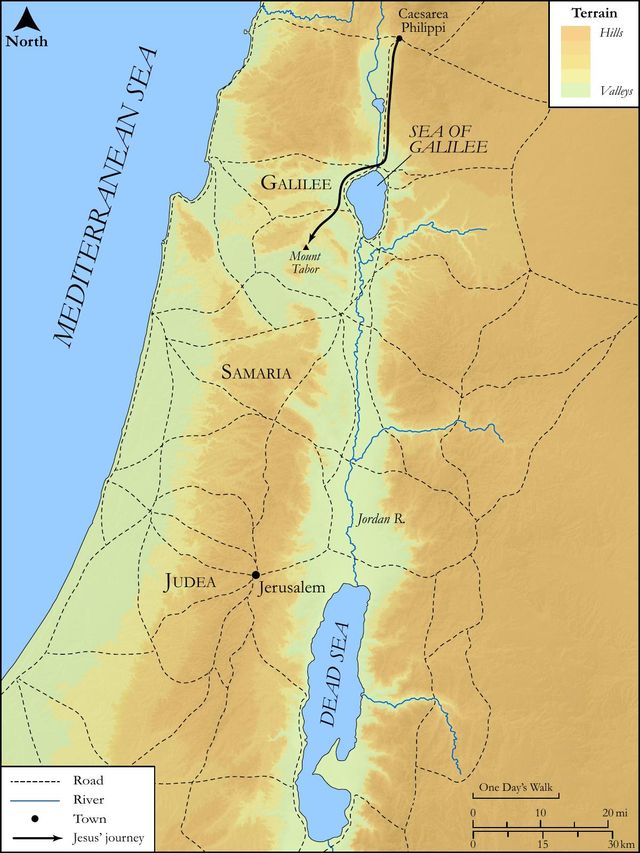
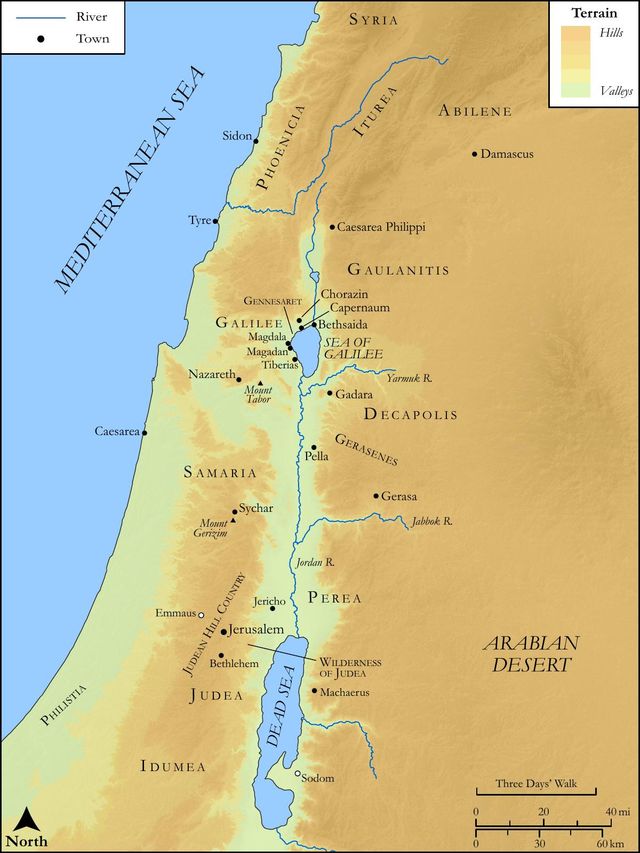
See on the biblical-era maps

Study this verse
Public-domain commentary
Matthew Henry
From his Commentary on the Whole Bible. Henry comments on passages, not single verses — this entry covers Matthew 17:1–13. His four-level outline is real structure in the source text, so it is rendered as structure.
We have here the story of Christ's transfiguration; he had said that the Son of man should shortly come in his kingdom, with which promise all the three evangelists industriously connect this story; as if Christ's transfiguration were intended for a specimen and an earnest of the kingdom of Christ, and of that light and love of his, which therein appears to his select and sanctified ones. Peter speaks of this as the power and coming of our Lord Jesus (Pe2 1:16); because it was an emanation of his power, and a previous notice of his coming, which was fitly introduced by such prefaces.
When Christ was here in his humiliation, though his state, in the main, was a state of abasement and afflictions, there were some glimpses of his glory intermixed, that he himself might be the more encouraged in his sufferings, and others the less offended. His birth, his baptism, his temptation, and his death, were the most remarkable instances of his humiliation; and these were each of them attended with some signal points of glory, and the smiles of heaven. But the series of his public ministry being a continued humiliation, here, just in the midst of that, comes in this discovery of his glory. As, now that he is in heaven, he has his condescensions, so, when he was on earth, he had his advancements.
Now concerning Christ's transfiguration, observe,
I.The circumstances of it, which are here noted, Mat 17:1.
1.The time; six days after he had the solemn conference with his disciples, Mat 16:21. St Luke saith, It was about eight days after, six whole days intervening, and this the eighth day, that day seven-night. Nothing is recorded to be said or done by our Lord Jesus for six days before his transfiguration; thus, before some great appearances, there was silence in heaven for the space of half an hour, Rev 8:1. Then when Christ seems to be doing nothing for his church, expect, ere long, something more than ordinary.
2.The place; it was on top of a high mountain apart. Christ chose a mountain,
(1.)As a secret place. He went apart; for though a city upon a hill can hardly be hid, two or three persons upon a hill can hardly be found; therefore their private oratories were commonly on mountains. Christ chose a retired place to be transfigured in, because his appearing publicly in his glory was not agreeable to his present state; and thus he would show his humility, and teach us that privacy much befriends our communion with God. Those that would maintain intercourse with Heaven, must frequently withdraw from the converse and business of this world; and they will find themselves never less alone than when alone, for the Father is with them.
(2.)Though a sublime place, elevated above things below. Note, Those that would have a transforming fellowship with God, must not only retire, but ascend; lift up their hearts, and seek things above. The call is, Come up hither, Rev 4:1.
3.The witnesses of it. He took with him Peter and James and John.
(1.)He took three, a competent number to testify what they should see; for out of the mouth of two or three witnesses shall every word be established. Christ makes his appearances certain enough, but not too common; not to all the people, but to witnesses (Act 10:41), that they might be blessed, who have not seen, and yet have believed.
(2.)He took these three because they were the chief of his disciples, the first three of the worthies of the Son of David; probably they excelled in gifts and graces; they were Christ's favourites, singled out to be the witnesses of his retirements. They were present when he raised the damsel to life, Mar 5:37. They were afterward to be the witnesses of his agony, and this was to prepare them for that. Note, A sight of Christ's glory, while we are here in this world, is a good preparative for our sufferings with him, as these are preparatives for the sight of his glory in the other world. Paul, who had abundance of trouble, had abundance of revelations.
II.The manner of it (Mat 17:2); He was transfigured before them.
The substance of his body remained the same, but the accidents and appearances of it were greatly altered; he was not turned into a spirit, but his body, which had appeared in weakness and dishonour, now appeared in power and glory. He was transfigured, metamorphōthē - he was metamorphosed. The profane poets amused and abused the world with idle extravagant stories of metamorphoses, especially the metamorphoses of their gods, such as were disparaging and diminishing to them, equally false and ridiculous; to these some think Peter has an eye, when, being about to mention this transfiguration of Christ, he saith, We have not followed cunningly devised fables when we made it known unto you, Pe2 1:16. Christ was both God and man; but, in the days of his flesh, he took on him the form of a servant - morphēn doulou, Phi 2:7. He drew a veil over the glory of his godhead; but now, in his transfiguration, he put by that veil, appeared en morphē theou - in the form of God (Phi 2:6), and gave his disciples a glimpse of his glory, which could not but change his form.
The great truth which we declare, is, that God is light (Jo1 1:5), dwells in the light (Ti1 6:16), covers himself with light, Psa 104:2. And therefore when Christ would appear in the form of God, he appeared in light, the most glorious of all visible beings, the first-born of the creation, and most nearly resembling the eternal Parent. Christ is the Light; while he was in the world, he shined in darkness, and therefore the world knew him not (Joh 1:5, Joh 1:10); but, at this time, that Light shined out of the darkness.
Now his transfiguration appeared in two things:
1.His face did shine as the sun. The face is the principal part of the body, by which we are known; therefore such a brightness was put on Christ's face, that face which afterward he hid not from shame and spitting. It shone as the sun when he goes forth in his strength, so clear, so bright; for he is the Sun of righteousness, the Light of the world. The face of Moses shone but as the moon, with a borrowed reflected light, but Christ's shone as the sun, with an innate inherent light, which was the more sensibly glorious, because it suddenly broke out, as it were, from behind a black cloud.
2.His raiment was white as the light. All his body was altered, as his face was; so that beams of light, darting from every part through his clothes, made them white and glittering. The shining of the face of Moses was so weak, that it could easily be concealed by a thin veil; but such was the glory of Christ's body, that his clothes were enlightened by it.
III.The companions of it.
He will come, at last, with ten thousands of his saints; and, as a specimen of that, there now appeared unto them Moses and Elias talking with him, Mat 17:3. Observe,
1.There were glorified saints attending him, that, when there were three to bear record on earth, Peter, James, and John, there might be some to bear record from heaven too. Thus here was a lively resemblance of Christ's kingdom, which is made up of saints in heaven and saints on earth, and to which belong the spirits of just men made perfect. We see here, that they who are fallen asleep in Christ are not perished, but exist in a separate state, and shall be forthcoming when there is occasion.
2.These two were Moses and Elias, men very eminent in their day. They had both fasted forty days and forty nights, as Christ did, and wrought other miracles, and were both remarkable at their going out of the world as well as in their living in the world. Elias was carried to heaven in a fiery chariot, and died not. The body of Moses was never found, possibly it was preserved from corruption, and reserved for this appearance. The Jews had great respect for the memory of Moses and Elias, and therefore they came to witness of him, they came to carry tidings concerning him to the upper world. In them the law and the prophets honoured Christ, and bore testimony to him. Moses and Elias appeared to the disciples; they saw them, and heard them talk, and, either by their discourse or by information from Christ, they knew them to be Moses and Elias; glorified saints shall know one another in heaven. They talked with Christ. Note, Christ has communion with the blessed, and will be no stranger to any of the members of that glorified corporation. Christ was now to be sealed in his prophetic office, and therefore these two great prophets were fittest to attend him, as transferring all their honour and interest to him; for in these last days God speaks to us by his Son, Heb 1:1.
IV.The great pleasure and satisfaction that the disciples took in the sight of Christ's glory.
Peter, as usual, spoke or the rest; Lord, it is good for us to be here. Peter here expresses,
1.The delight they had in this converse; Lord, it is good to be here. Though upon a high mountain, which we may suppose rough and unpleasant, bleak and cold, yet it is good to be here. He speaks the sense of his fellow-disciples; It is good not only for me, but for us. He did not covet to monopolize this favour, but gladly takes them in. He saith this to Christ. Pious and devout affections love to pour out themselves before the Lord Jesus. The soul that loves Christ, and loves to be with him, loves to go and tell him so; Lord, it is good for us to be here. This intimates a thankful acknowledgment of his kindness in admitting them to this favour. Note, Communion with Christ is the delight of Christians. All the disciples of the Lord Jesus reckon it is good for them to be with him in the holy mount. It is good to be here where Christ is, and whither he brings us along with him by his appointment; it is good to be here, retired and alone with Christ; to be here, where we may behold the beauty of the Lord Jesus, Psa 27:4. It is pleasant to hear Christ compare notes with Moses and the prophets, to see how all the institutions of the law, and all the predictions of the prophets, pointed at Christ, and were fulfilled in him.
2.The desire they had of the continuance of it; Let us make here three tabernacles. There was in this, as in many other of Peter's sayings, a mixture of weakness and of goodwill, more zeal than discretion.
(1.)Here was a zeal for this converse with heavenly things, a laudable complacency in the sight they had of Christ's glory. Note, Those that by faith behold the beauty of the Lord in his house, cannot but desire to dwell there all the days of their life. It is good having a nail in God's holy place (Ezr 9:8), a constant abode; to be in holy ordinances as a man at home, not as a wayfaring man. Peter thought this mountain was a fine spot of ground to build upon, and he was for making tabernacles there; as Moses in the wilderness made a tabernacle for the Shechinah, or divine glory.
It argued great respect for his Master and the heavenly guests, with some commendable forgetfulness of himself and his fellow-disciples, that he would have tabernacles for Christ, and Moses, and Elias, but none for himself. He would be content to lie in the open air, on the cold ground, in such good company; if his Master have but where to lay his head, no matter whether he himself has or no.
(2.)Yet in this zeal he betrayed a great deal of weakness and ignorance. What need had Moses and Elias of tabernacles? They belonged to that blessed world, where they hunger no more, nor doth the sun light upon them. Christ had lately foretold his sufferings, and bidden his disciples expect the like; Peter forgets this, or, to prevent it, will needs be building tabernacles in the mount of glory, out of the way of trouble. Still he harps upon, Master, spare thyself, though he had been so lately checked for it. Note, There is a proneness in good men to expect the crown without the cross. Peter was for laying hold of this as the prize, though he had not yet fought his fight, nor finished his course, as those other disciples, Mat 20:21. We are out in our aim, if we look for a heaven here upon earth. It is not for strangers and pilgrims (such as we are in our best circumstances in this world), to talk of building, or to expect a continuing city.
Yet it is some excuse for the incongruity of Peter's proposal, not only that he knew not what he said (Luk 9:33), but also that he submitted the proposal to the wisdom of Christ; If thou wilt, let us make tabernacles. Note, Whatever tabernacles we propose to make to ourselves in this world, we must always remember to ask Christ's leave.
Now to this which Peter said, there was no reply made; the disappearing of the glory would soon answer it. They that promise themselves great things on earth will soon be undeceived by their own experience.
V.The glorious testimony which God the Father gave to our Lord Jesus, in which he received from him honour and glory (Pe2 1:17), when there came this voice from the excellent glory. This was like proclaiming the titles of honour or the royal style of a prince, when, at his coronation, he appears in his robes of state; and be it known, to the comfort of mankind, the royal style of Christ is taken from his mediation. Thus, in vision, he appeared with a rainbow, the seal of the covenant, about his throne (Rev 4:3); for it is his glory to be our Redeemer.
Now concerning this testimony from heaven to Christ, observe.
1.How it came, and in what manner it was introduced.
(1.)There was a cloud. We find often in the Old Testament, that a cloud was the visible token of God's presence; he came down upon mount Sinai in a cloud (Exo 19:9), and so to Moses, Exo 34:5; Num 11:25. He took possession of the tabernacle in a cloud, and afterwards of the temple; where Christ was in his glory, the temple was, and there God showed himself present. We know not the balancing of the clouds, but we know that much of the intercourse and communication between heaven and earth is maintained by them. By the clouds vapours ascend, and rains descend; therefore God is said to make the clouds his chariots; so he did here when he descended upon this mount.
(2.)It was a bright cloud. Under the law it was commonly a thick and dark cloud that God made the token of his presence; he came down upon mount Sinai in a thick cloud (Exo 19:16), and said he would dwell in thick darkness; see Kg1 8:12. But we are now come, not to the mount that was covered with thick blackness and darkness (Heb 12:18), but to the mount that is crowned with a bright cloud. Both the Old Testament and the New Testament dispensation had tokens of God's presence; but that was a dispensation of darkness, and terror, and bondage, this of light, love, and liberty.
(3.)It overshadowed them. This cloud was intended to break the force of that great light which otherwise would have overcome the disciples, and have been intolerable; it was like the veil which Moses put upon his face when it shone. God, in manifesting himself to his people, considers their frame. This cloud was to their eyes as parables to their understandings, to convey spiritual things by things sensible, as they were able to bear them.
(4.)There came a voice out of the cloud, and it was the voice of God, who now, as of old, spake in the cloudy pillar, Psa 99:7. Here was no thunder, or lightning, or voice of a trumpet, as there was when the law was given by Moses, but only a voice, a still small voice, and that not ushered in with a strong wind, or an earthquake, or fire, as when God spake to Elias, Kg1 19:11, Kg1 19:12. Moses then and Elias were witnesses, that in these last days God hath spoken to us by his Son, in another way than he spoke formerly to them. This voice came from the excellent glory (Pe2 1:17), the glory which excelleth, in comparison of which the former had no glory; though the excellent glory was clouded, yet thence came a voice, for faith comes by hearing.
2.What this testimony from heaven was; This is my beloved Son, hear ye him. Here we have,
(1.)The great gospel mystery revealed; This is my beloved Son, in whom I am well pleased. This was the very same that was spoken from heaven at his baptism (Mat 3:17); and it was the best news that ever came from heaven to earth since man sinned. It is to the same purport with that great doctrine (Co2 5:19), That God was in Christ, reconciling the world unto himself. Moses and Elias were great men, and favourites of Heaven, yet they were but servants, and servants that God was not always well pleased in; for Moses spoke unadvisedly, and Elias was a man subject to passions; but Christ is a Son, and in him God was always well pleased. Moses and Elias were sometimes instruments of reconciliation between God and Israel; Moses was a great intercessor, and Elias a great reformer; but in Christ God is reconciling the world; his intercession is more prevalent than that of Moses, and his reformation more effectual than that of Elias.
This repetition of the same voice that came from heaven at his baptism was no vain repetition; but, like the doubling of Pharoah's dream, was to show the thing was established. What God hath thus spoken once, yea twice, no doubt he will stand to, and he expects we should take notice of it. It was spoken at his baptism, because then he was entering upon his temptation, and his public ministry; and now it was repeated, because he was entering upon his sufferings, which are to be dated from hence; for now, and not before, he began to foretel them, and immediately after his transfiguration it is said (Luk 9:51), that the time was come that he should be received up; this therefore was then repeated, to arm him against the terror, and his disciples against the offence, of the cross. When sufferings begin to abound, consolations are given in more abundantly, Co2 1:5.
(2.)The great gospel duty required, and it is the condition of our benefit by Christ; Hear ye him. God is well pleased with none in Christ but those that hear him. It is not enough to give him the hearing (what will that avail us?) but we must hear him and believe him, as the great Prophet and Teacher; hear him, and be ruled by him, as the great Prince and Lawgiver; hear him, and heed him. Whoever would know the mind of God, must hearken to Jesus Christ; for by him God has in these last days spoken to us. This voice from heaven has made all the sayings of Christ as authentic as if they had been thus spoken out of a cloud. God does here, as it were, turn us over to Christ for all the revelations of his mind; and it refers to that prediction concerning the Prophet God would raise up like unto Moses (Deu 18:18); him shall ye hear.
Christ now appeared in glory; and the more we see of Christ's glory, the more cause we shall see to hearken to him: but the disciples were gazing on that glory of his which they saw; they are therefore bid not to look at him, but to hear him. Their sight of his glory was soon intercepted by the cloud, but their business was to hear him. We walk by faith, which comes by hearing, not by sight, Co2 5:7.
Moses and Elias were now with him; the law and the prophets; hitherto it was said, Hear them, Luk 16:29. The disciples were ready to equal them with Christ, when they must have tabernacles for them as well as for him. They had been talking with Christ, and probably the disciples were very desirous to know what they said, and to hear something more from them; No, saith God, hear him, and that is enough; him, and not Moses and Elias, who were present, and whose silence gave consent to this voice; they had nothing to say to the contrary; whatever interest they had in the world as prophets, they were willing to see it all transferred to Christ, that in all things he might have the pre-eminence. Be not troubled that Moses and Elias make so short a stay with you; hear Christ, and you will not want them.
IV.The fright which the disciples were put into by this voice, and the encouragement Christ gave them.
1.The disciples fell on their faces, and were sore afraid. The greatness of the light, and the surprise of it, might have a natural influence upon them, to dispirit them. But that was not all, ever since man sinned, and heard God's voice in the garden, extraordinary appearances of God have ever been terrible to man, who, knowing he has no reason to expect any good, has been afraid to hear any thing immediately from God. Note, even then when fair weather comes out of the secret place, yet with God is terrible majesty, Job 37:22. See what dreadful work the voice of the Lord makes, Psa 29:4. It is well for us that God speaks to us by men like ourselves, whose terror shall not make us afraid.
2.Christ graciously raised them up with abundance of tenderness. Note, The glories and advancements of our Lord Jesus do not at all lessen his regard to, and concern for, his people that are compassed about with infirmity. It is comfortable to think, that now, in his exalted state, he has a compassion for, and condescends to, the meanest true believer. Observe here, (1.). What he did; he came, and touched them. His approaches banished their fears; and when they apprehended that they were apprehended of Christ, there needed no more to make them easy. Christ laid his right hand upon John is a like case, and upon Daniel, Rev 1:17; Dan 8:18; Dan 10:18. Christ's touches were often healing, and here they were strengthening and comforting. (2.) What he said; Arise, and be not afraid. Note, Though a fear of reverence in our converse with Heaven is pleasing to Christ, yet a fear of amazement is not so, but must be striven against. Christ said, Arise. Note, It is Christ by his word, and the power of his grace going along with it, that raises up good men from their dejections, and silences their fears; and none but Christ can do it; Arise, be not afraid. Note, causeless fears would soon vanish, if we would not yield to them, and lie down under them, but get up, and do what we can against them. considering what they had seen and heard, they had more reason to rejoice than to fear, and yet, it seems, they needed this caution. Note, Through the infirmity of the flesh, we often frighten ourselves with that wherewith we should encourage ourselves. Observe, After they had an express command from heaven to hear Christ, the first word they had from him was, Be not afraid, hear that. Note, Christ's errand into the world was to give comfort to good people, that, being delivered out of the hands of their enemies, they might serve God without fear, Luk 1:74, Luk 1:75.
VII.The disappearing of the vision (Mat 17:8); They lift up themselves, and then lift up their eyes, and saw no man, save Jesus only.
Moses and Elias were gone, the rays of Christ's glory were laid aside, or veiled again. They hoped this had been the day of Christ's entrance into his kingdom, and his public appearance in that external splendour which they dreamed of; but see how they are disappointed. Note, It is not wisdom to raise our expectations high in this world, for the most valuable of our glories and joys here are vanishing, even those of near communion with God are so, not a continual feast, but a running banquet. If sometimes we are favoured with special manifestations of divine grace, glimpses and pledges of future glory, yet they are withdrawn presently; two heavens are too much for those to expect that never deserve one. Now they saw no man, save Jesus only. Note, Christ will tarry with us when Moses and Elias are gone. The prophets do not live for ever (Zac 1:5), and we see the period of our ministers' conversation; but Jesus Christ is the same yesterday, today, and for ever, Heb 13:7, Heb 13:8.
VIII.The discourse between Christ and his disciples as they came down from the mountain, Mat 17:9-13.
Observe, 1. They came down from the mountain. Note, We must come down from the holy mountains, where we have communion with God, and complacency in that communion, and of which we are saying. It is good to be here; even there we have no continuing city. Blessed be God, there is a mountain of glory and joy before us, whence we shall never come down. But observe, When the disciples came down, Jesus came with them. Note, When we return to the world again after an ordinance, it must be our care to take Christ with us, and then it may be our comfort that he is with us.
2.As they came down, they talked of Christ. Note, When we are returning from holy ordinance, it is good to entertain ourselves and one another with discourse suitable to the work we have been about. That communication which is good to the use of edifying is then in a special manner seasonable; as, on the contrary, that which is corrupt, is worse then than at another time.
Here is, (1.) The charge that Christ gave the disciples to keep the vision very private for the present (Mat 17:9); Tell it to no man till the Son of man is risen. If they had proclaimed it, the credibility of it would have been shocked by his sufferings, which were now hastening on. But let the publication of it be adjourned till after his resurrection, and then that and his subsequent glory will be a great confirmation of it. Note, Christ observed a method in the manifestation of himself; he would have his works put together, mutually to explain and illustrate each other, that they might appear in their full strength and convincing evidence. Every thing is beautiful in its season. Christ's resurrection was properly the beginning of the gospel state and kingdom, to which all before was but preparatory and by way of preface; and therefore, though this was transacted before, it must not be produced as evidence till then (and then it appears to have been much insisted on by Pe2 1:16-18), when the religion it was designed for the confirmation of was brought to its full consistence and maturity. Christ's time is the best and fittest for the manifesting of himself and must be attended to by us.
(2.)An objection which the disciples made against something Christ had said (Mat 17:10); "Why then say the scribes that Elias must first come? If Elias make so short a stay, and is gone so suddenly, and we must say nothing of him; why have we been taught out of the law to expect his public appearance in the world immediately before the setting up of the Messiah's kingdom? Must the coming of Elias be a secret, which every body looks for?" or thus; "If the resurrection of the Messiah, and with it the beginning of his kingdom, be at hand, what becomes of that glorious preface and introduction to it, which we expect in the coming of Elias?" The scribes, who were the public expositors of the law, said this according to the scripture (Mal 4:5); Behold I send you Elijah the prophet. The disciples spoke the common language of the Jews, who made that the saying of the scribes which was the saying of the scripture, whereas of that which ministers speak to us according to the word of God, we should say, "God speaks to us, not the ministers;" for we must not receive it as the word of men, Th1 2:13. Observe, When the disciples could not reconcile what Christ said with what they had heard out of the Old Testament, they desired him to explain it to them. Note, When we are puzzled with scripture difficulties, we must apply ourselves to Christ by prayer for his Spirit to open our understandings and to lead us into all truth.
(3.)The solving of this objection. Ask, and it shall be given, ask instruction, and it shall be given.
[1.]Christ allows the prediction (Mat 17:11); "Elias truly shall first come, and restore all things; so far you are in the right." Christ did not come to alter or invalidate any thing foretold in the Old Testament. Note, Corrupt and mistaken glosses may be sufficiently rejected and exploded, without diminishing or derogating from the authority or dignity of the sacred text. New Testament prophecies are true and good, and are to be received and improved, though some hot foolish men may have misinterpreted them and drawn wrong inferences from them. He shall come, and restore all things; not restore them to their former state (John Baptist went not about to do that), but he shall accomplish all things (so it may be read), all things that were written of him, all the predictions of the coming of Elias. John Baptist came to restore things spiritually, to revive the decays of religion, to turn the hearts of the fathers to the children; which means the same with this, he shall restore all things. John preached repentance, and that restores all things.
[2.]He asserts the accomplishment. The scribes say true, that Elias is come, Mat 17:12. Note, God's promises are often fulfilled, and men perceive it not, but enquire, Where is the promise? when it is already performed. Elias is come, and they knew him not; they knew him not to be the Elias promised, the forerunner of the Messiah. The scribes busied themselves in criticizing upon the scripture, but understood not by the signs of the times the fulfilling of the scripture. Note, It is easier to explain the word of God than to apply it and make a right use of it. But it is no wonder that the morning star was not observed, when he who is the Sun itself, was in the world, and the world knew him not.
Because they knew him not, they have done to him whatsoever they listed; if they had known, they would not have crucified Christ, or beheaded John, Co1 2:8. They ridiculed John, persecuted him, and at last put him to death; which was Herod's doing, but is here charged upon the whole generation of unbelieving Jews, and particularly the scribes, who, though they could not prosecute John themselves, were pleased with what Herod did. He adds, Likewise also shall the Son of man suffer of them. Marvel not that Elias should be abused and killed by those who pretended, with a great deal of reverence, to expect him, when the Messiah himself will be in like manner treated. Note, The sufferings of Christ took off the strangeness of all other sufferings (Joh 15:18); when they had imbrued their hands in the blood of John Baptist, they were ready to do the like to Christ. Note, As men deal with Christ's servants, so they would deal with him himself; and they that are drunk with the blood of the martyrs still cry, Give, give, Act 12:1-3.
(4.)The disciples' satisfaction in Christ's reply to their objection (Mat 17:13); They understood that he spake unto them of John the Baptist. He did not name John, but gives them such a description of him as would put them in mind of what he had said to them formerly concerning him; This is Elias. This is a profitable way of teaching; it engages the learners' own thoughts, and makes them, if not their own teachers, yet their own remembrancers; and thus knowledge becomes easy to him that understands. When we diligently use the means of knowledge, how strangely are mists scattered and mistakes rectified!
Historical interpretation
Seventeen Centuries of Reception
16 surviving comments on this verse. Each one is dated, so this reads as a timeline rather than a list.
Select a marker to jump to its quote. Markers stagger vertically where authors wrote within a few decades of each other.
But, behold, with an abundance (of evidence) the Father from heaven replies, for the purpose of testifying to the Son: "This is my beloved Son, in whom I am well pleased; hear ye Him." So, again, in that asseveration, "I have both glorified, and will glorify again," how many Persons do you discover, obstinate Praxeas? Are there not as many as there are voices? You have the Son on earth, you have the Father in heaven.
The bright cloud overshadowing the Saints is the Power of the Father, or perhaps the Holy Spirit; or I may also venture to call the Saviour that bright cloud which overshadows the Gospel, the Law, and the Prophets, as they understand who can behold His light in all these three.
The voice out of the cloud speaks either to Moses or Elias, who desired to see the Son of God, and to hear Him; or it is for the teaching of the Apostles.
I think that God, wishing to dissuade Peter from making three tabernacles, under which so far as it depended on his choice he was going to dwell, shows him a better tabernacle, so to speak, and far superior: the cloud. It is the function of a tabernacle to give shade to one who is in it and to shelter him, and the bright cloud overshadowed them. So God made, as it were, a more divine tabernacle, inasmuch as it was bright, that it might be to them a pattern of the resurrection to come. For the shining cloud gives shade to the righteous and at the same time protects them, gives them light and illuminates them. What would the shining cloud that gives shade to the righteous be? Is it perhaps the Father’s power, from which comes the Father’s voice saying that this is his Son in whom he is well pleased, urging those that are shaded by it to listen to him and to no one else? He speaks—just as of old so also for all times—through those whom he wishes. Perhaps the shining cloud is the Holy Spirit, giving shade to the righteous and announcing the words of God at work within it and saying, “This is my beloved Son in whom I am well pleased.” I would even venture to say that the shining cloud is our Savior.
This is the Son, this the Beloved, this the Accepted; and He it is who is to be heard, as the voice out of the cloud signifies, saying, Hear ye Him. For He is a fit teacher of doing the things He has done, who has given the weight of His own example to the loss of the world, the joy of the cross, the death of the body, and after that the glory of the heavenly kingdom.
He enjoins silence respecting what they had seen, for this reason, that when they should be filled with the Holy Spirit, they should then become witnesses of these spiritual deeds.
The Father is evidently revealing the Son when the ringing voice from heaven bursts forth so loudly. Through it he reveals to everyone the testimony coming from above. One must not think that the voice of God is audible. Nor can one perceive a bodiless being. Just as no one has ever seen God, so no one has ever heard God. The words “listen to him” have the power of making a necessary distinction. For he says listen to him, rather than to Moses or the prophet who had been introduced, because it was now time to go forward and advance from the introduction to the fulfillment, from the prefiguration to the true reality.
When the Lord threatens, He shows a dark cloud, as on Sinai; but here where He sought not to terrify but to teach, there appeared a bright cloud.
Neither Moses, nor Elias speak, but the Father greater than all sends a voice out of the cloud, that the disciples might believe that this voice was from God. For God has ordinarily shown Himself in a cloud, as it is written, Clouds and darkness are round about Him; (Ps. 97:2.) and this is what is said, Behold, a voice out of the cloud.
Fear not then, Peter; for if God is mighty, it is manifest that the Son is also mighty; wherefore if He is loved, fear not thou; for none forsakes Him whom He loves; nor dost thou love Him equally with the Father. Neither does He love Him merely because He begot Him, but because He is of one will with Himself; as it follows, In whom I am well pleased; which is to say, in whom I rest content, whom I accept, for all things of the Father He performs with care, and His will is one with the Father; so if He will to be crucified, do not then speak against it.
But when before in Christ's baptism, such a voice came from heaven, yet none of the multitude then present suffered any thing of this kind, how is it that the disciples on the mount fell prostrate? Because in sooth their solicitude was much, the height and loneliness of the spot great, and the transfiguration itself attended with terrors, the clear light and the spreading cloud; all these things together wrought to terrify them.
What then? He Himself speaks nothing, nor Moses, nor Elias, but He that is greater than all, and more worthy of belief, the Father, uttereth a voice out of the cloud.
Wherefore out of the cloud? Thus doth God ever appear. "For a cloud and darkness are round about Him;" and, "He sitteth on a light cloud;" and again, "Who maketh clouds His chariot;" and, "A cloud received Him out of their sight;" and, "As the Son of Man coming in the clouds."
In order then that they might believe that the voice proceeds from God, it comes from thence.
And the cloud was bright. For "while he yet spake, behold, a bright cloud overshadowed them; and, behold, a voice out of the cloud, which said, This is My beloved Son, in whom I am well pleased; hear ye Him."
For as, when He threatens, He shows a dark cloud; as on Mount Sinai; for "Moses," it is said, "entered into the cloud, and into the thick darkness; and as a vapor, so went up the smoke;" and the prophet said, when speaking of His threatening, "Dark water in clouds of the air;" so here, because it was His desire not to alarm, but to teach, it is a bright cloud.
And whereas Peter had said "Let us make three tabernacles," He showed a tabernacle not made with hands. Wherefore in that case it was smoke, and vapor of a furnace; but in this, light unspeakable and a voice.
Then, to signify that not merely concerning some one of the three was it spoken, but concerning Christ only; when the voice was uttered, they were taken away. For by no means, had it been spoken merely concerning any one of them, would this man have remained alone, the two being severed from Him.
Why then did not the cloud likewise receive Christ alone, but all of them together? If it had received Christ alone, He would have been thought to have Himself uttered the voice. Wherefore also the evangelist, making sure this same point, saith, that the voice was from the cloud, that is, from God.
And what saith the voice? "This is my beloved Son." Now if He is beloved, fear not thou, O Peter. For thou oughtest indeed to know His power already, and to be fully assured touching His resurrection; but since thou knowest not, at least from the voice of the Father take courage. For if God be mighty, as surely He is mighty, very evidently the Son is so likewise. Be not afraid then of those fearful things.
But if as yet thou receive it not, consider at least that other fact, that He is both a Son, and is beloved. For "This," it is said, "is My beloved Son." Now if He is beloved, fear not. For no one gives up one whom he loves. Be not thou therefore confounded; though thou lovest Him beyond measure, thou lovest Him not as much as He that begat Him.
"In whom I am well pleased." For not because He begat Him only, doth He love Him, but because He is also equal to Him in all respects, and of one mind with Him. So that the charm of love is twofold, or rather even threefold, because He is the Son, because He is beloved, because in Him He is well pleased.
But what means, "In whom I am well pleased?" As though He had said, "In whom I am refreshed, in whom I take delight;" because He is in all respects perfectly equal with Himself, and there is but one will in Him and in the Father, and though He continue a Son, He is in all respects one with the Father.
"Hear ye Him." So that although He choose to be crucified, you are not to oppose Him.
Because Peter had asked imprudently, he does not merit the Lord’s answer. But the Father answered for the Son so that the word of the Lord might be fulfilled: “I do not bear witness for myself, but the Father who sent me, he bears witness for me.” The cloud appears bright and shades them, so that those who were looking for a material booth made from boughs or tents might be protected with the shade of a shining cloud. The voice of the Father speaking from heaven is also heard. It provides testimony and teaches Peter the truth with error removed, and in fact through Peter teaches all the apostles: “This is my beloved Son.” It is for him that you must build the tabernacle, him you must obey. “My Son” is distinguished from his servants, Moses and Elijah. They, along with you, are to prepare a tabernacle for the Lord in the inner sanctum of their heart.
While they thought only of an earthly tabernacle of boughs or tents, they are overshadowed by the covering of a bright cloud; While he yet spake, there came a bright cloud and overshadowed them. (Exod. 19:9, 16.)
Forasmuch as Peter had asked unwisely, he deserves not any answer; but the Father makes answer for the Son, that the Lord's word might be fulfilled, He that sent me, he beareth witness of me. (John 5:37.)
The voice of the Father is heard speaking from heaven, giving testimony to the Son, and teaching Peter the truth, taking away his error, and through Peter the other disciples also; whence he proceeds, This is my beloved Son. For Him make the tabernacle, Him obey; this is the Son, they are but servants; and they also ought as you to make ready a tabernacle for the Lord in the inmost parts of their heart.
Their cause of terror is threefold. Because they knew that they had done amiss; or because the bright cloud had covered them; or because they had heard the voice of God the Father speaking; for human frailty cannot endure to look upon so great glory, and falls to the earth trembling through both soul and body. And by how much higher any one has aimed, by so much lower will be his fall, if he shall be ignorant of his own measure.
And whereas they were laid down, and could not raise themselves again, He approaches them, touches them gently, that by His touch their fear might be banished, and their unnerved limbs gain strength; And Jesus drew near, and touched them. But He further added His word to His hand, And said unto them, Arise, fear not. He first banishes their fear, that He may after impart teaching. It follows, And when they lifted up their eyes, they saw no man, save Jesus only; which was done with good reason; for had Moses and Elias continued with the Lord, it might have seemed uncertain to which in particular the witness of the Father was borne. Also they see Jesus standing after the cloud has been removed, and Moses and Elias disappeared, because after the shadow of the Law and Prophets has departed, both are found in the Gospel. It follows; And as they came down from the mount, Jesus charged them, saying, Tell no man this vision, until the Son of Man shall rise from the dead. He will not be preached among the people, lest the marvel of the thing should seem incredible, and lest the cross following after so great glory should cause offence.
(Verse 5) While he was still speaking, behold, a bright cloud overshadowed them. And behold, a voice from the cloud, saying, This is my beloved Son, with whom I am well pleased; listen to him. Because he had asked foolishly, he does not deserve an answer from the Lord, but the Father speaks for the Son, so that the word of the Lord may be fulfilled: I do not testify of myself, but the Father who sent me, he testifies of me (John 5:37 and 8:18). But the cloud is seen as both bright and shadowed: like those who sought the tabernacle from the fleshly leaves or tents, they would be covered by the shadow of the bright cloud. Moreover, the voice of the Father speaking from heaven is heard, which also testifies to the Son; and through Peter, with error removed, teaches the truth: even through Peter to the other apostles. This is, he says, my beloved Son: to him the tabernacle must be affixed, to him obedience must be given. Here is the son, those slaves are: Moses and Elias themselves must prepare a tabernacle for the Lord with you in the innermost depths of their heart.
A voice from the cloud said, This is my beloved Son, with whom I am well pleased; listen to him. I am manifested through his preaching. I am glorified through his humility. So listen to him without hesitation. He is the truth and the life. He is my strength and wisdom. “Listen to him” whom the mysteries of the law foreshadowed, of whom the mouths of the prophets sang. “Listen to him” who by his blood redeemed the world, who binds the devil and seizes his vessels, who breaks the debt of sin and the bondage of iniquity. “Listen to him” who opens the way to heaven and by the pain of the cross prepares for you the steps of ascent into his kingdom.
He says therefore, Hear ye Him, as much as to say, Let the shadow of the Law be past, and the types of the Prophets, and follow ye the one shining light of the Gospel. Or He says, Hear ye Him, to show that it was He whom Moses had foretold, The Lord your God shall raise up a Prophet unto you of your brethren like unto me, Him shall ye hear. (Deut. 18:18.) Thus the Lord had witnesses on all sides; from heaven the voice of the Father, Elias out of Paradise, Moses out of Hades, the Apostles from among men, that at the name of Jesus every thing should bow the knee, of things in heaven, things on earth, and things beneath.
Whereas the holy Apostles fell upon their faces, that was a proof of their sanctity, for the saints are always described to fall upon their faces, but the wicked to fall backwardsa.
Or, because if His majesty should be published among the people, they should hinder the dispensation of His passion, by resistance to the chief Priests; and thus the redemption of the human race should suffer impediment.
Also in supposing that tabernacles were to be built for conversation in heaven, in which houses are not needed, as it is written in the Apocalypse, I saw not any temple therein. (Rev. 21:22.)
. You, Peter, desire tabernacles made with hands, but the Father has formed around them another tabernacle not made with hands, the cloud, showing that just as He Himself appeared as God in a cloud to the men of old, so also does His Son now appear in a cloud. Here the cloud is bright, not dark as in the time of old, for He desires not to bring fear but to teach. Out of the cloud came the voice, to show that it was of God. "In Whom I am well pleased," that is, in Whom I rest and take pleasure. And He teaches: "Hear ye Him and if He willeth to be crucified, oppose Him not."
(ap. Anselm.) It is to be observed, that the mystery of the second regeneration, that, to wit, which shall be in the resurrection, when the flesh shall be raised again, agrees well with the mystery of the first which is in baptism, when the soul is raised again. For in the baptism of Christ is shown the working of the whole Trinity; there was the Son incarnate, the Holy Ghost appealing in the figure of a dove, and the Father made known by the voice. In like manner in the transfiguration, which is the sacrament of the second regeneration, the whole Trinity appeared; the Father in the voice, the Son in the man, and the Holy Spirit in the cloud. It is made a question how the Holy Spirit was shown there in the dove, here in the cloud. Because it is His manner to mark His gifts by specific outward forms. And the gift of baptism is innocence, which is denoted by the bird of purity. But as in the resurrection, He is to give splendour and refreshment, therefore in the cloud are denoted both the refreshment and the brightness of the rising bodies. It follows, And when the disciples heard it, they fell on their faces, and feared greatly.
The Transfiguration and the walking on the water are glimpses of the beauty and the effortless power over all matter which will belong to men when they are really waked by God.
Continue studying Matthew 17:5 across the web’s major study libraries — every link below opens this exact verse, chapter, or book on the destination site.
Read & Compare
 BibleGatewayThis verse in more than 200 translations and 70 languages.
 Bible.comThe YouVersion reader — hundreds of translations, reading plans, and highlights.
 ESV.orgCrossway's official English Standard Version reader.
 NET BibleThe NET translation with 60,000+ translators' notes on every rendering decision.
 STEP BibleTyndale House's free study tool — original text, vocabulary, and scholarly resources.
 BibliaLogos Bible Software's free web reader.
 USCCBThe New American Bible (Revised Edition) with the U.S. bishops' study notes.
Commentaries
 BibleHub CommentariesDozens of classic commentaries on this verse, gathered on one page.
 StudyLightMore than 100 commentary sets — the largest collection on the web.
 BibleRefPlain-English commentary on what this verse means, verse by verse.
 Enduring WordDavid Guzik's free commentary on this chapter, widely used by Bible teachers.
 Bible Study ToolsVerse commentary alongside Greek and Hebrew study aids.
Original Language & Research
- BibleHub InterlinearThe verse word by word — original language, transliteration, and English.
- BibleHub LexiconEvery word's original-language definition and Strong's entry.
 Blue Letter BibleDeep-study tools — Strong's numbers, concordance, and word studies.
 CNTR CollationThe earliest Greek manuscripts of this verse, collated letter by letter.
Sermons, Hymns & Audio


TrulyRandomVerse is not affiliated with these sites and doesn’t control their content. They’re linked because they’re genuinely useful.
Summary
Matthew 17:5 captures the climactic moment of the Transfiguration, where God the Father audibly intervenes from a brilliant cloud to affirm Jesus Christ's divine identity as His "beloved Son" and to unequivocally command Peter, James, and John, and by extension all humanity, to "hear ye him." This profound declaration not only validates Jesus' unique relationship with the Father but also establishes His supreme authority as the ultimate revelation of God's will, superseding the Law and the Prophets.
Context
ShowHideLiterary Context
This pivotal verse immediately follows Peter's well-intentioned but misguided suggestion to construct three tabernacles for Jesus, Moses, and Elijah, who had just appeared with Jesus in radiant glory on the mountain Matthew 17:4. The disciples were witnessing an unparalleled display of divine majesty, a prefigurement of Christ's heavenly glory and ultimate exaltation. The preceding verses Matthew 17:1-3 detail Jesus taking Peter, James, and John to a high mountain, where His face shone like the sun and His clothes became as white as light, and Moses and Elijah appeared, conversing with Him. This entire event serves as a profound revelation of Jesus' true identity and authority, strengthening the disciples' faith in anticipation of His journey to Jerusalem and the cross.
Historical & Cultural Context
The setting, a "high mountain," is reminiscent of other significant divine encounters in biblical history, such as Moses receiving the Law on Mount Sinai Exodus 19. The "bright cloud" is a powerful symbol of the Shekinah glory, the visible manifestation of God's presence, familiar from the Old Testament narratives of the wilderness tabernacle Exodus 40:34-35 and the temple 1 Kings 8:10-11. The appearance of Moses (representing the Law) and Elijah (representing the Prophets) alongside Jesus signifies that Jesus is the culmination and fulfillment of all that the Law and the Prophets foretold. The voice from the cloud, echoing the divine pronouncement at Jesus' baptism Matthew 3:17, underscores the unique, divine sonship of Jesus, placing Him in a category distinct from all previous prophets and leaders.
Key Themes
ShowHideThis verse powerfully contributes to several major theological themes. Firstly, it provides a profound Divine Affirmation of Jesus' Identity, unequivocally declaring Him as God's "beloved Son." This echoes and reinforces the declaration made at Jesus' baptism, emphasizing His unique divine nature and mission. Secondly, the command "hear ye him" establishes Jesus' Supreme Authority, elevating His words and teachings above all others, including the foundational figures of the Law and the Prophets. This signifies that Jesus is the ultimate and final revelation of God's will, ushering in the new covenant. Thirdly, the presence of the "bright cloud" and the voice from it highlights the theme of Theophany and Divine Presence, indicating that God Himself is actively revealing His Son in a tangible and audible manner, signifying divine approval and the sacredness of the moment.
Exposition and Analysis
ShowHideKey Word Analysis
ShowHideMeaning "to cast a shade upon, i.e. (by analogy) to envelop in a haze of brilliancy; figuratively, to invest with preternatural influence." This word conveys more than just a literal shadow; it implies a divine, brilliant covering, a manifestation of God's glory that envelops and consecrates the scene, indicating a sacred, set-apart space where divine power is present. It evokes the dwelling of God's presence, as seen in the tabernacle.
Meaning "(dearly, well) beloved, dear." This term emphasizes Jesus' unique, cherished, and intimate relationship with the Father. It signifies a love that is not merely affection but also approval and delight, highlighting Jesus' singular position as the Son who perfectly embodies God's character and fulfills His will.
Meaning "to think well of, i.e. approve (an act); specially, to approbate (a person or thing); to be well pleased, have good pleasure, be willing." This word conveys God's complete satisfaction, delight, and affirmation in Jesus' person, life, and redemptive work. It signifies that Jesus' perfect obedience and His mission are entirely in line with the Father's will and bring Him immense joy.
Meaning "to hear (in various senses); give (in the) audience (of), come (to the ears), (shall) hear(-er, -ken), be noised, be reported, understand." In this imperative form, it is a direct command to listen attentively, to obey, and to understand. It implies not just passive reception of sound but active heeding and submission to Jesus' authority and teachings.
Verse Breakdown
ShowHide"While he yet spake"
This phrase sets the immediate context, indicating that God's intervention was direct and immediate, cutting across Peter's well-intentioned but humanly limited suggestion to build shelters. It underscores the divine interruption of human plans in favor of God's own revelation.
"behold, a bright cloud overshadowed them"
The sudden appearance of a "bright cloud" is a visual manifestation of God's presence, a theophany. It is "bright," signifying divine glory and purity, and it "overshadowed" them, indicating a divine covering and consecration of the space, reminiscent of the Shekinah glory in the Old Testament.
"and behold a voice out of the cloud, which said"
The voice is the audible component of the theophany, confirming the divine origin of the message. The cloud serves as the medium through which God speaks, emphasizing His transcendence and the sacredness of His pronouncement.
"This is my beloved Son, in whom I am well pleased"
This is the core divine declaration, echoing the words spoken at Jesus' baptism Matthew 3:17. It unequivocally identifies Jesus as God's unique, cherished, and fully approved Son, affirming His divine identity and the Father's complete satisfaction with Him.
"hear ye him"
This is a direct, imperative command from God the Father. It elevates Jesus' authority above all others, including Moses (the Law) and Elijah (the Prophets). It signifies that Jesus is the ultimate revelation of God's will and the one to whom all should listen, obey, and follow.
Literary Devices
ShowHideMatthew 17:5 is rich with literary devices that amplify its theological significance. The primary device is Theophany, the visible manifestation of God to humankind. This is conveyed through the "bright cloud" and the "voice out of the cloud," which are classic biblical elements of divine appearance, signifying God's direct intervention and communication. The "bright cloud" itself is a powerful Symbol of God's radiant presence and glory, reminiscent of the Shekinah, which both conceals and reveals the divine. The voice from the cloud is an instance of Divine Speech, where God directly addresses humanity, lending ultimate authority to the words spoken. Furthermore, the entire Transfiguration event, culminating in this divine declaration, serves as a profound Foreshadowing of Jesus' future glory, His resurrection, and His ultimate exaltation as King and Lord. The command "hear ye him" also functions as a Climax, providing the ultimate divine endorsement that resolves any lingering questions about Jesus' authority relative to the Law and the Prophets.
Theological and Thematic Connections
ShowHideMatthew 17:5 stands as a profound theological anchor, affirming Jesus' unique divine sonship and supreme authority. This declaration from the Father is not merely an emotional endorsement but a theological statement of Christ's identity and mission, echoing Old Testament prophecies of a coming prophet like Moses Deuteronomy 18:15 and the beloved servant of Isaiah Isaiah 42:1. It solidifies the Trinitarian nature of God, with the Father speaking, the Son being affirmed, and the Spirit implicitly present in the cloud of glory. The command to "hear ye him" signifies a new era, where the ultimate revelation of God is found in Jesus, not just through the Law and the Prophets, but in the living Word Himself.
Reflection and Application
ShowHideThe divine pronouncement at the Transfiguration, "This is my beloved Son, in whom I am well pleased; hear ye him," serves as a timeless call to prioritize Jesus Christ in every aspect of our lives. Just as the disciples were commanded to listen to Jesus above all others, so too are we called to make His words the ultimate authority for our faith and conduct. In a world filled with competing voices and philosophies, this verse directs us to the singular, authoritative voice of the Son of God. It challenges us to not only hear His teachings but to actively obey them, trusting in His perfect wisdom and His pathway to life. Our spiritual growth and maturity are directly tied to our willingness to submit to Christ's Lordship and to allow His words to shape our understanding of God, ourselves, and the world. This divine affirmation of Jesus also reminds us of God's deep love and pleasure in His Son, inviting us to find our own identity and purpose in Christ, knowing that as we are "in Him," we too become beloved children of God.
Questions for Reflection
ShowHideFAQ
ShowHideWhy did God choose to speak from a "bright cloud" at the Transfiguration?
ShowHideThe "bright cloud" in Matthew 17:5 is a powerful symbol of the Shekinah glory, the visible manifestation of God's presence in the Old Testament. This imagery connects the Transfiguration directly to momentous divine encounters, such as God appearing to Moses on Mount Sinai Exodus 19 or filling the Tabernacle Exodus 40:34-35. The "brightness" signifies divine purity, holiness, and the radiant glory of God. It serves to underscore the sacredness and divine authority of the moment, confirming that the voice emanating from it is indeed the voice of God Himself, setting apart Jesus as uniquely divine.
What is the significance of the command "hear ye him" in this context?
ShowHideThe command "hear ye him" Matthew 17:5 is a direct, divine imperative from God the Father. Its significance is profound, especially given that Moses (representing the Law) and Elijah (representing the Prophets) had just appeared with Jesus. This command elevates Jesus' authority above all previous revelations and figures in Israel's history. It signifies that Jesus is the ultimate and final Word of God, the one to whom all should listen, obey, and follow. It marks a transition from the old covenant mediated by Moses and spoken through the prophets to the new covenant established through Christ. The Father is essentially saying, "Pay attention to my Son; He is the ultimate revelation of my will and the way to salvation."
Christ-Centered Fulfillment
ShowHideMatthew 17:5 powerfully reveals Jesus as the Christ, the long-awaited fulfillment of God's redemptive plan. The Father's declaration, "This is my beloved Son, in whom I am well pleased," echoes the messianic pronouncements of the Old Testament, particularly Psalm 2:7, confirming Jesus' unique divine Sonship. His appearance alongside Moses and Elijah, representing the Law and the Prophets, demonstrates that Jesus is not merely another prophet or lawgiver, but the very culmination and embodiment of all that the Old Testament anticipated. The command, "hear ye him," directly fulfills the prophecy of a prophet like Moses whom Israel must obey Deuteronomy 18:15. In Jesus, the Law finds its perfect fulfillment Matthew 5:17, and the prophetic word finds its ultimate expression. He is the new covenant, the one through whom God now speaks definitively to humanity Hebrews 1:1-2. The Transfiguration, with its divine affirmation, serves as a powerful prefigurement of Christ's resurrection glory and His ultimate exaltation as Lord of all, to whom every knee will bow and every tongue confess Philippians 2:9-11. Thus, Matthew 17:5 is a profound Christological statement, revealing Jesus as the beloved Son, the supreme authority, and the ultimate revelation of God's saving purpose.