


Mark 1:11
- καὶkaiAndG2532CONJConjunction
- φωνὴphōnēa voiceG5456N-NSFNoun Nominative Singular Feminine
- ἐγένετοegenetocameG1096V-2ADI-3SVerb 2nd Aorist Middle Deponent Indicative 3rd Singular
- ἐκekout ofG1537PREPPreposition
- τῶνtōntheG3588T-GPMDefinite article Genitive Plural Masculine
- οὐρανῶν·ouranōnheavensG3772N-GPMNoun Genitive Plural Masculine
- σὺsuYou yourselfG4771P-2NSPersonal pronoun Nominative 2nd Singular
- εἶeiareG1510V-PAI-2SVerb Present Active Indicative 2nd Singular
- ὁhotheG3588T-NSMDefinite article Nominative Singular Masculine
- υἱόςhuiosSonG5207N-NSMNoun Nominative Singular Masculine
- μουmouof MineG3165P-1GSPersonal pronoun Genitive 1st Singular
- ὁhotheG3588T-NSMDefinite article Nominative Singular Masculine
- ἀγαπητόςagapētosbelovedG27A-NSMAdjective Nominative Singular Masculine
- ἐνeninG1722PREPPreposition
- σοὶsoiyouG4771P-2DSPersonal pronoun Dative 2nd Singular
- εὐδόκησαeudokēsaI am well pleasedG2106V-AAI-1SVerb Aorist Active Indicative 1st Singular
English is a literal word-by-word gloss of the Greek, not the KJV's wording. Why?
This is the original text the KJV's translators worked from — each Greek word with its own literal English meaning in this verse, prepared by scholars at Tyndale House, Cambridge. The KJV translates whole sentences, not word by word, so its wording differs: one Greek word can become several English words, and the KJV may choose “charity” where the gloss reads “love”. Both are faithful — they answer different questions. For the KJV's own rendering, switch to the KJV text.
Details
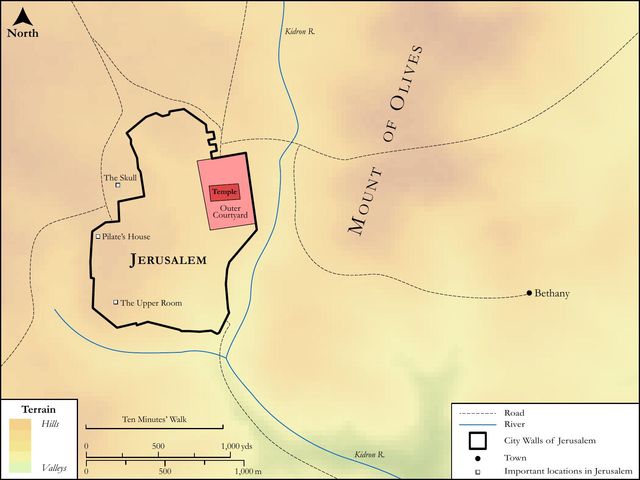
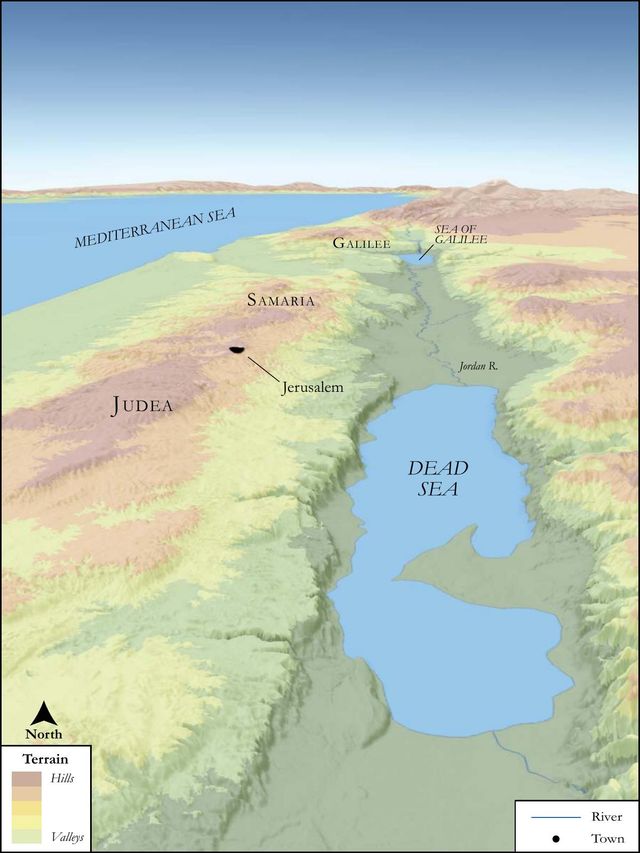
See on the biblical-era map

Study this verse
Public-domain commentary
Matthew Henry
From his Commentary on the Whole Bible. Henry comments on passages, not single verses — this entry covers Mark 1:9–13. His three-level outline is real structure in the source text, so it is rendered as structure.
We have here a brief account of Christ's baptism and temptation, which were largely related Mt. 3 and 4.
I.His baptism, which was his first public appearance, after he had long lived obscurely in Nazareth.
O how much hidden worth is there, which in this world is either lost in the dust of contempt and cannot be known, or wrapped up in the veil of humility and will not be known! But sooner or later it shall be known, as Christ's was.
1.See how humbly he owned God, by coming to be baptized of John; and thus it became him to fulfil all righteousness. Thus he took upon him the likeness of sinful flesh, that, though he was perfectly pure and unspotted, yet he was washed as if he had been polluted; and thus for our sakes he sanctified himself, that we also might be sanctified, and be baptized with him, Joh 17:19.
2.See how honourably God owned him, when he submitted to John's baptism. Those who justify God, and they are said to do, who were baptized with the baptism of John, he will glorify, Luk 7:29, Luk 7:30.
(1.)He saw the heavens opened; thus he was owned to be the Lord from heaven, and had a glimpse of the glory and joy that were set before him, and secured to him, as the recompence of his undertaking. Matthew saith, The heavens were opened to him. Mark saith, He saw them opened. Many have the heavens opened to receive them, but they do not see it; Christ had not only a clear foresight of his sufferings, but of his glory too.
(2.)He saw the Spirit like a dove descending upon him. Note, Then we may see heaven opened to us, when we perceive the Spirit descending and working upon us. God's good work in us is the surest evidence of his good will towards us, and his preparations for us. Justin Martyr says, that when Christ was baptized, a fire was kindled in Jordan: and it is an ancient tradition, that a great light shone round the place; for the Spirit brings both light and heat.
(3.)He heard a voice which was intended for his encouragement to proceed in his undertaking, and therefore it is here expressed as directed to him, Thou art my beloved Son. God lets him know, [1.] That he loved him never the less for that low and mean estate to which he had now humbled himself; "Though thus emptied and made of no reputation, yet he is my beloved Son still." [2.] That he loved him much the more for that glorious and kind undertaking in which he had now engaged himself. God is well pleased in him, as referee of all matters in controversy between him and man; and so well pleased in him, as to be well pleased with us in him.
II.His temptation.
The good Spirit that descended upon him, led him into the wilderness, Mar 1:12. Paul mentions it as a proof that he had his doctrine from God, and not from man - that, as soon as he was called, he went not to Jerusalem, but went into Arabia, Gal 1:17. Retirement from the world is an opportunity of more free converse with God, and therefore must sometimes be chosen, for a while, even by those that are called to the greatest business. Mark observes this circumstance of his being in the wilderness - that he was with the wild beasts. It was an instance of his Father's care of him, that he was preserved from being torn in pieces by the wild beasts, which encouraged him the more that his Father would provide for him when he was hungry. Special protections are earnests of seasonable supplies. It was likewise an intimation to him of the inhumanity of the men of that generation, whom he was to live among - no better than wild beasts in the wilderness, nay abundantly worse. In that wilderness,
1.The evil spirits were busy with him; he was tempted of Satan; not by any inward injections (the prince of this world had nothing in him to fasten upon), but by outward solicitations. Solicitude often gives advantages to the tempter, therefore two are better than one. Christ himself was tempted, not only to teach us, that it is no sin to be tempted, but to direct us whither to go for succour when we are tempted, even to him that suffered, being tempted; that he might experimentally sympathize with us when we are tempted.
2.The good spirits were busy about him; the angels ministered to him, supplied him with what he needed, and dutifully attended him. Note, The ministration of the good angels about us, is matter of great comfort in reference to the malicious designs of the evil angels against us; but much more doth it befriend us, to have the indwelling of the spirit in our hearts, which they that have, are so born of God, that, as far as they are so, the evil one toucheth them not, much less shall be triumph over them.
Historical interpretation
Five Centuries of Reception
13 surviving comments on this verse. Each one is dated, so this reads as a timeline rather than a list.
Select a marker to jump to its quote. Markers stagger vertically where authors wrote within a few decades of each other.
Mark the Evangelist, like a hart, longing after the fountains of water, leaps forward over places, smooth and steep; and, as a bee laden with honey, he sips the tops of the flowers. Wherefore he hath shown us in his narrative Jesus coming from Nazareth, saying, And it came to pass in those days, &c.
But this is the anointing of Christ according to the flesh, namely, the Holy Ghost, of which anointing it is said, God, even thy God, hath anointed thee with the oil of gladness above thy fellows. (Ps. 45:8)
Again, the Holy Ghost came down in the shape of a dove, because in the Canticles it is sung of the Church: (Cant. passim.) My bride, my love, my beloved, my dove. Bride in the Patriarchs, love in the Prophets, near of kin in Joseph and Mary, beloved in John the Baptist, dove in Christ and His Apostles: to whom it is said, Be ye wise as serpents, and harmless as doves. (Mat. 10:16)
Morally also it may be interpreted; we also, drawn aside from the fleeting world by the smell and purity of flowers, run with the young maidens after the bridegroom, (v. Cant. 1:2. 3.) and are washed in the sacrament of baptism, from the two fountains of the love of God, and of our neighbour, by the grace of remission, and mounting up by hope gaze upon heavenly mysteries with the eyes of a clean heart. Then we receive in a contrite and lowly spirit, with simplicity of heart, the Holy Spirit, who comes down to the meek, and abides in us, by a never-failing charity. And the voice of the Lord from heaven is directed to us the beloved of God; Blessed are the peacemakers, for they shall be called the sons of God; (Matt. 5:9) and then the Father, with the Son and the Holy Spirit, is well-pleased with us, when we are made one spirit with God.
For this reason did the Father send down the Holy Spirit from heaven upon the One who was baptized.… For what reason? That the faithfulness of the Father’s voice might be made known.… Listen to the Father’s voice: “This is my beloved Son, in whom I am well pleased.” This is he who is named the son of Joseph, who according to the divine essence is my only begotten. “This is my beloved Son,” yes, none other than the One who himself becomes hungry, yet feeds countless numbers. He is my Son who himself becomes weary, yet gives rest to the weary. He has no place to lay his head, yet bears up all things in his hand. He suffers, yet heals sufferings. He is beaten, yet confers liberty upon the world. He is pierced in his side, yet repairs the side of Adam.
In the Jordan the Trinity was manifested to humanity. The Father bore witness, the Son received witness, and the Holy Spirit gave confirmation.
This is spoken to him by God, with whom all time is today. For there is no evening with God, as I see it, and there is no morning—nothing but time that stretches out, along with his unbeginning and unseen life. The day is today with him in which the Son was begotten. Thus the beginning of his birth is not to be found, as neither is the day of it.
Today the Source of all the graces of baptism comes himself to be baptized in the river Jordan, there to make himself known to the world. Seeing him approach, John stretches out his hand to hold him back, protesting: Lord, by your own baptism you sanctify all others; yours is the true baptism, the source of perfect holiness. How can you wish to submit to mine? But the Lord replies, I wish it to be so. Come and baptize me. Do as I wish, for surely you cannot refuse me. Why do you hesitate, why are you so afraid? Do you not realize that the baptism I ask for is mine by every right? By my baptism the waters will be sanctified, receiving from me fire and the Holy Spirit.… See the hosts of heaven hushed and still, as the all-holy Bridegroom goes down into the Jordan. No sooner is he baptized than he comes up from the waters, his splendor shining forth over the earth. The gates of heaven are opened, and the Father’s voice is heard: “This is my beloved Son in whom I am well pleased.” All who are present stand in awe as they watch the Spirit descend to bear witness to him. O come all you peoples, worship him! Praise to you, Lord, for your glorious epiphany which brings joy to us all! The whole world has become radiant with the light of your manifestation.
These words are not to be understood, when we speak of God, as when we speak of bodies. The generation of the Son is incomprehensible, the Father begets without changing his nature. Yet this begottenness is of himself. In ages inconceivably remote the true God has begotten one who is truly God.
Again, the Holy Spirit camedown in the shape of a dove, because in the Canticles it is sung of the Church: "My bride, my love, my beloved, my dove. ”Bride” in the Patriarchs, “love” in the Prophets, “near of kin” in Joseph and Mary, “beloved” in John the Baptist, "dove” in Christ and His Apostles: to whom it is said, “Be ye wise as serpents, and harmless as doves.” .
Morally also it may be interpreted; we also, drawn aside from the fleeting world by the smell and purity of flowers, run with the young maidens after the bridegroom, and are washed in the sacrament of baptism, from the two fountains of the love of God, and of our neighbour, by the grace of remission, and mounting up by hope gaze upon heavenly mysteries with the eyes of a clean heart. Then we receive in a contrite and lowly spirit, with simplicity of heart, the Holy Spirit, who comes down to the meek, and abides in us, by the never-failing charity. And the voice of the Lord from heaven is directed to us the beloved of God; “Blessed are the peacemakers, forthey shall be called the sons of God;” and then the Father, with the Son and the Holy Spirit, is well-pleased with us, when we are made one spirit with God.
In the Scripture many details are mentioned distinguishably of each of the triune Persons individually, such as cannot be said of them jointly, even though they are inseparably together, as when they are made manifest by corporeal sounds. So in certain passages of Scripture and through certain created beings they are shown separately and successively, as the Father in the voice which is heard: “Thou art my Son,” and the Son in the human nature which he took from the Virgin, and the Holy Spirit in the physical appearance of a dove. These are mentioned distinguishably, it is true, but they do not prove that the Three are separated. To explicate this, we take as an example the unity of our memory, our understanding, our will. Although we list these distinguishably, individually and in their various functions, there is nothing we do or say which proceeds from one of them without the other two. However, we are not to think that these three faculties are compared to the Trinity so as to resemble it at every point, for a comparison is never given such importance in an argument that it exactly fits the thing to which it is compared. Besides, when can any likeness in a created being be applied to the Creator?
The Trinity appears very clearly: the Father in the voice, the Son in the man, the Spirit in the dove.
(de Cons. Ev. ii. 14) Wherefore Matthew relates that the voice said, This is my beloved Son; for he wished to show that the words, This is My Son, were in fact said, that thus the persons who heard it might know that He, and not another, was the Son of God. But, if you ask, which of these two sounded forth in that voice, take which you will, only remember, that the Evangelists, though not relating the same form of speaking, relate the same meaning. And that God delighted Himself in His Son, we are reminded in these words, In thee I am well pleased.
Whichever of the Evangelists may have preserved for us the words as they were literally uttered by the heavenly voice, the others have varied the terms only with the object of setting forth the same sense more familiarly, so that what is thus given by all of them might be understood as if the expression were: In You I have set my good pleasure; that is to say, by You I am doing what is my pleasure.
(Vict. Ant. e Cat. in Marc.) Forasmuch as He was ordaining a new baptism, He came to the baptism of John, which, in respect of His own baptism, was incomplete, but different from the Jewish baptism, as being between both. He did this that He might show, by the nature of His baptism, that He was not baptized for the remission of sins, nor as wanting the reception of the Holy Ghost: for the baptism of John was destitute of both these. But He was baptized that He might be made known to all, that they might believe on Him and fulfil all righteousness, which is keeping of the commandments: for it had been commanded to men that they should submit to the Prophet's baptism.
(Vict. Ant. e Cat. in Marc.) Or else, that from heaven sanctification might be given to men, and earthly things be joined to heavenly. But the Holy Spirit is said to have descended upon Him, not as if He then first came to Him, for He never had left Him; but that He might show forth the Christ, Who was preached by John, and point Him out to all, as it were by the finger of faith.
(in Marc. i. 4) He was baptized, that by being baptized Himself He might show His approval of John's baptisme, and that, by sanctifying the waters of Jordan through the descent of the dove, He might show the coming of the Holy Ghost in the laver of believers; whence there follows, And straightway coming up out of the water, he saw the heavens opened, and the Holy Spirit like a dove descending, and resting upon him. But the heavens are opened, not by the unclosing of the elements, but to the eyes of the spirit, to which Ezekiel in the beginning of his book relates that they were opened; (Ezek. 1.) or this His seeing the heavens opened after baptism was done for our sakes, to whom the door of the kingdom of heaven is opened by the laver of regeneration.
(ubi sup.) This event also, in which the Holy Ghost was seen to come down upon baptism, was a sign of spiritual grace to be given to us in baptism.
(ubi sup.) Well indeed in the shape of a dove did the Holy Ghost come down, for it is an animal of great simplicity, and far removed from the malice of gall, that in a figure He might show us that He looks out for simple hearts, and deigns not to dwell in the minds of the wicked.
(ubi sup.) Now the Dove sat on the head of Jesus, lest any one should think that the voice of the Father was addressed to John and not to Christ. And well did he add, abiding on Him; for this is peculiar to Christ, that the Holy Ghost once filling Him should never leave Him. For sometimes to His faithful disciples the grace of the Spirit is conferred for signs of virtue, and for the working of miracles, sometimes it is taken away; though for the working of piety and righteousness, for the preservation of love to God and to one's neighbour, the grace of the Spirit is never absent. But the voice of the Father showed, that He Himself, who came to John to be baptized with the others, was the very Son of God, willing to baptize with the Holy Spirit, whence there follows, And there came a voice from heaven, Thou art my beloved Son, in thee I am well pleased. Not that this informed the Son Himself of a thing of which He was ignorant, but it shows to us what we ought to believe.
(ubi sup.) The same voice has taught us, that we also, by the water of cleansing, and by the Spirit of sanctification, may be made the sons of God. The mystery of the Trinity also is shown forth in the baptism; the Son is baptized, the Spirit comes down in the shape of a dove, the voice of the Father bearing witness to the Son is heard.
Continue studying Mark 1:11 across the web’s major study libraries — every link below opens this exact verse, chapter, or book on the destination site.
Read & Compare
 BibleGatewayThis verse in more than 200 translations and 70 languages.
 Bible.comThe YouVersion reader — hundreds of translations, reading plans, and highlights.
 ESV.orgCrossway's official English Standard Version reader.
 NET BibleThe NET translation with 60,000+ translators' notes on every rendering decision.
 STEP BibleTyndale House's free study tool — original text, vocabulary, and scholarly resources.
 BibliaLogos Bible Software's free web reader.
 USCCBThe New American Bible (Revised Edition) with the U.S. bishops' study notes.
Commentaries
 BibleHub CommentariesDozens of classic commentaries on this verse, gathered on one page.
 StudyLightMore than 100 commentary sets — the largest collection on the web.
 BibleRefPlain-English commentary on what this verse means, verse by verse.
 Enduring WordDavid Guzik's free commentary on this chapter, widely used by Bible teachers.
 Bible Study ToolsVerse commentary alongside Greek and Hebrew study aids.
Original Language & Research
- BibleHub InterlinearThe verse word by word — original language, transliteration, and English.
- BibleHub LexiconEvery word's original-language definition and Strong's entry.
 Blue Letter BibleDeep-study tools — Strong's numbers, concordance, and word studies.
 CNTR CollationThe earliest Greek manuscripts of this verse, collated letter by letter.
Sermons, Hymns & Audio


TrulyRandomVerse is not affiliated with these sites and doesn’t control their content. They’re linked because they’re genuinely useful.
Summary
Mark 1:11 captures the profound divine affirmation of Jesus Christ at His baptism, serving as a pivotal moment that publicly inaugurates His earthly ministry. A voice from heaven unequivocally declares Jesus as God's "beloved Son," expressing the Father's complete pleasure and approval, thereby establishing Jesus' unique identity and authority before He embarks on His mission of redemption.
Context
ShowHideLiterary Context
This verse immediately follows the dramatic account of Jesus' baptism by John the Baptist in the Jordan River. Mark 1:9 describes Jesus' arrival from Nazareth and His immersion, while Mark 1:10 vividly portrays the heavens being "torn open" (a powerful image suggesting divine intervention) and the Holy Spirit descending upon Jesus "like a dove." Mark 1:11 is the climactic auditory component of this divine revelation, providing the explicit interpretation of the visual phenomena. It sets the stage for Jesus' subsequent temptation in the wilderness (Mark 1:12-13) and the commencement of His public ministry of preaching and healing (Mark 1:14-15). The event is also paralleled in Matthew 3:17 and Luke 3:22, underscoring its foundational importance in the Synoptic Gospels.
Historical & Cultural Context
In ancient Jewish thought, a "voice from heaven" (Hebrew: bat kol) was recognized as a form of divine communication, especially after the cessation of prophecy. While not considered on par with prophetic inspiration, it was understood as a direct, albeit less common, manifestation of God's will or affirmation. The concept of "Son of God" carried multiple layers of meaning in the ancient world, ranging from a king chosen by God (as in Psalm 2:7) to a righteous individual, but in this context, coupled with the unique "beloved," it points to a singular, divine relationship. Baptism itself, as practiced by John, was a ritual of repentance and purification, signifying a new beginning and commitment to God. For Jesus, who was without sin, His baptism was not for repentance but for identification with humanity and as a public anointing for His messianic mission.
Key Themes
ShowHideThis verse is rich with theological themes that are foundational to the Gospel of Mark and Christian theology. The most prominent is the Divine Affirmation of Jesus' Sonship, where God the Father directly declares Jesus' unique identity, establishing His divine nature and special relationship. This is not merely an adoption but an acknowledgment of His inherent being. Closely related is God's Perfect Pleasure and Approval, signified by "in whom I am well pleased." This highlights God's complete delight in Jesus, not based on future actions but on His perfect character and willingness to fulfill the Father's will. This resonates with the Servant Songs of Isaiah, particularly Isaiah 42:1, which speaks of God's chosen servant "in whom my soul delights." Furthermore, the event serves as a Messianic Inauguration, publicly identifying Jesus as the long-awaited Messiah, endowed with divine authority for His redemptive mission. Finally, the scene implicitly reveals the Trinitarian Presence: God the Father (the voice), God the Son (Jesus), and God the Holy Spirit (the descending dove), working in concert at this pivotal moment in salvation history, a theme seen throughout the New Testament.
Exposition and Analysis
ShowHideKey Word Analysis
ShowHideThis verb, G1096, signifies "to become," "come into being," or "happen." Its use here emphasizes the sudden, decisive, and real manifestation of the voice from heaven, indicating a divine event that truly occurred and inaugurated a new phase in salvation history. It's not a mere perception but an actual occurrence.
Derived from agapáō (to love), means "dearly, well beloved" or "dear." When applied to Jesus as "beloved Son," it conveys not just affection but a unique, singular, and incomparable relationship. In the Septuagint (Greek Old Testament), agapētós is used for Isaac, Abraham's "only son" (Genesis 22:2), implying uniqueness and preciousness, signifying Jesus' unparalleled status as God's unique Son.
Meaning "to think well of," "approve," or "to be pleased with." This word expresses God the Father's profound and complete satisfaction with Jesus. It's an active, deliberate approval, indicating that Jesus perfectly embodies God's will and character. This divine pleasure is foundational to Jesus' identity and mission, affirming His inherent righteousness and His readiness to undertake His redemptive work.
Verse Breakdown
ShowHide"And there came a voice from heaven"
This phrase signals a direct, audible, and supernatural communication from God. The "voice from heaven" (bat kol) was a recognized form of divine revelation in Jewish tradition, signifying a moment of profound divine intervention and communication. Its sudden appearance underscores the momentous nature of Jesus' baptism.
"Thou art my beloved Son"
This is the core declaration of Jesus' identity. "Thou art" is a direct, personal address, emphasizing Jesus' unique and intimate relationship with God. The term "my beloved Son" unequivocally establishes Jesus' divine Sonship, not merely as a human figure or prophet, but as one uniquely begotten of God, sharing His nature and essence. This echoes prophetic declarations like Psalm 2:7 and Isaiah 42:1.
"in whom I am well pleased."
This clause expresses God the Father's complete and utter delight in Jesus. It signifies divine approval, satisfaction, and endorsement. This pleasure is not conditional on future actions but is rooted in Jesus' inherent being and His perfect obedience to the Father's will, even before His public ministry began. It confirms Jesus' qualification for His messianic role and underscores the Father's perfect love for the Son.
Literary Devices
ShowHideMark 1:11 employs several powerful literary devices. Theophany is central, as God directly manifests His presence through an audible voice, a common biblical motif for divine revelation. This auditory manifestation complements the visual Symbolism of the descending dove, which represents the Holy Spirit's anointing. The entire scene functions as a divine Proclamation, publicly declaring Jesus' identity and mission. There is also significant Allusion to Old Testament texts, particularly Psalm 2:7 ("Thou art my Son") and Isaiah 42:1 ("in whom my soul delights"), which identify the Messiah as God's chosen Servant and Son. This intertextual connection enriches the meaning, presenting Jesus as the fulfillment of ancient prophecies. The brevity and directness of the declaration also contribute to its Impact, conveying authority and finality.
Theological and Thematic Connections
ShowHideMark 1:11 is a theological cornerstone, profoundly shaping our understanding of Jesus' identity and mission. It emphatically declares Jesus' divine Sonship, establishing His unique relationship with God the Father and affirming His inherent divinity. This declaration is not merely a title but an affirmation of His very nature, setting Him apart as the one through whom God's redemptive plan will unfold. The Father's "well pleased" statement underscores Jesus' perfect obedience and sinlessness, even before His public ministry, laying the groundwork for His sacrificial work. This divine approval validates His authority and the truth of His subsequent teachings and actions. The scene also presents an implicit Trinitarian revelation, with the Father speaking, the Son being affirmed, and the Spirit descending, demonstrating the unified work of the Godhead in salvation history.
Reflection and Application
ShowHideThe divine declaration at Jesus' baptism in Mark 1:11 offers profound insights for our own lives and faith. Hearing God's voice affirm Jesus as "my beloved Son, in whom I am well pleased" reminds us of the secure and unshakeable identity of Christ. For believers, this serves as the bedrock of our trust in Him: if God Himself is perfectly pleased with Jesus, then we can fully rely on His teachings, His sacrifice, and His authority. Furthermore, while we are not the "beloved Son" in the same unique, eternal sense as Jesus, through faith in Him, we are adopted into God's family (Ephesians 1:5). This verse encourages us to live in a way that seeks God's pleasure, not for salvation, but out of gratitude and love for the One who has made us His own. Our identity in Christ means we too are "beloved" by God, and He delights in our walk of faith and obedience. This truth can bring immense comfort and confidence, knowing that our ultimate worth and acceptance come from God's unmerited favor, just as Jesus' identity was affirmed by the Father.
Questions for Reflection
ShowHideFAQ
ShowHideWhy was a voice from heaven necessary if Jesus was already God's Son?
ShowHideThe voice from heaven served multiple crucial purposes. First, it was a public, audible declaration of Jesus' unique divine Sonship, not just for Jesus Himself, but for John the Baptist and any witnesses present. This public affirmation was essential for inaugurating Jesus' ministry and establishing His authority. Second, it underscored the divine approval and pleasure in Jesus, confirming His identity as the Messiah and the chosen Servant of the Lord, fulfilling Old Testament prophecies (e.g., Isaiah 42:1). Third, it was a Trinitarian event, explicitly revealing the Father's voice, the Son's presence, and the Spirit's descent, demonstrating the unified work of the Godhead in salvation history. It was less about informing Jesus of His identity (which He already knew) and more about revealing it to the world.
Does "beloved Son" mean Jesus was adopted by God at this moment?
ShowHideNo, "beloved Son" in Mark 1:11 does not imply that Jesus was adopted by God at His baptism. Christian theology affirms Jesus' eternal Sonship, meaning He has always been and always will be the Son of God. The Greek word agapētós (beloved) often carries the connotation of "unique" or "only," as seen in the Septuagint's use for Isaac, Abraham's "only beloved son" (Genesis 22:2). Therefore, the declaration at Jesus' baptism is an affirmation and public manifestation of His pre-existent, unique divine Sonship, not the initiation of it. It marks His anointing and commissioning for public ministry, not a change in His ontological status.
Christ-Centered Fulfillment
ShowHideMark 1:11 stands as a foundational Christ-centered declaration, revealing the very essence of Jesus' identity and mission. The Father's voice, "Thou art my beloved Son, in whom I am well pleased," directly connects Jesus to the Old Testament prophecies of the Messiah and the Suffering Servant (Isaiah 42:1). This divine affirmation at His baptism sets the stage for His entire redemptive work. Jesus, the perfectly obedient Son, enters into humanity's condition through baptism, identifying with sinners, yet remaining sinless. This pleasure of the Father is a profound endorsement of Jesus' perfect life, His willingness to fulfill all righteousness (Matthew 3:15), and His ultimate sacrifice. It foreshadows the ultimate fulfillment of God's pleasure in the Son's atoning work on the cross, where He bore the sin of the world (John 1:29). Because the Father was "well pleased" with His Son, believers can now find their own acceptance and pleasure in God through Christ, being adopted as sons and daughters and becoming "beloved" in Him (Ephesians 1:6). The voice from heaven at Jesus' baptism is a divine seal of approval on the one who would perfectly accomplish God's will, bringing salvation and reconciliation to all who believe.