


Isaiah 42:1
Bible text: King James Version (1769 Blayney text) · Public domain
Bible text: Berean Standard Bible · Public domain
Bible text: American Standard Version (1901) · Public domain
Bible text: World English Bible, Messianic edition · Public domain
Bible text: Geneva Bible (1599) · Public domain
Bible text: Young's Literal Translation · Public domain
- הֵןhenhere!H2005PrtParticle Interjection
- עַבְדִּי'av·Dimy servantH5650N-msc ¦ 1csNoun Singular Masculine Constructעַבְדִּservantיmy
- אֶתְמָךְ'et·mokh[whom] I supportH8551V-Qal-Imperf-1csVerb Qal Imperfect 1st Singular common gender
- בּוֹbo<in> himPrep-b ¦ 3msSuffix Personal 3rd Singular Masculineבּ<in>וֹhim
- בְּחִירִיbe·chi·Rimy chosen oneH972Adj-msc ¦ 1csAdjective Singular Masculine Constructבְּחִירִchosen oneיmy
- רָצְתָהra·tze·Tah[whom] it is pleased withH7521V-Qal-Perf-3fsVerb Qal Perfect 3rd Singular Feminine
- נַפְשִׁיnaf·Shimy selfH5315N-fsc ¦ 1csNoun Singular Feminine Constructנַפְשִׁselfיmy
- נָתַתִּיna·Ta·tiI have putH5414V-Qal-Perf-1csVerb Qal Perfect 1st Singular common gender
- רוּחִיru·Chimy spiritH7307N-csc ¦ 1fsNoun Singular common gender Constructרוּחִspiritיmy
- עָלָיו'a·Lavon himH5921Prep ¦ 3msPrepositionעָלָיonוhim
- מִשְׁפָּטmish·PatjusticeH4941N-msNoun Singular Masculine Absolute
- לַגּוֹיִםla·go·Yimto the nationsH1471Prep-l ¦ N-mpNoun Plural Masculine Absoluteלַto theגּוֹיִםnations
- יוֹצִיאyo·Tzi'he will bring forthH3318V-Hiphil-Imperf-3msVerb Hiphil Imperfect 3rd Singular Masculine
English is a literal word-by-word gloss of the Hebrew, not the KJV's wording. Why?
This is the original text the KJV's translators worked from — each Hebrew word with its own literal English meaning in this verse, prepared by scholars at Tyndale House, Cambridge. The KJV translates whole sentences, not word by word, so its wording differs: one Hebrew word can become several English words, and the KJV may choose “the LORD” where the gloss reads “Yahweh”. Both are faithful — they answer different questions. For the KJV's own rendering, switch to the KJV text.
Details
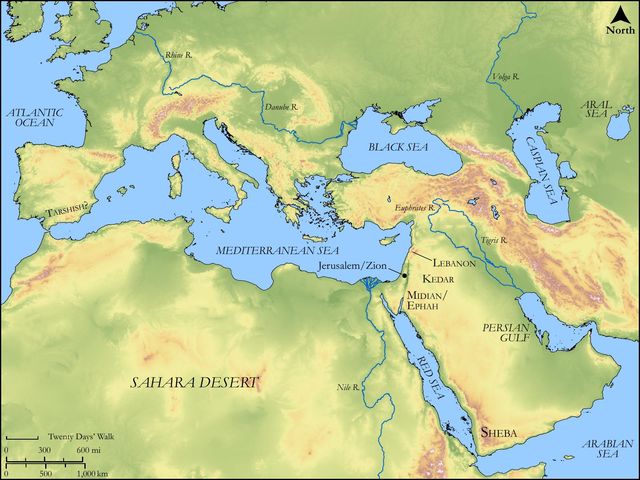
See on the biblical-era map
Study this verse
Public-domain commentary
Matthew Henry
From his Commentary on the Whole Bible. Henry comments on passages, not single verses — this entry covers Isaiah 42:1–4. His two-level outline is real structure in the source text, so it is rendered as structure.
We are sure that these verses are to be understood of Christ, for the evangelist tells us expressly that in him this prophecy was fulfilled, Mat 12:17-21. Behold with an eye of faith, behold and observe, behold and admire, my servant, whom I uphold. Let the Old Testament saints behold and remember him. Now what must we behold and consider concerning him?
I.The Father's concern for him and relation to him, the confidence he put and the complacency he took in him.
This put an honour upon him, and made him remarkable, above any other circumstance, Isa 42:1.
1.God owns him as one employed for him: He is my servant. Though he was a Son, yet, as a Mediator, he took upon him the form of a servant, learned obedience to the will of God and practised it, and laid out himself to advance the interests of God's kingdom, and so he was God's servant.
2.As one chosen by him: He is my elect. He did not thrust himself into the service, but was called of God, and pitched upon as the fittest person for it. Infinite Wisdom made the choice and then avowed it.
3.As one he put a confidence in: He is my servant on whom I lean; so some read it. The Father put a confidence in him that he would go through with his undertaking, and, in that confidence, brought many sons to glory. It was a great trust which the Father reposed in the Son, but he knew him to be par negotio - equal to it, both able and faithful.
4.As one he took care of: He is my servant whom I uphold; so we read it. The Father bore him up, and bore him out, in his upholding him; he stood by him and strengthened him.
5.As one whom he took an entire complacency in: My elect, in whom my soul delights. His delight was in him from eternity, when he was by him as one brought up with him, Pro 8:30. He had a particular satisfaction in his undertaking: he declared himself well pleased in him (Mat 3:17; Mat 17:5), and therefore loved him, because he laid down his life for the sheep. Let our souls delight in Christ, rely on him, and rejoice in him; and thus let us be united to him, and then, for his sake, the Father will be well pleased with us.
II.The qualification of him for his office:
I have put my Spirit upon him, to enable him to go through his undertaking, Isa 61:1. The Spirit did not only come, but rest, upon him (Isa 11:2), not by measure, as on others of God's servants, but without measure. Those whom God employs as his servants; as he will uphold them and be well pleased with them, so he will put his Spirit upon them.
III.The work to which he is appointed; it is to bring forth judgment to the Gentiles, that is, in infinite wisdom, holiness, and equity, to set up a religion in the world under the bonds of which the Gentiles should come and the blessings of which they should enjoy. The judgments of the Lord, which had been hidden from the Gentiles (Psa 147:20), he came to bring forth to the Gentiles, for he was to be a light to lighten them.
IV.The mildness and tenderness with which he should pursue this undertaking, Isa 42:2, Isa 42:3. He shall carry it on,
1.In silence, and without noise: He shall not strive nor cry. It shall not be proclaimed, Lo, here, is Christ or Lo, he is there; as when great princes ride in progress or make a public entry. He shall have no trumpet sounded before him, nor any noisy retinue to follow him. The opposition he meets with he shall not strive against, but patiently endure the contradiction of sinners against himself. His kingdom is spiritual, and therefore its weapons are not carnal, nor is its appearance pompous; it comes not with observation.
2.Gently, and without rigour. Those that are wicked he will be patient with; when he has begun to crush them, so that they are as bruised reeds, he will give them space to repent and not immediately break them; though they are very offensive, as smoking flax (Isa 65:5), yet he will bear with them, as he did with Jerusalem. Those that are weak he will be tender of; those that have but a little life, a little heat, that are weak as a reed, oppressed with doubts and fears, as a bruised reed, that are as smoking flax, as the wick of a candle newly lighted, which is ready to go out again, he will not despise them, will not plead against them with his great power, nor lay upon them more work or more suffering than they can bear, which would break and quench them, but will graciously consider their frame. More is implied than is expressed. He will not break the bruised reed, but will strengthen it, that it may become a cedar in the courts of our God. He will not quench the smoking flax, but blow it up into a flame. Note, Jesus Christ is very tender toward those that have true grace, though they are but weak in it, and accepts the willingness of the spirit, pardoning and passing by the weakness of the flesh.
V.The courage and constancy with which he should persevere in this undertaking, so as to carry his point at last (Isa 42:4):
He shall not fail nor be discouraged. Though he meets with hard service and much opposition, and foresees how ungrateful the world will be, yet he goes on with his part of the work, till he is able to say, Is is finished; and he enables his apostles and minsters to go on with theirs too, and not to fail nor be discouraged, till they also have finished their testimony. And thus he accomplishes what he undertook.
1.He brings forth judgment unto truth. By a long course of miracles, and his resurrection at last, he shall fully evince the truth of his doctrine and the divine origin and authority of that holy religion which he came to establish.
2.He sets judgment in the earth. He erects his government in the world, a church for himself among men, reforms the world, and by the power of his gospel and grace fixes such principles in the minds of men as tend to make them wise and just.
3.The isles of the Gentiles wait for his law, wait for his gospel, that is, bid it welcome as if it had been a thing they had long waited for. They shall become his disciples, shall sit at his feet, and be ready to receive the law from his mouth. What wilt thou have us to do?
Historical interpretation
Five Centuries of Reception
9 surviving comments on this verse. Each one is dated, so this reads as a timeline rather than a list.
Select a marker to jump to its quote. Markers stagger vertically where authors wrote within a few decades of each other.
And when he was departed thence, he went into their synagogue: And, behold, there was a man which had his hand withered. And they asked him, saying, Is it lawful to heal on the sabbath days? that they might accuse him. And he said unto them, What man shall there be among you, that shall have one sheep, and if it fall into a pit on the sabbath day, will he not lay hold on it, and lift it out? How much then is a man better than a sheep? Wherefore it is lawful to do well on the sabbath days. Then saith he to the man, Stretch forth thine hand. And he stretched it forth; and it was restored whole, like as the other. Then the Pharisees went out, and held a council against him, how they might destroy him. But when Jesus knew it, he withdrew himself from thence: and great multitudes followed him, and he healed them all; And charged them that they should not make him known: That it might be fulfilled which was spoken by Esaias the prophet, saying, Behold my servant, whom I have chosen; my beloved, in whom my soul is well pleased: I will put my spirit upon him, and he shall show judgment to the Gentiles. He shall not strive, nor cry; neither shall any man hear his voice in the streets. A bruised reed shall he not break, and smoking flax shall he not quench, till he send forth judgment unto victory. And in his name shall the Gentiles trust. [Isaiah 42:1-4]
As the Word shows his compassion and his denial of all preferential treatment among all the saints, he enlightens them and adapts them to that which is advantageous for them. He is like a skillful physician, understanding the weakness of each one. The ignorant he loves to teach. The erring he turns again to his own true way. By those who live by faith he is easily found. To those of pure eye and holy heart, who desire to knock at the door, he opens immediately. For he casts away none of his servants as unworthy of the divine mysteries. He does not esteem the rich person more highly than the poor, nor does he despise the poor person for his poverty. He does not disdain the barbarian, nor does he set the eunuch aside as no man. He does not hate the female on account of the woman’s act of disobedience in the beginning, nor does he reject the male on account of the man’s transgression. But he seeks all and desires to save all, wishing to make all the children of God and calling all the saints to one perfect human person. For there is one Son (or Servant) of God, by whom we too, receiving the regeneration through the Holy Spirit, desiring to come all into one perfect and heavenly human person.
Although this very great person is not the one who was in the mind of those hearing the prophecy the first time, he is not here called “Jacob” or “Israel” or “the seed of Abraham,” so clearly the Christ of God is meant here, just as the Evangelist paid witness: “I have set my Spirit on him, and he will execute judgment on the nations.” And after many things have taken place in the nations, which were not made fit to be counted in the apostolic chorus, the nations will hope in him. But in Isaiah’s prophecy the names of Jacob and Israel are missing. Who else could this be, the one called servant of God and his chosen one? Therefore it continues, “My soul delights in him.” For only he is the chosen one of God, and the so-called soul of God was delighting in him. In a manner similar to referring to the feet, hands, fingers and eyes of God, Scriptures make use of the term “soul” in relation to God.… He is “chosen,” not in the same way as the apostles, since it is to him alone that it is said, “whom my soul esteems,” but also “the Spirit of God was dwelling in him alone.” “For in him the fullness of the deity dwelled bodily.” For the Spirit is given to the one coming forth “from the root of Jesse,” the unique Word of God, whom the apostle revealed saying, “The Lord is the Spirit.” For he alone, pouring out the Spirit of inheritance, worked all things outwardly concerning the worldwide judgment on the nations, so that all would be prepared for the coming of God’s verdict.
It is possible, with the help of God, easily to distinguish the presence of the good and the bad; a vision of the holy ones is not agitated. “He shall not protest and cry out; none will hear his voice.” It occurs so quietly and gently that joy and gladness and confidence are at once born in the soul.… The soul’s thoughts remain untroubled and calm, so that, enlightened of itself, it contemplates those who appear. LIFE OF ST.
Next is the fact of his being called Servant and serving many well, and that it is a great thing for him to be called the Child of God. For in truth he was in servitude to flesh and to birth and to the conditions of our life with a view to our liberation, and to that of all those whom he has saved, who were in bondage under sin. What greater destiny can befall humanity’s humble state than that it should be intermingled with God and by this intermingling should be deified, and that we should be so visited by the Dayspring from on high, that even that holy thing that should be born should be called the Son of the Highest, and that there should be bestowed on him a name that is above every name? And what else can this be than God?—and that every knee should bow to him that was made of no reputation for us, and that mingled the form of God with the form of a servant, and that “all the house of Israel should know that God has made him both Lord and Christ”? For all this was done by the action of the Begotten and by the good pleasure of him that begat him.
What does it mean that it is written in Matthew: 'A bruised reed shall he not break, and smoking flax shall he not quench' (Matthew 12:20). For the explanation of this passage, the whole testimony that Matthew takes from the Prophet Isaiah must be set forth, even the words of Isaiah (Isaiah 42): according to the Septuagint interpreters and the Hebrew itself, to which Theodotus, Aquila, and Symmachus agree. Thus of the four Evangelists, only Matthew relates: "And Jesus knowing it, retired from thence: and many followed him, and he healed them all. And he charged them that they should not make him known. That it might be fulfilled which was spoken by Isaias the prophet, saying: Behold my servant whom I have chosen, my beloved in whom my soul hath been well pleased. I will put my spirit upon him, and he shall shew judgment to the Gentiles." (Chapter 12, verses 15-18) He will not strive, nor cry out, nor will anyone hear his voice in the streets. A bruised reed he will not break, and smoking flax he will not extinguish, until he brings forth judgment unto victory. And in his name the Gentiles will hope" (Matthew 12:15 and following). For which in Isaiah, according to the Septuagint interpreters, it is thus written: "Jacob my servant, I will uplift him. My chosen one, my soul has received him. I have given my spirit upon him, he shall bring forth judgment to the Gentiles. He shall not cry, nor have respect to person, neither shall his voice be heard abroad. The bruised reed he shall not break: and smoking flax he shall not extinguish: but he shall bring forth judgment unto truth. He shall shine, and shall not be broken, until he set judgment in the earth: and the countries shall wait for his law." However, we translate it from Hebrew like this, "Behold my servant, I will uphold him; my chosen, my soul has delighted in him. I have given my spirit upon him: he shall bring forth judgment to the Gentiles. "He will not cry out, nor raise his voice, nor make it heard in the street. A bruised reed he will not break, and a smoldering wick he will not snuff out. In truth he will bring forth justice. He will not grow faint or be discouraged till he has established justice on the earth; and the islands will put their hope in his law." This shows that the Gospel writer Matthew, not bound by authority of the old interpretation, dismissed the Hebrew truth and brought forth to the nations, educated in the Law of the Lord, the things he had read in Hebrew as if he were a Hebrew among Hebrews. For if it is to be taken thus, as the Seventy Interpreters have given it: Jacob is my servant, I will receive him; Israel is my chosen, my soul has received him, how do we understand that it has been fulfilled in Jesus, what has been written concerning Jacob and Israel? We read that Blessed Matthew did this not only in this testimony, but also in another place: Out of Egypt I called my son (Hosea 11:2): for which the Seventy translated: Out of Egypt I called his sons. Certainly, if we do not follow the Hebrew truth, it is evident that it does not pertain to the Lord and Savior. For it follows: but they sacrificed to Baalim. And that which is less in the assumed testimony in the Gospel: it shall shine and not be shaken, until he shall place judgment upon the earth, seems to have happened by the error of the first writer who, reading the higher sentence to be finished in the word judgment, thought that the final word of the lower sentence was judgment, and he omitted a few words which were in the middle, that is, between judgment and judgment. And again, that which is read among the Hebrews: And in his law shall the islands hope, Matthew, interpreting the sense rather than the words, put for law and islands, a name and nations. And not only in the present place, but wherever the testimonies of the Evangelists and Apostles from the old Instrument have been brought forth, it should be observed more diligently: not that they followed words, but the sense: and where they differ from the Hebrew in the Septuagint, they expressed the Hebrew sense in their own words. Therefore, the Child of the almighty God, according to the dispensation of assumed flesh, which is sent to us, is called the Savior. To whom and in another place the Father says: It is great for you to be called my child, to gather the tribes of Jacob (Isai. 49.3). This is the vineyard of Sorec, which is interpreted as chosen. This is the beloved son, in whom the soul of God is pleased; not because God has a soul, but because every affection of God is shown in the soul. And it is not surprising if the soul is named in God, when all the members of the human body, according to the laws of tropology, and various intelligences, are said to have it. He also placed his spirit upon him: the Spirit of Wisdom and Understanding, the Spirit of Counsel and Strength, the Spirit of Knowledge and Piety, and the Spirit of the Fear of the Lord (Isaiah 11): He who descends upon him in the form of a dove, about whom John the Baptist narrates having heard from God the Father: "The One upon whom you see the Holy Spirit descending and remaining upon, He is" (John 1:33). And He will announce judgment to the Gentiles; concerning whom it is also written in the Psalms: "Give the king your justice, O God, and your righteousness to the son of a king" (Psalm 71:1). He Himself speaks about it in the Gospel: "For the Father judges no one, but has given all judgment to the Son" (John 5:22). He will not contend: like a lamb led to the slaughter: He will not argue in the hearing. Nor will he cry out, in accordance with what the Apostle Paul writes: Let all clamor, and anger, and bitterness be taken away from you (Ephesians 4:31). He will not cry out: because Israel did not do justice, but cry out. Nor will anyone hear his voice in the streets or outdoors. For all the glory of the daughter of the king is within (Psalm 44:14): And, Narrow, and cramped is the way that leads to life (Matthew 7:14). Therefore his voice is not heard in the streets, where wisdom confidently acts, not entering a broad and spacious way, but accusing and condemning. And so he spoke to those who were outside, not in his own voice, but in parables: 'The reed, he said, shaken does not break; or, as the Septuagint translated, the broken reed not to be crushed. The broken reed that was once vocal, and sang in praise of the Lord, is called Israel, who, because he stumbled on a corner stone and fell on it, was broken in it; therefore it is said of him: Rebuke, O Lord, the beasts of the reed (Ps. 67. 31): and in the volume of Jesus he is called the torrent of the cane, that is, of the reed; who has turbid waters, which Israel chose, despising the purest streams of the Jordan: and turning his mind back to Egypt, and desiring the marshy and swampy region, and pumpkins, and onions, and garlic, and cucumbers, and the pots of Egyptian flesh, is rightly called a broken reed by Isaiah: he who wants to lean on which, his hand will be pierced. For whoever, after the advent of the Lord and Savior and leaving behind the spirit of interpreting the Gospel, rests in the death of Jewish literature, all the works of that person are harmed. Even smoking linen will not extinguish a people gathered from the nations who, with the ardor of natural law extinguished, are wrapped in the bitter smoke, which is hurtful to the eyes, and enveloped in the darkness of errors. He who not only did not restrain and reduce to ashes, but on the contrary, from a small spark, and almost dying, raised the greatest fire; so that the whole world burned with the fire of the Lord and Savior, whom he came to send upon the earth, and in all desires to burn (Luke 12:49). According to the tropology, what we see in this place, we have briefly noted in the Commentaries of Matthew. But he who has not broken the bruised reed, and has not extinguished the smoking flax, has also brought judgment unto victory (Isai. 42:3), whose judgments are true, justified in themselves (Psalm 18), so that he may be justified in his words and may overcome in judgment (Psalm 50), and so that the light of his preaching may shine in the world, not be crushed by anyone, and may overcome all snares, until he establishes judgment on earth and that which is written may be fulfilled: 'Thy will be done on earth, as it is in heaven' (Matthew 6:10). And, in his name shall the Gentiles hope (Isaiah 11:10); or the islands shall hope in his law (Ibid. 42:4). For just as the islands are struck by the blast and rush of winds and frequently buffeted by storms, but they are not overturned, as an example of the Gospel house built on a sturdy foundation of rock (Matthew 7; and Luke 6), so the Churches, which hope in the law and in the name of the Lord and Savior, speak through Isaiah: I am a strong city, a city that cannot be taken (Isaiah 27:3, LXX).
(Chapter 42, Verses 1 onward) Behold my servant, I will uphold him: my chosen one, my soul is pleased with him. I have put my spirit upon him: he will bring justice to the nations. He will not cry out or raise his voice: his voice will not be heard in the streets. A bruised reed he will not break: a smoldering wick he will not put out: he will faithfully bring forth justice. He will not be sad or discouraged, until he establishes justice on earth: and the coastlands will wait for his law. LXX: Jacob my servant, I will take him: Israel my chosen, my soul has received him. I have put my spirit upon him: he will bring forth justice to the nations: he will not cry out, nor raise his voice, nor will his voice be heard in the streets. A bruised reed he will not break, and smoking flax he will not extinguish: he will bring forth justice in truth: he will shine and not be broken, until he establishes justice upon the earth: and the nations will hope in his name. Jacob and Israel are not mentioned in the current chapter, nor did Matthew the Evangelist include them, following Hebrew truth. We say this as a rebuke to those who despise us. This matter was discussed in more detail in the little Commentary on Matthew, and in the book we recently wrote to Algasia. And in the meantime, it should be noted that when the chorus of the Apostles is mentioned, both Jacob and Israel are called the seed of Abraham: to whom, as if to men and servants, it is subsequently said: Fear not, you worm Jacob, and you little one of Israel. But when it comes to Christ's prophecy, it is read without Jacob and Israel: Behold my servant, I will uphold him; my chosen, my soul is pleased with him. And in the following: I have given you as a testament to the race, as a light to the nations: to open the eyes of the blind, and to bring out prisoners from confinement, and those who dwell in darkness from the house of the prison. It is not surprising if he is called a servant, being made from a woman, and being made under the law (Galatians 4); who, although being in the form of God, he humbled himself, taking the form of a servant, and being found in human form (Philippians 2). In whom the soul of God was pleased, seeing in him all the virtues: indeed, seeing him as the power and wisdom of God. He said: 'I will send my Spirit upon him, who will come down in the form of a dove. He will bring judgment to the nations, which they did not know before. He will not cry out, for he will be gentle and meek. He will not show favoritism in judgment, nor will he raise his voice in the streets. According to Symmachus, he will not be deceived, understanding all the schemes of the devil. Or according to the Septuagint, he will not leave the people of the Jews, but will call them to repentance.' Nor will his voice be heard outside of Galilee and Judea, for he did not preach the Gospel among the other nations. And if we read that he was in the region of Tyre and Sidon (Matt. XV), or in the vicinity of Caesarea Philippi, which is now called Paneas, it should be understood that it is not written that he actually entered those cities. A bruised reed he will not break, and a smoldering wick he will not snuff out. For he will be merciful to all and will grant forgiveness to sinners, saying to the woman: Have confidence, daughter, your sins are forgiven (Luke VII, 48). And the smoking flax, or as the others have translated it, dim and gloomy, will not be extinguished: those who were near to being extinguished were saved by the mercy of the Lord (which we have discussed about the Jews and the nations in the aforementioned writings); but with truth He will judge all things; not fearing the Scribes and Pharisees, whom He boldly called hypocrites (Mat. VII, XV, XXII, XXIII throughout, and Luc. VI, XII): But what follows: It will shine, and will not be crushed, until He establishes judgment upon the Earth, the Evangelist Matthew did not include (Mat. XII): or perhaps between judgment and judgment, they were omitted due to an error by the writer. But it signifies that, rising from the dead, he enlightened all, and was not crushed by death, until he placed judgment upon the earth: of whom it is spoken in the Gospel: I have come into this world for judgment, that those who do not see may see, and those who see may become blind (John 9:39). Concerning which we have interpreted: He will not be sad, nor troubled; but will always maintain an equal countenance: which they falsely boast about Socrates the Philosopher, that he was never, more than usual, either sad or joyful. For which reason Aquila and Theodotius are interpreted: It will not hide, and it will not run, until it establishes judgment on earth. And the meaning is: no sadness will deter the face, nor will it hurry to punishment, who has reserved the truth of judgment for the last time. What follows: and the law of that island they will expect, the nations, clearly, put hope in its name: which in the Scriptures are called islands, because they are open to incursions of persecutors from every side. But let us understand his law, not the one given through Moses, but the Gospel: For from Zion a law shall go forth, and the word of the Lord from Jerusalem (see above, II). Concerning this law, Jeremiah also prophesies: Behold, the days are coming, says the Lord, and I will establish a new covenant, not like the covenant which I made with their fathers in the day that I took them by the hand to bring them out of the land of Egypt (Jeremiah 31:31, 32).
The passage reads, “Jacob, my son, I will uphold him; Israel, my elect, my soul has assumed him.” … It is true, indeed, that the Vulgate text has “my servant” in place of “Jacob” and “Israel,” but the Septuagint translators preferred to make the meaning more explicit, namely, that the prophecy concerns the “Highest” insofar as he became the “lowliest,” in the form of a servant. Hence they placed the name of that man from whose stock the “form of a servant” was assumed. It was to him that the Holy Spirit was given.
The goodness of the Deity has endless love for humanity and never ceased from benignly pouring out on us its providential gifts. … It made it possible for us to escape from the domain of the rebellious, and it did this not through overwhelming force, but, as Scripture mysteriously tells us, by an act of judgment accomplished in all righteousness. Beneficently God’s goodness wrought a complete change in our nature. It filled our shadowed and unshaped minds with a kindly, divine light and adorned them with loveliness suitable to their divinized state. It saved our nature from almost complete wreckage and delivered the dwelling place of our soul from the most accursed passion and from destructive defilement. Finally, it showed us a supramundane uplifting and an inspired way of life in shaping ourselves to it as fully as lay in our power. - "Ecclesiastical Hierarchy 3.3.11"
Continue studying Isaiah 42:1 across the web’s major study libraries — every link below opens this exact verse, chapter, or book on the destination site.
Read & Compare
 BibleGatewayThis verse in more than 200 translations and 70 languages.
 Bible.comThe YouVersion reader — hundreds of translations, reading plans, and highlights.
 ESV.orgCrossway's official English Standard Version reader.
 NET BibleThe NET translation with 60,000+ translators' notes on every rendering decision.
 STEP BibleTyndale House's free study tool — original text, vocabulary, and scholarly resources.
 BibliaLogos Bible Software's free web reader.
 USCCBThe New American Bible (Revised Edition) with the U.S. bishops' study notes.
Commentaries
 BibleHub CommentariesDozens of classic commentaries on this verse, gathered on one page.
 StudyLightMore than 100 commentary sets — the largest collection on the web.
 BibleRefPlain-English commentary on what this verse means, verse by verse.
 Enduring WordDavid Guzik's free commentary on this chapter, widely used by Bible teachers.
 Bible Study ToolsVerse commentary alongside Greek and Hebrew study aids.
Original Language & Research
- BibleHub InterlinearThe verse word by word — original language, transliteration, and English.
- BibleHub LexiconEvery word's original-language definition and Strong's entry.
 Blue Letter BibleDeep-study tools — Strong's numbers, concordance, and word studies.
 SefariaThe Hebrew text with Rashi and centuries of Jewish commentary.
Sermons, Hymns & Audio


TrulyRandomVerse is not affiliated with these sites and doesn’t control their content. They’re linked because they’re genuinely useful.
Summary
Isaiah 42:1 introduces the first of the pivotal "Servant Songs," unveiling a divinely chosen and uniquely empowered figure. This verse serves as a foundational description of the Servant's identity and mission, portraying him as one upheld by God, in whom God's soul delights, and upon whom the Spirit of God rests. His ultimate purpose is to extend God's righteous judgment and established order to the Gentile nations, signaling a universal scope for God's redemptive plan.
Context
ShowHideLiterary Context
Isaiah 42:1 marks the commencement of the first of four distinct "Servant Songs" (chapters 42, 49, 50, and 52:13-53:12) within the larger prophetic tapestry of the book of Isaiah. These profound passages collectively portray a mysterious yet central figure, the "Servant of the Lord," whose identity and mission are intricately woven into God's overarching redemptive purposes. This particular section emerges following prophecies detailing Israel's spiritual blindness and the impending judgment, particularly in the context of the Babylonian exile. It strategically shifts the narrative focus towards God's chosen instrument for restoration and the establishment of true justice. The Servant stands in stark contrast to the failures of Israel, who was also called God's servant (e.g., Israel as God's Servant), by presenting a figure of perfect obedience and unwavering commitment to God's will.
Historical & Cultural Context
The prophecies encapsulated in Isaiah, especially chapters 40-55, are widely understood to be addressed to the people of Judah during or immediately preceding the Babylonian exile, offering a beacon of hope and a vision of future deliverance and restoration from their captivity. In the ancient Near Eastern cultural landscape, the term "servant" (Hebrew: ʻebed) carried a broad spectrum of meanings, ranging from a literal slave to a trusted royal official or an agent meticulously carrying out a king's directives. The concept of "judgment" (Hebrew: mishpâṭ) in this prophetic context is far more expansive than mere condemnation; it encompasses the establishment of justice, righteousness, divine order, and the comprehensive implementation of God's righteous rule. The "Gentiles" (Hebrew: gôwy) refers to all the nations outside of Israel, profoundly highlighting God's universal concern and the expansive reach of His covenant promises, which were initiated with the call of Abraham to be a blessing to all the families of the earth.
Key Themes
ShowHideThis foundational verse powerfully introduces several pivotal theological and narrative themes that reverberate throughout the Servant Songs and the broader biblical narrative. Firstly, it emphatically underscores Divine Election and Affirmation, emphasizing that the Servant is not a self-appointed figure but one specifically chosen ("mine elect") and profoundly affirmed by God ("in whom my soul delighteth"). This highlights God's sovereign initiative. Secondly, it illuminates the theme of Empowerment by the Spirit, as God places His Spirit upon the Servant, signifying a divine anointing and equipping for the monumental task at hand. This theme is central to prophetic and messianic expectations, as seen in passages describing the Spirit's anointing on the Messiah (e.g., The Spirit of the Lord on the Messiah). Thirdly, the verse unequivocally reveals the Universal Scope of God's Justice and Salvation, as the Servant's mission extends beyond the confines of Israel to "bring forth judgment to the Gentiles," indicating that God's redemptive plan is for all humanity, not exclusively for one nation. This universal vision is further developed and expanded in subsequent Servant Songs, such as the Servant being a light to the nations.
Exposition and Analysis
ShowHideKey Word Analysis
ShowHideThis term denotes one who serves, ranging in ancient Near Eastern contexts from a literal slave to a high-ranking official or a trusted agent carrying out a king's will. In the context of Isaiah 42:1, it signifies a divinely chosen and obedient agent of God, uniquely commissioned for a profound divine purpose. The Servant's identity is intrinsically defined by his intimate relationship to and dedicated service for the Lord.
This term fundamentally refers to wind, breath, or a spiritual essence. Here, "my spirit" refers specifically to the Spirit of God, indicating a divine anointing and empowerment that transcends human capability. The Spirit's presence is unequivocally the source of the Servant's wisdom, strength, and inherent authority to fulfill his divinely appointed mission.
This word is exceptionally rich in its semantic range, encompassing a verdict, a sentence, a formal decree, and abstractly, the very essence of justice or righteousness. In this prophetic context, it refers not merely to condemnation but primarily to the establishment of God's righteous order, His just rule, and the bringing of salvation, truth, and moral rectitude into a world steeped in chaos and injustice.
Verse Breakdown
ShowHide"Behold my servant"
This opening phrase is a powerful imperative, serving as an urgent call to attention, signaling the imminent introduction of a figure of immense theological and prophetic significance. It immediately establishes a unique, possessive, and intimate relationship between God and this divinely appointed Servant.
"whom I uphold"
This crucial clause emphasizes God's active, continuous, and unwavering role in sustaining, supporting, and empowering the Servant. It speaks profoundly to divine providence and the supernatural strength meticulously provided to the Servant for his arduous and pivotal task.
"mine elect"
This phrase unequivocally highlights the Servant's divine selection and his uniquely privileged status. He is not a self-appointed figure but one meticulously chosen by God Himself, setting him apart for a specific, sacred, and predetermined purpose that aligns perfectly with God's will.
"in whom my soul delighteth"
This expresses God's profound pleasure, deep approval, and intense affection for the Servant. It signifies a perfect harmony and alignment between the Servant's character, actions, and God's perfect will, indicating a relationship of intimate communion, divine favor, and unreserved acceptance.
"I have put my spirit upon him"
This signifies a divine anointing and an extraordinary empowerment that is supernatural in origin. The Holy Spirit is the indispensable source of the Servant's wisdom, inherent strength, and the authoritative ability to carry out his mission, unequivocally marking him as divinely commissioned and equipped.
"he shall bring forth judgment to the Gentiles"
This declares the Servant's primary mission and its expansive, universal scope. "Judgment" here refers to the establishment of God's just and righteous order, His truth, and His saving rule. This mission is not confined to the nation of Israel but extends comprehensively to all nations, revealing God's global redemptive purpose for all humanity.
Literary Devices
ShowHideIsaiah 42:1 is profoundly rich in literary devices, which collectively enhance its prophetic power and theological depth. The opening word, "Behold," functions as a powerful exclamation or an imperative, immediately drawing the reader's attention to the profound revelation that follows and emphasizing the unparalleled significance of the Servant being introduced. The verse itself is a quintessential example of a Divine Monologue or Oracle, as God Himself is the direct speaker, lending ultimate authority, divine weight, and unquestionable truth to the description of His chosen one. There is a strong element of Emphasis achieved through the repetition of divine ownership and action ("my servant," "whom I uphold," "mine elect," "my soul delighteth," "my spirit"), which powerfully underscores God's intimate involvement with and profound affirmation of the Servant. The evocative phrase "my soul delighteth" employs Personification, attributing human-like emotion to God to convey the immense depth of His pleasure and affection. Furthermore, the entire verse serves as a powerful instance of Prophecy and Thematic Foreshadowing, meticulously setting the stage for the unfolding narrative of the Servant's mission, which will culminate in the establishment of God's just and righteous rule over all the earth.
Theological and Thematic Connections
ShowHideIsaiah 42:1 stands as a profound theological statement, revealing God's character as sovereign, just, and merciful, actively working through a chosen agent to accomplish His universal purposes. The concept of divine election is central, demonstrating that God initiates and empowers those He calls, not based on human merit but on His divine prerogative. The anointing by the Spirit highlights the absolute necessity of divine enablement for spiritual tasks, a principle consistently seen throughout biblical history in the commissioning of prophets, priests, and kings. Most significantly, the Servant's mission to the Gentiles underscores the expansive, inclusive nature of God's redemptive plan. From the foundational covenant with Abraham, where all nations would be blessed through his offspring, to the New Testament's Great Commission, God's desire for all humanity to know His justice and salvation is an unwavering and consistent theme. This verse asserts that God's righteous rule is not exclusive to one people but is destined to encompass the entire world, bringing order, truth, and salvation where there was once spiritual darkness and moral chaos.
Reflection and Application
ShowHideIsaiah 42:1 offers profound insights for personal reflection and practical application in the life of a believer. Understanding that God chooses, upholds, delights in, and empowers His Servant provides immense comfort, assurance, and a deep sense of security. It powerfully reminds us that our effectiveness in God's kingdom is not contingent upon our own limited strength, inherent talents, or perceived merit, but rather on His sovereign choice and the enabling, transformative power of His indwelling Spirit. Just as the Servant was meticulously equipped for a global mission of cosmic significance, believers today are called to actively participate in God's universal plan, bringing His truth, His justice, and His redemptive love to their unique spheres of influence, whether those are local communities or global mission fields. This verse challenges us to critically consider how we are allowing the Holy Spirit to work through us, to uphold God's righteous standards in our daily lives, and to extend His boundless love and saving truth to those who do not yet know Him. Ultimately, it encourages us to find our deepest delight and satisfaction in God, knowing that as we align our lives with His perfect will, He, in turn, delights in us.
Questions for Reflection
ShowHideFAQ
ShowHideWho is the "Servant" in Isaiah 42:1?
ShowHideThe identity of the "Servant" in Isaiah 42:1 has been a subject of extensive theological discussion throughout history. Historically, interpretations have included: Israel as a nation (especially in its ideal, faithful form), a specific prophetic figure (such as Isaiah himself or a later prophet), or a future messianic king. Within Christian theology, this verse, along with the other Servant Songs (Isaiah 49, 50, 52:13-53:12), is predominantly understood as a direct and precise prophecy of Jesus Christ. The New Testament explicitly applies this passage to Jesus, as powerfully seen in Matthew 12:18, where He is unequivocally identified as the very Servant described by Isaiah.
What does "bring forth judgment to the Gentiles" mean?
ShowHideThe Hebrew word for "judgment" is mishpâṭ (H4941), which carries a much broader and richer meaning than mere condemnation or legal verdict. It refers comprehensively to the establishment of God's righteous order, His divine justice, His truth, and His saving rule. Therefore, the Servant's mission is to bring God's just and righteous reign, His divine law, and His salvation to all the Gentile nations. It signifies the universal extension of God's covenant promises and the establishment of His kingdom throughout the entire earth, transcending ethnic and national boundaries, rather than simply a legal pronouncement of guilt.
How does God "uphold" His Servant?
ShowHideGod "upholds" His Servant through divine sustenance, active and unwavering support, and continuous, supernatural empowerment. This implies God's constant presence, His protective hand, and His abundant provision, all of which enable the Servant to fulfill His divinely appointed mission despite any challenges, opposition, or suffering He may encounter. It speaks powerfully to God's faithfulness in equipping, sustaining, and ultimately ensuring the success of those He chooses for His purposes, in perfect accordance with His sovereign will.
Christ-Centered Fulfillment
ShowHideIsaiah 42:1 finds its ultimate and most profound fulfillment in the person and redemptive work of Jesus Christ. The magnificent description of the Servant as "my servant, whom I uphold; mine elect, in whom my soul delighteth" is directly echoed and powerfully affirmed in the New Testament accounts of Jesus' baptism, where a voice from heaven resoundingly declares, "This is my beloved Son, in whom I am well pleased" (see also God's Affirmation at the Transfiguration). The Gospel of Matthew explicitly quotes Isaiah 42:1, unequivocally identifying Jesus as the Servant, stating, "Behold my servant, whom I have chosen; my beloved, in whom my soul is well pleased". Furthermore, the pivotal phrase "I have put my spirit upon him" is powerfully fulfilled in Jesus' anointing by the Holy Spirit at His baptism (The Spirit Descending on Jesus) and His subsequent ministry, which was consistently characterized by the Spirit's dynamic power (e.g., Jesus Returns in the Power of the Spirit). Finally, the Servant's universal mission to "bring forth judgment to the Gentiles" is perfectly realized in Jesus' inclusive ministry and the global reach of the Gospel message. Jesus is indeed the light to the Gentiles, and His Great Commission commands His followers to make disciples of all nations, thereby extending God's righteous rule and saving truth to every corner of the earth. The "judgment" He brings is not merely condemnation, but the establishment of God's just and merciful kingdom, offering salvation, true righteousness, and eternal life to all who believe.