


Isaiah 43:10
Bible text: King James Version (1769 Blayney text) · Public domain
Bible text: King James Version with Strong's numbers · Public domain
Bible text: Berean Standard Bible · Public domain
Bible text: American Standard Version (1901) · Public domain
Bible text: World English Bible, Messianic edition · Public domain
Bible text: Geneva Bible (1599) · Public domain
Bible text: Young's Literal Translation · Public domain
- אַתֶּם'a·TemyouH859Pro-2mpPronoun Personal 2nd Plural Masculine
- עֵדַי'e·Dai[are] my witnessesH5707N-mpc ¦ 1csNoun Plural Masculine Constructעֵדַ[are] witnessesיmy
- נְאֻםne·'um[the] utterance ofH5002N-mscNoun Singular Masculine Construct
- יְהוָהYah·wehYahwehH3068N-properNoun Proper Title
- וְעַבְדִּיve·'av·Diand my servantH5650Conj-w ¦ N-msc ¦ 1csNoun Singular Masculine Constructוְandעַבְדִּservantיmy
- אֲשֶׁר'a·SherwhomH834RelParticle Relative
- בָּחָרְתִּיba·Cha·re·tiI have chosenH977V-Qal-Perf-1csVerb Qal Perfect 1st Singular common gender
- לְמַעַןle·Ma·'anso thatH4616PrtParticle Conditional
- תֵּדְעוּTe·de·'uyou may knowH3045V-Qal-Imperf-2mpVerb Qal Imperfect 2nd Plural Masculine
- וְתַאֲמִינוּve·ta·'a·Mi·nuand you may believeH539Conj-w ¦ V-Hiphil-ConjImperf-2mpVerb Hiphil Conjunction+Imperfect 2nd Plural Masculineוְandתַאֲמִינוּyou may believe
- לִיli<to> mePrep-l ¦ 1csSuffix Personal 1st Singular common genderלִ<to>יme
- וְתָבִינוּve·ta·Vi·nuand you may perceiveH995Conj-w ¦ V-Qal-ConjImperf-2mpVerb Qal Conjunction+Imperfect 2nd Plural Masculineוְandתָבִינוּyou may perceive
- כִּיkithatH3588PrtParticle Conditional
- אֲנִי'a·NiIH589Pro-1csPronoun Personal 1st Singular common gender
- הוּאHu'[am] heH1931Pro-3msPronoun Personal 3rd Singular Masculine
- לְפָנַיle·fa·Nai<to> before meH6440Prep-l ¦ N-mpc ¦ 1csNoun Plural Masculine Constructלְ<to>פָנַbeforeיme
- לֹאlo'notH3808NegParticle Negative
- נוֹצַרNo·tzarit was formedH3335V-Niphal-Perf-3msVerb Niphal Perfect 3rd Singular Masculine
- אֵל'Ela godH410N-msNoun Singular Masculine Absolute
- וְאַחֲרַיve·'a·cha·Raiand after meH310Conj-w ¦ Adj-mpc ¦ 1csAdjective Numerical Plural Masculine Constructוְandאַחֲרַafterיme
- לֹאlo'notH3808NegParticle Negative
- יִהְיֶהyih·Yehit will beH1961V-Qal-Imperf-3msVerb Qal Imperfect 3rd Singular Masculine
English is a literal word-by-word gloss of the Hebrew, not the KJV's wording. Why?
This is the original text the KJV's translators worked from — each Hebrew word with its own literal English meaning in this verse, prepared by scholars at Tyndale House, Cambridge. The KJV translates whole sentences, not word by word, so its wording differs: one Hebrew word can become several English words, and the KJV may choose “the LORD” where the gloss reads “Yahweh”. Both are faithful — they answer different questions. For the KJV's own rendering, switch to the KJV text.
Details
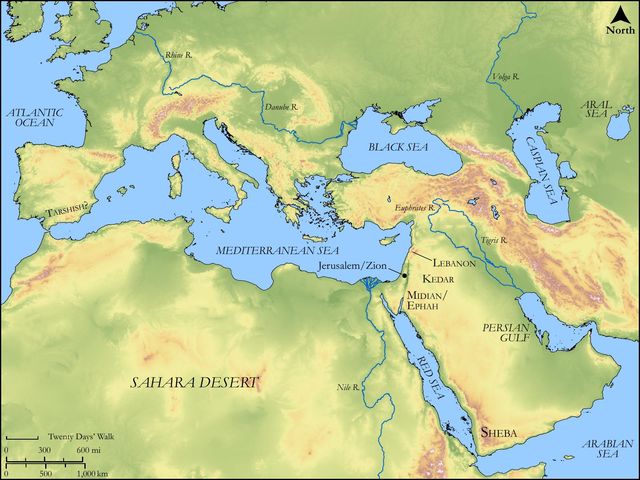
See on the biblical-era map
Study this verse
Public-domain commentary
Matthew Henry
From his Commentary on the Whole Bible. Henry comments on passages, not single verses — this entry covers Isaiah 43:8–13. His four-level outline is real structure in the source text, so it is rendered as structure.
God here challenges the worshippers of idols to produce such proofs of the divinity of their false gods as even this very instance (to go no further) of the redemption of the Jews out of Babylon furnished the people of Israel with, to prove that their God is the true and living God, and he only.
I.The patrons of idolatry are here called to appear, and say what they have to say in defence of their idols, Isa 43:8, Isa 43:9.
Their gods have eyes and see not, ears and hear not, and those that make them and trust in them are like unto them; so David had said (Psa 115:8), to which the prophet seems here to refer when he calls idolaters blind people that have eyes, and deaf people that have ears. They have the shape, capacities, and faculties, of men; but they are, in effect, destitute of reason and common sense, or they would never worship gods of their own making. "Let all the nations therefore be gathered together, let them help one another, and with a combined force plead the cause of their dunghill gods; and, if they have nothing to say in their own justification, let them hear what the God of Israel has to say for their conviction and confutation."
II.God's witnesses are subpoenaed, or summoned to appear, and give in evidence for him (Isa 43:10):
"You, O Israelites! all you that are called by my name, you are all my witnesses, and so is my servant whom I have chosen." It was Christ himself that was so described (Isa 42:1), My servant and my elect. Observe,
1.All the prophets that testified to Christ, and Christ himself, the great prophet, are here appealed to as God's witnesses.
(1.)God's people are witnesses for him, and can attest, upon their own knowledge and experience, concerning the power of his grace, the sweetness of his comforts, the tenderness of his providence, and the truth of his promise. They will be forward to witness for him that he is gracious and that no word of his has fallen to the ground.
(2.)His prophets are in a particular manner witnesses for him, with whom his secret is, and who know more of him than others do. But the Messiah especially is given to be a witness for him to the people; having lain in his bosom from eternity, he has declared him. Now,
2.Let us see what the point is which these witnesses are called to prove (Isa 43:12): You are my witnesses, saith the Lord, that I am God. Note, Those who do themselves acknowledge that the Lord is God should be ready to testify what they know of him to others, that they also may be brought to the acknowledgement of it. I believed, therefore have I spoken. Particularly, "Since you cannot but know, and believe, and understand, you must be ready to bear record,
(1.)That I am he, the only true God, that I am a being self-existent and self-sufficient; I am he whom you are to fear, and worship, and trust in. Nay (Isa 43:13), before the day was (before the first day of time, before the creation of the light, and, consequently, from eternity) I am he." The idols were but of yesterday, new gods that came newly up (Deu 32:17); but the God of Israel was from everlasting.
(2.)That there was no God formed before me, nor shall be after me. The idols were gods formed (dii facti - made gods, or rather fictitii - fictitious); by nature they were no gods, Gal 4:8. But God has a being from eternity, yea, and a religion in this world before there were either idols or idolaters (truth is more ancient than error); and he will have a being to eternity, and will be worshipped and glorified when idols are famished and abolished and idolatry shall be no more. True religion will keep its ground, and survive all opposition and competition. Great is the truth, and will prevail.
(3.)That I, even I, am the Lord, the great Jehovah, who is, and was, and is to come; and besides me there is no Saviour, Isa 43:11. See what it is that the great God glories in, not so much that he is the only ruler as that he is the only Saviour; for he delights to do good: he is the Saviour of all men, Ti1 4:10.
3.Let us see what the proofs are which are produced for the confirmation of this point. It appears,
(1.)That the Lord is God, by two proofs:
[1.]He has an infinite and infallible knowledge, as is evident from the predictions of his word (Isa 43:12): "I have declared and I have shown that which has without fail come to pass; nay, I never declared nor showed any thing but it has been accomplished. I showed when there was no strange god among you, that is, when you pretended not to consult any oracles but mine, nor to have any prophets but mine." It is said, when they came out of Egypt, that the Lord alone did lead him, and there was no strange god with him.
[2.]He has an infinite and irresistible power, as is evident from the performances of his providence. He pleads not only, I have shown, but, I have saved, not only foretold what none else could foresee, but done what none else could do; for (Isa 43:13), "None can deliver out of my hand those whom I will punish; not only no man can, but none of all the gods of the heathen can protect." It is therefore a fearful thing to fall into the hands of the living God, because there is no getting out of them again. "I will work what I have designed, both in mercy and judgment, and who shall either oppose or retard it?"
(2.)That the gods of the heathen, who are rivals with him, are not only inferior to him, but no gods at all, which is proved (Isa 43:9) by a challenge: Who among them can declare this that I now declare? Who can foretel things to come? Nay, which of them can show us former things? Isa 41:22. They cannot so much as inspire an historian, much less a prophet. They are challenged to join issue upon this: Let them bring forth their witnesses, to prove their omniscience and omnipotence. And,
[1.]If they do prove them, they shall be justified, the idols in demanding homage and the idolaters in paying it.
[2.]If they do not prove them, let them say, It is truth; let them own the true God, and receive the truth concerning him, that he is God alone. The cause of God is not afraid to stand a fair trial; but it may reasonably be expected that those who cannot justify themselves in their irreligion should submit to the power of the truth and true religion.
Historical interpretation
Two Centuries of Reception
4 surviving comments on this verse. Each one is dated, so this reads as a timeline rather than a list.
Select a marker to jump to its quote. Markers stagger vertically where authors wrote within a few decades of each other.
If Christ is Son, Christ is certainly after God. But after God there is nothing comparable to him. Christ is therefore not comparable to God; or if he is not after God, certainly he is with God; for in no way can he be before God; therefore he is consubstantial (homoousion) … substance as substance, especially if it is a homogeneous substance that is realized in two or more individuals, which is said to be identical substance, not similar.
Still I would like to ask of our opponents what the words mean that were once uttered by the prophet, “Before me there was no God, and after me there is none.” If the Son is younger than the Father, how can the Father say, “after me there shall be none”? You will not, therefore, also deprive the Only Begotten himself of his substance, will you? Indeed, you must dare to do this or else to accept the one Godhead with the distinct persons of the Father and the Son.
(Chapter 43, Verse 1 and following) And now, thus says the Lord, the one who created you, Jacob, and the one who formed you, Israel: Do not fear, for I have redeemed you; I have called you by name, you are mine. When you pass through the water, I will be with you, and the rivers will not overwhelm you. When you walk through fire, you shall not be burned, and the flame shall not consume you. For I am the Lord your God, the Holy One of Israel, your Savior; I have given Egypt as your ransom, Ethiopia and Seba in exchange for you. From the moment you became honorable and glorious in my eyes: I loved you, and I will give men for you, and peoples for your soul. Do not fear, for I am with you: I will bring your descendants from the East, and gather you from the West. I will say to the North, give up: and to the South, do not withhold: bring my sons from afar, and my daughters from the ends of the earth. And everyone who calls upon my name, I have created him for my glory, and I have formed him and made him. Bring out the blind people who have eyes, and the deaf who have ears. Let all the nations gather together, and let the peoples be assembled. Who among you will declare this, and show us former things? Let them bring their witnesses to justify them, and let them hear and say, 'It is true.' You are my witnesses, says the Lord, and my servant whom I have chosen, that you may know and believe me, and understand that I am he. Before me no god was formed, nor shall there be any after me. I am, I am the Lord, and there is no savior without me. I have declared and saved; I have made known, and there was no strange one among you. You are my witnesses, says the Lord, and I am God, and from the beginning I am myself, and there is no one who can rescue from my hand. I will work, and who can turn it aside? LXX; And now thus says the Lord who made you, Jacob, and formed you, Israel: Do not fear, for I have redeemed you; I have called you by your name, you are mine. If you pass through water, I am with you, and rivers will not cover you. And if you pass through fire, you will not be burned: the flame will not burn you: for I am the Lord your God, the Holy One of Israel, your Savior. I have made your exchange for Egypt, and Ethiopia, and Seba for you. Since you have been honorable and glorified in my sight: and I have loved you, I will give men for you, and princes for your life. Do not be afraid, for I am with you: I will bring your offspring from the East, and gather you from the West. I will say to the north, give up; and to the south, do not withhold: bring my sons from afar, and my daughters from the ends of the earth, everyone who is called by my name, whom I created for my glory, whom I formed and made. Bring out the people who are blind, yet have eyes, who are deaf, yet have ears. All the nations gather together, and the peoples assemble. Who among them can declare this, and show us the former things? Let them bring their witnesses to prove them right, and let them hear and say, 'It is true.' Let them bring their witnesses, and let them be justified, and let them hear and speak the truth. Be my witnesses, and I am a witness, says the Lord God, and my servant whom I have chosen, so that you may know and believe and understand that I am: Before me there was no other God and after me there will be none. I am God, and there is no Savior besides me. I have declared and saved: I have rebuked and there was no stranger among you. You are my witnesses, and I am the Lord God from the beginning, and there is no one who can deliver from my hand. I will do it, and who will turn it away? The Hebrews interpret this as the second coming of the Savior, when after the fullness of the Gentiles, all of Israel will be saved. But we do not think that the promise will be fulfilled for them, as it has been said: Who is blind, but my children? And who are deaf, but those who rule over them? And the servants of God have become blind. And again: The people have been devastated and plundered, and similar things. Finally he brought upon him the outpouring of his furious indignation, and perhaps war, and consumed him all around, and did not recognize, and set him ablaze, and did not understand. Therefore, what we have said above, there are two Jacobs and two Israels, one carnal and the other spiritual, those who did not want to believe in the Savior and those who received the Son of God. This should also be understood now, that the chorus of the Apostles and the first Church of Christ, gathered from the Jewish people, may understand their Creator and Maker, who is both the creator of their soul and body. And let him not fear persecutors, because he has been redeemed by the blood of Christ, who has called him by his name, and let him specifically call his people because of their special relationship; but let him preach fearlessly, and let him not fear any dangers. And what he implies: he describes the attack and fury of persecutors as waters and rivers, and fire and flames, who envy the salvation of the Gentiles and do not want the gospel message to be preached. Although the Jews want the Egyptians to be understood as waters, the Babylonians as rivers, the Macedonians as fire, and the Romans as flames. Therefore, He commands them not to fear, because the Lord their God, the Savior, and the holy one of Israel will be with them, who made them known in Egypt, Ethiopia, and Syene, and even to the ends of the earth to proclaim. Regarding Syene, the remaining interpreters have placed it in Saba (), where the queen of the South came to hear the wisdom of Solomon (III Kings 10). Therefore, the chorus of the Apostles became honorable in the sight of God, and beloved by Him; and they are the salvation of all people and nations who are called to the Gospel through them, and they will be considered for the salvation of their souls. And he joins and says: Do not be afraid, I am with you, who speak to you in the Gospel: Behold, I am with you all days even to the consummation of the world (Matt. 28:20). For I will bring your sons from the East and from the West, who will rest in the bosom of Abraham, and from all parts of the world the people of my sons and daughters will be gathered, who will either invoke my name or be called by my name, so that they may be called Christians to the glory of their creator. And what follows: Educate the blind people, who have eyes; the deaf, who have ears; many people think that it is said about the Gentile people, who began to hear and see through the teaching of the Apostles. But we should also understand this about the dispersed Israel, who was called by the Apostles and believed first; to whom Paul also speaks: It was necessary for the word of God to be preached to you first (Acts 13:46). And the Lord Himself in the Gospel: Go to the lost sheep of the house of Israel (Matthew 10:6). Finally, it follows: all the nations are gathered together, and the tribes are assembled, that is, with the people who believed from the Jews, so that there may be a dual calling, of circumcision and of uncircumcision. But what is said, 'Bring forth, O Lord, the word is spoken to the Son.' Or, according to the Septuagint, the Father speaks to the Son, that He may bring forth His blind and deaf people, and join them to the nations, and make many leaders of the Church from them. And the prophet marvels that no one among the nations could have known these things in advance, nor could they have known the plans of God; but only His people who have received the Law and had prophets: For God is known in Judea, His name is great in Israel (Ps. LXX, 1). Whether he himself is the witness of his own words, both the doer and the boy and servant whom he has chosen. There is no doubt that it signifies Christ, to whom he also says above: It is great for you to be called my servant. And all these things will happen, so that the truth may be preached to the world, and they may know, and believe, and understand, whose minds were previously brutish and insensible, that besides one God, there is no other God, neither before nor after. For the creator of times never has a beginning, since time itself sometimes exists. And how did He speak: I am a witness, says the Lord God; and the boy whom I have chosen, saying this very thing to the Lord in the Gospel: The testimony of two men is true. I am the one who testifies about myself, and the one who sent me is the Father (John 8:17-18). Thus, we must understand the divinity of Him, that there is no God except Himself who speaks, and His chosen boy. Besides God the Father, there is no other God: because Christ is the power of God and the wisdom of God (1 Corinthians 1), who speaks in the Gospel: I am in the Father, and the Father is in Me (John 14:11). For just as the one Lord Christ does not take away from the Father so that he may not be Lord, so the one God the Father does not take away from the Son so that he may not be God: who in the beginning was the Word, and the Word was with God, and the Word was God: this was in the beginning with God (John 1:1-2). And what follows: And there is no Savior without me, shows that the Son saves all things in the Father. Concerning whom the same prophet testifies: And the Lord will send them a Savior, who will make them safe (Isaiah 9). For indeed, God is wise and strong, and His wisdom and virtue cannot exist without Him. So when I foretell these things from the beginning, there will be no one who rejects my will: indeed, what I have done, they could make void. These things are indeed said to Jacob and Israel, but they refer to the apostolic choir and all who want to believe in Christ and be saved from the Jewish people.
“I have glorified you in the world.” By this glory Christ has led the blind people into the light. For the sun of righteousness does not allow us to be children of the night and shadows but rather of day, as the divine apostle says. When Paul says, “They have been gathered,” this in fact has not yet taken place, and he is obviously speaking prophetically, meaning “they will be gathered.” For speaking of things to come as if they had happened is customary in the Scriptures; another example of such is “I have given my back to the rod” and “they divided my clothing among them.”
Continue studying Isaiah 43:10 across the web’s major study libraries — every link below opens this exact verse, chapter, or book on the destination site.
Read & Compare
 BibleGatewayThis verse in more than 200 translations and 70 languages.
 Bible.comThe YouVersion reader — hundreds of translations, reading plans, and highlights.
 ESV.orgCrossway's official English Standard Version reader.
 NET BibleThe NET translation with 60,000+ translators' notes on every rendering decision.
 STEP BibleTyndale House's free study tool — original text, vocabulary, and scholarly resources.
 BibliaLogos Bible Software's free web reader.
 USCCBThe New American Bible (Revised Edition) with the U.S. bishops' study notes.
Commentaries
 BibleHub CommentariesDozens of classic commentaries on this verse, gathered on one page.
 StudyLightMore than 100 commentary sets — the largest collection on the web.
 BibleRefPlain-English commentary on what this verse means, verse by verse.
 Enduring WordDavid Guzik's free commentary on this chapter, widely used by Bible teachers.
 Bible Study ToolsVerse commentary alongside Greek and Hebrew study aids.
Original Language & Research
- BibleHub InterlinearThe verse word by word — original language, transliteration, and English.
- BibleHub LexiconEvery word's original-language definition and Strong's entry.
 Blue Letter BibleDeep-study tools — Strong's numbers, concordance, and word studies.
 SefariaThe Hebrew text with Rashi and centuries of Jewish commentary.
Sermons, Hymns & Audio


TrulyRandomVerse is not affiliated with these sites and doesn’t control their content. They’re linked because they’re genuinely useful.
Summary
Isaiah 43:10 presents a profound declaration of Yahweh's singular, eternal, and incomparable nature, establishing Him as the one true God. In this pivotal verse, the LORD commissions the nation of Israel as His chosen witnesses and servants, entrusting them with the sacred responsibility of experiencing, understanding, and proclaiming His unique identity. This divine mandate serves not only to deepen their own faith but also to provide irrefutable testimony to a world steeped in polytheism, affirming that no deity was ever formed before Him, nor will any exist after Him.
Context
ShowHideLiterary Context
Isaiah 43 is situated within the "Book of Comfort" (Isaiah 40-55), a section primarily addressed to the exiled people of Judah, offering hope and assurance of their future restoration. Chapters 40-48 specifically emphasize God's absolute sovereignty, His unmatched power, and His ability to deliver Israel from Babylonian captivity, often highlighting His foreknowledge and control over historical events, including the rise of figures like Cyrus. Immediately preceding this verse, God has been asserting His unique power and challenging the idols and false gods of the nations to prove their claims or foretell the future, demonstrating their utter impotence (e.g., God's challenge to the idols in Isaiah 41:21-29). Verse 10 builds directly on this divine challenge, presenting Israel as the living, historical evidence of God's unmatched power and singular identity. Following this declaration, God continues to emphasize His redemptive work for Israel, promising their return and restoration as a further demonstration of His glory and unique power (e.g., Isaiah 43:14-21).
Historical & Cultural Context
The historical backdrop for Isaiah 43 is the impending or ongoing Babylonian Exile (586-538 BC). During this period, the people of Israel were surrounded by powerful empires, such as Babylon, which worshipped vast pantheons of gods and goddesses, often represented by physical idols. The cultural milieu was one where national identity and prosperity were intimately intertwined with the perceived power of a nation's gods. In this context of pervasive polytheism and spiritual syncretism, Isaiah's message is a radical, uncompromising assertion of monotheism. Yahweh is not merely one god among many, but the only God. The call for Israel to be "witnesses" was a direct counter-cultural challenge, requiring them to stand apart from the prevailing religious norms and to testify to the unique, active, and sovereign God of Abraham, Isaac, and Jacob, whose power was demonstrated not in static idols but in dynamic historical intervention.
Key Themes
ShowHideThis verse encapsulates several major theological themes prevalent throughout Isaiah and the broader Old Testament. Firstly, it powerfully articulates God's absolute uniqueness and incomparable sovereignty, a theme echoed throughout the prophetic literature and the Pentateuch, affirming that there is no God before or after Him (e.g., Deuteronomy 4:35 and Isaiah 44:6). This emphasizes His eternality, uncreated nature, and sole claim to divinity. Secondly, it highlights Israel's covenantal role as God's chosen people, not for their inherent merit, but as a vessel for His revelation to the nations. Their history, marked by divine intervention and miraculous deliverance (e.g., the Exodus from Egypt), serves as tangible proof of God's power and faithfulness. Thirdly, the verse underscores the importance of experiential knowledge and unwavering belief in God's identity. It's not merely intellectual assent but a profound, transformative understanding and trust in who God is, leading to a life that reflects His truth and proclaims His glory.
Exposition and Analysis
ShowHideKey Word Analysis
ShowHideThis term (H5707) is derived from a root meaning "to bear witness" or "to testify." It carries a strong legal connotation, implying someone who provides evidence or testimony, often in a court setting. In this context, Israel's very existence, their historical experiences of deliverance and judgment, and God's interventions on their behalf serve as the irrefutable evidence of God's unique identity and power, distinguishing Him from all false deities. They are called to be living, walking proof of Yahweh's truth and His exclusive claim to divinity.
The Hebrew word (H3045) for "know" is rich in meaning, extending far beyond mere intellectual apprehension. It signifies a deep, intimate, experiential knowledge, often implying a relational bond. It's the kind of knowing that comes from personal encounter, observation, and participation in God's redemptive acts. God desires His people not just to possess facts about Him, but to truly and deeply understand Him through their lived experience, leading to a profound recognition of His identity and character. This knowledge is transformative and foundational to their belief.
This verb (H3335) primarily means "to mold into a form," especially as a potter shapes clay. It speaks of creation, fabrication, or determination. The declaration "no God formed" is a direct and potent challenge to the idols of the surrounding nations, which were literally "formed" by human hands (e.g., the critique of idols in Psalm 115:4-7). By stating that no god was "formed" before or after Him, God emphatically asserts His uncreated, eternal nature, distinguishing Himself absolutely from all human-made or conceptualized deities. He is the Creator, not the created.
Verse Breakdown
ShowHide"Ye are my witnesses, saith the LORD, and my servant whom I have chosen:"
This opening clause establishes Israel's divine commission and identity. They are not self-appointed, but specifically designated by Yahweh, the covenant-keeping God (LORD, Yᵉhôvâh). Their status as "witnesses" and "servant" (a collective term for Israel, echoing the "servant songs" of Isaiah) underscores their unique, chosen role in revealing God's truth to the world. Their election is for a profound purpose: to testify to God's identity, power, and faithfulness, particularly in contrast to the impotent gods of the nations.
"that ye may know and believe me, and understand that I am he:"
This clause articulates the dual purpose of their witness status, both for themselves and for others. Internally, their role as witnesses is intended to deepen their own intimate knowledge (yâdaʻ) and unwavering belief (ʼâman) in God. The phrase "I am he" (Hebrew: 'ani hu') is a powerful declaration of divine self-existence and identity, resonating with God's revelation to Moses as "I AM THAT I AM" (Exodus 3:14). It emphasizes His eternal, unchanging, and exclusive nature, affirming His sole claim to deity.
"before me there was no God formed, neither shall there be after me."
This climactic declaration is the core of God's self-revelation and the central truth Israel is to witness to. It is an absolute assertion of His singular, uncreated, and eternal divinity. The word "formed" (H3335, yâtsar) directly contrasts God with the manufactured idols of other nations. God is not a product of human hands or imagination; He exists independently, eternally, and uniquely. This statement serves as a powerful refutation of polytheism and a cornerstone of monotheistic faith, establishing Yahweh as utterly incomparable.
Literary Devices
ShowHideIsaiah 43:10 employs several potent literary devices to convey its profound theological message with compelling force. The most prominent is Divine Assertion and Declaration, as God makes unequivocal statements about His identity and Israel's designated role ("Ye are my witnesses," "I am he," "no God formed"). This direct, authoritative tone underscores His absolute sovereignty and unchallengeable truth. There is also a strong element of Contrast, as God explicitly differentiates Himself from the "formed" gods of the nations, highlighting His uncreated, eternal nature versus their manufactured, temporal, and impotent existence. The phrase "I am he" functions as a powerful Divine Self-Identification, resonating with earlier biblical revelations (e.g., Exodus 3:14) and emphasizing God's absolute uniqueness and unchanging character. Furthermore, the concept of "witnesses" employs a Legal Metaphor, casting Israel's role in terms of providing irrefutable evidence in a court of judgment, where God's claims are vindicated against the false claims of idols. The structure of the last clause, "before me there was no God formed, neither shall there be after me," uses Parallelism and Emphasis (specifically, a negative parallelism) to underscore God's eternal and exclusive divinity, reinforcing the idea that He is truly without peer or predecessor.
Theological and Thematic Connections
ShowHideIsaiah 43:10 serves as a theological bedrock, asserting God's absolute uniqueness and His sovereign claim over all creation and history. It establishes a clear distinction between the uncreated, eternal Yahweh and all other deities, which are either figments of human imagination or products of human hands. This verse powerfully reinforces the core monotheistic truth that there is only one true God, who is self-existent, incomparable, and the ultimate reality. It also highlights the relational aspect of God, who desires His people to deeply know and believe Him, not just intellectually, but experientially, through their lived encounter with His faithfulness. Furthermore, it underscores the missional purpose of Israel's election—they are chosen not just for their own blessing, but to be a living testimony to the world of God's unparalleled power and identity, a theme that reverberates through the entire biblical narrative concerning God's people's role in revealing Him to the nations.
Reflection and Application
ShowHideIsaiah 43:10 issues a profound and active call to faith for believers today. Just as ancient Israel was commissioned, so too are followers of Christ called to be God's witnesses in a world still filled with competing ideologies and "formed gods"—whether they are literal idols, the allure of materialism, the worship of self, the pursuit of power, or other transient cultural narratives. Our lives, transformed by God's grace and marked by His redemptive power, are meant to be living testimonies to His unique identity, His absolute sovereignty, and His unwavering faithfulness. This requires a deep, intimate, and experiential knowledge of God, moving beyond mere intellectual assent to a profound, relational understanding. We are to know Him, believe Him, and understand that He alone is "He"—the uncreated, eternal, and all-sufficient God. This understanding should cultivate unwavering trust in His promises, especially when facing personal trials or global uncertainties, reminding us that the God who formed the heavens and the earth and controls history is the same God who intimately guides our steps and faithfully fulfills His purposes in our lives.
Questions for Reflection
ShowHideFAQ
ShowHideWho are the "witnesses" in Isaiah 43:10, and what is their role?
ShowHideIn Isaiah 43:10, the "witnesses" are primarily the nation of Israel. They are God's chosen people, whom He has delivered from Egypt, sustained in the wilderness, and is now promising to restore from Babylonian exile. Their role is to testify to the world about Yahweh's unique identity, power, and faithfulness. Their history, marked by divine intervention and miraculous acts (such as the Exodus and subsequent preservation), serves as irrefutable evidence that He is the only true God, incomparable to the idols worshipped by other nations. This testimony is meant to lead both Israel themselves and the surrounding peoples to know, believe, and understand that He alone is "He," the self-existent and eternal God.
What is the significance of the phrase "I am he" in this verse?
ShowHideThe phrase "I am he" (Hebrew: 'ani hu') is a profoundly significant declaration of God's absolute self-existence, identity, and uniqueness. It resonates deeply with God's revelation to Moses at the burning bush, where He identified Himself as "I AM THAT I AM" (Exodus 3:14). In Isaiah, particularly in the "Book of Comfort" (Isaiah 40-55), this phrase emphasizes that Yahweh is the unchanging, eternal, and singular God, distinct from all other deities. It asserts His unparalleled sovereignty, His exclusive claim to divinity, and His active role in history, reinforcing that there is no other god beside Him, nor will there ever be. It's a statement of ultimate authority and incomparable being, setting Him apart from all created things.
How does Isaiah 43:10 challenge idol worship?
ShowHideIsaiah 43:10 directly challenges idol worship through its emphatic declaration: "before me there was no God formed, neither shall there be after me." The word "formed" (Hebrew: yâtsar) is crucial here, as it refers to the act of molding or shaping, particularly by a potter. This directly contrasts Yahweh, the uncreated and eternal God, with the idols of other nations, which are literally "formed" or manufactured by human hands. The prophet Isaiah consistently mocks these man-made gods as powerless, blind, deaf, and utterly dependent on their human creators (e.g., Isaiah 44:9-20). By asserting that no God was ever "formed" before or will be "formed" after Him, Yahweh declares His absolute distinction from all such fabricated deities, underscoring His unique, self-existent, and incomparable nature as the sole Creator and Sustainer of all things.
Christ-Centered Fulfillment
ShowHideIsaiah 43:10 finds its ultimate and most profound fulfillment in the person and work of Jesus Christ. The declaration "I am he" (Hebrew: 'ani hu') in this verse, a powerful statement of Yahweh's divine self-existence and uniqueness, is echoed by Jesus Himself in the New Testament. His repeated "I AM" statements (e.g., "I am the bread of life" in John 6:35; "Before Abraham was, I am" in John 8:58; "When you lift up the Son of Man, then you will know that I am he" in John 8:28) directly link Him to the divine identity of Yahweh revealed in the Old Testament, asserting His co-eternality and deity. Furthermore, if Israel was called to be God's witness, then Jesus is the ultimate and perfect Witness, embodying the truth of God's character and plan of salvation, testifying to the truth even unto death (e.g., John 18:37 and Revelation 1:5). He perfectly reveals the "God formed" by no one, for He is the "image of the invisible God" and the "radiance of the glory of God" (Colossians 1:15; Hebrews 1:3). Through Christ, the knowledge and belief in God's unique identity are made accessible to all humanity. The mission of being witnesses, once given to Israel, is now extended to all believers in Christ, empowered by the Holy Spirit to testify to His resurrection and redemptive work "unto the uttermost part of the earth" (Acts 1:8). Thus, the call to know, believe, and understand the one true God is fully realized in knowing, believing, and understanding Jesus Christ, who is God incarnate and the ultimate revelation of the "I AM."