


Luke 2:32
Bible text: King James Version (1769 Blayney text) · Public domain
Bible text: Berean Standard Bible · Public domain
Bible text: American Standard Version (1901) · Public domain
Bible text: World English Bible, Messianic edition · Public domain
Bible text: Geneva Bible (1599) · Public domain
Bible text: Young's Literal Translation · Public domain
- φῶςphōsa lightG5457N-ASNNoun Accusative Singular Neuter
- εἰςeisforG1519PREPPreposition
- ἀποκάλυψινapokalupsinrevelationG602N-ASFNoun Accusative Singular Feminine
- ἐθνῶνethnōnof [the] GentilesG1484N-GPNNoun Genitive Plural Neuter
- καὶkaiandG2532CONJConjunction
- δόξανdoxangloryG1391N-ASFNoun Accusative Singular Feminine
- λαοῦlaouof [the] peopleG2992N-GSMNoun Genitive Singular Masculine
- σουsouof YouG4771P-2GSPersonal pronoun Genitive 2nd Singular
- ἸσραήλIsraēlof IsraelG2474N-GSM-LNoun Genitive Singular Masculine Location
English is a literal word-by-word gloss of the Greek, not the KJV's wording. Why?
This is the original text the KJV's translators worked from — each Greek word with its own literal English meaning in this verse, prepared by scholars at Tyndale House, Cambridge. The KJV translates whole sentences, not word by word, so its wording differs: one Greek word can become several English words, and the KJV may choose “charity” where the gloss reads “love”. Both are faithful — they answer different questions. For the KJV's own rendering, switch to the KJV text.
Details
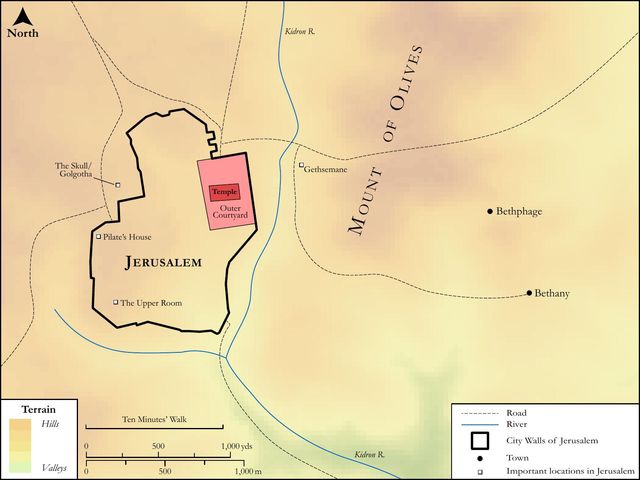
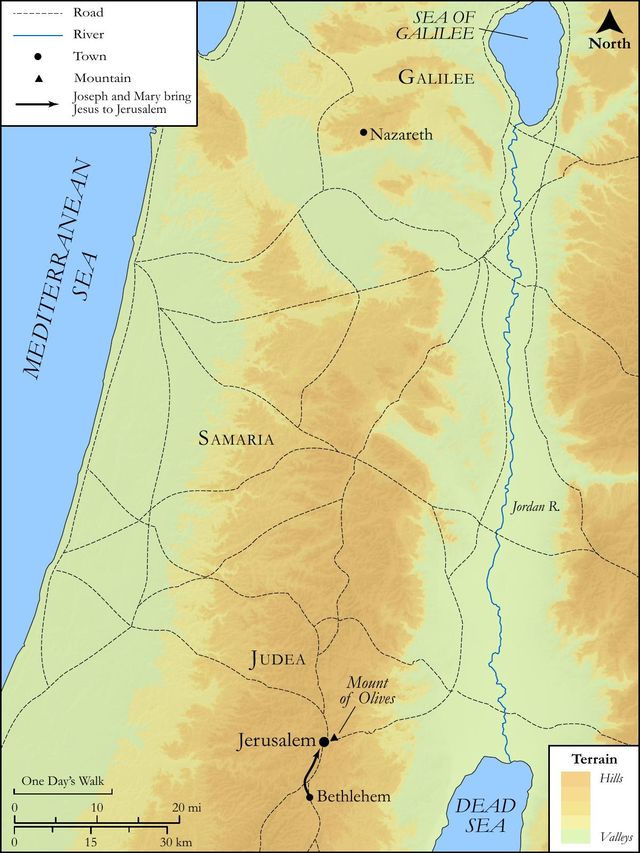
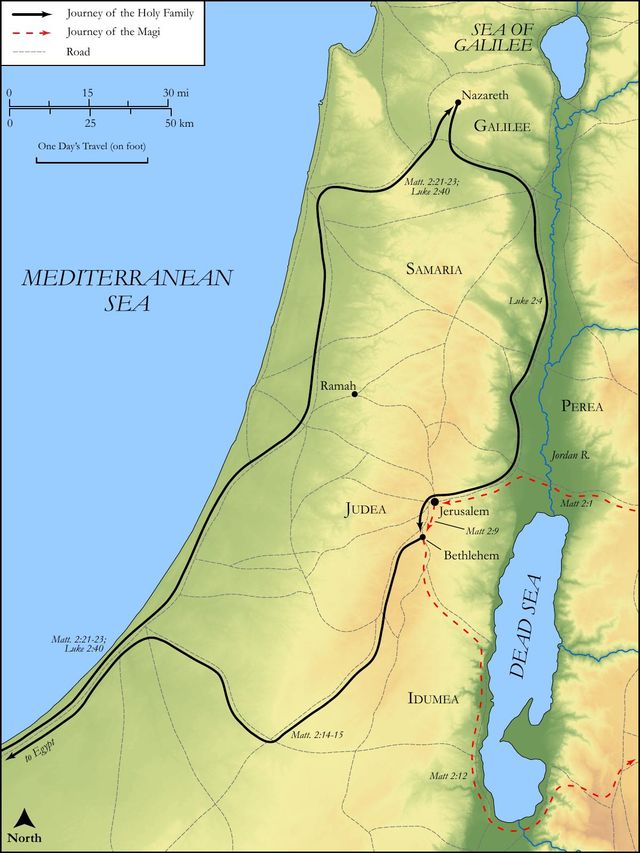
See on the biblical-era maps
Study this verse
Public-domain commentary
Matthew Henry
From his Commentary on the Whole Bible. Henry comments on passages, not single verses — this entry covers Luke 2:25–40. His four-level outline is real structure in the source text, so it is rendered as structure.
Even when he humbles himself, still Christ has honour done him to balance the offence of it. That we might not be stumbled at the meanness of his birth, angels then did him honour; and now, that we may not be offended at his being presented in the temple, like other children born in sin, and without any manner of solemnity peculiar to him, but silently, and in the crowd of other children, Simeon and Anna now do him honour, by the inspiration of the Holy Ghost.
I.A very honourable testimony is borne to him by Simeon, which was both a reputation to the child and an encouragement to the parents, and might have been a happy introduction of the priests into an acquaintance with the Saviour, if those watchmen had not been blind. Now observe here,
1.The account that is given us concerning this Simeon, or Simon. He dwelt now in Jerusalem, and was eminent for his piety and communion with God. Some learned men, who have been conversant with the Jewish writers, find that there was at this time one Simeon, a man of great note in Jerusalem, the son of Hillel, and the first to whom they gave the title of Rabban, the highest title that they gave to their doctors, and which was never given but to seven of them. He succeeded his father Hillel, as president of the college which his father founded, and of the great Sanhedrim. The Jews say that he was endued with a prophetical spirit, and that he was turned out of his place because he witnessed against the common opinion of the Jews concerning the temporal kingdom of the Messiah; and they likewise observe that there is no mention of him in their Mishna, or book of traditions, which intimates that he was no patron of those fooleries. One thing objected against this conjecture is that at this time his father Hillel was living, and that he himself lived many years after this, as appears by the Jewish histories; but, as to that, he is not here said to be old; and his saying, Now let thy servant depart intimates that he was willing to die now, but does not conclude that therefore he did die quickly. St. Paul lived many years after he had spoken of his death as near, Act 20:25. Another thing objected is that the son of Simeon was Gamaliel, a Pharisee, and an enemy to Christianity; but, as to that, it is no new thing for a faithful lover of Christ to have a son a bigoted Pharisee.
The account given of him here is, (1.) That he was just and devout, just towards men and devout towards God; these two must always go together, and each will befriend the other, but neither will atone for the defect of the other. (2.) That he waited for the consolation of Israel, that is, for the coming of the Messiah, in whom alone the nation of Israel, that was now miserably harassed and oppressed, would find consolation. Christ is not only the author of his people's comfort, but the matter and ground of it, the consolation of Israel. He was long a coming, and they who believed he would come continued waiting, desiring his coming, and hoping for it with patience; I had almost said, with some degree of impatience waiting till it came. He understood by books, as Daniel, that the time was at hand, and therefore was now more than ever big with expectation of it. The unbelieving Jews, who still expect that which is already come, use it as an oath, or solemn protestation, As ever I hope to see the consolation of Israel, so and so it is. Note, The consolation of Israel is to be waited for, and it is worth waiting for, and it will be very welcome to those who have waited for it, and continue waiting. (3.) The Holy Ghost was upon him, not only as a Spirit of holiness, but as a Spirit of prophecy; he was filled with the Holy Ghost, and enabled to speak things above himself. (4.) He had a gracious promise made him, that before he died he should have a sight of the Messiah, Luk 2:26. He was searching what manner of time the Spirit of Christ in the Old Testament prophets did signify, and whether it were not now at hand; and he received this oracle (for so the word signifies), that he should not see death before he had seen the Messiah, the Lord's Anointed. Note, Those, and those only, can with courage see death, and look it in the face without terror, that have had by faith a sight of Christ.
2.The seasonable coming of Simeon into the temple, at the time when Christ was presented there, Luk 2:27. Just then, when Joseph and Mary brought in the child, to be registered as it were in the church-book, among the first-born, Simeon came, by direction of the Spirit, into the temple. The same Spirit that had provided for the support of his hope now provided for the transport of his joy. It was whispered in his ear, "Go to the temple now, and you shall see what you have longed to see." Note, Those that would see Christ must go to his temple; for there The Lord, whom ye seek, shall suddenly come to meet you, and there you must be ready to meet him.
3.The abundant satisfaction wherewith he welcomed this sight: He took him up in his arms (Luk 2:28), he embraced him with the greatest affection imaginable, laid him in his bosom, as near his heart as he could, which was as full of joy as it could hold. He took him up in his arms, to present him to the Lord (so some think), to do either the parent's part or the priest's part; for divers of the ancients say that he was himself a priest. When we receive the record which the gospel gives us of Christ with a lively faith, and the offer it makes us of Christ with love and resignation, then we take Christ in our arms. It was promised him that he should have a sight of Christ; but more is performed than was promised: he has him in his arms.
4.The solemn declaration he made hereupon: He blessed God, and said, Lord, now let thou thy servant depart in peace, Luk 2:29-32.
(1.)He has a pleasant prospect concerning himself, and (which is a great attainment) is got quite above the love of life and fear of death; nay, he is arrived at a holy contempt of life, and desire of death: "Lord, now let thou thy servant depart, for mine eyes have seen the salvation I was promised a sight of before I died." Here is,
[1.]An acknowledgment that God had been as good as his word; there has not failed one tittle of his good promises, as Solomon owns, Kg1 8:56. Note, Never any that hoped in God's word were made ashamed of their hope.
[2.]A thanksgiving for it. He blessed God that he saw that salvation in his arms which many prophets and kings desired to see, and might not.
[3.]A confession of his faith, that the child in his arms was the saviour, the Salvation itself; thy salvation, the salvation of thine appointing, the salvation which thou has prepared with a great deal of contrivance. And, while it has been thus long in the coming, it hath still been in the preparing.
[4.]It is a farewell to this world: "Now let thy servant depart; now mine eyes have been blessed with this sight, let them be closed, and see no more in this world." The eye is not satisfied with seeing (Ecc 1:8), till it hath seen Christ, and then it is. What a poor thing doth this world look to one that hath Christ in his arms and salvation in his eye! Now adieu to all my friends and relations, all my enjoyments and employments here, even the temple itself.
[5.]It is a welcome to death: Now let thy servant depart. Note, Death is a departure, the soul's departure out of the body, from the world of sense to the world of spirits. We must not depart till God give us our discharge, for we are his servants and must not quit his service till we have accomplished our time. Moses was promised that he should see Canaan, and then die; but he prayed that this word might be altered, Deu 3:24, Deu 3:25. Simeon is promised that he should not see death till he had seen Christ; and he is willing to construe that beyond what was expressed, as an intimation that, when he had seen Christ, he should die: Lord, be it so, saith he, now let me depart. See here, First, How comfortable the death of a good man is; he departs as God's servant from the place of his toil to that of his rest. He departs in peace, peace with God, peace with his own conscience; in peace with death, well-reconciled to it, well-acquainted with it. He departs according to God's word, as Moses at the word of the Lord (Deu 34:5): the word of precept, Go up and die; the word of promise, I will come again and receive you to myself. Secondly, What is the ground of this comfort? For mine eyes have seen thy salvation. This bespeaks more than a great complacency in the sight, like that of Jacob (Gen 46:30), Now let me die, since I have seen thy face. It bespeaks a believing expectation of a happy state on the other side death, through this salvation he now had a sight of, which not only takes off the terror of death, but makes it gain, Phi 1:21. Note, Those that have welcomed Christ may welcome death.
(2.)He has a pleasant prospect concerning the world, and concerning the church. This salvation shall be,
[1.]A blessing to the world. It is prepared before the face of all people, not to be hid in a corner, but to be made known; to be a light to lighten the Gentiles that now sit in darkness: they shall have the knowledge of him, and of God, and another world through him. This has reference to Isa 49:6, I will give thee for a light to the Gentiles; for Christ came to be the light of the world, not a candle in the Jewish candlestick, but the Sun of righteousness.
[2.]A blessing to the church: the glory of thy people Israel. It was an honour to the Jewish nation that the Messiah sprang out of one of their tribes, and was born, and lived, and died, among them. And of those who were Israelites indeed of the spiritual Israel, he was indeed the glory, and will be so to eternity, Isa 60:19. They shall glory in him. In the Lord shall all the seed of Israel be justified and shall glory, Isa 45:25. When Christ ordered his apostles to preach the gospel to all nations, therein he made himself a light to lighten the Gentiles; and when he added, beginning at Jerusalem, he made himself the glory of his people Israel.
5.The prediction concerning this child, which he delivered, with his blessing, to Joseph and Mary. They marvelled at those things which were still more and more fully and plainly spoken concerning this child, Luk 2:33. And because they were affected with, and had their faith strengthened by, that which was said to them, here is more said to them.
(1.)Simeon shows them what reason they had to rejoice; for he blessed them (Luk 2:34), he pronounced them blessed who had the honour to be related to this child, and were entrusted with the bringing him up. He prayed for them, that God would bless them, and would have others do so too. They had reason to rejoice, for this child should be, not only a comfort and honour to them, but a public blessing. He is set for the rising again of many in Israel, that is, for the conversion of many to God that are dead and buried in sin, and for the consolation of many in God that are sunk and lost in sorrow and despair. Those whom he is set for the fall of may be the same with those whom he is set for the rising again of. He is set eis ptōsin kai anastasin - for their fall, in order to their rising again; to humble and abase them, and bring them off from all confidence in themselves, that they may be exalted by relying on Christ; he wounds and then heals, Paul falls, and rises again.
(2.)He shows them likewise what reason they had to rejoice with trembling, according to the advice given of old, with reference to the Messiah's kingdom, Psa 2:11. Lest Joseph, and Mary especially, should be lifted up with the abundance of the revelations, here is a thorn in the flesh for them, an allay to their joy; and it is what we sometimes need.
[1.]It is true, Christ shall be a blessing to Israel; but there are those in Israel whom he is set for the fall of, whose corruptions will be provoked, who will be prejudiced and enraged against him, and offended, and whose sin and ruin will be aggravated by the revelation of Jesus Christ; many who will extract poison to themselves out of the balm of Gilead, and split their souls on the Rock of salvation, to whom this precious Foundation-stone will be a stone of stumbling. This refers to that prophecy (Isa 8:14, Isa 8:15), He shall be for a sanctuary to some, and yet for a snare to others, Pe1 2:7, Pe1 2:8. Note, As it is pleasant to think how many there are to whom Christ and his gospel are a savour of life unto life, so it is sad to think how many there are to whom it is a savour of death unto death. He is set for a sign, to be admired by some, but by others, by many, spoken against. He had many eyes upon him, during the time of his public ministry, he was a sign, but he had many tongues against him, the contradiction and reproach of sinners, he was continually cavilled at and abused; and the effects of this will be that the thoughts of many hearts will be revealed (Luk 2:35), that is, upon this occasion, men will show themselves, will discover, and so distinguish, themselves. The secret good affections and dispositions in the minds of some will be revealed by their embracing Christ, and closing with him; the secret corruptions and vicious dispositions of others, that otherwise would never have appeared so bad, will be revealed by their enmity to Christ and their rage against him. Men will be judged of by the thoughts of their hearts, their thoughts concerning Christ; are they for him, or are they for his adversaries? The word of God is a discerner of the thoughts and intents of the heart, and by it we are discovered to ourselves, and shall be judged hereafter.
[2.]It is true, Christ shall be a comfort to his mother; but be not thou too proud of it, for a sword shall pass through thine own soul also. He shall be a suffering Jesus; and, First, "Thou shalt suffer with him, by sympathy, more than any other of his friends, because of the nearness of thy relation, and strength of affection, to him." When he was abused, it was a sword in her bones. When she stood by his cross, and saw him dying, we may well think her inward grief was such that it might truly be said, A sword pierced through her soul, it cut her to the heart. Secondly, Thou shalt suffer for him. Many understand it as a prediction of her martyrdom; and some of the ancients say that it had its accomplishment in that. Note, In the midst of our greatest delights and advancements in this world, it is good for us to know that bonds and afflictions abide us.
II.He is taken notice of by one Anna, or Ann, a prophetess, that one of each sex might bear witness to him in whom both men and women are invited to believe, that they may be saved. Observe,
1.The account here given of this Anna, who she was. She was,
(1.)A prophetess; the Spirit of prophecy now began to revive, which had ceased in Israel above three hundred years. Perhaps no more is meant than that she was one who had understanding in the scriptures above other women, and made it her business to instruct the younger women in the things of God. Though it was a very degenerate age of the church, yet God left not himself without witness.
(2.)She was the daughter of Phanuel; her father's name (says Grotius) is mentioned, to put us in mind of Jacob's Phanuel, or Penuel (Gen 32:30), that now the mystery of that should be unfolded, when in Christ we should as it were see God face to face, and our lives be preserved; and her name signifies gracious.
(3.)She was of the tribe of Asher, which was in Galilee; this, some think, is taken notice of to refute those who said, Out of Galilee ariseth no prophet, when no sooner did prophecy revive but it appeared from Galilee.
(4.)She was of a great age, a widow of about eighty-four years; some think she had now been eighty-four years a widow, and then she must be considerably above a hundred years old; others, rather than suppose that a woman so very old should be capable of fasting and praying as she did, suppose that she was only eighty-four years of age, and had been long a widow. Though she was a young widow, and had lived with her husband but seven years, yet she never married again, but continued a widow to her dying day, which is mentioned to her praise.
(5.)She was a constant resident in or at least attendant on the temple. Some think she had lodgings in the courts of the temple, either in an alms-house, being maintained by the temple charities; or, as a prophetess, she was lodged there, as in a proper place to be consulted and advised with by those that desired to know the mind of God; others think her not departing from the temple means no more, than that she was constantly there at the time of divine service: when any good work was to be done, she was ready to join in it. It is most probable she had an apartment of her own among the out-buildings of the temple; and, besides her constant attendance on the public worship, abounded in private devotions, for she served God with fastings and prayers night and day: having no secular business to employ herself in, or being past it, she gave up herself wholly to her devotions, and not only fasted twice in the week, but always lived a mortified life, and spent that time in religious exercises which others spent in eating and drinking and sleeping; she not only observed the hours of prayer, but prayed night and day; was always in a praying frame, lived a life of prayer, gave herself to prayer, was frequent in ejaculations, large in solemn prayers, and very particular in her intercessions. And in these she served God; that was it that put a value upon them and an excellency into them. The Pharisees fasted often, and made long prayers, but they served themselves, and their own pride and covetousness, in their fastings and prayers; but this good woman not only did that which was good, but did it from a good principle, and with a good end; she served God, and aimed at his honour, in fasting and praying. Note,
[1.]Devotion is a thing we ought to be constant in; other duties are in season now and then, but we must pray always.
[2.]It is a pleasant sight to see aged Christians abounding in acts of devotion, as those that are not weary of well-doing, that do not think themselves above these exercises, or past them, but that take more and more pleasure in them, and see more and more need of them, till they come to heaven.
[3.]Those that are diligent and faithful in improving the light and means they have shall have further discoveries made them. Anna is now at length abundantly recompensed for her attendance so many years in the temple.
2.The testimony she bore to our Lord Jesus (Luk 2:38): She came in at that instant when the child was presented, and Simeon discoursed concerning him; she, who was so constant to the temple, could not miss the opportunity.
Now, (1.) She gave thanks likewise to the Lord, just as Simeon, perhaps like him, wishing now to depart in peace. Note, Those to whom Christ is made known have reason enough to give thanks to the Lord for so great a favour; and we should be excited to that duty by the praises and thanksgivings of others; why should not we give thanks likewise, as well as they? Anna concurred with Simeon, and helped to make up the harmony. She confessed unto the Lord (so it may be read); she made an open profession of her faith concerning this child.
(2.)She, as a prophetess, instructed others concerning him: She spoke of him to all them that believed the Messiah would come, and with him looked for redemption in Jerusalem. Redemption was the thing wanted, waited for, and wished for; redemption in Jerusalem, for thence the word of the Lord was to go forth, Isa 2:3. Some there were in Jerusalem that looked for redemption; yet but a few, for Anna, it should seem, had acquaintance with all them that were joint-expectants with her of the Messiah; she knew where to find them, or they where to find her, and she told them all the good news, that she had seen the Lord; and it was great news, this of his birth now, as afterwards that of his resurrection. Note, Those that have an acquaintance with Christ themselves should do all they can to bring others acquainted with him.
Lastly, Here is a short account of the infancy and childhood of our Lord Jesus.
1.Where he spent it, Luk 2:39. When the ceremony of presenting the child, and purifying the mother, was all over, they returned into Galilee. Luke relates no more concerning them, till they were returned into Galilee; but it appears by St. Matthew's gospel (Mat 2:1) that from Jerusalem they returned to Bethlehem, where the wise men of the east found them, and there they continued till they were directed to flee into Egypt, to escape the malice and rage of Herod; and, returning thence when Herod was dead, they were directed to go to their old quarters in Nazareth, whence they had been perhaps some years absent. It is here called their own city, because there they had lived a great while, and their relations were there. He was ordered further from Jerusalem, because his kingdom and priesthood were to have no affinity with the present government of the Jewish church or state. He is sent into a place of obscurity and reproach; for in this, as in other things, he must humble himself and make himself of no reputation.
2.How he spent it, Luk 2:40. In all things it behoved him to be made like unto his brethren, and therefore he passed through infancy and childhood as other children did, yet without sin; nay, with manifest indications of a divine nature in him. As other children, he grew in stature of body, and the improvement of understanding in his human soul, that his natural body might be a figure of his mystical body, which, though animated by a perfect spirit, yet maketh increase of itself till it comes to the perfect man, Eph 4:13, Eph 4:16. But,
(1.)Whereas other children are weak in understanding and resolution, he was strong in spirit. By the Spirit of God his human soul was endued with extraordinary vigour, and all his faculties performed their offices in an extraordinary manner. He reasoned strongly, and his judgment was penetrating.
(2.)Whereas other children have foolishness bound in their hearts, which appears in what they say or do, he was filled with wisdom, not by any advantages of instruction and education, but by the operation of the Holy Ghost; every thing he said and did was wisely said, and wisely done, above his years.
(3.)Whereas other children show that the corruption of nature is in them, and the tares of sin grow up with the wheat of reason, he made it appear that nothing but the grace of God was upon him (the wheat sprang up without tares), and that, whereas other children are by nature children of wrath, he was greatly beloved, and high in the favour of God; that God loved him, and cherished him, and took a particular care of him.
Historical interpretation
Eleven Centuries of Reception
15 surviving comments on this verse. Each one is dated, so this reads as a timeline rather than a list.
Select a marker to jump to its quote. Markers stagger vertically where authors wrote within a few decades of each other.
The cleansing of the Syrian rather was significant throughout the nations of the world of their own cleansing in Christ their light, steeped as they were in the stains of the seven deadly sins: idolatry, blasphemy, murder, adultery, fornication, false-witness, and fraud.
But who departs from this world in peace, but he who is persuaded that God was Christ reconciling the world to Himself, (2 Cor. 5.) who has nothing hostile to God, having derived to himself all peace by good works in himself?
Hope which he had conceived of Christ, extending the limits of life, and putting off the debt of death-when they saw him, I say, leaping for joy, speaking words of good omen, quite transformed with gladness of heart, entirely rapt in a divine and holy ecstasy; who from a man had been changed into an angel by a godly change, and, for the immensity of his joy, chanted his hymn of thanksgiving, and openly proclaimed the "Light to lighten the Gentiles, and the glory of Thy people Israel."
(non occ.) That is to say, the salvation wrought by Christ for the whole world. How then was it said above that he was watching for the consolation of Israel, but because he truly perceived in the spirit that consolation would be to Israel at that time when salvation was prepared for all people.
(non occ.) For the Gentiles before the coming of Christ were lying in the deepest darkness, being without the knowledge of God.
The Son came to the servant not to be presented by the servant, but so that, through the Son, the servant might present to his Lord the priesthood and prophecy that had been entrusted to his keeping. Prophecy and priesthood, which had been given through Moses, were both passed down, and came to rest on Simeon. He was a pure vessel who consecrated himself, so that, like Moses, he too could contain them both. These were feeble vessels that accommodated great gifts—gifts that one might contain because of their goodness but that many cannot accept, because of their greatness. Simeon presented our Lord, and in him he presented the two gifts he had, so that what had been given Moses in the desert was passed on by Simeon in the temple. Because our Lord is the vessel in which all fullness dwells, when Simeon presented him to God, he poured out both of these upon him: the priesthood from his hands and prophecy from his lips. The priesthood had always been on Simeon’s hands, because of ritual purifications. Prophecy, in fact, dwelt on his lips because of revelations. When both of these saw the Lord of both of these, they were combined and were poured into the vessel that could accommodate them both, in order to contain priesthood, kingship and prophecy.That infant who was wrapped in swaddling clothes by virtue of his goodness was also dressed in priesthood and prophecy by virtue of his majesty. Simeon dressed him in these and presented him to the one who had dressed him in swaddling clothes. Then, as the old man returned him to his mother, he returned the priesthood with him. And when he prophesied to her about him: “This child is destined for the downfall and rising,” he gave her prophecy with him as well.
So Mary took her firstborn and left. Although he was visibly wrapped in swaddling clothes, he was invisibly clothed with prophecy and priesthood. Thus, what Moses had been given was received from Simeon, and it remained and continued with the Lord of these two gifts. The former steward and the final treasurer handed over the keys of priesthood and prophecy to the one in authority over the treasury of both of these. This is why his Father gave him the Spirit without measure, because all measures of the Spirit are under his hand. And to indicate that he received the keys from the former stewards, our Lord said to Simon, “I will give you the keys of the kingdom of heaven.” Now how could he give them to someone unless he had received them from someone else? So the keys he had received from Simeon the priest, he gave to another Simeon, the apostle. So even though the Jewish nation did not listen to the first Simeon, the Gentile nations would listen to the other Simeon.
Now, it is a custom in Scripture to call the Christ of God, salvation, as Simeon says: “Now let your servant depart in peace, O Lord, because my eyes have seen your salvation.” Therefore let us subject ourselves to God, because from him is salvation. He explains what salvation is. It is not some mere active force, which provides us with a certain grace for deliverance from weakness and for the good health of our body. What then is salvation?“For he is my God and my Savior: he is my protector, I shall be moved no more.” The Son, who is from God, is our God. He himself is also Savior of the human race, who supports our weakness, who corrects the disturbance that springs up in our souls from temptations.
(Hom. de grat. act.) If you examine the words of the righteous, you will find that they all sorrow over this world and its mournful delay. Alas me! says David, that my habitation is prolonged. (Ps. 120:5.)
(ubi sup.) For since Christ has destroyed the enemy, which is sin, and has reconciled us to the Father, the removal of saints has been in peace.
(ubi sup.) Blessed are the eyes, both of thy soul and thy body. For the one visibly embrace God, but the others not considering those things which are seen, but enlightened by the brightness of the Spirit of the Lord, acknowledge the Word made flesh. For the salvation which thou hast perceived with thy eyes is Jesus Himself, by which name salvation is declared.
(ubi sup.) Israel was enlightened though dimly by the law, so he says not that light came to them, but his words are, to be the glory of thy people Israel. Calling to mind the ancient history, that as of old Moses after speaking with God returned with his face glorious, so they also coming to the divine light of His human nature, casting away their old veil, might be transformed into the same image from glory to glory (2 Cor. 3:7.) For although some of them were disobedient, yet a remnant were saved and came through Christ to glory, of which the Apostles were first-fruits, whose brightness illumines the whole world. For Christ was in a peculiar manner the glory of Israel, because according to the flesh He came forth from Israel, although as God He was over all blessed for ever.
(ubi sup.) He said therefore, of thy people, signifying that not only was He adored by them, but moreover of them was He born according to the flesh.
Observe then that this just man, confined as it were in the prison house of his earthly frame, is longing to be loosed, that he may again be with Christ. (Phil. 1:23.) But whoso would be cleansed, let him come into the temple;—into Jerusalem: let him wait for the Lord's Christ, let him receive in his hands the word of God, and embrace it as it were with the arms of his faith. Then let him depart that he might not see death who has seen life.
(ubi sup.) But Christ was the mystery which has been revealed in the last times of the world, having been prepared before the foundation of the world. Hence it follows, which thou hast prepared before the face of all men.
(ubi sup.) But Christ coming was made a light to them that sat in darkness, being sore oppressed by the power of the devil, but they were called by God the Father to the knowledge of His Son, Who is the true light.
The mystery of Christ had been prepared even before the very foundation of the world but was manifested in the last ages of time. It became a light for those who in darkness and error had fallen under the devil’s hand. These were they “who serve the creature instead of the Creator,” worshiping moreover the dragon, the author of evil, and the impure throng of devils, to whom they attach the honor due God. Yet God the Father called them to the acknowledgment of the Son who is the true Light.…Christ therefore became the Gentiles’ light for revelation, but also for the glory of Israel. For even granting that some of them proved insolent and disobedient, and with minds that did not understand, yet there is a remnant there, saved and admitted to glory through Christ. The first fruits of these were the divine disciples, the brightness of whose renown lightens the whole world.
In another sense, Christ is the glory of Israel, for he came out of Israel according to the flesh, though he is God over all, and blessed for evermore. Amen.
And well is the enlightening of the Gentiles put before the glory of Israel, because when the fulness of the Gentiles shall have come in, then shall Israel be safe. (Rom 11:26.)
A light for revelation to the Gentiles, and for glory to your people Israel. Light indeed for both the peoples, God's salvation, that is, Christ prepared by God the Father. Who is rather the glory of Israel, long hoped for by them, from whom pre-announced he has come, but he is said to be the revelation for the Gentiles, whose eyes of mind sunk in deep blindness and raised by no hope of the Lord's coming, he himself has deigned to visit, reveal, and illuminate alike. And it is well that the revelation of the Gentiles is preferred to the glory of Israel, because when the fullness of the Gentiles has entered, then all Israel will be saved. As the Psalmist also says: The Lord hath made known his salvation; he hath revealed his justice in the sight of the nations (Psalm 97); he joined on and says: He hath remembered his mercy to Jacob, and his truth to the house of Israel (Psalm 98).
When he says Lord, he confesses that He is the very Lord of both life and death, and so acknowledges the Child whom he held in his arms to be God.
By these words, Before the face, he signifies that our Lord's incarnation would be visible to all men. And this salvation he says is to be the light of the Gentiles and the glory of Israel, as it follows, A light to lighten the Gentiles.
(Photius.) Simeon blessed God also, because the promises made to him had received their true fulfilment. For He was reckoned worthy to see with his eyes, and to carry in his arms the consolation of Israel. And therefore he says, According to thy word, i. e. since I have obtained the completion of thy promises. And now that I have seen with my eyes what was my desire to see, now lettest thou thy servant depart, neither dismayed at the taste of death, nor harassed with doubting thoughts: as he adds, in peace.
(ubi sup.) But it had been twice promised to him that he should not sec death before he should sec the Lord's Christ, and therefore he adds, to show that this promise was fulfilled, For mine eyes have seen thy salvation.
(Photius.) Mark the wisdom of the good and venerable old man, who before that he was thought worthy of the blessed vision, was waiting for the consolation of Israel, but when he obtained that which he was looking for, exclaims that he saw the salvation of all people. So enlightened was he by the unspeakable radiance of the Child, that he perceived at a glance things that were to happen a long time after.
Continue studying Luke 2:32 across the web’s major study libraries — every link below opens this exact verse, chapter, or book on the destination site.
Read & Compare
 BibleGatewayThis verse in more than 200 translations and 70 languages.
 Bible.comThe YouVersion reader — hundreds of translations, reading plans, and highlights.
 ESV.orgCrossway's official English Standard Version reader.
 NET BibleThe NET translation with 60,000+ translators' notes on every rendering decision.
 STEP BibleTyndale House's free study tool — original text, vocabulary, and scholarly resources.
 BibliaLogos Bible Software's free web reader.
 USCCBThe New American Bible (Revised Edition) with the U.S. bishops' study notes.
Commentaries
 BibleHub CommentariesDozens of classic commentaries on this verse, gathered on one page.
 StudyLightMore than 100 commentary sets — the largest collection on the web.
 BibleRefPlain-English commentary on what this verse means, verse by verse.
 Enduring WordDavid Guzik's free commentary on this chapter, widely used by Bible teachers.
 Bible Study ToolsVerse commentary alongside Greek and Hebrew study aids.
Original Language & Research
- BibleHub InterlinearThe verse word by word — original language, transliteration, and English.
- BibleHub LexiconEvery word's original-language definition and Strong's entry.
 Blue Letter BibleDeep-study tools — Strong's numbers, concordance, and word studies.
 CNTR CollationThe earliest Greek manuscripts of this verse, collated letter by letter.
Sermons, Hymns & Audio


TrulyRandomVerse is not affiliated with these sites and doesn’t control their content. They’re linked because they’re genuinely useful.
Summary
Luke 2:32 is a profound declaration from Simeon's prophetic prayer, often called the Nunc Dimittis, spoken over the infant Jesus in the temple. It articulates the dual scope of Christ's redemptive mission: He is presented as a radiant "light" destined to illuminate the spiritual darkness of the Gentile nations, offering them revelation and salvation, while simultaneously embodying the ultimate "glory" and fulfillment of God's covenant promises to His chosen people, Israel. This verse encapsulates the universal and particular aspects of God's saving plan, foreshadowing the global reach of the gospel and the continued significance of Israel in divine history.
Context
ShowHideLiterary Context
This verse is the culmination of Simeon's Spirit-inspired prophecy (the "Nunc Dimittis," Latin for "Now you dismiss"), found in Luke 2:29-32. Guided by the Holy Spirit, Simeon, a righteous and devout man, had been promised that he would not die before seeing the Lord's Messiah. When Mary and Joseph brought the infant Jesus to the temple for dedication according to the Law of Moses (Luke 2:22-24), Simeon recognized Him as the fulfillment of this divine promise. His prayer expresses profound contentment and acknowledges that God's salvation has arrived, specifically detailing its universal and particular dimensions in this verse. The preceding verses establish Simeon's character and the divine guidance he received, setting the stage for this pivotal prophetic utterance.
Historical & Cultural Context
The setting is the Second Temple in Jerusalem, a focal point of Jewish religious and national identity. At the time of Jesus' birth, Israel was under Roman occupation, and there was widespread Messianic expectation among the Jewish people, often with a strong nationalistic bent, anticipating a deliverer who would restore Israel's political sovereignty. However, the Old Testament prophecies also contained hints of a broader, international scope for God's salvation, involving the Gentiles (e.g., Isaiah 49:6). Simeon's prophecy, therefore, is striking in its immediate recognition of both these aspects—Jesus as the glory of Israel and a light to the Gentiles—challenging the narrow nationalistic interpretations prevalent among some Jewish groups while affirming the deep-rooted covenant promises to Israel. The dedication ritual itself, involving purification and sacrifice, underscores Jesus' fulfillment of the Mosaic Law, even as His mission transcends it.
Key Themes
ShowHideLuke 2:32 powerfully contributes to several overarching themes in Luke's Gospel and the broader biblical narrative. Firstly, it highlights the theme of Universal Salvation, emphasizing that God's redemptive plan extends beyond the boundaries of Israel to encompass all nations. This theme is foundational to Luke's Gospel, which frequently portrays Jesus interacting with and ministering to overlooked groups, including Gentiles, and culminates in the Great Commission to preach the gospel to all peoples (Luke 24:47). Secondly, the verse underscores Jesus as the Divine Light, a pervasive biblical metaphor for truth, revelation, life, and salvation, contrasting with the darkness of sin and ignorance. This imagery resonates with Old Testament prophecies (e.g., Isaiah 9:2) and is developed further in the New Testament, particularly in John's Gospel (John 1:4-9). Thirdly, it affirms Jesus as the Glory of Israel, fulfilling the Messianic hopes and covenant promises made to Abraham, David, and the patriarchs. He is the ultimate honor and vindication for God's chosen people, embodying their spiritual heritage and future hope, even as His mission expands globally.
Exposition and Analysis
ShowHideKey Word Analysis
ShowHideFrom an obsolete root meaning "to shine or make manifest," this term signifies luminousness in its widest application—natural or artificial, abstract or concrete, literal or figurative. In this context, phōs represents divine truth, revelation, salvation, and guidance, contrasting with the spiritual darkness of ignorance, sin, and separation from God. Jesus is the source of this illuminating presence.
Probably from a root meaning "habit" or "custom," this word refers to a race or tribe; specifically, a foreign (non-Jewish) one, often implying pagan or non-covenant peoples. Simeon's prophecy explicitly declares that Jesus' light is intended for these nations, breaking down the traditional barriers between Jew and Gentile and foreshadowing the global scope of the gospel.
From a root meaning "to seem, think, or suppose," this word denotes glory as something very apparent, with a wide application including dignity, honor, praise, and worship. Here, dóxa signifies Jesus as the ultimate honor, splendor, and eminence for Israel, embodying the fulfillment of their Messianic hopes and the culmination of God's promises to His people.
Verse Breakdown
ShowHide"A light to lighten the Gentiles"
This clause proclaims the universal aspect of Jesus' mission. The "light" (G5457, phōs) signifies divine revelation, truth, and salvation. To "lighten" (G602, apokálypsis) implies disclosure or manifestation, revealing God's saving plan to those previously in spiritual darkness. The "Gentiles" (G1484, éthnos) refers to all non-Jewish nations, indicating that God's salvation is not exclusive to Israel but extends to all peoples, breaking down the spiritual and ethnic barriers. This part of the prophecy is a direct echo of Old Testament promises regarding the Messiah's global impact.
"and the glory of thy people Israel"
This second clause affirms the particular aspect of Jesus' mission, specifically His significance for the Jewish people. Jesus is not only a light for the Gentiles but also the "glory" (G1391, dóxa) of Israel. "Glory" here encapsulates honor, splendor, and the fulfillment of divine promises. He is the culmination of Israel's history, the promised Messiah, and the ultimate source of their national and spiritual honor. This ensures that while His light extends universally, His identity and mission are deeply rooted in God's covenant with Israel.
Literary Devices
ShowHideLuke 2:32 is rich in literary devices that enhance its profound theological meaning. Symbolism is prominent, with "light" representing truth, salvation, and divine revelation, contrasting with the spiritual darkness of the world. "Glory" symbolizes honor, splendor, and the fulfillment of God's promises. The verse also employs Parallelism, specifically a form of synthetic parallelism, where the second clause ("and the glory of thy people Israel") expands upon and complements the first ("A light to lighten the Gentiles"). While distinct in their focus, both clauses describe different facets of the same person, Jesus, and His singular mission. Furthermore, the entire utterance is a Prophecy, a divinely inspired declaration of future events and their significance, spoken through Simeon. This prophetic nature lends immense authority and weight to the statement, revealing God's overarching plan for humanity through the Messiah.
Theological and Thematic Connections
ShowHideLuke 2:32 stands as a pivotal theological statement, bridging Old Testament prophecy with New Testament fulfillment. It encapsulates the dual nature of God's redemptive plan: a particular covenant with Israel that ultimately blossoms into a universal offer of salvation for all humanity. This verse underscores the continuity of God's purpose, demonstrating that the Messiah, born of Israel, is simultaneously the means by which God's light reaches the furthest corners of the earth. It challenges any narrow, ethnocentric view of salvation, affirming God's impartial love for all peoples while maintaining the unique covenantal relationship with Israel. Theologically, it highlights Jesus' unique identity as both the fulfillment of Israel's hopes and the universal Savior, laying the groundwork for the global mission of the church.
Reflection and Application
ShowHideLuke 2:32 invites us to contemplate the magnificent scope of God's redemptive work through Jesus Christ. It reminds us that salvation is not a tribal or exclusive privilege but a divine illumination intended for all who dwell in spiritual darkness. For those of us who have received this "light," it prompts profound gratitude for God's boundless grace that reached us, regardless of our background or heritage. This verse also challenges us to embrace the universal mission of the gospel, recognizing that the "light" we have received is meant to be shared. We are called to be reflections of this light, participating in God's ongoing work of bringing revelation and salvation to every nation, tribe, and tongue. Simultaneously, it calls us to appreciate the deep roots of our faith in God's covenant with Israel, understanding that our salvation is intricately linked to His faithfulness to His chosen people.
Questions for Reflection
ShowHideFAQ
ShowHideWhat is the significance of Simeon calling Jesus "a light to lighten the Gentiles"?
ShowHideThis statement is profoundly significant because it expands the traditional Jewish understanding of the Messiah's role. While many Jews expected a Messiah who would primarily deliver Israel from political oppression, Simeon, guided by the Holy Spirit, prophesies that Jesus' salvation would extend beyond the Jewish people to include the "Gentiles" (non-Jews). This foreshadows the universal scope of the gospel and the inclusion of all nations into God's family, a theme that becomes central to the New Testament and the mission of the early church (e.g., Acts 10 and Ephesians 2:11-22). It reveals God's heart for all humanity, not just one nation.
How can Jesus be both "a light to lighten the Gentiles" and "the glory of thy people Israel" simultaneously?
ShowHideThis verse beautifully captures the dual nature of God's redemptive plan. Jesus' mission is both universal and particular. He is the "light" for the Gentiles in the sense that He brings divine revelation, truth, and salvation to those who were previously in spiritual darkness and outside the covenant. At the same time, He is the "glory" of Israel because He is the promised Messiah, the fulfillment of all God's covenants and prophecies made to His chosen people. He embodies their ultimate honor, vindication, and the culmination of their spiritual heritage. His identity as the Jewish Messiah is foundational to His universal mission; He brings salvation to the world through Israel, not apart from it. This tension and harmony are central to biblical theology, as explored in books like Romans 9-11.
Christ-Centered Fulfillment
ShowHideLuke 2:32 offers a profound Christ-centered fulfillment, revealing Jesus as the embodiment of God's global saving purpose. As "a light to lighten the Gentiles," Jesus fulfills numerous Old Testament prophecies that spoke of a servant of the Lord who would bring salvation to the ends of the earth, such as Isaiah 42:6 and Isaiah 49:6. This "light" is ultimately the very presence and truth of God, now incarnate in Christ, who declares, "I am the light of the world" (John 8:12). His coming shatters the spiritual darkness that enveloped humanity, offering revelation, forgiveness, and eternal life to all who believe, regardless of their ethnic background, as seen in the Great Commission to "make disciples of all nations" (Matthew 28:19-20). Concurrently, as "the glory of thy people Israel," Jesus is the ultimate realization of God's covenant promises to Abraham and David, the long-awaited Messiah who brings honor and redemption to His chosen people. He is the King of Israel (John 1:49), the true temple (John 2:19-21), and the fulfillment of the Law and Prophets (Matthew 5:17). Thus, in Jesus, both the particularity of God's covenant with Israel and the universality of His love for all humanity find their perfect and glorious culmination.