


Luke 2:33
Bible text: King James Version (1769 Blayney text) · Public domain
Bible text: Berean Standard Bible · Public domain
Bible text: American Standard Version (1901) · Public domain
Bible text: World English Bible, Messianic edition · Public domain
Bible text: Geneva Bible (1599) · Public domain
Bible text: Young's Literal Translation · Public domain
- ΚαὶKaiAndG2532CONJConjunction
- ἦνēnwereG1510V-IAI-3SVerb Imperfect Active Indicative 3rd Singular
- πατὴρpatērfatherG3962N-NSMNoun Nominative Singular Masculine
- αὐτοῦautouof HimG846P-GSMPersonal pronoun Genitive Singular Masculine
- καὶkaiandG2532CONJConjunction
- ἡhētheG3588T-NSFDefinite article Nominative Singular Feminine
- μήτηρmētērmotherG3384N-NSFNoun Nominative Singular Feminine
- θαυμάζοντεςthaumazontesmarvelingG2296V-PAP-NPMVerb Present Active Participle Nominative Plural Masculine
- ἐπὶepiatG1909PREPPreposition
- τοῖςtoisthe [things]G3588T-DPNDefinite article Dative Plural Neuter
- λαλουμένοιςlaloumenoisbeing spokenG2980V-PPP-DPNVerb Present Passive Participle Dative Plural Neuter
- περὶpericoncerningG4012PREPPreposition
- αὐτοῦautouHimG846P-GSMPersonal pronoun Genitive Singular Masculine
English is a literal word-by-word gloss of the Greek, not the KJV's wording. Why?
This is the original text the KJV's translators worked from — each Greek word with its own literal English meaning in this verse, prepared by scholars at Tyndale House, Cambridge. The KJV translates whole sentences, not word by word, so its wording differs: one Greek word can become several English words, and the KJV may choose “charity” where the gloss reads “love”. Both are faithful — they answer different questions. For the KJV's own rendering, switch to the KJV text.
Words in [ ] are added by the English.
Details
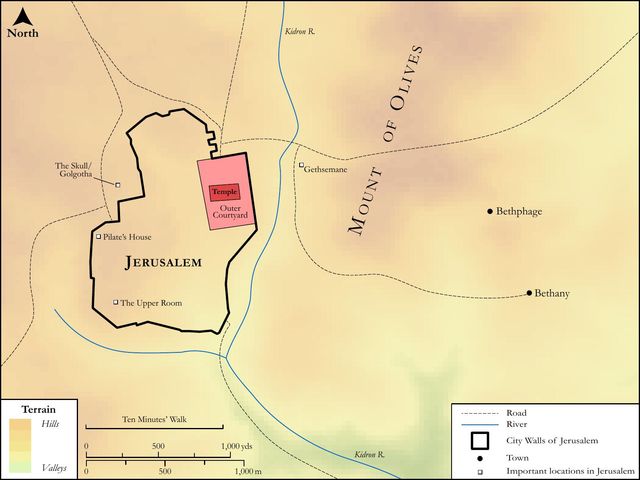
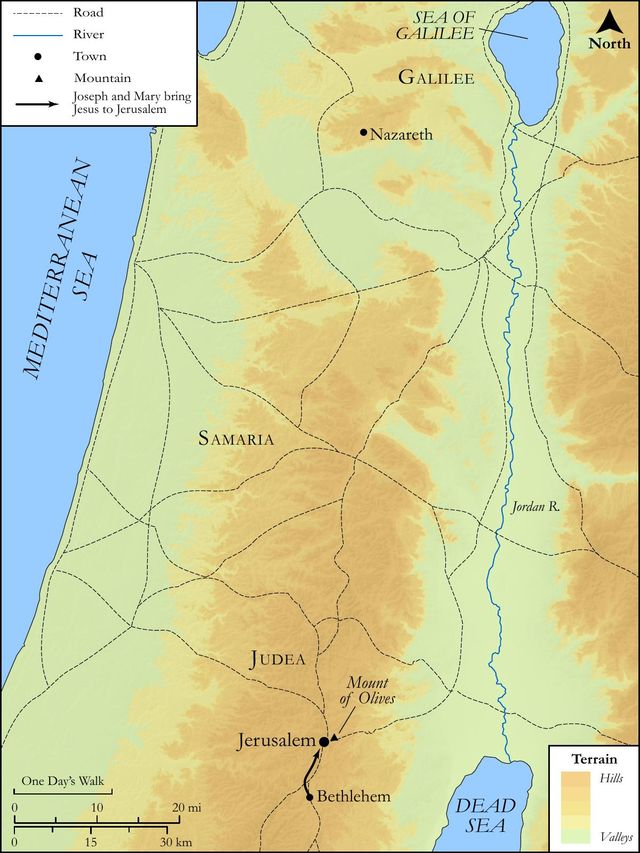
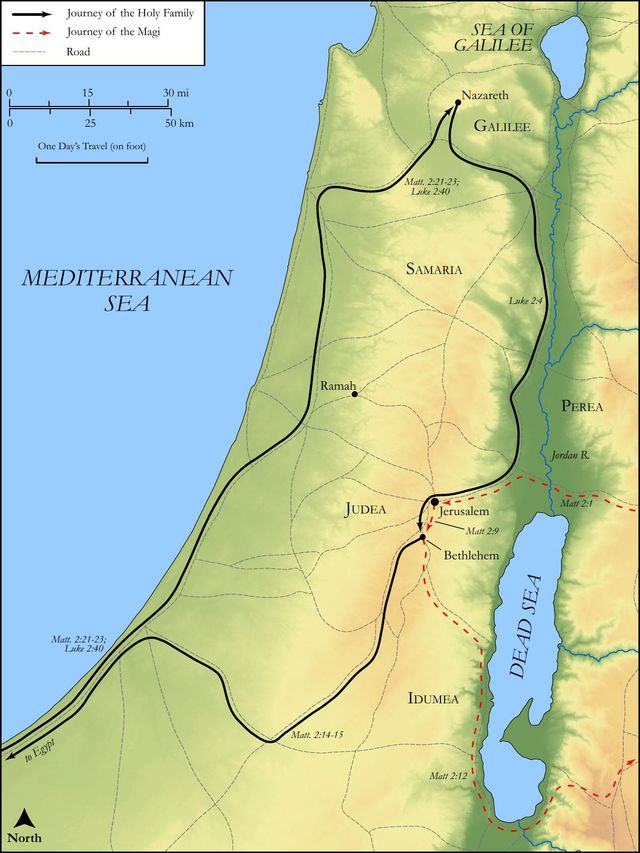
See on the biblical-era maps
Study this verse
Public-domain commentary
Matthew Henry
From his Commentary on the Whole Bible. Henry wrote on whole passages, and this entry covers Luke 2:25–40. He set out his notes in a four-level outline, kept here as he numbered it.
Even when he humbles himself, still Christ has honour done him to balance the offence of it. That we might not be stumbled at the meanness of his birth, angels then did him honour; and now, that we may not be offended at his being presented in the temple, like other children born in sin, and without any manner of solemnity peculiar to him, but silently, and in the crowd of other children, Simeon and Anna now do him honour, by the inspiration of the Holy Ghost.
I.A very honourable testimony is borne to him by Simeon, which was both a reputation to the child and an encouragement to the parents, and might have been a happy introduction of the priests into an acquaintance with the Saviour, if those watchmen had not been blind. Now observe here,
1.The account that is given us concerning this Simeon, or Simon. He dwelt now in Jerusalem, and was eminent for his piety and communion with God. Some learned men, who have been conversant with the Jewish writers, find that there was at this time one Simeon, a man of great note in Jerusalem, the son of Hillel, and the first to whom they gave the title of Rabban, the highest title that they gave to their doctors, and which was never given but to seven of them. He succeeded his father Hillel, as president of the college which his father founded, and of the great Sanhedrim. The Jews say that he was endued with a prophetical spirit, and that he was turned out of his place because he witnessed against the common opinion of the Jews concerning the temporal kingdom of the Messiah; and they likewise observe that there is no mention of him in their Mishna, or book of traditions, which intimates that he was no patron of those fooleries. One thing objected against this conjecture is that at this time his father Hillel was living, and that he himself lived many years after this, as appears by the Jewish histories; but, as to that, he is not here said to be old; and his saying, Now let thy servant depart intimates that he was willing to die now, but does not conclude that therefore he did die quickly. St. Paul lived many years after he had spoken of his death as near, Acts 20:25. Another thing objected is that the son of Simeon was Gamaliel, a Pharisee, and an enemy to Christianity; but, as to that, it is no new thing for a faithful lover of Christ to have a son a bigoted Pharisee.
The account given of him here is, (1.) That he was just and devout, just towards men and devout towards God; these two must always go together, and each will befriend the other, but neither will atone for the defect of the other. (2.) That he waited for the consolation of Israel, that is, for the coming of the Messiah, in whom alone the nation of Israel, that was now miserably harassed and oppressed, would find consolation. Christ is not only the author of his people's comfort, but the matter and ground of it, the consolation of Israel. He was long a coming, and they who believed he would come continued waiting, desiring his coming, and hoping for it with patience; I had almost said, with some degree of impatience waiting till it came. He understood by books, as Daniel, that the time was at hand, and therefore was now more than ever big with expectation of it. The unbelieving Jews, who still expect that which is already come, use it as an oath, or solemn protestation, As ever I hope to see the consolation of Israel, so and so it is. Note, The consolation of Israel is to be waited for, and it is worth waiting for, and it will be very welcome to those who have waited for it, and continue waiting. (3.) The Holy Ghost was upon him, not only as a Spirit of holiness, but as a Spirit of prophecy; he was filled with the Holy Ghost, and enabled to speak things above himself. (4.) He had a gracious promise made him, that before he died he should have a sight of the Messiah, Luke 2:26. He was searching what manner of time the Spirit of Christ in the Old Testament prophets did signify, and whether it were not now at hand; and he received this oracle (for so the word signifies), that he should not see death before he had seen the Messiah, the Lord's Anointed. Note, Those, and those only, can with courage see death, and look it in the face without terror, that have had by faith a sight of Christ.
2.The seasonable coming of Simeon into the temple, at the time when Christ was presented there, Luke 2:27. Just then, when Joseph and Mary brought in the child, to be registered as it were in the church-book, among the first-born, Simeon came, by direction of the Spirit, into the temple. The same Spirit that had provided for the support of his hope now provided for the transport of his joy. It was whispered in his ear, "Go to the temple now, and you shall see what you have longed to see." Note, Those that would see Christ must go to his temple; for there The Lord, whom ye seek, shall suddenly come to meet you, and there you must be ready to meet him.
3.The abundant satisfaction wherewith he welcomed this sight: He took him up in his arms (Luke 2:28), he embraced him with the greatest affection imaginable, laid him in his bosom, as near his heart as he could, which was as full of joy as it could hold. He took him up in his arms, to present him to the Lord (so some think), to do either the parent's part or the priest's part; for divers of the ancients say that he was himself a priest. When we receive the record which the gospel gives us of Christ with a lively faith, and the offer it makes us of Christ with love and resignation, then we take Christ in our arms. It was promised him that he should have a sight of Christ; but more is performed than was promised: he has him in his arms.
4.The solemn declaration he made hereupon: He blessed God, and said, Lord, now let thou thy servant depart in peace, Luke 2:29-32.
(1.)He has a pleasant prospect concerning himself, and (which is a great attainment) is got quite above the love of life and fear of death; nay, he is arrived at a holy contempt of life, and desire of death: "Lord, now let thou thy servant depart, for mine eyes have seen the salvation I was promised a sight of before I died." Here is,
[1.]An acknowledgment that God had been as good as his word; there has not failed one tittle of his good promises, as Solomon owns, 1 Kings 8:56. Note, Never any that hoped in God's word were made ashamed of their hope.
[2.]A thanksgiving for it. He blessed God that he saw that salvation in his arms which many prophets and kings desired to see, and might not.
[3.]A confession of his faith, that the child in his arms was the saviour, the Salvation itself; thy salvation, the salvation of thine appointing, the salvation which thou has prepared with a great deal of contrivance. And, while it has been thus long in the coming, it hath still been in the preparing.
[4.]It is a farewell to this world: "Now let thy servant depart; now mine eyes have been blessed with this sight, let them be closed, and see no more in this world." The eye is not satisfied with seeing (Ecclesiastes 1:8), till it hath seen Christ, and then it is. What a poor thing doth this world look to one that hath Christ in his arms and salvation in his eye! Now adieu to all my friends and relations, all my enjoyments and employments here, even the temple itself.
[5.]It is a welcome to death: Now let thy servant depart. Note, Death is a departure, the soul's departure out of the body, from the world of sense to the world of spirits. We must not depart till God give us our discharge, for we are his servants and must not quit his service till we have accomplished our time. Moses was promised that he should see Canaan, and then die; but he prayed that this word might be altered, Deuteronomy 3:24, Deuteronomy 3:25. Simeon is promised that he should not see death till he had seen Christ; and he is willing to construe that beyond what was expressed, as an intimation that, when he had seen Christ, he should die: Lord, be it so, saith he, now let me depart. See here, First, How comfortable the death of a good man is; he departs as God's servant from the place of his toil to that of his rest. He departs in peace, peace with God, peace with his own conscience; in peace with death, well-reconciled to it, well-acquainted with it. He departs according to God's word, as Moses at the word of the Lord (Deuteronomy 34:5): the word of precept, Go up and die; the word of promise, I will come again and receive you to myself. Secondly, What is the ground of this comfort? For mine eyes have seen thy salvation. This bespeaks more than a great complacency in the sight, like that of Jacob (Genesis 46:30), Now let me die, since I have seen thy face. It bespeaks a believing expectation of a happy state on the other side death, through this salvation he now had a sight of, which not only takes off the terror of death, but makes it gain, Philippians 1:21. Note, Those that have welcomed Christ may welcome death.
(2.)He has a pleasant prospect concerning the world, and concerning the church. This salvation shall be,
[1.]A blessing to the world. It is prepared before the face of all people, not to be hid in a corner, but to be made known; to be a light to lighten the Gentiles that now sit in darkness: they shall have the knowledge of him, and of God, and another world through him. This has reference to Isaiah 49:6, I will give thee for a light to the Gentiles; for Christ came to be the light of the world, not a candle in the Jewish candlestick, but the Sun of righteousness.
[2.]A blessing to the church: the glory of thy people Israel. It was an honour to the Jewish nation that the Messiah sprang out of one of their tribes, and was born, and lived, and died, among them. And of those who were Israelites indeed of the spiritual Israel, he was indeed the glory, and will be so to eternity, Isaiah 60:19. They shall glory in him. In the Lord shall all the seed of Israel be justified and shall glory, Isaiah 45:25. When Christ ordered his apostles to preach the gospel to all nations, therein he made himself a light to lighten the Gentiles; and when he added, beginning at Jerusalem, he made himself the glory of his people Israel.
5.The prediction concerning this child, which he delivered, with his blessing, to Joseph and Mary. They marvelled at those things which were still more and more fully and plainly spoken concerning this child, Luke 2:33. And because they were affected with, and had their faith strengthened by, that which was said to them, here is more said to them.
(1.)Simeon shows them what reason they had to rejoice; for he blessed them (Luke 2:34), he pronounced them blessed who had the honour to be related to this child, and were entrusted with the bringing him up. He prayed for them, that God would bless them, and would have others do so too. They had reason to rejoice, for this child should be, not only a comfort and honour to them, but a public blessing. He is set for the rising again of many in Israel, that is, for the conversion of many to God that are dead and buried in sin, and for the consolation of many in God that are sunk and lost in sorrow and despair. Those whom he is set for the fall of may be the same with those whom he is set for the rising again of. He is set eis ptōsin kai anastasin - for their fall, in order to their rising again; to humble and abase them, and bring them off from all confidence in themselves, that they may be exalted by relying on Christ; he wounds and then heals, Paul falls, and rises again.
(2.)He shows them likewise what reason they had to rejoice with trembling, according to the advice given of old, with reference to the Messiah's kingdom, Psalm 2:11. Lest Joseph, and Mary especially, should be lifted up with the abundance of the revelations, here is a thorn in the flesh for them, an allay to their joy; and it is what we sometimes need.
[1.]It is true, Christ shall be a blessing to Israel; but there are those in Israel whom he is set for the fall of, whose corruptions will be provoked, who will be prejudiced and enraged against him, and offended, and whose sin and ruin will be aggravated by the revelation of Jesus Christ; many who will extract poison to themselves out of the balm of Gilead, and split their souls on the Rock of salvation, to whom this precious Foundation-stone will be a stone of stumbling. This refers to that prophecy (Isaiah 8:14, Isaiah 8:15), He shall be for a sanctuary to some, and yet for a snare to others, 1 Peter 2:7, 1 Peter 2:8. Note, As it is pleasant to think how many there are to whom Christ and his gospel are a savour of life unto life, so it is sad to think how many there are to whom it is a savour of death unto death. He is set for a sign, to be admired by some, but by others, by many, spoken against. He had many eyes upon him, during the time of his public ministry, he was a sign, but he had many tongues against him, the contradiction and reproach of sinners, he was continually cavilled at and abused; and the effects of this will be that the thoughts of many hearts will be revealed (Luke 2:35), that is, upon this occasion, men will show themselves, will discover, and so distinguish, themselves. The secret good affections and dispositions in the minds of some will be revealed by their embracing Christ, and closing with him; the secret corruptions and vicious dispositions of others, that otherwise would never have appeared so bad, will be revealed by their enmity to Christ and their rage against him. Men will be judged of by the thoughts of their hearts, their thoughts concerning Christ; are they for him, or are they for his adversaries? The word of God is a discerner of the thoughts and intents of the heart, and by it we are discovered to ourselves, and shall be judged hereafter.
[2.]It is true, Christ shall be a comfort to his mother; but be not thou too proud of it, for a sword shall pass through thine own soul also. He shall be a suffering Jesus; and, First, "Thou shalt suffer with him, by sympathy, more than any other of his friends, because of the nearness of thy relation, and strength of affection, to him." When he was abused, it was a sword in her bones. When she stood by his cross, and saw him dying, we may well think her inward grief was such that it might truly be said, A sword pierced through her soul, it cut her to the heart. Secondly, Thou shalt suffer for him. Many understand it as a prediction of her martyrdom; and some of the ancients say that it had its accomplishment in that. Note, In the midst of our greatest delights and advancements in this world, it is good for us to know that bonds and afflictions abide us.
II.He is taken notice of by one Anna, or Ann, a prophetess, that one of each sex might bear witness to him in whom both men and women are invited to believe, that they may be saved. Observe,
1.The account here given of this Anna, who she was. She was,
(1.)A prophetess; the Spirit of prophecy now began to revive, which had ceased in Israel above three hundred years. Perhaps no more is meant than that she was one who had understanding in the scriptures above other women, and made it her business to instruct the younger women in the things of God. Though it was a very degenerate age of the church, yet God left not himself without witness.
(2.)She was the daughter of Phanuel; her father's name (says Grotius) is mentioned, to put us in mind of Jacob's Phanuel, or Penuel (Genesis 32:30), that now the mystery of that should be unfolded, when in Christ we should as it were see God face to face, and our lives be preserved; and her name signifies gracious.
(3.)She was of the tribe of Asher, which was in Galilee; this, some think, is taken notice of to refute those who said, Out of Galilee ariseth no prophet, when no sooner did prophecy revive but it appeared from Galilee.
(4.)She was of a great age, a widow of about eighty-four years; some think she had now been eighty-four years a widow, and then she must be considerably above a hundred years old; others, rather than suppose that a woman so very old should be capable of fasting and praying as she did, suppose that she was only eighty-four years of age, and had been long a widow. Though she was a young widow, and had lived with her husband but seven years, yet she never married again, but continued a widow to her dying day, which is mentioned to her praise.
(5.)She was a constant resident in or at least attendant on the temple. Some think she had lodgings in the courts of the temple, either in an alms-house, being maintained by the temple charities; or, as a prophetess, she was lodged there, as in a proper place to be consulted and advised with by those that desired to know the mind of God; others think her not departing from the temple means no more, than that she was constantly there at the time of divine service: when any good work was to be done, she was ready to join in it. It is most probable she had an apartment of her own among the out-buildings of the temple; and, besides her constant attendance on the public worship, abounded in private devotions, for she served God with fastings and prayers night and day: having no secular business to employ herself in, or being past it, she gave up herself wholly to her devotions, and not only fasted twice in the week, but always lived a mortified life, and spent that time in religious exercises which others spent in eating and drinking and sleeping; she not only observed the hours of prayer, but prayed night and day; was always in a praying frame, lived a life of prayer, gave herself to prayer, was frequent in ejaculations, large in solemn prayers, and very particular in her intercessions. And in these she served God; that was it that put a value upon them and an excellency into them. The Pharisees fasted often, and made long prayers, but they served themselves, and their own pride and covetousness, in their fastings and prayers; but this good woman not only did that which was good, but did it from a good principle, and with a good end; she served God, and aimed at his honour, in fasting and praying. Note,
[1.]Devotion is a thing we ought to be constant in; other duties are in season now and then, but we must pray always.
[2.]It is a pleasant sight to see aged Christians abounding in acts of devotion, as those that are not weary of well-doing, that do not think themselves above these exercises, or past them, but that take more and more pleasure in them, and see more and more need of them, till they come to heaven.
[3.]Those that are diligent and faithful in improving the light and means they have shall have further discoveries made them. Anna is now at length abundantly recompensed for her attendance so many years in the temple.
2.The testimony she bore to our Lord Jesus (Luke 2:38): She came in at that instant when the child was presented, and Simeon discoursed concerning him; she, who was so constant to the temple, could not miss the opportunity.
Now, (1.) She gave thanks likewise to the Lord, just as Simeon, perhaps like him, wishing now to depart in peace. Note, Those to whom Christ is made known have reason enough to give thanks to the Lord for so great a favour; and we should be excited to that duty by the praises and thanksgivings of others; why should not we give thanks likewise, as well as they? Anna concurred with Simeon, and helped to make up the harmony. She confessed unto the Lord (so it may be read); she made an open profession of her faith concerning this child.
(2.)She, as a prophetess, instructed others concerning him: She spoke of him to all them that believed the Messiah would come, and with him looked for redemption in Jerusalem. Redemption was the thing wanted, waited for, and wished for; redemption in Jerusalem, for thence the word of the Lord was to go forth, Isaiah 2:3. Some there were in Jerusalem that looked for redemption; yet but a few, for Anna, it should seem, had acquaintance with all them that were joint-expectants with her of the Messiah; she knew where to find them, or they where to find her, and she told them all the good news, that she had seen the Lord; and it was great news, this of his birth now, as afterwards that of his resurrection. Note, Those that have an acquaintance with Christ themselves should do all they can to bring others acquainted with him.
Lastly, Here is a short account of the infancy and childhood of our Lord Jesus.
1.Where he spent it, Luke 2:39. When the ceremony of presenting the child, and purifying the mother, was all over, they returned into Galilee. Luke relates no more concerning them, till they were returned into Galilee; but it appears by St. Matthew's gospel (Matthew 2:1) that from Jerusalem they returned to Bethlehem, where the wise men of the east found them, and there they continued till they were directed to flee into Egypt, to escape the malice and rage of Herod; and, returning thence when Herod was dead, they were directed to go to their old quarters in Nazareth, whence they had been perhaps some years absent. It is here called their own city, because there they had lived a great while, and their relations were there. He was ordered further from Jerusalem, because his kingdom and priesthood were to have no affinity with the present government of the Jewish church or state. He is sent into a place of obscurity and reproach; for in this, as in other things, he must humble himself and make himself of no reputation.
2.How he spent it, Luke 2:40. In all things it behoved him to be made like unto his brethren, and therefore he passed through infancy and childhood as other children did, yet without sin; nay, with manifest indications of a divine nature in him. As other children, he grew in stature of body, and the improvement of understanding in his human soul, that his natural body might be a figure of his mystical body, which, though animated by a perfect spirit, yet maketh increase of itself till it comes to the perfect man, Ephesians 4:13, Ephesians 4:16. But,
(1.)Whereas other children are weak in understanding and resolution, he was strong in spirit. By the Spirit of God his human soul was endued with extraordinary vigour, and all his faculties performed their offices in an extraordinary manner. He reasoned strongly, and his judgment was penetrating.
(2.)Whereas other children have foolishness bound in their hearts, which appears in what they say or do, he was filled with wisdom, not by any advantages of instruction and education, but by the operation of the Holy Ghost; every thing he said and did was wisely said, and wisely done, above his years.
(3.)Whereas other children show that the corruption of nature is in them, and the tares of sin grow up with the wheat of reason, he made it appear that nothing but the grace of God was upon him (the wheat sprang up without tares), and that, whereas other children are by nature children of wrath, he was greatly beloved, and high in the favour of God; that God loved him, and cherished him, and took a particular care of him.
Historical interpretation
Five Centuries of Reception
14 surviving comments on this verse. Each one is dated, so this reads as a timeline rather than a list.
Select a marker to jump to its quote. Markers stagger vertically where authors wrote within a few decades of each other.
(Photius.) The knowledge of supernatural things, as often as it is brought to the recollection, renews the miracle in the mind, and hence it is said, His father and mother marvelled at those things which were said of him.
(ubi sup.) Having given praise to God, Simeon now turns to bless them that brought the Child, as it follows, And Simeon blessed them. He gave to each a blessing, but his presage of hidden things he imparts only to the mother, in order that in the common blessing He might not deprive Joseph of the likeness of a father, but in what he says to the mother apart from Joseph he might proclaim her to be the true mother.
Both by the angel and the multitude of the heavenly host, by the shepherds also, and Simeon.
But they who look deeper into the matter may say, that since the genealogy is deduced from David to Joseph, therefore lest Joseph should seem to be mentioned for no purpose, as not being the father of the Saviour, he was called His father, that the genealogy might maintain its place.
Simeon said likewise, “You will remove the sword.” Mary removed the sword that protected Paradise because of Eve. Alternatively, “you will remove the sword,” that is, a denial. For the Greek says clearly, the inner thoughts of a great number will be revealed, that is, the thoughts of those who had doubted. For he said, “You will remove the sword.” Indeed, you too will doubt, because she thought that he was the gardener. Mary wondered at his birth, it is said, and at his conception. She recounted to others how she had conceived, and indeed how she had given birth. Those who had doubted it were comforted by the wonderment of her word.
(ep. 260. ad Opt.) The sign which is spoken against is called in Scripture, the cross. For Moses, it says, made a brazen serpent, and placed it for a sign. (Numb. 21:8.)
(ubi sup.) For a sign betokens something marvellous and mysterious, which is seen indeed by the simple minded.
“That the thoughts of many hearts may be revealed” means that after the scandal which happened at the cross of Christ to both the disciples and to Mary herself, some swift healing will follow from the Lord, confirming their hearts in their faith in him. Thus we see that even Peter, after having stumbled, clung more firmly to his faith in Christ. What was human, therefore, was proven unsound in order that the power of the Lord might be manifested.
(non occ.) Mark the nice distinction here observed. Salvation is said to be prepared before the face of all people, but the falling and raising is of many; for the Divine purpose was the salvation and sanctification of every one, whereas the falling and lifting up stands in the will of many, believers and unbelievers. But that those who were lying in unbelief should be raised up again is not unreasonable.
(non occ.) But by this he signifies a fall to the very lowest, as if the punishment before the mystery of the incarnation, fell far short of that after the giving and preaching of the Gospel dispensation. And those spoken of are chiefly of Israel, who must of necessity forfeit their ancient privileges, and pay a heavier penalty than any other nation, because they were so unwilling to receive Him Who had long been prophesied among them, had been worshipped, and had come forth from them. In a most especial manner then he threatens them with not only a fall from spiritual freedom, but also the destruction of their city, and of those who dwelt among them. But a resurrection is promised to believers, partly indeed as subject to the law, and about to be delivered from its bondage, but partly as buried together with Christ, and rising with Him.
(hom. de occ. Dom.) Now from these words, you may perceive through the agreement of men's minds on the word of prophecy, that one and the same God and lawgiver hath spoken both in the Prophets and the New Testament. For the language of prophecy declared that there shall be a stone of fulling, and a rock of offence, that they who believe on Him should not be confounded. (Is. 8:14, Rom. 9:33.) The fall therefore is to them who are offended with the meanness of His coming in the flesh; the rising again to those who acknowledge the stedfastness of the Divine purpose.
(non occ.) He has joined together honour and dishonour. For to us Christians this sign is a token of honour, but it is a sign of contradiction, inasmuch by some indeed it is received as absurd and monstrous, by others with the greatest veneration. Or perhaps Christ Himself is termed a sign, as having a supernatural existence, and as the author of signs.
(non occ.) Though these things are said of the Son, yet they have reference also to His mother, who takes each thing to herself, whether it be of danger or glory. He announces to her not only her prosperity, but her sorrows; for it follows. And a sword shall pierce through thy own heart.
(de occ. Dom. non occ.) But it is not meant that she alone was concerned in that passion, for it is added, that the thoughts of many hearts may be revealed. The word that marks the event; it is not used causatively; for when all these events took place, there followed the discovery of many men's intentions. For some confessed God on the cross, others even then ceased not from their blasphemies and revilings. Or this was said, meaning that at the time of the passion the thoughts of men's hearts should be laid open, and be corrected by the resurrection. For doubts are quickly superseded by certainty. Or perhaps by revealing may be meant, the enlightening of the thoughts, as it is often used in Scripture.
Neither letter nor history teaches that Mary passed from this life by the bodily suffering of death; for it was not the soul, but the body, that was pierced by the material sword. And therefore, the prudence of Mary shows her to be not unaware of the heavenly mystery. For the living word of God, and sharp and piercing with every sharpest sword, penetrates even to the division of soul and spirit, of joints and marrow, and searches the thoughts and secret intentions of the heart; for all things are naked and open to the Son of God, to whom the secrets of consciences do not deceive.
Behold what abundant grace is extended to all men by the birth of the Lord, and how prophecy is withheld from the unbelievers, not from the righteous. Simeon also prophesies that Christ Jesus has come for the fall and rising again of many.
That is, to distinguish the merits of the just and the unjust, and according to the quality of our deeds, as a true and just Judge, to decree punishment or rewards.
Or it shows the wisdom of Mary, that she was not ignorant of the heavenly Majesty. For the word of God is living and strong, and sharper than the sharpest sword. (Heb. 4:12.)
He is set for the fall of the unbelieving Jews, but for the resurrection of the believing Gentiles. “And for a sign that is spoken against.” The cross is a sign that is spoken against. Why? Because many who did not believe denied him at the cross. They ridiculed it both by deeds and words. They gave him vinegar to drink, offered him gall for his thirst, twisted a wreath of thorns to put on his brow, pierced his side with a spear, struck him with their hands, and shouted at him with offensive clamor: “He saved others, but cannot save himself.”
As the light though it may annoy weak eyes, is still light; in like manner the Saviour endures, though many fall away, for His office is not to destroy; but their way is madness. Wherefore not only by the salvation of the good, but by the scattering of the wicked, is His power shewn. For the sun the brighter it shines, is the more trying to the weak sight.
The resurrection is a new life and conversation. For when the sensual man becomes chaste, the covetous merciful, the cruel man gentle, a resurrection takes place. Sin being dead, righteousness rises again. It follows, And for a sign which shall be spoken against.
(de Con. in Evan. ii. 1.) He however might be called His father in that light in which he is rightly regarded as the husband of Mary, that is, not from any carnal connection, but by reason of the very bond of wedlock, a far closer relationship than that of adoption. For that Joseph was not to be called Christ's father was not, because he had not begotten Him by cohabitation, since in truth he might be a father to one whom he had not begotten from his wife, but had adopted from another.
Joseph is called the father of the Saviour, not because he was (as the Photinians say) His real father, but because from regard to the reputation of Mary, all men considered him so.
No history tells us that Mary departed this life by being slain with the sword, therefore since not the soul but the body is killed with iron, we are left to understand that sword which is mentioned, And a sword in their lips, (Ps. 59:7.) that is, grief because of our Lord's passion passed through her soul, who although she saw Christ the very Son of God die a voluntary death, and doubted not that He who was begotten of her flesh would overcome death, could not without grief see Him crucified.
But now even down to the close of the present time, the sword of the severest tribulation ceases not to go through the soul of the Church, when with bitter sorrow she experiences the evil speaking against the sign of faith, when hearing the word of God that many are raised with Christ, she finds still more falling from the faith, when at the revealing of the thoughts of many hearts, in which the good seed of the Gospel has been sown, she beholds the tares of vice overshooting it, spreading beyond it, or growing alone.
And his father and mother were marveling at what was said about him, and Simeon blessed them. He calls Joseph the father of the Savior, not that he was truly his father according to the Photinians, but since he was considered by all to be the father for the preservation of Mary's reputation. Nor did the Evangelist forget that he told she had conceived by the Holy Spirit and given birth as a virgin, but expressing the opinion of the people, which is the true law of history, he calls Joseph the father of Christ. Although in that way, he can rightly be called his father, as he is rightly understood as the husband of Mary without physical union, by the marriage bond itself, much more closely united indeed than if he had been adopted from elsewhere. For neither should Joseph be called the father of Christ because he had not begotten him through intercourse, since he would rightly be the father even if he had adopted someone not born from his wife elsewhere.
However, this blessed one, who had been found worthy of gifts surpassing nature, did at the time of the passion suffer the pangs which she had escaped at childbirth. When she saw him put to death as a criminal—the man she knew to be God when she gave birth to him—her heart was torn from maternal compassion and she was rent by her thoughts as by a sword. This is the meaning of “and a sword will pierce through your own soul.” But her grief gave way to the joy of the resurrection, the resurrection which proclaimed him to be God who had died in the flesh.
Continue studying Luke 2:33 across the web’s major study libraries — every link below opens this exact verse, chapter, or book on the destination site.
Read & Compare
 BibleGatewayThis verse in more than 200 translations and 70 languages.
 Bible.comThe YouVersion reader — hundreds of translations, reading plans, and highlights.
 ESV.orgCrossway's official English Standard Version reader.
 NET BibleThe NET translation with 60,000+ translators' notes on every rendering decision.
 STEP BibleTyndale House's free study tool — original text, vocabulary, and scholarly resources.
 BibliaLogos Bible Software's free web reader.
 USCCBThe New American Bible (Revised Edition) with the U.S. bishops' study notes.
Commentaries
 BibleHub CommentariesDozens of classic commentaries on this verse, gathered on one page.
 StudyLightMore than 100 commentary sets — the largest collection on the web.
 BibleRefPlain-English commentary on what this verse means, verse by verse.
 Enduring WordDavid Guzik's free commentary on this chapter, widely used by Bible teachers.
 Bible Study ToolsVerse commentary alongside Greek and Hebrew study aids.
Original Language & Research
- BibleHub InterlinearThe verse word by word — original language, transliteration, and English.
- BibleHub LexiconEvery word's original-language definition and Strong's entry.
 Blue Letter BibleDeep-study tools — Strong's numbers, concordance, and word studies.
 CNTR CollationThe earliest Greek manuscripts of this verse, collated letter by letter.
Sermons, Hymns & Audio


TrulyRandomVerse is not affiliated with these sites and doesn’t control their content. They’re linked because they’re genuinely useful.
Written with AI assistance. Always check it against Scripture.
This verse
Joseph and Mary are filled with wonder at what Simeon says about their son.
“And Joseph and his mother”
Both parents heard Simeon, and both were moved.
“marvelled”
Wonder and awe at what they heard.
“at those things which were spoken of him.”
Simeon’s words in verses 29–32, above all that the child would be a light to the Gentiles.
Mine Eyes Have Seen Thy Salvation
Luke 2:21–40
Summary
Eight days after his birth the child is circumcised and given the name the angel had chosen, JESUS. When Mary’s forty days of purification are over, Joseph and Mary bring him to the temple in Jerusalem to present him to the Lord as the law of the firstborn requires, and they offer the two birds the law allows to families who cannot afford a lamb. The Holy Spirit brings Simeon into the temple at that hour, a just and devout man who has been promised that he will see the Lord’s Christ before he dies. He takes the child in his arms and blesses God, because he can now depart in peace: he has seen God’s salvation, a light for the Gentiles and the glory of Israel. Then he tells Mary that her son will be the fall and rising again of many, a sign spoken against, and that a sword will pierce her own soul. Anna, a widow and prophetess who has worshipped in the temple for decades, gives thanks too and speaks of him to all who are waiting for redemption. The family goes home to Nazareth, and the child grows strong, full of wisdom, with the grace of God upon him. In these twenty verses the Son of God keeps the law from his first days, and those who have waited longest for God’s promise are the first to recognise it in a poor family’s baby.
Why Jesus was circumcised and named on the eighth day
Luke moves from the birth in Bethlehem and the visit of the shepherds (Luke 2:1–20) to the child’s first week. The law commanded that a baby boy be circumcised on the eighth day (Leviticus 12:3), and circumcision was the sign of the covenant God made with Abraham and his descendants (Genesis 17:9–14). The word Luke uses for the days being “accomplished”, plḗthō, means to fill or to fulfil, and it describes a set time running its full course. On the very day the law appointed, Joseph and Mary did what every faithful family in Israel did, and God’s plan moved forward on time.
Circumcision was also the usual occasion for giving a boy his name, often with family and neighbours present. The verb kaléō means to call or to name, and the passive “his name was called” fits what Luke says next, that the name came from God. Gabriel had told Mary to call her son JESUS before he was conceived (Luke 1:31), and an angel told Joseph the same and gave the reason: “thou shalt call his name JESUS: for he shall save his people from their sins” (Matthew 1:21). Mary and Joseph gave their son the name God had already given him.
Iēsoûs is the Greek form of the Hebrew name Yeshua, or Joshua, which means “the LORD is salvation” or “the LORD saves”. In Israel a name often carried meaning and could speak of a person’s character or calling, and this name tells the child’s whole mission. God settled who he would be and what he would do before he was conceived, so the plan of salvation was already in place on the day he was born.
Why was the sinless Jesus circumcised?
Jesus had no sin, and still he received the sign of the covenant, because he came as a true son of Abraham and a true member of Israel. Paul writes, “when the fulness of the time was come, God sent forth his Son, made of a woman, made under the law, to redeem them that were under the law, that we might receive the adoption of sons” (Galatians 4:4–5). The one who gave the law placed himself under it, and from his eighth day he began the obedience that marked his whole life. At his baptism he told John that it became them “to fulfil all righteousness” (Matthew 3:15), and he said that he came to fulfil the law and the prophets (Matthew 5:17).
His circumcision is an early picture of the humility Paul describes, when the Son who was in the form of God took the form of a servant and became obedient unto death (Philippians 2:5–8). He stood with sinful people as one of them, and in the end God “made him to be sin for us, who knew no sin” (2 Corinthians 5:21). By the obedience of this one man many are made righteous (Romans 5:19), and he is the Lamb of God who takes away the sin of the world (John 1:29). Those who belong to him receive “the circumcision made without hands”, the putting off of sin through union with him (Colossians 2:11–12).
Why Jesus was brought to the temple
Two laws brought the family to Jerusalem about forty days after the birth. The first concerned the mother. Under Leviticus 12:1–4, a woman who gave birth to a son was ceremonially unclean for forty days, and at the end of that time she brought offerings to the priest so that she could be declared clean and take part again in the worship of God’s house (Leviticus 12:6–8). The word for purification, katharismós, means a washing or cleansing, here the ritual cleansing the law required. The second law concerned the child, because a firstborn son belonged to the Lord. The temple stood in Jerusalem, and that is where these things were to be done.
To “present” him, parístēmi, is to stand someone beside another, or to offer him. The parents set their son before God and gave him to God. “The Lord” here, kýrios, the one supreme in authority, is the LORD, the God of Israel, who had claimed every firstborn as his own ever since the Passover, when he spared the firstborn of Israel (Exodus 13:2, 13:12). The law also required a firstborn son to be redeemed with five shekels paid to the priests (Numbers 18:15–16). Luke is silent about the payment and dwells on the giving of the child to God.
With this child the offering means more than it did for any other family. The baby set before the Lord is the Son who would one day offer himself “without spot to God” through the eternal Spirit (Hebrews 9:14), and who became our high priest, “touched with the feeling of our infirmities” (Hebrews 4:14–16). Paul uses the same picture of presenting when he asks believers to present their bodies “a living sacrifice, holy, acceptable unto God” (Romans 12:1).
Why did Mary need to be purified?
Mary conceived by the Holy Spirit and her son was sinless, yet she kept the law of purification like any other mother. The uncleanness of Leviticus 12 was a ritual state that came on every woman after childbirth, whatever the circumstances of the birth, and it was no mark of personal sin. It belonged to the order God gave to keep his people and his house holy, and Mary, a faithful daughter of Israel, humbly kept it. Her obedience, like her son’s circumcision, shows a family living fully within the life of God’s people.
Every firstborn son holy to the Lord
Luke stops to quote the law: “Every male that openeth the womb shall be called holy to the Lord.” The word “written”, gráphō, means to engrave or to write, and it marks this as God’s recorded command. The law Luke sums up is Exodus 13:2, where God says, “Sanctify unto me all the firstborn,” and Numbers 3:13, where he says that all the firstborn are his because he hallowed them on the day he smote the firstborn of Egypt.
The verb dianoígō means to open fully, and “openeth the womb” is the Bible’s way of speaking of a mother’s first child. The word hágios, holy, means set apart for God and belonging to him, so a firstborn son was called holy because God had a claim on him. Firstborn animals were sacrificed and firstborn sons were redeemed, and both acknowledged that the first and best belonged to God. Behind it all stands the Exodus, when God called the whole nation “my son, even my firstborn” (Exodus 4:22).
Jesus fulfils this law as no other firstborn could. He is “the firstborn of every creature” (Colossians 1:15) and “the firstborn from the dead” (Colossians 1:18), and he is the high priest who is “holy, harmless, undefiled” (Hebrews 7:26). Through him those who believe belong to “the church of the firstborn, which are written in heaven” (Hebrews 12:23).
The offering of the poor
The sacrifice, thysía, was an offering brought to God. The law, nómos, comes from a word meaning to parcel out, and it means a fixed rule, here the law God gave through Moses. A mother normally brought a lamb for a burnt offering and a young pigeon or a turtledove for a sin offering (Leviticus 12:6). Then the law adds, “And if she be not able to bring a lamb, then she shall bring two turtles, or two young pigeons; the one for the burnt offering, and the other for a sin offering” (Leviticus 12:8). Luke quotes this allowance: a pair of turtledoves or two young pigeons. The word for pair, zeûgos, is related to the yoke that joins two animals, and the birds are the turtledove, trygṓn, and the pigeon, peristerá. So Joseph and Mary were among the poor, too poor to bring a lamb.
God made this provision so that the poorest family could come before him with what it had, and their offering was received as fully as a lamb. The Son of God came into a household of modest means. Mary had sung that God “hath put down the mighty from their seats, and exalted them of low degree. He hath filled the hungry with good things” (Luke 1:52–53), and her own son was born among the lowly, the one who “took upon him the form of a servant” (Philippians 2:7). The family who were too poor for a lamb carried in their arms the Lamb of God, whose one sacrifice would accomplish what the blood of animals could only point to (Hebrews 10:1–18).
Simeon, the man waiting for the consolation of Israel
Luke’s “And, behold” brings a new and important person into the story. Simeon lived in Jerusalem, and Luke describes him in four ways. He was just, díkaios, living by God’s righteous standards, and devout, eulabḗs, a word for careful reverence that comes from the idea of taking hold of things well. He was waiting for the consolation of Israel, and the Holy Ghost was upon him.
The consolation, paráklēsis, is comfort, encouragement and solace. “The consolation of Israel” was the comfort God had promised to send his people through the Messiah. Isaiah opens his message of hope with the words, “Comfort ye, comfort ye my people, saith your God” (Isaiah 40:1–2), and he looks to the day when “the LORD hath comforted his people, he hath redeemed Jerusalem” (Isaiah 52:9). In Simeon’s day Israel lived under Rome, and many devout people longed for God to deliver the nation and restore David’s kingdom. Simeon was one of the faithful who kept trusting God’s promise through those hard years.
Jesus later called the Holy Spirit “another Comforter” (John 14:16), using a word from the same family. The comfort Simeon waited for reaches further than any political rescue, for it brings reconciliation with God through the death of his Son (Romans 5:10–11) and the cleansing of the conscience by a better sacrifice (Hebrews 9:11–14).
The Holy Spirit resting on Simeon belongs to the way Luke tells this whole history. The Spirit came upon Mary at the conception (Luke 1:35), and in Acts he comes with power on the disciples at Pentecost (Acts 1:8, Acts 2:1–4). On Simeon he gave the insight to recognise God’s Christ and the words to speak about him.
The promise that Simeon would see the Lord’s Christ
The verb for “revealed”, chrēmatízō, is used of a divine message or oracle. Simeon had a direct word from God, given by the Holy Ghost (hágios, holy, with pneûma, Spirit), and it was certain. To “see death” is a common Bible expression for dying, and God had promised that Simeon would live until he had seen the Lord’s Christ with his own eyes. Simeon is usually pictured as an old man, and both this promise and his words about departing fit that, though Luke leaves his age unstated. The same Spirit later spoke to the church at Antioch (Acts 13:2), for he makes God’s will known to his servants.
Christós means anointed. It is the Greek for the Hebrew Messiah, the one God sets apart as king and deliverer. “The Lord’s Christ” is the Anointed who belongs to the Lord and is sent by him, the title of the second psalm, where the rulers take counsel “against the LORD, and against his anointed” (Psalm 2:2). The prophets had spoken of him as “a covenant of the people” and “a light of the Gentiles” (Isaiah 42:6), as the child born whose government and peace would ever increase (Isaiah 9:6–7), and as the coming of the LORD’s glory, which “all flesh shall see” (Isaiah 40:5). Simeon was given to see it while the child was still a baby. God sent his Son “when the fulness of the time was come” (Galatians 4:4), and the Word was made flesh and dwelt among us (John 1:14).
Led by the Spirit into the temple
Simeon “came by the Spirit into the temple”. The word pneûma means breath or wind, and here it is the Holy Spirit, who moved Simeon to go to the temple at the very time the parents came in. The temple, hierón, is the whole sacred area with its courts, where people gathered, as distinct from the inner sanctuary. God brought the waiting man and the promised child to the same place at the same hour. Jesus himself would later be “led by the Spirit into the wilderness” (Luke 4:1).
Luke calls Joseph and Mary “the parents” (goneis), the ordinary word for a child’s father and mother. He has already told of the virgin birth, and the word speaks of the family and legal role they had in raising him. They had come “to do for him after the custom of the law” (katá to ethisménon tou nómou), and the law (nómos) in view is the purification of the mother (Leviticus 12:2–4) and the dedication of the firstborn.
Simeon takes the child in his arms
Simeon “took him up in his arms”. The verb, déchomai, means to receive or welcome, and it shows a man gladly receiving what he had waited for. The word for arms, ankálē, is the bent arm, curved to hold something close. Holding the child, Simeon “blessed God”. The verb eulogéō is made from the words for good and for word, and it means to speak well of someone, so spoken toward God it is praise and thanksgiving. Simeon’s first response was to praise God for keeping his promise, and his song follows, joining Mary’s song (Luke 1:46–55) and Zacharias’s (Luke 1:68–79) as Luke’s songs of the Saviour’s coming.
Simeon holds the promised seed of Abraham (Galatians 3:16), in whom all the families of the earth would be blessed (Genesis 12:3). Many of his own people would later reject him (John 1:11), while Simeon, taught by the Spirit, knew him as a baby. His praise looks ahead to the day when every knee shall bow and every tongue confess that Jesus Christ is Lord (Philippians 2:9–11).
Simeon’s song, the Nunc Dimittis
Simeon’s words in verses 29 to 32 are known as the Nunc Dimittis, from their opening words in Latin, “Now you dismiss”. They move from Simeon’s own peace to God’s salvation for the whole world.
“Lord, now lettest thou thy servant depart in peace”
Simeon addresses God as despótēs, an absolute master who owns and rules, and calls himself God’s doûlos, a bondservant. The verb for “depart”, from apolýō, means to release or dismiss. Simeon speaks as a servant whose Master now releases him, because the task he was kept for is complete: he has seen the Lord’s Christ, and the promise of verse 26 is kept. “According to thy word” says that God has done exactly as he said, for “he is faithful that promised” (Hebrews 10:23).
Peace, eirḗnē, carries the full sense of the Hebrew shalom: well-being, wholeness and harmony with God. Simeon can face death calmly, with his life’s hope fulfilled, because he has seen God’s salvation. God keeps in perfect peace the one whose mind is stayed on him (Isaiah 26:3), and the peace Simeon knew is the peace Jesus gives, “not as the world giveth” (John 14:27), the peace of God which passes all understanding (Philippians 4:7). Being justified by faith, “we have peace with God through our Lord Jesus Christ” (Romans 5:1), and Christ came to deliver “them who through fear of death were all their lifetime subject to bondage” (Hebrews 2:14–15).
“For mine eyes have seen thy salvation”
The word “For” gives the reason Simeon can depart. The eye, ophthalmós, stands for sight and also for perception, and eídō, to see, can carry the sense of knowing. Simeon saw a baby with his eyes and knew by the Spirit who the baby was. What he saw he calls God’s salvation, sōtḗrion, a form of the word that points to the means of salvation, something concrete and present. God’s saving work had come as a person, and Simeon was holding him.
This is “thy salvation”, God’s own work. Jesus is “the author of eternal salvation unto all them that obey him” (Hebrews 5:9), and “there is none other name under heaven given among men, whereby we must be saved” (Acts 4:12). God sent his Son “that the world through him might be saved” (John 3:17), and those who trust him receive “the end of your faith, even the salvation of your souls” (1 Peter 1:9).
“Before the face of all people”
God “prepared” this salvation. The verb hetoimázō means to make ready or provide, and it speaks of a plan God purposed long before and has now brought to readiness. “Before the face” (kata prosōpon) uses prósōpon, the face or front of a thing, and means openly and in full view. God’s salvation is set out in public. “All people” joins pâs, all, to laós, a people, in the plural: all the peoples. The word laós often means Israel, but joined to “all” it reaches every nation, as the next verse makes plain. This is the salvation the risen Lord sent his disciples to carry to all nations (Matthew 28:19–20) and to the uttermost part of the earth (Acts 1:8), because “God so loved the world” (John 3:16).
“A light to lighten the Gentiles, and the glory of thy people Israel”
Simeon names the two who share this salvation. To the Gentiles, éthnos, the nations outside Israel, the child is light. The word phōs covers light in every sense, and here it is God’s truth and salvation shining on those who sat in darkness. Behind “to lighten” stands apokálypsis, revelation or uncovering, so this light reveals God to the nations. Simeon is echoing Isaiah, where God says to his Servant, “I will also give thee for a light to the Gentiles, that thou mayest be my salvation unto the end of the earth” (Isaiah 49:6), and calls him “a light of the Gentiles” (Isaiah 42:6). Isaiah had also said, “The people that walked in darkness have seen a great light” (Isaiah 9:2).
Luke shows this promise coming true. The risen Jesus sends repentance and remission of sins to be preached “among all nations, beginning at Jerusalem” (Luke 24:47), Peter is sent to the Gentile Cornelius (Acts 10), and Paul and Barnabas quote Isaiah 49:6 itself when they turn to the Gentiles (Acts 13:47). Paul writes that in Christ Jew and Gentile are made one new man, with the middle wall between them broken down (Ephesians 2:11–22). John calls the Word the true Light that lights every man (John 1:4–9), and Jesus says, “I am the light of the world” (John 8:12).
To Israel the child is glory, dóxa, honour and splendour that can be seen. He is Israel’s Messiah, the fulfilment of the promises God made to Abraham and to David. Paul says of Israel that from them “as concerning the flesh Christ came, who is over all, God blessed for ever” (Romans 9:4–5), and he sets out God’s faithfulness to Israel at length in Romans 9–11. Jesus is the King of Israel (John 1:49), the true temple (John 2:19–21), and the fulfilment of the law and the prophets (Matthew 5:17). He brings salvation to the world through Israel, and the light that reaches the nations brings honour to the people it came from.
A sign spoken against, and a sword for Mary
Why did Joseph and Mary marvel?
Joseph and Mary “marvelled”, thaumázō, a word for deep wonder and astonishment, at what Simeon spoke (laléō, to speak or utter words). They had already heard from angels (Luke 1:26–38, Matthew 1:18–25), they knew the child was conceived by the Holy Ghost (Luke 1:35), and they had heard the shepherds’ report (Luke 2:15–20). Their wonder came from hearing a stranger in the temple, moved by the Spirit, confirm all of it and add more, that their son would be a light to the Gentiles as well as Israel’s glory. God makes his purposes known step by step, and even those closest to his work were filled with fresh wonder as he showed them more.
The fall and rising again of many
Simeon blessed the parents, and then he spoke to Mary alone. “This child is set”, keîmai, a verb meaning to lie or be laid, and here it means placed there by God for a purpose. He is set “for the fall and rising again of many in Israel”. The fall, ptōsis, is a crash or downfall, and the rising again, anástasis, is a standing up again, the same word the New Testament uses for resurrection. How people respond to Jesus decides which it will be. Those who reject him stumble and fall, and those who trust him are raised to new life.
Isaiah spoke of the LORD as “a stone of stumbling and for a rock of offence to both the houses of Israel” (Isaiah 8:14), and Paul and Peter apply this to Christ (Romans 9:33, 1 Peter 2:7–8). Christ crucified is “unto the Jews a stumblingblock” (1 Corinthians 1:23). Jesus said of himself, “I came not to send peace, but a sword” (Matthew 10:34), because his coming divides those who receive him from those who refuse him.
He is also “a sign which shall be spoken against”. A sign, sēmeîon, is a mark that points beyond itself, here to God’s presence and work. The verb antilégō means to speak against, dispute or contradict. Jesus was contradicted all his life. He was charged with blasphemy for forgiving sins (Mark 2:7), his own “received him not” (John 1:11), the council plotted his death (John 11:47–53), and he lamented over Jerusalem, which refused to be gathered (Luke 13:34). Others rose. The dying thief turned to him and heard, “To day shalt thou be with me in paradise” (Luke 23:42–43). The cross, where he was most spoken against, is where God commended his love toward us (Romans 5:8).
What is the sword that will pierce Mary’s soul?
The sword, rhomphaía, is a large, broad blade, and here it pictures grief that cuts deep. It will pierce Mary’s soul, psychḗ, her innermost self. The word “also” ties her sorrow to her son’s, so the opposition that falls on him will wound her too. Mary would watch him rejected, and she stood by his cross (John 19:25–27). Some ask whether the sword means Mary was sinful or needed it for her own salvation. It is the grief of the mother of the Saviour, who called herself “the handmaid of the Lord” (Luke 1:38), and it shows what her calling would cost her.
The end of the verse gives the purpose of the child’s appointment for the fall and rising of many: “that the thoughts of many hearts may be revealed”. The verb apokalýptō means to uncover or bring into the open. Faced with Jesus, every heart shows what it is. “Light is come into the world, and men loved darkness rather than light, because their deeds were evil” (John 3:19–21). The word of God is “a discerner of the thoughts and intents of the heart” (Hebrews 4:12), and the Spirit reproves the world of sin, of righteousness and of judgment (John 16:8). Jesus’ teaching in the Sermon on the Mount laid the heart bare (Matthew 5–7), and his miracles drew faith from some while driving the council to plot against him (John 11:47–48).
Anna the prophetess
Beside Simeon, Luke sets a second witness. The law required two or three witnesses to establish a matter (Deuteronomy 19:15), and in the temple that day a man and a woman, both devout and both moved by God, testified to the child.
Anna was a prophētis, a prophetess, a woman who spoke messages from God. Scripture names few of them, among them Miriam (Exodus 15:20) and Huldah (2 Kings 22:14), and at Pentecost Peter announces that in the last days “your sons and your daughters shall prophesy” (Acts 2:17–18). Her word about the child carries a prophet’s authority.
She was the daughter of Phanuel, a name meaning “face of God”, of the tribe of Aser, that is, Asher. Asher was one of the northern tribes, which were largely scattered after the Assyrian conquest in 722 BC. A daughter of Asher worshipping in Jerusalem shows that faithful people from the scattered tribes still shared Israel’s life and hope. The prophets foresaw God gathering the outcasts of Israel and making the tribes one nation again (Isaiah 11:11–12, Ezekiel 37:21–22), and the Messiah came for all twelve tribes.
She was “of a great age”, literally advanced in many days, with polýs, many, and hēméra, day. She had “lived”, záō, with her husband seven years from her virginity, that is, from her marriage as a young woman. Then he died, and she spent the long years after as a widow.
A widow who served God night and day
The word for widow, chḗra, comes from a word for lack, and in Israel widows were often poor and vulnerable. Anna was about eighty-four. She “served”, latreúō, the word for sacred service and worship offered to God, “with fastings and prayers night and day”. Fasting is nēsteía, and her prayers, déēsis, were petitions brought to God out of need and longing. “Night and day” (nýx and hēméra) means that her worship went on continually. Daniel sought God in the same way, “by prayer and supplications, with fasting” (Daniel 9:3), and Paul describes the true widow as one who “trusteth in God, and continueth in supplications and prayers night and day” (1 Timothy 5:5). Anna lived out the desire of the psalm, “that I may dwell in the house of the LORD all the days of my life” (Psalm 27:4), and God, the rewarder of those who diligently seek him (Hebrews 11:6), let her see the one she had prayed for.
Did Anna live in the temple?
Anna “departed not from the temple”. Luke is describing her constant presence at the temple’s services and prayers, the way we might say a scholar lives in the library. The words speak of devotion, and they leave open where she slept.
Anna gives thanks and speaks of him
Anna came up “in that instant”. The verb ephístēmi means to stand by, to come up and be present, and “instant” is hṓra, the hour. She arrived at the very moment, as Simeon had. She “gave thanks likewise”, anthomologéomai, to confess in turn or to answer with praise, so her thanks answered Simeon’s and joined it, and both were directed to the Lord (kýrios).
Then she “spake of him”, laléō, “to all them that looked for redemption in Jerusalem”. Those who “looked for” it, prosdéchomai, were awaiting it with confident patience, as Simeon had waited. Redemption, lýtrōsis, is a ransoming, freedom bought with a price, and Hierousalḗm is the holy city where they waited. Many hoped for Israel’s freedom from Rome, and in Jesus they would find a redemption from sin far greater than that. Isaiah had called on Jerusalem to lift up her voice with good tidings and say, “Behold your God!” (Isaiah 40:9), and Micah foresaw the LORD reigning over his people in mount Zion for ever (Micah 4:7).
The Son of man came “to give his life a ransom for many” (Mark 10:45). We are justified freely “through the redemption that is in Christ Jesus” (Romans 3:24–25), Christ has redeemed us from the curse of the law (Galatians 3:13–14), and he “gave himself for us, that he might redeem us from all iniquity” (Titus 2:13–14). Anna went straight from thanksgiving to telling others, and those waiting for redemption heard that it had come.
Home to Nazareth, and the child who grew
When they had “performed all things according to the law of the Lord”, the family went home. The verb teléō means to finish, complete or discharge a debt, and it tells us that Joseph and Mary did everything the law (nómos) required, as God’s own command. Their careful obedience fits the child’s calling, for he was born under the law to fulfil it, and he is “the end of the law for righteousness to every one that believeth” (Romans 10:4).
Then “they returned into Galilee, to their own city Nazareth”. The child had been born in Bethlehem because of the census (Luke 2:1–7), and Nazareth, Nazaréth, was their home. Matthew tells of the wise men, Herod’s cruelty and the flight into Egypt before the family settled in Nazareth (Matthew 2:1–23, 2:13–23). Luke passes over those events and takes us straight home.
Nazareth was a small village in Galilee, a northern region far from Jerusalem and often looked down on. Nathanael asked, “Can there any good thing come out of Nazareth?” (John 1:46). There the Son of God grew up, and he was known all his life as Jesus of Nazareth (Mark 1:24, Acts 2:22). The LORD looks on the heart, while man looks on the outward appearance (1 Samuel 16:7), and he chose a humble town for his Son’s upbringing, in a home where his law was kept and taught to the children as he had commanded Israel (Deuteronomy 6:4–9).
The child who grew strong, filled with wisdom
One verse covers the years from infancy to the visit to the temple at twelve (Luke 2:41–52). The word paidíon is a little child, and “grew” is ordinary bodily growth. He “waxed strong”, krataióō, was strengthened or grew in vigour, and this strength was “in spirit”, in his inner life. He was “filled with wisdom”, in Greek plēroúmenon sophías, full of insight into God’s truth, and at twelve the teachers in the temple were astonished at his understanding and answers (Luke 2:46–47). Isaiah had said that the Spirit of the LORD would rest on the Messiah, “the spirit of wisdom and understanding” (Isaiah 11:2).
Grace, cháris, means favour and kindness, and here it is God’s favour resting on the child and his blessing at work in him. The Word made flesh was “full of grace and truth” (John 1:14), and the one on whom God’s favour rested would declare the Father to us (John 1:18).
How could the Son of God grow in spirit and wisdom?
Jesus is fully God, and he is also fully human, and as a man he grew the way children grow, in body, mind and spirit. The strengthening of his spirit was the growth of his human inner life, readied by the Holy Spirit for the work the Father gave him. He was without sin throughout, so he grew from a child’s strength and understanding to a man’s, ready to fulfil his Father’s will. That is why we have a high priest who “was in all points tempted like as we are, yet without sin” (Hebrews 4:15). Luke tells us very little of these years, because what matters for his account is who this child is, and this one verse tells us that.
Waiting for God’s promise with Simeon and Anna
Simeon and Anna waited most of their lives, and God kept his word to them at the hour he had chosen. Their faithfulness was quiet and steady. Simeon kept looking for the consolation of Israel, and Anna kept praying and fasting in God’s house. We wait now with more than they had, because the salvation they longed to see has come, and all the promises of God are yea and amen in Christ (2 Corinthians 1:20). Anna came near to God in the temple, and we may draw near with boldness by the blood of Jesus (Hebrews 10:19–22). Jesus taught his disciples to pray and to fast before their Father in secret (Matthew 6:5–18), and with thanksgiving we may make our requests known to God (Philippians 4:6).
Simeon’s song is a believer’s way of facing death. Having seen God’s salvation, he was ready to go in peace, and everyone who knows Christ may say the same. The word to Mary is honest too. The child who brought Simeon peace would cost his mother grief, and following him brings sorrow as well as joy. Every heart shows itself before him, falling or rising.
The quiet end of the passage is a comfort as well. After the songs and prophecies, the Son of God went home to an ordinary town and grew up in his parents’ care, and the grace of God was upon him there. We are told to grow in grace and in the knowledge of our Lord and Saviour Jesus Christ (2 Peter 3:18), and when we lack wisdom we may ask God, who gives to all men liberally (James 1:5). Mercy and truth kept close bring favour and good understanding in the sight of God and man (Proverbs 3:3–4). And like Mary and Joseph, believing parents may bring their children to the Lord from their first days and give them back to him.
Luke 2:21
“And when eight days were accomplished for the circumcising of the child,”
The day the law fixed in Leviticus 12:3. The eighth day was also thought of as a day of new beginnings, and it gave a newborn time to recover from the birth.
“his name was called JESUS,”
He was named at his circumcision, as was the custom. The name means “the LORD saves”.
“which was so named of the angel before he was conceived in the womb.”
Gabriel gave the name to Mary, and an angel confirmed it to Joseph. Mary and Joseph gave the name God had chosen.
Luke 2:22
“And when the days of her purification according to the law of Moses were accomplished,”
Forty days after the birth of a son. The time set by the law had run its course, as in verse 21.
“they brought him to Jerusalem,”
The temple was there, the place for these rites.
“to present him to the Lord;”
The parents give their firstborn to God, who claimed Israel’s firstborn when he spared them at the Passover.
Luke 2:23
“(As it is written in the law of the Lord,”
Luke grounds the family’s act in Scripture, the law given through Moses.
“Every male that openeth the womb”
The firstborn son, the first child his mother bore.
“shall be called holy to the Lord;)”
Set apart as God’s own. “Shall be called” is God’s own decree, and the firstborn son was redeemed in acknowledgment that he belonged to God.
Luke 2:24
“And to offer a sacrifice”
The visit included an act of worship, the offering for Mary’s purification.
“according to that which is said in the law of the Lord,”
Luke names “the law of the Lord” again and again in this passage (verses 23, 24 and 39), because this family did what God said.
“A pair of turtledoves, or two young pigeons.”
Two (dýo) birds, one for a burnt offering and one for a sin offering, in place of a lamb.
Luke 2:25
“And, behold, there was a man in Jerusalem, whose name was Simeon;”
“Behold” calls attention to a new and important person, who lived in the city of the temple.
“and the same man was just and devout,”
Right with God in his life and reverent in his worship.
“waiting for the consolation of Israel:”
Watching for the comfort God had promised, the coming of the Messiah.
“and the Holy Ghost was upon him.”
The Spirit’s presence prepared him to know the child when he saw him.
Luke 2:26
“And it was revealed unto him by the Holy Ghost,”
A direct word from God, received by Simeon.
“that he should not see death,”
To “see death” is to die.
“before he had seen the Lord’s Christ.”
Two kinds of seeing frame the promise: he would see the Christ first, and only then see death.
Luke 2:27
“And he came by the Spirit into the temple:”
The Spirit led him there at the very hour the child arrived.
“and when the parents brought in the child Jesus,”
Carried into the temple courts like any other firstborn.
“to do for him after the custom of the law,”
The dedication of the firstborn, alongside Mary’s purification.
Luke 2:28
“Then took he him up in his arms,”
The waiting man receives the long-awaited child, and the promise of verse 26 is kept in his arms.
“and blessed God,”
Simeon praises God before he says a word about the child.
“and said,”
His song follows, spoken under the Spirit’s guidance.
Luke 2:29
“Lord,”
Simeon calls God his sovereign Master, who rules over life and death.
“now lettest thou thy servant depart in peace,”
“Now” marks the moment the promise is kept. Simeon is content.
“according to thy word:”
The word is the promise of verse 26, and God has kept it.
Luke 2:30
“For mine eyes have seen”
“For” gives the reason he can go in peace. Seeing here is also knowing.
“thy salvation,”
God’s salvation, present in the child Simeon is holding.
Luke 2:31
“Which thou hast prepared”
God planned this salvation and made it ready.
“before the face of all people;”
In full public view, for all the peoples of the earth.
Luke 2:32
“A light to lighten the Gentiles,”
A light that reveals God to the nations outside Israel.
“and the glory of thy people Israel.”
Israel’s honour is that the Saviour of the world is her son.
Luke 2:33 This verse
“And Joseph and his mother”
Both parents heard Simeon, and both were moved.
“marvelled”
Wonder and awe at what they heard.
“at those things which were spoken of him.”
Simeon’s words in verses 29–32, above all that the child would be a light to the Gentiles.
Luke 2:34
“And Simeon blessed them,”
He blessed the parents.
“and said unto Mary his mother,”
What follows concerns her most of all.
“Behold, this child is set for the fall and rising again of many in Israel;”
Appointed by God. Whether a person falls or rises depends on how he receives this child.
“and for a sign which shall be spoken against;”
A sign that points to God, and one that people would oppose and contradict.
Luke 2:35
“(Yea, a sword shall pierce through thy own soul also,)”
A grief that would reach Mary’s inmost self, fulfilled at the cross.
“that the thoughts of many hearts may be revealed.”
This completes verse 34: the child’s coming brings hidden thoughts into the open.
Luke 2:36
“And there was one Anna, a prophetess,”
A second witness beside Simeon, a woman who spoke from God.
“the daughter of Phanuel, of the tribe of Aser:”
Luke gives her father and tribe, as he would for any real woman he could name.
“she was of a great age,”
Literally “advanced in many days”.
“and had lived with an husband seven years from her virginity;”
Married young and widowed after seven years, she remained a widow the rest of her long life.
Luke 2:37
“And she was a widow of about fourscore and four years,”
About eighty-four years old.
“which departed not from the temple,”
The temple was the centre of her life.
“but served God with fastings and prayers night and day.”
Her worship was sacred service offered to God, and it went on continually.
Luke 2:38
“And she coming in that instant”
At the same hour as Simeon’s song, in God’s timing.
“gave thanks likewise unto the Lord,”
Her thanks answered Simeon’s and joined it.
“and spake of him to all them that looked for redemption in Jerusalem.”
She told those who were waiting for God to redeem his people that their redemption had come.
Luke 2:39
“And when they had performed all things according to the law of the Lord,”
Everything the law required was done.
“they returned into Galilee,”
North again, away from Jerusalem and the temple.
“to their own city Nazareth.”
Their home before the census took them to Bethlehem.
Luke 2:40
“And the child grew,”
Real growth of body, as every child grows.
“and waxed strong in spirit,”
Strength in his inner life, given by God.
“filled with wisdom:”
Full of insight into God’s truth.
“and the grace of God was upon him.”
God’s favour rested on him through all his growing years.
Last revised