


Luke 1:65
- καὶkaiAndG2532CONJConjunction
- ἐγένετοegenetocameG1096V-2ADI-3SVerb 2nd Aorist Middle Deponent Indicative 3rd Singular
- ἐπὶepiuponG1909PREPPreposition
- πάνταςpantasallG3956A-APMAdjective Accusative Plural Masculine
- φόβοςphobosfearG5401N-NSMNoun Nominative Singular Masculine
- τοὺςtousthoseG3588T-APMDefinite article Accusative Plural Masculine
- περιοικοῦνταςperioikountasdwelling aroundG4039V-PAP-APMVerb Present Active Participle Accusative Plural Masculine
- αὐτούς·autousthemG846P-APMPersonal pronoun Accusative Plural Masculine
- καὶkaiandG2532CONJConjunction
- ἐνeninG1722PREPPreposition
- ὅλῃholēallG3650A-DSFAdjective Dative Singular Feminine
- τῇtēatheG3588T-DSFDefinite article Dative Singular Feminine
- ὀρεινῇoreinēahill countryG3714A-DSFAdjective Dative Singular Feminine
- τῆςtēs<the>G3588T-GSFDefinite article Genitive Singular Feminine
- ἸουδαίαςIoudaiasof JudeaG2449N-GSF-LNoun Genitive Singular Feminine Location
- διελαλεῖτοdielaleitowere being talked aboutG1255V-IPI-3SVerb Imperfect Passive Indicative 3rd Singular
- πάνταpantaallG3956A-NPNAdjective Nominative Plural Neuter
- τὰta<the>G3588T-NPNDefinite article Nominative Plural Neuter
- ῥήματαrhēmatadeclarationsG4487N-NPNNoun Nominative Plural Neuter
- ταῦταtautatheseG3778D-NPNDemonstrative pronoun Nominative Plural Neuter
English is a literal word-by-word gloss of the Greek, not the KJV's wording. Why?
This is the original text the KJV's translators worked from — each Greek word with its own literal English meaning in this verse, prepared by scholars at Tyndale House, Cambridge. The KJV translates whole sentences, not word by word, so its wording differs: one Greek word can become several English words, and the KJV may choose “charity” where the gloss reads “love”. Both are faithful — they answer different questions. For the KJV's own rendering, switch to the KJV text.
Details
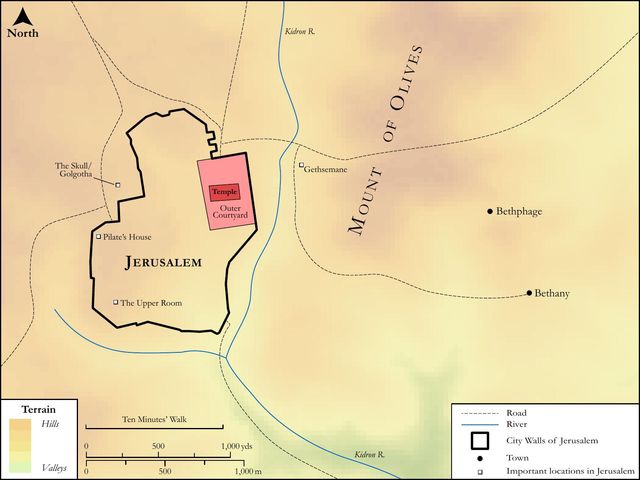
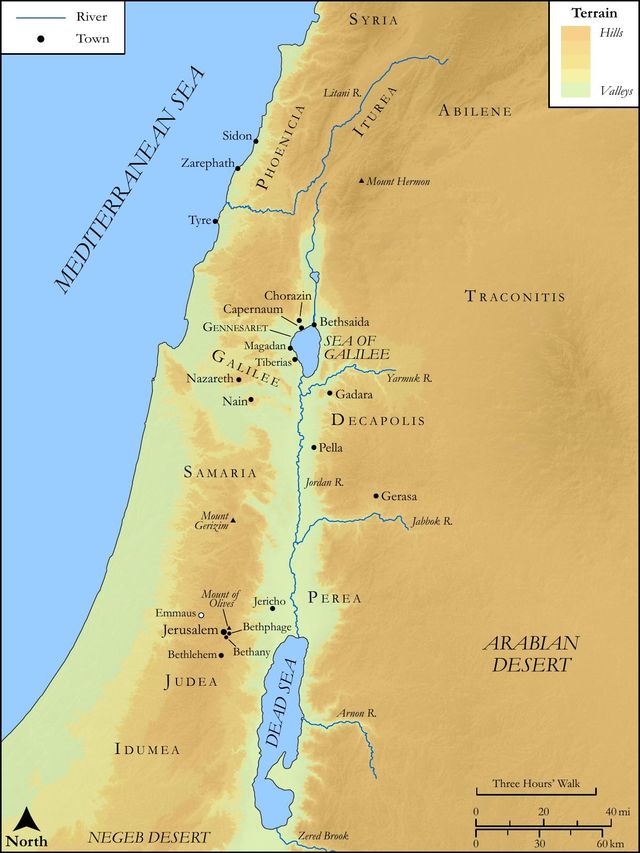
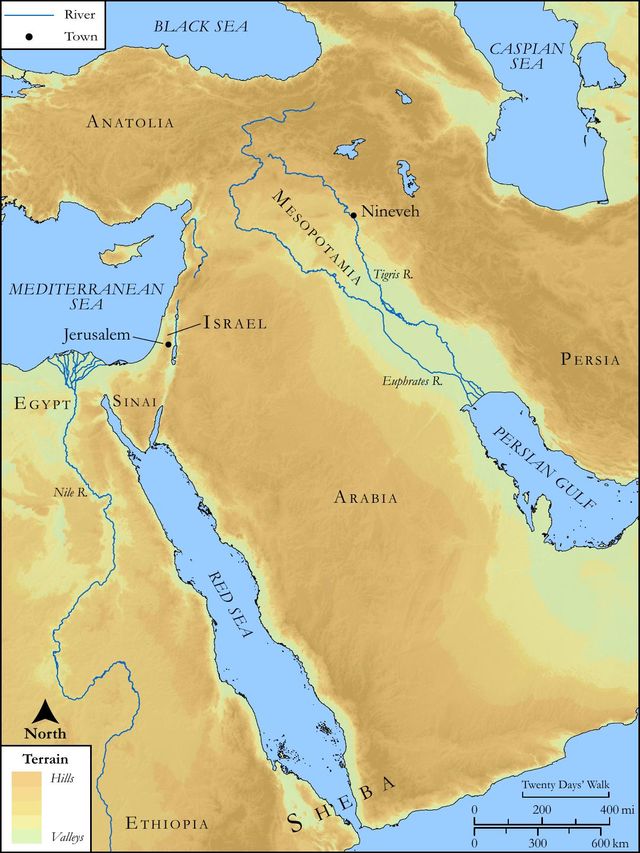
See on the biblical-era map
Study this verse
Public-domain commentary
Matthew Henry
From his Commentary on the Whole Bible. Henry comments on passages, not single verses — this entry covers Luke 1:57–66. His three-level outline is real structure in the source text, so it is rendered as structure.
In these verses, we have,
I.The birth of John Baptist, Luk 1:57.
Though he was conceived in the womb by miracle, he continued in the womb according to the ordinary course of nature (so did our Saviour): Elisabeth's full time came, that she should be delivered, and then she brought forth a son. Promised mercies are to be expected when the full time for them is come, and not before.
II.The great joy that was among all the relations of the family, upon this extraordinary occasion (Luk 1:58):
Her neighbours and her cousins heard of it; for it would be in every body's mouth, as next to miraculous. Dr. Lightfoot observes that Hebron was inhabited by priests of the family of Aaron, and that those were the cousins here spoken of; but the fields and villages about, by the children of Judah, and that those were the neighbours. Now these here discovered,
1.A pious regard to God. They acknowledged that the Lord had magnified his mercy to her, so the word is. It was a mercy to have her reproach taken away, a mercy to have her family built up, and the more being a family of priests, devoted to God, and employed for him. Many things concurred to make the mercy great - that she had been long barren, was now old, but especially that the child should be great in the sight of the Lord.
2.A friendly regard to Elisabeth. When she rejoiced, they rejoiced with her. We ought to take pleasure in the prosperity of our neighbours and friends, and to be thankful to God for their comforts as for our own.
III.The dispute that was among them concerning the naming him (Luk 1:59):
On the eighth day, as God has appointed, they came together, to circumcise the child; it was here, in Hebron, that circumcision was first instituted; and Isaac, who, like John Baptist, was born by promise, was one of the first that was submitted to it, at least the chief eyed in the institution of it. They that rejoiced in the birth of the child came together to the circumcising of him. Note, The greatest comfort we can take in our children is in giving them up to God, and recognizing their covenant-relation to him. The baptism of our children should be more our joy than their birth.
Now it was the custom, when they circumcised their children, to name them, because, when Abram was circumcised God gave him a new name, and called him Abraham; and it is not unfit that they should be left nameless till they are by name given up to God. Now,
1.Some proposed that he should be called by his father's name, Zacharias. We have not any instance in scripture that the child should bear the father's name; but perhaps it was of late come into use among the Jews, at it is with us, and they intended hereby to do honour to the father, who was not likely to have another child.
2.The mother opposed it, and would have called him John; having learned, either by inspiration of the Holy Ghost (as is most probable), or by information in writing from her husband, that God appointed this to be his name (Luk 1:60); He shall be called Johanan - Gracious, because he shall introduce the gospel of Christ, wherein God's grace shines more brightly than ever.
3.The relations objected against that (Luk 1:61): "There is none of thy kindred, none of the relations of thy family, that is called by that name; and therefore, if he may not have his father's name, yet let him have the name of some of his kindred, who will take it as a piece of respect to have such a child of wonders as this named from them." Note, As those that have friends must show themselves friendly, so those that have relations must be obliging to them in all the usual regards that are paid to kindred.
4.They appealed to the father, and would try if they could possibly get to know his mind; for it was his office to name the child, Luk 1:62. They made signs to him, by which it appears that he was deaf as well as dumb; nay, it should seem, mindless of any thing, else one would think they should at first have desired him to write down his child's name, if he had ever communicated any thing by writing since he was struck. However, they would carry the matter as far as they could, and therefore gave him to understand what the dispute was which he only could determine; whereupon he made signs to them to give him a table-book, such as they then used, and with the pencil he wrote these words, His name is John, Luk 1:63. Note, "It shall be so," or, "I would have it so," but "It is so." The matter is determined already; the angel had given him that name. Observe, When Zacharias could not speak, he wrote. When ministers have their mouths stopped, that they cannot preach, yet they may be doing good as long as they have not their hands tied, that they cannot write. Many of the martyrs in prison wrote letters to their friends, which were of great use; blessed Paul himself did so. Zacharias's pitching upon the same name that Elisabeth had chosen was a great surprise to the company: They marvelled all; for they knew not that, though by reason of his deafness and dumbness they could not converse together, yet they were both guided by one and the same Spirit: or perhaps they marvelled that he wrote so distinctly and intelligently, which (the stroke he was under being somewhat like that of a palsy) he had not done before.
5.He thereupon recovered the use of his speech (Luk 1:64): His mouth was opened immediately. The time prefixed for his being silenced was till the day that these blessed things shall be fulfilled (Luk 1:20); not all the things going before concerning John's ministry, but those which relate to his birth and name (Luk 1:13). That time was now expired, whereupon the restraint was taken off, and God gave him the opening of the mouth again, as he did to Ezekiel, Eze 3:27. Dr. Lightfoot compares this case of Zacharias with that of Moses, Exo 4:24-26. Moses, for distrust, is in danger of his life, as Zacharias, for the same fault, is struck dumb; but, upon the circumcision of his child, and recovery of his faith, there, as here, the danger is removed. Infidelity closed his mouth, and now believing opens it again; he believes, therefore he speaks. David lay under guilt from the conception of his child till a few days after its birth; then the Lord takes away his sin: upon his repentance, he shall not die. So here he shall be no longer dumb; his mouth was opened, and he spoke, and praised God. Note, When God opens our lips, our mouths must show forth his praise. As good be without our speech as not use it in praising God; for then our tongue is most our glory when it is employed for God's glory.
6.These things were told all the country over, to the great amazement of all that heard them, Luk 1:65, Luk 1:66. The sentiments of the people are not to be slighted, but taken notice of. We are here told,
(1.)That these sayings were discoursed of, and were the common talk all about the hill-country of Judea. It is a pity but a narrative of them had been drawn up, and published in the world, immediately.
(2.)That most people who heard of these things were put into consternation by them: Fear came on all them that dwell round about there. If we have not a good hope, as we ought to have, built upon the gospel, we may expect that the tidings of it will fill us with fear. They believed and trembled, whereas they should have believed and triumphed.
(3.)It raised the expectations of people concerning this child, and obliged them to have their eye upon him, to see what he would come to. They laid up these presages in their hearts, treasured them up in mind and memory, as foreseeing they should hereafter have occasion to recollect them. Note, What we hear, that may be of use to us, we should treasure up, that we may be able to bring forth, for the benefit of others, things new and old, and, when things come to perfection, may be able to look back upon the presages thereof, and to say, "It was what we might expect." They said within themselves, and said among themselves, "What manner of child shall this be? What will be the fruit when these are the buds, or rather when the root is out of such a dry ground?" Note, When children are born into the world, it is very uncertain what they will prove; yet sometimes there have been early indications of something great, as in the birth of Moses, Samson, Samuel, and here of John. And we have reason to think that there were some of those living at the time when John began his public ministry who could, and did, remember these things, and relate them to others, which contributed as much as any thing to the great flocking there was after him.
Lastly, It is said, The hand of the Lord was with him; that is, he was taken under the special protection of the Almighty, from his birth, as one designed for something great and considerable, and there were many instances of it. It appeared likewise that the Spirit was at work upon his soul very early. As soon as he began to speak or go, you might perceive something in him very extraordinary. Note, God has ways of operating upon children in their infancy, which we cannot account for. God never made a soul but he knew how to sanctify it.
Historical interpretation
Eight Centuries of Reception
7 surviving comments on this verse. Each one is dated, so this reads as a timeline rather than a list.
Select a marker to jump to its quote. Markers stagger vertically where authors wrote within a few decades of each other.
When John his son was born, among his neighbors there was concern about what name he should be given. Writing tablets were offered to his father so that he himself could put down the name that he had decided upon, so that he might express in writing what he could not in speech. Then, in a wonderful manner, when he had taken the tablets in order to begin writing, his tongue was loosened, the written word gave way to speech, and he did not write “John” but spoke it. Consider, then, the merit of the holy Baptist: he gave his father back his voice, he restored the faculty of speech to the priest. Consider, I say, his merit: John unloosed the mouth that the angel had bound. What Gabriel had closed the little child unlocked.… When John is born the father suddenly becomes a prophet or priest, speech attains its use, love receives an offspring, the office recognizes the priest.
For forerunning signs prepare the way for the forerunner of the truth, and the future prophet is recommended by auspices sent before him; hence it follows, For the hand of the Lord was with him.
On the day of John’s circumcision, when he also received his name, “fear came upon all their neighbors, and all these words were spread abroad throughout the mountain country of Judea.” Furthermore, at the time of our Lord’s resurrection, when the Spirit had been sent down from above and the glory of his name was made known to the world by the apostles, a most salutary fear immediately struck the hearts. Not only of the Jews, who were of the neighborhood either by their physical location or by their knowledge of the law, but also those of foreign nations, even to the ends of the earth. And John’s reputation for virtue exceeded not only the whole mountain country of Judea, but also all the heights of worldly kingdoms and worldly wisdom, so that everywhere people left behind their former way of life and flocked together to attain the sacramental mysteries of his faith.
And these words were spread over all the mountains of Judaea. And all those who heard them laid them up in their hearts, saying: What will this child be? For the hand of the Lord was with him. Great are the works of the Lord, exquisite in all his desires (Psalm 110). Behold, the silence of Zacharias alone, given to him as a punishment for disbelief and as a sign of belief, not only benefits him when it is taken away, but it also astounds all his neighbors with the miracle and fear. The fame of the born prophet spreads throughout all the surrounding mountains; it stirs up all who can hear to diligently inquire about the manner and state of the child who is born, so that by this and similar auspices, the future prophet of Christ is commended, and, so to speak, it provides signs for the herald of the forthcoming truth. And Zacharias his father was filled with the Holy Spirit, and he prophesied, saying: Blessed be the Lord God of Israel, for he has visited and wrought the redemption of his people. How great is the abundance of the heavenly gift, if the piety of our faith is ready to receive it. Behold, the speech that was taken away for disbelief is restored with the spirit of prophecy to the believer. The Lord has visited his people, as if wasting away from a long infirmity, and as if sold under sin, he has redeemed them by the blood of his only son. Because blessed Zacharias knew this was about to be done soon, he narrates it as though it were already accomplished in a prophetic manner. And it should be noted that it is said he visited and redeemed his people, not because he came and found them as his own, but because by visiting them, he made them his own. Similar to this is what is sung in the conclusion of the Proverbs about the same people: Who shall find a valiant woman (Proverbs 31)? For he did not find that same woman, namely the Church, strong, that is, devoted in faith, but by betrothing her to himself, he made her strong, because he perfected her by the sublimity of his faith.
As at the silence of Zacharias the people marvelled, so likewise when he spoke. Hence it is said, And fear came upon all; that from these two circumstances all might believe there was something great in the child that was born. But all these things were ordained, to the end that he who was to bear witness of Christ might also be esteemed trustworthy. Hence it follows, And all they that heard them laid them up in their heart, saying, What manner of child, &c.
(Metaphrastes.) For God worked miracles in John which he did not himself, but the right hand of God in him.
(ordin.) But mystically, at the time of our Lord's resurrection, by the preaching of the grace of Christ, a wholesome dread shook the hearts not only of the Jews, (who were neighbours, either from the place of their dwelling, or from the knowledge of the law,) but of the foreign nations also. The name of Christ surmounts not only the hilly country of Judæa, but all the heights of worldly dominion and wisdom.
Continue studying Luke 1:65 across the web’s major study libraries — every link below opens this exact verse, chapter, or book on the destination site.
Read & Compare
 BibleGatewayThis verse in more than 200 translations and 70 languages.
 Bible.comThe YouVersion reader — hundreds of translations, reading plans, and highlights.
 ESV.orgCrossway's official English Standard Version reader.
 NET BibleThe NET translation with 60,000+ translators' notes on every rendering decision.
 STEP BibleTyndale House's free study tool — original text, vocabulary, and scholarly resources.
 BibliaLogos Bible Software's free web reader.
 USCCBThe New American Bible (Revised Edition) with the U.S. bishops' study notes.
Commentaries
 BibleHub CommentariesDozens of classic commentaries on this verse, gathered on one page.
 StudyLightMore than 100 commentary sets — the largest collection on the web.
 BibleRefPlain-English commentary on what this verse means, verse by verse.
 Enduring WordDavid Guzik's free commentary on this chapter, widely used by Bible teachers.
 Bible Study ToolsVerse commentary alongside Greek and Hebrew study aids.
Original Language & Research
- BibleHub InterlinearThe verse word by word — original language, transliteration, and English.
- BibleHub LexiconEvery word's original-language definition and Strong's entry.
 Blue Letter BibleDeep-study tools — Strong's numbers, concordance, and word studies.
 CNTR CollationThe earliest Greek manuscripts of this verse, collated letter by letter.
Sermons, Hymns & Audio


TrulyRandomVerse is not affiliated with these sites and doesn’t control their content. They’re linked because they’re genuinely useful.
Summary
Luke 1:65 powerfully depicts the immediate and profound impact of God's miraculous intervention on the community surrounding Zechariah and Elisabeth. Following the dramatic restoration of Zechariah's speech and the naming of John, a deep sense of reverential awe settled upon the neighbors. The extraordinary events, seen as clear signs of divine activity, were not confined to a small circle but rapidly and widely disseminated, becoming the subject of widespread discussion throughout the rural hill country of Judaea, setting the stage for John's unique prophetic ministry.
Context
ShowHideLiterary Context
This verse serves as a crucial transition point in Luke's narrative, immediately following the miraculous birth of John the Baptist and the dramatic restoration of his father Zechariah's speech. Having been struck mute by the angel Gabriel for his unbelief (Luke 1:20), Zechariah's tongue was loosed precisely when he affirmed the divinely appointed name "John" for his son (Luke 1:63-64). The preceding verses detail the astonishment of the relatives and neighbors at these events, culminating in the "fear" described here. Luke 1:65 sets the stage for Zechariah's Spirit-inspired prophecy in the following verses (Luke 1:67-79), which further expounds on John's prophetic role and the coming of the Messiah. The widespread public reaction underscores the divine significance of John's birth, preparing the audience for his future ministry.
Historical & Cultural Context
First-century Judaea was a region deeply steeped in Jewish tradition and anticipation of the Messiah. In this period, miraculous births, particularly to elderly or barren couples, were understood as clear indicators of God's special favor and intervention, recalling figures like Isaac and Samuel. The "hill country of Judaea" refers to the rugged, often rural, central highlands, where communities were typically close-knit and news traveled quickly by word of mouth. Public events like a child's naming ceremony, especially one involving such unusual circumstances as Zechariah's muteness and its sudden reversal, would naturally become the subject of intense local discussion and speculation. The people, familiar with the Old Testament prophets, would be keenly attuned to signs of God's activity and the unfolding of His redemptive plan, recognizing these events as potentially fulfilling ancient prophecies.
Key Themes
ShowHideLuke 1:65 contributes to several overarching themes within Luke's Gospel and the broader biblical narrative. Firstly, it highlights the theme of Divine Awe and Reverence, demonstrating a proper human response to God's miraculous power. The "fear" that came upon the people was not mere terror but a profound sense of respectful astonishment in the face of unmistakable divine intervention, echoing the biblical concept of the fear of the Lord as the beginning of wisdom. Secondly, the verse emphasizes God's Public Revelation, indicating that God's redemptive work is not hidden but is openly displayed and witnessed by humanity. The fact that "all these sayings were noised abroad" underscores that God's actions are meant to be known and discussed, serving as a public testimony to His faithfulness and the unfolding of His plan. Finally, this widespread reaction serves as Preparation for John's Ministry, establishing his unique, divinely appointed role. The extraordinary circumstances of his birth and the public acknowledgment of God's hand upon him would set him apart in the minds of the people, paving the way for his future prophetic ministry as the forerunner of the Messiah, as further elaborated in Luke 1:66.
Exposition and Analysis
ShowHideKey Word Analysis
ShowHideThis term, while broadly meaning "alarm or fright," in this context, specifically denotes a profound sense of reverential awe, astonishment, and respect in the presence of the divine. It is a proper, humble response to a supernatural manifestation, recognizing God's power and holiness. It is not a paralyzing terror but a recognition of the sacred.
Derived from a primary verb meaning "to cause to be" or "to become," this word here signifies that the fear "came into being" or "happened" to them. It suggests an event that was not self-generated but occurred as a direct result of the preceding divine actions, emphasizing the spontaneous and divinely orchestrated nature of the community's reaction.
This compound verb, formed from "through" (dia) and "to speak" (laleō), literally means "to talk throughout a company" or "to publish." It vividly conveys the rapid, extensive, and pervasive dissemination of the news. It implies that the events were not merely whispered but were openly and widely discussed, becoming common knowledge across the region.
Verse Breakdown
ShowHide"And fear came on all that dwelt round about them"
This clause describes the immediate, supernatural effect of Zechariah's restored speech and John's naming on the local community. The "fear" (phóbos) signifies a deep, reverential awe, a recognition of God's powerful hand at work. The phrase "all that dwelt round about them" emphasizes the widespread nature of this awe, indicating that the divine intervention was recognized by the entire immediate neighborhood, not just a select few.
"and all these sayings were noised abroad"
This part of the verse highlights the specific content that was being discussed – "all these sayings" (rhēma), referring to the extraordinary events surrounding John's birth, Zechariah's muteness, and its miraculous reversal. The verb "were noised abroad" (dialaléō) underscores the rapid and extensive spread of this news, indicating that the events became a topic of widespread public conversation and proclamation.
"throughout all the hill country of Judaea."
This final phrase specifies the geographical scope of the news's dissemination. The "hill country of Judaea" (oreinós Ioudaía) refers to the central, elevated region of Judaea, a rural area where Zechariah and Elisabeth resided. This detail emphasizes that the impact of God's work was not confined to a single household or village but permeated an entire region, setting the stage for John's future public ministry.
Literary Devices
ShowHideLuke 1:65 effectively employs several literary devices to convey its message. Hyperbole is evident in the phrases "all that dwelt round about them" and "all the hill country of Judaea." While not necessarily implying every single individual, these expressions serve to emphasize the widespread and undeniable impact of the events, underscoring their public nature and significance. The verse also utilizes Foreshadowing, as the widespread awe and discussion surrounding John's birth subtly prepare the audience for his future prophetic ministry and, more importantly, for the coming of the Messiah. The extraordinary circumstances of John's arrival set a precedent for the even more profound and globally impactful events surrounding Jesus. Furthermore, the use of the Divine Passive in "fear came" and "sayings were noised abroad" implicitly points to God as the ultimate agent behind these occurrences. The events are not accidental or merely human-driven but are divinely orchestrated, highlighting God's sovereign control over the unfolding of His redemptive plan.
Theological and Thematic Connections
ShowHideLuke 1:65 powerfully illustrates God's active involvement in human history, particularly in the unfolding of His redemptive plan. The "fear" that came upon the people is a theological response to the manifestation of divine power, signifying a recognition of God's holiness and sovereignty. This awe is not a paralyzing terror but a reverent acknowledgment of God's presence and work, a proper posture for humanity before its Creator. The widespread dissemination of the "sayings" emphasizes that God's saving acts are intended for public witness and proclamation, preparing hearts and minds for the greater revelation to come. This verse highlights the theme of divine preparation, where God orchestrates events and stirs human hearts to anticipate the fulfillment of His promises, laying the groundwork for the arrival of the Messiah.
Reflection and Application
ShowHideLuke 1:65 offers profound insights for contemporary believers, urging us to cultivate a similar sense of awe and reverence for God's work in our lives and in the world around us. In an age often characterized by skepticism or casualness toward the divine, this verse reminds us to pause and truly perceive God's hand at work, whether through overt miracles or the subtle, consistent guidance of His Spirit. Our response to God's intervention should be one of humble adoration and wonder, recognizing His sovereignty and power. Furthermore, just as the people in Judaea "noised abroad" the extraordinary events surrounding John's birth, we are called to be faithful witnesses to God's ongoing activity. The spread of this news serves as a compelling model for sharing the good news of God's saving acts, particularly the transformative message of the Gospel. Our personal testimonies and the collective witness of the church can help others recognize God's active presence and draw them to a deeper understanding of His love and redemptive plan.
Questions for Reflection
ShowHideFAQ
ShowHideWhat kind of "fear" is mentioned in Luke 1:65?
ShowHideThe "fear" (Greek: phóbos) described in Luke 1:65 is not a terror or dread in the modern sense, but rather a profound sense of reverential awe, astonishment, and respect. It is the appropriate human response to a clear manifestation of divine power and presence. This is akin to the "fear of the Lord" frequently mentioned in the Old Testament, which signifies a humble recognition of God's holiness, majesty, and sovereignty, often leading to worship and obedience. The people were struck with a deep sense of wonder and recognition that something truly extraordinary and divine had occurred.
Why was the news "noised abroad" so quickly throughout the hill country of Judaea?
ShowHideThe rapid dissemination of the news was due to several factors. Firstly, the events themselves were genuinely miraculous and highly unusual: Zechariah, a priest, had been mute for nine months, and his speech was dramatically restored at the naming of his son, John, whose birth was also extraordinary given his parents' old age. Such events would naturally capture immediate attention in a close-knit, rural community like the "hill country of Judaea" (Luke 1:39). Secondly, in a society without mass media, oral communication was the primary means of spreading significant news. People would gather, share stories, and the news would travel quickly from village to village by word of mouth. The public nature of the naming ceremony and the widespread astonishment ensured that these "sayings" (Luke 1:65) would become common knowledge, fulfilling God's purpose of publicly announcing the advent of John, the forerunner of the Messiah.
Christ-Centered Fulfillment
ShowHideThe widespread "fear" and public proclamation surrounding John the Baptist's birth in Luke 1:65 serve as a powerful prelude and foreshadowing of the even greater awe and global dissemination of the good news concerning Jesus Christ. John's miraculous birth and the restoration of Zechariah's speech were divine signs, preparing the hearts of the people in the "hill country of Judaea" for the imminent arrival of the Messiah. The "sayings" that were "noised abroad" about John's extraordinary beginnings were a divine whisper before the thunderous declaration of the Word made flesh, Jesus Christ (John 1:14). The reverential awe that came upon the people at John's birth would find its ultimate and perfect object in Jesus, who is the full revelation of God's glory and the exact representation of His being (Hebrews 1:3). The public witness to John's miraculous advent was a divinely orchestrated overture to the universal proclamation of the Gospel of Jesus Christ, which is commanded to be preached to "all nations" (Matthew 28:19-20). Just as the news of John spread throughout Judaea, the message of salvation through Christ is meant to be proclaimed to the ends of the earth, inviting all humanity to respond in faith and worship to the One who takes away the sin of the world (John 1:29).