


Luke 1:46
Bible text: King James Version (1769 Blayney text) · Public domain
Bible text: Berean Standard Bible · Public domain
Bible text: American Standard Version (1901) · Public domain
Bible text: World English Bible, Messianic edition · Public domain
Bible text: Geneva Bible (1599) · Public domain
Bible text: Young's Literal Translation · Public domain
- ΚαὶKaiAndG2532CONJConjunction
- εἶπενeipensaidG2036V-2AAI-3SVerb 2nd Aorist Active Indicative 3rd Singular
- Μαριάμ·MariamMaryG3137N-NSF-PNoun Nominative Singular Feminine Individual
- μεγαλύνειmegaluneiMagnifiesG3170V-PAI-3SVerb Present Active Indicative 3rd Singular
- ἡhētheG3588T-NSFDefinite article Nominative Singular Feminine
- ψυχήpsuchēsoulG5590N-NSFNoun Nominative Singular Feminine
- μουmouof MineG3165P-1GSPersonal pronoun Genitive 1st Singular
- τὸνtontheG3588T-ASMDefinite article Accusative Singular Masculine
- κύριονkurionLordG2962N-ASM-TNoun Accusative Singular Masculine Title
English is a literal word-by-word gloss of the Greek, not the KJV's wording. Why?
This is the original text the KJV's translators worked from — each Greek word with its own literal English meaning in this verse, prepared by scholars at Tyndale House, Cambridge. The KJV translates whole sentences, not word by word, so its wording differs: one Greek word can become several English words, and the KJV may choose “charity” where the gloss reads “love”. Both are faithful — they answer different questions. For the KJV's own rendering, switch to the KJV text.
Details
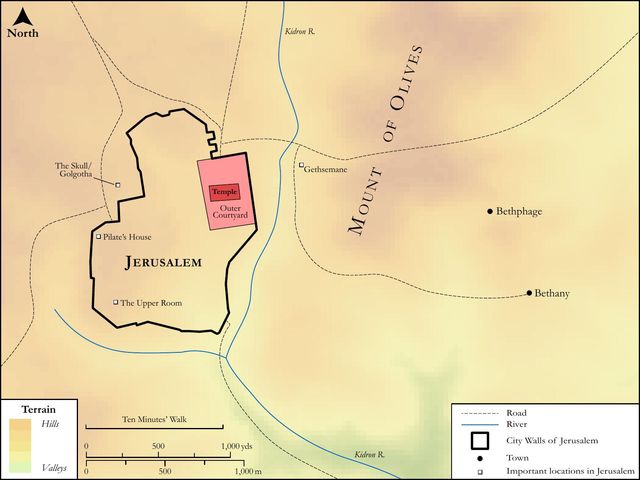
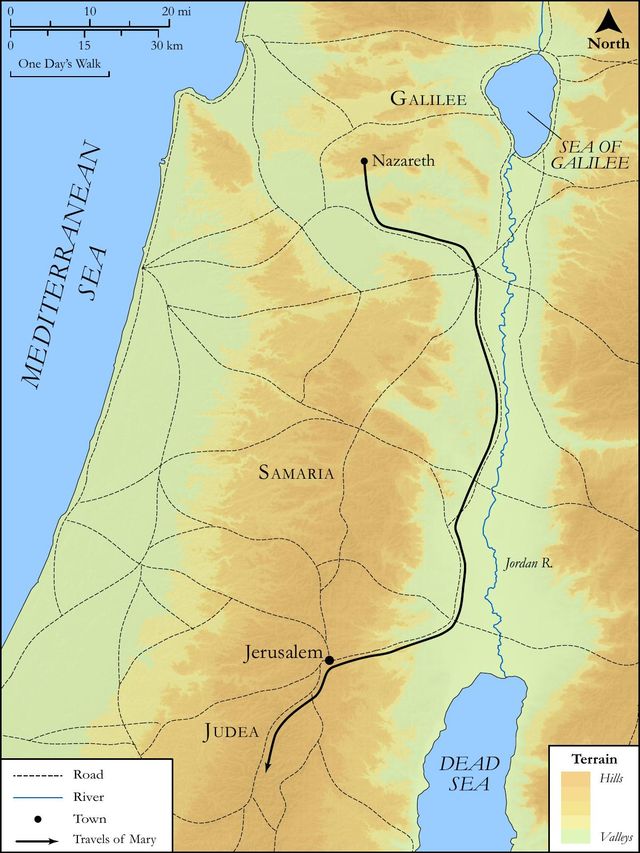
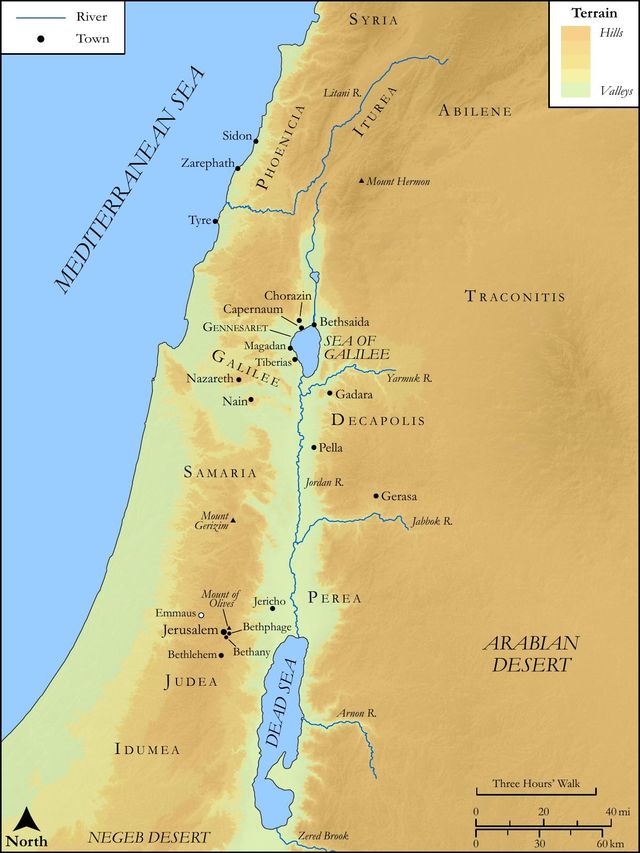
See on the biblical-era maps
Study this verse
Public-domain commentary
Matthew Henry
From his Commentary on the Whole Bible. Henry comments on passages, not single verses — this entry covers Luke 1:39–56. His four-level outline is real structure in the source text, so it is rendered as structure.
We have here an interview between the two happy mothers, Elisabeth and Mary: the angel, by intimating to Mary the favour bestowed on her cousin Elisabeth (Luk 1:36), gave occasion for it; and sometimes it may prove a better piece of service that we think to bring good people together, to compare notes. Here is,
I.The visit which Mary made to Elisabeth.
Mary was the younger, and younger with child; and therefore, if they must come together, it was fittest that Mary should take the journey, not insisting on the preference which the greater dignity of her conception gave her, Luk 1:39. She arose, and left her affairs, to attend this greater matter: in those days, at that time (as it is commonly explained, Jer 33:15; Jer 50:4), in a day or two after the angel had visited her, taking some time first, as it is supposed, for her devotion, or rather hastening away to her cousin's, where she would have more leisure, and better help, in the family of a priest. She went, meta spoudēs - with care, diligence, and expedition; not as young people commonly go abroad and visit their friends, to divert herself, but to inform herself: she went to a city of Judah in the hill-country; it is not named, but by comparing the description of it here with Jos 21:10, Jos 21:11, it appears to be Hebron, for that is there said to be in the hill-country of Judah, and to belong to the priests, the sons of Aaron; thither Mary hastened, though it was a long journey, some scores of miles.
1.Dr. Lightfoot offers a conjecture that she was to conceive our Saviour there at Hebron, and perhaps had so much intimated to her by the angel, or some other way; and therefore she made such haste thither. He thinks it probable that Shiloh, of the tribe of Judah, and the seed of David, should be conceived in a city of Judah and of David, as he was to be born in Bethlehem, another city which belonged to them both. In Hebron the promise was given to Isaac, circumcision was instituted. Here (saith he) Abraham had his first land, and David his first crown: here lay interred the three couples, Abraham and Sarah, Isaac and Rebecca, Jacob and Leah, and, as antiquity has held, Adam and Eve. He therefore thinks that it suits singularly with the harmony and consent which God uses in his works that the promise should begin to take place by the conception of the Messias, even among those patriarchs to whom it was given. I see no improbability in the conjecture, but add this for the support of it, that Elisabeth said (Luk 1:45), There shall be a performance; as if it were not performed yet, but was to be performed there.
2.It is generally supposed that she went thither for the confirming of her faith by the sign which the angel had given her, her cousin's being with child, and to rejoice with her sister-favourite. And, besides, she went thither, perhaps, that she might be more retired from company, or else might have more agreeable company than she could have in Nazareth. We may suppose that she did not acquaint any of her neighbours at Nazareth with the message she had received from heaven, yet longed to talk over a thing she had a thousand time thought over, and knew no person in the world with whom she could freely converse concerning it but her cousin Elisabeth, and therefore she hastened to her. Note, it is very beneficial and comfortable for those that have a good work of grace begun in their souls, and Christ in the forming there, to consult those who are in the same case, that they may communicate experiences one to another; and they will find that, as in water face answers to face, so doth the heart of man to man, of Christian to Christian.
II.The meeting between Mary and Elisabeth.
Mary entered into the house of Zacharias; but he, being dumb and deaf, kept his chamber, it is probable, and saw no company; and therefore she saluted Elisabeth (Luk 1:40), told her she was come to make her a visit, to know her state, and rejoice with her in her joy.
Now, at their first coming together, for the confirmation of the faith of both of them, there was something very extraordinary. Mary knew that Elisabeth was with child, but it does not appear that Elisabeth had been told any thing of her cousin Mary's being designed for the mother of the Messiah; and therefore what knowledge she appears to have had of it must have come by a revelation, which would be a great encouragement to Mary.
1.The babe leaped in her womb, Luk 1:41. It is very probable that she had been several weeks quick (for she was six months gone), and that she had often felt the child stir; but this was a more than ordinary motion of the child, which alarmed her to expect something very extraordinary, eskirtēse. It is the same word that is used by the Septuagint (Gen 25:22) for the struggling of Jacob and Esau in Rebecca's womb, and the mountains skipping, Psa 114:4. The babe leaped as it were to give a signal to his mother that he was now at had whose forerunner he was to be, about six months in ministry, as he was in being; or, it was the effect of some strong impression made upon the mother. Now began to be fulfilled what the angel said to his father (Luk 1:15), that he should be filled with the Holy Ghost, even from his mother's womb; and perhaps he himself had some reference to this, when he said (Joh 3:29), The friend of the Bridegroom rejoiceth greatly, because of the Bridegroom's voice, heard, though not by him, yet by his mother.
2.Elisabeth was herself filled with the Holy Ghost, or a Spirit of prophecy, by which, as well as by the particular suggestions of the Holy Ghost she was filled with, she was given to understand that the Messiah was at hand, in whom prophecy should revive, and by whom the Holy Ghost should be more plentifully poured out than ever, according to the expectations of those who waited for the consolation of Israel. The uncommon motion of the babe in her womb was a token of extraordinary emotion of her spirit under a divine impulse. Note, Those whom Christ graciously visits may know it by their being filled with the Holy Ghost; for, if any man have not the Spirit of Christ, he is none of his.
III.The welcome which Elisabeth, by the Spirit of prophecy, gave to Mary, the mother of our Lord; not as to a common friend making a common visit, but as to one of whom the Messiah was to be born.
1.She congratulates her on her honour, and, though perhaps she knew not of it till just now, she acknowledges it with the greatest assurance and satisfaction. She spoke with a loud voice, which does not at all intimate (as some think) that there was a floor or a wall between them, but that she was in a transport or exultation of joy, and said what she cared not who knew. She said, Blessed art thou among women, the same word that the angels had said (Luk 1:28); for thus this will of God, concerning honouring the Son, should be done on earth as it is done in heaven. But Elisabeth adds a reason, Therefore blessed art thou because blessed is the fruit of thy womb; thence it was that she derived this excelling dignity. Elisabeth was the wife of a priest, and in years, yet she grudges not that her kinswoman, who was many years younger than she, and every way her inferior, should have the honour of conceiving in her virginity, and being the mother of the Messiah, whereas the honour put upon her was much less; she rejoices in it, and is well pleased, as her son was afterwards, that she who cometh after her is preferred before her, Joh 1:27. Note, While we cannot but own that we are more favoured of God than we deserve, let us by no means envy that others are more highly favoured than we are.
2.She acknowledges her condescension, in making her this visit (Luk 1:43): Whence is this to me, that the mother of my Lord should come to me? Observe,
(1.)She calls the virgin Mary the mother of her Lord (as David in spirit, called the Messiah Lord, his Lord), for she knew he was to be Lord of all.
(2.)She not only bids her welcome to her house, though perhaps she came in mean circumstances, but reckons this visit a great favour, which she thought herself unworthy of. Whence is this to me? It is in reality, and not in compliment, that she saith, "This was a greater favour than I could have expected." Note, Those that are filled with the Holy Ghost have low thoughts of their own merits, and high thoughts of God's favours. Her son the Baptist spoke to the same purport with this, when he said, Comest thou to me? Mat 3:14.
3.She acquaints her with the concurrence of the babe in her womb, in this welcome to her (Luk 1:44): "Thou certainly bringest some extraordinary tidings, some extraordinary blessing, with thee; for as soon as the voice of thy salutation sounded in my ears, not only my heart leaped for joy, though I knew not immediately why or wherefore, but the babe in my womb, who was not capable of knowing, did so too." He leaped as it were for joy that the Messiah, whose harbinger he was to be, would himself come soon after him. This would serve very much to strengthen the faith of the virgin, that there were such assurances as these given to others; and it would be in part the accomplishment of what had been so often foretold, that there should be universal joy before the Lord, when he cometh, Psa 98:8, Psa 98:9.
4.She commends her faith, and encourages it (Luk 1:45): Blessed is she that believed. Believing souls are blessed souls, and will be found so at last; this blessedness cometh through faith, even the blessedness of being related to Christ, and having him formed in the soul. They are blessed who believe the word of God, for that Word will not fail them; there shall, without doubt, be a performance of those things which are told her from the Lord. Note, The inviolable certainty of the promise is the undoubted felicity of those that build upon it and expect their all from it. The faithfulness of God is the blessedness of the faith of the saints. Those that have experienced the performance of God's promises themselves should encourage others to hope that he will be as good as his word to them also: I will tell you what God has done for my soul.
IV.Mary's song of praise, upon this occasion.
Elisabeth's prophecy was an echo to the virgin Mary's salutation, and this song is yet a stronger echo to that prophecy, and shows her to be no less filled with the Holy Ghost than Elisabeth was. We may suppose the blessed virgin to come in, very much fatigued with her journey; yet she forgets that, and is inspired with new life, and vigour, and joy, upon the confirmation she here meets with of her faith; and since, by the sudden inspiration and transport, she finds that this was designed to be her errand hither, weary as she is, like Abraham's servant, she would neither eat nor drink till she had told her errand.
1.Here are the expressions of joy and praise, and God alone the object of the praise and centre of the joy. Some compare this song with that which her name-sake Miriam, the sister of Moses, sung, upon the triumphant departure of Israel out of Egypt, and their triumphant passage through the Red Sea; others think it better compared with the song of Hannah, upon the birth of Samuel, which, like this, passes from a family mercy to a public and general one. This begins, like that, My heart rejoiceth in the Lord, Sa1 2:1. Observe how Mary here speaks of God.
(1.)With great reverence of him, as the Lord: "My soul doth magnify the Lord; I never saw him so great as now I find him so good." Note, Those, and those only, are advanced in mercy, who are thereby brought to think the more highly and honourably of God; whereas there are those whose prosperity and preferment make them say, What is the Almighty, that we should serve him? The more honour God has any way put upon us, the more honour we must study to give to him; and then only are we accepted in magnifying the Lord, when our souls magnify him, and all that is within us. Praising work must be soul work.
(2.)With great complacency in him as her Saviour: My spirit rejoiceth in God my Saviour. This seems to have reference to the Messiah, whom she was to be the mother of. She calls him God her Saviour; for the angel had told her that he should be the Son of the Highest, and that his name should be Jesus, a Saviour; this she fastened upon, with application to herself: He is God my Saviour. Even the mother of our Lord had need of an interest in him as her Saviour, and would have been undone without it: and she glories more in that happiness which she had in common with all believers than in being his mother, which was an honour peculiar to herself, and this agrees with the preference Christ have to obedient believers above his mother and brethren; see Mat 12:50; Luk 11:27, Luk 11:28. Note, Those that have Christ for their God and Saviour have a great deal of reason to rejoice, to rejoice in spirit, that is rejoicing as Christ did (Luk 10:21), with spiritual joy.
2.Here are just causes assigned for this joy and praise.
(1.)Upon her own account, Luk 1:48, Luk 1:49. [1.] Her spirit rejoiced in the Lord, because of the kind things he had done for her: his condescension and compassion to her. He has regarded the low estate of his handmaiden; that is, he has looked upon her with pity, for so the word is commonly used. "He has chosen me to this honour, notwithstanding my great meanness, poverty, and obscurity." Nay, the expression seems to intimate, not only (to allude to that of Gideon, Jdg 6:15) that her family was poor in Judah, but that she was the least in her father's house, as if she were under some particular contempt and disgraced among her relations, was unjustly neglected, and the outcast of the family, and God put this honour upon her, to balance abundantly the contempt. I the rather suggest this, for we find something toward such honour as this put upon others, on the like consideration. Because God saw that Leah was hated, he opened her womb, Gen 29:31. Because Hannah was provoked, and made to fret, and insulted over, by Peninnah, therefore God gave her a son, Sa1 1:19. Whom men wrongfully depress and despise God doth sometimes, in compassion to them, especially if they have borne it patiently, prefer and advance; see Jdg 11:7. So in Mary's case. And, if God regards her low estate, he not only thereby gives a specimen of his favour to the whole race of mankind, whom he remembers in their low estate, as the psalmist speaks (Psa 136:23), but secures a lasting honour to her (for such the honour is that God bestows, honour that fades not away): "From henceforth all generations shall call me blessed, shall think me a happy woman and highly advanced." All that embrace Christ and his gospel will say, Blessed was the womb that bore him and the paps which he sucked, Luk 11:27. Elizabeth had once and again called her blessed: "But that is not all," saith she, "all generations of Gentiles as well as Jews shall call me so." [2.] Her soul magnifies the Lord, because of the wonderful things he had done for her (Luk 1:49): He that is mighty has done to me great things. A great thing indeed, that a virgin should conceive. A great thing indeed, that Messiah, who had been so long promised to the church, and so long expected by the church, should now at length be born. It is the power of the Highest that appears in this. She adds, and holy is his name; for so Hannah saith her song, There is none holy as the Lord, which she explains in the next words, for there is none beside thee, Sa1 2:2. God is a Being by himself, and he manifests himself to be so, especially in the work of our redemption. He that is mighty, even he whose name is holy, has done to me great things. Glorious things may be expected from him that is both mighty and holy; who can do every thing, and will do every thing well and for the best.
(2.)Upon the account of others. The virgin Mary, as the mother of the Messiah, is become a kind of public person, wears a public character, and is therefore immediately endued with another spirit, a more public spirit than before she had, and therefore looks abroad, looks about her, looks before her, and takes notice of God's various dealings with the children of men (Luk 1:50, etc.), as Hannah (Sa1 2:3, etc.). In this she has especially an eye to the coming of the Redeemer and God's manifesting himself therein.
[1.]It is a certain truth that God has mercy in store, mercy in reserve, for all that have a reverence for his majesty, and a due regard to his sovereignty and authority. But never did this appear so as in sending his Son into the world to save us (Luk 1:50): His mercy is on them that fear him; it has always been so; he has ever looked upon them with an eye of peculiar favour who have looked up to him with and eye of filial fear. But he hath manifested this mercy, so as never before, in sending his Son to bring in an everlasting righteousness, and work out an everlasting salvation, for them that fear him, and this from generation to generation; for there are gospel privileges transmitted by entail, and intended for perpetuity. Those that fear God, as their Creator and Judge, are encouraged to hope for mercy in him, through their Mediator and Advocate; and in him mercy is settled upon all that fear God, pardoning mercy, healing mercy, accepting mercy, crowning mercy, from generation to generation, while the world stands. In Christ he keepeth mercy for thousands.
[2.]It has been a common observation that God in his providence puts contempt upon the haughty and honour upon the humble; and this he has done remarkably in the whole economy of the work of man's redemption. As God had, with his mercy to her, shown himself mighty also (Luk 1:48, Luk 1:49), so he had, with his mercy on them that fear him, shown strength likewise with his arm. First, In the course of his providence, it is his usual method to cross the expectations of men, and proceed quite otherwise than they promise themselves. Proud men expect to carry all before them, to have their way and their will; but he scatters them in the imagination of their hearts, breaks their measures, blasts their projects, nay, and brings them low, and brings them down, by those very counsels with which they thought to advance and establish themselves. The mighty think to secure themselves by might in their seats, but he puts them down, and overturns their seats; while, on the other hand, those of low degree, who despaired of ever advancing themselves, and thought of no other than of being ever low, are wonderfully exalted. This observation concerning honour holds likewise concerning riches; many who were so poor that they had not bread for themselves and their families, by some surprising turn of Providence in favour of them, come to be filled with good things; while, on the other hand, those who were rich, and thought no other than that tomorrow should be as this day, that their mountain stood strong and should never be moved, are strangely impoverished, and sent away empty. Now this is the same observation that Hannah had made, and enlarged upon, in her song, with application to the case of herself and her adversary (Sa1 2:4-7), which very much illustrates this here. And compare also Psa 107:33-41; Psa 113:7-9; and Ecc 9:11. God takes a pleasure in disappointing their expectations who promise themselves great things in the world, and in out-doing the expectations of those who promise themselves but a little; as a righteous God, it is his glory to abase those who exalt themselves, and strike terror on the secure; and, as a good God, it is his glory to exalt those who humble themselves, and to speak comfort to those who fear before him. Secondly, This doth especially appear in the methods of gospel grace.
1.In the spiritual honours it dispenses. When the proud Pharisees were rejected, and Publicans and sinners went into the kingdom of heaven before them, - when the Jews, who followed after the law of righteousness, did not attain it, and the Gentiles, who never thought of it, attained to righteousness (Rom 9:30, Rom 9:31), - when God chose not the wise men after the flesh, not the mighty, or the noble, to preach the gospel, and plant Christianity in the world, but the foolish and weak things of the world, and things that were despised ( Co1 1:26, Co1 1:27) - then he scattered the proud, and put down the mighty, but exalted them of low degree. When the tyranny of the chief priests and elders were brought down, who had long lorded it over God's heritage, and hoped always to do so, and Christ's disciples, a company of poor despised fishermen, by the power they were clothed with, were made to sit on thrones, judging the twelve tribes of Israel, - when the power of the four monarchies was broken, and the kingdom of the Messiah, that stone cut out of the mountain without hands, is made to fill the earth, - then are the proud scattered, and those of low degree exalted.
2.In the spiritual riches it dispenses, Luk 1:53.
(1.)Those who see their need of Christ, and are importunately desirous of righteousness and life in him, he fills with good things, with the best things; he gives liberally to them, and they are abundantly satisfied with the blessings he gives. Those who are weary and heavy-laden shall find rest with Christ, and those who thirst are called to come to him and drink; for they only know how to value his gifts. To the hungry soul every bitter thing is sweet, manna is angels' food; and to the thirsty fair water is honey out of the rock.
(2.)Those who are rich, who are not hungry, who, like Laodicea, think they have need of nothing, are full of themselves and their own righteousness, and think they have a sufficiency in themselves, those he sends away from his door, they are not welcome to him, he sends them empty away, they come full of self, and are sent away empty of Christ. He sends them to the gods whom they served, to their own righteousness and strength which they trusted to.
[3.]It was always expected that the Messiah should be, in a special manner, the strength and glory of his people Israel, and so he is in a peculiar manner (Luk 1:54): He hath helped his servant Israel, antelabeto. He hath taken them by the hand, and helped them up that were fallen and could not help themselves. Those that were sunk under the burdens of a broken covenant of innocency are helped up by the blessings of a renewed covenant of grace. The sending of the Messiah, on whom help was laid for poor sinners, was the greatest kindness that could be done, the greatest help that could be provided for his people Israel, and that which magnifies it is,
First, That it is in remembrance of his mercy, the mercifulness of his nature, the mercy he has in store for his servant Israel. While this blessing was deferred, his people, who waited for it, were often ready to ask, Has God forgotten to be gracious? But now he made it appear that he had not forgotten, but remembered, his mercy. He remembered his former mercy, and repeated that to them in spiritual blessings which he had done formerly to them in temporal favours. He remembered the days of old. Where is he that brought them up out of the sea, out of Egypt? Isa 63:11. He will do the like again, which that was a type of.
Secondly, That it is in performance of his promise. It is a mercy not only designed, but declared (Luk 1:55); it was what he spoke to our fathers, that the Seed of the woman should break the head of the serpent; that God should dwell in the tents of Shem; and particularly to Abraham, that in his seed all the families of the earth shall be blessed, with the best of blessings, with the blessings that are for ever, and to the seed that shall be for ever; that is, his spiritual seed, for his carnal seed were cut off a little after this. Note, What God has spoken he will perform; what he hath spoken to the fathers will be performed to their seed; to their seed's seed, in blessings that shall last for ever.
Lastly, Mary's return to Nazareth (Luk 1:56), after she had continued with Elisabeth about three months, so long as to be fully satisfied concerning herself that she was with child, and to be confirmed therein by her cousin Elisabeth. Some think, though her return is here mentioned before Elisabeth's being delivered, because the evangelist would finish this passage concerning Mary before he proceeded with the story of Elisabeth, yet that Mary staid till her cousin was (as we say) down and up again; that she might attend on her, and be with her in her lying-in, and have her own faith confirmed by the full accomplishment of the promise of God concerning Elisabeth. But most bind themselves to the order of the story as it lies, and think she returned again when Elisabeth was near her time; because she still affected retirement, and therefore would not be there when the birth of this child of promise would draw a great deal of company to the house. Those in whose hearts Christ is formed take more delight than they used to do in sitting alone and keeping silence.
Historical interpretation
Eleven Centuries of Reception
13 surviving comments on this verse. Each one is dated, so this reads as a timeline rather than a list.
Select a marker to jump to its quote. Markers stagger vertically where authors wrote within a few decades of each other.
For who else is there who can reign uninterruptedly over the house of Jacob for ever, except Jesus Christ our Lord, the Son of the Most High God, who promised by the law and the prophets that He would make His salvation visible to all flesh; so that He would become the Son of man for this purpose, that man also might become the son of God? And Mary, exulting because of this, cried out, prophesying on behalf of the Church, "My soul does magnify the Lord, and my spirit has rejoiced in God my Saviour. For He has taken up His child Israel, in remembrance of His mercy, as He spoke to our fathers, Abraham, and his seed forever." [Luke 1:46-47] By these and such like [passages] the Gospel points out that it was God who spoke to the fathers; that it was He who, by Moses, instituted the legal dispensation, by which giving of the law we know that He spoke to the fathers.
Therefore Abraham also, knowing the Father through the Word, who made heaven and earth, confessed Him to be God; and having learned, by an announcement [made to him], that the Son of God would be a man among men, by whose advent his seed should be as the stars of heaven, he desired to see that day, so that he might himself also embrace Christ; and, seeing it through the spirit of prophecy, he rejoiced. [Genesis 17:17] Wherefore Simeon also, one of his descendants, carried fully out the rejoicing of the patriarch, and said: "Lord, now let Your servant depart in peace. For my eyes have seen Your salvation, which You have prepared before the face of all people: a light for the revelation of the Gentiles, and the glory of the people Israel." [Luke 2:29, etc.] And the angels, in like manner, announced tidings of great joy to the shepherds who were keeping watch by night. [Luke 2:8] Moreover, Mary said, "My soul does magnify the Lord, and my spirit has rejoiced in God my salvation;" [Luke 1:46] — the rejoicing of Abraham descending upon those who sprang from him — those, namely, who were watching, and who beheld Christ, and believed in Him; while, on the other hand, there was a reciprocal rejoicing which passed backwards from the children to Abraham, who did also desire to see the day of Christ's coming. Rightly, then, did our Lord bear witness to him, saying, "Your father Abraham rejoiced to see my day; and he saw it, and was glad."
Elizabeth exults with joy, (for) John had leaped in her womb; Mary magnifies the Lord, (for) Christ had instigated her within. The mothers recognise each their own offspring, being moreover each recognised by their infants, which were therefore of course alive, and were not souls merely, but spirits also.
Elizabeth prophesies before John. Before the birth of the Lord and Savior, Mary prophesies. Sin began from the woman and then spread to the man. In the same way, salvation had its first beginnings from women. Thus the rest of women can also lay aside the weakness of their sex and imitate as closely as possible the lives and conduct of these holy women whom the Gospel now describes.
Let us consider the Virgin's prophecy. She says, "My soul magnifies the Lord, and my spirit has rejoiced in God my Savior." Two subjects, "soul" and "spirit," carry out a double praise. The soul praises the Lord, the Spirit praises God—not because the praise of the Lord differs from the praise of God but because he who is God is also Lord, and he who is Lord is also God.We ask how a soul can magnify the Lord. The Lord can undergo neither increase nor loss. He is what he is. Thus, why does Mary now say, "My soul magnifies the Lord?" … My soul is not directly an image of God. It was created as the image of an Image that already existed.… Each one of us shapes his soul into the image of Christ and makes either a larger or a smaller image of him. The image is either dingy and dirty, or it is clean and bright and corresponds to the form of the original. Therefore, when I make the image of the Image—that is, my soul—large and magnify it by work, thought and speech, then the Lord himself is magnified in my soul, because it is an image of him. Just as the Lord is thus magnified in our image of him, so too, if we are sinners, he diminishes and decreases.
But surely the Lord is not diminished, nor does he decrease. Rather, we create other images in ourselves instead of the Savior's image. Instead of being the image of the Word, or of wisdom, justice and the rest of the virtues, we assume the form of the devil.
Now if the Lord could neither receive increase or decrease, what is this that Mary speaks of, My soul doth magnify (magnificat) the Lord? But if I consider that the Lord our Saviour is the image of the invisible God, and that the soul is created according to His image, so as to be an image of an image, then I shall see plainly, that as after the manner of those who are accustomed to paint images, each one of us forming his soul after the image of Christ, makes it great or little, base or noble, after the likeness of the original; so when I have made my soul great in thought, word, and deed, the image of God is made great, and the Lord Himself, whose image it is, is magnified in my soul.
[Mary] revealed to Elizabeth what the angel spoke to her in secret, and that he called her blessed because she believed in the realization of the prophecy and the teaching that she heard. Then Mary gently brought forth the fruit of what she heard from the angel and Elizabeth: “My soul bless the Lord.” Elizabeth had said, “Blessed is she who has believed,” and Mary replied, “From henceforth all generations will call me blessed.” It was then that Mary began to preach the new kingdom. “She returned home after three months,” so that the Lord whom she was carrying would not begin service before his servant. She returned to her husband to clarify the matter, for if she had become pregnant through human fruit, it would have been appropriate for her to flee from her husband.
(in Psalm 33) For the Virgin, with lofty thoughts and deep penetration, contemplates the boundless mystery, the further she advances, magnifying God; And Mary said, My soul doth magnify the Lord.
As evil came into the world by a woman, so also is good introduced by women; and so it seems not without meaning, that both Elisabeth prophesies before John, and Mary before the birth of the Lord. But it follows, that as Mary was the greater person, so she uttered the fuller prophecy.
(super Ezech. lib. i. Hom. i. 8.) She was touched with the spirit of prophecy at once, both as to the past, present, and future. She knew that Mary had believed the promises of the Angel; she perceived when she gave her the name of mother, that Many was carrying in her womb the Redeemer of mankind; and when she foretold that all things would be accomplished, she saw also what was to follow in the future.
In the following words she teaches us how worthless she felt of herself and that she received by the heavenly grace that was lavished on her every sort of good merit that she had. She says, “For he has considered the humility of his handmaid. For behold from this time on all generations will call me blessed.” She demonstrates that in her own judgment she was indeed Christ’s humble handmaid, but with respect to heavenly grace she pronounces herself all at once lifted up and glorified to such a degree that rightly her preeminent blessedness would be marveled at by the voices of all nations.
And Mary said: My soul magnifies the Lord. And my spirit has rejoiced in God my Savior. The Lord has raised me up to such and such an unheard-of honor, which cannot be explained by the service of any language, but can barely be comprehended by the feeling of the innermost heart, and thus I offer all the strength of my soul in praiseful thanks, I joyfully devote whatever I live, feel, and know in contemplation of His greatness, which has no end, because my spirit rejoices in the same Jesus, that is, the Savior, in whose eternal divinity my flesh rejoices in temporal conception. Similar to this is what the Psalmist says: And my soul shall exult in the Lord, and shall be delighted above His salvation (Psalm 35). For he indeed venerated the Father and the Son with equal love.
(Athanasius.) As if she said, Marvellous things hath the Lord declared that He will accomplish in my body, but neither shall my soul be unfruitful before God. It becomes me to offer Him the fruit also of my will, for inasmuch as I am obedient to a mighty miracle, am I bound to glorify Him who performs His mighty works in me.
Continue studying Luke 1:46 across the web’s major study libraries — every link below opens this exact verse, chapter, or book on the destination site.
Read & Compare
 BibleGatewayThis verse in more than 200 translations and 70 languages.
 Bible.comThe YouVersion reader — hundreds of translations, reading plans, and highlights.
 ESV.orgCrossway's official English Standard Version reader.
 NET BibleThe NET translation with 60,000+ translators' notes on every rendering decision.
 STEP BibleTyndale House's free study tool — original text, vocabulary, and scholarly resources.
 BibliaLogos Bible Software's free web reader.
 USCCBThe New American Bible (Revised Edition) with the U.S. bishops' study notes.
Commentaries
 BibleHub CommentariesDozens of classic commentaries on this verse, gathered on one page.
 StudyLightMore than 100 commentary sets — the largest collection on the web.
 BibleRefPlain-English commentary on what this verse means, verse by verse.
 Enduring WordDavid Guzik's free commentary on this chapter, widely used by Bible teachers.
 Bible Study ToolsVerse commentary alongside Greek and Hebrew study aids.
Original Language & Research
- BibleHub InterlinearThe verse word by word — original language, transliteration, and English.
- BibleHub LexiconEvery word's original-language definition and Strong's entry.
 Blue Letter BibleDeep-study tools — Strong's numbers, concordance, and word studies.
 CNTR CollationThe earliest Greek manuscripts of this verse, collated letter by letter.
Sermons, Hymns & Audio


TrulyRandomVerse is not affiliated with these sites and doesn’t control their content. They’re linked because they’re genuinely useful.
Summary
Luke 1:46 initiates Mary's profound song of praise, traditionally known as the Magnificat, capturing her immediate and heartfelt response to the divine favor bestowed upon her—the miraculous conception of the Son of God. This verse reveals Mary's deep spiritual insight and unreserved devotion, expressing from the depths of her being an exaltation of God's inherent greatness and sovereign character.
Context
ShowHideLiterary Context
Luke 1:46 immediately follows the pivotal encounter between Mary and her cousin Elizabeth. After Gabriel's annunciation of Jesus's birth to Mary (Luke 1:26-38), Mary travels to visit Elizabeth, who is also miraculously pregnant with John the Baptist (Luke 1:39-40). Upon Mary's arrival, Elizabeth, "filled with the Holy Spirit," greets her with prophetic words, acknowledging Mary as "blessed among women" and the mother of her Lord, even before Jesus's birth (Luke 1:41-45). Mary's song, beginning with this verse, is her Spirit-inspired, spontaneous, and deeply theological response to Elizabeth's prophetic affirmation and the extraordinary divine favor she has received. It serves as a bridge, transitioning from the personal annunciation to a broader declaration of God's redemptive plan.
Historical & Cultural Context
In ancient Israel, women's songs of praise often marked significant divine interventions, such as Miriam's song after the Red Sea crossing (Exodus 15:20-21), Deborah's song of victory (Judges 5), and especially Hannah's prayer after the birth of Samuel (1 Samuel 2:1-10). Mary, a young, humble woman from Nazareth, would have been steeped in the Scriptures and familiar with these traditions. Her song aligns with a long-standing pattern of prophetic utterance and worship from the lowly, underscoring God's consistent choice to work through the humble and overlooked. Her praise reflects a deep understanding of God's covenant faithfulness to Israel, particularly in a time of Roman occupation and messianic expectation, where the hope for divine intervention was paramount.
Key Themes
ShowHideLuke 1:46 introduces several foundational themes that resonate throughout the Gospel of Luke and the broader biblical narrative. Firstly, it highlights Heartfelt Praise and Worship, demonstrating that true worship stems from the innermost being in response to God's mighty acts. Secondly, it sets the stage for the theme of God's Reversal of Fortunes, where the humble are exalted and the proud are brought low, a motif that Mary elaborates on in the subsequent verses of the Magnificat (Luke 1:52-53). Thirdly, the verse underscores Divine Sovereignty and Covenant Faithfulness, as Mary's praise is rooted in her conviction that God is actively fulfilling His ancient promises to Israel through the unexpected means of her humble person. This initial declaration of magnifying the Lord encapsulates Mary's profound theological insight into God's character and His unfolding redemptive plan.
Exposition and Analysis
ShowHideKey Word Analysis
ShowHideThis verb, G2036, signifies to "speak or say by word or writing." In this context, it emphasizes that Mary's response was an articulate, verbal declaration, not merely an internal thought. It highlights the intentionality and public nature of her praise, an immediate and Spirit-prompted utterance in response to Elizabeth's Spirit-filled greeting.
G5590 refers to the "breath," and by implication, the "spirit" or "the animal sentient principle." In biblical anthropology, psychē often denotes the seat of emotions, will, and intellect—the innermost being or life principle of a person. When Mary says "My soul," she is expressing a total, holistic, and deeply personal engagement in her act of worship, involving her entire inner self, not just her lips or mind. It is a profound, all-encompassing devotion.
G3170 means "to make (or declare) great," "to increase," or "to extol." This word does not imply that Mary literally makes God larger or more powerful, as God is already infinitely great. Rather, it signifies her act of proclaiming, exalting, and making manifest God's existing greatness, power, and glory through her words and spirit. It is an act of acknowledging and celebrating His inherent majesty and demonstrating His greatness to others.
Verse Breakdown
ShowHide"And Mary said"
This phrase signals the commencement of Mary's inspired response. Following Elizabeth's Spirit-filled blessing, Mary's immediate verbal outpouring demonstrates her deep faith and spiritual receptivity. It is not merely a polite reply but a divinely prompted declaration, indicating the profound impact of God's work in her life and the Holy Spirit's enablement.
"My soul doth magnify"
This clause reveals the depth and nature of Mary's praise. The "soul" (psychē) signifies her innermost being—her emotions, will, and intellect—all engaged in this act of worship. To "magnify" (megalýnō) means to declare God's greatness, to extol Him, and to make His majesty visible and known. It is an act of profound adoration, recognizing and proclaiming God's inherent glory and power from the core of her existence.
"the Lord"
This refers to God, the sovereign Master and supreme authority (kýrios). Mary's praise is directed specifically to the one true God, acknowledging His absolute dominion and His active involvement in human affairs, particularly in the unfolding of His redemptive plan through her. This designation underscores the theological weight of her song, rooting her personal experience in the broader narrative of God's covenant relationship with His people.
Literary Devices
ShowHideLuke 1:46 employs several literary devices to convey Mary's profound spiritual state. The phrase "My soul doth magnify the Lord" utilizes Personification, as the abstract concept of "soul" is given the active capacity to "magnify." This emphasizes that Mary's praise is not superficial but emanates from her deepest spiritual and emotional core. Furthermore, the verb "magnify" itself, when applied to God, functions as a form of Hyperbole or Anthropomorphism, as it's understood not as literally making God larger, but as an intense declaration of His already infinite greatness. It is an act of exalting Him in human perception and expression. The entire verse also serves as a strong Allusion to Old Testament songs of praise, particularly echoing Hannah's prayer in 1 Samuel 2, establishing a thematic continuity of God's work through the humble throughout salvation history.
Theological and Thematic Connections
ShowHideMary's opening declaration in Luke 1:46 serves as a foundational statement for understanding the nature of true worship and God's character. Her "magnifying" of the Lord is not an attempt to increase God's inherent greatness, which is infinite, but rather an act of proclaiming and exalting His existing majesty, power, and faithfulness. It is a deeply personal and Spirit-inspired response to God's condescension and grace, demonstrating that genuine praise flows from a heart that recognizes divine favor and sovereignty. This verse sets the stage for the Magnificat's broader theological themes: God's justice in exalting the humble and abasing the proud, His unwavering faithfulness to His covenant promises, and the radical reversal of human expectations that characterizes His redemptive work. Mary's song, therefore, stands as a powerful testament to the continuity of God's redemptive plan from the Old Testament prophets to the dawn of the New Covenant.
Reflection and Application
ShowHideMary's spontaneous and profound declaration in Luke 1:46 offers a timeless model for believers facing God's blessings or challenging circumstances. Her response teaches us that true worship is not merely an outward act but an internal disposition, emanating from the "soul"—the deepest part of our being. To "magnify the Lord" means to consciously acknowledge, proclaim, and extol His inherent greatness, power, and goodness, allowing our lives to reflect His glory. In a world often consumed by self-magnification or despair, Mary's example calls us to reorient our focus entirely on God. It invites us to cultivate a heart of gratitude and awe, recognizing that any favor or blessing we receive is purely by God's grace, leading to humble adoration rather than self-exaltation. This verse reminds us that a life lived in constant recognition of God's sovereignty and faithfulness will naturally overflow with praise, magnifying Him in every circumstance, whether in joy or in trial.
Questions for Reflection
ShowHideFAQ
ShowHideWhat does it mean for Mary's "soul" to "magnify" the Lord?
ShowHideWhen Mary says "My soul doth magnify the Lord," she is expressing a profound and holistic act of worship emanating from her innermost being. "Soul" (Greek: psychē) refers to her entire inner person—her emotions, will, intellect, and spirit. It signifies that her praise is not merely intellectual or superficial, but deeply personal and all-encompassing. To "magnify" (Greek: megalýnō) does not mean to make God literally bigger or greater, as He is already infinitely so. Instead, it means to declare, extol, and proclaim His existing greatness, power, and glory. Mary is making God's majesty visible and known through her words and spirit, acknowledging His supreme authority and wonderful works in her life and in the world. It is an act of exalting Him in human perception and expression, reflecting His inherent worthiness of all praise.
Was Mary's song, the Magnificat, a spontaneous utterance or a carefully composed piece?
ShowHideWhile the Magnificat is a highly structured and theologically rich poem, its presentation in Luke 1:46-55 suggests it was a spontaneous, Spirit-inspired outpouring. Luke states, "And Mary said," implying an immediate verbal response to Elizabeth's Spirit-filled greeting. However, Mary, being a devout Jewish woman, would have been deeply familiar with the Old Testament Scriptures, particularly the Psalms and prophetic texts. The Magnificat is replete with allusions and echoes of Old Testament passages, most notably Hannah's prayer in 1 Samuel 2:1-10. This suggests that while the words were spontaneously uttered under the inspiration of the Holy Spirit, they drew from a wellspring of biblical knowledge and a heart already attuned to God's character and promises. It's a beautiful example of divine inspiration working through a prepared and receptive human vessel.
Christ-Centered Fulfillment
ShowHideMary's declaration, "My soul doth magnify the Lord," finds its ultimate Christ-centered fulfillment in the person and work of Jesus Christ. While Mary's song is a magnificent expression of praise for God's faithfulness and the coming Messiah, it is Jesus Himself who supremely "magnifies" the Lord. Through His perfect obedience, His life, His atoning death on the cross, and His glorious resurrection, Jesus fully revealed the character and glory of God in a way no human could. He is the visible image of the invisible God, the radiance of God's glory and the exact imprint of His nature (Colossians 1:15; Hebrews 1:3). The very purpose of Christ's incarnation was to bring glory to God by accomplishing the Father's will and redeeming humanity (John 17:4). Therefore, Mary's praise for the Lord is ultimately a praise for the One who would perfectly embody and demonstrate God's greatness, making it possible for all who believe in Him to also magnify the Lord with their souls, reconciled to God through His Son (Philippians 2:9-11).