


1 Samuel 2:1
Bible text: King James Version (1769 Blayney text) · Public domain
Bible text: King James Version with Strong's numbers · Public domain
Bible text: Berean Standard Bible · Public domain
Bible text: American Standard Version (1901) · Public domain
Bible text: World English Bible, Messianic edition · Public domain
Bible text: Geneva Bible (1599) · Public domain
Bible text: Young's Literal Translation · Public domain
- וַתִּתְפַּלֵּלva·tit·pa·Leland she prayedH6419Conj-w ¦ V-Hithpael-ConsecImperf-3fsVerb Hithpael Consecutive Imperfect 3rd Singular Feminineוַandתִּתְפַּלֵּלshe prayed
- חַנָּהcha·NahHannahH2584N-proper-fNoun Proper Feminine
- וַתֹּאמַרva·to·Marand she saidH559Conj-w ¦ V-Qal-ConsecImperf-3fsVerb Qal Consecutive Imperfect 3rd Singular Feminineוַandתֹּאמַרshe said
- עָלַץ'a·Latzit rejoicesH5970V-Qal-Perf-3msVerb Qal Perfect 3rd Singular Masculine
- לִבִּיli·Bimy heartH3820N-msc ¦ 1csNoun Singular Masculine Constructלִבִּheartיmy
- בַּיהוָהba·Yah·wehin YahwehH3068Prep-b ¦ N-properNoun Proper TitleבַּinיהוָהYahweh
- רָמָהRa·mahit is exaltedH7311V-Qal-Perf-3fsVerb Qal Perfect 3rd Singular Feminine
- קַרְנִיkar·Nimy hornH7161N-fsc ¦ 1csNoun Singular Feminine Constructקַרְנִhornיmy
- בַּיהוָהba·Yah·wehin YahwehH3068Prep-b ¦ N-properNoun Proper TitleבַּinיהוָהYahweh
- רָחַבRa·chavit has opened wideH7337V-Qal-Perf-3msVerb Qal Perfect 3rd Singular Masculine
- פִּיpimy mouthH6310N-msc ¦ 1csNoun Singular Masculine Constructפִּmouthיmy
- עַל'alonH5921PrepPreposition
- אוֹיְבַי'oy·Vaimy enemiesH341V-Qal-Prtcpl-mp ¦ 1csVerb Qal Participle Plural Masculine Constructאוֹיְבַenemiesיmy
- כִּיkiforH3588PrtParticle Conditional
- שָׂמַחְתִּיsa·Mach·tiI rejoicedH8055V-Qal-Perf-1csVerb Qal Perfect 1st Singular common gender
- בִּישׁוּעָתֶךָbi·shu·'a·Te·khain your deliveranceH3444Prep-b ¦ N-fsc ¦ 2msNoun Singular Feminine Constructבִּinישׁוּעָתֶdeliveranceךָyour
English is a literal word-by-word gloss of the Hebrew, not the KJV's wording. Why?
This is the original text the KJV's translators worked from — each Hebrew word with its own literal English meaning in this verse, prepared by scholars at Tyndale House, Cambridge. The KJV translates whole sentences, not word by word, so its wording differs: one Hebrew word can become several English words, and the KJV may choose “the LORD” where the gloss reads “Yahweh”. Both are faithful — they answer different questions. For the KJV's own rendering, switch to the KJV text.
Details
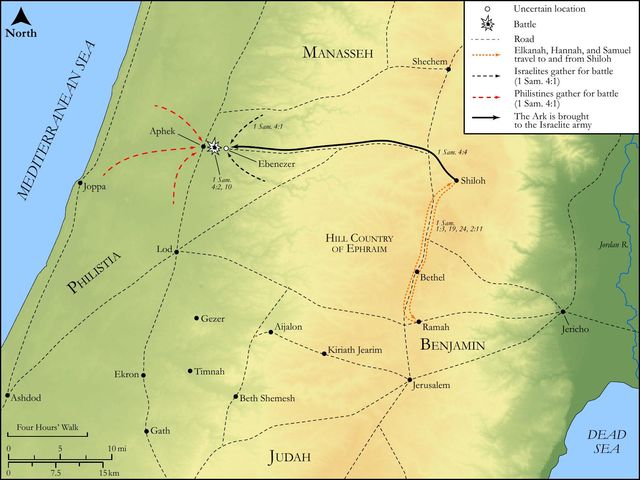
See on the biblical-era map
Study this verse
Public-domain commentary
Matthew Henry
From his Commentary on the Whole Bible. Henry comments on passages, not single verses — this entry covers 1 Samuel 2:1–10. His three-level outline is real structure in the source text, so it is rendered as structure.
We have here Hannah's thanksgiving, dictated, not only by the spirit of prayer, but by the spirit of prophecy. Her petition for the mercy she desired we had before (Sa1 1:11), and here we have her return of praise; in both out of the abundance of a heart deeply affected (in the former with her own wants, and in the latter with God's goodness) her mouth spoke. Observe in general, 1. When she had received mercy from God she owned it, with thankfulness to his praise. Not like the nine lepers, Luk 17:17. Praise is our rent, our tribute. We are unjust if we do not pay it. 2. The mercy she had received was an answer to prayer, and therefore she thought herself especially obliged to give thanks for it. What we win by prayer we may wear with comfort, and must wear with praise. 3. Her thanksgiving is here called a prayer: Hannah prayed; for thanksgiving is an essential part of prayer. In every address to God we must express a grateful regard to him as our benefactor. Nay, and thanksgiving for mercies received shall be accepted as a petition for further mercy. 4. From this particular mercy which she had received from God she takes occasion, with an elevated and enlarged heart, to speak glorious things of God and of his government of the world for the good of his church. Whatever at any time gives rise to our praises in this manner they should be raised. 5. Her prayer was mental. Her voice was not heard; but in her thanksgiving she spoke, that all might hear her. She made her supplication with groanings that could not be uttered, but now her lips were opened to show forth God's praise. 6. This thanksgiving is here left upon record for the encouragement of those of the weaker sex to attend the throne of grace. God will regard their prayers and praises. The virgin Mary's song has great affinity with this of Hannah, Luk 1:46. Three things we have in this thanksgiving: -
I.Hannah's triumph in God, in his glorious perfections, and the great things he had done for her, Sa1 2:1-3. Observe,
1.What great things she says of God. She takes little notice of the particular mercy she was now rejoicing in, does not commend Samuel for the prettiest child, the most toward and sensible for his age that she ever saw, as fond parents are too apt to do. No, she overlooks the gift, and praises the giver; whereas most forget the giver and fasten only on the gift. Every stream should lead us to the fountain; and the favours we receive from God should raise our admiration of the infinite perfections there are in God. There may be other Samuels, but no other Jehovah. There is none beside thee. Note, God is to be praised as a peerless being, and of unparalleled perfection. This glory is due unto his name, to own not only that there is none like him, but that there is none besides him. All others were pretenders, Psa 18:31. Four of God's glorious attributes Hannah here celebrates the glory of: - (1.) His unspotted purity. This is that attribute which is most praised in the upper world, by those that always behold his face, Isa 6:3; Rev 4:8. When Israel triumphed over the Egyptians God was praised as glorious in holiness, Exo 15:11. So here, in Hannah's triumph, There is none holy as the Lord. It is the rectitude of his nature, his infinite agreement with himself, and the equity of his government and judgment in all the administrations of both. At the remembrance of this we ought to give thanks. (2.) His almighty power: Neither is there any rock (or any strength, for so the word is sometimes rendered) like our God. Hannah had experienced a mighty support by staying herself upon him, and therefore speaks as she had found, and seems to refer to that of Moses, Deu 32:31. (3.) His unsearchable wisdom: The Lord, the Judge of all, is a God of knowledge; he clearly and perfectly sees into the character of every person and the merits of every cause, and he gives knowledge and understanding to those that seek them of him. (4.) His unerring justice: By him actions are weighed. His own are so, in his eternal counsels; the actions of the children of men are so, in the balances of his judgment, so that he will render to every man according to his work, and is not mistaken in what any man is or does.
2.How she solaces herself in these things. What we give God the glory of we may take the comfort of. Hannah does so, (1.) In holy joy: My heart rejoiceth in the Lord; not so much in her son as in her God; he is to be the gladness of our joy (Psa 43:4), and our joy must not terminate in any thing short of him: "I rejoice in thy salvation; not only in this particular favour to me, but in the salvation of thy people Israel, those salvations especially which this child will be an instrument of, and that, above all, by Christ, which those are but the types of." (2.) In holy triumph: "My horn is exalted; not only is my reputation saved by my having a son, but greatly raised by having such a son." We read of some of the singers whom David appointed to lift up the horn, an instrument of music, in praising God (Ch1 25:5), so that, My horn is exalted means this, "My praises are very much elevated to an unusual strain." Exalted in the Lord; God is to have the honour of all our exaltations, and in him must we triumph. My mouth is enlarged, that is, "Now I have wherewith to answer those that reproached me." He that has his quiver full of arrows, his house full of children, shall not be ashamed to speak with the enemy in the gate, Psa 127:5.
3.How she herewith silences those that set up themselves as rivals with God and rebels against him (Sa1 2:3): Talk no more so exceedingly proudly. Let not Peninnah and her children upbraid her any more with her confidence in God and praying to him: at length she found it not in vain. See Mic 7:10, Then she that is my enemy shall see it, and shame shall cover her that said, Where is thy God? Or perhaps it was below her to take so much notice of Peninnah, and her malice, in this song; but this is intended as a check to the insolence of the Philistines, and other enemies of God and Israel, that set their mouth against the heavens, Psa 73:9. "Let this put them to silence and shame; he that has thus judged for me against my adversary will judge for his people against all theirs."
II.The notice she takes of the wisdom and sovereignty of the divine providence, in its disposals of the affairs of the children of men; such are the vicissitudes of them, and such the strange and sudden turns and revolutions of them, that it is often found a very short step between the height of prosperity and the depth of adversity. God has not only set the one over against the other (Ecc 7:14), but the one very near the other, and no gulf fixed between them, that we may rejoice as though we rejoiced not and weep as though we wept not.
1.The strong are soon weakened and the weak are soon strengthened, when God pleases, Sa1 2:4. On the one hand, if he speak the word, the bows of the mighty men are broken; they are disarmed, disabled to do as they have before done and as they have designed to do. Those have been worsted in battle who seemed upon all accounts to have the advantage on their side, and thought themselves sure of victory. See Psa 46:9; Psa 37:15, Psa 37:17. Particular persons are soon weakened by sickness and age, and they find that the bow does not long abide in strength; many a mighty man who has gloried in his might has found it a deceitful bow, that failed him when he trusted to it. On the other hand, if the Lord speak the word, those who stumble through weakness, who were so feeble that they could not go straight or steady, are girded with strength, in body and mind, and are able to bring great things to pass. Those who were weakened by sickness return to their vigour (Job 33:25), and those who were brought down by sorrow shall recover their comfort, which will confirm the weak hands and the feeble knees, Isa 35:3. Victory turns in favour of that side that was given up for gone, and even the lame take the prey, Isa 33:23.
2.The rich are soon impoverished and the poor strangely enriched on a sudden, Sa1 2:5. Providence sometimes does so blast men's estates and cross their endeavours, and with a fire not blown consume their increase, that those who were full (their barns full, and their bags full, their houses full of good things, Job 22:18, and their bellies full of these hidden treasures, Psa 17:14) have been reduced to such straits and extremities as to want the necessary supports of life, and to hire out themselves for bread, and they must dig, since to beg they are ashamed. Riches flee away (Pro 23:5), and leave those miserable who, when they had them, placed their happiness in them. To those that have been full and free poverty must needs be doubly grievous. But, on the other hand, sometimes Providence so orders it that those who are hungry cease, that is, cease to hire out themselves for bread as they have done. Having, by God's blessing on their industry, got beforehand in the world, and enough to live upon at ease, they shall hunger no more, not thirst any more. This is not to be ascribed to fortune, nor merely to men's wisdom or folly. Riches are not to men of understanding, nor favour to men of skill (Ecc 9:11), nor is it always men's own fault that they become poor, but (Sa1 2:7) the Lord maketh some poor and maketh others rich; the impoverishing of one is the enriching of another, and it is God's doing. To some he gives power to get wealth, from others he takes away power to keep the wealth they have. Are we poor? God made us poor, which is a good reason why we should be content, and reconcile ourselves to our condition. Are we rich? God made us rich, which is a good reason why we should be thankful, and serve him cheerfully in the abundance of good things he gives us. It may be understood of the same person; those that were rich God makes poor, and after awhile makes rich again, as Job; he gave, he takes away, and then gives again. Let not the rich be proud and secure, for God can soon make them poor; let not the poor despond and despair, for God can in due time enrich them again.
3.Empty families are replenished and numerous families diminished and made few. This is the instance that comes close to the occasion of the thanksgiving: The barren hath borne seven, meaning herself, for, though at present she had but one son, yet that one being a Nazarite, devoted to God and employed in his immediate service, he was to her as good as seven. Or it is the language of her faith. Now that she had one she hoped for more, and was not disappointed; she had five more (Sa1 2:21), so that if we reckon Samuel but for two, as we well may, she has the number she promised herself: the barren hath borne seven, while, on the other hand, she that hath many children has waxed feeble, and hath left bearing. She says no more. Peninnah is now mortified and crest-fallen. The tradition of the Jews is that when Hannah bore one child Peninnah buried two. There are many instances both of the increase of families that were inconsiderable and the extinguishing of families that made a figure, Job 22:23; Psa 107:38, etc.
4.God is the sovereign Lord of life and death (Sa1 2:6): The Lord killeth and maketh alive. Understand it,
(1.)Of God's sovereign dominion and universal agency, in the lives and deaths of the children of men. He presides in births and burials. Whenever any die it is God that directs the arrows of death. The Lord killeth. Death is his messenger, strikes whom and when he bids; none are brought to the dust but it is he that brings them down, for in his hand are the keys of death and the grave, Rev 1:18. Whenever any are born it is he that makes them alive. None knows what is the way of the spirit, but this we know, that it comes from the Father of spirits. Whenever any are recovered from sickness, and delivered from imminent perils, it is God that bringeth up; for to him belong the issues from death.
(2.)Of the distinction he makes between some and others: He killeth some, and maketh, that is, keepeth, others alive that were in the same danger (in war, suppose, or pestilence), two in a bed together, it may be, one taken by death and the other left alive. Even so, Father, because it seemed good in thy eyes. Some that were most likely to live are brought down to the grave, and others that were as likely to die are brought up; for living and dying do not go by likelihoods. God's providences towards some are killing, ruining to their comforts, and towards others at the same time reviving.
(3.)Of the change he makes with one and the same person: He killeth and bringeth down to the grave, that is, he brings even to death's door, and then revives and raises up, when even life was despaired of and a sentence of death received, Co2 1:8, Co2 1:9. He turns to destruction, and then says, Return, Psa 110:3. Nothing is too hard for God to do, no, not the quickening of the dead, and putting life into dry bones.
5.Advancement and abasement are both from him. He brings some low and lifts up others (Sa1 2:7), humbles the proud and gives grace and honour to the lowly, lays those in the dust that would vie with the God above them and trample upon all about them (Job 40:12, Job 40:13), but lifts up those with his salvation that humble themselves before him, Jam 4:10. Or it may be understood of the same persons: those whom he had brought low, when they are sufficiently humbled, he lifteth up. This is enlarged upon, Sa1 2:8. He raiseth up the poor out of the dust, a low and mean condition, nay, from the dunghill, a base and servile condition, loathed, and despised, to set them among princes. See Psa 113:7, Psa 113:8. Promotion comes not by chance, but from the counsel of God, which often prefers those that were very unlikely and that men thought very unworthy. Joseph and Daniel, Moses and David, were thus strangely advanced, from a prison to a palace, from a sheep-hook to a sceptre. The princes they are set among may be tempted to disdain them, but God can establish the honour which he gives thus surprisingly, and make them even to inherit the throne of glory. Let not those whom Providence has thus preferred be upbraided with the dust and dunghill they are raised out of, for the meaner their beginnings were the more they are favoured, and God is glorified, in their advancement, if it be by lawful and honourable means.
6.A reason is given for all these dispensations which obliges us to acquiesce in them, how surprising soever they are: For the pillars of the earth are the Lord's.
(1.)If we understand this literally, it intimates God's almighty power, which cannot be controlled. He upholds the whole creation, founded the earth, and still sustains it by the word of his power. What cannot he do in the affairs of families and kingdoms, far beyond our conception and expectation, who hangs the earth upon nothing? Job 26:7. But,
(2.)If we understand it figuratively, it intimates his incontestable sovereignty, which cannot be disputed. The princes and great ones of the earth, the directors of states and governments, are the pillars of the earth, Psa 75:3. On these hinges the affairs of the world seem to turn, but they are the Lord's, Psa 47:9. From him they have their power, and therefore he may advance whom he pleases; and who may say, What doest thou?
III.A prediction of the preservation and advancement of all God's faithful friends, and the destruction of all his and their enemies.
Having testified her joyful triumph in what God had done, and is doing, she concludes with joyful hopes of what he would do, Sa1 2:9, Sa1 2:10. Pious affections (says bishop Patrick) in those days rose many times to the height of prophecy, whereby God continued in that nation his true religion, in the midst of their idolatrous inclinations. This prophecy may refer,
1.More immediately to the government of Israel by Samuel, and by David whom he was employed to anoint. The Israelites, God's saints, should be protected and delivered; the Philistines, their enemies, should be conquered and subdued, and particularly by thunder, Sa1 7:10. Their dominions should be enlarged, king David strengthened and greatly exalted, and Israel (that in the time of the judges had made so small a figure and had much ado to subsist) should now shortly become great and considerable, and give law to all its neighbours. An extraordinary change that was; and the birth of Samuel was, as it were, the dawning of that day. But,
2.We have reason to think that this prophecy looks further, to the kingdom of Christ, and the administration of that kingdom of grace, of which she now comes to speak, having spoken so largely of the kingdom of providence. And here is the first time that we meet with the name Messiah, or his Anointed. The ancient expositors, both Jewish and Christian, make it to look beyond David, to the Son of David. Glorious things are here spoken of the kingdom of the Mediator, both before and since his incarnation; for the method of the administration of it, both by the eternal Word and by that Word made flesh, is much the same. Concerning that kingdom we are here assured,
(1.)That all the loyal subjects of it shall be carefully and powerfully protected (Sa1 2:9): He will keep the feet of his saints. There are a people in the world that are God's saints, his select and sanctified ones; and he will keep their feet, that is, all that belongs to them shall be under his protection, down to their very feet, the lowest part of the body. If he will keep their feet, much more their head and hearts. Or he will keep their feet, that is, he will secure the ground they stand on, and establish their goings; he will set a guard of grace upon their affections and actions, that their feet may neither wander out of the way nor stumble in the way. When their feet are ready to slip (Psa 73:2) his mercy holdeth them up (Psa 94:18) and keepeth them from falling, Jde 1:24. While we keep God's ways he will keep our feet. See Psa 37:23, Psa 37:24.
(2.)That all the powers engaged against it shall not be able to effect the ruin of it. By strength shall no man prevail. God's strength is engaged for the church; and, while it is so, man's strength shall not prevail against it. The church seems destitute of strength, her friends few and feeble, but prevalency does not go by human strength, Psa 33:16. God neither needs it for him (Psa 147:10) nor dreads it against him.
(3.)That all the enemies of it will certainly be broken and brought down: The wicked shall be silent in darkness, Sa1 2:9. They shall be struck both blind and dumb, not be able to see their way nor have any thing to say for themselves. Damned sinners are sentenced to utter darkness, and in it they will be for ever speechless, Mat 22:12, Mat 22:13. The wicked are called the adversaries of the Lord, and it is foretold (Mat 22:10) that they shall be broken to pieces. Their designs against his kingdom among men will all be dashed, and they themselves destroyed; how can those speed better that are in arms against Omnipotence? See Luk 19:27. God has many ways of doing it, and, rather than fail, from heaven shall he thunder upon them, and so, not only put them in terror and consternation, but bring them to destruction. Who can stand before God's thunderbolts?
(4.)That the conquests of this kingdom shall extend themselves to distant regions: The Lord shall judge the ends of the earth. David's victories and dominions reached far, but the uttermost parts of the earth are promised to the Messiah for his possession (Psa 2:8), to be either reduced to his golden sceptre or ruined by his iron rod. God is Judge of all, and he will judge for his people against his and their enemies, Psa 110:5, Psa 110:6.
(5.)That the power and honour of Messiah the prince shall grow and increase more and more: He shall give strength unto his king, for the accomplishing of his great undertaking (Psa 89:21, and see Luk 22:43), strengthen him to go through the difficulties of his humiliation, and in his exaltation he will lift up the head (Psa 110:7), lift up the horn, the power and honour, of his anointed, and make him higher than the kings of the earth, Psa 89:27. This crowns the triumph, and is, more than any thing, the matter of her exultation. Her horn is exalted (Sa1 2:1) because she foresees the horn of the Messiah will be so. This secures the hope. The subjects of Christ's kingdom will be safe, and the enemies of it will be ruined, for the anointed, the Lord Christ, is girded with strength, and is able to save and destroy unto the uttermost.
Historical interpretation
Fourteen Centuries of Reception
5 surviving comments on this verse. Each one is dated, so this reads as a timeline rather than a list.
Select a marker to jump to its quote. Markers stagger vertically where authors wrote within a few decades of each other.
What is the meaning of “my horn”? Scripture frequently employs this phrase, remember, as when it says, “His horn was exalted” and “The horn of his anointed was exalted.” So what on earth does “horn” mean? Force, glory, prominence, using a metaphor from the brute beasts: God implanted in them only the horn by way of glory and weaponry, and if they lose it, they lose most of their force; and like a soldier without weapons a bull without horns is also easily disposed of. So by this the woman means nothing other than this, my glory is exalted. How is it exalted? “In my God,” she says. Hence the exaltation is also secure, having a firm and permanent root: while glory from human beings corresponds to the baseness of those glorifying, and so is very liable to disappear, God’s glory is not like that, remaining forever permanent.
Are these words going to be regarded as simply the words of one mere woman giving thanks for the birth of her son? Are people’s minds so turned away from the light of truth that they do not feel that the words poured out by this woman transcend the limit of her own thoughts? Surely, anyone who is appropriately moved by the events whose fulfillment has already begun, even in this earthly pilgrimage, must listen to these words and observe and recognize that through this woman (whose very name, Hannah, means “God’s grace”), there speaks, by the spirit of prophecy, the Christian religion itself, the City of God itself, whose king and founder is Christ. There speaks, in fact, the grace of God itself, from which the proud are estranged so that they fall, with which the humble are filled so that they rise up, which was in fact the chief theme that rang out in her hymn of praise. Now it may be that someone will be ready to say that the woman didn’t utter a prophecy but merely praised God in an outburst of exultation for the son who was granted in answer to her prayer. If so, what is the meaning of this passage, “He has made weak the bow of the mighty ones, and the weak have girded themselves with strength. Those who were full of bread have been reduced to want, and the hungry have passed over the earth. Because the barren woman has given birth to seven, while she who has many children has become weak.” Had Hannah herself really borne seven children, although she was barren? She had only one son when she spoke these words; and even afterwards she did not give birth to seven, or to six, which would have made Samuel the seventh. She had in fact three male and two female children. And then observe her concluding words, spoken among that people at a time when no one had yet been king over them: “He gives strength to our kings and will exalt the horn of his anointed.” How is it that she said this, if she was not uttering a prophecy? Therefore, let the church of Christ speak, the “city of the great king,” the church that is “full of grace,” fruitful in children. Let it speak the words that it recognizes as spoken prophetically about itself, so long ago, by the lips of this devout mother, “My heart is strengthened in the Lord; my horn is exalted in my God.” Her heart is truly strengthened and her horn truly exalted, because it is “in the Lord her God,” not in herself, that she finds strength and exaltation.
My heart exulted in the Lord, etc. Truly a heart exulting, truly has the horn of spiritual kingship been exalted, which does not boast in itself, nor in perishable and fragile things, but glories in the Lord its God; according to him who says: Rejoice, O righteous, in the Lord, and I shall break all the horns of sinners, and the horns of the righteous will be exalted (Psalm 75). He does not say, He shall break, He has exalted; but, I shall break, and thus they shall be exalted.
My mouth is enlarged over my enemies, etc. While my heart is enlarged to rejoice in Jesus, that is, in your salvation, my mouth is also enlarged over all enemies of faith and truth, to confess and proclaim His name; because even in the tightness of afflictions your word is not bound, nor is it bound in preachers.
My horn: The horn in the scriptures signifies strength, power, the horn is said to be exalted, when a person receives an increase of strength or glory.
Continue studying 1 Samuel 2:1 across the web’s major study libraries — every link below opens this exact verse, chapter, or book on the destination site.
Read & Compare
 BibleGatewayThis verse in more than 200 translations and 70 languages.
 Bible.comThe YouVersion reader — hundreds of translations, reading plans, and highlights.
 ESV.orgCrossway's official English Standard Version reader.
 NET BibleThe NET translation with 60,000+ translators' notes on every rendering decision.
 STEP BibleTyndale House's free study tool — original text, vocabulary, and scholarly resources.
 BibliaLogos Bible Software's free web reader.
 USCCBThe New American Bible (Revised Edition) with the U.S. bishops' study notes.
Commentaries
 BibleHub CommentariesDozens of classic commentaries on this verse, gathered on one page.
 StudyLightMore than 100 commentary sets — the largest collection on the web.
 BibleRefPlain-English commentary on what this verse means, verse by verse.
 Enduring WordDavid Guzik's free commentary on this chapter, widely used by Bible teachers.
 Bible Study ToolsVerse commentary alongside Greek and Hebrew study aids.
Original Language & Research
- BibleHub InterlinearThe verse word by word — original language, transliteration, and English.
- BibleHub LexiconEvery word's original-language definition and Strong's entry.
 Blue Letter BibleDeep-study tools — Strong's numbers, concordance, and word studies.
 SefariaThe Hebrew text with Rashi and centuries of Jewish commentary.
Sermons, Hymns & Audio


TrulyRandomVerse is not affiliated with these sites and doesn’t control their content. They’re linked because they’re genuinely useful.
Summary
1 Samuel 2:1 introduces Hannah's magnificent prayer of thanksgiving, often referred to as Hannah's Song, a profound prophetic hymn that sets a foundational theological tone for the entire book. This verse captures her overflowing, exultant joy and deep gratitude, not merely for the miraculous gift of her son, Samuel, but for the very character, faithfulness, and powerful intervention of the LORD. It articulates her triumph over long-standing barrenness and the taunts of her adversaries, establishing a theme of divine sovereignty and justice that elevates the humble and humbles the proud.
Context
ShowHideLiterary Context
This verse immediately follows the miraculous birth of Samuel, a direct answer to Hannah's fervent prayer and solemn vow at Shiloh, recorded in 1 Samuel 1:10-11. After dedicating Samuel to the LORD's service, Hannah bursts forth in this song of praise, demonstrating that her joy is rooted not in the fulfillment of her desire for a child, but in the God who answers prayer and vindicates His faithful servants. The song serves as a theological anchor for the entire book, introducing key themes of divine sovereignty, the reversal of human fortunes, and God's ultimate kingship, which will be dramatically unfolded through the narratives of Samuel, Saul, and David. It functions as a prophetic overture, foreshadowing God's future actions in Israel's history and setting the stage for the establishment of the monarchy.
Historical & Cultural Context
In ancient Israelite society, barrenness was a profound source of shame and sorrow for women, often perceived as a divine curse or disfavor, and a significant threat to family lineage and social standing. Children, especially sons, were seen as an essential blessing from God. Hannah's suffering, exacerbated by Peninnah's cruel taunts (1 Samuel 1:6-7), was deeply personal yet culturally resonant. The "horn" in Hebrew thought was a powerful symbol of strength, dignity, and honor, often associated with powerful animals like bulls or rams. To have one's horn "exalted" meant to be lifted up, vindicated, and given power or authority. Conversely, to have one's horn "cut off" signified humiliation and defeat (Psalm 75:10). Hannah's declaration reflects a profound understanding of God as the ultimate source of all power and vindication, capable of reversing social and personal standing.
Key Themes
ShowHideHannah's song introduces and develops several foundational themes that permeate the book of 1 Samuel and indeed the entire biblical narrative. Foremost is the theme of Divine Sovereignty, where God is depicted as actively involved in human affairs, orchestrating events, and demonstrating His power over life and death, barrenness and fertility (1 Samuel 2:6-8). Another crucial theme is the Reversal of Fortunes, where the proud are humbled and the humble are exalted. Hannah's personal experience of being lifted from barrenness and shame to joy and honor becomes a microcosm of God's broader work in history, exemplified later in the fall of Saul and the rise of David. The song also emphasizes Joy in the LORD, highlighting that true rejoicing is found not in circumstances or gifts, but in the character and faithfulness of God Himself, who delivers and saves. Finally, the theme of God's Salvation is central, encompassing not just personal deliverance from distress but also God's redemptive plan for His people, culminating in the establishment of His anointed king (1 Samuel 2:10).
Exposition and Analysis
ShowHideKey Word Analysis
ShowHideThis word (H5970) signifies a deep, exultant, leaping joy, often associated with triumph. It means "to jump for joy" or "exult." Hannah's joy is not merely happiness but an overflowing, almost physical expression of delight that springs from a profound sense of vindication and divine deliverance. It is a spiritual exhilaration rooted in God's character and His mighty acts.
The term "horn" (H7161) literally refers to the horn of an animal, but figuratively, it represents power, strength, and dignity. In this verse, "mine horn is exalted" is a powerful metaphor for Hannah's restoration of status, strength, and self-respect. It speaks to her vindication from the shame of barrenness and the taunts of Peninnah, acknowledging God as the one who has lifted her up and restored her dignity and authority.
The verb "râchab" (H7337) means "to broaden," "make large," or "make wide." When applied to the mouth, "my mouth is enlarged" signifies a newfound freedom and boldness to speak, to declare, and to triumph openly. It implies that her mouth, once perhaps closed in sorrow or shame, is now wide open in praise and victorious declaration over those who had tormented her, speaking to her complete vindication and the ability to articulate her triumph.
Verse Breakdown
ShowHide"And Hannah prayed, and said,"
This opening phrase immediately establishes the nature of the following text as a direct address to God, indicating a deeply personal and spiritual communication. The Hebrew verb for "prayed" (H6419, pâlal) suggests a formal, earnest petition or discourse with God, even though the content is primarily praise and thanksgiving. This highlights the intimate and deliberate nature of her communion with the LORD.
"My heart rejoiceth in the LORD,"
Hannah's joy is explicitly directed towards the LORD (H3068, Yᵉhôvâh), not merely the blessing (Samuel) He has given. This highlights the theological principle that true, abiding joy is found in the Giver, not just the gift. Her heart (H3820, lêb), the seat of emotion, will, and intellect, finds its ultimate delight and satisfaction in God's character, His faithfulness, and His sovereign power.
"mine horn is exalted in the LORD:"
This powerful metaphorical statement declares that Hannah's strength, dignity, and honor have been restored and elevated, and critically, that this exaltation comes from the LORD. It signifies her vindication and triumph over the shame of barrenness and the mockery of her adversary, acknowledging God as the sole source of her renewed status and authority.
"my mouth is enlarged over mine enemies;"
This clause expresses her complete triumph and newfound freedom to speak openly and boldly. Her "enemies" (H341, ʼôyêb) primarily refer to Peninnah, who had provoked her, but can also encompass the broader adversity and sorrow she experienced. Her "enlarged mouth" (H6310, peh) signifies her ability to declare God's goodness and her vindication without shame or fear, effectively silencing her detractors and proclaiming her victory.
"because I rejoice in thy salvation."
This concluding phrase provides the ultimate reason for her profound joy and triumph: God's "salvation" (H3444, yᵉshûwʻâh). This term encompasses God's deliverance, rescue, aid, and the fulfillment of His promises. Hannah's personal experience of being granted a child is a profound act of salvation, but her song, as it unfolds, points to God's broader redemptive plan for His people, foreshadowing a greater, ultimate salvation to come.
Literary Devices
ShowHideHannah's prayer in 1 Samuel 2:1 is rich with literary artistry, primarily employing Metaphor and Parallelism. The most prominent metaphor is "mine horn is exalted," where the "horn" vividly symbolizes strength, dignity, and power. This imagery powerfully conveys Hannah's restored honor and vindication, attributing it directly to the LORD's intervention. The phrase "my mouth is enlarged over mine enemies" can be seen as a form of Hyperbole, emphasizing the completeness of her triumph and her newfound freedom to speak boldly, though it also functions as a Metonymy where the mouth represents her voice and declaration of victory. The verse also employs Parallelism, particularly synthetic parallelism, where the second and third clauses ("mine horn is exalted in the LORD" and "my mouth is enlarged over mine enemies") expand upon and reinforce the initial declaration of joy in the LORD, each adding a new dimension to her experience of divine vindication and strength. The repetition of the concept of "rejoice" ("rejoiceth" and "rejoice") also creates a sense of Emphasis, underscoring the depth and unwavering source of her joy.
Theological and Thematic Connections
ShowHideHannah's prayer in 1 Samuel 2:1 is a profound theological statement, setting a template for understanding God's character and His ways throughout redemptive history. Her joy is not in the gift but in the Giver, establishing a critical theological principle that true satisfaction and security are found solely in the LORD. Her experience of personal salvation and vindication foreshadows God's consistent pattern of reversing human fortunes, humbling the proud, and exalting the lowly. This theme is central to the biblical narrative, demonstrating God's sovereignty over all aspects of life, from individual circumstances to national destinies. Her song is a testament to God's faithfulness to His promises and His power to deliver and transform, laying the groundwork for understanding God's ultimate redemptive plan for His people.
Reflection and Application
ShowHideHannah's prayer in 1 Samuel 2:1 offers a timeless model for faith and worship, particularly in times of answered prayer or deliverance. It challenges us to cultivate a heart that rejoices primarily in the LORD Himself, rather than in the blessings He bestows. While it is natural to be grateful for answered prayers, Hannah redirects her ultimate praise to God's character—His faithfulness, power, and salvific nature. This verse encourages us to trust in God's timing and His ability to vindicate us from our adversaries, whether they be external foes or internal struggles like shame and despair. It reminds us that God is the one who lifts up the humble and gives strength to the weak, enabling us to speak boldly of His goodness even after periods of silence and suffering. Our "salvation" in Christ is the ultimate reason for our rejoicing, empowering us to declare His praise with an "enlarged mouth" to a world in need of His deliverance.
Questions for Reflection
ShowHideFAQ
ShowHideWhat is the significance of Hannah stating, "mine horn is exalted in the LORD"?
ShowHideThe "horn" in Hebrew thought was a powerful symbol of strength, dignity, and honor, often associated with powerful animals like bulls or rams. To have one's horn "exalted" means to be lifted up, to gain power, respect, and vindication. For Hannah, this signifies her restoration from the profound shame of barrenness and the relentless taunts of her rival, Peninnah. It's a declaration that God Himself has restored her status, dignity, and strength, demonstrating His sovereign power to reverse human fortunes. This metaphor is echoed in other parts of Scripture, such as Psalm 75:10, where God declares He will cut off the horns of the wicked but exalt the horns of the righteous.
Who are Hannah's "enemies" over whom her mouth is "enlarged"?
ShowHideWhile Hannah's most immediate and personal "enemy" was Peninnah, her husband Elkanah's other wife, who continually provoked her because of her barrenness (1 Samuel 1:6-7), the term "enemies" in this context can be understood more broadly. It encompasses any form of adversity, sorrow, or opposition that had silenced Hannah's joy and brought her low. Her "enlarged mouth" signifies her newfound freedom and boldness to speak, to declare God's goodness, and to triumph openly, no longer silenced by grief or shame. It is a testament to God's complete intervention and her vindication, allowing her to proclaim His praise without reservation.
Christ-Centered Fulfillment
ShowHideHannah's song in 1 Samuel 2:1, with its profound themes of divine reversal, the exaltation of the humble, and joy in God's salvation, finds its ultimate and most profound fulfillment in Jesus Christ. Hannah's personal experience of being lifted from barrenness and shame foreshadows the greater spiritual reversal brought about by Christ: the humbling of the proud and the exaltation of those who humble themselves before God (Matthew 23:12). Her rejoicing in God's "salvation" points directly to the ultimate salvation accomplished through Christ's atoning work on the cross and His resurrection. He is the true "horn of salvation" that God has raised up for His people (Luke 1:69), delivering them from spiritual barrenness and the power of sin. Just as Hannah's barrenness gave way to fruitfulness, Christ's death and resurrection bring spiritual life and fruitfulness to those who were spiritually dead in sin (John 15:5). Mary's Magnificat in Luke 1:46-55 echoes Hannah's song almost perfectly, celebrating God's power to cast down the mighty and lift up the lowly, explicitly connecting this divine pattern to the coming of the Messiah. Thus, Hannah's personal triumph becomes a prophetic blueprint for the triumph of God over all things through His Son, Jesus Christ, who delivers His people from their spiritual enemies and exalts them in His grace and righteousness.