


1 Peter 2:7
Bible text: King James Version (1769 Blayney text) · Public domain
Bible text: King James Version with Strong's numbers · Public domain
Bible text: Berean Standard Bible · Public domain
Bible text: American Standard Version (1901) · Public domain
Bible text: World English Bible, Messianic edition · Public domain
Bible text: Geneva Bible (1599) · Public domain
Bible text: Young's Literal Translation · Public domain
- ὑμῖνhuminTo youG4771P-2DPPersonal pronoun Dative 2nd Plural
- οὖνountherefore [is]G3767CONJConjunction
- ἡhētheG3588T-NSFDefinite article Nominative Singular Feminine
- τιμὴtimēpreciousnessG5092N-NSFNoun Nominative Singular Feminine
- τοῖςtoisof thoseG3588T-DPMDefinite article Dative Plural Masculine
- πιστεύουσιν·pisteuousinbelievingG4100V-PAP-DPMVerb Present Active Participle Dative Plural Masculine
- ἀπιστοῦσινapistousin[for those] disbelievingG569V-PAP-DPMVerb Present Active Participle Dative Plural Masculine
- δὲdehoweverG1161CONJConjunction
- λίθοςlithos[the] stoneG3037N-NSMNoun Nominative Singular Masculine
- ὃνhonwhichG3739R-ASMRelative pronoun Accusative Singular Masculine
- ἀπεδοκίμασανapedokimasanrejectedG593V-AAI-3PVerb Aorist Active Indicative 3rd Plural
- οἱhoithoseG3588T-NPMDefinite article Nominative Plural Masculine
- οἰκοδομοῦντεςoikodomountesbuildingG3618V-PAP-NPMVerb Present Active Participle Nominative Plural Masculine
- οὗτοςhoutosthisG3778D-NSMDemonstrative pronoun Nominative Singular Masculine
- ἐγενήθηegenēthēhas becomeG1096V-2AOI-3SVerb 2nd Aorist Passive Deponent Indicative 3rd Singular
- εἰςeisintoG1519PREPPreposition
- κεφαλὴνkephalēn[the] headG2776N-ASFNoun Accusative Singular Feminine
- γωνίαςgōniasof [the] cornerG1137N-GSFNoun Genitive Singular Feminine
English is a literal word-by-word gloss of the Greek, not the KJV's wording. Why?
This is the original text the KJV's translators worked from — each Greek word with its own literal English meaning in this verse, prepared by scholars at Tyndale House, Cambridge. The KJV translates whole sentences, not word by word, so its wording differs: one Greek word can become several English words, and the KJV may choose “charity” where the gloss reads “love”. Both are faithful — they answer different questions. For the KJV's own rendering, switch to the KJV text.
Details
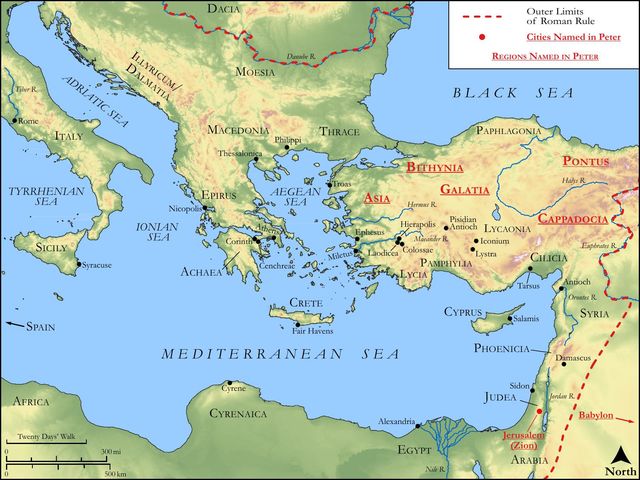
See on the biblical-era maps

Study this verse
Public-domain commentary
Matthew Henry
From his Commentary on the Whole Bible. Henry comments on passages, not single verses — this entry covers 1 Peter 2:4–12. His four-level outline is real structure in the source text, so it is rendered as structure.
I.The apostle here gives us a description of Jesus Christ as a living stone; and though to a capricious wit, or an infidel, this description may seem rough and harsh, yet to the Jews, who placed much of their religion in their magnificent temple, and who understood the prophetical style, which calls the Messiah a stone (Isa 8:14; Isa 28:16), it would appear very elegant and proper.
1.In this metaphorical description of Jesus Christ, he is called a stone, to denote his invincible strength and everlasting duration, and to teach his servants that he is their protection and security, the foundation on which they are built, and a rock of offence to all their enemies. He is the living stone, having eternal life in himself, and being the prince of life to all his people. The reputation and respect he has with God and man are very different. He is disallowed of men, reprobated or rejected by his own countrymen the Jews, and by the generality of mankind; but chosen of God, separated and fore-ordained to be the foundation of the church (as Pe1 1:20), and precious, a most honourable, choice, worthy person in himself, in the esteem of God, and in the judgment of all who believe on him. To this person so described we are obliged to come: To whom coming, not by a local motion, for that is impossible since his exaltation, but by faith, whereby we are united to him at first, and draw nigh to him afterwards. Learn,
(1.)Jesus Christ is the very foundation-stone of all our hopes and happiness. He communicates the true knowledge of God (Mat 11:27); by him we have access to the Father (Joh 14:6), and through him are made partakers of all spiritual blessings, Eph 1:3.
(2.)Men in general disallow and reject Jesus Christ; they slight him, dislike him, oppose and refuse him, as scripture and experience declare, Isa 53:3.
(3.)However Christ may be disallowed by an ungrateful world, yet he is chosen of God, and precious in his account. He is chosen and fixed upon to be the Lord of the universe, the head of the church, the Saviour of his people, and the Judge of the world. He is precious in the excellency of his nature, the dignity of his office, and the gloriousness of his services.
(4.)Those who expect mercy from this gracious Redeemer must come to him, which is our act, though done by God's grace - an act of the soul, not of the body - a real endeavour, not a fruitless wish.
2.Having described Christ as the foundation, the apostle goes on to speak of the superstructure, the materials built upon him: You also, as living stones, are built up, Pe1 2:6. The apostle is recommending the Christian church and constitution to these dispersed Jews. It was natural for them to object that the Christian church had no such glorious temple, nor such a numerous priesthood; but its dispensation was mean, the services and sacrifices of it having nothing of the pomp and grandeur which the Jewish dispensation had. To this the apostle answers that the Christian church is a much nobler fabric than the Jewish temple; it is a living temple, consisting not of dead materials, but of living parts. Christ, the foundation, is a living stone. Christians are lively stones, and these make a spiritual house, and they are a holy priesthood; and, though they have no bloody sacrifices of beasts to offer, yet they have much better and more acceptable, and they have an altar too on which to present their offerings; for they offer spiritual sacrifices, acceptable to God by Jesus Christ. Learn,
(1.)All sincere Christians have in them a principle of spiritual life communicated to them from Christ their head: therefore, as he is called a living stone, so they are called lively, or living stones; not dead in trespasses and sins, but alive to God by regeneration and the working of the divine Spirit.
(2.)The church of God is a spiritual house. The foundation is Christ, Eph 2:22. It is a house for its strength, beauty, variety of parts, and usefulness of the whole. It is spiritual foundation, Christ Jesus, - in the materials of it, spiritual persons, - in its furniture, the graces of the Spirit, - in its connection, being held together by the Spirit of God and by one common faith, - and in its use, which is spiritual work, to offer up spiritual sacrifices. This house is daily built up, every part of it improving, and the whole supplied in every age by the addition of new particular members.
(3.)All good Christians are a holy priesthood. The apostle speaks here of the generality of Christians, and tells them they are a holy priesthood; they are all select persons, sacred to God, serviceable to others, well endowed with heavenly gifts and graces, and well employed.
(4.)This holy priesthood must and will offer up spiritual sacrifices to God. The spiritual sacrifices which Christians are to offer are their bodies, souls, affections, prayers, praises, alms, and other duties.
(5.)The most spiritual sacrifices of the best men are not acceptable to God, but through Jesus Christ; he is the only great high priest, through whom we and our services can be accepted; therefore bring all your oblations to him, and by him present them to God.
II.He confirms what he had asserted of Christ being a living stone, etc., from Isa 28:16.
Observe the manner of the apostle's quoting scripture, not by book, chapter, and verse; for these distinctions were not then made, so no more was said than a reference to Moses, David, or the prophets, except once a particular psalm was named, Act 13:33. In their quotations they kept rather to the sense than the words of scripture, as appears from what is recited from the prophet in this place. He does not quote the scripture, neither the Hebrew nor Septuagint, word for word, yet makes a just and true quotation. The true sense of scripture may be justly and fully expressed in other than in scripture - words. It is contained. The verb is active, but our translators render it passively, to avoid the difficulty of finding a nominative case for it, which had puzzled so many interpreters before them. The matter of the quotation is this, Behold, I lay in Zion. Learn,
1.In the weighty matters of religion we must depend entirely upon scripture - proof; Christ and his apostles appealed to Moses, David, and the ancient prophets. The word of God is the only rule God hath given us. It is a perfect and sufficient rule.
2.The accounts that God hath given us in scripture concerning his Son Jesus Christ are what require our strictest attention. Behold, I lay, etc. John calls for the like attention, Joh 1:29. These demands of attention to Christ show us the excellency of the matter, the importance of it, and our stupidity and dulness.
3.The constituting of Christ Jesus head of the church is an eminent work of God: I lay in Zion. The setting up of the pope for the head of the church is a human contrivance and an arrogant presumption; Christ only is the foundation and head of the church of God.
4.Jesus Christ is the chief corner-stone that God hath laid in his spiritual building. The corner-stone stays inseparably with the building, supports it, unites it, and adorns it. So does Christ by his holy church, his spiritual house.
5.Jesus Christ is the corner-stone for the support and salvation of none but such as are his sincere people: none but Zion, and such as are of Zion; not for Babylon, not for his enemies.
6.True faith in Jesus Christ is the only way to prevent a man's utter confusion. Three things put a man into great confusion, and faith prevents them all - disappointment, sin, and judgment. Faith has a remedy for each.
III.He deduces an important inference, Pe1 2:7.
Jesus Christ is said to be the chief corner-stone. Hence the apostle infers with respect to good men, "To you therefore who believe he is precious, or he is an honour. Christ is the crown and honour of a Christian; you who believe will be so far from being ashamed of him that you will boast of him and glory in him for ever." As to wicked men, the disobedient will go on to disallow and reject Jesus Christ; but God is resolved that he shall be, in despite of all opposition, the head of the corner. Learn,
1.Whatever is by just and necessary consequence deduced from scripture may be depended upon with as much certainty as if it were contained in express words of scripture. The apostle draws an inference from the prophet's testimony. The prophet did not expressly say so, but yet he said that from which the consequence was unavoidable. Our Saviour bids them search the scriptures, because they testified of him; and yet no place in those scriptures to which he there refers them said that Jesus of Nazareth was the Messiah. Yet those scriptures do say that he who should be born of a virgin, before the sceptre departed from Judah, during the second temple, and after Daniel's seventy weeks, was the Messiah; but such was Jesus Christ: to collect this conclusion one must make use of reason, history, eye-sight, experience, and yet it is an infallible scripture - conclusion notwithstanding.
2.The business of a faithful minister is to apply general truths to the particular condition and state of his hearers. The apostle quotes a passage (Pe1 2:6) out of the prophet, and applies it severally to good and bad. This requires wisdom, courage, and fidelity; but it is very profitable to the hearers.
3.Jesus Christ is exceedingly precious to all the faithful. The majesty and grandeur of his person, the dignity of his office, his near relation, his wonderful works, his immense love - every thing engages the faithful to the highest esteem and respect for Jesus Christ.
4.Disobedient people have no true faith. By disobedient people understand those that are unpersuadable, incredulous, and impenitent. These may have some right notions, but no solid faith.
5.Those that ought to be builders of the church of Christ are often the worst enemies that Christ has in the world. In the Old Testament the false prophets did the most mischief; and in the New Testament the greatest opposition and cruelty that Christ met with were from the scribes, pharisees, chief priests, and those who pretended to build and take care of the church. Still the hierarchy of Rome is the worst enemy in the world to Jesus Christ and his interest.
6.God will carry on his own work, and support the interest of Jesus Christ in the world, notwithstanding the falseness of pretended friends and the opposition of his worst enemies.
IV.The apostle adds a further description, still preserving the metaphor of a stone, Pe1 2:8.
The words are taken from Isa 8:13, Isa 8:14, Sanctify the Lord of hosts himself - and he shall be for a stone of stumbling, and for a rock of offence, whence it is plain that Jesus Christ is the Lord of hosts, and consequently the most high God. Observe,
1.The builders, the chief-priests, refused him, and the people followed their leaders; and so Christ became to them a stone of stumbling, and a rock of offence, at which they stumbled and hurt themselves; and in return he fell upon them as a mighty stone or rock, and punished them with destruction. Mat 12:44, Whosoever shall fall on this stone shall be broken; but on whomsoever it shall fall it will grind him to powder. Learn,
(1.)All those that are disobedient take offense at the word of God: They stumble at the word, being disobedient. They are offended with Christ himself, with his doctrine and the purity of his precepts; but the Jewish doctors more especially stumbled at the meanness of his appearance and the proposal of trusting only to him for their justification before God. They could not be brought to seek justification by faith, but as it were by the works of the law; for they stumbled at that stumbling-stone, Rom 9:32.
(2.)The same blessed Jesus who is the author of salvation to some is to others the occasion of their sin and destruction. He is set for the rising and fall of many in Israel. He is not the author of their sin, but only the occasion of it; their own disobedience makes them stumble at him and reject him, which he punishes, as a judge, with destruction. Those who reject him as a Saviour will split upon him as a Rock.
(3.)God himself hath appointed everlasting destruction to all those who stumble at the word, being disobedient. All those who go on resolutely in their infidelity and contempt of the gospel are appointed to eternal destruction; and God from eternity knows who they are.
(4.)To see the Jews generally rejecting Christ, and multitudes in all ages slighting him, ought not to discourage us in our love and duty to him; for this had been foretold by the prophets long ago, and is a confirmation of our faith both in the scriptures and in the Messiah.
2.Those who received him were highly privileged, Pe1 2:9. The Jews were exceedingly tender of their ancient privileges, of being the only people of God, taken into a special covenant with him, and separated from the rest of the world. "Now," say they, "if we submit to the gospel - constitution, we shall lose all this, and stand upon the same level with the Gentiles."
(1.)To this objection the apostle answers, that if they did not submit they were ruined (Pe1 2:7, Pe1 2:8), but that if they did submit they should lose no real advantage, but continue still what they desired to be, a chosen generation, a royal priesthood, etc. Learn,
[1.]All true Christians are a chosen generation; they all make one family, a sort and species of people distinct from the common world, of another spirit, principle, and practice, which they could never be if they were not chosen in Christ to be such, and sanctified by his Spirit.
[2.]All the true servants of Christ are a royal priesthood. They are royal in their relation to God and Christ, in their power with God, and over themselves and all their spiritual enemies; they are princely in the improvements and the excellency of their own spirits, and in their hopes and expectations; they are a royal priesthood, separated from sin and sinners, consecrated to God, and offering to God spiritual services and oblations, acceptable to God through Jesus Christ.
[3.]All Christians, wheresoever they be, compose one holy nation. They are one nation, collected under one head, agreeing in the same manners and customs, and governed by the same laws; and they are a holy nation, because consecrated and devoted to God, renewed and sanctified by his Holy Spirit.
[4.]It is the honour of the servants of Christ that they are God's peculiar people. They are the people of his acquisition, choice, care, and delight. These four dignities of all genuine Christians are not natural to them; for their first state is a state of horrid darkness, but they are effectually called out of darkness into a state of marvellous light, joy, pleasure, and prosperity, with this intent and view, that they should show forth, by words and actions, the virtues and praises of him who hath called them.
(2.)To make this people content, and thankful for the great mercies and dignities brought unto them by the gospel, the apostle advises them to compare their former and their present state. Time was when they were not a people, nor had they obtained mercy, but they were solemnly disclaimed and divorced (Jer 3:8; Hos 1:6, Hos 1:9); but now they are taken in again to be the people of God, and have obtained mercy. Learn,
[1.]The best people ought frequently to look back upon what they were in time past.
[2.]The people of God are the most valuable people in the world; all the rest are not a people, good for little.
[3.]To be brought into the number of the people of God is a very great mercy, and it may be obtained.
V.He warns them to beware of fleshly lusts, Pe1 2:11.
Even the best of men, the chosen generation, the people of God, need an exhortation to abstain from the worst sins, which the apostle here proceeds most earnestly and affectionately to warn them against. Knowing the difficulty, and yet the importance of the duty, he uses his utmost interest in them: Dearly beloved, I beseech you. The duty is to abstain fRom. and to suppress, the first inclination or rise of fleshly lusts. Many of them proceed from the corruption of nature, and in their exercise depend upon the body, gratifying some sensual appetite or inordinate inclination of the flesh. These Christians ought to avoid, considering,
1.The respect they have with God and good men: They are dearly beloved.
2.Their condition in the world: They are strangers and pilgrims, and should not impede their passage by giving into the wickedness and lusts of the country through which they pass.
3.The mischief and danger these sins do: "They war against the soul; and therefore your souls ought to war against them." Learn,
(1.)The grand mischief that sin does to man is this, it wars against the soul; it destroys the moral liberty of the soul; it weakens and debilitates the soul by impairing its faculties; it robs the soul of its comfort and peace; it debases and destroys the dignity of the soul, hinders its present prosperity, and plunges it into everlasting misery.
(2.)Of all sorts of sin, none are more injurious to the soul than fleshly lusts. Carnal appetites, lewdness, and sensuality, are most odious to God, and destructive to man's soul. It is a sore judgment to be given up to them.
VI.He exhorts them further to adorn their profession by an honest conversation.
Their conversation in every turn, every instance, and every action of their lives, ought to be honest; that is, good, lovely, decent, amiable, and without blame: and that because they lived among the Gentiles, people of another religion, and who were inveterate enemies to them, who did already slander them and constantly spoke evil of them as of evil-doers. "A clean, just, good conversation may not only stop their mouths, but may possibly be a means to bring them to glorify God, and turn to you, when they shall see you excel all others in good works. They now call you evil-doers; vindicate yourselves by good works, this is the way to convince them. There is a day of visitation coming, wherein God may call them by his word and his grace to repentance; and then they will glorify God, and applaud you, for your excellent conversation, Luk 1:68. When the gospel shall come among them, and take effect, a good conversation will encourage them in their conversion, but an evil one will obstruct it." Note,
1.A Christian profession should be attended with an honest conversation, Phi 4:8.
2.It is the common lot of the best Christians to be evil spoken of by wicked men.
3.Those that are under God's gracious visitation immediately change their opinion of good people, glorifying God and commending those whom before they railed at as evil-doers.
Historical interpretation
Six Centuries of Reception
6 surviving comments on this verse. Each one is dated, so this reads as a timeline rather than a list.
Select a marker to jump to its quote. Markers stagger vertically where authors wrote within a few decades of each other.
Just as the Lord is the true light who has come into the world for judgment, so that at his coming he may give sight to the blind and blind those who see in the wrong way, so he is also a chosen cornerstone, giving honor to those who join themselves to him in faith and revealing himself to them as a reliable foundation, but to those who do not believe he is not precious but a stone of stumbling and a rock of offense, considered worthless by the builders who have rejected him. These builders are the scribes and the Pharisees.
These words refer to Christ, who himself prophesied in the Gospels, saying: “Have you not read, ‘The stone which the builders rejected, the same has become the head of the corner?’ ”
Those of you who believe in Christ are more than just stones—you are sons of God!
Therefore, to you who believe belongs honor. Certainly this honor, that you may not be put to shame by him at his coming, but as he said: If anyone serves me, my Father will honor him (John 12).
However, for those who do not believe, the stone which the builders rejected. So that as they rejected him while building their deeds, refusing to place him in the foundation of their hearts, they themselves may be rejected by him at his coming, when he will refuse to accept as part of his heavenly house those who rejected him. And this distinction of honor for the believers and the rejection of the unbelievers extends thus far. Hence, speaking again of the believers, he says:
To you therefore who believe, honor is given. But to those who do not believe, the stone which the builders rejected has become the head of the corner, and a stone to stumble over, and a rock to offend: namely, to those who stumble at the word, being disobedient to that which they were also appointed.
"To you therefore who believe, honor is given." To God, namely, who said, I lay, honor is given: but against the unbelievers, this is what God now says: I lay for you in Sion a stone on which you will stumble over: which is both a rock to which they will stumble, and a rock on which they will stumble if they fall: who, namely, the unbelievers, remaining in the word, stumble over it: for which, namely, they were also appointed. Therefore, the whole part must be ordered in this way: Behold, I lay in Sion a chief cornerstone, elect, precious, and he who believes in Him will by no means be put to shame [Isa. 28:16]: precious to you who believe, but to the unbelievers, a stone over which they will stumble: which stone the builders rejected, but has become the head of the corner, uniting the believers into one: but to the fallen, it is for those who stumble, namely, not believing in the word of the Gospel.
"to that which they were also appointed." not as if they are separated from God, this has been said. For no cause of destruction is administered by Him who desires all men to be saved, but those who have made themselves vessels of wrath, and unbelief has followed, and in that order they have been given to what they had prepared themselves for. For if man has been made free in will, and cannot be obligated in free will, no one could respectfully accuse him who has decreed such a fate for himself, which he has brought upon himself through his own actions.
Furthermore, Christ is called the head of the corner, as he completes the two walls of the Father's house, joining those who were from the nations and the Jews through his own contract, and adapting them into one fitting unity: indeed removing useless sacrifices from the midst, while transferring demonic superstition to the true worship of God.
Continue studying 1 Peter 2:7 across the web’s major study libraries — every link below opens this exact verse, chapter, or book on the destination site.
Read & Compare
 BibleGatewayThis verse in more than 200 translations and 70 languages.
 Bible.comThe YouVersion reader — hundreds of translations, reading plans, and highlights.
 ESV.orgCrossway's official English Standard Version reader.
 NET BibleThe NET translation with 60,000+ translators' notes on every rendering decision.
 STEP BibleTyndale House's free study tool — original text, vocabulary, and scholarly resources.
 BibliaLogos Bible Software's free web reader.
 USCCBThe New American Bible (Revised Edition) with the U.S. bishops' study notes.
Commentaries
 BibleHub CommentariesDozens of classic commentaries on this verse, gathered on one page.
 StudyLightMore than 100 commentary sets — the largest collection on the web.
 BibleRefPlain-English commentary on what this verse means, verse by verse.
 Enduring WordDavid Guzik's free commentary on this chapter, widely used by Bible teachers.
 Bible Study ToolsVerse commentary alongside Greek and Hebrew study aids.
Original Language & Research
- BibleHub InterlinearThe verse word by word — original language, transliteration, and English.
- BibleHub LexiconEvery word's original-language definition and Strong's entry.
 Blue Letter BibleDeep-study tools — Strong's numbers, concordance, and word studies.
 CNTR CollationThe earliest Greek manuscripts of this verse, collated letter by letter.
Sermons, Hymns & Audio


TrulyRandomVerse is not affiliated with these sites and doesn’t control their content. They’re linked because they’re genuinely useful.
Summary
First Peter 2:7 powerfully articulates the divergent responses to Jesus Christ, establishing Him as the indispensable cornerstone of God's redemptive plan. For those who embrace Him in faith, He is supremely valuable and honored, the very foundation of their spiritual lives. Conversely, for those who willfully reject Him through disobedience, He becomes the very stone that the "builders" (a reference to those in authority, particularly Jewish religious leaders) once discarded, yet whom God has now exalted to the preeminent position as the "head of the corner," signifying His ultimate authority and essential role in the divine architecture of salvation.
Context
ShowHideLiterary Context
This verse is deeply embedded within Peter's broader theological argument concerning the identity of Christ and the identity of believers. In the preceding verses, Peter introduces the imagery of Christ as the "living stone" (1 Peter 2:4), chosen by God and precious. He then extends this metaphor to believers, describing them as "living stones" being built into a "spiritual house" and a "holy priesthood" (1 Peter 2:5) to offer spiritual sacrifices. Peter grounds this concept in Old Testament prophecy, quoting from Isaiah 28:16 and Psalm 118:22 in 1 Peter 2:6, which speak of God laying a "chief corner stone, elect, precious." Verse 7 directly builds upon this foundation, elaborating on the contrasting outcomes based on one's response to this divine cornerstone, setting the stage for the warning about Christ being a "stone of stumbling" in 1 Peter 2:8.
Historical & Cultural Context
Peter is writing to scattered Christians in Asia Minor (modern-day Turkey), likely facing various forms of social ostracism and nascent persecution. These believers, many of whom were Gentiles, were being integrated into a community whose identity was deeply rooted in Old Testament promises and imagery. The architectural metaphor of a "cornerstone" or "head of the corner" would have been readily understood in that day. This stone was crucial for the stability and alignment of a building, often laid first and determining the orientation of the entire structure. It could refer to the foundational stone at the juncture of two walls or the capstone at the apex of an arch or wall, binding the structure together. The reference to "builders" often implies those who were responsible for constructing the religious and social framework of Israel, particularly the religious leaders of Jesus' time who rejected Him.
Key Themes
ShowHideFirst Peter 2:7 contributes significantly to several major theological themes within the epistle and the broader New Testament. It underscores Christ's Supremacy and Divine Election, emphasizing that despite human rejection, God has sovereignly exalted Him to the position of ultimate authority and indispensable significance. This verse also highlights the Dichotomy of Faith and Disobedience, presenting a stark contrast in how individuals relate to Christ, leading to vastly different spiritual destinies. For believers, Christ is the source of their spiritual Preciousness and Identity, as they are built upon Him. For the disobedient, He becomes a source of judgment and spiritual failure, echoing the themes found throughout Psalm 118 and applied by Jesus Himself in Matthew 21:42.
Exposition and Analysis
ShowHideKey Word Analysis
ShowHideThis word signifies a high value, honor, esteem, or dignity. In this context, it conveys the immense worth and profound significance that Christ holds for those who believe in Him. It's not merely that He is valuable, but that He is held in the highest regard, cherished and honored above all else by His followers.
Derived from a root meaning "to disbelieve," this term describes a willful and perverse refusal to be persuaded or to obey. It implies not just a lack of understanding, but an active, deliberate rejection of truth or authority. Here, it characterizes those who, despite evidence or revelation, stubbornly refuse to submit to Christ.
This verb means "to reject after testing or scrutiny," or "to disapprove." It suggests that the "builders" examined Jesus, found Him wanting according to their own criteria, and consequently repudiated Him. This rejection was not accidental but a deliberate, considered act of dismissal.
This versatile verb means "to come into being," "to become," or "to happen." In this passive construction, "is made," it emphasizes that Christ's exaltation to the "head of the corner" is not a result of human effort or approval, but a divine act. It highlights God's sovereign intervention in establishing Christ's preeminence despite human rejection.
Literally "head," this word is used figuratively to denote the chief, leader, or supreme authority. In the context of a building, the "head of the corner" refers to the most crucial stone, whether foundational or crowning, that unifies and completes the structure, signifying Christ's supreme and indispensable position.
This term refers to an angle or corner, specifically the corner of a building. In combination with "head," it reinforces the architectural metaphor, pointing to Christ's role as the essential stone that binds together and provides stability for the entire spiritual edifice.
Verse Breakdown
ShowHide"Unto you therefore which believe [he is] precious:"
This clause establishes the first of two contrasting responses to Christ. For those who have placed their faith (Gk. pisteúō) in Him, Jesus is of immeasurable value (Gk. timḗ). He is honored, esteemed, and cherished, reflecting a deep spiritual understanding of His person and redemptive work. This "preciousness" is not merely an intellectual assent but a heartfelt recognition of His supreme worth in their lives.
"but unto them which be disobedient,"
This introduces the stark contrast. The conjunction "but" (Gk. dé) signals a shift to those who respond differently. "Disobedient" (Gk. apeithéō) describes those who willfully refuse to believe or submit to Christ. Their response is characterized by a stubborn rejection of God's truth as revealed in Jesus.
"the stone which the builders disallowed,"
This phrase directly references Psalm 118:22, identifying Christ as the "stone" (Gk. líthos) that was rejected. The "builders" (Gk. oikodoméō, house-builders), often interpreted as the religious authorities of Israel, are depicted as having scrutinized and then deliberately "disallowed" (Gk. apodokimázō), or repudiated, Jesus. They deemed Him unfit or unworthy according to their own flawed criteria.
"the same is made the head of the corner,"
Despite the rejection by human "builders," this clause declares God's sovereign act of exaltation. The very stone they "disallowed" has been divinely "made" (Gk. gínomai, indicating a divine act of becoming) the "head of the corner" (Gk. kephalḗ gōnía). This signifies Christ's ultimate and indispensable position as the foundational and unifying stone of God's spiritual temple, the Church. He is the supreme authority and the essential element upon which all true spiritual reality rests.
Literary Devices
ShowHideFirst Peter 2:7 is rich in Symbolism, primarily employing the architectural metaphor of the "stone." Jesus is symbolized as the "living stone" and the "head of the corner," representing His foundational, unifying, and supreme role in God's redemptive plan. This imagery draws directly from Old Testament prophecies, establishing a powerful connection between the old covenant and the new. The verse also utilizes Contrast (or antithesis), setting up a stark dichotomy between the "precious" experience of believers and the rejection faced by the "disobedient." This highlights the critical nature of one's response to Christ. Furthermore, there is an element of Irony in the "builders" disallowing the very stone that God then exalts to the most crucial position, underscoring the folly of human wisdom compared to divine wisdom. The phrase "the same is made the head of the corner" also demonstrates Divine Passive, where the action (being made the head of the corner) is attributed to God, even if not explicitly stated, emphasizing His sovereign power in Christ's exaltation.
Theological and Thematic Connections
ShowHideFirst Peter 2:7 stands as a cornerstone (pun intended) of New Testament Christology, affirming Jesus' unique and indispensable role in salvation history. It highlights the divine paradox where the one rejected by human authorities becomes the one exalted by God to the position of ultimate authority and significance. This verse underscores the sovereignty of God in His plan of salvation, demonstrating that human unbelief cannot thwart His purposes. It also establishes a fundamental theological truth: one's eternal destiny is irrevocably tied to their response to Jesus Christ. He is either the precious foundation upon which life is built or the stone over which one stumbles into judgment. This truth resonates throughout Scripture, emphasizing the exclusivity and centrality of Christ for salvation and spiritual life.
Reflection and Application
ShowHideFirst Peter 2:7 presents a profound spiritual challenge and comfort. For those who believe, it is a glorious affirmation of Christ's unparalleled worth and His secure place as the foundation of our faith and lives. In a world that often dismisses or even ridicules faith, this verse reminds us that our Savior is not just a historical figure, but the "precious" and essential "head of the corner," holding all things together. This should inspire deeper worship, unwavering trust, and a profound sense of security in His divine authority. For those who are disobedient, the verse serves as a sober warning: rejecting Christ is not a neutral act, but a choice to stumble over the very stone designed for salvation. It calls for introspection, urging every individual to examine their own heart's response to Jesus. Is He precious to you, or have you, like the ancient builders, disallowed Him? Our eternal standing and the very structure of our lives depend on how we answer this question, for Christ remains the ultimate arbiter and foundation.
Questions for Reflection
ShowHideFAQ
ShowHideWhat does "the head of the corner" mean in this verse?
ShowHide"The head of the corner" (Greek: kephalḗ gōnía) is an architectural metaphor referring to the most crucial stone in a building. It can signify either the foundational stone laid at the intersection of two walls, which aligns and supports the entire structure, or the capstone at the very top of an arch or wall, which binds the structure together and completes it. In either interpretation, it emphasizes Christ's supreme importance, His indispensable role as the foundation and unifier of God's spiritual temple (the Church), and His ultimate authority over all things. This imagery is rooted in Old Testament prophecy, particularly Psalm 118:22, which speaks of the rejected stone becoming the chief cornerstone.
Christ-Centered Fulfillment
ShowHideFirst Peter 2:7 finds its profound Christ-centered fulfillment in Jesus' life, death, resurrection, and exaltation. The "stone which the builders disallowed" is a direct prophetic reference to Jesus, who was rejected by the religious and political authorities of His day, ultimately leading to His crucifixion. Yet, in a stunning display of divine reversal, God "made" this very rejected stone "the head of the corner." This points directly to Christ's resurrection from the dead and His subsequent ascension to the right hand of God, where He now reigns as Lord and Christ, the supreme authority over all creation (as seen in Acts 2:36 and Ephesians 1:20-22). For believers, this means that the one they trust is not merely a human teacher or martyr, but the divinely appointed and exalted Lord, the very foundation upon whom their salvation and eternal hope securely rest (as Paul declares in 1 Corinthians 3:11). His preciousness to us is rooted in His perfect obedience, His atoning sacrifice on the cross, and His victorious resurrection, all of which confirm His unique status as the essential "cornerstone" of God's redemptive work.