


Acts 4:12
Bible text: King James Version (1769 Blayney text) · Public domain
Bible text: King James Version with Strong's numbers · Public domain
Bible text: Berean Standard Bible · Public domain
Bible text: American Standard Version (1901) · Public domain
Bible text: World English Bible, Messianic edition · Public domain
Bible text: Geneva Bible (1599) · Public domain
Bible text: Young's Literal Translation · Public domain
- καὶkaiAndG2532CONJConjunction
- οὐκouknotG3756PRT-NNegative Particle Negative
- ἔστινestinthere isG1510V-PAI-3SVerb Present Active Indicative 3rd Singular
- ἐνeninG1722PREPPreposition
- ἄλλῳallōotherG243A-DSMAdjective Dative Singular Masculine
- οὐδενὶoudenino [one]G3762A-DSMAdjective Dative Singular Masculine
- ἡhētheG3588T-NSFDefinite article Nominative Singular Feminine
- σωτηρία·sōtēriasalvationG4991N-NSFNoun Nominative Singular Feminine
- οὐδὲoudenotG3761CONJ-NConjunction Negative
- γὰρgarforG1063CONJConjunction
- ὄνομάonomanameG3686N-NSNNoun Nominative Singular Neuter
- ἐστινestinis thereG1510V-PAI-3SVerb Present Active Indicative 3rd Singular
- ἕτερονheteronanotherG2087A-NSNAdjective Nominative Singular Neuter
- ὑπὸhupounderG5259PREPPreposition
- τὸνton<the>G3588T-ASMDefinite article Accusative Singular Masculine
- οὐρανὸνouranonheavenG3772N-ASMNoun Accusative Singular Masculine
- τὸtowhichG3588T-NSNDefinite article Nominative Singular Neuter
- δεδομένονdedomenongivenG1325V-RPP-NSNVerb Perfect Passive Participle Nominative Singular Neuter
- ἐνenamongG1722PREPPreposition
- ἀνθρώποιςanthrōpoismenG444N-DPMNoun Dative Plural Masculine
- ἐνenbyG1722PREPPreposition
- ᾧhōwhichG3739R-DSNRelative pronoun Dative Singular Neuter
- δεῖdeiit behoovesG1163V-PAI-3SVerb Present Active Indicative 3rd Singular
- σωθῆναιsōthēnaito be savedG4982V-APNVerb Aorist Passive Infinitive
- ἡμᾶςhēmasusG3165P-1APPersonal pronoun Accusative 1st Plural
English is a literal word-by-word gloss of the Greek, not the KJV's wording. Why?
This is the original text the KJV's translators worked from — each Greek word with its own literal English meaning in this verse, prepared by scholars at Tyndale House, Cambridge. The KJV translates whole sentences, not word by word, so its wording differs: one Greek word can become several English words, and the KJV may choose “charity” where the gloss reads “love”. Both are faithful — they answer different questions. For the KJV's own rendering, switch to the KJV text.
Details
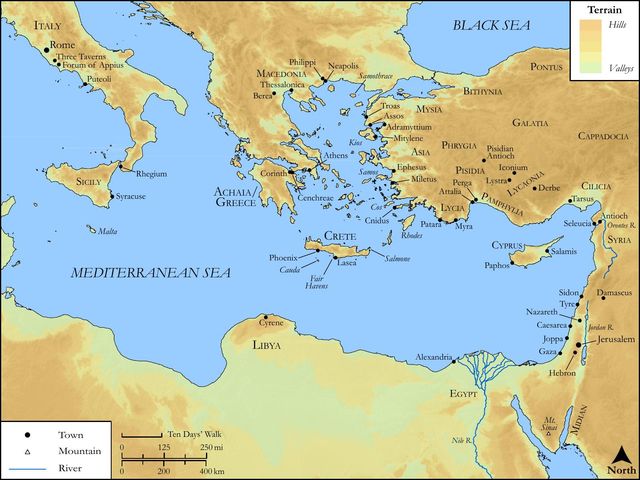
See on the biblical-era map
Study this verse
Public-domain commentary
Matthew Henry
From his Commentary on the Whole Bible. Henry comments on passages, not single verses — this entry covers Acts 4:5–14. His four-level outline is real structure in the source text, so it is rendered as structure.
We have here the trial of Peter and John before the judges of the ecclesiastical court, for preaching a sermon concerning Jesus Christ, and working a miracle in his name. This is charged upon them as a crime, which was the best service they could do to God or men.
I.Here is the court set.
An extraordinary court, it should seem, was called on purpose upon this occasion. Observe,
1.The time when the court sat (Act 4:5) - on the morrow; not in the night, as when Christ was to be tried before them, for they seem not to have been so hot upon this prosecution as they were upon that; it was well if they began to relent. But they adjourned it to the morrow, and no longer; for they were impatient to get them silenced, and would lose no time.
2.The place where - in Jerusalem (Act 4:6); there it was that he told his disciples they must expect to suffer hard things, as he had done before them in that place. This seems to come in here as an aggravation of their sin, that in Jerusalem, where there were so many that looked for redemption before it came, yet there were more that would not look upon it when it did come. How is that faithful city become a harlot! See Mat 23:37. It was in the foresight of Jerusalem's standing in her own light that Christ beheld the city, and wept over it.
3.The judges of the court.
(1.)Their general character: they were rulers, elders, and scribes, Act 4:5. The scribes were men of learning, who came to dispute with the apostles, and hoped to confute them. The rulers and elders were men in power, who, if they could not answer them, thought they could find some cause or other to silence them. If the gospel of Christ had not been of God, it could not have made its way, for it had both the learning and power of the world against it, both the colleges of the scribes and the courts of the elders.
(2.)The names of some of them, who were most considerable. Here were Annas and Caiaphas, ringleaders in this persecution; Annas the president of the sanhedrim, and Caiaphas the high priest (though Annas is here called so) and father of the house of judgment. It should seem that Annas and Caiaphas executed the high priest's office alternately, year for year. These two were most active against Christ; then Caiaphas was high priest, now Annas was; however they were both equally malignant against Christ and his gospel. John is supposed to be the son of Annas; and Alexander is mentioned by Josephus as a man that made a figure at that time. There were others likewise that were of the kindred of the high priest, who having dependence on him, and expectations from him, would be sure to say as he said, and vote with him against the apostles. Great relations, and not good, have been a snare to many.
II.The prisoners are arraigned, Act 4:7.
1.They are brought to the bar; they set them in the midst, for the sanhedrim sat in a circle, and those who had any thing to do in the court stood or sat in the midst of them (Luk 2:46), so Dr. Lightfoot. Thus the scripture was fulfilled, The assembly of the wicked has enclosed me, Psa 22:16. They compassed me about like bees, Psa 118:12. They were seated on every side.
2.The question they asked them was, "By what power, or by what name, have you done this? By what authority do you these things?" (the same question that they had asked their Master, Mat 21:23): "Who commissioned you to preach such a doctrine as this, and empowered you to work such a miracle as this? You have no warrant nor license from us, and therefore are accountable to us whence you have your warrant." Some think this question was grounded upon a fond conceit that the very naming of some names might do wonders, as Act 19:13. The Jewish exorcists made use of the name of Jesus. Now they would know what name they made use of in their cure, and consequently what name they set themselves to advance in their preaching. They knew very well that they preached Jesus, and the resurrection of the dead, and the healing of the sick, through Jesus (Act 4:2), yet they asked them, to tease them, and try if they could get any thing out of them that looked criminal.
III.The plea they put in, the design of which was not so much to clear and secure themselves as to advance the name and honour of their Master, who had told them that their being brought before governors and kings would give them an opportunity of preaching the gospel to those to whom otherwise they could not have had access, and it should be a testimony against them. Mar 13:19. Observe,
1.By whom this plea was drawn up: it was dictated by the Holy Ghost, who fitted Peter more than before for this occasion. The apostles, with a holy negligence of their own preservation, set themselves to preach Christ as he had directed them to do in such a case, and then Christ made good to them his promise, that the Holy Ghost should give them in that same hour what they should speak. Christ's faithful advocates shall never want instructions, Mar 13:11.
2.To whom it was given in: Peter, who is still the chief speaker, addresses himself to the judges of the court, as the rulers of the people, and elders of Israel; for the wickedness of those in power does not divest them of their power, but the consideration of the power they are entrusted with should prevail to divest them of their wickedness. "You are rulers and elders, and should know more than others of the signs of the times, and not oppose that which you are bound by the duty of your place to embrace and advance, that is, the kingdom of the Messiah; you are rulers and elders of Israel, God's people, and if you mislead them, and cause them to err, you will have a great deal to answer for."
3.What the plea is: it is a solemn declaration,
(1.)That what they did was in the name of Jesus Christ, which was a direct answer to the question the court asked them (Act 4:9, Act 4:10): "If we this day be examined, be called to an account as criminals, so the word signifies, for a good deed (as any one will own it to be) done to the impotent man, - if this be the ground of the commitment, this the matter of the indictment, - if we are put to the question, by what means, or by whom, he is made whole, we have an answer ready, and it is the same we gave to the people (Act 3:16), we will repeat it to you, as that which we will stand by. Be it known to you all who pretend to be ignorant of this matter, and not to you only, but to all the people of Israel, for they are all concerned to know it, that by the name of Jesus Christ, that precious, powerful, prevailing name, that name above every name, even by him whom you in contempt called Jesus of Nazareth, whom you crucified, both rulers and people, and whom God hath raised from the dead and advanced to the highest dignity and dominion, even by him doth this man stand here before you whole, a monument of the power of the Lord Jesus." Here,
[1.]He justifies what he and his colleague had done in curing the lame man. It was a good deed; it was a kindness to the man that had begged, but could not work for his living; a kindness to the temple, and to those that went in to worship, who were now freed from the noise and clamour of this common beggar. "Now, if we be reckoned with for this good deed, we have no reason to be ashamed, Pe1 2:20; Pe1 4:14, Pe1 4:16. Let those be ashamed who bring us into trouble for it." Note, It is no new thing for good men to suffer ill for doing well. Bene agere et male pati vere Christianum est - To do well and to suffer punishment is the Christian's lot.
[2.]He transfers all the praise and glory of this good deed to Jesus Christ. "It is by him, and not by any power of ours, that this man is cured." The apostles seek not to raise an interest for themselves, nor to recommend themselves by this miracle to the good opinion of the court; but, "Let the Lord alone be exalted, no matter what becomes of us." [3.] He charges it upon the judges themselves, that they had been the murderers of this Jesus: "It is he whom you crucified, look how you will answer it;" in order to the bringing of them to believe in Christ (for he aims at no less than this) he endeavours to convince them of sin, of that sin which, one would think, of all others, was most likely to startle conscience - their putting Christ to death. Let them take it how they will, Peter will miss no occasion to tell them of it. [4.] He attests the resurrection of Christ as the strongest testimony for him, and against his persecutors: "They crucified him, but God raised him from the dead; they took away his life, but God gave it to him again, and your further opposition to his interest will speed no better." He tells them that God raised him from the dead, and they could not for shame answer him with that foolish suggestion which they palmed upon the people, that his disciples came by night and stole him away. [5.] He preaches this to all the bystanders, to be by them repeated to all their neighbours, and commands all manner of persons, from the highest to the lowest, to take notice of it at their peril: "Be it known to you all that are here present, and it shall be made known to all the people of Israel, wherever they are dispersed, in spite of all your endeavours to stifle and suppress the notice of it: as the Lord God of gods knows, so Israel shall know, all Israel shall know, that wonders are wrought in the name of Jesus, not by repeating it as a charm, but believing in it as a divine revelation of grace and good-will to men."
(2.)That the name of this Jesus, by the authority of which they acted, is that name alone by which we can be saved. He passes from this particular instance to show that it is not a particular sect or party that is designed to be set up by the doctrine they preached, and the miracle they wrought, which people might either join with or keep off from at their pleasure, as it was with the sects of the philosophers and those among the Jews; but that it is a sacred and divine institution that is hereby ratified and confirmed, and which all people are highly concerned to submit to and come into the measures of. It is not an indifferent thing, but of absolute necessity, that people believe in this name, and call upon it.
[1.]We are obliged to it in duty to God, and in compliance with his designs (Act 4:11): "This is the stone which was set at nought of your builders, you that are the rulers of the people, and the elders of Israel, that should be the builders of the church, that pretend to be so, for the church is God's building. Here was a stone offered you, to be put in the chief place of the building, to be the main pillar on which the fabric might entirely rest; but you set it at nought, rejected it, would not make use of it, but threw it by as good for nothing but to make a stepping-stone of; but this stone is now become the head of the corner; God has raised up this Jesus whom you rejected, and, by setting him at his right hand, has made him both the corner stone and the head stone, the centre of unity and the fountain of power." Probably St. Peter here chose to make use of this quotation because Christ had himself made use of it, in answer to the demand of the chief priests and the elders concerning his authority, not long before this, Mat 21:42. Scripture is a tried weapon in our spiritual conflicts: let us therefore stick to it.
[2.]We are obliged to it for our own interest. We are undone if we do not take shelter in this name, and make it our refuge and strong tower; for we cannot be saved but by Jesus Christ, and, if we be not eternally saved, we are eternally undone (Act 4:12): Neither is there salvation in any other. As there is no other name by which diseased bodies can be cured, so there is no other by which sinful souls can be saved. "By him, and him only, by receiving and embracing his doctrine, salvation must now be hoped for by all. For there is no other religion in the world, no, not that delivered by Moses, by which salvation can be had for those that do not now come into this, at the preaching of it." So. Dr. Hammond. Observe here, First, Our salvation is our chief concern, and that which ought to lie nearest to our hearts - our rescue from wrath and the curse, and our restoration to God's favour and blessing. Secondly, Our salvation is not in ourselves, nor can be obtained by any merit or strength of our own; we can destroy ourselves, but we cannot save ourselves. Thirdly, There are among men many names that pretend to be saving names, but really are not so; many institutions in religion that pretend to settle a reconciliation and correspondence between God and man, but cannot do it. Fourthly, It is only by Christ and his name that those favours can be expected from God which are necessary to our salvation, and that our services can be accepted with God. This is the honour of Christ's name, that it is the only name whereby we must be saved, the only name we have to plead in all our addresses to God. This name is given. God has appointed it, and it is an inestimable benefit freely conferred upon us. It is given under heaven. Christ has not only a great name in heaven, but a great name under heaven; for he has all power both in the upper and in the lower world. It is given among men, who need salvation, men who are ready to perish. We may be saved by his name, that name of his, The Lord our righteousness; and we cannot be saved by any other. How far those may find favour with God who have not the knowledge of Christ, nor any actual faith in him, yet live up to the light they have, it is not our business to determine. But this we know, that whatever saving favour such may receive it is upon the account of Christ, and for his sake only; so that still there is no salvation in any other. I have surnamed thee, though thou hast not known me, Isa 45:4.
IV.The stand that the court was put to in the prosecution, by this plea, Act 4:13, Act 4:14.
Now was fulfilled that promise Christ made, that he would give them a mouth and wisdom, such as all their adversaries should not be able to gainsay nor resist.
1.They could not deny the cure of the lame man to be both a good deed and a miracle. He was there standing with Peter and John, ready to attest the cure, if there were occasion, and they had nothing to say against it (Act 4:14), either to disprove it or to disparage it. It was well that it was not the sabbath day, else they would have had that to say against it.
2.They could not, with all their pomp and power, face down Peter and John. This was a miracle not inferior to the cure of the lame man, considering both what cruel bloody enemies these priests had been to the name of Christ (enough to make any one tremble that appeared for him), and considering what cowardly faint-hearted advocates those disciples had lately been for him, Peter particularly, who denied him for fear of a silly maid; yet now they see the boldness of Peter and John, Act 4:13. Probably there was something extraordinary and very surprising in their looks; they appeared not only undaunted by the rulers, but daring and daunting to them; they had something majestic in their foreheads, sparkling in their eyes, and commanding, if not terrifying, in their voice. They set their faces like a flint, as the prophet, Isa 50:7; Eze 3:9. The courage of Christ's faithful confessors has often been the confusion of their cruel persecutors. Now,
(1.)We are here told what increased their wonder: They perceived that they were unlearned and ignorant men. They enquired either of the apostles or themselves or of others, and found that they were of mean extraction, born in Galilee, that they were bred fishermen, and had no learned education, had never been at any university, were not brought up at the feet of any of the rabbin, had never been conversant in courts, camps, or colleges; nay, perhaps, talk to them at this time upon any point in natural philosophy, mathematics, or politics, and you will find they know nothing of the matter; and yet speak to them of the Messiah and his kingdom, and they speak with so much clearness, evidence, and assurance, so pertinently and so fluently, and are so ready in the scriptures of the Old Testament relating to it, that the most learned judge upon the bench is not able to answer them, nor to enter the lists with them. They were ignorant men - idiōtai, private men, men that had not any public character nor employment; and therefore they wondered they should have such high pretensions. They were idiots (so the word signifies): they looked upon them with as much contempt as if they had been mere naturals, and expected no more from them, which made them wonder to see what freedom they took.
(2.)We are told what made their wonder in a great measure to cease: they took knowledge of them that they had been with Jesus; they, themselves, it is probable, had seen them with him in the temple, and now recollected that they had seen them; or some of their servants or those about them informed them of it, for they would not be thought themselves to have taken notice of such inferior people. But when they understood that they had been with Jesus, had been conversant with him, attendant on him, and trained up under him, they knew what to impute their boldness to; nay, their boldness in divine things was enough to show with whom they had had their education. Note, Those that have been with Jesus, in converse and communion with him, have been attending on his word, praying in his name, and celebrating the memorials of his death and resurrection, should conduct themselves, in every thing, so that those who converse with them may take knowledge of them that they have been with Jesus; and this makes them so holy, and heavenly, and spiritual, and cheerful; this has raised them so much above this world, and filled them with another. One may know that they have been in the mount by the shining of their faces.
Historical interpretation
Six Centuries of Reception
5 surviving comments on this verse. Each one is dated, so this reads as a timeline rather than a list.
Select a marker to jump to its quote. Markers stagger vertically where authors wrote within a few decades of each other.
Well did you escape from it, because you cast your care on God, and opened your heart to the Lord, believing that you can be saved by no other than by His great and glorious name. On this account the Lord has sent His angel, who has rule over the beasts, and whose name is Thegri, and has shut up its mouth, so that it cannot tear you.
And when there was need to teach, observe how they speak and allege many prophecies; but when the point was to use boldness of speech, then they only speak peremptorily. Thus "Neither," says he, "is there any other name under heaven given among men whereby we must be saved." It is manifest to all, he says, because not to us alone was that Name given; he cites even themselves as witnesses. "For there exists not another name under heaven, whereby we must be saved." This is the language of a soul which has renounced this present life. His exceeding out-spokenness proves here, that when he speaks in lowly terms of Christ, he does it not of fear, but of wise forbearance: but now that it was the fitting time, he speaks not in lowly terms: by this very thing intending to strike dismay into them.
"Neither is there salvation in any other," Peter says. What wounds, think you, must these words inflict on them! "For there is none other name," he continues, "under heaven given among men, whereby we must be saved." Here he utters also lofty words. For when the object is, not to carry some point successfully, but only to show boldness he does not spare; for he was not afraid of striking too deep. Nor does he say simply, "By another;" but, "Neither is there salvation in any other": that is, He is able to save us. In this way he subdued their threatening.
For “there is one God, and one Mediator between God and men, the man Christ Jesus,” since “there is no other name under heaven given to men, whereby we must be saved,” and “in him God has defined to all men their faith, in that he has raised him from the dead.” Now without this faith, that is to say, without a belief in the one Mediator between God and humankind, the man Christ Jesus; without faith, I say, in his resurrection by which God has given assurance to all people and which no one could of course truly believe were it not for his incarnation and death; without faith, therefore, in the incarnation and death and resurrection of Christ, the Christian truth unhesitatingly declares that the ancient saints could not possibly have been cleansed from sin so as to have become holy and justified by the grace of God. And this is true both of the saints who are mentioned in holy Scripture and of those also who are not indeed mentioned therein but must yet be supposed to have existed—either before the deluge or in the interval between that event and the giving of the law or in the period of the law itself—not merely among the children of Israel, as the prophets, but even outside that nation, as for instance Job. For cleansing from sin was by the self-same faith. The one Mediator cleansed the hearts of these too, and there also was “shed abroad in them the love of God by the Holy Spirit,” “who blows where he wills,” not following people’s merits but even producing these very merits himself. For the grace of God will in no wise exist unless it be wholly free.
And there is no salvation in any other. If salvation is in no other, but only in Christ, then the fathers of the Old Testament were saved by the same Redeemer’s incarnation and passion, in which we believe and hope to be saved. And though the sacraments may differ according to the times, yet the same faith agrees. For the dispensation of Christ, which we know to have been accomplished through the apostles, they learned through the prophets would come. For there is no redemption of human captivity except in the blood of Him who gave Himself as a ransom for all.
Continue studying Acts 4:12 across the web’s major study libraries — every link below opens this exact verse, chapter, or book on the destination site.
Read & Compare
 BibleGatewayThis verse in more than 200 translations and 70 languages.
 Bible.comThe YouVersion reader — hundreds of translations, reading plans, and highlights.
 ESV.orgCrossway's official English Standard Version reader.
 NET BibleThe NET translation with 60,000+ translators' notes on every rendering decision.
 STEP BibleTyndale House's free study tool — original text, vocabulary, and scholarly resources.
 BibliaLogos Bible Software's free web reader.
 USCCBThe New American Bible (Revised Edition) with the U.S. bishops' study notes.
Commentaries
 BibleHub CommentariesDozens of classic commentaries on this verse, gathered on one page.
 StudyLightMore than 100 commentary sets — the largest collection on the web.
 BibleRefPlain-English commentary on what this verse means, verse by verse.
 Enduring WordDavid Guzik's free commentary on this chapter, widely used by Bible teachers.
 Bible Study ToolsVerse commentary alongside Greek and Hebrew study aids.
Original Language & Research
- BibleHub InterlinearThe verse word by word — original language, transliteration, and English.
- BibleHub LexiconEvery word's original-language definition and Strong's entry.
 Blue Letter BibleDeep-study tools — Strong's numbers, concordance, and word studies.
 CNTR CollationThe earliest Greek manuscripts of this verse, collated letter by letter.
Sermons, Hymns & Audio


TrulyRandomVerse is not affiliated with these sites and doesn’t control their content. They’re linked because they’re genuinely useful.
Summary
Acts 4:12 is a pivotal declaration by the Apostle Peter before the Jewish Sanhedrin, asserting the exclusive and indispensable role of Jesus Christ as the sole means of salvation for all humanity. Following the miraculous healing of a lame man, Peter, filled with the Holy Spirit, boldly proclaims that this healing, and indeed all spiritual deliverance, originates from the unique authority and power inherent in the "name" of Jesus, emphasizing that no other person or system offers the path to reconciliation with God and eternal life.
Context
ShowHideLiterary Context
This verse is the climactic statement in Peter's impassioned defense before the Sanhedrin. The narrative immediately precedes this moment with Peter and John's healing of a lame man at the Beautiful Gate of the Temple, an event that caused a stir among the people and led to their arrest by temple authorities (Acts 3:1-10). Peter then delivered a sermon in Solomon's Portico, attributing the miracle to the resurrected Jesus and calling the people to repentance (Acts 3:11-26). The Sadducees, disturbed by their teaching on the resurrection, arrested Peter and John (Acts 4:1-4). When questioned by what power or name they acted (Acts 4:7), Peter, "filled with the Holy Spirit," identifies Jesus of Nazareth as the source, referencing Psalm 118:22 in Acts 4:11. Acts 4:12 then serves as the profound theological conclusion to his argument, directly answering the Sanhedrin's question and establishing the singular path to salvation.
Historical & Cultural Context
The setting is first-century Jerusalem, a city deeply rooted in Jewish tradition and governed by both Roman imperial authority and the religious authority of the Sanhedrin. The Sanhedrin, composed of Sadducees, Pharisees, and elders, was the supreme Jewish court, responsible for interpreting and enforcing Mosaic Law. They were the same body that had condemned Jesus. In this context, Peter's declaration was revolutionary and highly provocative. Judaism, while monotheistic, did not traditionally conceive of a single "name" outside of God Himself as the exclusive means of salvation from sin and judgment. The concept of "salvation" (Greek: sōtēría) in the Jewish mind often encompassed physical deliverance, national preservation, and spiritual well-being, usually tied to adherence to the Law and the covenant. Peter's message, proclaiming a crucified and resurrected Messiah as the sole path to salvation, directly challenged the established religious order and their understanding of God's redemptive plan.
Key Themes
ShowHideActs 4:12 powerfully articulates several foundational themes within the book of Acts and broader Christian theology. Firstly, it underscores The Authority and Power of the Name of Jesus. The healing of the lame man and Peter's bold proclamation are directly attributed to Jesus' name, signifying His person, authority, and redemptive work, contrasting sharply with human power or religious systems (as seen throughout Acts 3 and Acts 4). Secondly, the verse establishes the Exclusivity of Salvation in Christ. This is a radical claim in a world of diverse religious beliefs, asserting that true and ultimate salvation from sin and its consequences is found uniquely in Jesus, leaving no room for alternative paths. Thirdly, it highlights the Divine Necessity of Salvation. The phrase "whereby we must be saved" (G1163 deî) indicates a divine imperative, not merely a human preference or one option among many. God has divinely ordained this singular path for humanity's redemption. This theme is further reinforced by the consistent apostolic witness to Jesus' resurrection as God's validation of His unique role, as seen in passages like Acts 2:24 and Acts 3:15.
Exposition and Analysis
ShowHideKey Word Analysis
ShowHideG4991 - This term denotes rescue or safety, encompassing both physical deliverance and moral or spiritual well-being. In the context of Acts 4:12, while linked to the physical healing of the lame man, its primary reference is to spiritual deliverance from sin, its guilt, its power, and its eternal consequences. It signifies the comprehensive work of God in rescuing humanity from a lost state and bringing them into a right relationship with Him.
G3686 - More than just a label, "name" here represents the entire person, character, authority, and power of Jesus Christ. To be saved "in His name" means to be saved by who Jesus is, by His divine nature, His sinless life, His atoning death, and His victorious resurrection. It encapsulates His unique identity and redemptive work.
G1163 - This verb expresses divine necessity or obligation. It indicates that salvation through Jesus is not merely a possibility or a preferable option, but an absolute, divinely mandated requirement. It conveys that there is no other divinely appointed way for humanity to be saved, underscoring the indispensable nature of Christ's role.
Verse Breakdown
ShowHide"Neither is there salvation in any other:"
This opening phrase immediately establishes the absolute exclusivity of the claim. It negates any alternative source for true salvation, whether it be human effort, adherence to religious law, the teachings of other prophets, or any other spiritual path. Peter asserts that outside of the specific "name" he is about to declare, there is no genuine deliverance from sin and its eternal consequences.
"for there is none other name under heaven given among men,"
This clause provides the reason and further specifies the exclusivity. "None other name" reiterates the singular nature of the source of salvation. The phrase "under heaven" emphasizes the universal scope of this truth, applying to all people in all places. The crucial addition "given among men" highlights that this unique path is not a human invention or discovery, but a divine revelation and gift, graciously provided by God to humanity.
"whereby we must be saved."
This concluding phrase underscores the absolute necessity and divine imperative of this singular means of salvation. The word "must" (Greek: deî) signifies that it is a binding requirement, a divinely appointed and indispensable means for humanity to achieve reconciliation with God and deliverance from spiritual death. It implies that without this specific "name," salvation is impossible.
Literary Devices
ShowHideThe verse employs Assertion as its primary literary device, making a direct, unequivocal, and forceful claim about the singular path to salvation. The repeated use of negations like "neither... any other" and "none other name" creates a powerful sense of Exclusivity and Emphasis, leaving no ambiguity about the unique role of Jesus. The phrase "under heaven" functions as a Merism or Hyperbole, encompassing all of humanity and all possible religious or philosophical systems, thereby underscoring the universal applicability and singular nature of this truth. The entire statement serves as the Climax of Peter's defense, delivering the core theological message of the early church with bold authority and profound conviction.
Theological and Thematic Connections
ShowHideActs 4:12 stands as a cornerstone of Christian theology, affirming the absolute uniqueness and sufficiency of Jesus Christ for salvation. It articulates a truth that distinguishes Christianity from all other worldviews: salvation is not earned through human effort, adherence to law, or participation in rituals, but is a gracious gift received through faith in the person and work of Jesus Christ alone. This declaration, made before the very authorities who condemned Jesus, highlights the apostles' unwavering conviction in the resurrected Christ and their understanding that God had established Him as the sole means of redemption for all humanity. It challenges any notion of multiple paths to God, presenting Jesus as the exclusive "way, the truth, and the life." This verse underscores the radical nature of the Gospel and the profound love of God in providing such a specific and powerful solution to humanity's deepest need.
Reflection and Application
ShowHideActs 4:12 calls believers to a profound reflection on the nature of God's salvation and the person of Jesus Christ. In a world increasingly advocating for religious pluralism and multiple paths to truth, this verse stands as a powerful, counter-cultural declaration. It compels us to understand the gravity of sin and the radical, singular solution God has provided in His Son. For those who believe, it fosters deep gratitude for the exclusive grace found in Christ and ignites a passion to share this life-giving truth with compassion and conviction. It reminds us that our hope is not in human systems or philosophies, but in the divine act of redemption accomplished through Jesus. This verse also challenges us to examine our own lives: are we truly resting in Christ alone for our salvation, or are we subtly adding human efforts, good works, or other dependencies to our faith? It is a call to unwavering conviction in the uniqueness of Christ and a compassionate urgency in proclaiming His name to a world in need of salvation.
Questions for Reflection
ShowHideFAQ
ShowHideWhy is salvation only through Jesus Christ?
ShowHideSalvation is exclusively through Jesus Christ because He is the unique God-man, the only one capable of bridging the infinite gap between a holy God and sinful humanity. As the Son of God, He perfectly fulfilled God's righteous requirements, and as a sinless human, He offered Himself as the perfect, once-for-all sacrifice for sin on the cross. No other person, prophet, or religious system has the divine authority, sinless nature, or redemptive power to atone for sin and reconcile humanity to God. Jesus Himself declared, "I am the way, the truth, and the life: no man cometh unto the Father, but by me." His resurrection from the dead further validates His claims and His unique position as the only Savior.
Does "under heaven given among men" mean salvation is only for certain people or groups?
ShowHideNo, quite the opposite. The phrase "under heaven given among men" emphasizes the universality of the offer of salvation through Jesus Christ, not its restriction. It means that of all the possible "names" or sources of hope that exist anywhere in the world, among all humanity, only one has been divinely "given" or appointed by God for salvation. It underscores that this truth applies to everyone, everywhere, regardless of their background, culture, or previous beliefs. It is a declaration that the one true path to salvation is available to all who would believe, as God desires "all men to be saved, and to come unto the knowledge of the truth."
Christ-Centered Fulfillment
ShowHideActs 4:12 finds its profound Christ-centered fulfillment in the person and finished work of Jesus of Nazareth. Peter's bold declaration is not merely an assertion of Christian dogma, but a direct consequence of the Old Testament's prophetic trajectory pointing to a singular deliverer. Jesus is the ultimate "name" because He embodies the very nature and redemptive purpose of God. He is the Lamb of God, whose sacrifice on the cross atones for sin, fulfilling the sacrificial system of the Old Covenant (Hebrews 9:22). His resurrection from the dead decisively demonstrates His victory over sin and death, validating His divine identity and authority as the "Lord of all" and the "Author of life". The "salvation" Peter speaks of is holistic: it encompasses forgiveness of sins, reconciliation with God, deliverance from eternal judgment, and the promise of eternal life, all made possible solely through faith in Jesus. He is the "cornerstone" rejected by humanity but chosen by God (1 Peter 2:7), the one upon whom all true salvation is built. Therefore, the "must be saved" of Acts 4:12 is a divine imperative rooted in God's perfect plan to redeem humanity exclusively through His Son, Jesus Christ, who alone is "the mediator between God and men".