


1 Timothy 2:6
Bible text: King James Version (1769 Blayney text) · Public domain
Bible text: Berean Standard Bible · Public domain
Bible text: American Standard Version (1901) · Public domain
Bible text: World English Bible, Messianic edition · Public domain
Bible text: Geneva Bible (1599) · Public domain
Bible text: Young's Literal Translation · Public domain
- ὁhothe [One]G3588T-NSMDefinite article Nominative Singular Masculine
- δοὺςdoushaving givenG1325V-2AAP-NSMVerb 2nd Aorist Active Participle Nominative Singular Masculine
- ἑαυτὸνhe'autonHimselfG1438F-3ASMReflexive pronoun Accusative 3rd Singular Masculine
- ἀντίλυτρονantilutron[as] a ransomG487N-ASNNoun Accusative Singular Neuter
- ὑπὲρhuperforG5228PREPPreposition
- πάντωνpantōnallG3956A-GPMAdjective Genitive Plural Masculine
- τὸtotheG3588T-NSNDefinite article Nominative Singular Neuter
- μαρτύριονmarturiontestimonyG3142N-NSNNoun Nominative Singular Neuter
- καιροῖςkairoisproper timesG2540N-DPMNoun Dative Plural Masculine
- ἰδίοιςidioisin [their] ownG2398A-DPMAdjective Dative Plural Masculine
English is a literal word-by-word gloss of the Greek, not the KJV's wording. Why?
This is the original text the KJV's translators worked from — each Greek word with its own literal English meaning in this verse, prepared by scholars at Tyndale House, Cambridge. The KJV translates whole sentences, not word by word, so its wording differs: one Greek word can become several English words, and the KJV may choose “charity” where the gloss reads “love”. Both are faithful — they answer different questions. For the KJV's own rendering, switch to the KJV text.
Details
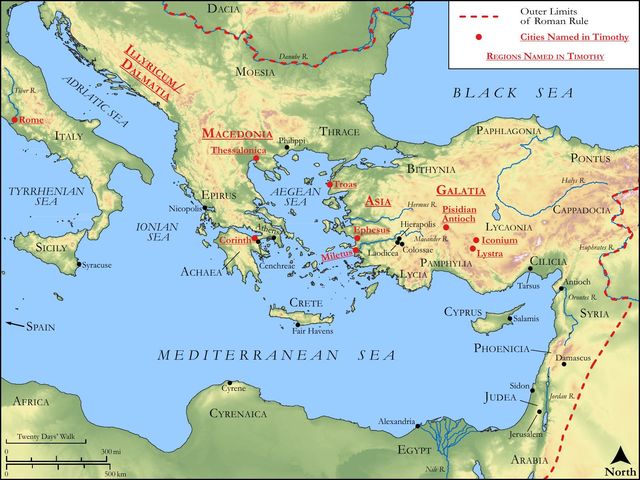
See on the biblical-era maps

Study this verse
Public-domain commentary
Matthew Henry
From his Commentary on the Whole Bible. Henry comments on passages, not single verses — this entry covers 1 Timothy 2:1–8. His three-level outline is real structure in the source text, so it is rendered as structure.
Here is, I. A charge given to Christians to pray for all men in general, and particularly for all in authority. Timothy must take care that this be done. Paul does not send him any prescribed form of prayer, as we have reason to think he would if he had intended that ministers should be tied to that way of praying; but, in general, that they should make supplications, prayers, intercessions, and giving of thanks: supplications for the averting of evil, prayers for the obtaining of good, intercessions for others, and thanksgivings for mercies already received. Paul thought it enough to give them general heads; they, having the scripture to direct them in prayer and the Spirit of prayer poured out upon them, needed not any further directions. Observe, The design of the Christian religion is to promote prayer; and the disciples of Christ must be praying people. Pray always with all prayer, Eph 6:18. There must be prayers for ourselves in the first place; this is implied here. We must also pray for all men, for the world of mankind in general, for particular persons who need or desire our prayers. See how far the Christian religion was from being a sect, when it taught men this diffusive charity, to pray, not only for those of their own way, but for all men. Pray for kings (Ti1 2:2); though the kings at this time were heathens, enemies to Christianity, and persecutors of Christians, yet they must pray for them, because it is for the public good that there should be civil government, and proper persons entrusted with the administration of it, for whom therefore we ought to pray, yea, though we ourselves suffer under them. For kings, and all that are in authority, that is, inferior magistrates: we must pray for them, and we must give thanks for them, pray for their welfare and for the welfare of their kingdoms, and therefore must not plot against them, that in the peace thereof we may have peace, and give thanks for them and for the benefit we have under their government, that we may lead a quiet and peaceable life in all godliness and honesty. Here see what we must desire for kings, that God will so turn their hearts, and direct them and make use of them, that we under them may lead a quiet and peaceable life. He does not say, "that we may get preferments under them, grow rich, and be in honour and power under them;" no, the summit of the ambition of a good Christian is to lead a quiet and peaceable life, to get through the world unmolested in a low private station. We should desire that we and others may lead a peaceable life in all godliness and honesty, implying that we cannot expect to be kept quiet and peaceable unless we keep in all godliness and honesty. Let us mind our duty, and then we may expect to be taken under the protection both of God and the government. In all godliness and honesty. Here we have our duty as Christians summed up in two words: godliness, that is, the right worshipping of God; and honesty, that is, a good conduct towards all men. These two must go together; we are not truly honest if we are not godly, and do not render to God his due; and we are not truly godly if we are not honest, for God hates robbery for burnt-offering. Here we may observe, 1. Christians are to be men much given to prayer: they ought to abound herein, and should use themselves to prayers, supplications, etc. 2. In our prayers we are to have a generous concern for others as well as for ourselves; we are to pray for all men, and to give thanks for all men; and must not confine our prayers nor thanksgiving to our own persons or families. 3. Prayer consists of various parts, of supplications, intercessions, and thanksgivings; for we must pray for the mercies we want, as well as be thankful for mercies already received; and we are to deprecate the judgments which our own sins or the sins of others have deserved. 4. All men, yea, kings themselves, and those who are in authority, are to be prayed for. They want our prayers, for they have many difficulties to encounter, many snares to which their exalted stations expose them. 5. In praying for our governors, we take the most likely course to lead a peaceable and quiet life. The Jews at Babylon were commanded to seek the peace of the city whither the Lord had caused them to be carried captives, and to pray to the Lord for it; for in the peace thereof they should have peace, Jer 29:7. 6. If we would lead a peaceable and quiet life, we must live in all godliness and honesty; we must do our duty to God and man. He that will love life, and see good days, let him refrain his tongue from evil, and his lips that they speak no guile; let him eschew evil, and do good; let him seek peace, and pursue it, Pe1 3:10, Pe1 3:11. Now the reason he gives for this is because this is good in the sight of God our Saviour; that is, the gospel of Christ requires this. That which is acceptable in the sight of God our Saviour we should do, and should abound in.
II.As a reason why we should in our prayers concern ourselves for all men, he shows God's love to mankind in general, Ti1 2:4.
1.One reason why all men are to be prayed for is because there is one God, and that God bears a good will to all mankind. There is one God (Ti1 2:5), and one only, there is no other, there can be no other, for there can be but one infinite. This one God will have all men to be saved; he desires not the death and destruction of any (Eze 33:11), but the welfare and salvation of all. Not that he has decreed the salvation of all, for then all men would be saved; but he has a good will to the salvation of all, and none perish but by their own fault, Mat 23:37. He will have all to be saved, and to come to the knowledge of the truth, to be saved in the way that he has appointed and not otherwise. It concerns us to get the knowledge of the truth, because that is the way to be saved; Christ is the way and the truth, and so he is the life.
2.There is one Mediator, and that mediator gave himself a ransom for all. As the mercy of God extends itself to all his works, so the mediation of Christ extends itself thus far to all the children of men that he paid a price sufficient for the salvation of all mankind; he brought mankind to stand upon new terms with God, so that they are not now under the law as a covenant of works, but as a rule of life. They are under grace; not under the covenant of innocence, but under a new covenant: He gave himself a ransom. Observe, The death of Christ was a ransom, a counter-price. We deserved to have died. Christ died for us, to save us from death and hell; he gave himself a ransom voluntarily, a ransom for all; so that all mankind are put in a better condition than that of devils. He died to work out a common salvation: in order hereunto, he put himself into the office of Mediator between God and man. A mediator supposes a controversy. Sin had made a quarrel between us and God; Jesus Christ is a Mediator who undertakes to make peace, to bring God and man together, in the nature of an umpire or arbitrator, a days - man who lays his hand upon u both, Job 9:33. He is a ransom that was to be testified in due time; that is, in the Old Testament times, his sufferings and the glory that should follow were spoken of as things to be revealed in the last times, Pe1 1:10, Pe1 1:11. And they are accordingly revealed, Paul himself having been ordained a preacher and an apostle, to publish to the Gentiles the glad tidings of redemption and salvation by Jesus Christ. This doctrine of Christ's mediation Paul was entrusted to preach to every creature, Mar 16:15. He was appointed to be a teacher of the Gentiles; besides his general call to the apostleship, he was commissioned particularly to preach to the Gentiles, in faith and truth, or faithfully and truly. Note,
(1.)It is good and acceptable in the sight of God and our Saviour that we pray for kings and for all men, and also that we lead a peaceable and quiet life; and this is a very good reason why we should do the one as well as the other.
(2.)God has a good will to the salvation of all; so that it is not so much the want of a will in God to save them as it is a want of will in themselves to be saved in God's way. Here our blessed Lord charges the fault: You will not come unto me that you may have life, Joh 5:40. I would have gathered you, and you would not.
(3.)Those who are saved must come to the knowledge of the truth, for this is God's appointed way to save sinners. Without knowledge the heart cannot be good; if we do not know the truth, we cannot be ruled by it.
(4.)It is observable that the unity of God is asserted, and joined with the unity of the Mediator; and the church of Rome might as well maintain a plurality of gods as a plurality of mediators.
(5.)He that is a Mediator in the New Testament sense, gave himself a ransom. Vain then is the pretence of the Romanists that there is but one Mediator of satisfaction, but many of intercession; for, according to Paul, Christ's giving himself a ransom was a necessary part of the Mediator's office; and indeed this lays the foundation for his intercession.
(6.)Paul was ordained a minister, to declare this to the Gentiles, that Christ is the one Mediator between God and men, who gave himself a ransom for all. This is the substance of which all ministers are to preach, to the end of the world; and Paul magnified his office, as he was the apostle of the Gentiles, Rom 11:13.
(7.)Ministers must preach the truth, what they apprehend to be so, and they must believe it themselves; they are, like our apostle, to preach in faith and verity, and they must also be faithful and trusty.
III.A direction how to pray, Ti1 2:8.
1.Now, under the gospel, prayer is not to be confined to any one particular house of prayer, but men must pray every where: no place is amiss for prayer, no place more acceptable to God than another, Joh 4:21. Pray every where. We must pray in our closets, pray in our families, pray at our meals, pray when we are on journeys, and pray in the solemn assemblies, whether more public or private.
2.It is the will of God that in prayer we should lift up holy hands: Lifting up holy hands, or pure hands, pure from the pollution of sin, washed in the fountain opened for sin and uncleanness. I will wash my hands, etc., Psa 26:6.
3.We must pray in charity: Without wrath, or malice, or anger at any person.
4.We must pray in faith without doubting (Jam 1:6), or, as some read it, without disputing, and then it falls under the head of charity.
Historical interpretation
Nine Centuries of Reception
4 surviving comments on this verse. Each one is dated, so this reads as a timeline rather than a list.
Select a marker to jump to its quote. Markers stagger vertically where authors wrote within a few decades of each other.
Now I write these things unto you, not that I know there are any such persons among you; nay, indeed I hope that God will never permit any such report to reach my ears, He "who spared not His Son for the sake of His holy Church." But foreseeing the snares of the wicked one, I arm you beforehand by my admonitions, as my beloved and faithful children in Christ, furnishing you with the means of protection against the deadly disease of unruly men, by which do ye flee from the disease [referred to] by the good-will of Christ our Lord. Do ye therefore, clothing yourselves with meekness, become the imitators of His sufferings, and of His love, wherewith He loved us when He gave Himself a ransom for us, that He might cleanse us by His blood from our old ungodliness, and bestow life on us when we were almost on the point of perishing through the depravity that was in us. Let no one of you, therefore, cherish any grudge against his neighbour. For says our Lord, "Forgive, and it shall be forgiven unto you." Give no occasion to the Gentiles, lest "by means of a few foolish men the word and doctrine [of Christ.] be blasphemed." For says the prophet, as in the person of God, "Woe to him by whom my name is blasphemed among the Gentiles."
Do not wonder that the whole world was redeemed, for it was no mere man but the Only-begotten Son of God who died for it. The sin of one man, Adam, availed to bring death to the world; if by one man’s offense death reigned for the world, why should not life reign all the more “from the justice of the one?” If Adam and Eve were cast out of paradise because of the tree from which they ate, should not believers more easily enter into paradise because of the Tree of Jesus? If the first man, fashioned out of the earth, brought universal death, shall not he who fashioned him, being the Life, bring everlasting life? If Phinees by his zeal in slaying the evildoer appeased the wrath of God, shall not Jesus, who slew no other, but “gave himself a ransom for all,” take away God’s wrath against man?
Was Christ then a ransom for the Heathen? Undoubtedly Christ died even for Heathen; and you cannot bear to pray for them. Why then, you ask, did they not believe? Because they would not: but His part was done. His suffering was a "Testimony," he says; for He came, it is meant, "to bear witness to the truth" of the Father, and was slain. Thus not only the Father bore witness to Him, but He to the Father. "For I came," He saith, "in my Father's name." And again, "No man hath seen God at any time." And again, "That they might know Thee, the only true God." And, "God is a Spirit." And He bore witness even to the death. But this, "in due time," means, In the fittest time.
"He gave himself a ransom," he saith, how then was He delivered up by the Father? Because it was of His goodness. And what means "ransom"? God was about to punish them, but He forbore to do it. They were about to perish, but in their stead He gave His own Son, and sent us as heralds to proclaim the Cross. These things are sufficient to attract all, and to demonstrate the love of Christ.
who gave himself as a ransom for all, the testimony given at the proper time.
who gave himself as a ransom for all, and of the Greeks. Therefore, he died for all, but you do not endure to pray? Note then the phrase, "who gave himself." For this is against the Arians, who say that he was delivered up unwillingly. But what is the price of redemption? Nature was unwilling to perish, but Jesus gave Himself for it.
the testimony. That is, through the testimony the Son became a ransom. The interpreter now says this means that the testimony is called a ransom, that is, the passion. For He came to bear witness to the truth. He testified by what He did, that He Himself is Christ, the Son of God, even to death. For He also revealed the Father, and introduced the true doctrine and the true and angelic life, given at the proper time, He says. That is, when people were suitably disposed toward faith. Thus Clement of Alexandria in the seventh "Hypotyposes."
at the proper time. Through the testimony, he gave himself, he says, as a ransom. Through the testimony, that is, through the passion (for in it he bears witness to the goodness of the Father that he gave both himself and the Son. But they did not cease their hostility toward him, but even crucified the Son. And that he wishes to fulfill the promises to them, but they do not want it), in proper time, he says, having been prefigured and predestined by the holy and blessed Trinity.
Continue studying 1 Timothy 2:6 across the web’s major study libraries — every link below opens this exact verse, chapter, or book on the destination site.
Read & Compare
 BibleGatewayThis verse in more than 200 translations and 70 languages.
 Bible.comThe YouVersion reader — hundreds of translations, reading plans, and highlights.
 ESV.orgCrossway's official English Standard Version reader.
 NET BibleThe NET translation with 60,000+ translators' notes on every rendering decision.
 STEP BibleTyndale House's free study tool — original text, vocabulary, and scholarly resources.
 BibliaLogos Bible Software's free web reader.
 USCCBThe New American Bible (Revised Edition) with the U.S. bishops' study notes.
Commentaries
 BibleHub CommentariesDozens of classic commentaries on this verse, gathered on one page.
 StudyLightMore than 100 commentary sets — the largest collection on the web.
 BibleRefPlain-English commentary on what this verse means, verse by verse.
 Enduring WordDavid Guzik's free commentary on this chapter, widely used by Bible teachers.
 Bible Study ToolsVerse commentary alongside Greek and Hebrew study aids.
Original Language & Research
- BibleHub InterlinearThe verse word by word — original language, transliteration, and English.
- BibleHub LexiconEvery word's original-language definition and Strong's entry.
 Blue Letter BibleDeep-study tools — Strong's numbers, concordance, and word studies.
 CNTR CollationThe earliest Greek manuscripts of this verse, collated letter by letter.
Sermons, Hymns & Audio


TrulyRandomVerse is not affiliated with these sites and doesn’t control their content. They’re linked because they’re genuinely useful.
Summary
First Timothy 2:6 powerfully encapsulates the core of the Christian gospel, declaring that Christ Jesus voluntarily offered Himself as a complete and sufficient ransom for all humanity. This profound act of substitutionary atonement, orchestrated according to God's perfect timing, serves as the foundational truth to be proclaimed universally, underscoring both the boundless scope of God's redemptive purpose and the unique efficacy of Christ's sacrifice.
Context
ShowHideLiterary Context
This verse is deeply embedded within Paul's pastoral instructions to Timothy concerning proper church order and sound doctrine in Ephesus. It immediately follows the declaration of God's universal desire for salvation in 1 Timothy 2:4—"Who will have all men to be saved, and to come unto the knowledge of the truth." Verse 6 then provides the theological bedrock for this universal aspiration, building directly upon 1 Timothy 2:5 which states, "For there is one God, and one mediator between God and men, the man Christ Jesus." Thus, 1 Timothy 2:6 explains how Christ functions as this unique Mediator: by giving Himself as a ransom, thereby making salvation accessible to all and fulfilling God's redemptive will. The passage transitions from the necessity of prayer for all people (vv. 1-4) to the theological basis for such universal concern, culminating in the foundational truth of Christ's atoning work.
Historical & Cultural Context
Paul is writing to Timothy, who is leading the church in Ephesus, a bustling Roman provincial capital known for its diverse religious landscape, including the prominent cult of Artemis and various philosophical schools. The concept of "ransom" (ἀντίλυτρον) would have been readily understood under Rome, where slavery was common, and a payment (λύτρον) could be made to secure a person's freedom. This background gives vivid meaning to Christ's act: He pays the ultimate price to liberate humanity from the bondage of sin, death, and the law. Furthermore, the emphasis on "one God" and "one mediator" directly challenged the polytheistic tendencies and multiple intercessors prevalent among the Gentiles, asserting the exclusive and singular path to reconciliation with God through Christ. The "due time" also reflects the historical unfolding of God's redemptive plan, from Old Testament prophecies to Christ's advent and the subsequent global proclamation of the Gospel.
Key Themes
ShowHide1 Timothy 2:6 contributes significantly to several major theological themes within the book of 1 Timothy and the broader New Testament. Foremost is the theme of Substitutionary Atonement, where Christ's death is understood as a vicarious sacrifice, a payment made in place of humanity to satisfy divine justice and secure redemption. This concept is central to the Gospel message, as seen in passages like Mark 10:45. Another crucial theme is the Universality of God's Salvific Will, emphasizing that Christ's atoning work is sufficient for "all," reflecting God's desire for all people to be saved, as articulated in 1 Timothy 2:4. This underscores the boundless nature of God's love and the unrestricted offer of grace. Finally, the phrase "to be testified in due time" highlights the theme of Divine Sovereignty and Proclamation, indicating that God has a specific, appointed time for the revelation and widespread declaration of this saving truth. This mandates the ongoing mission of the church to bear witness to Christ's redeeming work, echoing the Great Commission found in Matthew 28:19-20.
Exposition and Analysis
ShowHideKey Word Analysis
ShowHideThis verb signifies a deliberate, voluntary act of bestowal or delivery. In the context of Christ, it emphasizes His active agency and self-sacrifice, rather than a passive offering. He was not coerced but willingly "gave himself," indicating a profound act of love and obedience. The term implies a complete surrender and transfer of something precious.
This reflexive pronoun underscores the personal and complete nature of the offering. Christ did not offer something external or a mere substitute; He offered His very being, His life, His divine and human person. This highlights the unparalleled intimacy and totality of His sacrifice.
This is a strong and specific term, meaning "a redemption-price" or "that which is given in exchange for another as the price of his redemption." The prefix "anti-" (ἀντί) signifies "in place of" or "instead of," powerfully conveying the idea of a substitutionary payment. It is the price paid to free someone from bondage, debt, or captivity, signifying Christ's payment for humanity's freedom from sin and its consequences.
This word denotes totality, encompassing "all," "every," or "the whole." Its inclusion here is crucial, emphasizing the universal scope and sufficiency of Christ's ransom. It indicates that His sacrifice is not limited to a select few but is applicable and available to the entire human race, demonstrating God's boundless love and inclusive salvific intent.
While "ídios" often means "one's own" or "private," in this context, when combined with "time" (kairós), it refers to a specific, appropriate, or appointed time. It implies a divinely ordained moment, a proper season, rather than an arbitrary or random occurrence.
This word refers to a specific, opportune, or appointed season or moment, as opposed to "chronos" (χρόνος), which denotes chronological duration. "Kairós" here signifies God's sovereignly determined and perfect timing for the revelation and proclamation of the gospel truth concerning Christ's ransom.
Verse Breakdown
ShowHide"Who gave himself"
This clause highlights the active, voluntary, and personal nature of Christ's sacrifice. It was not a passive event but a deliberate act of self-giving, demonstrating profound love and obedience to the Father's will. The subject "Who" refers back to "the man Christ Jesus" in the preceding verse, emphasizing His unique identity as both fully God and fully man, capable of such a singular act.
"a ransom for all"
This is the heart of the verse, articulating the purpose and scope of Christ's self-giving. "Ransom" (ἀντίλυτρον) signifies a payment made to secure release from bondage, debt, or penalty. The preposition "for" (ὑπέρ) means "on behalf of" or "instead of," clearly indicating a substitutionary act. Christ's life was given in exchange for ours, to liberate us from the enslavement of sin and its just penalty. The crucial addition "for all" underscores the universal applicability and sufficiency of this ransom, demonstrating God's desire for the salvation of all humanity.
"to be testified in due time"
This final clause speaks to the divine plan for the proclamation of this saving truth. "To be testified" (μαρτύριον) implies a witness or evidence, signifying that the truth of Christ's ransom is a fact to be declared and attested to. "In due time" (καιρῷ ἰδίῳ) indicates God's perfect, appointed timing for this testimony to be revealed and spread throughout the world. It points to the historical unfolding of God's redemptive plan, culminating in Christ's advent and the subsequent mission of the church to proclaim the Gospel to all nations.
Literary Devices
ShowHideThe verse employs several powerful literary devices to convey its profound theological truth. The central device is Metaphor, specifically the Metaphor of Ransom/Redemption. Christ's self-giving is likened to a payment made to free captives, vividly illustrating humanity's bondage to sin and the cost required for liberation. This metaphor is deeply rooted in both Old Testament sacrificial language and the socio-economic realities of that day. Furthermore, the statement functions as a Theological Assertion or Declarative Statement, presenting a foundational truth about Christ's identity and work with concise authority. The phrase "to be testified" implies a Divine Passive, suggesting that the proclamation of this truth is not merely a human endeavor but is divinely ordained and empowered, unfolding according to God's sovereign Timing (kairos). The succinctness of the verse, particularly the pairing of "gave himself" with "ransom," creates a powerful Juxtaposition that emphasizes the active, personal nature of Christ's sacrifice in contrast to the passive state of those being ransomed.
Theological and Thematic Connections
ShowHideFirst Timothy 2:6 stands as a profound theological cornerstone, articulating the very essence of the Christian doctrine of atonement. It reveals God's boundless love and His sovereign plan to reconcile humanity to Himself through the singular, substitutionary sacrifice of His Son. This verse underscores that Christ's death was not merely a tragic event but a deliberate, purposeful act—a divine transaction where His life was given as the ultimate price to redeem all who believe from the bondage and penalty of sin. It is the theological bedrock for the universal call to salvation, confirming that God's desire for "all men to be saved" (1 Timothy 2:4) is grounded in the infinite sufficiency of Christ's blood. This truth compels believers to live lives of gratitude and to participate actively in the "testimony" of this gospel, knowing that God's "due time" for its proclamation is now.
Reflection and Application
ShowHideThe profound truth of 1 Timothy 2:6 calls for a deep and transformative reflection on the nature of God's love and the magnitude of Christ's sacrifice. To truly grasp that the Creator of the universe "gave himself a ransom for all" should evoke overwhelming gratitude and humility. It assures us that our salvation is not based on our merit or efforts, but solely on the finished work of Christ—a complete and sufficient payment for our sins, offering true freedom and peace. This understanding should dismantle any lingering doubts about God's willingness to forgive and embrace us. Furthermore, the universal scope ("for all") compels us beyond personal assurance to a fervent passion for evangelism. If Christ died for "all," then our mission is to testify to this truth to everyone, recognizing that we are living in the "due time" for its proclamation. This verse empowers us to share the Gospel with boldness, knowing that the foundation for salvation has already been laid, and the invitation is open to all.
Questions for Reflection
ShowHideFAQ
ShowHideWhat does "ransom" specifically mean in this verse?
ShowHideIn 1 Timothy 2:6, "ransom" translates the Greek word antilutron (ἀντίλυτρον). This is a very strong and precise term. It means "a price of redemption," or more specifically, "that which is given in exchange for another as the price of his redemption." The prefix anti- means "in place of" or "instead of." Therefore, when the verse states that Christ "gave himself a ransom for all," it means He offered His very life as a substitutionary payment to free humanity from the bondage of sin, its penalty, and its power. It signifies a complete and sufficient payment made on our behalf to secure our liberation and reconciliation with God. This concept is echoed in Mark 10:45, where Jesus states He came to give His life as a ransom for many.
Does "for all" mean everyone will be saved?
ShowHideThe phrase "for all" (Greek: pas) indicates the universal scope and sufficiency of Christ's atoning work, not necessarily the universal efficacy for every individual without their response. It means Christ's sacrifice is sufficient for the entire human race, demonstrating God's boundless love and desire for all people to find salvation. As stated in 1 Timothy 2:4, God "will have all men to be saved, and to come unto the knowledge of the truth." While the offer of salvation through Christ's ransom is open to all, the reception of that salvation requires a personal response of faith and repentance. The "all" here emphasizes that no one is excluded from the opportunity for salvation based on Christ's provision.
What is the significance of "in due time"?
ShowHide"In due time" translates the Greek phrase kairō idiō, referring to God's specific, appointed, or opportune time. It signifies that the revelation and proclamation of the truth about Christ's ransom were not random but part of God's sovereign, unfolding plan throughout history. This "due time" refers to the historical advent of Christ, His crucifixion, resurrection, and the subsequent commission of the church to spread the Gospel message globally. It implies that God orchestrates history to bring about His redemptive purposes, and now, in the New Covenant era, is the appointed time for this saving truth to be testified to all nations. This divine timing underscores the urgency and privilege of the church's mission to bear witness to Christ.
Christ-Centered Fulfillment
ShowHideFirst Timothy 2:6 finds its ultimate and glorious fulfillment in the person and work of Jesus Christ. He is the pre-existent Son of God, who, in the fullness of time, willingly "gave himself"—an act of unparalleled love and obedience—to become the very "ransom for all." This verse points directly to His unique role as the one Mediator between God and men, a role He could only fulfill by offering His perfect, sinless life as the ultimate atoning sacrifice. Unlike the temporary and insufficient animal sacrifices of the Old Covenant, Christ's self-giving was a once-for-all act, providing eternal redemption (Hebrews 9:11-14). His death on the cross was not a defeat but the triumphant payment of the antilutron, securing freedom from the dominion of sin and death for all who believe (Colossians 2:13-15). The "due time" for this truth to be "testified" began with His resurrection and the outpouring of the Holy Spirit, commissioning His followers to proclaim this good news to the ends of the earth (Acts 1:8). Thus, Christ is not merely the subject of the ransom; He is the Ransom, the Giver, and the ultimate fulfillment of God's universal plan of salvation, revealing the Father's heart to reconcile a lost world to Himself through His Son (2 Corinthians 5:19).