


Titus 3:4
Bible text: King James Version (1769 Blayney text) · Public domain
Bible text: Berean Standard Bible · Public domain
Bible text: American Standard Version (1901) · Public domain
Bible text: World English Bible, Messianic edition · Public domain
Bible text: Geneva Bible (1599) · Public domain
Bible text: Young's Literal Translation · Public domain
- ὍτεHoteWhenG3753CONJConjunction
- δὲdehoweverG1161CONJConjunction
- ἡhētheG3588T-NSFDefinite article Nominative Singular Feminine
- χρηστότηςchrēstotēskindnessG5544N-NSFNoun Nominative Singular Feminine
- καὶkaiandG2532CONJConjunction
- ἡhētheG3588T-NSFDefinite article Nominative Singular Feminine
- φιλανθρωπίαphilanthrōpialove of mankindG5363N-NSFNoun Nominative Singular Feminine
- ἐπεφάνηepephanēappearedG2014V-2API-3SVerb 2nd Aorist Passive Indicative 3rd Singular
- τοῦtouof theG3588T-GSMDefinite article Genitive Singular Masculine
- σωτῆροςsōtērosSaviorG4990N-GSMNoun Genitive Singular Masculine
- ἡμῶνhēmōnof usG3165P-1GPPersonal pronoun Genitive 1st Plural
- θεοῦtheouGodG2316N-GSM-TNoun Genitive Singular Masculine Title
English is a literal word-by-word gloss of the Greek, not the KJV's wording. Why?
This is the original text the KJV's translators worked from — each Greek word with its own literal English meaning in this verse, prepared by scholars at Tyndale House, Cambridge. The KJV translates whole sentences, not word by word, so its wording differs: one Greek word can become several English words, and the KJV may choose “charity” where the gloss reads “love”. Both are faithful — they answer different questions. For the KJV's own rendering, switch to the KJV text.
Details
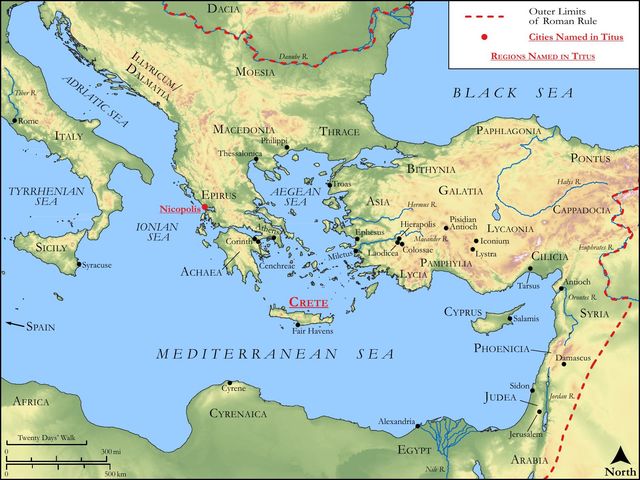
See on the biblical-era maps

Study this verse
Public-domain commentary
Matthew Henry
From his Commentary on the Whole Bible. Henry comments on passages, not single verses — this entry covers Titus 3:1–8. His three-level outline is real structure in the source text, so it is rendered as structure.
Here is the fourth thing in the matter of the epistle. The apostle had directed Titus in reference to the particular and special duties of several sorts of persons; now he bids him exhort to what concerned them more in common, namely, to quietness and submission to rulers, and readiness to do good, and to equitable and gentle behaviour towards all men - things comely and ornamental of religion; he must therefore put them in mind of such things. Ministers are people's remembrancers of their duty. As they are remembrancers for the people to God in prayers (Isa 62:6), so are they from God to them in preaching: I will not be negligent to put you always in remembrance, Pe2 1:12. Forgetfulness of duty is a common frailty; there is need therefore of reminding and quickening them thereto. Here are the duties themselves, and the reasons of them.
I.The duties themselves, which they were to be reminded of.
1.Put them in mind to be subject to principalities and powers, to obey magistrates. Magistracy is God's ordinance for the good of all, and therefore must be regarded and submitted to by all; not for wrath and by force only, but willingly and for conscience' sake. Principalities, and powers, and magistrates, that is, all civil rulers, whether supreme and chief or subordinate, in the government under which they live, of whatever form it be; that they be subject to them and obey them in things lawful and honest, and which it belongs to their office to require. The Christian religion was misrepresented by its adversaries as prejudicial to the rights of princes and civil powers, and tending to faction and sedition, and to rebellion against lawful authority; therefore to put to silence the ignorance of foolish men, and stop the mouths of malicious enemies, Christians must be reminded to show themselves examples rather of all due subjection and obedience to the government that is over them. Natural desire of liberty must be guided and bounded by reason and scripture. Spiritual privileges do not make void or weaken, but confirm and strengthen, their obligations to civil duties: "Remind them therefore to be subject to principalities and powers and to obey magistrates." And,
2.To be ready to every good work. Some refer this to such good works as are required by magistrates and within their sphere: "Whatever tends to good order, and to promote and secure public tranquility and peace, be not backward, but ready, to promote such things." But, though this be included, if not first intended, yet is it not to be hereto restrained. The precept regards doing good in all kinds, and on every occasion that may offer, whether resecting God, ourselves, or our neighbour - what may bring credit to religion in the world. Whatsoever things are true, honest, just, pure, lovely, of good report: if there be any virtue, if there be any praise, think on these things (Phi 4:8), to do and follow and further them. Mere harmlessness, or good words and good meanings only, are not enough without good works. Pure religion and undefiled before God and the Father is this, to visit the fatherless, and the widow in their affliction, and keep unspotted from the world. "Not only take, but seek, occasion for doing good, keep fitness and readiness that way; put it not off to others, but embrace and lay hold on it thyself, delight and rejoice therein, put all in mind of this." And,
3.To speak evil of no man: mēdena blasphēmein, to revile, or curse, or blaspheme none: or (as our translation more generally) to speak evil of none, unjustly and falsely, or unnecessarily, without call, and when it may do hurt but no good to the person himself or any other. If no good can be spoken, rather than speak evil unnecessarily, say nothing. We must never take pleasure in speaking ill of others, nor make the worst of any thing, but the best we can. We must not go up and down as tale-bearers, carrying ill-natured stories, to the prejudice of our neighbour's good name and the destruction of brotherly love. Misrepresentations, or insinuations of bad intentions, or of hypocrisy in what is done, things out of our reach or cognizance, these come within the reach of this prohibition. As this evil is too common, so it is of great malignity. If any man seemeth to be religious and bridleth not his tongue, that man's religion is vain, Jam 1:26. Such loose uncharitable talk is displeasing to God, and hurtful among men. Pro 17:9, He that covereth a transgression seeketh love (that is, to himself by this tenderness and charity, or rather to the transgressor); but he that repeateth a matter (that blazes and tells the faults of another abroad) separateth very friends; he raises dissensions and alienates his friend from himself, and perhaps from others. This is among the sins to be put off (Eph 4:31); for, if indulged, it unfits for Christians communion here and the society of the blessed in heaven, Co1 6:10. Remind them therefore to avoid this. And,
4.To be no brawlers; amachous einai - no fighters, either with hand or tongue, no quarrelsome contentious persons, apt to give or return ill and provoking language. A holy contending there is for matters good and important, and in a manner suitable and becoming, not with wrath nor injurious violence. Christian must follow the things that are conducive to peace, and that in a peaceful, not a rough and boisterous and hurtful way, but as becomes the servants of the God of peace and love (Rom 12:19), Dearly beloved, avenge not yourselves, but rather give place unto wrath; this is the Christian's wisdom and duty. The glory of a man is to pass over a transgression; it is the duty of a reasonable, and therefore certainly of a Christian man, whose reason is improved and advanced by religion; such may not, and will not, presently fall foul on one who has offended him, but, like God, will be slow to anger, and ready to forgive. Contention and strife arise from men's lusts, and exorbitant unruly passions, which must be curbed and moderated, not indulged; and Christians need to be reminded of these things, that they do not by a wrathful contentious spirit and behaviour displease and dishonour God and discredit religion, promoting feuds in the places where they live. He that is slow to anger is better than the mighty, and he that ruleth his spirit than he that taketh a city. Wherefore it follows,
5.But gentle; epieikeis, equitable and just, or candid and fair in constructions of things, not taking words or actions in the worst sense; and for peace sometimes yielding somewhat of strict right. And,
6.Showing all meekness to all men. We must be of a mild disposition, and not only have meekness in our hearts, but show it in our speech and conduct. All meekness - meekness in all instances and occasions, not towards friends only, but to all men, though still with wisdom, as James admonishes, Jam 3:13. "Distinguish the person and the sin; pity the one and hate the other. Distinguish between sin and sin; look not on all alike, there are motes and beams. Distinguish also between sinner and sinner: of some have compassion, others save with fear, pulling them out of the fire, thus making a difference, Jde 1:22, Jde 1:23. Mind these things; the wisdom that is from above is pure and peaceable, gentle and easy to be entreated." Meekness of spirit and demeanour renders religion amiable; it is a commanded imitation of Christ the grand exemplar, and what brings it own reward with it, in the ease and comfort of the disposition itself and the blessings accompanying it. These shall be glad and rejoice, shall be taught and guided in their way, and satisfied with bread, and beautified with salvation. Thus of the duties themselves, which Titus was to put people in mind of: for which,
II.He adds the reasons, which are derived
1.From their own past condition. Consideration of men's natural condition is a great means and ground of equity and gentleness, and all meekness, towards those who are yet in such a state. This has a tendency to abate pride and work pity and hope in reference to those who are yet unconverted: "We ourselves also were so and so, corrupt and sinful, therefore we should not be impatient and bitter, hard and severe, towards those who are but as ourselves once were. Should we then have been willing to be contemned, and proudly and rigorously dealt with? No, but treated with gentleness and humanity; and therefore we should now so treat those who are unconverted, according to that rule of equity: Quod tibi non vis fieri, alteri ne feceris - What you would not have done to you that do not you to another." Their past natural condition is set forth in divers particulars. We ourselves also were sometimes,
(1.)Foolish; without true spiritual understanding and knowledge, ignorant of heavenly things. Observe, Those should be most disposed to bear with others' follies who may remember many of their own; those should be meek and gentle, and patient towards others, who once needed and doubtless then expected the same. We ourselves also were sometimes foolish. And,
(2.)Disobedient; heady and unpersuadable, resisting the word, and rebellious even against the natural laws of God, and those which human society requires. Well are these set together, foolish and obedient. For what folly like this, to disobey God and his laws, natural or revealed? This is contrary to right reason, and men's true and greatest interests; and what so foolish as to violate and go counter to these?
(3.)Deceived, or wandering; namely, out of the ways of truth and holiness. Man in this his degenerate state is of a straying nature, thence compared to a lost sheep; this must be sought and brought back, and guided in the right way, Psa 119:176. He is weak, and ready to be imposed upon by the wiles and subtleties of Satan, and of men lying in wait to seduce and mislead.
(4.)Serving divers lusts and pleasures; namely, as vassals and slaves under them. Observe, Men deceived are easily entangled and ensnared; they would not serve divers lusts and pleasures as they do, were they not blinded and beguiled into them. See here too what a different notion the word gives of a sensual and fleshly life from what the world generally has of it. Carnal people think they enjoy their pleasures; the word calls it servitude and vassalage: they are very drudges and bond slaves under them; so far are they from freedom and felicity in them that they are captivated by them, and serve them as taskmasters and tyrants. Observe further, It is the misery of the servants of sin that they have many masters, one lust hurrying them one way, and another; pride commands one thing, covetousness another, and often a contrary. What vile slaves are sinners, while they conceit themselves free! the lusts that tempt them promise them liberty, but in yielding they become the servants of corruption; for of whom a man is overcome of the same is he brought into bondage.
(5.)Living in malice, one of those lusts that bear rule in them. Malice desires hurt to another and rejoices in it.
(6.)And envy, which grudges and repines at another's good, frets at his prosperity and success in any thing: both are roots of bitterness, whence many evils spring: evil thoughts and speeches, tongues set on fire of hell, detracting from and impairing the just and due praises of others. Their words are swords, wherewith they slay the good name and honour of their neighbour. This was the sin of Satan, and of Cain who was of that evil one, and slew his brother; for wherefore slew he him, but of this envy and malice, because his own works were evil, and his brother's righteous? These were some of the sins in which we lived in our natural state. And, (7.), Hateful, or odious - deserving to be hated. (8.) And hating one another. Observe, Those that are sinful, living and allowing themselves in sin, are hateful to God and all good men. Their temper and ways are so, though not simply their persons. It is the misery of sinners that thy hate one another, as it is the duty and happiness of saints to love one another. What contentions and quarrels flow from men's corruptions, such as were in the nature of those who by conversion are now good, but in their unconverted state made them ready to run like furious wild beasts one upon another! The consideration of its having been thus with us should moderate our spirits, and dispose us to be more equal and gentle, meek and tenderhearted, towards those who are such. This is the argument from their own past condition here described. And he reasons,
2.From their present state. "We are delivered out of that our miserable condition by no merit nor strength of our own; but only by the mercy and free grace of God, and merit of Christ, and operation of his Spirit. Therefore we have no ground, in respect of ourselves, to condemn those who are yet unconverted, but rather to pity them, and cherish hope concerning them, that they, though in themselves as unworthy and unmeet as we were, yet may obtain mercy, as we have:" and so upon this occasion the apostle again opens the causes of our salvation, Tit 3:4-7.
(1.)We have here the prime author of our salvation - God the Father, therefore termed here God our Saviour. All things are of God, who hath reconciled us to himself by Jesus Christ, Co2 5:18. All things belonging to the new creation, and recovery of fallen man to life and happiness, of which the apostle is there speaking, all these things are of God the Father, as contriver and beginner of this work. There is an order in acting, as in subsisting. The Father begins, the Son manages, and the Holy Spirit works and perfects all. God (namely, the Father) is a Saviour by Christ, through the Spirit. Joh 3:16, God so loved the world as to give his only begotten Son, that whoever believes in him might not perish, but have everlasting life. He is the Father of Christ, and through him the Father of mercies; all spiritual blessings are by Christ from him, Eph 1:3. We joy in God through Jesus Christ, Rom 5:11. And with one mind, and one mouth, glorify God, even the Father of our Lord Jesus Christ, Rom 15:5.
(2.)The spring and rise of it - the divine philanthropy, or kindness and love of God to man. By grace we are saved from First to last. This is the ground and motive. God's pity and mercy to man in misery were the first wheel, or rather the Spirit in the wheels, that sets and keeps them all in motion. God is not, cannot be, moved by any thing out of himself. The occasion is in man, namely, his misery and wretchedness. Sin bringing that misery, wrath might have issued out rather than compassion; but God, knowing how to adjust all with his own honour and perfections, would pity and save rather than destroy. He delights in mercy. Where sin abounded, grace did much more abound. We read of riches of goodness and mercy, Rom 2:4; Eph 2:7. Let us acknowledge this, and give him the glory of it, not turning it to wantonness, but to thankfulness and obedience.
(3.)Here is the means, or instrumental cause - the shining out of this love and grace of God in the gospel, after it appeared, that is, in the word. The appearing of love and grace has, through the Spirit, great virtue to soften and change and turn to God, and so is the power of God to salvation to every one that believeth. Thus having asserted God to be the author, his free grace the spring, and the manifestation of this in the gospel the means of salvation, that the honour of all still may be the better secured to him,
(4.)False grounds and motives are here removed: Not by works of righteousness which we have done, but according to his mercy, he saved us; not for foreseen works of ours, but his own free grace and mercy alone. Works must be in the saved (where there is room for it), but not among the causes of his salvation; they are the way to the kingdom, not the meriting price of it; all is upon the principle of undeserved favour and mercy from first to last. Election is of grace: we are chosen to be holy, not because it was antecedently seen that we should be so, Eph 1:4. It is the fruit, not the cause, of election: God hath from the beginning chosen you to salvation through sanctification of the Spirit and belief of the truth, Th2 2:13. So effectual calling, in which election breaks out, and is first seen: He hath saved us, and called us with a holy calling; not according to our works, but according to his own purpose and grace, which was given us in Christ Jesus before the world began, Ti2 1:9. We are justified freely by grace (Rom 3:24), and sanctified and saved by grace: By grace you are saved, through faith; and that not of yourselves, it is the gift of God, Eph 2:8. Faith and all saving graces are God's free gift and his work; the beginning, increase, and perfection of them in glory, all are from him. In building men up to be a holy temple unto God, from the foundation to the top-stone, we must cry nothing but Grace, grace unto it. It is not of works, lest any man should boast; but of grace, that he who glorieth should glory only in the Lord. Thus the true cause is shown, and the false removed.
(5.)Here is the formal cause of salvation, or that wherein it lies, the beginnings of it at least - in regeneration or spiritual renewing, as it is here called. Old things pass away, and all things become new, in a moral and spiritual, not in a physical and natural, sense. It is the same man, but with other dispositions and habits; evil ones are done away, as to the prevalency of them at present; and all remains of them in due time will be so, when the work shall be perfected in heaven. A new prevailing principle of grace and holiness is wrought, which inclines, and sways, and governs, and makes the man a new man, a new creature, having new thoughts, desires, and affections, a new and holy turn of life and actions; the life of God in man, not only from God in a special manner, but conformed and tending to him. Here is salvation begun, and which will be growing and increasing to perfection; therefore it is said, He saved us. What is so begun, as sure to be perfected in time, is expressed as if it already were so. Let us look to this therefore without delay; we must be initially saved now, by regeneration, if on good ground we would expect complete salvation in heaven. The change then will be but in degree, not in kind. Grace is glory begun, as glory is but grace in its perfection. How few mind this! Most act as if they were afraid to be happy before the time; they would have heaven, they pretend, at last, yet care not for holiness now; that is, they would have the end without the beginning; so absurd are sinners. But without regeneration, that is, the first resurrection, there is no attaining the second glorious one, the resurrection of the just. Here then is formal salvation, in the new divine life wrought by the gospel.
(6.)Here is the outward sign and seal thereof in baptism, called therefore the washing of regeneration. The work itself is inward and spiritual; but it is outwardly signified and sealed in this ordinance. Water is of a cleansing and purifying nature, does away the filth of the flesh, and so was apt to signify the doing away of the guilt and defilement of sin by the blood and Spirit of Christ, though that aptness alone, without Christ's institution, would not have been sufficient. This it is that makes it of this signification on God's part, a seal of righteousness by faith, as circumcision was, in the place of which it succeeds; and on ours an engagement to be the Lord's. Thus baptism saves figuratively and sacramentally, where it is rightly used. Arise, and be baptized, and wash away thy sins, calling upon the name of the Lord, Act 22:16. So Eph 5:26, That he might sanctify and cleanse us by the washing of water by the word. Slight not this outward sign and seal, where it may be had according to Christ's appointment; yet rest not in the outward washing, but look to the answer of a good conscience, without which the external washing will avail nothing. The covenant sealed in baptism binds to duties, as well as exhibits and conveys benefits and privileges; if the former be not minded, in vain are the latter expected. Sever not what God has joined; in both the outer and inner part is baptism complete; as he that was circumcised became debtor to the whole law (Gal 5:3), so is he that is baptized to the gospel, to observe all the commands and ordinances thereof, as Christ appointed. Disciple all nations, baptizing them in the name of the Father, and of the Son, and of the Holy Ghost; teaching them to observe all things whatsoever I have commanded you, Mat 28:19, Mat 28:20. This is the outward sign and seal of salvation, baptism, called here the washing of regeneration.
(7.)Here is the principal efficient, namely, the Spirit of God; it is the renewing of the Holy Ghost; not excluding the Father and the Son, who in all works without themselves are concurring; nor the use of means, the word and sacraments, by which the Spirit works; through his operation it is that they have their saving effect. In the economy of our salvation, the applying and effecting part is especially attributed to the Holy Spirit. We are said to be born of the Spirit, to be quickened and sanctified by the Spirit, to be led and guided, strengthened and helped, by the Spirit. Through him we mortify sin, perform duty, walk in God's ways; all the acts and operations of the divine life in us, the works and fruits of righteousness without us, all are through this blessed and Holy Spirit, who is therefore called the Spirit of life, and of grace and holiness; all grace is from him. Earnestly therefore is he to be sought, and greatly to be heeded by us, that we quench not his holy motions, nor resist and oppose him in his workings. Res delicatula est Spiritus - The Spirit is a tender thing. As we act towards him, so may we expect he will to us; if we slight, and resist, and oppose his workings, he will slacken them; if we continue to vex him, he will retire. Grieve not therefore the Holy Spirit of God, whereby you are sealed to the day of redemption, Eph 4:30. The Spirit seals by his renewing and sanctifying, his witnessing and assuring work; he distinguishes and marks out for salvation, and fits for it; it is his work: we could not turn to God by any strength of our own, any more than we can be justified by any righteousness of our own.
(8.)Here is the manner of God's communicating this Spirit in the gifts and graces of it; not with a scanty and niggardly hand, but most freely and plentifully: Which he shed on us abundantly. More of the Spirit in its gifts and graces is poured out under the gospel than was under the law, whence it is eminently styled the ministration of the Spirit, Co2 3:8. A measure of the Spirit the church has had in all ages, but more in gospel times, since the coming of Christ, than before. The law came by Moses, but grace and truth by Jesus Christ; that is, a more plentiful effusion of grace, fulfilling the promises and prophecies of old. Isa 44:3, I will pour water upon him that is thirsty, and floods upon the dry ground. I will pour my Spirit upon thy seed, and my blessing upon thy offspring: this greatest and best of blessings, an effusion of grace, and of the sanctifying gifts of the Spirit. Joe 2:28, I will pour out my Spirit upon all flesh; not on Jews only, but Gentiles also. This was to be in gospel times; and accordingly (Act 2:17, Act 2:18, Act 2:33), speaking of Christ risen and ascended, having received of the Father the promise of the Holy Ghost, he hath shed forth (says Peter) this that you now see and hear: and Act 10:44, Act 10:45, The Holy Ghost fell on all those that heart the word, Gentiles as well as Jews. This indeed was, in a great measure, in the miraculous gifts of the Holy Ghost, but not without his sanctifying graces also accompanying many if not all of them. There was then great abundance of common gifts of illumination, outward calling and profession, and general faith, and of more special gifts of sanctification too, such as faith, and hope, and love, and other graces of the Spirit. Let us get a share in these. What will it signify if much be shed forth and we remain dry? Our condemnation will but be aggravated the more if under such a dispensation of grace we remain void of grace. Be filled with the Spirit, says the apostle; it is duty as well as privilege, because of the means which God in the gospel is ready to bless and make effectual; this is the manner of God's communicating grace and all spiritual blessings under the gospel - plentifully; he is not straitened towards us, but we towards him and in ourselves.
(9.)Here is the procuring cause of all, namely, Christ: Through Jesus Christ our Saviour. He it is who purchased the Spirit and his saving gifts and graces. All come through him, and through him as a Saviour, whose undertaking and work it is to bring to grace and glory; he is our righteousness and peace, and our head, from whom we have all spiritual life and influences. He is made of God to us wisdom, righteousness, sanctification, and redemption. Let us praise God for him above all; let us go to the Father by him, and improve him to all sanctifying and saving purposes. Have we grace? Let us thank him with the Father and Spirit for it: account all things but loss and dung for the excellency of the knowledge of him, and grow and increase therein more and more.
(10.)Here are the ends why we are brought into this new spiritual condition, namely, justification, and heirship, and hope of eternal life: That, being justified by his grace, we should be made heirs according to the hope of eternal life. Justification in the gospel sense is the free remission of a sinner, and accepting him as righteous through the righteousness of Christ received by faith. In it there is the removing of guilt that bound to punishment, and the accepting and dealing with the person as one that now is righteous in God's sight. This God does freely as to us, yet through the intervention of Christ's sacrifice and righteousness, laid hold on by faith (Rom 3:20, etc.): By the deeds of the law shall no flesh be justified; but through the righteousness of God, which is by faith of Jesus Christ unto all and upon all those that believe, whence (Rom 3:24) we are said to be justified freely by his grace, through the redemption that is in Jesus Christ, whom God hath set forth to be a propitiation through faith in his blood, to declare his righteousness for the remission of sins, that he might be just, and the justifier of him that believeth in Jesus. God, in justifying a sinner in the way of the gospel, is gracious to him, and yet just to himself and his law, forgiveness being through a perfect righteousness, and satisfaction made to justice by Christ, who is the propitiation for sin, and not merited by the sinner himself. So it is here: Not by works of righteousness which we have done, but according to his mercy he saved us, that, being justified by his grace, we should be made heirs according to the hope of eternal life. It is by grace, as the spring and rise (as was said), though through the redemption that is in Christ as making the way, God's law and justice being thereby satisfied, and by faith applying that redemption. By him (by Christ) all that believe are justified from all things from which they could not be justified by the law of Moses, Act 13:39. Hence the apostle desires to be found in him, not having his own righteousness, which was of the law, but that which is through the faith of Christ, the righteousness which is of God by faith. Let us not trust therefore in our own righteousness or merit of good works, but in Christ's righteousness alone, received by faith for justification and acceptance with God. Inherent righteousness we must have, and the fruits of it in works of obedience; not however as our justifying righteousness before God, but as fruits of our justification, and evidences of our interest in Christ and qualification for life and happiness, and the very beginning and part of it; but the procuring of all this is by Christ, that, being justified by his grace, we should be made heirs. Observe, Our justification is by the grace of God, and our justification by that grace is necessary in order to our being made heirs of eternal life; without such justification there can be no adoption and sonship, and so no right of inheritance. Joh 1:12, Whoever received him (namely, Christ), to them gave he power to become the sons of God, even to those that believed on his name. Eternal life is set before us in the promise, the Spirit works faith in us and hope of that life, and so are we made heirs of it and have a kind of possession of it even now; faith and hope bring it near, and fill with joy in the well-grounded expectation of it. The meanest believer is a great heir. Though he has not his portion in hand, he has good hope through grace, and may bear up under all difficulties. There is a better state in view. He is waiting for an inheritance incorruptible, undefiled, and that fadeth not away, reserved in heaven for him. How well may such comfort themselves with these words! And now all this gives good reason why we should show all meekness to all men, because we have experienced so much benefit by the kindness and love of God to us, and may hope that they, in God's time, may be partakers of the like grace as we are. And thus of the reasons of equal and gentle, meek and tender behaviour to wards others, from their own bad condition in time past, and the present more happy state into which they are brought, without any merit or deservings of their own, and whereinto by the same grace others may be brought also.
III.The apostle, having opened the duties of Christians in common, with the reasons respecting themselves, adds another from their goodness and usefulness to men. Observe, When he has opened the grace of God towards us, he immediately presses the necessity of good works; for we must not expect the benefit of God's mercy, unless we make conscience of our duty (Tit 3:8): This is a faithful saying, and these things I will that thou affirm constantly (this is a true Christian doctrine of highest importance, and which ministers must most earnestly and constantly press and inculcate), that those who have believed in God do not think that a bare naked faith will save them; but it must be an operative working faith, bringing forth the fruit of righteousness; they must make it their care to maintain good works, not to do them occasionally only, and when opportunities come in their way, but to seek opportunities for doing them. These things are good and profitable unto men: these good works, say some, or the teaching of these things, rather than idle questions, as follows. These things are good in themselves and the teaching of them useful to mankind, making persons a common good in their places. Note, Ministers, in teaching, must see that they deliver what is sound and good in itself, and profitable to those that hear: all must be to the use of edifying both of persons and societies.
Historical interpretation
Six Centuries of Reception
5 surviving comments on this verse. Each one is dated, so this reads as a timeline rather than a list.
Select a marker to jump to its quote. Markers stagger vertically where authors wrote within a few decades of each other.
Every kind of help comes to our souls through Christ. Various appropriate titles have been devised for each particular kind of care. When he presents a blameless soul to himself, a soul which like a pure virgin has neither spot nor wrinkle, he is called Bridegroom. But when he receives someone paralyzed by the devil’s evil strokes and heals the heavy burden of his sins, he is called Physician. Because he cares for us, will this make us think less of him? Or will we not be struck with amazement at our Savior’s mighty power and love for mankind, who patiently endured to suffer our infirmities with us and condescended to our weakness? No heaven, or earth, or the great oceans, or all creatures living in the waters and on dry land, or plants, stars, air, or seasons or the vast expanse of the universe can illustrate the surpassing greatness of God’s might so well as he has himself. The infinite God, remaining changeless, assumed flesh and fought with death, freeing us from suffering by his own suffering!
Ver. 4. "But after that the kindness and love of God our Saviour toward man appeared." How? "Not by works of righteousness which we have done, but according to His mercy He saved us, by the washing of regeneration, and renewing of the Holy Ghost."
Strange! How were we drowned in wickedness, so that we could not be purified, but needed a new birth? For this is implied by "Regeneration." For as when a house is in a ruinous state no one places props under it, nor makes any addition to the old building, but pulls it down to its foundations, and rebuilds it anew; so in our case, God has not repaired us, but has made us anew. For this is "the renewing of the Holy Ghost." He has made us new men. How? "By His Spirit"; and to show this further, he adds,
Ver. 6. "Which He shed on us abundantly through Jesus Christ our Saviour."
Thus we need the Spirit abundantly.
"That being justified by His grace"-again by grace and not by debt-"we may be made heirs according to the hope of eternal life."
At the same time there is an incitement to humility, and a hope for the future. For if when we were so abandoned, as to require to be born again, to be saved by grace, to have no good in us, if then He saved us, much more will He save us in the world to come.
For nothing was worse than the brutality of mankind before the coming of Christ. They were all affected towards each other as if enemies and at war. Fathers slew their own sons, and mothers were mad against their children. There was no order settled, no natural, no written law; everything was subverted. There were adulteries continually, and murders, and things if possible worse than murders, and thefts; indeed we are told by one of the heathen, that this practice was esteemed a point of virtue. And naturally, since they worshiped a god of such character.
For we also were once foolish, disobedient, deceived, serving various desires and pleasures, living in malice and envy, hateful, hating one another. But when the goodness and loving kindness of God our Savior appeared, he saved us, not because of works done by us in righteousness, but according to his own mercy, by the washing of regeneration and renewal of the Holy Spirit, whom he poured out on us richly through Jesus Christ our Savior, so that being justified by his grace we might become heirs according to the hope of eternal life. (Titus 3:3-7) Someone might ask how Paul was foolish, unbelieving, wandering, and serving various desires and pleasures in wickedness and envy, hateful and hating, before the goodness and mercy of our Savior made him safe through the washing of regeneration: not by works of righteousness which he had done, but by his mercy, poured out abundantly and richly upon the apostles and believers through Jesus Christ the Holy Spirit: that, having obtained the inheritance of grace, they might possess the hope of eternal life. And indeed, we read that he was circumcised on the eighth day without objection according to the righteousness under the Law (Philippians 3:5): he was a Hebrew of the Hebrews, according to the Pharisaic Law, of the tribe of Benjamin, educated at the feet of Gamaliel, and instructed from childhood in the sacred writings (Acts 22). To which it is replied that the Jews who were versed in the Law before the coming, passion, and resurrection of the Savior, although not full, nevertheless had some righteousness: just as Simeon and the prophetess Anna were also found serving in the temple of God. But once the people cried out, "Crucify him, crucify him; we have no king but Caesar!" (John 19:15) and "His blood be on us and on our children!" (Matthew 27:25), the kingdom of God was taken away from them and given to a nation producing its fruit. From that time on, anyone who did not believe in Christ was foolish, wandering, unbelieving, and serving various desires. Does it not seem to us [you] that Paul was foolish when he had zeal for God, but not according to knowledge; and was persecuting the Church: and was keeping the clothes of those stoning Stephen? When he had been so inflamed with hatred against the Savior that he received a letter from the priests, he went to Damascus to have those who believed in Christ bound? He could not have any virtues apart from the virtue of God, Christ Jesus, or put out the burning flame of desire, since he was not a temple of God? But what could be a greater evil and envy, than to take letters against those who are absent, and to destroy Christ's disciples everywhere; not wanting Him to be saved and envying those who were able to be saved; hating Christians and consequently earning hatred from everyone? What greater error both in obedience and in folly than to want to keep the Law that was abolished, and to say: Do not touch, do not taste, do not handle, and to desire to be given milk like an infant when solid food is appearing and manly? Let us pay closer attention, and we will find in this present chapter the most obvious Trinity. For the kindness and mercy of our God and Savior, not of anyone else but of God the Father himself, justified us to eternal life through the regeneration of baptism and the renewal of the Holy Spirit, which he poured out richly upon us through Jesus Christ our Savior. The salvation of believers is the mystery of the Trinity. Some understand this passage in such a way that they think it is not about Paul and the apostles, but rather, spoken by another under the apostles' authority, about others; this is so that just as under his own name, Apollo, and Cephas spoke about the dissension and schism he was pointing out in the Corinthians, so also in the present passage, he who names himself and the apostles shows what kind of people who had believed in Christ, no matter what they were like before the regeneration of spiritual baptism. At the same time, his humility is admirable, that he, who disregarded all humility and righteousness of the Law as if it were mere refuse and garbage, rightly remembered how he served without Christ and all his flaws.
By the delay of his saving work, he has made us better disposed to accept his calling. In this is shown the “goodness and kindness of God.” By this means, what had been foretold through so many ages by numerous signs, numerous words and numerous mysteries would no longer be open to doubt in these days of the gospel. That way, the birth of the Savior—which was to exceed all wonders and the whole measure of human intelligence—would engender in us a faith all the more steadfast, the more often and the earlier it had been proclaimed beforehand.
But when the kindness and love of God our Savior appeared, not because of works done by us in righteousness, but according to His own mercy, He saved us through the washing of rebirth and renewal by the Holy Spirit.
kindness and love of God our Savior appeared. Through His incarnation.
not because of works done by us in righteousness. Not because, Paul says, we live so religiously as to urge him to become incarnate, but because God himself wished to have mercy on us, being unworthy.
works done by us. For we did not do it.
Continue studying Titus 3:4 across the web’s major study libraries — every link below opens this exact verse, chapter, or book on the destination site.
Read & Compare
 BibleGatewayThis verse in more than 200 translations and 70 languages.
 Bible.comThe YouVersion reader — hundreds of translations, reading plans, and highlights.
 ESV.orgCrossway's official English Standard Version reader.
 NET BibleThe NET translation with 60,000+ translators' notes on every rendering decision.
 STEP BibleTyndale House's free study tool — original text, vocabulary, and scholarly resources.
 BibliaLogos Bible Software's free web reader.
 USCCBThe New American Bible (Revised Edition) with the U.S. bishops' study notes.
Commentaries
 BibleHub CommentariesDozens of classic commentaries on this verse, gathered on one page.
 StudyLightMore than 100 commentary sets — the largest collection on the web.
 BibleRefPlain-English commentary on what this verse means, verse by verse.
 Enduring WordDavid Guzik's free commentary on this chapter, widely used by Bible teachers.
 Bible Study ToolsVerse commentary alongside Greek and Hebrew study aids.
Original Language & Research
- BibleHub InterlinearThe verse word by word — original language, transliteration, and English.
- BibleHub LexiconEvery word's original-language definition and Strong's entry.
 Blue Letter BibleDeep-study tools — Strong's numbers, concordance, and word studies.
 CNTR CollationThe earliest Greek manuscripts of this verse, collated letter by letter.
Sermons, Hymns & Audio


TrulyRandomVerse is not affiliated with these sites and doesn’t control their content. They’re linked because they’re genuinely useful.
Summary
Titus 3:4 marks a pivotal theological declaration, dramatically contrasting humanity's fallen state with the divine initiative of salvation. It proclaims that God's inherent "kindness" (chrēstotēs) and "love toward man" (philanthrōpia) were not merely abstract qualities but were concretely "appeared" or made manifest, setting the stage for the redemptive work that transforms human lives and serves as the foundation for all Christian conduct and hope.
Context
ShowHideLiterary Context
This verse serves as a profound theological "but" that pivots from Paul's preceding description of humanity's depravity in Titus 3:3. In Titus 3:1-2, Paul instructs believers on how to live in society, emphasizing submission to authorities and gracious conduct towards all people. He then immediately provides the theological motivation for such behavior by reminding them of their former, unredeemed condition in Titus 3:3, characterized by foolishness, disobedience, malice, and hatred. Titus 3:4 then introduces the divine intervention that radically changed this state, establishing the theological bedrock for the ethical imperatives that follow in Titus 3:5-7. The "But after that" acts as a powerful narrative and theological turning point, moving from human sinfulness to divine grace.
Historical & Cultural Context
The letter to Titus is one of Paul's Pastoral Epistles, written to his trusted associate, Titus, who was left on the island of Crete to organize the churches there (Titus 1:5). Crete was known for its difficult, often morally lax, culture, as evidenced by the unflattering description of Cretans in Titus 1:12. Against this backdrop of societal corruption and the inherent sinfulness of humanity (as described in Titus 3:3), Paul's emphasis on God's "kindness and love toward man" becomes even more striking. It highlights that God's redemptive action was not a response to human merit or cultural virtue, but an unprovoked act of divine benevolence towards a world, and specifically a people, deeply entrenched in sin. This divine act was the only hope for transformation in such a challenging environment.
Key Themes
ShowHideTitus 3:4 profoundly contributes to several overarching themes within the book of Titus and Pauline theology. It underscores the Divine Initiative in Salvation, asserting that salvation originates entirely from God's character and will, not from human works or worthiness. This verse also powerfully reveals God's Character, specifically highlighting His benevolent attributes of "kindness" and "love toward man," which are foundational to understanding His redemptive plan. Furthermore, the phrase "appeared" points to the Historical Manifestation of God's Grace, primarily through the incarnation of Jesus Christ, making God's saving power tangible and accessible. This concept is echoed in Titus 2:11, which speaks of "the grace of God that bringeth salvation... hath appeared to all men." Finally, the verse reinforces the theme of God as Saviour, a title frequently used by Paul in the Pastoral Epistles (e.g., 1 Timothy 2:3).
Exposition and Analysis
ShowHideKey Word Analysis
ShowHideThis term denotes moral excellence, benignity, and uprightness of character. In the context of God, it speaks of His inherent goodness and gracious disposition, His benevolent nature that desires the well-being of His creation. It's not merely a passive quality but an active, useful goodness that seeks to benefit others.
This word literally means "fondness of mankind" or "man-loving." It describes a deep, affectionate concern and benevolence specifically directed towards humanity. This term emphasizes God's unique and profound affection for human beings, despite their fallen state, underscoring that His saving act was motivated by genuine care and compassion for all people.
This verb means "to shine upon," "to become visible," or "to be known." It conveys the idea of a clear, unmistakable, and glorious manifestation or revelation. In this context, it signifies that God's kindness and love were not hidden or abstract but were openly and visibly demonstrated, particularly through the person and work of Jesus Christ.
Verse Breakdown
ShowHide"But after that"
This phrase, using the Greek particle dé (G1161) and conjunction hóte (G3753), signals a dramatic and decisive turning point. It establishes a stark contrast with the preceding verse (Titus 3:3), highlighting a shift from humanity's former state of depravity and sin to a new era initiated by divine intervention. It emphasizes a specific moment in time when something new and transformative occurred.
"the kindness and love of God our Saviour toward man"
This clause identifies the subject of the divine intervention. It is not human effort or merit, but the very character of God Himself—specifically His "kindness" (chrēstotēs) and "love toward man" (philanthrōpía). The title "God our Saviour" (G2316, G2257, G4990) underscores His active role as the deliverer and preserver of humanity, emphasizing that salvation is a sovereign act rooted in His benevolent nature. The phrase "toward man" specifies the object of this divine affection and action: all humanity, without distinction.
"appeared"
This powerful verb (epiphaínō, G2014) signifies a public, visible, and unmistakable manifestation. It implies that God's inherent attributes of kindness and love were not merely conceptual but were revealed in a concrete, historical event. This "appearing" points directly to the incarnation of Jesus Christ, through whom God's saving grace and benevolent character were made known and accessible to the world. It speaks of a divine epiphany, a shining forth of God's true nature.
Literary Devices
ShowHideThe verse employs several potent literary devices. The most prominent is Contrast, as "But after that" immediately sets up a dramatic opposition to the preceding description of human sinfulness in Titus 3:3. This highlights the radical nature of God's intervention. There is also significant Personification in describing God's "kindness and love" as actively "appearing," almost as if these divine attributes are themselves agents entering the human sphere. Furthermore, the verb "appeared" (epiphaínō) functions as a powerful Theological Declaration of an Epiphany or Revelation. It signifies a divine breaking into human history, making the previously unseen or misunderstood character of God clearly visible and operative, primarily through the person of Jesus Christ. This declaration serves as the foundational truth upon which all subsequent ethical instruction in the letter is built.
Theological and Thematic Connections
ShowHideTitus 3:4 is a cornerstone of Christian theology, articulating the profound truth that salvation is entirely a work of God's unmerited grace, flowing from His intrinsic character of kindness and love. It refutes any notion that human effort, religious observance, or moral uprightness could earn divine favor. Instead, it posits that God, in His sovereign benevolence, initiated the plan of redemption out of a deep affection for humanity, revealing this saving disposition at a specific point in history. This divine initiative underscores the radical nature of grace, where God acts on behalf of undeserving sinners, driven solely by His own compassionate nature.
Reflection and Application
ShowHideTitus 3:4 offers a profound wellspring for reflection and a powerful impetus for practical application in the life of a believer. Understanding that our salvation is rooted in God's unprovoked "kindness and love toward man" should cultivate a deep sense of humility and overwhelming gratitude. It frees us from the burden of earning God's favor and empowers us to live not out of obligation, but out of a joyful response to His boundless grace. This truth transforms our perspective on ourselves, others, and God. Recognizing God's "philanthrōpía" towards us, despite our former state, compels us to extend similar kindness and love to those around us, reflecting His character in our interactions, especially towards those who may seem undeserving or difficult. It reminds us that our identity is not defined by our past sins but by the gracious intervention of "God our Saviour," providing a secure hope for the future and a foundation for living a life that honors Him.
Questions for Reflection
ShowHideFAQ
ShowHideWhat does "God our Saviour" mean in the context of Titus 3:4?
ShowHideIn Titus 3:4, the title "God our Saviour" emphasizes God's active and primary role in delivering humanity from sin and its consequences. It signifies that salvation originates with God Himself, not through human effort or merit. This title highlights His power and benevolent will to rescue and preserve His people. While the New Testament often applies "Saviour" to Jesus Christ (e.g., 2 Peter 3:18), it also attributes it directly to God the Father (e.g., 1 Timothy 2:3), indicating a unified divine purpose in salvation. Here, it underscores that the entire plan of salvation, culminating in Christ's work, is God's initiative and design.
How does the "appearing" of God's kindness and love relate to the incarnation of Jesus Christ?
ShowHideThe term "appeared" (Greek: epiphaínō) in Titus 3:4 strongly points to the historical manifestation of God's character and saving purpose in the person of Jesus Christ. While God's kindness and love are eternal attributes, they were made tangibly visible and accessible to humanity through the Incarnation—when God took on human flesh in Jesus. This is consistent with other Pauline passages, such as Titus 2:11, which states, "For the grace of God that bringeth salvation hath appeared to all men." Christ's life, death, and resurrection are the ultimate demonstration of God's profound kindness and love towards a fallen world, making salvation a historical reality rather than a mere theological concept.
Christ-Centered Fulfillment
ShowHideTitus 3:4 finds its ultimate and glorious fulfillment in the person and work of Jesus Christ. The "kindness and love of God our Saviour toward man" did not merely appear as an abstract concept or a philosophical idea, but was embodied and perfectly revealed in the Incarnation of God the Son. Jesus Christ is the visible manifestation of God's benevolent nature, the very image of the invisible God (Colossians 1:15). His entire earthly ministry—His compassionate healing, His teaching, His selfless service, and ultimately His atoning death on the cross—is the supreme demonstration of God's "philanthrōpía" towards humanity (John 3:16). It was through Christ's "appearing" that God's saving grace was brought to light, delivering humanity from the depravity described in Titus 3:3 and establishing the new covenant of grace (Hebrews 9:15). Thus, Jesus is not just the messenger of God's kindness and love, but the very embodiment and active agent through whom these divine attributes were fully and redemptively "appeared" for the salvation of all who believe (1 Peter 1:20).