


2 Corinthians 5:18
Bible text: King James Version (1769 Blayney text) · Public domain
Bible text: King James Version with Strong's numbers · Public domain
Bible text: Berean Standard Bible · Public domain
Bible text: American Standard Version (1901) · Public domain
Bible text: World English Bible, Messianic edition · Public domain
Bible text: Geneva Bible (1599) · Public domain
Bible text: Young's Literal Translation · Public domain
- τὰta<the>G3588T-NPNDefinite article Nominative Plural Neuter
- δὲdeAndG1161CONJConjunction
- πάνταpantaall thingsG3956A-NPNAdjective Nominative Plural Neuter
- ἐκek[are] ofG1537PREPPreposition
- τοῦtou<the>G3588T-GSMDefinite article Genitive Singular Masculine
- θεοῦtheouGodG2316N-GSM-TNoun Genitive Singular Masculine Title
- τοῦtouthe [One who]G3588T-GSMDefinite article Genitive Singular Masculine
- καταλλάξαντοςkatallaxantoshaving reconciledG2644V-AAP-GSMVerb Aorist Active Participle Genitive Singular Masculine
- ἡμᾶςhēmasusG3165P-1APPersonal pronoun Accusative 1st Plural
- ἑαυτῷhe'autōto HimselfG1438F-3DSMReflexive pronoun Dative 3rd Singular Masculine
- διὰdiathroughG1223PREPPreposition
- ἸησοῦIēsouJesusG2424N-GSM-PNoun Genitive Singular Masculine Individual
- ΧριστοῦChristouChristG5547N-GSM-TNoun Genitive Singular Masculine Title
- καὶkaiandG2532CONJConjunction
- δόντοςdontoshaving givenG1325V-2AAP-GSMVerb 2nd Aorist Active Participle Genitive Singular Masculine
- ἡμῖνhēminto usG3165P-1DPPersonal pronoun Dative 1st Plural
- τὴνtēntheG3588T-ASFDefinite article Accusative Singular Feminine
- διακονίανdiakonianministryG1248N-ASFNoun Accusative Singular Feminine
- τῆςtēs<the>G3588T-GSFDefinite article Genitive Singular Feminine
- καταλλαγῆςkatallagēsof reconciliationG2643N-GSFNoun Genitive Singular Feminine
English is a literal word-by-word gloss of the Greek, not the KJV's wording. Why?
This is the original text the KJV's translators worked from — each Greek word with its own literal English meaning in this verse, prepared by scholars at Tyndale House, Cambridge. The KJV translates whole sentences, not word by word, so its wording differs: one Greek word can become several English words, and the KJV may choose “charity” where the gloss reads “love”. Both are faithful — they answer different questions. For the KJV's own rendering, switch to the KJV text.
Details
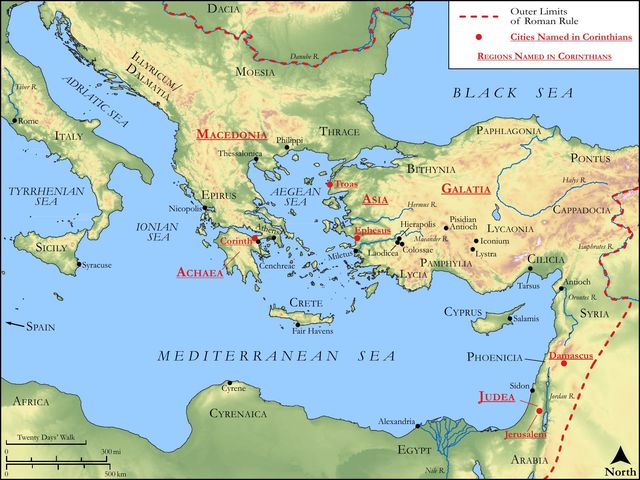
See on the biblical-era maps

Study this verse
Public-domain commentary
Matthew Henry
From his Commentary on the Whole Bible. Henry comments on passages, not single verses — this entry covers 2 Corinthians 5:16–21. His four-level outline is real structure in the source text, so it is rendered as structure.
In these verses the apostle mentions two things that are necessary in order to our living to Christ, both of which are the consequences of Christ's dying for us; namely, regeneration and reconciliation.
I.Regeneration, which consists of two things; namely,
1.Weanedness from the world: "Henceforth we know no man after the flesh, Co2 5:16. We do not own nor affect any person or thing in this world for carnal ends and outward advantage: we are enabled, by divine grace, not to mind nor regard this world, nor the things of this world, but to live above it. The love of Christ is in our hearts, and the world is under our feet." Note, Good Christians must enjoy the comforts of this life, and their relations in this world, with a holy indifference. Yea, though we have known Christ after the flesh, yet, says the apostle, we know him no more. It is questioned whether Paul had seen Christ in the flesh. However, the rest of the apostles had, and so might some among those he was now writing to. However, he would not have them value themselves upon that account; for even the bodily presence of Christ is not to be desired nor doted upon by his disciples. We must live upon his spiritual presence, and the comfort it affords. Note, Those who make images of Christ, and use them in their worship, do not take the way that God has appointed for strengthening their faith and quickening their affections; for it is the will of God that we should not know Christ any more after the flesh.
2.A thorough change of the heart: For if any man be in Christ, if any man be a Christian indeed, and will approve himself such, he is, or he must be, a new creature, Co2 5:17. Some read it, Let him be a new creature. This ought to be the care of all who profess the Christian faith, that they be new creatures; not only that they have a new name, and wear a new livery, but that they have a new heart and new nature. And so great is the change the grace of God makes in the soul, that, as it follows, old things are passed away - old thoughts, old principles, and old practices, are passed away; and all these things must become new. Note, Regenerating grace creates a new world in the soul; all things are new. The renewed man acts from new principles, by new rules, with new ends, and in new company.
II.Reconciliation, which is here spoken of under a double notion: -
1.As an unquestionable privilege, Co2 5:18, Co2 5:19. Reconciliation supposes a quarrel, or breach of friendship; and sin has made a breach, it has broken the friendship between God and man. The heart of the sinner is filled with enmity against God, and God is justly offended with the sinner. Yet, behold, there may be a reconciliation; the offended Majesty of heaven is willing to be reconciled. And observe, 1. He has appointed the Mediator of reconciliation. He has reconciled us to himself by Jesus Christ, Co2 5:18. God is to be owned from first to last in the undertaking and performance of the Mediator. All things relating to our reconciliation by Jesus Christ are of God, who by the mediation of Jesus Christ has reconciled the world to himself, and put himself into a capacity of being actually reconciled to offenders, without any wrong or injury to his justice or holiness, and does not impute to men their trespasses, but recedes from the rigour of the first covenant, which was broken, and does not insist upon the advantage he might justly take against us for the breach of that covenant, but is willing to enter into a new treaty, and into a new covenant of grace, and, according to the tenour thereof, freely to forgive us all our sins, and justify freely by his grace all those who do believe. 2. He has appointed the ministry of reconciliation, Co2 5:18. By the inspiration of God the scriptures were written, which contain the word of reconciliation, showing us that peace was made by the blood of the cross, that reconciliation is wrought, and directing us how we may be interested therein. And he has appointed the office of the ministry, which is a ministry of reconciliation: ministers are to open and proclaim to sinners the terms of mercy and reconciliation, and persuade them to comply therewith. For,
2.Reconciliation is here spoken of as our indispensable duty, Co2 5:20. As God is willing to be reconciled to us, we ought to be reconciled to God. And it is the great end and design of the gospel, that word of reconciliation, to prevail upon sinners to lay aside their enmity against God. Faithful ministers are Christ's ambassadors, sent to treat with sinners on peace and reconciliation: they come in God's name, with his entreaties, and act in Christ's stead, doing the very thing he did when he was upon this earth, and what he wills to be done now that he is in heaven. Wonderful condescension! Though God can be no loser by the quarrel, nor gainer by the peace, yet by his ministers he beseeches sinners to lay aside their enmity, and accept of the terms he offers, that they would be reconciled to him, to all his attributes, to all his laws, and to all his providences, to believe in the Mediator, to accept the atonement, and comply with his gospel, in all the parts of it and in the whole design of it. And for our encouragement so to do the apostle subjoins what should be well known and duly considered by us (Co2 5:21), namely,
(1.)The purity of the Mediator: He knew no sin.
(2.)The sacrifice he offered: He was made sin; not a sinner, but sin, that is, a sin-offering, a sacrifice for sin.
(3.)The end and design of all this: that we might be made the righteousness of God in him, might be justified freely by the grace of God through the redemption which is in Christ Jesus. Note,
[1.]As Christ, who knew no sin of his own, was made sin for us, so we, who have no righteousness of our own, are made the righteousness of God in him.
[2.]Our reconciliation to God is only through Jesus Christ, and for the sake of his merit: on him therefore we must rely, and make mention of his righteousness and his only.
Historical interpretation
Historical reception
4 surviving comments on this verse. Each one is dated, so this reads as a timeline rather than a list.
Select a marker to jump to its quote. Markers stagger vertically where authors wrote within a few decades of each other.
Since all things are reconciled in him, recognize … that he reconciles all things to the Father in himself, which he will reconcile through himself. The same apostle says: “But all things are from God, who has reconciled us to himself through Christ and has given to us the ministry of reconciliation. For God was truly in Christ, reconciling the world to himself.” Compare the entire mystery of the evangelical faith with these words! He who is seen in him who is seen, he who works in him who works, he who speaks in him who speaks is the same one who will reconcile in him who reconciles. Accordingly, there is the reconciliation in him and through him, because the Father himself, who remains in him through the identical nature, restored the world to himself through him and in him by this reconciliation.
Although Christ has redeemed us all things come from God, because all fatherhood comes from him. Therefore [in triune reasoning] precedence must be given to the person of the Father.
Nothing of ourselves. For remission of sins and adoption and unspeakable glory are given to us by Him. For he exhorts them no longer from the things to come only, but even from those now present. For consider. He said, that we shall be raised again, and go on unto incorruption, and have an eternal house; but since present things have more force to persuade than things to come, with those who believe not in these as they ought to believe, he shows how great things they have even already received, and being themselves what. What then being, received they them? Dead all; (for he saith, "all died;" and, "He died for all;" so loved He all alike;) inveterate all, and grown old in their vices. But behold, both a new soul, (for it was cleansed,) and a new body, and a new worship, and promises new, and covenant, and life, and table, and dress, and all things new absolutely. For instead of the Jerusalem below we have received that mother city which is above; and instead of a material temple have seen a spiritual temple; instead of tables of stone, fleshy ones; instead of circumcision, baptism; instead of the manna, the Lord's body; instead of water from a rock, blood from His side; instead of Moses' or Aaron's rod, the Cross; instead of the promised land, the kingdom of heaven; instead of a thousand priests, One High Priest; instead of a lamb without reason, a Spiritual Lamb. With these and such like things in his thought he said, "all things are new." But "all" these "things are of God," by Christ, and His free gift.
For from Him are all the good things. For He that made us friends is Himself also the cause of the other things which God hath given to His friends. For He rendered not these things unto us, allowing us to continue enemies, but having made us friends unto Himself. But when I say that Christ is the cause of our reconciliation, I say the Father is so also: when I say that the Father gave, I say the Son gave also. "For all things were made by Him;" and of this too He is the Author. For we ran not unto Him, but He Himself called us. How called He us? By the sacrifice of Christ.
Here again he sets forth the dignity of the Apostles; showing how great a thing was committed to their hands, and the surpassing greatness of the love of God. For even when they would not hear the Ambassador that came, He was not exasperated nor left them to themselves, but continueth to exhort them both in His own person and by others. Who can be fittingly amazed at this solicitude? The Son Who came to reconcile, His True and Only-Begotten, was slain, yet not even so did the Father turn away from His murderers; nor say, "I sent My Son as an Ambassador, but they not only would not hear Him, but even slew and crucified Him, it is meet henceforth to leave them to themselves:" but quite the contrary, when the Son departed, He entrusted the business to us; for he says, "gave unto us the ministry of reconciliation."
It is not just that God has been reconciled to us; we also have been reconciled to him.
Continue studying 2 Corinthians 5:18 across the web’s major study libraries — every link below opens this exact verse, chapter, or book on the destination site.
Read & Compare
 BibleGatewayThis verse in more than 200 translations and 70 languages.
 Bible.comThe YouVersion reader — hundreds of translations, reading plans, and highlights.
 ESV.orgCrossway's official English Standard Version reader.
 NET BibleThe NET translation with 60,000+ translators' notes on every rendering decision.
 STEP BibleTyndale House's free study tool — original text, vocabulary, and scholarly resources.
 BibliaLogos Bible Software's free web reader.
 USCCBThe New American Bible (Revised Edition) with the U.S. bishops' study notes.
Commentaries
 BibleHub CommentariesDozens of classic commentaries on this verse, gathered on one page.
 StudyLightMore than 100 commentary sets — the largest collection on the web.
 BibleRefPlain-English commentary on what this verse means, verse by verse.
 Enduring WordDavid Guzik's free commentary on this chapter, widely used by Bible teachers.
 Bible Study ToolsVerse commentary alongside Greek and Hebrew study aids.
Original Language & Research
- BibleHub InterlinearThe verse word by word — original language, transliteration, and English.
- BibleHub LexiconEvery word's original-language definition and Strong's entry.
 Blue Letter BibleDeep-study tools — Strong's numbers, concordance, and word studies.
 CNTR CollationThe earliest Greek manuscripts of this verse, collated letter by letter.
Sermons, Hymns & Audio


TrulyRandomVerse is not affiliated with these sites and doesn’t control their content. They’re linked because they’re genuinely useful.
Summary
Second Corinthians 5:18 encapsulates the profound truth that the entire redemptive process, from its inception to its ongoing application, originates solely from God. Through Jesus Christ, God has unilaterally reconciled humanity to Himself, restoring a broken relationship, and in doing so, has commissioned believers with the sacred privilege and responsibility of participating in this very work—the ministry of reconciliation—sharing this transformative message with a world alienated from its Creator.
Context
ShowHideLiterary Context
This verse stands as a pivotal explanation following Paul's powerful declaration in 2 Corinthians 5:17 that "if anyone is in Christ, he is a new creation; old things have passed away; behold, all things have become new." Verse 18 immediately clarifies how this radical transformation into a "new creation" occurs: it is entirely "of God" through the act of reconciliation in Christ. Paul is defending his apostolic ministry and the authenticity of his gospel message, emphasizing that his suffering and weakness are part of God's plan to demonstrate divine power and grace. The concept of reconciliation here sets the stage for the impassioned appeal in 2 Corinthians 5:20, where believers are called "ambassadors for Christ," imploring others to "be reconciled to God." The flow of thought moves from the believer's new identity to the divine source of that identity, and then to the believer's subsequent mission.
Historical & Cultural Context
The city of Corinth was a bustling, cosmopolitan hub known for its wealth, diverse population, and significant moral challenges. The Corinthian church itself was plagued by internal divisions, challenges to Paul's apostolic authority, and a blend of pagan influences with Christian practices. In this environment, Paul's emphasis on "reconciliation" was particularly potent. In the Greco-Roman world, reconciliation often implied a mutual effort to restore a relationship, or a payment to appease an offended party. Paul's message radically redefines this by asserting that God, the offended party, initiates and accomplishes reconciliation entirely on His own terms, through Christ, for a humanity that was utterly incapable of initiating such a restoration. This unilateral divine action would have been a striking counter-cultural concept, highlighting God's immense grace and sovereignty in a world accustomed to human-driven appeasement of deities.
Key Themes
ShowHideThe overarching themes in 2 Corinthians 5 and this verse specifically include God's Initiative and Sovereignty, underscoring that salvation is not a human achievement but a divine work. The concept of Reconciliation is central, portraying God's act of restoring a broken relationship with humanity, moving from enmity to peace. This reconciliation is exclusively Through Jesus Christ, whose life, death, and resurrection serve as the sole means by which this divine work is accomplished. Finally, the verse introduces the Ministry of Reconciliation, highlighting that those who have received this divine gift are now entrusted with the privilege and responsibility of sharing this message, making them active participants in God's ongoing redemptive plan, as further expounded in 2 Corinthians 5:19-20.
Exposition and Analysis
ShowHideKey Word Analysis
ShowHideThis verb means "to change mutually, i.e. (figuratively) to compound a difference." In this theological context, it signifies a profound shift from a state of alienation or hostility to one of peace and restored relationship. Crucially, in Paul's usage, it emphasizes God's unilateral action in initiating and accomplishing this change, not a mutual agreement between equal parties. Humanity was estranged from God due to sin, and God, in His sovereign grace, acted through Christ to bridge this chasm, changing the relationship from one of enmity to one of favor and peace.
This noun refers to "attendance (as a servant, etc.); figuratively (eleemosynary) aid, (official) service (especially of the Christian teacher, or technically of the diaconate)." It denotes active, humble service. When applied to "the ministry of reconciliation," it highlights the practical, active, and servant-hearted role believers are called to play in proclaiming the message of reconciliation. It's not a passive reception but an active commission to serve God's purpose in the world.
This noun means "exchange (figuratively, adjustment), i.e. restoration to (the divine) favor." It is the outcome or state resulting from the act of reconciliation. It describes the new condition of peace and favor that exists between God and humanity, achieved through Christ. This term underscores the complete and permanent nature of the restored relationship, a state of being brought back into harmony with God.
Verse Breakdown
ShowHide"And all things are of God"
This opening clause establishes the ultimate source and origin of everything related to the new creation and reconciliation. It emphasizes God's absolute sovereignty, initiative, and authorship in the entire redemptive process. Nothing in this spiritual transformation originates from human effort, merit, or initiative; it is solely a divine work, stemming from God's character and purpose.
"who hath reconciled us to himself by Jesus Christ"
This is the core declaration of the verse, identifying the agent and the means of reconciliation. "Who" refers directly back to God, reiterating His active role. "Reconciled us to himself" highlights the restoration of a personal relationship, moving from alienation to intimacy with God. The crucial phrase "by Jesus Christ" specifies the exclusive and indispensable means through which this reconciliation is accomplished—through Christ's atoning work on the cross, which satisfied divine justice and removed the barrier of sin.
"and hath given to us the ministry of reconciliation"
This final clause shifts from the reception of reconciliation to the commission for it. Having experienced God's reconciling grace, believers are not merely recipients but also participants in His ongoing redemptive mission. The "ministry of reconciliation" is the sacred task entrusted to believers: to proclaim the good news of God's reconciling work in Christ to a world still alienated from Him, inviting others to experience the same restoration. This highlights the active, outward-focused calling of every believer.
Literary Devices
ShowHidePaul employs several literary techniques to convey the profound truths in this verse. There is a strong Emphasis on divine initiative, beginning with "all things are of God," which immediately establishes God as the sole orchestrator of salvation. This is reinforced by the active voice verbs describing God's actions: "hath reconciled" and "hath given." The verse also contains an implicit Contrast or Antithesis between humanity's prior state of alienation (implied by the need for reconciliation) and the new state of peace and restored relationship with God. Furthermore, the concept of being "given... the ministry of reconciliation" functions as a Commissioning, a formal appointment of believers to a specific, vital task. This is not merely an instruction but a bestowal of authority and purpose, transforming recipients of grace into active agents of God's ongoing work in the world.
Theological and Thematic Connections
ShowHideThis verse is a cornerstone of Christian theology, articulating the heart of the gospel. It reveals God's character as one who actively seeks to restore His relationship with humanity, not out of human merit, but out of His boundless love and grace. The concept of reconciliation underscores the severity of sin, which created a chasm between God and humanity, yet simultaneously magnifies the efficacy and completeness of Christ's atoning work. It moves beyond mere forgiveness to a full restoration of fellowship, making peace where there was enmity. The "ministry of reconciliation" then establishes the Church's fundamental mission: to be God's agents in proclaiming this good news, inviting all people to experience the peace and new life found in Christ. This ministry is not optional but an inherent outflow of having been reconciled oneself, reflecting God's own heart for the lost.
Reflection and Application
ShowHideTo truly grasp the magnitude of 2 Corinthians 5:18 is to be overwhelmed by the sheer grace of God and invigorated by a profound sense of purpose. It reminds us that our standing with God is not based on our efforts but entirely on His initiative and the finished work of Christ. This truth should cultivate deep gratitude, humility, and unwavering confidence in God's love. Furthermore, it clarifies our identity and mission as believers. We are not just recipients of reconciliation but also its ambassadors, entrusted with the most vital message in the universe. This calls us to live lives that authentically reflect the "new creation" we have become, characterized by peace, love, and a passionate desire to see others reconciled to God. It challenges us to actively engage in sharing the gospel, not as a burdensome duty, but as a joyful privilege, knowing that we are participating in God's redemptive plan for the world. Our lives, words, and actions become living testimonies to the transforming power of God's reconciliation.
Questions for Reflection
ShowHideFAQ
ShowHideWhat does "reconciliation" truly mean in the context of this verse?
ShowHideIn 2 Corinthians 5:18, "reconciliation" (Greek: katallagḗ) signifies the restoration of a broken relationship, specifically between God and humanity. It's more than just forgiveness; it's the removal of enmity and the establishment of peace and favor. Humanity, due to sin, was alienated from God, in a state of hostility. God, in His sovereign love, took the initiative to change this relationship, not by demanding payment from us, but by providing the means of peace through the sacrifice of His Son, Jesus Christ. Thus, it's a profound transformation from being God's enemies to being His beloved children, enjoying fellowship and peace with Him. This concept is beautifully elaborated throughout Paul's letters, such as in Romans 5:10.
Is the "ministry of reconciliation" only for pastors or missionaries?
ShowHideNo, the "ministry of reconciliation" is given to "us," referring to all believers who have been reconciled to God through Jesus Christ. While specific individuals may be called to full-time pastoral or missionary roles, the fundamental call to share the message of reconciliation is universal for every Christian. As 2 Corinthians 5:20 states, we are all "ambassadors for Christ," meaning we represent Him and His message to the world. This ministry can take many forms, from direct evangelism to living a life that reflects the transforming power of God's grace, inviting others to inquire about the hope that is within us (1 Peter 3:15). It is a privilege and responsibility that flows naturally from having received God's reconciling grace.
Christ-Centered Fulfillment
ShowHideSecond Corinthians 5:18 finds its ultimate and glorious fulfillment in the person and work of Jesus Christ. He is the singular, indispensable means by which God's reconciling work is accomplished. Before Christ, humanity was separated from God by sin, an impassable chasm of divine justice and human rebellion. However, in Christ, God Himself entered human history, not to condemn, but to save. His perfect life, His atoning death on the cross, and His victorious resurrection are the very acts through which God "reconciled us to himself." Jesus is the Lamb of God who takes away the sin of the world, the one who bore the penalty for our alienation, bridging the gap between a holy God and sinful humanity. He is the propitiation for our sins, satisfying divine wrath and establishing peace. Therefore, when Paul declares that "all things are of God, who hath reconciled us to himself by Jesus Christ," he is pointing to the cross and empty tomb as the decisive moments in redemptive history where God's plan for reconciliation was perfectly executed. Christ is not just the message of reconciliation; He is reconciliation embodied, the living proof of God's initiative and the very foundation upon which the "ministry of reconciliation" rests, empowering believers to proclaim His finished work to a world desperately in need of peace with God.