


2 Corinthians 5:17
Bible text: King James Version (1769 Blayney text) · Public domain
Bible text: Berean Standard Bible · Public domain
Bible text: American Standard Version (1901) · Public domain
Bible text: World English Bible, Messianic edition · Public domain
Bible text: Geneva Bible (1599) · Public domain
Bible text: Young's Literal Translation · Public domain
- ὥστεhōsteThereforeG5620CONJConjunction
- εἴeiifG1487CONDConjunction
- τιςtisanyoneG5100X-NSMIndefinite pronoun Nominative Singular Masculine
- ἐνen[is] inG1722PREPPreposition
- ΧριστῷChristōChristG5547N-DSM-TNoun Dative Singular Masculine Title
- καινὴkainē[he is] a newG2537A-NSFAdjective Nominative Singular Feminine
- κτίσις·ktisiscreationG2937N-NSFNoun Nominative Singular Feminine
- τὰtaTheG3588T-NPNDefinite article Nominative Plural Neuter
- ἀρχαῖαarchaiaold thingsG744A-NPNAdjective Nominative Plural Neuter
- παρῆλθενparēlthenhave passed awayG3928V-2AAI-3SVerb 2nd Aorist Active Indicative 3rd Singular
- ἰδοὺidoubeholdG2400INJInterjection
- γέγονενgegonenhas come into beingG1096V-2RAI-3SVerb 2nd Perfect Active Indicative 3rd Singular
- καινάkainanewG2537A-NPNAdjective Nominative Plural Neuter
- τὰta<the>G3588T-NPNDefinite article Nominative Plural Neuter
- πάνταpantaall thingsG3956A-NPNAdjective Nominative Plural Neuter
English is a literal word-by-word gloss of the Greek, not the KJV's wording. Why?
This is the original text the KJV's translators worked from — each Greek word with its own literal English meaning in this verse, prepared by scholars at Tyndale House, Cambridge. The KJV translates whole sentences, not word by word, so its wording differs: one Greek word can become several English words, and the KJV may choose “charity” where the gloss reads “love”. Both are faithful — they answer different questions. For the KJV's own rendering, switch to the KJV text.
Details
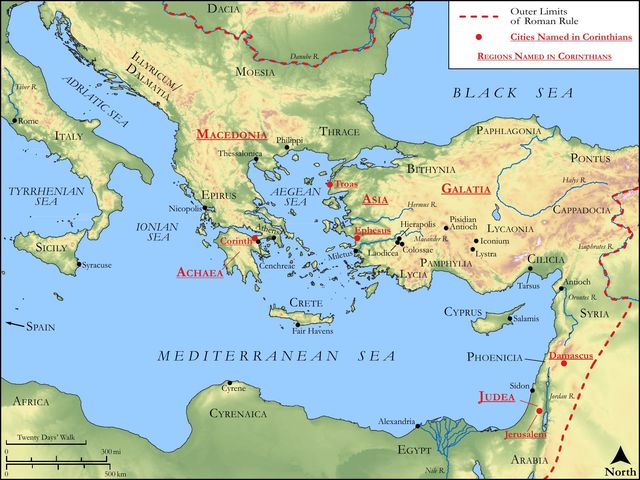
See on the biblical-era maps

Study this verse
Public-domain commentary
Matthew Henry
From his Commentary on the Whole Bible. Henry comments on passages, not single verses — this entry covers 2 Corinthians 5:16–21. His four-level outline is real structure in the source text, so it is rendered as structure.
In these verses the apostle mentions two things that are necessary in order to our living to Christ, both of which are the consequences of Christ's dying for us; namely, regeneration and reconciliation.
I.Regeneration, which consists of two things; namely,
1.Weanedness from the world: "Henceforth we know no man after the flesh, Co2 5:16. We do not own nor affect any person or thing in this world for carnal ends and outward advantage: we are enabled, by divine grace, not to mind nor regard this world, nor the things of this world, but to live above it. The love of Christ is in our hearts, and the world is under our feet." Note, Good Christians must enjoy the comforts of this life, and their relations in this world, with a holy indifference. Yea, though we have known Christ after the flesh, yet, says the apostle, we know him no more. It is questioned whether Paul had seen Christ in the flesh. However, the rest of the apostles had, and so might some among those he was now writing to. However, he would not have them value themselves upon that account; for even the bodily presence of Christ is not to be desired nor doted upon by his disciples. We must live upon his spiritual presence, and the comfort it affords. Note, Those who make images of Christ, and use them in their worship, do not take the way that God has appointed for strengthening their faith and quickening their affections; for it is the will of God that we should not know Christ any more after the flesh.
2.A thorough change of the heart: For if any man be in Christ, if any man be a Christian indeed, and will approve himself such, he is, or he must be, a new creature, Co2 5:17. Some read it, Let him be a new creature. This ought to be the care of all who profess the Christian faith, that they be new creatures; not only that they have a new name, and wear a new livery, but that they have a new heart and new nature. And so great is the change the grace of God makes in the soul, that, as it follows, old things are passed away - old thoughts, old principles, and old practices, are passed away; and all these things must become new. Note, Regenerating grace creates a new world in the soul; all things are new. The renewed man acts from new principles, by new rules, with new ends, and in new company.
II.Reconciliation, which is here spoken of under a double notion: -
1.As an unquestionable privilege, Co2 5:18, Co2 5:19. Reconciliation supposes a quarrel, or breach of friendship; and sin has made a breach, it has broken the friendship between God and man. The heart of the sinner is filled with enmity against God, and God is justly offended with the sinner. Yet, behold, there may be a reconciliation; the offended Majesty of heaven is willing to be reconciled. And observe, 1. He has appointed the Mediator of reconciliation. He has reconciled us to himself by Jesus Christ, Co2 5:18. God is to be owned from first to last in the undertaking and performance of the Mediator. All things relating to our reconciliation by Jesus Christ are of God, who by the mediation of Jesus Christ has reconciled the world to himself, and put himself into a capacity of being actually reconciled to offenders, without any wrong or injury to his justice or holiness, and does not impute to men their trespasses, but recedes from the rigour of the first covenant, which was broken, and does not insist upon the advantage he might justly take against us for the breach of that covenant, but is willing to enter into a new treaty, and into a new covenant of grace, and, according to the tenour thereof, freely to forgive us all our sins, and justify freely by his grace all those who do believe. 2. He has appointed the ministry of reconciliation, Co2 5:18. By the inspiration of God the scriptures were written, which contain the word of reconciliation, showing us that peace was made by the blood of the cross, that reconciliation is wrought, and directing us how we may be interested therein. And he has appointed the office of the ministry, which is a ministry of reconciliation: ministers are to open and proclaim to sinners the terms of mercy and reconciliation, and persuade them to comply therewith. For,
2.Reconciliation is here spoken of as our indispensable duty, Co2 5:20. As God is willing to be reconciled to us, we ought to be reconciled to God. And it is the great end and design of the gospel, that word of reconciliation, to prevail upon sinners to lay aside their enmity against God. Faithful ministers are Christ's ambassadors, sent to treat with sinners on peace and reconciliation: they come in God's name, with his entreaties, and act in Christ's stead, doing the very thing he did when he was upon this earth, and what he wills to be done now that he is in heaven. Wonderful condescension! Though God can be no loser by the quarrel, nor gainer by the peace, yet by his ministers he beseeches sinners to lay aside their enmity, and accept of the terms he offers, that they would be reconciled to him, to all his attributes, to all his laws, and to all his providences, to believe in the Mediator, to accept the atonement, and comply with his gospel, in all the parts of it and in the whole design of it. And for our encouragement so to do the apostle subjoins what should be well known and duly considered by us (Co2 5:21), namely,
(1.)The purity of the Mediator: He knew no sin.
(2.)The sacrifice he offered: He was made sin; not a sinner, but sin, that is, a sin-offering, a sacrifice for sin.
(3.)The end and design of all this: that we might be made the righteousness of God in him, might be justified freely by the grace of God through the redemption which is in Christ Jesus. Note,
[1.]As Christ, who knew no sin of his own, was made sin for us, so we, who have no righteousness of our own, are made the righteousness of God in him.
[2.]Our reconciliation to God is only through Jesus Christ, and for the sake of his merit: on him therefore we must rely, and make mention of his righteousness and his only.
Historical interpretation
Four Centuries of Reception
18 surviving comments on this verse. Each one is dated, so this reads as a timeline rather than a list.
Select a marker to jump to its quote. Markers stagger vertically where authors wrote within a few decades of each other.
Be not deceived with strange doctrines, "nor give heed to fables and endless genealogies," and things in which the Jews make their boast. "Old things are passed away: behold, all things have become new."
"If therefore any man be in Christ, he is a new creature; old; things are passed away; behold, all things are become new; " and so is accomplished the prophecy of Isaiah.
But when the Word of God descended into flesh,-(flesh) not unsealed even by marriage,-and "the Word was made flesh," -(flesh) never to be unsealed by marriage,-which was to find its way to the tree not of incontinence, but of endurance; which was to taste from that tree not anything sweet, but something bitter; which was to pertain not to the infernal regions, but to heaven; which was to be precinct not with the leaves of lasciviousness, but the flowers of holiness; which was to impart to the waters its own purities-thenceforth, whatever flesh (is) "in Christ" has lost its pristine soils, is now a thing different, emerges in a new state, no longer (generated) of the slime of natural seed, nor of the grime of concupiscence, but of "pure water" and a "clean Spirit.
Plainly we do, if we are observers of Jewish ceremonies, of legal solemnities: for those the apostle unteaches, suppressing the continuance of the Old Testament which has been buried in Christ, and establishing that of the New. But if there is a new creation in Christ, our solemnities too will be bound to be new: else, if the apostle has erased all devotion absolutely "of seasons, and days, and months, and years," why do we celebrate the passover by an annual rotation in the first month? Why in the fifty ensuing days do we spend our time in all exultation? Why do we devote to Stations the fourth and sixth days of the week, and to fasts the "preparation-day? " Anyhow, you sometimes continue your Station even over the Sabbath,-a day never to be kept as a fast except at the passover season, according to a reason elsewhere given.
All the rest of his precepts, as we have shown sufficiently, when treating of them as they occurred in another epistle, emanated from the Creator, who, while predicting that "old things were to pass away," and that He would "make all things new," commanded men "to break up fresh ground for themselves," and thereby taught them even then to put off the old man and put on the new.
When by Jeremiah He gave this precept, "Break up for yourselves new pastures," does He not turn away from the old state of things? And when by Isaiah He proclaims how "old things were passed away; and, behold, all things, which I am making, are new," does He not advert to a new state of things? We have generally been of opinion that the destination of the former state of things was rather promised by the Creator, and exhibited in reality by Christ, only under the authority of one and the same God, to whom appertain both the old things and the new.
Now, if the Creator indeed promised that "the ancient things should pass away," to be superseded by a new course of things which should arise, whilst Christ marks the period of the separation when He says, "The law and the prophets were until John" -thus making the Baptist the limit between the two dispensations of the old things then terminating-and the new things then beginning, the apostle cannot of course do otherwise, (coming as he does) in Christ, who was revealed after John, than invalidate "the old things" and confirm "the new," and yet promote thereby the faith of no other god than the Creator, at whose instance it was foretold that the ancient things should pass away.
This Logos the Father in the latter days sent forth, no longer to speak by a prophet, and not wishing that the Word, being obscurely proclaimed, should be made the subject of mere conjecture, but that He should be manifested, so that we could see Him with our own eyes. This Logos, I say, the Father sent forth, in order that the world, on beholding Him, might reverence Him who was delivering precepts not by the person of prophets, nor terrifying the soul by an angel, but who was Himself-He that had spoken-corporally present amongst us. This Logos we know to have received a body from a virgin, and to have remodelled the old man by a new creation. And we believe the Logos to have passed through every period in this life, in order that He Himself might serve as a law for every age, and that, by being present (amongst) us, He might exhibit His own manhood as an aim for all men. And that by Himself in person He might prove that God made nothing evil, and that man possesses the capacity of self-determination, inasmuch as he is able to will and not to will, and is endued with power to do both. This Man we know to have been made out of the compound of our humanity. For if He were not of the same nature with ourselves, in vain does He ordain that we should imitate the Teacher. For if that Man happened to be of a different substance from us, why does He lay injunctions similar to those He has received on myself, who am born weak; and how is this the act of one that is good and just? In order, however, that He might not be supposed to be different from us, He even underwent toil, and was willing to endure hunger, and did not refuse to feel thirst, and sunk into the quietude of slumber. He did not protest against His Passion, but became obedient unto death, and manifested His resurrection. Now in all these acts He offered up, as the first-fruits, His own manhood, in order that thou, when thou art in tribulation, mayest not be disheartened, but, confessing thyself to be a man (of like nature with the Redeemer), mayest dwell in expectation of also receiving what the Father has granted unto this Son.
To-day, the most holy assembly, bearing upon its shoulders the heavenly joy that was for generations expected, imparts it to the race of man. "Old things are passed away".
With good right, therefore, has the sacred trumpet sounded, "Old things are passed away, behold all things are become new."
But, if we must go on with our discussion and make a deeper study, let us from this point contemplate especially the divine power of the Holy Spirit. We find three creations mentioned in the Scripture; the first, the education from nonexistence into existence; the second, the change from worse to better; and the third, the resurrection of the dead. In these you will find the Holy Spirit co-operating with the Father and the Son.… Now, humanity is created a second time through baptism, “for if any man is in Christ, he is a new creature.”
By whom also we exhort you in the Lord to abstain from your old conversation, vain bonds, separations, observances, distinction of meats, and daily washings: for "old things are passed away; behold, all things are become new."
“If any man is in Christ, he is a new creature, the former things have passed away.” The “new creation” is the apostolic rule. And what this is Paul makes abundantly clear in another section, saying: “In order that I might present to myself the church in all her glory, not having spot or wrinkle or any such thing, but that she might be holy and without blemish.” A new creature he called the indwelling of the Holy Spirit in a pure and blameless soul removed from evil and wickedness and shamefulness. For, when the soul hates sin, it closely unites itself with God, as far as it can, in the regimen of virtue; having been transformed in life, it receives the grace of the Spirit to itself, becomes entirely new again and is recreated.
For seeing he had exhorted unto virtue from His love, he now leads them on to this from what has been actually done for them; wherefore also he added, "If any man is in Christ," he is "a new creature." "If any," saith he, "have believed in Him, he has come to another creation, for he hath been born again by the Spirit." So that for this cause also, he says, we ought to live unto Him, not because we are not our own only, nor because He died for us only, nor because He raised up our First-fruits only, but because we have also come unto another life. See how many just grounds he urges for a life of virtue. For on this account he also calls the reformation by a grosser name, in order to show the transition and the change to be great. Then following out farther what he had said, and showing how it is "a new creation," he adds, "The old things are passed away, behold, all things are become new."
What old things? He means either sins and impieties, or else all the Judaical observances. Yea rather, he means both the one and the other. "Behold, all things are become new."
Do you see why faith in Christ and the return to virtue are called a new creation? I exhort you, therefore, both you who have previously been initiated and you who have just now enjoyed the Master’s generosity, let us all listen to the exhortation of the apostle, who tells us: “The former things have passed away; behold, they are all made new.” Let us forget the whole past and, like citizens in a new world, let us reform our lives, and let us consider in our every word and deed the dignity of him who dwells within us.
You heard today that the blessed Paul … told us in his letter to the Corinthians: “If any man is in Christ, he is a new creature.” To prevent us from interpreting the text as applying to a visible creation, he stated: “If any man is in Christ,” teaching us that if any man has gone over to the side of those who believe in Christ, he is an example of a new creature. Tell me, if we see new heavens and other portions of his creation, is there a profit in this which can match the benefit we gain from seeing a man converted from evil to virtue and changing from the side of error to that of truth? This is what the blessed Paul called a new creature, and so immediately he went on to say: “The former things have passed away; behold, they are all made new!” By this he briefly showed that those who, by their faith in Christ, had put off like an old cloak the burden of their sins, those who had been set free from their error and been illumined by the light of justification, had put on this new and shining cloak, this royal robe. This is why he said: “If any man is in Christ, he is a new creature: the former things have passed away; behold, they are all made new.”
We are then truly free when God orders our lives, that is, forms and creates us not as human beings—this he has already done—but as good people, which he is now doing by his grace, that we may indeed be new creatures in Christ Jesus. Accordingly the prayer: “Create in me a clean heart, O God.”.
Those who believe in Christ have entered a new life. They must be born again in baptism and renounce their former sins.
The Old Testament was good, but without spiritual understanding it dies with the letter. The New Testament, through grace, restores the odor of life.
Continue studying 2 Corinthians 5:17 across the web’s major study libraries — every link below opens this exact verse, chapter, or book on the destination site.
Read & Compare
 BibleGatewayThis verse in more than 200 translations and 70 languages.
 Bible.comThe YouVersion reader — hundreds of translations, reading plans, and highlights.
 ESV.orgCrossway's official English Standard Version reader.
 NET BibleThe NET translation with 60,000+ translators' notes on every rendering decision.
 STEP BibleTyndale House's free study tool — original text, vocabulary, and scholarly resources.
 BibliaLogos Bible Software's free web reader.
 USCCBThe New American Bible (Revised Edition) with the U.S. bishops' study notes.
Commentaries
 BibleHub CommentariesDozens of classic commentaries on this verse, gathered on one page.
 StudyLightMore than 100 commentary sets — the largest collection on the web.
 BibleRefPlain-English commentary on what this verse means, verse by verse.
 Enduring WordDavid Guzik's free commentary on this chapter, widely used by Bible teachers.
 Bible Study ToolsVerse commentary alongside Greek and Hebrew study aids.
Original Language & Research
- BibleHub InterlinearThe verse word by word — original language, transliteration, and English.
- BibleHub LexiconEvery word's original-language definition and Strong's entry.
 Blue Letter BibleDeep-study tools — Strong's numbers, concordance, and word studies.
 CNTR CollationThe earliest Greek manuscripts of this verse, collated letter by letter.
Sermons, Hymns & Audio


TrulyRandomVerse is not affiliated with these sites and doesn’t control their content. They’re linked because they’re genuinely useful.
Summary
Second Corinthians 5:17 profoundly declares the radical, transformative reality experienced by anyone united with Christ. It asserts that to be "in Christ" is to undergo a divine re-creation, resulting in a fundamentally new spiritual identity where the former way of life, dominated by sin and separation from God, has definitively passed away, and all aspects of one's being and perspective are made new by God's power. This verse encapsulates the essence of Christian conversion as a complete spiritual rebirth, not merely an improvement of the old self.
Context
ShowHideLiterary Context
This pivotal verse is situated within Paul's broader discussion of his apostolic ministry and the motivations behind it, particularly his conviction that Christ's love compels him (2 Corinthians 5:14). Paul contrasts his former, fleshly understanding of Christ with a new, spiritual apprehension (2 Corinthians 5:16). He then introduces the concept of "new creation" as the foundational truth that undergirds the ministry of reconciliation, which he elaborates on in the subsequent verses (2 Corinthians 5:18-20). The transformative power of being "in Christ" is presented as the prerequisite for participating in and experiencing this divine reconciliation, moving from alienation to a restored relationship with God. The immediate context emphasizes the profound shift in perspective and purpose that defines the believer's life and mission.
Historical & Cultural Context
The Corinthian church was plagued by divisions, moral laxity, and challenges to Paul's authority, often influenced by worldly wisdom and a focus on external appearances. Paul's letter seeks to defend his apostleship, correct errant behaviors, and call the believers to a deeper, more authentic walk with Christ. In a culture that valued status, rhetoric, and outward show, Paul emphasizes an internal, spiritual transformation that transcends societal norms and human achievements. The concept of "new creation" would have resonated with both Jewish ideas of a new covenant and Gentile philosophical notions of personal change, yet Paul's understanding roots it firmly in the redemptive work of Christ, distinguishing it from mere self-improvement or adherence to a new set of rules. It speaks to a divine intervention that reorders one's entire existence, a stark contrast to the superficiality sometimes present in Corinth.
Key Themes
ShowHideThe verse powerfully contributes to several overarching themes in Paul's theology and the broader biblical narrative. Firstly, it highlights the theme of Union with Christ, emphasizing that the believer's new identity and status are entirely dependent on their spiritual incorporation "in Christ." This union is the source of all spiritual blessings and transformation, as seen throughout Paul's epistles, such as in Ephesians 1:3-14. Secondly, the verse introduces the profound theme of New Creation, asserting that conversion is not merely a change of behavior but a radical, divine act of re-creation. This echoes the original creation account in Genesis 1 and points forward to the eschatological hope of a new heavens and new earth in Revelation 21:1-5. Thirdly, it underscores the theme of Radical Transformation, demonstrating that the "old things" associated with a life alienated from God have "passed away," making way for a completely "new" reality. This transformation encompasses one's worldview, values, and ultimate purpose, aligning them with God's kingdom.
Exposition and Analysis
ShowHideKey Word Analysis
ShowHideThis word signifies new in quality, nature, or kind, rather than new in time or age (which would be neos). It implies a freshness, an unprecedented quality that did not exist before. In the context of 2 Corinthians 5:17, it means the believer is not merely renovated or improved, but fundamentally, qualitatively different, possessing a new spiritual nature imparted by God.
This term refers to original formation, the act of creation, or the thing created. It emphasizes that the transformation described is not a human achievement but a divine act of creation, akin to God's original work in Genesis. The believer is a "new creation" because God has brought something entirely new into being within them, a work of divine power.
This word means to come near or aside, to go by or away, or figuratively, to perish or neglect. In this verse, it conveys the definitive cessation and removal of the "old things." It's not a gradual fading but a decisive departure, indicating that the former state of being, characterized by sin and alienation, has been superseded and rendered obsolete by the new reality in Christ.
Verse Breakdown
ShowHide"Therefore if any man [be] in Christ,"
This opening clause establishes the essential condition for the radical transformation that follows. The phrase "in Christ" signifies a profound spiritual union and identification with Jesus Christ through faith. It is a state of being, a new spiritual address, where one is united with His death, resurrection, and new life. This union is the exclusive prerequisite for becoming a "new creature."
"[he is] a new creature
": This is the central declaration of the verse. Because of the union "in Christ," the individual is not merely reformed or improved, but is fundamentally, spiritually re-created by God. The term "new creature" (Greek: kainē ktisis) emphasizes a qualitative newness, a fresh existence that derives directly from God's creative power, akin to the original act of creation. It denotes a person who has undergone a radical, divine transformation at the core of their being.
"old things are passed away;"
This clause details the consequence of becoming a new creature. The "old things" refer to the former way of life, the previous identity, the dominion of sin, the old covenant, and the worldly perspectives that defined the person before Christ. These things are not merely set aside but have "passed away" (Greek: parerchomai), indicating a definitive cessation, a complete removal or obsolescence. They no longer hold sway or define the believer.
"behold, all things are become new."
This concluding exclamation (Greek: idou - "behold!") draws attention to the comprehensive and miraculous nature of the transformation. It is not just a part of the person that is new, but "all things." This encompasses a new relationship with God, new desires, new purposes, new perspectives, new values, and the indwelling Holy Spirit enabling a new way of living. This "newness" is a present reality, though its full realization is an ongoing process of sanctification.
Literary Devices
ShowHidePaul employs several powerful literary devices in 2 Corinthians 5:17 to convey the profound truth of spiritual transformation. The most prominent is Metaphor, where the believer is described as a "new creature" or "new creation." This metaphor vividly portrays a radical, qualitative change, implying a divine act of re-creation rather than mere renovation. It draws a parallel to God's original act of creation, emphasizing the supernatural nature of conversion. Contrast is also central, as Paul juxtaposes "old things" with "all things... become new." This stark opposition highlights the definitive break from the past and the comprehensive nature of the change. The "old" represents a life under sin and the law, while the "new" signifies a life in Christ, empowered by grace. Finally, the interjection "behold" (Greek: idou) serves as an exclamation or imperative, drawing the reader's immediate attention to the astonishing and undeniable reality of this transformation. It functions as a rhetorical device to emphasize the wonder and certainty of what has occurred.
Theological and Thematic Connections
ShowHideThe theological implications of 2 Corinthians 5:17 are vast and foundational to Christian doctrine. It speaks directly to the doctrine of regeneration or the new birth, asserting that conversion is not merely a decision or a change of behavior, but a supernatural work of God that imparts a new spiritual life. This new creation signifies a radical break from the old self, which was dead in trespasses and sins, and an entrance into a vibrant, living union with Christ. This transformation is comprehensive, affecting one's identity, desires, and relationship with God, moving from alienation to reconciliation. It undergirds the call to sanctification, as believers are called to live out this new identity by continually putting off the old self and putting on the new (Ephesians 4:22-24). The verse also points to the eschatological hope of a fully renewed creation, where all things will ultimately be made new by God.
Reflection and Application
ShowHide2 Corinthians 5:17 offers a profound lens through which believers can understand their identity and purpose. It calls us to embrace the radical truth that in Christ, we are not merely improved versions of our old selves, but entirely new creations. This truth liberates us from the condemnation and patterns of our past, reminding us that our identity is now rooted in our union with Christ. Practically, this means living in light of this new reality: allowing the Holy Spirit to transform our minds, desires, and actions to align with our new nature. It encourages us to discern and "pass away" from "old things"—old habits, thought patterns, and worldly perspectives that are inconsistent with our new life in Christ—and to actively pursue "all things new" that reflect His character and kingdom. This verse is a powerful source of hope and assurance, reminding us that God is actively at work within us, continually making us more like His Son.
Questions for Reflection
ShowHideFAQ
ShowHideDoes "new creature" mean I'm perfect and no longer struggle with sin?
ShowHideNo, being a "new creature" does not mean instant perfection or the complete absence of sin. It signifies a fundamental change in your spiritual identity and nature. Before Christ, you were spiritually dead and enslaved to sin; in Christ, you are spiritually alive, indwelt by the Holy Spirit, and empowered to resist sin. While your position in Christ is perfect and complete, your experience of sanctification is an ongoing process. The "old things" have passed away in terms of their dominion over you, but the struggle with the flesh remains, as described in Romans 7:14-25. The "new creature" has a new desire and capacity for righteousness, but the journey of conforming to Christ's image continues throughout life.
What exactly are the "old things" that are passed away?
ShowHideThe "old things" refer to the former way of life and identity that characterized a person before their union with Christ. This includes:
These "old things" are no longer the defining realities of the believer's existence; they have been decisively superseded by the new life in Christ.
Is this transformation instantaneous or a process?
ShowHideThe initial act of becoming a "new creature" (regeneration) is instantaneous and complete at the moment of conversion when one is united with Christ by faith. At that point, the "old things" are definitively "passed away" in terms of one's spiritual standing and identity before God. However, the outworking of this new creation in daily life, known as sanctification, is an ongoing, lifelong process. While the root of sin's dominion is broken, the fruit of righteousness takes time to grow as the Holy Spirit progressively renews the believer's mind, desires, and actions (Philippians 1:6). So, it's both an instantaneous spiritual reality and a progressive practical experience.
Christ-Centered Fulfillment
ShowHideSecond Corinthians 5:17 finds its ultimate fulfillment and meaning in the person and work of Jesus Christ. He is not merely the catalyst for this "new creation," but He is the New Creation in human form, the prototype and source of all spiritual newness. Christ's death on the cross definitively put an end to the "old things"—the power of sin, the curse of the Law, and humanity's alienation from God. His resurrection inaugurated the "new things"—a new humanity, a new covenant, and a new way of life empowered by the Spirit. When we are "in Christ," we are mystically united with His death and resurrection, dying to the old self and being raised to walk in "newness of life" (Romans 6:4). He is the "last Adam," through whom a new humanity is formed, contrasting with the old humanity represented by the first Adam (1 Corinthians 15:45). The "new creature" is therefore a participant in Christ's own resurrected life, a foretaste of the ultimate "new heavens and new earth" where He will make "all things new" (Revelation 21:5). Thus, the transformation described in 2 Corinthians 5:17 is entirely Christ-centered, flowing from His redemptive work and culminating in our conformity to His glorious image.