


1 Corinthians 15:45
Bible text: King James Version (1769 Blayney text) · Public domain
Bible text: Berean Standard Bible · Public domain
Bible text: American Standard Version (1901) · Public domain
Bible text: World English Bible, Messianic edition · Public domain
Bible text: Geneva Bible (1599) · Public domain
Bible text: Young's Literal Translation · Public domain
- οὕτωςhoutōsSoG3779ADVAdverb
- καὶkaialsoG2532CONJConjunction
- γέγραπται·gegraptaiit has been writtenG1125V-RPI-3SVerb Perfect Passive Indicative 3rd Singular
- ἐγένετοegenetoBecameG1096V-2ADI-3SVerb 2nd Aorist Middle Deponent Indicative 3rd Singular
- ὁhotheG3588T-NSMDefinite article Nominative Singular Masculine
- πρῶτοςprōtosfirstG4413A-NSMAdjective Nominative Singular Masculine
- ἄνθρωποςanthrōposmanG444N-NSMNoun Nominative Singular Masculine
- ἈδὰμAdamAdamG76N-NSM-PNoun Nominative Singular Masculine Individual
- εἰςeisintoG1519PREPPreposition
- ψυχὴνpsuchēna soulG5590N-ASFNoun Accusative Singular Feminine
- ζῶσαν·zōsanlivingG2198V-PAP-ASFVerb Present Active Participle Accusative Singular Feminine
- ὁhotheG3588T-NSMDefinite article Nominative Singular Masculine
- ἔσχατοςeschatoslastG2078A-NSMAdjective Nominative Singular Masculine
- ἈδὰμAdamAdamG76N-NSM-PNoun Nominative Singular Masculine Individual
- εἰςeisintoG1519PREPPreposition
- πνεῦμαpneumaa spiritG4151N-ASNNoun Accusative Singular Neuter
- ζῳοποιοῦνzōopoiounlife-givingG2227V-PAP-ASNVerb Present Active Participle Accusative Singular Neuter
English is a literal word-by-word gloss of the Greek, not the KJV's wording. Why?
This is the original text the KJV's translators worked from — each Greek word with its own literal English meaning in this verse, prepared by scholars at Tyndale House, Cambridge. The KJV translates whole sentences, not word by word, so its wording differs: one Greek word can become several English words, and the KJV may choose “charity” where the gloss reads “love”. Both are faithful — they answer different questions. For the KJV's own rendering, switch to the KJV text.
Details
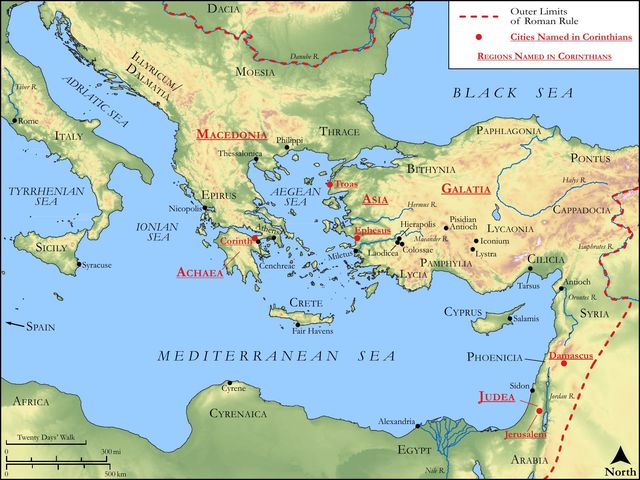
See on the biblical-era maps

Study this verse
Public-domain commentary
Matthew Henry
From his Commentary on the Whole Bible. Henry comments on passages, not single verses — this entry covers 1 Corinthians 15:35–50. His three-level outline is real structure in the source text, so it is rendered as structure.
The apostle comes now to answer a plausible and principal objection against the doctrine of the resurrection of the dead, concerning which observe the proposal of the objection: Some man will say, How are the dead raised up? And with what body do they come? Co1 15:35. The objection is plainly two-fold. How are they raised up? that is, "By what means? How can they be raised? What power is equal to this effect?" It was an opinion that prevailed much among the heathens, and the Sadducees seem to have been in the same sentiment, that it was not within the compass of divine power, mortales aeternitate donare, aut revocare defunctos - to make mortal men immortal, or revive and restore the dead. Such sort of men those seem to have been who among the Corinthians denied the resurrection of the dead, and object here, "How are they raised? How should they be raised? Is it not utterly impossible?" The other part of the objection is about the quality of their bodies, who shall rise: "With what body will they come? Will it be with the same body, with like shape, and form, and stature, and members, and qualities, or various?" The former objection is that of those who opposed the doctrine, the latter the enquiry of curious doubters.
I.To the former the apostle replies by telling them this was to be brought about by divine power, that very power which they had all observed to do something very like it, year after year, in the death and revival of the corn; and therefore it was an argument of great weakness and stupidity to doubt whether the resurrection of the dead might not be effected by the same power: Thou fool! that which thou sowest is not quickened unless it die, Co1 15:36. It must first corrupt, before it will quicken and spring up. It not only sprouts after it is dead, but it must die that it may live. And why should any be so foolish as to imagine that the man once dead cannot be made to live again, by the same power which every year brings the dead grain to life? This is the substance of the apostle's answer to the first question. Note, It is a foolish thing to question the divine power to raise the dead, when we see it every day quickening and reviving things that are dead.
II.But he is longer in replying to the second enquiry.
1.He begins by observing that there is a change made in the grain that is sown: It is not that body which shall be that is sown, but bare grain, of wheat or barley, etc.; but God gives it such a body as he will, and in such way as he will, only so as to distinguish the kinds from each other. Every seed sown has its proper body, is constituted of such materials, and figured in such a manner, as are proper to it, proper to that kind. This is plainly in the divine power, though we no more know how it is done than we know how a dead man is raised to life again. It is certain the grain undergoes a great change, and it is intimated in this passage that so will the dead, when they rise again, and live again, in their bodies, after death.
2.He proceeds hence to observe that there is a great deal of variety among others bodies, as there is among plants: as,
(1.)In bodies of flesh: All flesh is not the same; that of men is of one kind, that of beasts another, another that of fishes, and that of birds another, Co1 15:39. There is a variety in all the kinds, and somewhat peculiar in every kind, to distinguish it from the other.
(2.)In bodies celestial and terrestrial there is also a difference; and what is for the glory of one is not for the other; for the true glory of every being consists in its fitness for its rank and state. Earthly bodies are not adapted to the heavenly regions, nor heavenly bodies fitted to the condition of earthly beings. Nay,
(3.)There is a variety of glory among heavenly bodies themselves: There is one glory of the sun, and another of the moon, and another of the stars; for one star differs from another star in glory, Co1 15:41. All this is to intimate to us that the bodies of the dead, when they rise, will be so far changed, that they will be fitted for the heavenly regions, and that there will be a variety of glories among the bodies of the dead, when they shall be raised, as there is among the sun, and moon, and stars, nay among the stars themselves. All this carries an intimation along with it that it must be as easy to divine power to raise the dead, and recover their mouldered bodies, as out of the same materials to form so many different kinds of flesh and plants, and, for aught we know, celestial bodies as well as terrestrial ones. The sun and stars may, for aught we know, be composed of the same materials as the earth we tread on, though as much refined and changed by the divine skill and power. And can he, out of the same materials, form such various beings, and yet not be able to raise the dead? Having thus prepared the way, he comes,
3.To speak directly to the point: So also, says he, is the resurrection of the dead; so (as the plant growing out of the putrefied grain), so as no longer to be a terrestrial but a celestial body, and varying in glory from the other dead, who are raised, as one star does from another. But he specifies some particulars: as,
(1.)It is sown in corruption, it is raised in incorruption. It is sown. Burying the dead is like sowing them; it is like committing the seed to the earth, that it may spring out of it again. And our bodies, which are sown, are corruptible, liable to putrefy and moulder, and crumble to dust; but, when we rise, they will be out of the power of the grave, and never more be liable to corruption.
(2.)It is sown in dishonour, it is raised in glory. Ours is at present a vile body, Phi 3:21. Nothing is more loathsome than a dead body; it is thrown into the grave as a despised and broken vessel, in which there is no pleasure. But at the resurrection a glory will be put upon it; it will be made like the glorious body of our Saviour; it will be purged from all the dregs of earth, and refined into an ethereal substance, and shine out with a splendour resembling his.
(3.)It is sown in weakness, it is raised in power. It is laid in the earth, a poor helpless thing, wholly in the power of death, deprived of all vital capacities and powers, of life and strength: it is utterly unable to move or stir. But when we arise our bodies will have heavenly life and vigour infused into them; they will be hale, and firm, and durable, and lively, and liable no more to any infirmity, weakness, or decay.
(4.)It is sown a natural, or animal body, sōma psuchikon, a body fitted to the low condition and sensitive pleasures and enjoyments of this life, which are all gross in comparison of the heavenly state and enjoyments. But when we rise it will be quire otherwise; our body will rise spiritual. Not that body would be changed into spirit: this would be a contradiction in our common conceptions; it would be as much as to say, Body changed into what is not body, matter made immaterial. The expression is to be understood comparatively. We shall at the resurrection have bodies purified and refined to the last degree, made light and agile; and, though they are not changed into spirit, yet made fit to be perpetual associates of spirits made perfect. And why should it not be as much in the power of God to raise incorruptible, glorious, lively, spiritual bodies, out of the ruins of those vile, corruptible, lifeless, and animal ones, as first to make matter out of nothing, and then, out of the same mass of matter, produce such variety of beings, both in earth and heaven? To God all things are possible; and this cannot be impossible.
4.He illustrates this by a comparison of the first and second Adam: There is an animal body, says he, and there is a spiritual body; and then goes into the comparison in several instances.
(1.)As we have our natural body, the animal body we have in this world, from the first Adam, we expect our spiritual body from the second. This is implied in the whole comparison.
(2.)This is but consonant to the different characters these two persons bear: The first Adam was made a living soul, such a being as ourselves, and with a power of propagating such beings as himself, and conveying to them a nature and animal body like his own, but none other, nor better. The second Adam is a quickening Spirit; he is the resurrection and the life, Joh 11:25. He hath life in himself, and quickeneth whom he will, Joh 5:20, Joh 5:21. The first man was of the earth, made out of the earth, and was earthy; his body was fitted to the region of his abode: but the second Adam is the Lord from heaven; he who came down from heaven, and giveth life to the world (Joh 6:33); he who came down from heaven and was in heaven at the same time (Joh 3:13); the Lord of heaven and earth. If the first Adam could communicate to us natural and animal bodies, cannot the second Adam make our bodies spiritual ones? If the deputed lord of this lower creation could do the one, cannot the Lord from heaven, the Lord of heaven and earth, do the other?
(3.)We must first have natural bodies from the first Adam before we can have spiritual bodies from the second (Co1 15:49); we must bear the image of the earthy before we can bear the image of the heavenly. Such is the established order of Providence. We must have weak, frail, mortal bodies by descent from the first Adam, before we can have lively, spiritual, and immortal ones by the quickening power of the second. We must die before we can live to die no more.
(4.)Yet if we are Christ's, true believers in him (for this whole discourse relates to the resurrection of the saints), it is as certain that we shall have spiritual bodies as it is now that we have natural or animal ones. By these we are as the first Adam, earthy, we bear his image; by those we shall be as the second Adam, have bodies like his own, heavenly, and so bear him image. And we are as certainly intended to bear the one as we have borne the other. As surely therefore as we have had natural bodies, we shall have spiritual ones. The dead in Christ shall not only rise, but shall rise thus gloriously changed.
5.He sums up this argument by assigning the reason of this change (Co1 15:50): Now this I say that flesh and blood cannot inherit the kingdom of God; nor doth corruption inherit incorruption. The natural body is flesh and blood, consisting of bones, muscles, nerves, veins, arteries, and their several fluids; and, as such, it is of a corruptible frame and form, liable to dissolution, to rot and moulder. But no such thing shall inherit the heavenly regions; for this were for corruption to inherit incorruption, which is little better than a contradiction in terms. The heavenly inheritance is incorruptible, and never fadeth away, Pe1 1:4. How can this be possessed by flesh and blood, which is corruptible and will fade away? It must be changed into ever-during substance, before it can be capable of possessing the heavenly inheritance. The sum is that the bodies of the saints, when they shall rise again, will be greatly changed from what they are now, and much for the better. They are now corruptible, flesh and blood; they will be then incorruptible, glorious, and spiritual bodies, fitted to the celestial world and state, where they are ever afterwards to dwell, and have their eternal inheritance.
Historical interpretation
Eighteen Centuries of Reception
10 surviving comments on this verse. Each one is dated, so this reads as a timeline rather than a list.
Select a marker to jump to its quote. Markers stagger vertically where authors wrote within a few decades of each other.
For there had been a necessity that, in the first place, a human being should be fashioned, and that what was fashioned should receive the soul; afterwards that it should thus receive the communion of the Spirit. Wherefore also "the first Adam was made" by the Lord "a living soul, the second Adam a quickening spirit." As, then, he who was made a living soul forfeited life when he turned aside to what was evil, so, on the other hand, the same individual, when he reverts to what is good, and receives the quickening Spirit, shall find life.
That, however, which we have reserved for a concluding argument, will now stand as a plea for all, and for the apostle himself, who in very deed would have to be charged with extreme indiscretion, if he had so abruptly, as some will have it, and as they say, blindfold, and so indiscriminately, and so unconditionally, excluded from the kingdom of God, and indeed from the court of heaven itself, all flesh and blood whatsoever; since Jesus is still sitting there at the right hand of the Father, man, yet God-the last Adam, yet the primary Word-flesh and blood, yet purer than ours-who "shall descend in like manner as He ascended into heaven" the same both in substance and form, as the angels affirmed, so as even to be recognised by those who pierced Him.
For to this effect he just before remarked of Christ Himself: "The first man Adam was made a living soul, the last Adam was made a quickening spirit." Our heretic, however, in the excess of his folly, being unwilling that the statement should remain in this shape, altered "last Adam" into "last Lord; " because he feared, of course, that if he allowed the Lord to be the last (or second) Adam, we should contend that Christ, being the second Adam, must needs belong to that God who owned also the first Adam.
And therefore he confirms the passage afresh, by putting on it the impress (of his own inspired authority), saying, "For so it is written; " that you may not suppose that the "being sown" means anything else than "thou shalt return to the ground, out of which thou wast taken; "nor that the phrase "for so it is written" refers to any other thing that the flesh.
Now the apostle, by severally adducing this order in Adam and in Christ, fairly distinguishes between the two states, in the very essentials of their difference. And when he calls Christ "the last Adam," you may from this circumstance discover how strenuously he labours to establish throughout his teaching the resurrection of the flesh, not of the soul.
And thus in the sixth Psalm for the eighth day, David asks the Lord that He would not rebuke him in His anger, nor judge him in His fury; for this is indeed the eighth day of that future judgment, which will pass beyond the order of the sevenfold arrangement. Jesus also, the son of Nave, the successor of Moses, himSelf broke the Sabbath-day; for on the Sabbath-day he commanded the children of Israel to go round the walls of the city of Jericho with trumpets, and declare war against the aliens. Matthias also, prince of Judah, broke the Sabbath; for he slew the prefect of Antiochus the king of Syria on the Sabbath, and subdued the foreigners by pursuing them. And in Matthew we read, that it is written Isaiah also and the rest of his colleagues broke the Sabbath -that that true and just Sabbath should be observed in the seventh millenary of years. Wherefore to those seven days the Lord attributed to each a thousand years; for thus went the warning: "In Thine eyes, O Lord, a thousand years are as one day." Therefore in the eyes of the Lord each thousand of years is ordained, for I find that the Lord's eyes are seven. Wherefore, as I have narrated, that true Sabbath will be in the seventh millenary of years, when Christ with His elect shall reign. Moreover, the seven heavens agree with those days; for thus we are warned: "By the word of the Lord were the heavens made, and all the powers of them by the spirit of His mouth." There are seven spirits. Their names are the spirits which abode on the Christ of God, as was intimated in Isaiah the prophet: "And there rests upon Him the spirit of wisdom and of understanding, the spirit of counsel and might, the spirit of wisdom and of piety, and the spirit of God's fear hath filled Him." Therefore the highest heaven is the heaven of wisdom; the second, of understanding; the third, of counsel; the fourth, of might; the fifth, of knowledge; the sixth, of piety; the seventh, of God's fear. From this, therefore, the thunders bellow, the lightnings are kindled, the fires are heaped together; fiery darts appear, stars gleam, the anxiety caused by the dreadful comet is aroused. Sometimes it happens that the sun and moon approach one another, and cause those more than frightful appearances, radiating with light in the field of their aspect. But the author of the whole creation is Jesus. His name is the Word; for thus His Father says: "My heart hath emitted a good word." John the evangelist thus says: "In the beginning was the Word, and the Word was with God, and the Word was God. The same was in the beginning with God. All things were made by Him, and without Him was nothing made that was made." Therefore, first, was made the creation; secondly, man, the lord of the human race, as says the apostle. Therefore this Word, when it made light, is called Wisdom; when it made the sky, Understanding; when it made land and sea, Counsel; when it made sun and moon and other bright things, Power; when it calls forth land and sea, Knowledge; when it formed man, Piety; when it blesses and sanctifies man, it has the name of God's fear.
"So also it is written, the first man Adam became a living soul: the last Adam became a life-giving Spirit."
And yet the one indeed is written, but the other not written. How then said He, "it is written?" He modified the expression according to the issue of events: as he is wont continually to do: and indeed as it is the way of every prophet. For so Jerusalem, the prophet said, should be "called a city of righteousness;" yet it was not so called. What then? Did the prophet speak false? By no means. For he is speaking of the issue of events. And that Christ too should be called Immanuel; yet was he not so called. But the facts utter this voice; so also here, "the last Adam became a life-giving Spirit."
And these things he said that thou mayest learn that the signs and pledges both of the present life and of that which is to come have already come upon us; to wit, of the present life, Adam, and of the life to come, Christ. For since he sets down the better things as matters of hope, he signifies that their beginning hath already come to pass, and their root and their fountain been brought to light. But if the root and the fountain be evident to all, there is no need to doubt of the fruits. Wherefore he saith, "The last Adam became a life-giving Spirit." And elsewhere too, He "shall quicken your mortal bodies through His Spirit that dwelleth in you." It is the Spirit's work then to quicken.
Further, lest any should say, "why are the worse things the elder? and why hath the one sort, to wit, the natural, come to pass not merely as far as the first-fruits, but altogether; the other as far as the first-fruits only?"-he signifies that the principles also of each were so ordered.
The first man, Adam, was made into a living soul … but of all the animals it was said: “Let the earth bring forth the living creatures.” We understand, then, that the natural body is said to be like the other animals because of the dissolution and corruption of death. It is daily renewed by food, and when the bond of life is broken it is dissolved. But the spiritual body which is now with the Spirit is immortal.
But whereas he that was formed of the earth returned to the earth, He that became the second man returned to heaven. And so we read of the "first Adam and the last Adam."
The second class of miracles, on this view, foretell what God has not yet done, but will do, universally. He raised one man (the man who was Himself) from the dead because He will one day raise all men from the dead. Perhaps not only men, for there are hints in the New Testament that all creation will eventually be rescued from decay, restored to shape and subserve the splendour of re-made humanity. The Transfiguration and the walking on the water are glimpses of the beauty and the effortless power over all matter which will belong to men when they are really waked by God. Now resurrection certainly involves “reversal” of natural process in the sense that it involves a series of changes moving in the opposite direction to those we see. At death, matter which has been organic, falls back gradually into the inorganic, to be finally scattered and used perhaps in other organisms. Resurrection would be the reverse process. It would not of course mean the restoration to each personality of those very atoms, numerically the same, which had made its first or “natural” body. There would not be enough to go round, for one thing; and for another, the unity of the body even in this life was consistent with a slow but perplexed change of its actual ingredients. But it certainly does mean matter of some kind rushing towards organism as now we see it rushing away. It means, in fact, playing backwards a film we have already seen played forwards. In that sense it is a reversal of Nature. But, of course, it is a further question whether reversal in this sense is necessarily contradiction. Do we know that the film cannot be played backwards?
Well, in one sense, it is precisely the teaching of modern physics that the film never works backwards. For modern physics, as you have heard before, the universe is “running down.” Disorganization and chance is continually increasing. There will come a time, not infinitely remote, when it will be wholly run down or wholly disorganized, and science knows of no possible return from that state. There must have been a time, not infinitely remote, in the past when it was wound up, though science knows of no winding-up process. The point is that for our ancestors the universe was a picture: for modern physics it is a story. If the universe is a picture these things either appear in that picture or not; and if they don’t, since it is an infinite picture, one may suspect that they are contrary to the nature of things. But a story is a different matter; specially if it is an incomplete story. And the story told by modern physics might be told briefly in the words “Humpty Dumpty was falling.” That is, it proclaims itself an incomplete story. There must have been a time before he fell, when he was sitting on the wall; there must be a time after he had reached the ground. It is quite true that science knows of no horses and men who can put him together again once he has reached the ground and broken. But then she also knows of no means by which he could originally have been put on the wall. You wouldn’t expect her to. All science rests on observation: all our observations are taken during Humpty Dumpty’s fall, because we were born after he lost his seat on the wall and shall be extinct long before he reaches the ground. But to assume from observations taken while the clock is running down that the unimaginable winding-up which must have preceded this process cannot occur when the process is over is the merest dogmatism. From the very nature of the case the laws of degradation and disorganization which we find in matter at present, cannot be the ultimate and eternal nature of things. If they were, there would have been nothing to degrade and disorganize. Humpty Dumpty can’t fall off a wall that never existed.
Continue studying 1 Corinthians 15:45 across the web’s major study libraries — every link below opens this exact verse, chapter, or book on the destination site.
Read & Compare
 BibleGatewayThis verse in more than 200 translations and 70 languages.
 Bible.comThe YouVersion reader — hundreds of translations, reading plans, and highlights.
 ESV.orgCrossway's official English Standard Version reader.
 NET BibleThe NET translation with 60,000+ translators' notes on every rendering decision.
 STEP BibleTyndale House's free study tool — original text, vocabulary, and scholarly resources.
 BibliaLogos Bible Software's free web reader.
 USCCBThe New American Bible (Revised Edition) with the U.S. bishops' study notes.
Commentaries
 BibleHub CommentariesDozens of classic commentaries on this verse, gathered on one page.
 StudyLightMore than 100 commentary sets — the largest collection on the web.
 BibleRefPlain-English commentary on what this verse means, verse by verse.
 Enduring WordDavid Guzik's free commentary on this chapter, widely used by Bible teachers.
 Bible Study ToolsVerse commentary alongside Greek and Hebrew study aids.
Original Language & Research
- BibleHub InterlinearThe verse word by word — original language, transliteration, and English.
- BibleHub LexiconEvery word's original-language definition and Strong's entry.
 Blue Letter BibleDeep-study tools — Strong's numbers, concordance, and word studies.
 CNTR CollationThe earliest Greek manuscripts of this verse, collated letter by letter.
Sermons, Hymns & Audio


TrulyRandomVerse is not affiliated with these sites and doesn’t control their content. They’re linked because they’re genuinely useful.
Summary
First Corinthians 15:45 stands as a pivotal theological statement within Paul's comprehensive defense of the resurrection, articulating a profound contrast between humanity's two representative heads: Adam and Christ. Paul asserts that just as the "first man Adam" was created a natural, living soul, establishing a lineage of physical life subject to mortality, "the last Adam," Jesus Christ, became a life-giving spirit, inaugurating a new spiritual humanity endowed with eternal life and resurrection power. This verse succinctly encapsulates the transition from a natural, earthly existence to a spiritual, heavenly reality, foundational to understanding the believer's ultimate hope and destiny in Christ.
Context
ShowHideLiterary Context
This verse is situated within 1 Corinthians 15, often hailed as the "Resurrection Chapter," where Paul meticulously addresses the Corinthian believers' doubts and misconceptions concerning the resurrection of the dead. Having already firmly established the historical veracity of Christ's resurrection as the cornerstone of Christian faith and the guarantor of future resurrection, Paul transitions in verses 35-49 to explain the nature of the resurrected body. He employs analogies from nature, such as a seed transforming into a plant, to illustrate that the resurrected body will be fundamentally different from the earthly, perishable body. Verse 45 serves as a crucial theological anchor for this transformation, providing the ultimate contrast between the natural and spiritual realms by juxtaposing humanity's two progenitors, Adam and Christ, thereby explaining the source and character of both mortal and immortal life.
Historical & Cultural Context
The Corinthian church, situated in a bustling, cosmopolitan Greek city, was heavily influenced by Hellenistic thought. Many Greeks held a dualistic worldview, often despising the physical body as a prison for the soul and viewing any bodily resurrection as undesirable or illogical. This philosophical backdrop contributed to their skepticism regarding a bodily resurrection. Furthermore, the Jewish understanding of Adam, drawn from Genesis 2:7, depicted him as a "living soul" (Hebrew: nephesh chayyah), emphasizing his natural, earthly existence. Paul's argument directly challenges these prevailing notions by introducing Christ as a new, superior archetype—not merely a recipient of life, but its active source—thereby re-framing the very concept of life and existence through a distinctly Christian lens that affirms a transformed, spiritual body.
Key Themes
ShowHideFirst Corinthians 15:45 powerfully contributes to several overarching themes within the chapter and Paul's broader theology. The primary theme is The Two Adams, establishing a profound typological contrast between the "first man Adam," whose actions brought sin and death to all humanity (Romans 5:12), and "the last Adam," Jesus Christ, who through His obedience and resurrection brings righteousness and life (Romans 5:18-19). This highlights Christ's role as the new head of a spiritual humanity, reversing the effects of Adam's fall. Closely related is the distinction between Natural vs. Spiritual, underscoring the fundamental difference between the earthly, perishable existence inherited from Adam ("living soul") and the heavenly, imperishable reality inaugurated by Christ ("quickening spirit"). This is not a devaluation of the physical creation but an affirmation of the superior, eternal nature of the resurrected life, culminating in the theme of Christ as the Life-Giver. Jesus is presented not merely as one who received life, but as the active source of life itself, capable of "quickening" or making alive those who are spiritually dead or destined for mortality, ultimately leading to the glorious transformation of believers into His likeness (1 Corinthians 15:49).
Exposition and Analysis
ShowHideKey Word Analysis
ShowHideAs derived from ψύχω (psycho), meaning "breath," this term (G5590) refers to the animating principle of natural life, the animal sentient principle. It is distinguished from pneûma (spirit) as the rational and immortal soul, and from zōḗ (mere vitality). In the context of "living soul" for Adam, it directly echoes Genesis 2:7 in the Septuagint, signifying a being animated by natural breath and possessing a natural, earthly life, inherently mortal and subject to decay.
This verb (G2227), formed from zōon (living being) and poieō (to make), means "to make alive" or "to give life." It describes an active, vitalizing process. When applied to Christ, it emphasizes His unique power and function as the source of life, not merely a recipient, but one who imparts life, particularly spiritual and resurrection life.
This noun (G4151), derived from pneō (to breathe), refers to a current of air, breath, or by analogy, a spirit. In this context, it signifies the divine, life-giving essence that Christ embodies and imparts. Unlike psychḗ, which denotes natural animation, pneûma here points to a higher, spiritual, and eternal quality of life, often associated with the Holy Spirit and divine power.
Verse Breakdown
ShowHide"And so it is written"
This introductory phrase (Greek: kai houtōs gegraptai) signals that Paul is drawing upon established scripture, specifically alluding to Genesis 2:7. It grounds his theological argument in the Old Testament narrative, lending authority and continuity to his teaching on the nature of humanity and the contrast he is about to draw. It implies that the distinction between Adam and Christ, and their respective impacts, is part of God's overarching redemptive plan, revealed in sacred texts.
"The first man Adam was made a living soul"
This clause directly quotes or paraphrases Genesis 2:7 (LXX: egeneto ho anthrōpos eis psychēn zōsan). It describes Adam's creation as a being animated by natural breath, possessing a physical, earthly life (psychē zōsan). This life, while real, was finite and susceptible to death, representing the natural, mortal existence inherited by all humanity through Adam. He received life, but was not its ultimate source.
"the last Adam [was made] a quickening spirit"
This is the profound counter-statement. "The last Adam" refers to Jesus Christ, who stands as the new representative head of humanity, bringing about a new spiritual order. The phrase "[was made]" is supplied in the KJV but is implied by the parallel structure with the first clause. Crucially, Christ is described as a "quickening spirit" (pneuma zōopoion), meaning a "life-giving spirit." Unlike Adam, who merely received life, Christ is the active source and giver of spiritual, resurrection life. This spiritual life is transcendent, eternal, and capable of overcoming death, fundamentally transforming the nature of human existence for those united with Him.
Literary Devices
ShowHidePaul employs several potent literary devices in this concise verse. The most prominent is Contrast, setting "the first man Adam" against "the last Adam," and "a living soul" against "a quickening spirit." This stark opposition highlights the fundamental difference in their natures and the distinct types of life they impart. Hand in hand with contrast is Typology, where Adam serves as a type (a prefiguring pattern) of Christ. Adam's role as the head of the old creation, bringing natural life and mortality, foreshadows Christ's role as the head of the new creation, bringing spiritual life and immortality. There is also a clear Parallelism in the structure of the two clauses, reinforcing the comparison and making the contrast even more impactful. Furthermore, the verse contains an Allusion to Genesis 2:7, grounding Paul's argument in the foundational narrative of creation while simultaneously reinterpreting and expanding its implications through the lens of Christ's redemptive work.
Theological and Thematic Connections
ShowHideThis verse is a cornerstone of Pauline theology, articulating the profound redemptive work of Christ in reversing the effects of Adam's fall. It establishes Jesus not merely as a moral example or a prophet, but as the new federal head of humanity, inaugurating a new spiritual creation. Where Adam's natural life led to universal mortality and spiritual death, Christ's life-giving Spirit offers universal spiritual life and the promise of resurrection to all who are "in Him." This theological truth underpins the Christian hope of a transformed existence, one that transcends the limitations of the perishable, earthly body and participates in the imperishable, spiritual reality of Christ's resurrection. It underscores that our ultimate identity and destiny are not found in our Adamic inheritance but in our union with the resurrected Lord.
Reflection and Application
ShowHideFirst Corinthians 15:45 offers immense hope and assurance for believers, reminding us that our destiny is not confined to the mortality inherited from Adam. Through faith in Jesus Christ, "the last Adam," we are intimately connected to a source of eternal, spiritual life that triumphs decisively over death. This profound truth means that our current physical limitations and the certainty of death are not the final word. Instead, our future is defined by a glorious transformation, promising a spiritual body fit for eternity and a life empowered by the very Spirit of God. This verse calls us to live with an eternal perspective, recognizing that our identity and ultimate hope are firmly rooted in the life-giving power of the resurrected Christ, who has secured for us a new, imperishable existence. It encourages us to embrace the spiritual realities of our new life in Christ, allowing His quickening Spirit to animate and guide our daily walk, anticipating the full realization of our resurrection hope.
Questions for Reflection
ShowHideFAQ
ShowHideWhat does it mean that Adam was "made a living soul" and Jesus "a quickening spirit"?
ShowHideThe phrase "living soul" for Adam directly references Genesis 2:7, where God breathed into Adam, and he became a nephesh chayyah (Hebrew) or psychē zōsan (Greek Septuagint), meaning a being animated by natural breath and possessing a physical, earthly life. This life, while real, was mortal and subject to decay. In contrast, Jesus, "the last Adam," is described as a "quickening spirit" (pneuma zōopoion), meaning a "life-giving spirit." This signifies that Jesus is not merely a recipient of life but its active source, possessing and imparting a higher, spiritual, and eternal quality of life. He is the one who makes alive, particularly in a spiritual and resurrection sense, fundamentally different from Adam's natural animation.
Why is Jesus called "the last Adam"?
ShowHideJesus is called "the last Adam" because He serves as the new and final representative head of humanity, bringing to completion and reversing the trajectory set by the "first man Adam." Adam's actions introduced sin and death into the world for all humanity (Romans 5:12). Jesus, as "the last Adam," through His perfect obedience, sacrificial death, and resurrection, inaugurated a new spiritual humanity, offering righteousness and eternal life to all who are united with Him (Romans 5:18-19). He is "last" not because there will be another, but because He is the ultimate and definitive Adam, fulfilling God's original design for humanity in a way the first Adam failed, and establishing a new covenant of life.
Christ-Centered Fulfillment
ShowHideFirst Corinthians 15:45 stands as a profound declaration of Christ's ultimate supremacy and His pivotal role in God's redemptive plan, fulfilling the Adamic typology in a way that transcends and reverses the first Adam's legacy. As "the last Adam," Jesus Christ is the culmination of humanity, not merely a restored version of Adam, but the inaugurator of a new, spiritual humanity. Where Adam's natural life was bound by mortality and sin, leading to universal death (Romans 5:12), Christ, as the "quickening spirit," is the inexhaustible source of eternal, spiritual life. His resurrection from the dead (1 Corinthians 15:20) demonstrates His power to overcome death and impart life, making Him the "firstborn from the dead" (Colossians 1:18). Through His Spirit, He indwells believers, transforming them from "living souls" destined for decay into those who partake in His divine nature and spiritual vitality (2 Peter 1:4). This means that our ultimate hope for resurrection and eternal life is not merely a future event, but a present reality, as the life-giving Spirit of Christ is already at work within us, guaranteeing our future glorification and conformity to His resurrected image (Romans 8:11). Thus, Christ is the very essence of the new creation, the one in whom all things are made new, and the ultimate fulfillment of God's purpose for humanity.