


Philippians 3:21
Bible text: King James Version (1769 Blayney text) · Public domain
Bible text: King James Version with Strong's numbers · Public domain
Bible text: Berean Standard Bible · Public domain
Bible text: American Standard Version (1901) · Public domain
Bible text: World English Bible, Messianic edition · Public domain
Bible text: Geneva Bible (1599) · Public domain
Bible text: Young's Literal Translation · Public domain
- ὃςhoswhoG3739R-NSMRelative pronoun Nominative Singular Masculine
- μετασχηματίσειmetaschēmatiseiwill transformG3345V-FAI-3SVerb Future Active Indicative 3rd Singular
- τὸtotheG3588T-ASNDefinite article Accusative Singular Neuter
- σῶμαsōmabodyG4983N-ASNNoun Accusative Singular Neuter
- τῆςtēsof theG3588T-GSFDefinite article Genitive Singular Feminine
- ταπεινώσεωςtapeinōseōshumiliationG5014N-GSFNoun Genitive Singular Feminine
- ἡμῶνhēmōnof usG3165P-1GPPersonal pronoun Genitive 1st Plural
- εἰςeistowardG1519PREPPreposition
- τὸto<the>G3588T-ASNDefinite article Accusative Singular Neuter
- γενέσθαιgenesthaito becomeG1096V-2ADNVerb 2nd Aorist Middle Deponent Infinitive
- αὐτὸautoitG846P-ASNPersonal pronoun Accusative Singular Neuter
- σύμμορφονsummorphonconformedG4832A-ASNAdjective Accusative Singular Neuter
- τῷtōto theG3588T-DSNDefinite article Dative Singular Neuter
- σώματιsōmatibodyG4983N-DSNNoun Dative Singular Neuter
- τῆςtēsof theG3588T-GSFDefinite article Genitive Singular Feminine
- δόξηςdoxēsgloryG1391N-GSFNoun Genitive Singular Feminine
- αὐτοῦautouof HimselfG846P-GSMPersonal pronoun Genitive Singular Masculine
- κατὰkataaccording toG2596PREPPreposition
- τὴνtēntheG3588T-ASFDefinite article Accusative Singular Feminine
- ἐνέργειανenergeianworkingG1753N-ASFNoun Accusative Singular Feminine
- τοῦtou<the>G3588T-GSNDefinite article Genitive Singular Neuter
- δύνασθαιdunasthaienablingG1410V-PNNVerb Present Middle Or Passive Deponent Infinitive
- αὐτὸνautonHimG846P-ASMPersonal pronoun Accusative Singular Masculine
- καὶkaievenG2532CONJConjunction
- ὑποτάξαιhupotaxaito subdueG5293V-2AANVerb 2nd Aorist Active Infinitive
- αὐτῷautōto HimG846P-DSMPersonal pronoun Dative Singular Masculine
- τὰta<the>G3588T-APNDefinite article Accusative Plural Neuter
- πάνταpantaall thingsG3956A-APNAdjective Accusative Plural Neuter
English is a literal word-by-word gloss of the Greek, not the KJV's wording. Why?
This is the original text the KJV's translators worked from — each Greek word with its own literal English meaning in this verse, prepared by scholars at Tyndale House, Cambridge. The KJV translates whole sentences, not word by word, so its wording differs: one Greek word can become several English words, and the KJV may choose “charity” where the gloss reads “love”. Both are faithful — they answer different questions. For the KJV's own rendering, switch to the KJV text.
Details
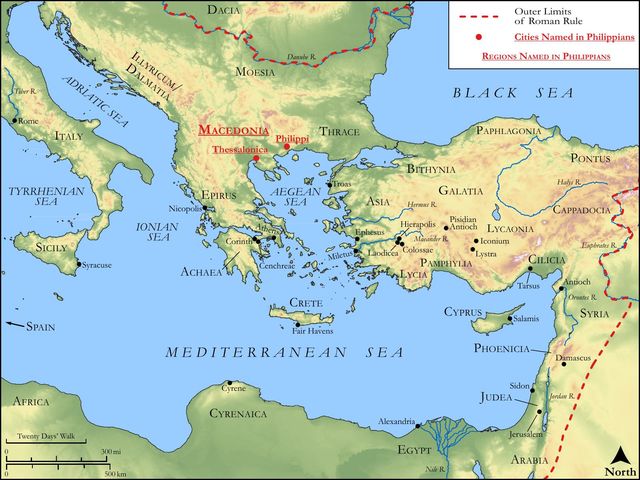
See on the biblical-era maps

Study this verse
Public-domain commentary
Matthew Henry
From his Commentary on the Whole Bible. Henry comments on passages, not single verses — this entry covers Philippians 3:17–21. His three-level outline is real structure in the source text, so it is rendered as structure.
He closes the chapter with warnings and exhortations.
I.He warns them against following the examples of seducers and evil teachers (Phi 3:18, Phi 3:19):
Many walk, of whom I have told you often, and now tell you weeping, that they are the enemies of the cross of Christ. Observe,
1.There are many called by Christ's name who are enemies to Christ's cross, and the design and intention of it. Their walk is a surer evidence what they are than their profession. By their fruits you shall know them, Mat 7:20. The apostle warns people against such,
(1.)Very frequently: I have told you often. We so little heed the warnings given us that we have need to have them repeated. To write the same things is safe, Phi 3:1.
(2.)Feelingly and affectionately: I now tell you weeping. Paul was upon proper occasions a weeping preacher, as Jeremiah was a weeping prophet. Observe, An old sermon may be preached with new affections; what we say often we may say again, if we say it affectionately, and are ourselves under the power of it.
2.He gives us the characters of those who were the enemies of the cross of Christ.
(1.)Whose God is their belly. They minded nothing but their sensual appetites. A wretched idol it is, and a scandal for any, but especially for Christians, to sacrifice the favour of God, the peace of their conscience, and their eternal happiness to it. Gluttons and drunkards make a god of their belly, and all their care is to please it and make provision for it. The same observance which good people give to God epicures give to their appetites. Of such he says, They serve not the Lord Jesus Christ, but their own bellies, Rom 16:18.
(2.)They glory in their shame. They not only sinned, but boasted of it and gloried in that of which they ought to have been ashamed. Sin is the sinner's shame, especially when it is gloried in. "They value themselves for what is their blemish and reproach." (3.) They mind earthly things. Christ came by his cross to crucify the world to us and us to the world; and those who mind earthly things act directly contrary to the cross of Christ, and this great design of it. They relish earthly things, and have no relish of the things which are spiritual and heavenly. They set their hearts and affections on earthly things; they love them, and even dote upon them, and have a confidence and complacency in them. He gives them this character, to show how absurd it would be for Christians to follow the example of such or be led away by them; and, to deter us all from so doing, he reads their doom. (4.) Whose end is destruction. Their way seems pleasant, but death and hell are at the end of it. What fruit had you then in those things whereof you are now ashamed? For the end of those things is death, Rom 6:21. It is dangerous following them, though it is going down the stream; for, if we choose their way, we have reason to fear their end. Perhaps he alludes to the total destruction of the Jewish nation.
II.He proposes himself and his brethren for an example, in opposition to these evil examples:
Brethren, be followers together of me, and mark those who walk as you have us for an example, Phi 3:17. Mark them out for your pattern. He explains himself (Phi 3:20) by their regard to Christ and heaven: For our conversation is in heaven. Observe, Good Christians, even while they are here on earth, have their conversation in heaven. Their citizenship is there, politeuma. As if he had said, We stand related the that world, and are citizens of the New Jerusalem. This world is not our home, but that is. There our greatest privileges and concerns lie. And, because our citizenship is there, our conversation is there; being related to that world, we keep up a correspondence with it. The life of a Christian is in heaven, where his head is, and his home is, and where he hopes to be shortly; he sets his affections upon things above; and where his heart is there will his conversation be. The apostle had pressed them to follow him and other ministers of Christ: "Why," might they say, "you are a company of poor, despised, persecuted people, who make no figure, and pretend to no advantages in the world; who will follow you?" "Nay," says he, "but our conversation is in heaven. We have a near relation and a great pretension to the other world, and are not so mean and despicable as we are represented." It is good having fellowship with those who have fellowship with Christ, and conversation with those whose conversation is in heaven.
1.Because we look for the Saviour from heaven (Phi 3:20): Whence also we look for the Saviour, the Lord Jesus Christ. He is not here, he has ascended, he has entered within the veil for us; and we expect his second coming thence, to gather in all the citizens of that New Jerusalem to himself.
2.Because at the second coming of Christ we expect to be happy and glorified there. There is good reason to have our conversation in heaven, not only because Christ is now there, but because we hope to be there shortly: Who shall change our vile bodies, that they may be fashioned like unto his glorious body, Phi 3:21. There is a glory reserved for the bodies of the saints, which they will be instated in at the resurrection. The body is now at the best a vile body, to sōma tēs tapeinōseōs hēmōn - the body of our humiliation: it has its rise and origin from the earth, it is supported out of the earth, and is subject to many diseases and to death at last. Besides, it is often the occasion and instrument of much sin, which is called the body of this death, Rom 7:24. Or it may be understood of its vileness when it lies in the grave; at the resurrection it will be found a vile body, resolved into rottenness and dust; the dust will return to the earth as it was, Ecc 12:7. But it will be made a glorious body; and not only raised again to life, but raised to great advantage. Observe,
(1.)The sample of this change, and that is, the glorious body of Christ; when he was transfigured upon the mount, his face did shine as the sun, and his raiment was white as the light, Mat 17:2. He went to heaven clothed with a body, that he might take possession of the inheritance in our nature, and be not only the first-born from the dead, but the first-born of the children of the resurrection. We shall be conformed to the image of his Son, that he may be the first-born among many brethren, Rom 8:29.
(2.)The power by which this change will be wrought: According to the working whereby he is able even to subdue all things unto himself. There is an efficacy of power, an exceeding greatness of power, and the working of mighty power, Eph 1:19. It is matter of comfort to us that he can subdue all things to himself, and sooner or later will bring over all into his interest. And the resurrection will be wrought by this power. I will raise him up at the last day, Joh 6:44. Let this confirm our faith of the resurrection, that we not only have the scriptures, which assure us it shall be, but we know the power of God, which can effect it, Mat 22:29. At Christ's resurrection was a glorious instance of the divine power, and therefore he is declared to be the Son of God with power, by the resurrection from the dead (Rom 1:4), so will our resurrection be: and his resurrection is a standing evidence, as well as pattern, of ours. And then all the enemies of the Redeemer's kingdom will be completely conquered. Not only he who had the power of death, that is, the devil (Heb 2:14), but the last enemy, shall be destroyed, that is, death, Co1 15:26, shall be swallowed up in victory, Co1 15:54.
Historical interpretation
Four Centuries of Reception
12 surviving comments on this verse. Each one is dated, so this reads as a timeline rather than a list.
Select a marker to jump to its quote. Markers stagger vertically where authors wrote within a few decades of each other.
If, again, Christ in His advent from heaven "shall change the body of our humiliation, that it may be fashioned like unto His glorious body," it follows that this body of ours shall rise again, which is now in a state of humiliation in its sufferings and according to the law of mortality drops into the ground.
It was as full of this splendid example that Paul said: "Who shall change our vile body, that it may be fashioned like unto His glorious body." But if you maintain that a transfiguration and a conversion amounts to the annihilation of any substance, then it follows that "Saul, when changed into another man," passed away from his own bodily substance; and that Satan himself, when "transformed into an angel of light," loses his own proper character.
If Christ coming from heaven will “transform the body of our humiliation into conformity with the body of his glory,” then this body of ours, which is humbled by sufferings and cast down into the earth by the very law of death, is the very body that will rise. For how will it be transformed if there is nothing?
That in the meantime we die, we are passing over to immortality by death; nor can eternal life follow, unless it should befall us to depart from this life. That is not an ending, but a transit, and, this journey of time being traversed, a passage to eternity. Who would not hasten to better things? Who would not crave to be changed and renewed into the likeness of Christ, and to arrive more quickly to the dignity of heavenly glory, since Paul the apostle announces and says, "For our conversation is in heaven, from whence also we look for the Lord Jesus Christ; who shall change the body of our humiliation, and conform it to the body of His glory? " Christ the Lord also promises that we shall be such, when, that we may be with Him, and that we may live with Him in eternal mansions, and may rejoice in heavenly kingdoms, He prays the Father for us, saying, "Father, I will that they also whom Thou hast given me be with me where I am, and may see the glory which Thou hast given me before the world was made." He who is to attain to the throne of Christ, to the glory of the heavenly kingdoms, ought not to mourn nor lament, but rather, in accordance with the Lord's promise, in accordance with his faith in the truth, to rejoice in this his departure and translation.
But that, being first severely beaten with clubs, and ill-used, you have begun by sufferings of that kind, the glorious firstlings of your confession, is not a matter to be execrated by us. For a Christian body is not very greatly terrified at clubs, seeing all its hope is in the Wood. The servant of Christ acknowledges the sacrament of his salvation: redeemed by wood to life eternal, he is advanced by wood to the crown. But what wonder if, as golden and silver vessels, you have been committed to the mine that is the home of gold and silver, except that now the nature of the mines is changed, and the places which previously had been accustomed to yield gold and silver have begun to receive them? Moreover, they have put fetters on your feet, and have bound your blessed limbs, and the temples of God with disgraceful chains, as if the spirit also could be bound with the body, or your gold could be stained by the contact of iron. To men who are dedicated to God, and attesting their faith with religious courage, such things are ornaments, not chains; nor do they bind the feet of the Christians for infamy, but glorify them for a crown. Oh feet blessedly bound, which are loosed, not by the smith but by the Lord! Oh feet blessedly bound, which are guided to paradise in the way of salvation! Oh feet bound for the present time in the world, that they may be always free with the Lord! Oh feet, lingering for a while among the fetters and cross-bars, but to run quickly to Christ on a glorious road! Let cruelty, either envious or malignant, hold you here in its bonds and chains as long as it will, from this earth and from these sufferings you shall speedily come to the kingdom of heaven. The body is not cherished in the mines with couch and cushions, but it is cherished with the refreshment and solace of Christ. The frame wearied with labours lies prostrate on the ground, but it is no penalty to lie down with Christ. Your limbs unbathed, are foul and disfigured with filth and dirt; but within they are spiritually cleansed, although without the flesh is defiled. There the bread is scarce; but man liveth not by bread alone, but by the word of God. Shivering, you want clothing; but he who puts on Christ is both abundantly clothed and adorned. The hair of your half-shorn bead seems repulsive; but since Christ is the head of the man, anything whatever must needs become that head which is illustrious on account of Christ's name. All that deformity, detestable and foul to Gentiles, with what splendour shall it be recompensed! This temporal and brief suffering, how shall it be exchanged for the re ward of a bright and eternal honour, when, according to the word of the blessed apostle, "the Lord shall change the body of our humiliation, that it may be fashioned like to the body of His brightness!"
The transformation, he says, is the restoration into an impassible and glorious state. For now the body is a body of desire and of humiliation,
“The power that enables him to subject all things to himself” consists in the transition from one nature to another nature. Insofar as it ceases to be its previous nature, it becomes subject to its new nature. It does not stop existing but advances in existing. It ceases to be the old nature and becomes the new nature. It is subdued by transformation as it passes into the fashion of the new kind that it has assumed.
When we rise and are changed and are made spiritual in soul, body and spirit (for all these three make up one man and are one spirit), the body in which we have been humbled will be raised. It will be of the same and an equal form to the body of Christ’s own glory. So too we shall be spirits as he himself is a spirit.
In this place of worship dwells the mystery of the resurrection. For what was fulfilled in Christ in the flesh was this: that he should save souls and also cause immortality to be given to the flesh through resurrection. This he accomplished by the power of his cross.
Through the resurrection of the dead and their transformation into glory the power of the Lord will be manifestly apparent, subduing all the principalities and powers so that he may be manifestly the God and Lord of all.
"Who shall fashion anew the body of our humiliation, that it may be conformed to the body of his glory." By little and little he hath carried us up. The body now suffereth many things: it is bound with chains, it is scourged, it suffereth innumerable evils; but the body of Christ suffered the same. This, then, he hinted at when he said, "That it may be conformed to the body of his glory." Wherefore the body is the same, but putteth on incorruption. "Shall fashion anew." Wherefore the fashion is different; or perchance he has spoken figuratively of the change.
He saith, "the body of our humiliation," because it is now humbled, subject to destruction, to pain, because it seemeth to be worthless, and to have nothing beyond that of other animals. "That it may be conformed to the body of his glory." What? shall this our body be fashioned like unto Him, who sitteth at the right hand of the Father, to Him who is worshiped by the Angels, before whom do stand the incorporeal Powers, to Him who is above all rule and power, and might? If then the whole world were to take up weeping and lament for those who have fallen from this hope, could it worthily lament? because, when a promise is given us of our body being made like to Him, it still departs with the demons. I care not for hell henceforth; whatever can be said, having fallen from so great glory, now and henceforth consider hell to be nothing to this falling away. What sayest thou, O Paul? To be made like unto Him? Yes, he answereth; then, lest you should disbelieve, he addeth a reason; "According to the working whereby He is able even to subject all things unto Himself." He hath power, saith he, to subject all things unto Himself, wherefore also destruction and death. Or rather, He doth this also with the same power. For tell me, which requireth the greater power, to subject demons, and Angels, and Archangels, and Cherubim, and Seraphim, or to make the body incorruptible and immortal? The latter certainly much more than the former; he showed forth the greater works of His power, that you might believe these too. Wherefore, though ye see these men rejoicing, and honored, yet stand firm, be not offended at them, be not moved. These our hopes are sufficient to raise up even the most sluggish and indolent.
What he obviously means is that those who no longer desire sins are immortal, since they enjoy divine delights. That is the rule ordained for the blessed, of whom it is said, “They shall be as angels.”
Continue studying Philippians 3:21 across the web’s major study libraries — every link below opens this exact verse, chapter, or book on the destination site.
Read & Compare
 BibleGatewayThis verse in more than 200 translations and 70 languages.
 Bible.comThe YouVersion reader — hundreds of translations, reading plans, and highlights.
 ESV.orgCrossway's official English Standard Version reader.
 NET BibleThe NET translation with 60,000+ translators' notes on every rendering decision.
 STEP BibleTyndale House's free study tool — original text, vocabulary, and scholarly resources.
 BibliaLogos Bible Software's free web reader.
 USCCBThe New American Bible (Revised Edition) with the U.S. bishops' study notes.
Commentaries
 BibleHub CommentariesDozens of classic commentaries on this verse, gathered on one page.
 StudyLightMore than 100 commentary sets — the largest collection on the web.
 BibleRefPlain-English commentary on what this verse means, verse by verse.
 Enduring WordDavid Guzik's free commentary on this chapter, widely used by Bible teachers.
 Bible Study ToolsVerse commentary alongside Greek and Hebrew study aids.
Original Language & Research
- BibleHub InterlinearThe verse word by word — original language, transliteration, and English.
- BibleHub LexiconEvery word's original-language definition and Strong's entry.
 Blue Letter BibleDeep-study tools — Strong's numbers, concordance, and word studies.
 CNTR CollationThe earliest Greek manuscripts of this verse, collated letter by letter.
Sermons, Hymns & Audio


TrulyRandomVerse is not affiliated with these sites and doesn’t control their content. They’re linked because they’re genuinely useful.
Summary
Philippians 3:21 is a profound declaration of the believer's future hope, articulating the transformative power of Jesus Christ over our physical bodies. It reveals that our current mortal, perishable bodies will be supernaturally changed and conformed to the glorious, resurrected body of Christ, a testament to His ultimate omnipotence and His ability to bring all things into submission to Himself. This verse serves as a powerful anchor for Christian eschatology and the promise of complete redemption.
Context
ShowHideLiterary Context
Philippians 3:21 serves as the triumphant crescendo to Paul's impassioned exhortation in the latter part of chapter 3. Preceding this verse, Paul issues a stark warning against those who "mind earthly things" and are "enemies of the cross of Christ," whose end is destruction and whose "glory is in their shame" (Philippians 3:18-19). In direct contrast, Paul reminds the Philippian believers, and us, that "our conversation [citizenship] is in heaven" (Philippians 3:20), from which we eagerly await the Savior, the Lord Jesus Christ. This sets the stage for the ultimate outworking of that heavenly citizenship: the radical transformation of our physical bodies. The verse therefore functions as the glorious culmination of Paul's argument for heavenly-mindedness and a future-oriented hope, providing the ultimate incentive for living a life devoted to Christ rather than earthly pursuits.
Historical & Cultural Context
Philippi was a Roman colony, and its citizens took immense pride in their Roman citizenship, which afforded them special privileges and status. Paul cleverly uses this familiar concept of citizenship to draw a powerful theological parallel: believers possess a superior, heavenly citizenship. This would have resonated deeply with his audience. Furthermore, the Greeks often held a dualistic view of humanity, sometimes devaluing the physical body as inferior or even evil compared to the spirit. Paul's emphatic assertion of a bodily transformation to a glorious state directly challenges such notions, affirming the goodness of God's creation and the comprehensive nature of His redemption, which includes the physical. The concept of resurrection was also a point of contention and skepticism among the Athenians (Acts 17:32), making Paul's declaration of a future bodily conformity to Christ's glorious body a bold and counter-cultural statement of Christian hope.
Key Themes
ShowHideThis verse encapsulates several profound themes central to Christian theology. Firstly, Eschatological Hope and Bodily Resurrection are paramount; it points to the future, complete redemption of the believer, including the physical body, at Christ's return. This is not merely a spiritual transformation but a physical one, echoing the broader biblical teaching on the resurrection of the dead (e.g., 1 Corinthians 15). Secondly, it highlights Christ's Omnipotence and Sovereignty; the transformation is accomplished "according to the working whereby he is able even to subdue all things unto himself," underscoring His absolute power over creation, sin, and death. This power guarantees the fulfillment of the promise. Thirdly, it reinforces the theme of Conformity to Christ; our future bodies will be "fashioned like unto his glorious body," emphasizing that the ultimate goal of salvation is to be made like Christ in every respect, physically and spiritually (1 John 3:2). Finally, it contrasts Heavenly Citizenship with Earthly Mindedness, providing the ultimate motivation for believers to live with an eternal perspective, knowing that their true home and ultimate destiny are with Christ in glory.
Exposition and Analysis
ShowHideKey Word Analysis
ShowHideFrom the Strong's data, this word refers to "depression (in rank or feeling)," "humiliation," "low estate," or "being made low." In the context of "vile body," it does not imply moral depravity or inherent evil of the physical body. Instead, it speaks to its present state of weakness, mortality, susceptibility to decay, disease, sin's effects, and ultimately, death. It describes the body's humble or abased condition as a result of the Fall, contrasting sharply with the glorified state it will achieve.
This term, derived from the base of δοκέω (dokeō), signifies "glory (as very apparent)," encompassing dignity, honor, praise, and worship. When applied to Christ's body, and subsequently to the believer's transformed body, it denotes a state of splendor, majesty, perfection, incorruptibility, and divine radiance. It is the opposite of "vile" or "humiliation," indicating a body that fully reflects God's character and is free from all limitations imposed by sin and mortality.
From the Strong's data, this word means "to subordinate," or reflexively, "to obey," "to be under obedience," or "to be subject to." In Philippians 3:21, it emphasizes Christ's absolute authority and power to bring all things, including the very forces of decay, sin, and death that affect our bodies, into complete submission under His dominion. His ability to transform our bodies is presented as a manifestation of this comprehensive power over all creation.
Verse Breakdown
ShowHide"Who shall change our vile body"
This opening clause immediately introduces the agent of transformation—Christ ("Who"). The verb "change" (Greek metaschēmatízō) implies a radical alteration, a transfiguration. "Our vile body" (Greek sōma tēs tapeinōseōs hēmōn) refers to our present physical bodies in their state of humiliation, weakness, and mortality, a consequence of the Fall and subject to decay and death.
"that it may be fashioned like unto his glorious body"
This clause reveals the purpose and nature of the transformation. The phrase "fashioned like unto" (Greek sýmmorphos) indicates a conformity or similarity in form. The ultimate standard and pattern for this transformation is "his glorious body" (Greek sōma tēs dóxēs autoû), referring to the resurrected, glorified body of Jesus Christ, which is immortal, incorruptible, and perfect. This signifies that believers will share in the very nature of Christ's resurrected physicality.
"according to the working whereby he is able even to subdue all things unto himself"
This final clause powerfully underscores the means and extent of this transformation. It is accomplished "according to the working" (Greek katá tēn enérgeian), emphasizing the active, dynamic power ("energy") of Christ. His ability to perform this miraculous transformation of our bodies is presented as a demonstration of His ultimate, boundless power "whereby he is able even to subdue all things unto himself" (Greek dynámenon kaì hypotáxai ta pánta heautō). This highlights Christ's absolute sovereignty and omnipotence, assuring believers that the promised transformation is not merely a hope but a guaranteed reality rooted in His divine authority over all creation, including death itself.
Literary Devices
ShowHidePhilippians 3:21 employs several potent literary devices to convey its profound message. Most prominently, Contrast is central, setting the "vile body" (a body of humiliation, weakness, and mortality) in stark opposition to Christ's "glorious body" (a body of splendor, perfection, and immortality). This antithesis heightens the dramatic impact of the promised transformation, emphasizing the radical nature of God's redemptive work. The phrase "subdue all things unto himself" functions as Hyperbole and Emphasis, not to suggest literal subjugation of inanimate objects, but to powerfully convey the absolute and comprehensive nature of Christ's omnipotence and authority over every opposing force, including sin, death, and decay. The transformation itself can be seen as a form of Metamorphosis, a complete change in form and nature, akin to the spiritual transformation believers undergo, but here applied to the physical realm. The verse also utilizes Theological Statement to declare a foundational truth about Christ's power and the believer's future, serving as a doctrinal anchor for Christian hope.
Theological and Thematic Connections
ShowHidePhilippians 3:21 stands as a cornerstone of Christian eschatology, affirming the comprehensive nature of God's redemption which extends beyond the spiritual to encompass the physical body. This transformation is not merely an improvement but a radical re-creation, a conformity to the resurrected Christ, signifying the ultimate victory over the effects of the Fall, sin, and death. It speaks to the integrity of human existence as both spiritual and physical, ensuring that our future glory will be holistic. This promise is a powerful demonstration of Christ's absolute sovereignty and omnipotence, assuring believers that the same power that raised Him from the dead will also raise and transform them. It underscores the New Testament's consistent teaching that the future of the believer is inextricably linked to the resurrected Christ, providing immense hope and a clear trajectory for our eternal destiny.
Reflection and Application
ShowHidePhilippians 3:21 offers an incredibly rich source of hope and encouragement for believers navigating the realities of a fallen world. In a world where our bodies are prone to sickness, aging, and decay, and ultimately face death, this verse provides a profound eternal perspective. It reminds us that our present physical limitations and sufferings are temporary, and a glorious, perfected body awaits us. This hope should not lead to a devaluation of our current bodies, but rather to a recognition of their future potential and a motivation to use them for God's glory now, knowing they are destined for incorruptibility. It empowers us to face physical challenges with resilience, to grieve with hope, and to live with an eager anticipation of Christ's return. Furthermore, the verse anchors our confidence in Christ's absolute power. If He is able to subdue all things to Himself, including the very laws of nature and the power of death, then we can trust Him with every aspect of our lives, knowing His purposes will ultimately prevail. This truth liberates us from fear and empowers us to live as citizens of heaven, eagerly awaiting the full realization of our redemption.
Questions for Reflection
ShowHideFAQ
ShowHideWhat does Paul mean by "vile body" in this verse?
ShowHideThe King James Version's translation "vile body" (Greek sōma tēs tapeinōseōs) might sound harsh, but it doesn't imply that our current bodies are inherently evil or morally corrupt. Instead, the Greek word tapeínōsis (G5014) signifies a state of "humiliation," "lowliness," or "abasement." Therefore, "vile body" refers to our body in its present state of weakness, mortality, susceptibility to disease, decay, and the effects of sin, which ultimately lead to death. It contrasts sharply with the future "glorious body" (Greek sōma tēs dóxēs) that believers will receive, which will be free from these limitations and reflect the perfection of Christ's resurrected body. It's a description of our body's current, fallen condition, not its moral character.
How will our transformed bodies be "fashioned like unto his glorious body"?
ShowHideThis phrase means that our future resurrected bodies will be conformed to, or made similar in nature to, the resurrected body of Jesus Christ. While the Bible doesn't give us every detail, 1 Corinthians 15 provides significant insight, describing the resurrection body as "sown in corruption, it is raised in incorruption; sown in dishonor, it is raised in glory; sown in weakness, it is raised in power; sown a natural body, it is raised a spiritual body" (1 Corinthians 15:42-44). This implies a body that is immortal, incorruptible, powerful, and perfectly suited for eternal life in God's presence, capable of both physical and spiritual realities, just as Christ's resurrected body was. It will be a body perfectly redeemed and glorified, reflecting the divine glory.
Christ-Centered Fulfillment
ShowHidePhilippians 3:21 finds its ultimate Christ-centered fulfillment in the person and work of Jesus Christ, particularly in His glorious resurrection. Christ's own resurrection from the dead is not merely an isolated event but the prototype and guarantee of the believer's future transformation. His "glorious body" is the pattern for our own, demonstrating the power of God to overcome death and decay. When Paul states that Christ "is able even to subdue all things unto himself," he is pointing to the same divine power that raised Jesus from the tomb (Romans 8:11) and established Him as Lord over all creation (Ephesians 1:20-22). Christ's victory over sin and death on the cross and in His resurrection is the foundational work that enables the radical transformation of our "vile bodies" into glorious ones. He is the "firstfruits of those who have fallen asleep" (1 Corinthians 15:20), meaning His resurrection is the initial harvest, guaranteeing the full harvest of believers' resurrection and glorification. Our future bodily transformation is therefore a direct outflow of Christ's finished work and ongoing sovereign power, showcasing His complete redemption of humanity, spirit and body alike, and His ultimate triumph over all the effects of the Fall.