


Romans 8:11
- εἰeiIfG1487CONDConjunction
- δὲdenowG1161CONJConjunction
- τὸtotheG3588T-NSNDefinite article Nominative Singular Neuter
- πνεῦμαpneumaSpiritG4151N-NSNNoun Nominative Singular Neuter
- τοῦtouof the [One]G3588T-GSMDefinite article Genitive Singular Masculine
- ἐγείραντοςegeirantoshaving raised upG1453V-AAP-GSMVerb Aorist Active Participle Genitive Singular Masculine
- ἸησοῦνIēsounJesusG2424N-ASM-PNoun Accusative Singular Masculine Individual
- ἐκekout fromG1537PREPPreposition
- νεκρῶνnekrōn[the] deadG3498A-GPMAdjective Genitive Plural Masculine
- οἰκεῖoikeidwellsG3611V-PAI-3SVerb Present Active Indicative 3rd Singular
- ἐνeninG1722PREPPreposition
- ὑμῖνhuminyouG4771P-2DPPersonal pronoun Dative 2nd Plural
- ὁhothe [One]G3588T-NSMDefinite article Nominative Singular Masculine
- ἐγείραςegeirashaving raised upG1453V-AAP-NSMVerb Aorist Active Participle Nominative Singular Masculine
- τὸνton<the>G3588T-ASMDefinite article Accusative Singular Masculine
- ΧριστὸνChristonChristG5547N-ASM-TNoun Accusative Singular Masculine Title
- ἐκekout fromG1537PREPPreposition
- νεκρῶνnekrōn[the] deadG3498A-GPMAdjective Genitive Plural Masculine
- ζῳοποιήσειzōopoiēseiwill give lifeG2227V-FAI-3SVerb Future Active Indicative 3rd Singular
- καὶkaialsoG2532CONJConjunction
- τὰtato theG3588T-APNDefinite article Accusative Plural Neuter
- θνητὰthnētamortalG2349A-APNAdjective Accusative Plural Neuter
- σώματαsōmatabodiesG4983N-APNNoun Accusative Plural Neuter
- ὑμῶνhumōnof youG4771P-2GPPersonal pronoun Genitive 2nd Plural
- διὰdiaon account ofG1223PREPPreposition
- τοῦtoutheG3588T-GSNDefinite article Genitive Singular Neuter
- ἐνοικοῦντοςenoikountosdwellingG1774V-PAP-GSNVerb Present Active Participle Genitive Singular Neuter
- αὐτοῦautouof HisG846P-GSMPersonal pronoun Genitive Singular Masculine
- πνεύματοςpneumatosSpiritG4151N-GSNNoun Genitive Singular Neuter
- ἐνeninG1722PREPPreposition
- ὑμῖνhuminyouG4771P-2DPPersonal pronoun Dative 2nd Plural
English is a literal word-by-word gloss of the Greek, not the KJV's wording. Why?
This is the original text the KJV's translators worked from — each Greek word with its own literal English meaning in this verse, prepared by scholars at Tyndale House, Cambridge. The KJV translates whole sentences, not word by word, so its wording differs: one Greek word can become several English words, and the KJV may choose “charity” where the gloss reads “love”. Both are faithful — they answer different questions. For the KJV's own rendering, switch to the KJV text.
Details
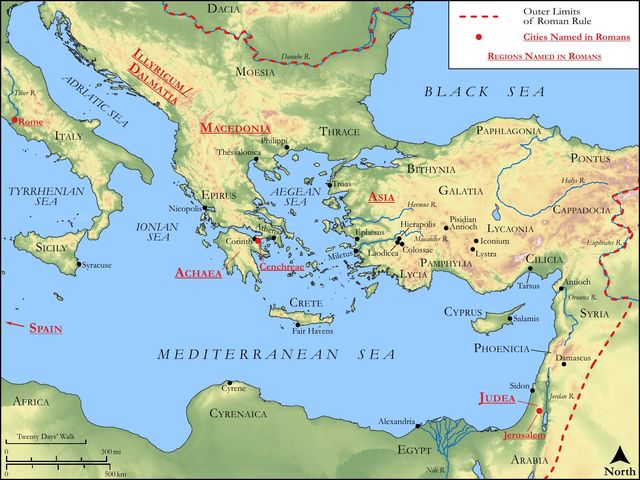
See on the biblical-era map

Study this verse
Public-domain commentary
Matthew Henry
From his Commentary on the Whole Bible. Henry comments on passages, not single verses — this entry covers Romans 8:10–16. His four-level outline is real structure in the source text, so it is rendered as structure.
In these verses the apostle represents two more excellent benefits, which belong to true believers.
I.Life.
The happiness is not barely a negative happiness, not to be condemned; but it is positive, it is an advancement to a life that will be the unspeakable happiness of the man (Rom 8:10, Rom 8:11): If Christ be in you. Observe, If the Spirit be in us, Christ is in us. He dwells in the heart by faith, Eph 3:17. Now we are here told what becomes of the bodies and souls of those in whom Christ is.
1.We cannot say but that the body is dead; it is a frail, mortal, dying body, and it will be dead shortly; it is a house of clay, whose foundation is in the dust. The life purchased and promised does not immortalize the body in its present state. It is dead, that is, it is appointed to die, it is under a sentence of death: as we say one that is condemned is a dead man. In the midst of life we are in death: be our bodies ever so strong, and healthful, and handsome, they are as good as dead (Heb 11:12), and this because of sin. It is sin that kills the body. This effect the first threatening has (Gen 3:19): Dust thou art. Methinks, were there no other argument, love to our bodies should make us hate sin, because it is such an enemy to our bodies. The death even of the bodies of the saints is a remaining token of God's displeasure against sin.
2.But the spirit, the precious soul, that is life; it is now spiritually alive, nay, it is life. Grace in the soul is its new nature; the life of the saint lies in the soul, while the life of the sinner goes no further than the body. When the body dies, and returns to the dust, the spirit if life; not only living and immortal, but swallowed up of life. Death to the saints is but the freeing of the heaven-born spirit from the clog and load of this body, that it may be fit to partake of eternal life. When Abraham was dead, yet God was the God of Abraham, for even then his spirit was life, Mat 22:31, Mat 22:32. See Psa 49:15. And this because of righteousness. The righteousness of Christ imputed to them secures the soul, the better part, from death; the righteousness of Christ inherent in them, the renewed image of God upon the soul, preserves it, and, by God's ordination, at death elevates it, and improves it, and makes it meet to partake of the inheritance of the saints in light. The eternal life of the soul consists in the vision and fruition of God, and both assimilating, for which the soul is qualified by the righteousness of sanctification. I refer to Psa 17:15, I will behold thy face in righteousness.
3.There is a life reserved too for the poor body at last: He shall also quicken your mortal bodies, Rom 8:11. The Lord is for the body; and though at death it is cast aside as a despised broken vessel, a vessel in which is no pleasure, yet God will have a desire to the work of his hands (Job 14:15), will remember his covenant with the dust, and will not lose a grain of it; but the body shall be reunited to the soul, and clothed with a glory agreeable to it. Vile bodies shall be newly fashioned, Phi 3:21; Co1 15:42. Two great assurances of the resurrection of the body are mentioned: - (1.) The resurrection of Christ: He that raised up Christ from the dead shall also quicken. Christ rose as the head, and first-fruits, and forerunner of all the saints, Co1 15:20. The body of Christ lay in the grave, under the sin of all the elect imputed, and broke through it. O grave, then, where is thy victory? It is in the virtue of Christ's resurrection that we shall rise. (2.) The indwelling of the Spirit. The same Spirit that raiseth the soul now will raise the body shortly: By his Spirit that dwelleth in you. The bodies of the saints are the temples of the Holy Ghost, Co1 3:16; Co1 6:19. Now, though these temples may be suffered for awhile to lie in ruins, yet they shall be rebuilt. The tabernacle of David, which has fallen down, shall be repaired, whatever great mountains may be in the way. The Spirit, breathing upon dead and dry bones, will make them live, and the saints even in their flesh shall see God. Hence the apostle by the way infers how much it is our duty to walk not after the flesh, but after the Spirit, Rom 8:12, Rom 8:13. Let not our life be after the wills and motions of the flesh. Two motives he mentions here: - [1.] We are not debtors to the flesh, neither by relation, gratitude, nor any other bond or obligation. We owe no suit nor service to our carnal desires; we are indeed bound to clothe, and feed, and take care of the body, as a servant to the soul in the service of God, but no further. We are not debtors to it; the flesh never did us so much kindness as to oblige us to serve it. It is implied that we are debtors to Christ and to the Spirit: there we owe our all, all we have and all we can do, by a thousand bonds and obligations. Being delivered from so great a death by so great a ransom, we are deeply indebted to our deliverer. See Co1 6:19, Co1 6:20. [2.] Consider the consequences, what will be at the end of the way. Here are life and death, blessing and cursing, set before us. If you live after the flesh, you shall die; that is, die eternally. It is the pleasing, and serving, and gratifying, of the flesh, that are the ruin of souls; that is, the second death. Dying indeed is the soul's dying: the death of the saints is but a sleep. But, on the other hand, You shall live, live and be happy to eternity; that is the true life: If you through the Spirit mortify the deeds of the body, subdue and keep under all fleshly lusts and affections, deny yourselves in the pleasing and humouring of the body, and this through the Spirit; we cannot do it without the Spirit working it in us, and the Spirit will not do it without our doing our endeavour. So that in a word we are put upon this dilemma, either to displease the body or destroy the soul.
II.The Spirit of adoption is another privilege belonging to those that are in Christ Jesus, Rom 8:14-16.
1.All that are Christ's are taken into the relation of Children to God, Rom 8:14. Observe,
(1.)Their property: They are led by the Spirit of God, as a scholar in his learning is led by his tutor, as a traveller in his journey is led by his guide, as a soldier in his engagements is led by his captain; not driven as beasts, but led as rational creatures, drawn with the cords of a man and the bands of love. It is the undoubted character of all true believers that they are led by the Spirit of God. Having submitted themselves in believing to his guidance, they do in their obedience follow that guidance, and are sweetly led into all truth and all duty.
(2.)Their privilege: They are the sons of God, received into the number of God's children by adoption, owned and loved by him as his children.
2.And those that are the sons of God have the Spirit,
(1.)To work in them the disposition of children.
[1.]You have not received the spirit of bondage again to fear, Rom 8:15. Understand it, First, Of that spirit of bondage which the Old Testament church was under, by reason of the darkness and terror of that dispensation. The veil signified bondage, Co2 3:15. Compare Rom 8:17. The Spirit of adoption was not then so plentifully poured out as now; for the law opened the wound, but little of the remedy. Now you are not under that dispensation, you have not received that spirit. Secondly, Of that spirit of bondage which many of the saints themselves were under at their conversion, under the convictions of sin and wrath set home by the Spirit; as those in Act 2:37, the jailer (Act 16:30), Paul, Act 9:6. Then the Spirit himself was to the saints a spirit of bondage: "But," says the apostle, "with you this is over." "God as a Judge," says Dr. Manton, "by the spirit of bondage, sends us to Christ as Mediator, and Christ as Mediator, by the spirit of adoption, sends us back again to God as a Father." Though a child of God may come under fear of bondage again, and may be questioning his sonship, yet the blessed Spirit is not again a spirit of bondage, for then he would witness an untruth.
[2.]But you have received the Spirit of adoption. Men may give a charter of adoption; but it is God's prerogative, when he adopts, to give a spirit of adoption - the nature of children. The Spirit of adoption works in the children of God a filial love to God as a Father, a delight in him, and a dependence upon him, as a Father. A sanctified soul bears the image of God, as the child bears the image of the father. Whereby we cry, Abba, Father. Praying is here called crying, which is not only an earnest, but a natural expression of desire; children that cannot speak vent their desires by crying. Now, the Spirit teaches us in prayer to come to God as a Father, with a holy humble confidence, emboldening the soul in that duty. Abba, Father. Abba is a Syriac word signifying father or my father; patēr, a Greek work; and why both, Abba, Father? Because Christ said so in prayer (Mar 14:36), Abba, Father: and we have received the Spirit of the Son. It denotes an affectionate endearing importunity, and a believing stress laid upon the relation. Little children, begging of their parents, can say little but Father, Father, and that is rhetoric enough. It also denotes that the adoption is common both to Jews and Gentiles: the Jews call him Abba in their language, the Greeks may call him patēr in their language; for in Christ Jesus there is neither Greek nor Jew.
(2.)To witness to the relation of children, Rom 8:16. The former is the work of the Spirit as a Sanctifier; this as a Comforter. Beareth witness with our spirit. Many a man has the witness of his own spirit to the goodness of his state who has not the concurring testimony of the Spirit. Many speak peace to themselves to whom the God of heaven does not speak peace. But those that are sanctified have God's Spirit witnessing with their spirits, which is to be understood not of any immediate extraordinary revelation, but an ordinary work of the Spirit, in and by the means of comfort, speaking peace to the soul. This testimony is always agreeable to the written word, and is therefore always grounded upon sanctification; for the Spirit in the heart cannot contradict the Spirit in the word. The Spirit witnesses to none the privileges of children who have not the nature and disposition of children.
Historical interpretation
Four Centuries of Reception
17 surviving comments on this verse. Each one is dated, so this reads as a timeline rather than a list.
Select a marker to jump to its quote. Markers stagger vertically where authors wrote within a few decades of each other.
"Wherefore, girding up your loins," "serve the Lord in fear" and truth, as those who have forsaken the vain, empty talk and error of the multitude, and "believed in Him who raised up our Lord Jesus Christ from the dead, and gave Him glory," and a throne at His right hand. To Him all things in heaven and on earth are subject. Him every spirit serves. He comes as the Judge of the living and the dead. His blood will God require of those who do not believe in Him. But He who raised Him up from the dead will raise up us also, if we do His will, and walk in His commandments, and love what He loved, keeping ourselves from all unrighteousness, covetousness, love of money, evil speaking, false witness; "not rendering evil for evil, or railing for railing," or blow for blow, or cursing for cursing, but being mindful of what the Lord said in His teaching: "Judge not, that ye be not judged; forgive, and it shall be forgiven unto you; be merciful, that ye may obtain mercy; with what measure ye mete, it shall be measured to you again;" and once more, "Blessed are the poor, and those that are persecuted for righteousness' sake, for theirs is the kingdom of God."
For, as himself foreseeing, through the Spirit, the subdivisions of evil teachers .
And again to the Romans he says, "But if the Spirit of Him that raised up Jesus from the dead dwell in you, He that raised up Christ from the dead shall also quicken your mortal bodies."
The resurrection of the dead implies the resurrection of their bodies.
And once for all, that we may not wander through every passage, He "who raised up Christ from the dead, and is also to raise up our mortal bodies," must certainly be, as the quickener, different from the dead Father, or even from the quickened Father, if Christ who died is the Father.
But why am I resorting to knotty arguments, when the apostle treats the subject with perfect plainness? "For if," says he, "the Spirit of Him that raised up Jesus from the dead dwell in you, He that raised up Jesus from the dead shall also quicken your mortal bodies, because of His Spirit that dwelleth in you; " so that even if a person were to assume that the soul is "the mortal body," he would (since he cannot possibly deny that the flesh is this also) be constrained to acknowledge a restoration even of the flesh, in consequence of its participation in the selfsame state.
He accordingly subjoins: "He that raised up Christ from the dead, shall also quicken your mortal bodies." In these words he both affirmed the resurrection of the flesh (without which nothing can rightly be called body, nor can anything be properly regarded as mortal), and proved the bodily substance of Christ; inasmuch as our own mortal bodies will be quickened in precisely the same way as He was raised; and that was in no other way than in the body.
In these words he both affirmed the resurrection of the flesh (without which nothing can rightly be called body, nor can anything be properly regarded as mortal), and proved the bodily substance of Christ; inasmuch as our own mortal bodies will be quickened in precisely the same way as He was raised; and that was in no other way than in the body. I have here a very wide gulf of expunged Scripture to leap across; however, I alight on the place where the apostle bears record of Israel "that they have a zeal of God"-their own God, of course-"but not according to knowledge.
Concerning this (Logos) they have a great question amongst them-an occasion both of divisions and dissension. And hence the doctrine of these has become divided: and one doctrine, according to them, is termed Oriental, and the other Italian. They from Italy, of whom is Heracleon and Ptolemaeus, say that the body of Jesus was (an) animal (one). And on account of this, (they maintain) that at his baptism the Holy Spirit as a dove came down-that is, the Logos of the mother above, (I mean Sophia)-and became (a voice) to the animal (man), and raised him from the dead. This, he says, is what has been declared: "He who raised Christ from the dead will also quicken your mortal and natural bodies." For loam has come under a curse; "for," says he, "dust thou art, and unto dust shalt thou return." The Orientals, on the other hand, of whom is Axionicus and Bardesianes, assert that the body of the Saviour was spiritual; for there came upon Mary the Holy Spirit-that is, Sophia and the power of the highest. This is the creative art, (and was vouchsafed) in order that what was given to Mary by the Spirit might be fashioned.
Let us look next at the apostle's word: "Whose are the fathers, of whom as concerning the flesh Christ came, who is over all, God blessed for ever." This word declares the mystery of the truth rightly and clearly. He who is over all is God; for thus He speaks boldly, "All things are delivered unto me of my Father." He who is over all, God blessed, has been born; and having been made man, He is (yet) God for ever. For to this effect John also has said, "Which is, and which was, and which is to come, the Almighty." And well has he named Christ the Almighty. For in this he has said only what Christ testifies of Himself. For Christ gave this testimony, and said, "All things are delivered unto me of my Father; " and Christ rules all things, and has been appointed Almighty by the Father. And in like manner Paul also, in setting forth the truth that all things are delivered unto Him, said, "Christ the first-fruits; afterwards they that are Christ's at His coming. Then cometh the end, when He shall have delivered up the kingdom to God, even the Father; when He shall have put down all rule, and all authority, and power. For He must reign, till He hath put all enemies under His feet. The last enemy that shall be destroyed is death. For all things are put under Him. But when He saith, All things are put under Him, it is manifest that He is excepted which did put all things under Him. Then shall He also Himself be subject to Him who put all things under Him, that God may be all in all." If, therefore, all things are put under Him with the exception of Him who put them under Him, He is Lord of all, and the Father is Lord of Him, that in all there might be manifested one God, to whom all things are made subject together with Christ, to whom the Father hath made all things subject, with the exception of Himself. And this, indeed, is said by Christ Himself, as when in the Gospel He confessed Him to be His Father and His God. For He speaks thus: "I go to my Father and your Father, and to my God and your God." If then, Noetus ventures to say that He is the Father Himself, to what father will he say Christ goes away according to the word of the Gospel? But if he will have us abandon the Gospel and give credence to his senselessness, he expends his labour in vain; for "we ought to obey God rather than men."
If the Spirit of Christ dwells in you, it seems essential that his dwelling place (i.e., your body) will be given back to him and his temple restored.This is how you can know whether you have the Spirit of Christ or not. Christ is wisdom, so if you are wise according to Christ and know what is his, then by this wisdom you have the Spirit of Christ. Likewise, Christ is righteousness; therefore, if you have the righteousness of Christ, by that righteousness you have the Spirit of Christ. Christ is peace; if you have Christ’s peace in you, then through the Spirit of peace you have the Spirit of Christ. So it goes with love, with sanctification and with all that belongs to Christ. The one who has these things may be confident of having the Spirit of Christ in him and can hope that his mortal body will be restored to life on account of the Spirit of Christ dwelling in him.
Paul repeats here what he has just said. Once again, the word body stands for the whole person.
Having already mentioned the Spirit of Christ, Paul refers to him once more, calling him “the Spirit of him who raised Jesus from the dead.” By saying that the Spirit of Christ is also the Spirit of the Father, Paul teaches clearly that the Spirit of the Son partakes of the Father’s divinity and that their power is one, because they share the same essence as the Father.
Again, he touches the point of the Resurrection, since this was the most encouraging hope to the hearer, and gave him a security from what had happened unto Christ. Now be not thou afraid because thou art compassed about with a dead body. Let it have the Spirit, and it shall assuredly rise again. What then, shall the bodies which have not the Spirit not rise? How then must "all stand before the judgment-seat of Christ?" or how will the account of hell be trustworthy? For if they that have not the Spirit rise not, there will not be a hell at all. What then is it which is said? All shall rise, yet not all to life, but some to punishment and some to life. This is why he did not say, shall raise up, but shall quicken. And this is a greater thing than resurrection, and is given to the just only. And the cause of this honor he adds in the words, "By His Spirit that dwelleth in you." And so if while here thou drive away the grace of the Spirit, and do not depart with it still safe, thou wilt assuredly perish, though thou dost rise again. For as He will not endure then, if he see His Spirit shining in thee, to give thee up to punishment, so neither will He allow them, if He see It quenched, to bring thee into the Bride-chamber, even as He admitted not those virgins. Suffer not thy body then to live in this world, that it may live then! Make it die, that it die not. For if it keep living, it will not live: but if it die, then shall it live. And this is the case with resurrection in general. For it must die first and be buried, and then become immortal. But this has been done in the Font. It has therefore had first its crucifixion and burial, and then been raised. This has also happened with the Lord's Body. For that also was crucified and buried and rose again. This then let us too be doing: let us keep continually mortifying it in its works. I do not mean in its substance-far be it from me-but in its inclinations towards evil doings. For this is a life too, or rather this only is life, undergoing nothing that is common to man, nor being a slave to pleasures.
God will not allow the temple of his Spirit to perish. In the same way as he raised Jesus from the dead he will also restore your body.
This is a very explicit witness to the resurrection of the body, and it is sufficiently clear that as long as we are in this life there will be no lack of both the annoyances occasioned by the mortal flesh and some excitations arising from carnal pleasures. For although he who is established under grace serves the law of God with his mind and does not yield, nevertheless, with the flesh he continues to serve the law of sin.
Paul now explains the fourth of the four states which we mentioned above. But this state is not attained in this life. It belongs to the hope by which we await the redemption of our body, when this corruptible matter will put on incorruption and immortality. Then there will be perfect peace, because the soul will no longer be troubled by the body, which will be revived and transformed into a heavenly substance.
And again he says: "But if the Spirit of Him that raised up Jesus from the dead dwell in you, He that raised up Christ from the dead shall also quicken your mortal bodies by His Spirit that dwelleth in you."
Continue studying Romans 8:11 across the web’s major study libraries — every link below opens this exact verse, chapter, or book on the destination site.
Read & Compare
 BibleGatewayThis verse in more than 200 translations and 70 languages.
 Bible.comThe YouVersion reader — hundreds of translations, reading plans, and highlights.
 ESV.orgCrossway's official English Standard Version reader.
 NET BibleThe NET translation with 60,000+ translators' notes on every rendering decision.
 STEP BibleTyndale House's free study tool — original text, vocabulary, and scholarly resources.
 BibliaLogos Bible Software's free web reader.
 USCCBThe New American Bible (Revised Edition) with the U.S. bishops' study notes.
Commentaries
 BibleHub CommentariesDozens of classic commentaries on this verse, gathered on one page.
 StudyLightMore than 100 commentary sets — the largest collection on the web.
 BibleRefPlain-English commentary on what this verse means, verse by verse.
 Enduring WordDavid Guzik's free commentary on this chapter, widely used by Bible teachers.
 Bible Study ToolsVerse commentary alongside Greek and Hebrew study aids.
Original Language & Research
- BibleHub InterlinearThe verse word by word — original language, transliteration, and English.
- BibleHub LexiconEvery word's original-language definition and Strong's entry.
 Blue Letter BibleDeep-study tools — Strong's numbers, concordance, and word studies.
 CNTR CollationThe earliest Greek manuscripts of this verse, collated letter by letter.
Sermons, Hymns & Audio


TrulyRandomVerse is not affiliated with these sites and doesn’t control their content. They’re linked because they’re genuinely useful.
Summary
Romans 8:11 is a profound declaration of the Holy Spirit's indwelling power, asserting that the same divine force that resurrected Jesus from the dead is actively at work within believers, guaranteeing the future quickening and glorification of their mortal bodies. This verse anchors the Christian hope in bodily resurrection, emphasizing the Spirit's role as the life-giving agent who will transform perishable flesh into imperishable glory, thereby completing God's redemptive work in humanity.
Context
ShowHideLiterary Context
Romans 8:11 stands as a climactic statement within Romans chapter 8, often celebrated as the "Spirit chapter" due to its extensive focus on the person and work of the Holy Spirit. Paul meticulously contrasts life "in the flesh," characterized by sin and death, with life "in the Spirit," marked by righteousness and life. Having established that there is "no condemnation for those who are in Christ Jesus" (Romans 8:1), and that believers are now "controlled not by the flesh but by the Spirit" (Romans 8:9), Paul progressively builds his argument towards the ultimate triumph of the Spirit. Verse 11 serves as a powerful capstone, extending the Spirit's life-giving work from spiritual regeneration to future bodily resurrection, thereby completing the believer's redemption and securing their eternal hope. It directly follows the assertion that "if anyone does not have the Spirit of Christ, he does not belong to Christ" (Romans 8:9), linking the Spirit's indwelling to the very essence of Christian identity and destiny.
Historical & Cultural Context
Paul's letter to the Romans was written to a diverse community of believers in the capital of the Roman Empire, a city steeped in paganism, emperor worship, and a strong emphasis on physical prowess and earthly power. Within this context, the concept of resurrection, particularly bodily resurrection, was a point of significant contention and often ridicule, especially among philosophical schools like the Epicureans and Stoics, who viewed the body as a prison or something to be transcended, not resurrected. Jews, however, generally held to a belief in bodily resurrection, though its precise nature and timing were debated. Paul, a former Pharisee, would have been familiar with this Jewish hope. His assertion in Romans 8:11 therefore speaks powerfully against the prevailing Greco-Roman skepticism about the body, affirming a distinctly Christian hope that encompasses both spirit and body. It also provides comfort and assurance to a community facing potential persecution, reminding them that their ultimate future is secure in God's hands, extending even beyond physical death.
Key Themes
ShowHideThis verse encapsulates several major theological themes prevalent in Romans and throughout Paul's epistles. Firstly, the Indwelling of the Holy Spirit is paramount; the Spirit is not merely an external force but an internal, transformative presence, signifying God's intimate relationship with believers and serving as the "down payment" or "guarantee" of future glory (Ephesians 1:13-14). Secondly, the theme of Resurrection Power is central, highlighting that the same divine power that conquered death in Christ is now at work within believers, demonstrating God's absolute sovereignty over life and death. This power is not just for spiritual quickening but for the ultimate physical transformation. Thirdly, Future Glorification and Bodily Redemption is a key eschatological theme. Paul consistently teaches that salvation is holistic, encompassing not only the spirit but also the body. The "mortal bodies" will be "quickened," pointing to the future resurrection and transformation into a glorious, imperishable body, mirroring Christ's resurrected body, as further elaborated in 1 Corinthians 15 and Philippians 3:21. This hope provides profound assurance and shapes the believer's perspective on suffering and mortality.
Exposition and Analysis
ShowHideKey Word Analysis
ShowHideMeaning "a current of air, i.e. breath (blast) or a breeze; by analogy or figuratively, a spirit, i.e. (human) the rational soul, (by implication) vital principle, mental disposition, etc., or (superhuman) an angel, demon, or (divine) God, Christ's spirit, the Holy Spirit." In this context, it refers unequivocally to the Holy Spirit, the third person of the Trinity, who is the divine agent of life, power, and sanctification dwelling within believers.
Meaning "to waken (transitively or intransitively), i.e. rouse (literally, from sleep, from sitting or lying, from disease, from death; or figuratively, from obscurity, inactivity, ruins, nonexistence):--awake, lift (up), raise (again, up), rear up, (a-)rise (again, up), stand, take up." This word is crucial as it directly refers to the act of resurrection, specifically God's powerful act of bringing Jesus back from the dead, and by extension, the future resurrection of believers.
Meaning "to (re-)vitalize (literally or figuratively):--make alive, give life, quicken." This term denotes the act of imparting life, making something alive that was dead or inert. When applied to "mortal bodies," it signifies the divine act of infusing them with new, immortal life, overcoming decay and death.
Meaning "to inhabit (figuratively):--dwell in." This word emphasizes the permanent and intimate presence of the Holy Spirit within the believer, not merely a temporary visit. It signifies a profound union and continuous indwelling that is the basis for the Spirit's life-giving work.
Verse Breakdown
ShowHide"But if the Spirit of him that raised up Jesus from the dead dwell in you,"
This opening clause establishes the condition and the divine agent. The "Spirit of him that raised up Jesus from the dead" unequivocally refers to the Holy Spirit, who is intrinsically linked to the Father's (and Son's) power over death. The phrase "dwell in you" highlights the profound and personal indwelling of the Holy Spirit within every believer, a foundational truth for Christian life and hope. This indwelling is not optional but a defining characteristic of those who belong to Christ.
"he that raised up Christ from the dead"
This phrase reiterates the identity of the divine agent, God the Father, and his singular, unparalleled act of power—the resurrection of Jesus Christ. The repetition of "raised up... from the dead" underscores the absolute authority and power of God over death, setting the stage for the glorious promise that follows. The use of "Jesus" and "Christ" interchangeably within the verse emphasizes the unified person and work of the Son.
"shall also quicken your mortal bodies"
This is the core promise. The same divine power that raised Jesus will "quicken" (make alive, vitalize) the "mortal bodies" of believers. "Mortal bodies" refers to our current, perishable, death-bound physical forms. The "quickening" points to a future resurrection and transformation, where these perishable bodies will be made imperishable and glorious, no longer subject to decay or death. This is the ultimate hope for the physical dimension of human existence.
"by his Spirit that dwelleth in you."
This concluding phrase reaffirms the means by which this future quickening will occur: through the Holy Spirit who already indwells believers. It emphasizes the continuity of the Spirit's work, from initial regeneration to final glorification, and reinforces that the power for future resurrection is already present within the believer through the Spirit's abiding presence. The Spirit is the guarantee and the agent of this ultimate transformation.
Literary Devices
ShowHideRomans 8:11 employs several powerful literary devices to convey its profound theological message. Parallelism is evident in the two nearly identical phrases: "the Spirit of him that raised up Jesus from the dead" and "he that raised up Christ from the dead." This synonymous parallelism serves to reinforce the identity of God as the ultimate resurrecting power, while also emphasizing the unified work of the Trinity (Father and Spirit) in the resurrection of the Son. The Repetition of "Spirit... dwell in you" at the beginning and end of the verse creates an inclusio, powerfully framing the promise of bodily quickening within the context of the Spirit's continuous indwelling. This repetition underscores the Spirit's active and ongoing presence as the source and guarantee of future life. Furthermore, Metonymy is present where "Spirit" stands for the divine power and presence of God, and "mortal bodies" represents the entire physical, perishable human existence. The verse also uses Antithesis implicitly by contrasting the "mortal" (subject to death) nature of our current bodies with the "quickening" (made alive, immortal) power of the Spirit, highlighting the transformative victory over death that is promised to believers.
Theological and Thematic Connections
ShowHideRomans 8:11 is a cornerstone text for understanding the Christian hope in bodily resurrection and the comprehensive nature of salvation. It teaches that the Holy Spirit's indwelling is not merely for spiritual vitality in this life but is the divine down payment and power for the ultimate redemption of our physical bodies. This holistic view of salvation underscores God's commitment to restoring the whole human person—spirit, soul, and body—to His original design. The resurrection of Jesus serves as the irrefutable proof and the firstfruits of this future reality for all who believe, demonstrating God's absolute victory over sin and death. The Spirit's presence within us is the living assurance that we will share in Christ's resurrection glory.
Reflection and Application
ShowHideRomans 8:11 offers profound comfort, hope, and empowerment for the believer's daily life. It reminds us that our hope is not merely for a disembodied spiritual existence after death, but for a complete and glorious redemption that includes our physical bodies. This truth transforms our perspective on suffering, illness, and mortality, assuring us that physical death is not the final word for those in Christ. Knowing that the same omnipotent power that raised Jesus from the dead dwells within us means we are not left to our own strength in the face of life's challenges or the struggle against sin. The indwelling Spirit empowers us to live a life that honors God, bringing vitality not only to our spiritual walk but also, in a profound sense, preparing our mortal bodies for their ultimate transformation. This verse calls us to live with an eternal perspective, anticipating the glorious day when our bodies will be made immortal and incorruptible, fully reflecting the image of our resurrected Lord.
Questions for Reflection
ShowHideFAQ
ShowHideDoes "quicken your mortal bodies" refer to present spiritual vitality or future physical resurrection?
ShowHideWhile the Holy Spirit certainly brings spiritual vitality and new life to believers in the present (e.g., Romans 6:4), the primary and ultimate meaning of "quicken your mortal bodies" in Romans 8:11 refers to the future physical resurrection and glorification of the believer's body. The context of Romans 8, moving from justification to sanctification and then to glorification, points to the culmination of God's redemptive work. The phrase "mortal bodies" specifically denotes our perishable physical forms, and "quicken" means to make alive, implying a transformation from death to life. This aligns with Paul's broader teaching on the resurrection of the dead in 1 Corinthians 15, where he describes the perishable body being raised imperishable. The Spirit's indwelling is the guarantee and the power for this future physical transformation.
Christ-Centered Fulfillment
ShowHideRomans 8:11 finds its ultimate Christ-centered fulfillment in the person and work of Jesus Christ, who is Himself the "resurrection and the life" (John 11:25). The verse explicitly states that the Spirit is "of him that raised up Jesus from the dead," directly linking the power at work in believers to God's triumphant act in Christ's resurrection. Jesus's resurrection is not merely a historical event but the foundational promise and pattern for our own future. He is the "firstfruits" of those who will be raised (1 Corinthians 15:20), demonstrating that death has been conquered and that a transformed, glorious body awaits believers. The Spirit, who indwells us, is the Spirit of Christ (Romans 8:9), and it is through Him that we are united to Christ in His death and resurrection. Therefore, when Christ, who is our life, appears, we "will also appear with him in glory" (Colossians 3:4), our mortal bodies quickened and conformed to His glorious body (Philippians 3:21). Thus, Romans 8:11 is a powerful declaration that our future bodily redemption is utterly dependent on and guaranteed by the finished work and ongoing life of Jesus Christ, applied to us by His indwelling Spirit.