


Romans 8:9
Bible text: King James Version (1769 Blayney text) · Public domain
Bible text: King James Version with Strong's numbers · Public domain
Bible text: Berean Standard Bible · Public domain
Bible text: American Standard Version (1901) · Public domain
Bible text: World English Bible, Messianic edition · Public domain
Bible text: Geneva Bible (1599) · Public domain
Bible text: Young's Literal Translation · Public domain
- ὑμεῖςhumeisYou yourselvesG4771P-2NPPersonal pronoun Nominative 2nd Plural
- δὲdenowG1161CONJConjunction
- οὐκouknotG3756PRT-NNegative Particle Negative
- ἐστὲesteareG1510V-PAI-2PVerb Present Active Indicative 2nd Plural
- ἐνeninG1722PREPPreposition
- σαρκὶsarkifleshG4561N-DSFNoun Dative Singular Feminine
- ἀλλ᾽all᾽butG235CONJConjunction
- ἐνeninG1722PREPPreposition
- πνεύματιpneumatiSpiritG4151N-DSNNoun Dative Singular Neuter
- εἴπερeiperif indeedG4007COND + G4007=CONJ
- πνεῦμαpneumaSpiritG4151N-NSNNoun Nominative Singular Neuter
- θεοῦtheouof GodG2316N-GSM-TNoun Genitive Singular Masculine Title
- οἰκεῖoikeidwellsG3611V-PAI-3SVerb Present Active Indicative 3rd Singular
- ἐνeninG1722PREPPreposition
- ὑμῖνhuminyouG4771P-2DPPersonal pronoun Dative 2nd Plural
- εἰeiifG1487CONDConjunction
- δέdehoweverG1161CONJConjunction
- τιςtisanyoneG5100X-NSMIndefinite pronoun Nominative Singular Masculine
- πνεῦμαpneuma[the] SpiritG4151N-ASNNoun Accusative Singular Neuter
- ΧριστοῦChristouof ChristG5547N-GSM-TNoun Genitive Singular Masculine Title
- οὐκouknotG3756PRT-NNegative Particle Negative
- ἔχειecheihasG2192V-PAI-3SVerb Present Active Indicative 3rd Singular
- οὗτοςhoutosheG3778D-NSMDemonstrative pronoun Nominative Singular Masculine
- οὐκouknotG3756PRT-NNegative Particle Negative
- ἔστινestinisG1510V-PAI-3SVerb Present Active Indicative 3rd Singular
- αὐτοῦautouof HimG846P-GSMPersonal pronoun Genitive Singular Masculine
English is a literal word-by-word gloss of the Greek, not the KJV's wording. Why?
This is the original text the KJV's translators worked from — each Greek word with its own literal English meaning in this verse, prepared by scholars at Tyndale House, Cambridge. The KJV translates whole sentences, not word by word, so its wording differs: one Greek word can become several English words, and the KJV may choose “charity” where the gloss reads “love”. Both are faithful — they answer different questions. For the KJV's own rendering, switch to the KJV text.
Details
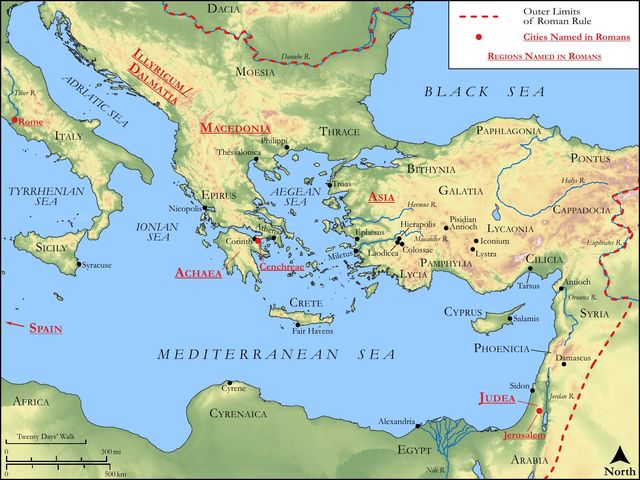
See on the biblical-era maps

Study this verse
Public-domain commentary
Matthew Henry
From his Commentary on the Whole Bible. Henry comments on passages, not single verses — this entry covers Romans 8:1–9. His four-level outline is real structure in the source text, so it is rendered as structure.
I.The apostle here beings with one signal privilege of true Christians, and describes the character of those to whom it belongs:
There is therefore now no condemnation to those that are in Christ Jesus, Rom 8:1. This is his triumph after that melancholy complaint and conflict in the foregoing chapter - sin remaining, disturbing, vexing, but, blessed be God, not ruining. The complaint he takes to himself, but humbly transfers the comfort with himself to all true believers, who are all interested in it.
1.It is the unspeakable privilege and comfort of all those that are in Christ Jesus that there is therefore now no condemnation to them. He does not say, "There is no accusation against them," for this there is; but the accusation is thrown out, and the indictment quashed. He does not say, "There is nothing in them that deserves condemnation," for this there is, and they see it, and own it, and mourn over it, and condemn themselves for it; but it shall not be their ruin. He does not say, "There is no cross, no affliction to them or no displeasure in the affliction," for this there may be; but no condemnation. They may be chastened of the Lord, but not condemned with the world. Now this arises from their being in Christ Jesus; by virtue of their union with him through faith they are thus secured. They are in Christ Jesus, as in their city of refuge, and so are protected from the avenger of blood. He is their advocate, and brings them off. There is therefore no condemnation, because they are interested in the satisfaction that Christ by dying made to the law. In Christ, God does not only not condemn them, but is well pleased with them, Mat 17:5.
2.It is the undoubted character of all those who are so in Christ Jesus as to be freed from condemnation that they walk not after the flesh but after the Spirit. Observe, The character is given from their walk, not from any one particular act, but from their course and way. And the great question is, What is the principle of the walk, the flesh or the spirit, the old or the new nature, corruption or grace? Which of these do we mind, for which of these doe we make provision, by which of these are we governed, which of these do we take part with?
II.This great truth, thus laid down, he illustrates in the following verses; and shows how we come by this great privilege, and how we may answer this character.
1.How we come by these privileges - the privilege of justification, that there is no condemnation to us - the privilege of sanctification, that we walk after the Spirit, and not after the flesh, which is no less our privilege than it is our duty. How comes it about?
(1.)The law could not do it, Rom 8:3. It could neither justify nor sanctify, neither free us from the guilt nor from the power of sin, having not the promises either of pardon or grace. The law made nothing perfect: It was weak. Some attempt the law made towards these blessed ends, but, alas! it was weak, it could not accomplish them: yet that weakness was not through any defect in the law, but through the flesh, through the corruption of human nature, by which we became incapable either of being justified or sanctified by the law. We had become unable to keep the law, and, in case of failure, the law, as a covenant of works, made no provision, and so left us as it found us. Or understand it of the ceremonial law; that was a plaster not wide enough for the wound, it could never take away sin, Heb 10:4.
(2.)The law of the Spirit of life in Christ Jesus does it, Rom 8:2. The covenant of grace made with us in Christ is a treasury of merit and grace, and thence we receive pardon and a new nature, are freed from the law of sin and death, that is, both from the guilt and power of sin - from the course of the law, and the dominion of the flesh. We are under another covenant, another master, another husband, under the law of the Spirit, the law that gives the Spirit, spiritual life to qualify us for eternal. The foundation of this freedom is laid in Christ's undertaking for us, of which he speaks Rom 8:3, God sending his own Son. Observe, When the law failed, God provided another method. Christ comes to do that which the law could not do. Moses brought the children of Israel to the borders of Canaan, and then died, and left them there; but Joshua did that which Moses could not do, and put them in possession of Canaan. Thus what the law could not do Christ did. The best exposition of this verse we have Heb 10:1-10. To make the sense of the words clear, which in our translation is a little intricate, we may read it thus, with a little transposition: - God sending his own Son in the likeness of sinful flesh, and a sacrifice for sin, condemned sin in the flesh, which the law could not do, in that it was weak through the flesh, etc., Rom 8:4. Observe,
[1.]How Christ appeared: In the likeness of sinful flesh. Not sinful, for he was holy, harmless, undefiled; but in the likeness of that flesh which was sinful. He took upon him that nature which was corrupt, though perfectly abstracted from the corruptions of it. His being circumcised, redeemed, baptized with John's baptism, bespeaks the likeness of sinful flesh. The bitings of the fiery serpents were cured by a serpent of brass, which had the shape, through free from the venom, of the serpents that bit them. It was great condescension that he who was God should be made in the likeness of flesh; but much greater that he who was holy should be made in the likeness of sinful flesh. And for sin, - here the best Greek copies place the comma. God sent him, en homoiōmati sarkos hamartias, kai peri hamartias - in the likeness of sinful flesh, and as a sacrifice for sin. The Septuagint call a sacrifice for sin no more than peri hamartias - for sin; so Christ was a sacrifice; he was sent to be so, Heb 9:26.
[2.]What was done by this appearance of his: Sin was condemned, that is, God did therein more than ever manifest his hatred of sin; and not only so, but for all that are Christ's both the damning and the domineering power of sin is broken and taken out of the way. He that is condemned can neither accuse nor rule; his testimony is null, and his authority null. Thus by Christ is sin condemned; though it live and remain, its life in the saints is still but like that of a condemned malefactor. it was by the condemning of sin that death was disarmed, and the devil, who had the power of death, destroyed. The condemning of sin saved the sinner from condemnation. Christ was made sin for us (Co2 5:21), and, being so made, when he was condemned sin was condemned in the flesh of Christ, condemned in the human nature: So was sanctification made to divine justice, and way made for the salvation of the sinner.
[3.]The happy effect of this upon us (Rom 8:4): That the righteousness of the law might be fulfilled in us. Both in our justification and in our sanctification, the righteousness of the law if fulfilled. A righteousness of satisfaction for the breach of the law is fulfilled by the imputation of Christ's complete and perfect righteousness, which answers the utmost demands of the law, as the mercy-seat was as long and as broad as the ark. A righteousness of obedience to the commands of the law is fulfilled in us, when by the Spirit the law of love is written upon the heart, and that love is the fulfilling of the law, Rom 13:10. Though the righteousness of the law is not fulfilled by us, yet, blessed be God, it is fulfilled in us; there is that to be found upon and in all true believers which answers the intention of the law. Us who walk not after the flesh, but after the Spirit. This is the description of all those that are interested in this privilege - they act from spiritual and not from carnal principles; as for others, the righteousness of the law will be fulfilled upon them in their ruin. Now,
2.Observe how we may answer to this character, Rom 8:5, etc.
(1.)By looking to our minds. How may we know whether we are after the flesh or after the Spirit? By examining what we mind, the things of the flesh or the things of the spirit. Carnal pleasure, worldly profit and honour, the things of sense and time, are the things of the flesh, which unregenerate people mind. The favour of God, the welfare of the soul, the concerns of eternity, are the things of the Spirit, which those that are after the Spirit do mind. The man is as the mind is. The mind is the forge of thoughts. As he thinketh in his heart, so is he, Pro 23:7. Which way do the thoughts move with most pleasure? On what do they dwell with most satisfaction? The mind is the seat of wisdom. Which way go the projects and contrivances? whether are we more wise for the world or for our souls? phronousi ta tēs sarkos - they savour the things of the flesh; so the word is rendered, Mat 16:23. It is a great matter what our savour is, what truths, what tidings, what comforts, we do most relish, and are most agreeable to us. Now, to caution us against this carnal-mindedness, he shows the great misery and malignity of it, and compares it with the unspeakable excellency and comfort of spiritual-mindedness.
[1.]It is death, Rom 8:6. It is spiritual death, the certain way to eternal death. It is the death of the soul; for it is its alienation from God, in union and communion with whom the life of the soul consists. A carnal soul is a dead soul, dead as a soul can die. She that liveth in pleasure is dead (Ti1 5:6), not only dead in law as guilty, but dead in state as carnal. Death includes all misery; carnal souls are miserable souls. But to be spiritually minded, phronēma tou pneumatos - a spiritual savour (the wisdom that is from above, a principle of grace) is life and peace; it is the felicity and happiness of the soul. The life of the soul consists in its union with spiritual things by the mind. A sanctified soul is a living soul, and that life is peace; it is a very comfortable life. All the paths of spiritual wisdom are paths of peace. It is life and peace in the other world, as well as in this. Spiritual-mindedness is eternal life and peace begun, and an assuring earnest of the perfection of it.
[2.]It is enmity to God (Rom 8:7), and this is worse than the former. The former speaks the carnal sinner a dead man, which is bad; but this speaks him a devil of a man. It is not only an enemy, but enmity itself. It is not only the alienation of the soul from God, but the opposition of the soul against God; it rebels against his authority, thwarts his design, opposes his interest, spits in his face, spurns at his bowels. Can there be a greater enmity? An enemy may be reconciled, but enmity cannot. How should this humble us for and warn us against, carnal-mindedness! Shall we harbour and indulge that which is enmity to God our creator, owner, ruler, and benefactor? To prove this, he urges that it is not subject to the law of God, neither indeed can be. The holiness of the law of God, and the unholiness of the carnal mind, are as irreconcilable as light and darkness. The carnal man may, by the power of divine grace, be made subject to the law of God, but the carnal mind never can; this must be broken and expelled. See how wretchedly the corrupt will of man is enslaved to sin; as far as the carnal mind prevails, there is no inclination to the law of God; therefore wherever there is a change wrought it is by the power of God's grace, not by the freedom of man's will. Hence he infers (Rom 8:8), Those that are in the flesh cannot please God. Those that are in a carnal unregenerate state, under the reigning power of sin, cannot do the things that please God, wanting grace, the pleasing principle, and an interest in Christ, the pleasing Mediator. The very sacrifice of the wicked is an abomination, Pro 15:8. Pleasing God is our highest end, of which those that are in the flesh cannot but fall short; they cannot please him, nay, they cannot but displease him. We may know our state and character,
(2.)By enquiring whether we have the Spirit of God and Christ, or not (Rom 8:9): You are not in the flesh, but in the Spirit. This expresses states and conditions of the soul vastly different. All the saints have flesh and spirit in them; but to be in the flesh and to be in the Spirit are contrary. It denotes our being overcome and subdued by one of these principles. As we say, A man is in love, or in drink, that is, overcome by it. Now the great question is whether we are in the flesh or in the Spirit; and how may we come to know it? Why, by enquiring whether the Spirit of God dwell in us. The Spirit dwelling in us is the best evidence of our being in the Spirit, for the indwelling is mutual (Jo1 4:16): Dwelleth in God, and God in him. The Spirit visits many that are unregenerate with his motions, which they resist and quench; but in all that are sanctified he dwells; there he resides and rules. He is there as a man at his own house, where he is constant and welcome, and has the dominion. Shall we put this question to our own hearts, Who dwells, who rules, who keeps house, here? Which interest has the ascendant? To this he subjoins a general rule of trial: If any man has not the Spirit of Christ, he is none of his. To be Christ's (that is, to be a Christian indeed, one of his children, his servants, his friends, in union with him) is a privilege and honour which many pretend to that have no part nor lot in the matter. None are his but those that have his Spirit; that is,
[1.]That are spirited as he was spirited-are meek, and lowly, and humble, and peaceable, and patient, and charitable, as he was. We cannot tread in his steps unless we have his spirit; the frame and disposition of our souls must be conformable to Christ's pattern.
[2.]That are actuated and guided by the Holy Spirit of God, as a sanctifier, teacher, and comforter. Having the Spirit of Christ is the same with having the Spirit of God to dwell in us. But those two come much to one; for all that are actuated by the Spirit of God as their rule are conformable to the spirit of Christ as their pattern. Now this description of the character of those to whom belongs this first privilege of freedom from condemnation is to be applied to all the other privileges that follow.
Historical interpretation
Eight Centuries of Reception
12 surviving comments on this verse. Each one is dated, so this reads as a timeline rather than a list.
Select a marker to jump to its quote. Markers stagger vertically where authors wrote within a few decades of each other.
"For ye "he declares, "are not in the flesh, but in the Spirit, if so be that the Spirit of God dwell in you.".
And again he declares, "But ye are not in the flesh, but in the Spirit, if so be that the Spirit of God dwell in you."
Wherefore also he has added, "neither yet are ye now able, for ye are still carnal "minding the things of the flesh,-desiring, loving, feeling jealousy, wrath, envy. "For we are no more in the flesh".
To whom speaks the Lord? To those who reject as far as possible all that is of man. And the apostle says, "For ye are not any longer in the flesh, but in the Spirit."
Since, however he has declared of men which are yet alive in the flesh, that they "are not in the flesh," meaning that they are not living in the works of the flesh, you ought not to subvert its form nor its substance, but only the works done in the substance (of the flesh), alienating us from the kingdom of God.
Is the Spirit of God somehow different from the Spirit of Christ, or are the two one and the same? As far as I can follow the logic of this passage, not to mention what the Savior says of the Holy Spirit in the Gospel, viz., that “he proceeds from the Father” and “he receives of me,” to which he adds by way of explanation: “Father, everything which is mine is yours, and everything which is yours is mine; wherefore I said, that he receives of me.” When, I say, I consider the logic of this unity between the Father and the Son, it seems to me that the Spirit of God and the Spirit of Christ are one and the same Spirit.We can understand this to mean that someone who is not of such a character as to deserve to have the Spirit of Christ is not recognized as belonging to him.… It may also be understood to mean that anyone who does not act in the Spirit, who is not prepared for righteousness, for truth, for the proclamation of the Word of God, for the preaching of the kingdom of heaven, for rejecting the letter of the law and for opening up its spirit, for resisting sin, for everything which will prevent him from coming to death, is not Christ’s disciple.
Those who are said to be in the Spirit are not in the flesh if they agree with the apostle John and do not love the world. … Paul speaks somewhat ambiguously because those who have been inducted into the law do not yet have a perfect faith, although Paul saw a hope of perfection in them. For this reason he sometimes speaks to them as if they are perfect and sometimes as if they are yet to become perfect. This is why sometimes he praises them and sometimes he warns them, so that if they maintain the law of nature according to what has been said above they will be said to be in the Spirit, because the Spirit of God cannot dwell in anyone who follows carnal things.Here Paul says that the Spirit of God is the Spirit of Christ, for everything which belongs to the Father belongs to the Son as well. Therefore he says that whoever is subject to the abovementioned sins does not belong to Christ. Such a person does not have the Spirit of God, even if he has accepted that Christ is God’s Son. For the Holy Spirit abandons people for one of two reasons, either because they think carnally or because they act carnally. Therefore he exhorts them to good behavior by the things which he commands.
For, if a man be only in name called holy, he is not holy; but he must be holy in everything: in his body and in his spirit. And those who are virgins rejoice at all times in becoming like God and His Christ, and are imitators of them. For in those that are such there is not "the mind of the flesh." In those who are truly believers, and "in whom the Spirit of Christ dwells" [Romans 8:9] — in them "the mind of the flesh" cannot be: which is fornication, uncleanness, wantonness; idolatry, sorcery; enmity, jealousy, rivalry, wrath, disputes, dissensions, ill-will; drunkenness, revelry; buffoonery, foolish talking, boisterous laughter; backbiting, insinuations; bitterness, rage; clamour, abuse, insolence of speech; malice, inventing of evil, falsehood; talkativeness, babbling; threatenings, gnashing of teeth, readiness to accuse, jarring, disdainings, blows; perversions of the right, laxness in judgment; haughtiness, arrogance, ostentation, pompousness, boasting of family, of beauty, of position, of wealth, of an arm of flesh; quarrelsomeness, injustice, eagerness for victory; hatred, anger, envy, perfidy, retaliation; debauchery, gluttony, "overreaching (which is idolatry)," [Colossians 3:5] "the love of money (which is the root of all evils);" [1 Timothy 6:10] love of display, vainglory, love of rule, assumption, pride (which is called death, and which "God fights against").
"You are not in the flesh" not because you are not clad in flesh but because in spite of being clad in flesh you rise above the thinking of the flesh.
Here again, he does not mean flesh absolutely, but such sort of flesh, that which was in a whirl and thraldom of passions. Why then, it may be said, does he not say so, nor state any difference? It is to rouse the hearer, and to show that he that liveth aright is not even in the body. For inasmuch as it was in a manner clear to every one that the spiritual man was not in sin, he states the greater truth that it was not in sin alone, that the spiritual man was not, but not even in the flesh was he henceforward, having become from that very moment an Angel, and ascended into heaven, and henceforward barely carrying the body about. Now if this be thy reason for disparaging the flesh, because it is by its name that he calls the fleshly life, at this rate you are also for disparaging the world, because wickedness is often called after it, as Christ also said to His disciples, "Ye are not of this world;" and again to His brethren, He says, "The world cannot hate you, but me it hateth." And the soul too Paul must afterwards be calling estranged from God, since to those that live in error, he gives the name of men of the soul. But this is not so, indeed it is not so. For we are not to look to the bare words, but always to the sentiment of the speaker, and so come to a perfectly distinct knowledge of what is said. For some things are good, some bad, and some indifferent. Thus the soul and the flesh belong to things indifferent, since each may become either the one or the other. But the spirit belongs to things good, and at no time becometh any other thing. Again, the mind of the flesh, that is, ill-doing, belongs to things always bad. "For it is not subject to the law of God." If then thou yieldest thy soul and body to the better, thou wilt have become of its part. If on the other hand thou yield to the worse, then art thou made a partaker of the ruin therein, not owing to the nature of the soul and the flesh, but owing to that judgment which has the power of choosing either. "Now if any man have not the Spirit of Christ." He does not say, if ye have not, but he brings forward the distressing word, as applied to other persons. "He is none of His." he says.
You are in the Spirit because you are occupied with spiritual things. The Spirit of God dwells in those in whom his fruit is manifest, as Paul says to the Galatians: “The fruit of the Spirit is love, joy, etc.” The Spirit of Christ, who loved his enemies and prayed for them, is the Spirit of humility, patience and all the virtues.
By “Spirit of God” Paul here refers to the spiritual gifts of the New Testament.
And Paul in his Epistle to the Romans says "But ye are not in the flesh, but in the Spirit, if so be that the Spirit of God dwell in you."
The Spirit is common to the Father and the Son.
Continue studying Romans 8:9 across the web’s major study libraries — every link below opens this exact verse, chapter, or book on the destination site.
Read & Compare
 BibleGatewayThis verse in more than 200 translations and 70 languages.
 Bible.comThe YouVersion reader — hundreds of translations, reading plans, and highlights.
 ESV.orgCrossway's official English Standard Version reader.
 NET BibleThe NET translation with 60,000+ translators' notes on every rendering decision.
 STEP BibleTyndale House's free study tool — original text, vocabulary, and scholarly resources.
 BibliaLogos Bible Software's free web reader.
 USCCBThe New American Bible (Revised Edition) with the U.S. bishops' study notes.
Commentaries
 BibleHub CommentariesDozens of classic commentaries on this verse, gathered on one page.
 StudyLightMore than 100 commentary sets — the largest collection on the web.
 BibleRefPlain-English commentary on what this verse means, verse by verse.
 Enduring WordDavid Guzik's free commentary on this chapter, widely used by Bible teachers.
 Bible Study ToolsVerse commentary alongside Greek and Hebrew study aids.
Original Language & Research
- BibleHub InterlinearThe verse word by word — original language, transliteration, and English.
- BibleHub LexiconEvery word's original-language definition and Strong's entry.
 Blue Letter BibleDeep-study tools — Strong's numbers, concordance, and word studies.
 CNTR CollationThe earliest Greek manuscripts of this verse, collated letter by letter.
Sermons, Hymns & Audio


TrulyRandomVerse is not affiliated with these sites and doesn’t control their content. They’re linked because they’re genuinely useful.
Summary
Romans 8:9 serves as a definitive declaration of the believer's new identity and spiritual reality in Christ, emphatically contrasting a life governed by the sinful nature ("flesh") with one empowered by the Holy Spirit. It asserts that the indwelling presence of the Spirit of God is the indispensable mark of true belonging to Christ, distinguishing those who are genuinely His from those who are not.
Context
ShowHideLiterary Context
Romans 8 opens with the triumphant declaration of "no condemnation" for those in Christ Jesus, setting the stage for a profound exploration of the Spirit-led life in contrast to the futility of the Law in conquering sin, as detailed in Romans 7. Paul meticulously builds his argument from the previous chapter, where he describes the internal conflict of a person under the Law, desiring to do good but finding evil present. Romans 8:1-8 establishes the Spirit as the new principle of life, liberating believers from the law of sin and death. Verse 9 then acts as a crucial hinge, directly applying this theological truth to the Roman believers, affirming their new spiritual status and the essential role of the Spirit as the defining characteristic of their union with Christ.
Historical & Cultural Context
Paul writes to a diverse church in Rome, comprising both Jewish and Gentile converts. The concept of "flesh" (σάρξ, sarx) would have resonated with both groups, though perhaps with different nuances. For Jews, it might evoke the failure to keep the Mosaic Law despite earnest effort, as well as the human inclination towards sin. For Gentiles, it would represent the pagan lifestyles and moral corruption prevalent in Roman society. Paul's emphasis on the "Spirit" (πνεῦμα, pneuma) would introduce a radical new paradigm for living righteously, one not based on external rules or human effort but on an internal divine empowerment. The idea of a divine spirit "dwelling" within individuals was not entirely foreign among the Gentiles, but Paul's articulation of the Holy Spirit's indwelling as a universal mark of Christian identity was distinctive and foundational for understanding the new covenant.
Key Themes
ShowHideThis verse powerfully encapsulates several overarching themes central to Paul's theology in Romans. Firstly, it highlights the radical transformation that occurs at conversion, shifting one's fundamental orientation from "flesh" to "Spirit." Secondly, it underscores the essential nature of the Holy Spirit's indwelling as the divine agent of this transformation and the guarantor of salvation. The Spirit's presence is not merely an optional extra but the very essence of belonging to Christ, as further elaborated in Romans 8:10-11. Thirdly, the verse subtly introduces the Trinitarian unity, using "Spirit of God" and "Spirit of Christ" interchangeably, affirming the co-equality and shared mission of the Father, Son, and Holy Spirit in the work of redemption. This theological truth is foundational to understanding the believer's adoption as sons and daughters, as discussed in Romans 8:14-17.
Exposition and Analysis
ShowHideKey Word Analysis
ShowHideThis primary preposition denotes a fixed position, state, or sphere of influence. When Paul says "in the flesh" or "in the Spirit," he is not referring to a physical location but to the dominant sphere or principle that governs one's life. To be "in the flesh" means to be controlled by the sinful nature, while to be "in the Spirit" means to be under the Spirit's control and influence.
In this context, "flesh" does not refer to the physical body but to human nature apart from God, characterized by its fallenness, weakness, and propensity to sin. It represents the old, unregenerate self, driven by selfish desires and hostile to God's law.
Here, "Spirit" refers specifically to the Holy Spirit, the third person of the Trinity. It signifies the divine, life-giving power and presence that indwells believers, empowering them to live righteously and in conformity to God's will, in stark contrast to the "flesh."
This verb means "to occupy a house, to reside, to inhabit, to remain, to inhere." It conveys the idea of a permanent, settled presence. The Spirit's indwelling is not a temporary visit or fleeting influence but a continuous, abiding presence within the believer, marking a fundamental change in their spiritual status.
Verse Breakdown
ShowHide"But ye are not in the flesh, but in the Spirit"
This opening clause presents a sharp contrast and a definitive statement of the believer's new reality. It declares that for those who have embraced Christ, their fundamental orientation has shifted from being dominated by the sinful nature ("flesh") to being governed by the Holy Spirit. This is a statement of spiritual identity, not a conditional possibility.
"if so be that the Spirit of God dwell in you"
This sub-clause clarifies the condition and evidence of being "in the Spirit." The phrase "if so be that" indicates that the indwelling of the Spirit of God is the proof or consequence of being in the Spirit, rather than a mere possibility. It is the Spirit's permanent residence within the believer that defines their new spiritual state and relationship with God.
"Now if any man have not the Spirit of Christ, he is none of his"
This second part of the verse serves as a stark warning and a clear theological demarcation. It reiterates the absolute necessity of the Spirit's presence. Paul uses "Spirit of Christ" interchangeably with "Spirit of God," emphasizing the unity of the Godhead. To "have not the Spirit of Christ" means to lack the essential mark of genuine conversion and therefore to not belong to Christ. This highlights the Spirit's role as the seal and guarantor of salvation.
Literary Devices
ShowHidePaul employs several powerful literary devices in Romans 8:9 to convey his crucial theological point. The most prominent is Antithesis, creating a stark contrast between "flesh" and "Spirit." This binary opposition underscores the radical shift in allegiance and nature that defines the Christian life, emphasizing that these two principles are mutually exclusive as governing forces. The repetition of "Spirit" (πνεῦμα) throughout the verse, first as the sphere of existence ("in the Spirit") and then as the indwelling agent ("the Spirit of God," "the Spirit of Christ"), functions as Anaphora and Emphasis, reinforcing the centrality and indispensable nature of the Holy Spirit. Furthermore, Paul uses Metonymy when he refers to "flesh" and "Spirit" not merely as abstract concepts but as shorthand for entire ways of being and living—the fallen human condition versus the divinely empowered new creation. The concluding statement, "he is none of his," serves as a powerful Rhetorical Device of exclusion, leaving no ambiguity about the consequences of lacking the Spirit's presence and underscoring the Spirit's role as the definitive mark of belonging to Christ.
Theological and Thematic Connections
ShowHideRomans 8:9 is a cornerstone of Pauline theology, asserting that the indwelling Holy Spirit is not an optional extra for believers but the very essence of their new identity and relationship with God. This verse firmly establishes the Spirit as the active agent in applying Christ's redemptive work to the individual, transforming them from a state of being "in the flesh" (controlled by sin) to being "in the Spirit" (controlled by God). It underscores the Trinitarian nature of salvation, where the Spirit, identified as both the "Spirit of God" and the "Spirit of Christ," unites believers to the Father through the Son. The Spirit's presence is the definitive mark of adoption into God's family and the guarantee of future glorification, signifying a profound shift in allegiance, power, and destiny.
Reflection and Application
ShowHideRomans 8:9 offers profound assurance and a clear challenge for believers today. It assures us that if we have genuinely placed our faith in Christ, we are no longer defined by our past sins or the power of the "flesh," but by the indwelling presence of the Holy Spirit. This means we possess a new nature, a new power, and a new orientation towards God. Our lives are meant to be increasingly characterized by the Spirit's leading, producing the fruit of righteousness and holiness. This verse also serves as a vital self-examination: is the Spirit of God truly dwelling within me? Is there evidence of His transforming work in my thoughts, desires, and actions? The presence of the Spirit is not merely a theological concept but a living reality that should manifest in a life of obedience, love, and spiritual vitality. It calls us to yield daily to the Spirit's influence, allowing Him to guide us away from the desires of the flesh and into a deeper walk with Christ.
Questions for Reflection
ShowHideFAQ
ShowHideWhat does Paul mean by "flesh" and "Spirit" in this verse?
ShowHideIn Romans 8:9, "flesh" (Greek: sarx) does not refer to the physical body itself, but to the fallen human nature apart from God, which is inherently sinful, self-centered, and hostile to God's will. It represents the old, unregenerate way of life dominated by sin. Conversely, "Spirit" (Greek: pneuma) refers to the Holy Spirit, the third person of the Trinity. To be "in the Spirit" means to be under the control and influence of the Holy Spirit, living a life empowered by God's divine presence and aligned with His purposes. This contrast highlights the radical transformation that occurs when one becomes a believer, shifting from a life governed by sin to one led by God's Spirit.
Is the indwelling of the Holy Spirit optional for believers?
ShowHideNo, according to Romans 8:9, the indwelling of the Holy Spirit is presented as a non-negotiable mark of true Christian identity. Paul states, "if any man have not the Spirit of Christ, he is none of his." This makes it clear that the presence of the Spirit is essential for belonging to Christ. It signifies that one has been born again and united with Christ, receiving the divine life that empowers them to live righteously. The Spirit's indwelling is not a secondary blessing but a foundational aspect of salvation.
How can I know if the Spirit of God dwells in me?
ShowHideWhile the indwelling of the Spirit is a spiritual reality, its presence is evidenced by certain characteristics and fruits in a believer's life. The primary evidence is a genuine faith in Jesus Christ as Lord and Savior. Other indicators include a growing desire to obey God's commands, a love for God and others, conviction of sin, spiritual discernment, and the manifestation of the fruit of the Spirit (love, joy, peace, patience, kindness, goodness, faithfulness, gentleness, self-control) as described in Galatians 5:22-23. The Spirit also bears witness with our spirit that we are children of God (Romans 8:16).
Christ-Centered Fulfillment
ShowHideRomans 8:9 finds its ultimate fulfillment and meaning in the person and work of Jesus Christ. The "Spirit of God" and the "Spirit of Christ" are one and the same Holy Spirit, who was poured out precisely because of Christ's finished work on the cross and His glorious resurrection. It is through Christ's atoning sacrifice that the power of the "flesh" (sinful human nature) was decisively broken, allowing for a new covenant reality where God's Spirit could indwell His people. Jesus himself promised the coming of the Helper, the Spirit of Truth, who would abide with His disciples forever (John 14:16-17). The Spirit's indwelling is the direct result of Christ's ascension and His sending of the Spirit, as foretold in Acts 2:33. Therefore, to be "in the Spirit" is to be united with Christ, to participate in His resurrected life, and to be empowered by the same Spirit who raised Him from the dead (Romans 8:11). The Spirit's presence within us is the living proof that we belong to Christ, are heirs with Him, and are being conformed to His image, ultimately fulfilling God's redemptive plan centered on His Son.