


Galatians 4:6
Bible text: King James Version (1769 Blayney text) · Public domain
Bible text: Berean Standard Bible · Public domain
Bible text: American Standard Version (1901) · Public domain
Bible text: World English Bible, Messianic edition · Public domain
Bible text: Geneva Bible (1599) · Public domain
Bible text: Young's Literal Translation · Public domain
- ὅτιhotiBecauseG3754CONJConjunction
- δέdenowG1161CONJConjunction
- ἐστεesteyou areG1510V-PAI-2PVerb Present Active Indicative 2nd Plural
- υἱοίhuioisonsG5207N-NPMNoun Nominative Plural Masculine
- ἐξαπέστειλενexapesteilensent forthG1821V-2AAI-3SVerb 2nd Aorist Active Indicative 3rd Singular
- ὁho<the>G3588T-NSMDefinite article Nominative Singular Masculine
- θεὸςtheosGodG2316N-NSM-TNoun Nominative Singular Masculine Title
- τὸtotheG3588T-ASNDefinite article Accusative Singular Neuter
- πνεῦμαpneumaSpiritG4151N-ASNNoun Accusative Singular Neuter
- τοῦtouof theG3588T-GSMDefinite article Genitive Singular Masculine
- υἱοῦhuiouSonG5207N-GSMNoun Genitive Singular Masculine
- αὐτοῦautouof HimG846P-GSMPersonal pronoun Genitive Singular Masculine
- εἰςeisintoG1519PREPPreposition
- τὰςtastheG3588T-APFDefinite article Accusative Plural Feminine
- καρδίαςkardiasheartsG2588N-APFNoun Accusative Plural Feminine
- ἡμῶνhēmōnof usG3165P-1GPPersonal pronoun Genitive 1st Plural
- κρᾶζον·krazoncrying outG2896V-PAP-ASNVerb Present Active Participle Accusative Singular Neuter
- αββαabbaAbbaG5N-VSM-TNoun Vocative Singular Masculine Person Gentilic
- ὁhoOG3588T-VSMDefinite article Vocative Singular Masculine
- πατήρpatērFather!G3962N-VSM-TNoun Vocative Singular Masculine Person Gentilic
English is a literal word-by-word gloss of the Greek, not the KJV's wording. Why?
This is the original text the KJV's translators worked from — each Greek word with its own literal English meaning in this verse, prepared by scholars at Tyndale House, Cambridge. The KJV translates whole sentences, not word by word, so its wording differs: one Greek word can become several English words, and the KJV may choose “charity” where the gloss reads “love”. Both are faithful — they answer different questions. For the KJV's own rendering, switch to the KJV text.
Details
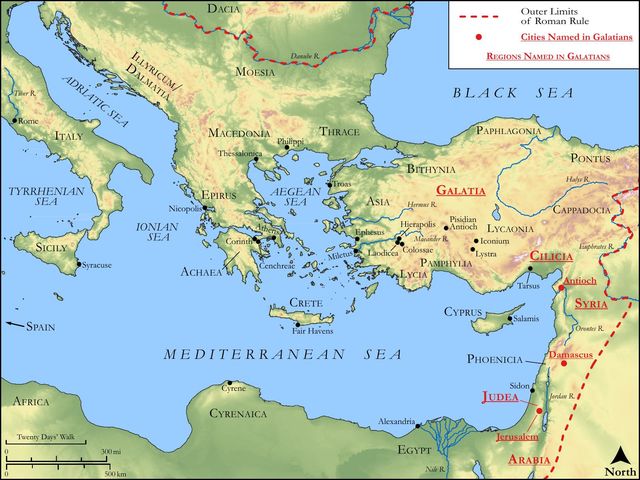
See on the biblical-era maps

Study this verse
Public-domain commentary
Matthew Henry
From his Commentary on the Whole Bible. Henry comments on passages, not single verses — this entry covers Galatians 4:1–7. His four-level outline is real structure in the source text, so it is rendered as structure.
In this chapter the apostle deals plainly with those who hearkened to the judaizing teachers, who cried up the law of Moses in competition with the gospel of Christ, and endeavored to bring them under the bondage of it. To convince them of their folly, and to rectify their mistake herein, in these verses he prosecutes the comparison of a child under age, which he had touched upon in the foregoing chapter, and thence shows what great advantages we have now, under the gospel, above what they had under the law. And here.
I.He acquaints us with the state of the Old Testament church:
it was like a child under age, and it was used accordingly, being kept in a state of darkness and bondage, in comparison of the greater light and liberty which we enjoy under the gospel. That was indeed a dispensation of grace, and yet it was comparatively a dispensation of darkness; for as the heir, in his minority, is under tutors and governors till the time appointed of his father, by whom he is educated and instructed in those things which at present he knows little of the meaning of, though afterwards they are likely to be of great use to him; so it was with the Old Testament church - the Mosaic economy, which they were under, was what they could not fully understand the meaning of; for, as the apostle says (Co2 3:13), They could not stedfastly look to the end of that which is abolished. But to the church, when grown up to maturity, in gospel days, it becomes of great use. And as that was a dispensation of darkness, so of bondage too; for they were in bondage under the elements of the world, being tied to a great number of burdensome rites and observances, by which, as by a kind of first rudiments, they were taught and instructed, and whereby they were kept in a state of subjection, like a child under tutors and governors. The church then lay more under the character of a servant, being obliged to do every thing according to the command of God, without being fully acquainted with the reason of it; but the service under the gospel appears to be more reasonable than that was. The time appointed of the Father having come, when the church was to arrive at its full age, the darkness and bondage under which it before lay are removed, and we are under a dispensation of greater light and liberty.
II.He acquaints us with the much happier state of Christians under the gospel-dispensation, Gal 4:4-7.
When the fulness of time had come, the time appointed of the Father, when he would put an end to the legal dispensation, and set up another and a better in the room of it, he sent forth his Son, etc. The person who was employed to introduce this new dispensation was no other than the Son of God himself, the only-begotten of the Father, who, as he had been prophesied of and promised from the foundation of the world, so in due time he was manifested for this purpose. He, in pursuance of the great design he had undertaken, submitted to be made of a woman - there is his incarnation; and to be made under the law - there is his subjection. He who was truly God for our sakes became man; and he who was Lord of all consented to come into a state of subjection and to take upon him the form of a servant; and one great end of all this was to redeem those that were under the law - to save us from that intolerable yoke and to appoint gospel ordinances more rational and easy. He had indeed something more and greater in his view, in coming into the world, than merely to deliver us from the bondage of the ceremonial law; for he came in our nature, and consented to suffer and die for us, that hereby he might redeem us from the wrath of God, and from the curse of the moral law, which, as sinners, we all lay under. But that was one end of it, and a mercy reserved to be bestowed at the time of his manifestation; then the more servile state of the church was to come to a period, and a better to succeed in the place of it; for he was sent to redeem us, that we might receive the adoption of sons - that we might no longer be accounted and treated as servants, but as sons grown up to maturity, who are allowed greater freedoms, and admitted to larger privileges, than while they were under tutors and governors. This the course of the apostle's argument leads us to take notice of, as one thing intended by this expression, though no doubt it may also be understood as signifying that gracious adoption which the gospel so often speaks of as the privilege of those who believe in Christ. Israel was God's son, his first-born, Rom 9:4. But now, under the gospel, particular believers receive the adoption; and, as an earnest and evidence of it, they have together therewith the Spirit of adoption, putting them upon the duty of prayer, and enabling them in prayer to eye God as a Father (Gal 4:6): Because you are sons, God hath sent forth the Spirit of his Son into your hearts, crying Abba, Father. And hereupon (Gal 4:7) the apostle concludes this argument by adding, Wherefore thou art no more a servant, but a son; and, if a son, then an heir of God through Christ; that is, Now, under the gospel state, we are no longer under the servitude of the law, but, upon our believing in Christ, become the sons of God; we are thereupon accepted of him, and adopted by him; and, being the sons, we are also heirs of God, and are entitled to the heavenly inheritance (as he also reasons Rom 8:17), and therefore it must needs be the greatest weakness and folly to turn back to the law, and to seek justification by the works of it. From what the apostle says in these verses, we may observe,
1.The wonders of divine love and mercy towards us, particularly of God the Father, in sending his Son into the world to redeem and save us, - of the Son of God, in submitting so low, and suffering so much, for us, in pursuance of that design, - and of the Holy Spirit, in condescending to dwell in the hearts of believers for such gracious purposes.
2.The great and invaluable advantages which Christians enjoy under the gospel; for,
(1.)We receive the adoption of sons. Whence note, It is the great privilege which believers have through Christ that they are adopted children of the God of heaven. We who by nature are children of wrath and disobedience have become by grace children of love.
(2.)We receive the Spirit of adoption. Note,
[1.]All who have the privilege of adoption have the Spirit of adoption - all who are received into the number partake of the nature of the children of God; for he will have all his children to resemble him.
[2.]The Spirit of adoption is always the Spirit of prayer, and it is our duty in prayer to eye God as a Father. Christ has taught us in prayer to eye God as our Father in heaven.
[3.]If we are his sons, then his heirs. It is not so among men, with whom the eldest son is heir; but all God's children are heirs. Those who have the nature of sons shall have the inheritance of sons.
Historical interpretation
Two Centuries of Reception
7 surviving comments on this verse. Each one is dated, so this reads as a timeline rather than a list.
Select a marker to jump to its quote. Markers stagger vertically where authors wrote within a few decades of each other.
That we may have, therefore the assurance that we are the children of God, "He hath sent forth His Spirit into our hearts, crying, Abba, Father." For "in the last days," saith He," I will pour out of my Spirit upon all flesh.
Behold the whole array of those three powers through one power and one Godhead. For God, he says, who is the Father, sent his own Son, who is Christ, and again Christ, who himself being the power of God is God, … sent the spirit of his Son, who is the Holy Spirit.
Yet the love of God for humanity is such that by grace He becomes Father of those in relation to whom he had previously only been Maker. He becomes their Father when created beings receive ‘into their hearts the Spirit of the Son crying out, ‘Abba, Father’ [Gal 4.6]., as the apostle says. These are the ones who, by receiving the Word, receive authority from him ‘to become the children of God’ (John 1.12). Being creatures by nature, they would not become ‘sons’ except by receiving the Spirit of the natural and true Son. So it was in order to bring this about and to make humanity receptive of divinity that ‘The Word became flesh’ (John 1.14)… Accordingly, the Father calls ‘sons’ those in whom He sees His own Son and He says, ‘I begot’ since ‘begetting’ signifies ‘sons’ while ‘making’ is indicative of the works. Therefore we are not begotten first but made [created], for it is written, ‘Let us make humanity’ (Gen 1.26). But when we later receive the grace of The Spirit, we are henceforth said to also be begotten. - "Against the Arians, 2.59"
He says of the Gentiles who believed in Christ, “You are sons,” having previously been enemies. There can be no doubt that believing Jews were also said to be sons of God, since they had long been called by that name. They had received the name of sons at one time as though by anticipation in order that this sonship might subsequently be understood in Christ, being incomplete without the Spirit.
Had not we been first made sons, we could not have called Him Father. If then grace hath made us freemen instead of slaves, men instead of children, heirs and sons instead of aliens, is it not utter absurdity and stupidity to desert this grace, and to turn away backwards?
(Verse 6.) But because you are sons of God, God has sent the spirit of His Son into our hearts, crying out, Abba, Father. Clearly the Apostle Paul mentions three spirits, the Spirit of the Son of God, as in this present place, God has sent the Spirit of His Son into our hearts (Rom. VIII, 14). And the Spirit of God, as in that place: For as many as are led by the Spirit of God, these are sons of God. And the Holy Spirit, as in that place: Your bodies are the temple of the Holy Spirit, who is in you (I Cor. VI, 19). That the Holy Spirit is distinct from the Son of God is clearly and convincingly confirmed in the Gospel: Whoever speaks a word against the Son of man will be forgiven. But whoever speaks against the Holy Spirit, neither in this age nor in the age to come will be forgiven (Luke 12:10). This is because many, due to their lack of knowledge of the Scriptures (as Firmianus also states in the eighth letter to Demetrianus), assert that the Holy Spirit is often referred to as the Father and sometimes as the Son. And while we believe clearly in the Trinity, removing the third person, they do not want to be his substance, but his name. But in order not to take too long (for this is not a dialogue, but a commentary), I will briefly show the three spirits named in the fiftieth psalm, as the prophet says: Create a clean heart in me, O God, and renew a right spirit within me. Do not cast me away from your presence, and do not take your Holy Spirit from me. Give me the joy of your salvation, and strengthen me with your principal spirit. He calls the principal spirit Father, because the Son is from the Father, and not the Father from the Son. But the spirit of righteousness, truth, and justice signifies Christ the Lord: for the Father has given all judgment to the Son (John V, 22), as David says: O God, give your judgment to the king, and your power to the son of the king (Psalm LXXI, 1). Moreover, he calls the Holy Spirit by its explicit name. These things, although they differ in terms and persons, are associated by substance and nature: and the same Spirit, due to the fellowship of nature, is now called the Father, now the Son. However, the argument by which he endeavors to assert that we are no longer under the Law, but under the grace of the Lord Jesus, concludes with such a purpose. He had said above that we should receive the adoption of sons: now he proves that we are children of God by the Spirit whom we have in us. For never, he says, would we dare to say: Our Father who art in heaven: Hallowed be thy name, unless from the consciousness of the Spirit dwelling within us, and with a great voice of senses and teachings crying out: Abba, Father (Rom. VIII, 15). Abba is a Hebrew word, signifying the same as Father. And Scripture preserves this custom in several places, putting the Hebrew word in its own interpretation. Aser, riches. Tabitha, Dorcas (Acts IX): and in Genesis, Mesech, a slave (Gen. XV), and so on and so forth. However, since Abba Father is said in both Hebrew and Syriac language, and our Lord in the Gospel commands that only God should be called Father (Matt. XXIII), I do not know by what license we either call others by this name in monasteries, or consent to be called by it. And certainly, he himself commanded this when he said there should be no swearing (Matt. V). If we do not swear, we should not even mention anyone's father. If we interpret the father differently, we will be forced to have different opinions about swearing. It should also be noted that in the Scriptures, a shout is not understood as a loud voice, but as an expression of knowledge and the magnitude of teachings. For in Exodus, the Lord responded to Moses: Why do you cry out to me (Exodus 14:15)? when Moses' voice did not go before him. However, Scripture called it a shout when his heart was deeply moved and he groaned for the people with tears. Therefore, just as one who has the Spirit of the Son of God is a son of God, so in reverse, one who does not have the Spirit of the Son of God cannot be called a son of God.
There are two words that he has set down so that the former may be interpreted by the latter, “for Abba” means the same as “Father.” Now we see that he has elegantly, and not without reason, put together words from two languages signifying the same thing because of the whole people, which has been called from Jews and Gentiles into the unity of faith.
Continue studying Galatians 4:6 across the web’s major study libraries — every link below opens this exact verse, chapter, or book on the destination site.
Read & Compare
 BibleGatewayThis verse in more than 200 translations and 70 languages.
 Bible.comThe YouVersion reader — hundreds of translations, reading plans, and highlights.
 ESV.orgCrossway's official English Standard Version reader.
 NET BibleThe NET translation with 60,000+ translators' notes on every rendering decision.
 STEP BibleTyndale House's free study tool — original text, vocabulary, and scholarly resources.
 BibliaLogos Bible Software's free web reader.
 USCCBThe New American Bible (Revised Edition) with the U.S. bishops' study notes.
Commentaries
 BibleHub CommentariesDozens of classic commentaries on this verse, gathered on one page.
 StudyLightMore than 100 commentary sets — the largest collection on the web.
 BibleRefPlain-English commentary on what this verse means, verse by verse.
 Enduring WordDavid Guzik's free commentary on this chapter, widely used by Bible teachers.
 Bible Study ToolsVerse commentary alongside Greek and Hebrew study aids.
Original Language & Research
- BibleHub InterlinearThe verse word by word — original language, transliteration, and English.
- BibleHub LexiconEvery word's original-language definition and Strong's entry.
 Blue Letter BibleDeep-study tools — Strong's numbers, concordance, and word studies.
 CNTR CollationThe earliest Greek manuscripts of this verse, collated letter by letter.
Sermons, Hymns & Audio


TrulyRandomVerse is not affiliated with these sites and doesn’t control their content. They’re linked because they’re genuinely useful.
Summary
Galatians 4:6 profoundly reveals the spiritual reality of believers' adoption into God's family. As those who have been graciously made sons and daughters through faith in Christ, God Himself validates this new status by sending the Holy Spirit, the Spirit of His Son, into their hearts. This indwelling Spirit empowers believers to cry out to God with the deepest intimacy and affection, addressing Him as "Abba, Father," thereby confirming their secure and loving relationship with their heavenly Parent.
Context
ShowHideLiterary Context
Galatians 4:6 stands as a pivotal declaration within Paul's passionate defense of justification by faith against the legalistic demands of the Judaizers. In the preceding chapters, Paul meticulously argues that the Law served as a temporary guardian until Christ came, highlighting that believers are no longer under its tutelage but have "come of age" as heirs (Galatians 3:24-25). Galatians 4:1-5 elaborates on this transition from slavery under the Law to the freedom of sonship, culminating in God sending His Son "to redeem those who were under the Law, so that we might receive adoption as sons." Verse 6 then presents the immediate, tangible evidence and experience of this adoption: the indwelling Spirit who enables an intimate cry to God. It forms a theological and experiential climax to Paul's argument for the believer's new identity in Christ, setting the stage for the practical implications of this freedom in the verses that follow.
Historical & Cultural Context
The concept of "adoption" (Greek: huiothesia) was well-understood in the Greco-Roman world, signifying a legal process by which a person, often an adult, was formally brought into a new family, receiving all the rights, privileges, and inheritance of a natural-born child. This legal act was irreversible and conferred full legal standing. Paul uses this powerful legal metaphor to explain the believer's new standing before God, contrasting it with the "slavery" (legal bondage) of being under the Mosaic Law. The term "Abba" is Aramaic, a common Semitic language spoken in Judea during Jesus' time. It is an intimate, familial term, akin to "Daddy" or "Papa," used by children for their father. Its pairing with the Greek word "Patēr" (Father) emphasizes both the deep personal intimacy and the universal, formal recognition of God's paternity, bridging Jewish and Gentile understanding of God as Father. This combination would have powerfully resonated with both Jewish and Gentile converts in Galatia, highlighting the radical shift from a distant, fearful relationship with God under the Law to one of loving, familial closeness through Christ.
Key Themes
ShowHideThis verse powerfully encapsulates several core themes central to Paul's theology in Galatians and beyond. Firstly, Divine Sonship and Adoption is foundational; the verse explicitly states, "because ye are sons," reinforcing that believers' identity is not based on works but on God's gracious act of adoption, a theme Paul develops from Galatians 3:26-29. Secondly, the Indwelling Holy Spirit is presented as the divine seal and dynamic evidence of this sonship. God's sending of "the Spirit of his Son into your hearts" signifies an intimate, vital connection, making God's presence a living reality within the believer (Romans 8:9-11). Thirdly, the theme of Intimacy with God is powerfully expressed through the Spirit-empowered cry of "Abba, Father." This intimate address transforms the believer's relationship with God from one of fear and obligation to one of trust, love, and security, echoing Jesus' own address to the Father (e.g., Mark 14:36). These themes collectively underscore the profound spiritual freedom and relational transformation available to all who are in Christ.
Exposition and Analysis
ShowHideKey Word Analysis
ShowHideThis term (G5207) refers to a "son" and is used very widely of immediate, remote, or figurative kinship. In this context, it signifies not merely biological offspring but a legal and relational status of full maturity and inheritance, contrasting with the minor under a guardian (Galatians 4:1-3). It emphasizes the believer's full rights and privileges as legitimate children and heirs of God.
This verb (G1821) means "to send away forth," specifically on a mission or to dispatch. Its use here highlights the divine initiative and deliberate action of God in commissioning and dispatching the Spirit. It underscores that the indwelling of the Spirit is not a human achievement but a sovereign act of God, a gift given from His own will and purpose.
This word (G5) is of Chaldee origin, serving as a vocative for "father." It is an intimate, familial term for "Father," akin to "Daddy" or "Papa," used by children in a family setting. Its presence alongside the Greek "Patēr" (Father) emphasizes the profound, personal, and affectionate relationship believers now share with God, a relationship characterized by trust and security rather than fear or distance.
Verse Breakdown
ShowHide"And because ye are sons"
This opening clause establishes the foundational truth: the believer's new identity and status as adopted children of God. It is not a contingent possibility but a settled reality, the basis for what follows. This sonship is a gift, not an achievement, received through faith in Christ.
"God hath sent forth the Spirit of his Son"
This reveals the divine agency and the means by which this sonship is confirmed and experienced. God Himself takes the initiative, dispatching the Holy Spirit. The Spirit is specifically identified as "the Spirit of his Son," emphasizing His intimate connection to Christ and His role in bringing believers into Christ's own filial relationship with the Father.
"into your hearts"
The Spirit's indwelling is not merely an external legal declaration but an internal, transformative reality. The "heart" (Greek, kardía' - G2588) here signifies the innermost being, the seat of thoughts, feelings, and will. This indicates a deep, personal, and pervasive presence of the Spirit within the believer, affecting their very identity and disposition.
"crying, Abba, Father"
This describes the Spirit's active work within the believer. The word "crying" (Greek, krázō' - G2896) implies a strong, urgent, and spontaneous utterance. The Spirit enables and empowers believers to address God with profound intimacy ("Abba") and reverent recognition ("Father"). This dual address underscores both the personal affection and the universal acknowledgment of God's paternity, signifying a relationship of secure belonging and unreserved trust.
Literary Devices
ShowHidePaul employs several potent literary devices in Galatians 4:6 to convey its profound theological truth. The most prominent is Metaphor, where the relationship between God and believers is likened to that of a Father and Son, emphasizing adoption and inheritance. This metaphor contrasts sharply with the previous state of "slavery" under the Law, highlighting the radical shift in status. There is also a subtle use of Personification as the Spirit is depicted as "crying," an action typically associated with a conscious being expressing deep emotion. This imbues the Spirit's work with a dynamic, active quality, demonstrating that it is the Spirit Himself who enables this intimate address to God. The phrase "Abba, Father" functions as a powerful Repetition or Tautology (using two words with similar meanings for emphasis), reinforcing both the deep, personal intimacy (Abba) and the universal, theological recognition (Father) of God's paternal relationship. This dual expression acts as a Symbol of the new covenant relationship, transcending cultural and linguistic barriers to unite believers in a common, intimate cry to God.
Theological and Thematic Connections
ShowHideGalatians 4:6 is a cornerstone verse for understanding the believer's identity and relationship with God in the New Covenant. It reveals that the indwelling Holy Spirit is not merely a theological concept but a dynamic, experiential reality that validates our adoption as God's children. The Spirit's presence empowers us to relate to God with the same intimacy and trust that Jesus Himself displayed towards His Father, transforming a relationship once marked by fear and legal obligation into one of profound love and familial belonging. This verse underscores that our sonship is a gracious gift, sealed and evidenced by the Spirit, who enables us to confidently approach the Creator of the universe as our loving "Abba, Father."
Reflection and Application
ShowHideGalatians 4:6 offers profound comfort and liberation for the believer. It reassures us that our standing with God is not predicated on our performance or adherence to rules, but on His gracious act of adoption, confirmed by the indwelling Spirit. This truth frees us from striving for acceptance and enables us to rest in our beloved identity as God's children. When we face doubts about our salvation, feelings of unworthiness, or the temptation to revert to legalism, this verse reminds us that the Holy Spirit within us constantly affirms our sonship, prompting us to cry out to God with confidence and affection. It invites us to live in the reality of this intimate relationship, approaching God not as a distant judge but as a loving, accessible Father who delights in His children. This should transform our prayer lives, moving us from formal petitions to heartfelt conversations, and empower us to live with the security and joy that comes from knowing we are truly part of God's eternal family.
Questions for Reflection
ShowHideFAQ
ShowHideWhat is the significance of the phrase "Abba, Father"?
ShowHideThe phrase "Abba, Father" is highly significant because it combines an Aramaic term ("Abba") with a Greek term ("Patēr," meaning Father). "Abba" was an intimate, familial term used by children for their father, much like "Daddy" or "Papa" in English. Its inclusion alongside the more formal Greek "Father" emphasizes both the profound personal intimacy and the universal, theological recognition of God's paternity. It signifies a radical shift from a relationship with God based on fear or distant respect to one characterized by deep affection, trust, and secure belonging, enabled by the indwelling Holy Spirit. Jesus Himself used "Abba" to address God (e.g., Mark 14:36), highlighting the unique access and intimacy believers now share through Christ.
Is the indwelling of the Holy Spirit for all believers?
ShowHideYes, the Bible teaches that the indwelling of the Holy Spirit is a universal experience for all who believe in Jesus Christ. Paul states in Romans 8:9 that "if anyone does not have the Spirit of Christ, he does not belong to him." Similarly, Ephesians 1:13-14 describes believers as being "sealed with the promised Holy Spirit, who is the guarantee of our inheritance." Galatians 4:6 reinforces this, indicating that because we are sons, God has sent forth the Spirit into our hearts. The Spirit's indwelling is not an optional extra but an essential mark of true sonship and a vital aspect of the New Covenant experience, empowering believers for intimacy with God and for living a life that honors Him.
Christ-Centered Fulfillment
ShowHideGalatians 4:6 finds its ultimate fulfillment and deepest meaning in Christ. The verse declares that God sends "the Spirit of his Son" into our hearts, enabling us to cry "Abba, Father." This is profoundly Christ-centered because it reveals that our sonship is not merely a legal declaration but an experiential reality made possible by our union with Jesus, the eternal Son of God. It is through Christ's redemptive work that we are redeemed from the curse of the Law (Galatians 3:13) and adopted into God's family (Galatians 4:5). The Spirit sent into our hearts is specifically "the Spirit of his Son," meaning the very Spirit who dwelt perfectly in Jesus, enabling His intimate relationship with the Father, now indwells us. This allows us to share in Christ's own filial relationship with God, addressing God with the same tender intimacy that Jesus Himself used (e.g., Mark 14:36). Furthermore, Jesus promised to send the Holy Spirit, the Comforter, after His departure (John 14:16-17), and He breathed the Spirit upon His disciples (John 20:22). Thus, our ability to cry "Abba, Father" is a direct result of Christ's finished work, His ascension, and His sending of His Spirit, making us co-heirs with Him (Romans 8:17) and enabling us to participate in the very life and love of the Trinity.