


Mark 14:36
- καὶkaiAndG2532CONJConjunction
- ἔλεγεν·elegenHe was sayingG3004V-IAI-3SVerb Imperfect Active Indicative 3rd Singular
- αββαabbaAbbaG5N-VSM-TNoun Vocative Singular Masculine Person Gentilic
- ὁhoOG3588T-VSMDefinite article Vocative Singular Masculine
- πατήρpatērFatherG3962N-VSM-TNoun Vocative Singular Masculine Person Gentilic
- πάνταpantaall things [are]G3956A-NPNAdjective Nominative Plural Neuter
- δυνατάdunatapossibleG1415A-NPNAdjective Nominative Plural Neuter
- σοι·soito YouG4771P-2DSPersonal pronoun Dative 2nd Singular
- παρένεγκεparenegkedo take awayG3911V-2AAM-2SVerb 2nd Aorist Active Imperative 2nd Singular
- τὸto<the>G3588T-ASNDefinite article Accusative Singular Neuter
- ποτήριονpotērioncupG4221N-ASNNoun Accusative Singular Neuter
- τοῦτοtoutothisG3778D-ASNDemonstrative pronoun Accusative Singular Neuter
- ἀπ᾽ap᾽fromG575PREPPreposition
- ἐμοῦemouMeG1473S-1SGSNPossessive pronoun Genitive 1st Person Singular Neuter
- ἀλλ᾽all᾽butG235CONJConjunction
- οὐounot [it is]G3756PRT-NNegative Particle Negative
- τίtiwhatG5101I-ASNInterrogative pronoun Accusative Singular Neuter
- ἐγὼegōI myselfG1473P-1NSPersonal pronoun Nominative 1st Singular
- θέλωthelōwantG2309V-PAI-1SVerb Present Active Indicative 1st Singular
- ἀλλὰallabutG235CONJConjunction
- τίtiwhatG5101I-ASNInterrogative pronoun Accusative Singular Neuter
- σύsuYouG4771P-2NSPersonal pronoun Nominative 2nd Singular
English is a literal word-by-word gloss of the Greek, not the KJV's wording. Why?
This is the original text the KJV's translators worked from — each Greek word with its own literal English meaning in this verse, prepared by scholars at Tyndale House, Cambridge. The KJV translates whole sentences, not word by word, so its wording differs: one Greek word can become several English words, and the KJV may choose “charity” where the gloss reads “love”. Both are faithful — they answer different questions. For the KJV's own rendering, switch to the KJV text.
Details
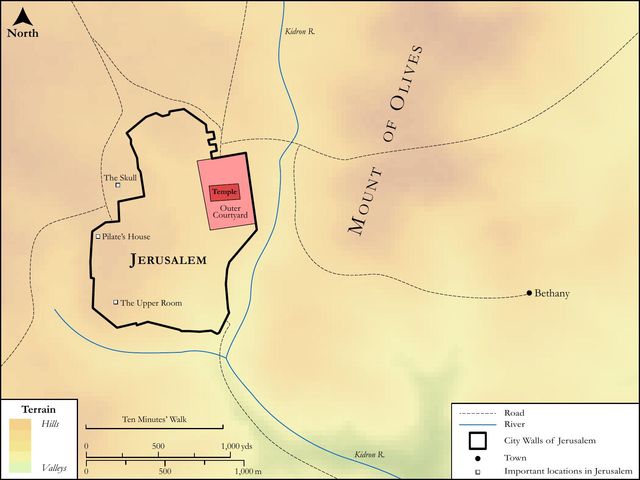
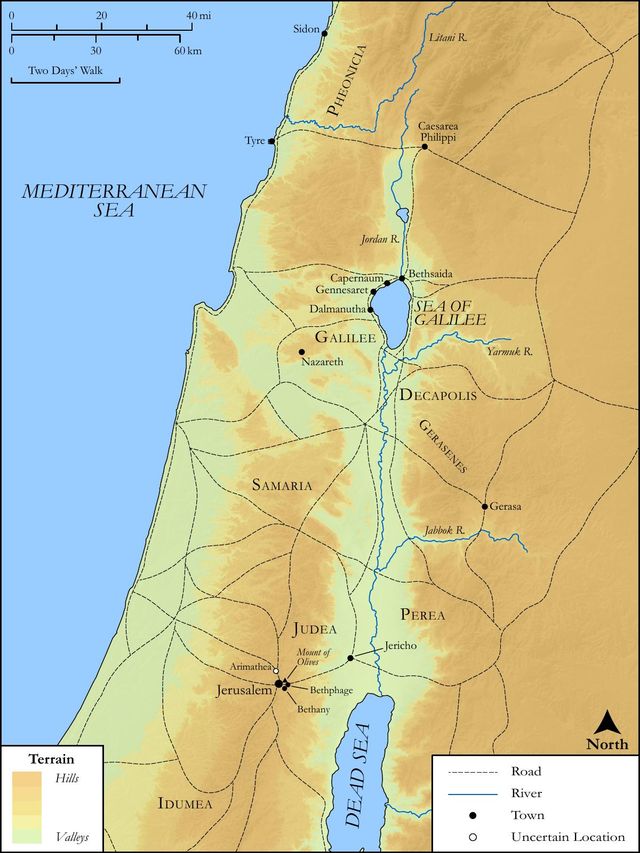
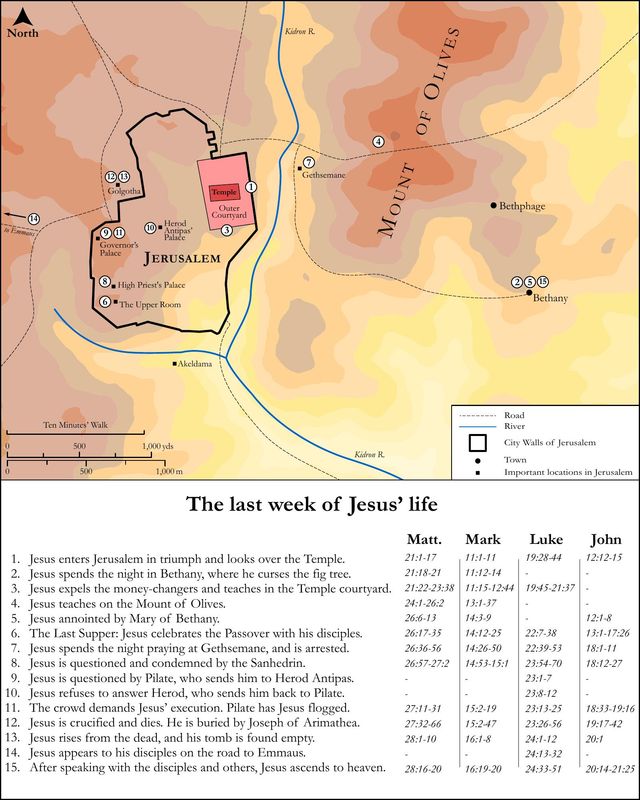
See on the biblical-era map
Study this verse
Public-domain commentary
Matthew Henry
From his Commentary on the Whole Bible. Henry comments on passages, not single verses — this entry covers Mark 14:32–42. His three-level outline is real structure in the source text, so it is rendered as structure.
Christ is here entering upon his sufferings, and begins with those which were the sorest of all his sufferings, those in his soul. Here we have him in his agony; this melancholy story we had in Matthew; this agony in soul was the wormwood and the gall in the affliction and misery; and thereby it appeared that no sorrow was forced upon him, but that it was what he freely admitted.
I.He retired for prayer; Sit ye here (saith he to his disciples), while I go a little further, and pray.
He had lately prayed with them (Jn. 17); and now he appoints them to withdraw while he goes to his Father upon an errand peculiar to himself. Note, Our praying with our families will not excuse our neglect of secret worship. When Jacob entered into his agony, he first sent over all that he had, and was left alone, and then there wrestled a man with him (Gen 32:23, Gen 32:24), though he had been at prayer before (Mar 14:9), it is likely, with his family.
II.Even into that retirement he took with him Peter, and James, and John (Mar 14:33), three competent witnesses of this part of his humiliation; and though great spirits care not how few know any thing of their agonies, he was not ashamed that they should see. These three had boasted most of their ability and willingness to suffer with him; Peter here, in this chapter, and James and John (Mar 10:39); and therefore Christ takes them to stand by, and see what a struggle he had with the bloody baptism and the bitter cup, to convince them that they knew not what they said. It is fit that they who are most confident, should be first tried, that they may be made sensible of their folly and weakness.
III.There he was in a tremendous agitation (Mar 14:33); He began to be sore amazed - ekthambeisthai, a word not used in Matthew, but very significant; it bespeaks something like that horror of great darkness, which fell upon Abraham (Gen 15:12), or, rather, something much worse, and more frightful. The terrors of God set themselves in array against him, and he allowed himself the actual and intense contemplation of them. Never was sorrow like unto his at that time; never any had such experience as he had from eternity of divine favours, and therefore never any had, or could have, such a sense as he had of divine favours. Yet there was not the least disorder or irregularity in this commotion of his spirits; his affections rose not tumultuously, but under direction, and as they were called up, for he had no corrupt nature to mix with them, as we have. If water have a sediment at the bottom, though it may be clear while it stands still, yet, when shaken, it grows muddy; so it is with our affections: but pure water in a clean glass, though ever so much stirred, continues clear; and so it was with Christ. Dr. Lightfoot thinks it very probable that the devil did now appear to our Saviour in a visible shape, in his own shape and proper colour, to terrify and affright him, and to drive him from his hope in God (which he aimed at in persecuting Job, a type of Christ, to make him curse God, and die), and to deter him from the further prosecution of his undertaking; whatever hindered him from that, he looked upon as coming from Satan, Mat 16:23. When the devil had tempted him in the wilderness, it is said, He departed from him for a season (Luk 4:13), intending another grapple with him, and in another way; finding that he could not by his flatteries allure him into sin, he would try by his terrors to affright him into it, and so make void his design.
IV.He made a sad complaint of this agitation. He said, My soul is exceeding sorrowful.
1.He was made sin for us, and therefore was thus sorrowful; he fully knew the malignity of the sins he was to suffer for; and having the highest degree of love to God, who was offended by them, and of love to man, who was damaged and endangered by them, now that those were set in order before him, no marvel that his soul was exceeding sorrowful. Now was he made to serve with our sins, and was thus wearied with our iniquities.
2.He was made a curse for us; the curses of the law were transferred to him as our surety and representative, not as originally bound with us, but a bail to the action. And when his soul was thus exceeding sorrowful, he did, as it were, yield to them, and lie down under the load, until by his death he had satisfied for sin, and so for ever abolished the curse. He now tasted death (as he is said to do, Heb 2:9), which is not an extenuating expression, as if he did but taste it; no, he drank up even the dregs of the cup; but it is rather aggravating; it did not go down by wholesale, but he tasted all the bitterness of it. This was that fear which the apostle speaks of (Heb 5:7), a natural fear of pain and death, which it is natural to human nature to startle at.
Now the consideration of Christ's sufferings in his soul, and his sorrows for us, should be of use to us,
(1.)To embitter our sins. Can we ever entertain a favourable or so much as a slight thought of sin, when we see what impression sin (though but imputed) made upon the Lord Jesus? Shall that sit light upon our souls, which sat so heavy upon his? Was Christ in such an agony for our sins, and shall we never be in an agony about them? How should we look upon him whom we have pressed, whom we have pierced, and mourn, and be in bitterness! It becomes us to be exceeding sorrowful for sin, because Christ was so, and never to make a mock at it. If Christ thus suffered for sin, let us arm ourselves with the same mind.
(2.)To sweeten our sorrows; if our souls be at any time exceeding sorrowful, through the afflictions of this present time, let us remember that our Master was so before us, and the disciple is not greater than his Lord. Why should we affect to drive away sorrow, when Christ for our sakes courted it, and submitted to it, and thereby not only took out the sting of it, and made it tolerable, but put virtue into it, and made it profitable (for by the sadness of the countenance the heart is made better), nay, and put sweetness into it, and made it comfortable. Blessed Paul was sorrowful, and yet always rejoicing. If we be exceeding sorrowful, it is but unto death; that will be the period of all our sorrows, if Christ be ours; when the eyes are closed, all tears are wiped away from them.
V.He ordered his disciples to keep with him, not because he needed their help, but because he would have them to look upon him and receive instruction; he said to them, Tarry ye here and watch. He had said to the other disciples nothing but, Sit ye here (Mar 14:32); but these three he bids to tarry and watch, as expecting more from them than from the rest.
VI.He addressed himself to God by prayer (Mar 14:35); He fell on the ground, and prayed.
It was but a little before this, that in prayer he lifted up his eyes (Joh 17:1); but here, being in an agony, he fell upon his face, accommodating himself to his present humiliation, and teaching us thus to abase ourselves before God; it becomes us to be low, when we come into the presence of the Most High.
1.As Man, he deprecated his sufferings, that, if it were possible, the hour might pass from him (Mar 14:35); "This short, but sharp affliction, that which I am now this hour to enter upon, let man's salvation be, if possible, accomplished without it." We have his very words (Mar 14:36), Abba, Father. The Syriac word is here retained, which Christ used, and which signifies Father, to intimate what an emphasis our Lord Jesus, in his sorrows, laid upon it, and would have us to lay. It is with an eye to this, that St. Paul retains this word, putting it into the mouths of all that have the Spirit of adoption; they are taught to cry, Abba, Father, Rom 8:15; Gal 4:6. Father, all things are possible to thee. Note, Even that which we cannot expect to be done for us, we ought yet to believe that God is able to do: and when we submit to his will, and refer ourselves to his wisdom and mercy, it must be with a believing acknowledgment of his power, that all things are possible to him.
2.As Mediator, he acquiesced in the will of God concerning them; "Nevertheless, not what I will, but what thou wilt. I know the matter is settled, and cannot be altered, I must suffer and die, and I bid it welcome."
VII.He roused his disciples, who were dropped asleep while he was at prayer, Mar 14:37, Mar 14:38.
He comes to look after them, since they did not look after him; and he finds them asleep, so little affected were they with his sorrows, his complaints, and prayers. This carelessness of theirs was a presage of their further offence in deserting him; and it was an aggravation of it, that he had so lately commended them for continuing with him in his temptations, though they had not been without their faults. Was he so willing to make the best of them, and were they so indifferent in approving themselves to him? They had lately promised not to be offended in him; what! and yet mind him so little? He particularly upbraided Peter with his drowsiness; Simon, sleepest thou? Kai su teknon; - "What thou, my son? Thou that didst so positively promise thou wouldest not deny me, dost thou slight me thus? From thee I expected better things. Couldest thou not watch one hour?" He did not require him to watch all night with him, only for one hour. It aggravates our faintness and short continuance in Christ's service, that he doth not over-task us, nor weary us with it, Isa 43:23. He puts upon us no other burthen than to hold fast till he comes (Rev 2:24, Rev 2:25); and behold, he comes quickly, Rev 3:11.
As those whom Christ loves he rebukes when they do amiss, so those whom he rebukes he counsels and comforts. 1. It was a very wise and faithful word of advice which Christ here gave to his disciples; Watch and pray, lest ye enter into temptation, v. 38. It was bad to sleep when Christ was in his agony, but they were entering into further temptation, and if they did not stir up themselves, and fetch in grace and strength from God by prayer, they would do worse; and so they did, when they all forsook him, and fled. 2. It was a very kind and tender excuse that Christ made for them; "The spirit truly is willing; I know it is, it is ready, it is forward; you would willingly keep awake, but you cannot." This may be taken as a reason for that exhortation, "Watch and pray; because, though the spirit is willing, I grant it is (you have sincerely resolved never to be offended in me), yet the flesh is weak, and if you do not watch and pray, and use the means of perseverance, you may be overcome, notwithstanding." The consideration of the weakness and infirmity of our flesh should engage and quicken us to prayer and watchfulness, when we are entering into temptation.
VIII.He repeated his address to his Father (Mar 14:39); He went again, and prayed, saying, ton auton logon - the same word, or matter, or business; he spoke to the same purport, and again the third time. This teaches us, that men ought to pray, and not to faint, Luk 18:1. Though the answers to our prayers do not come quickly, yet we must renew our requests, and continue instant in prayer; for the vision is for an appointed time, and at the end it shall speak, and not lie, Hab 2:3. Paul, when he was buffeted by a messenger of Satan, besought the Lord thrice, as Christ did here, before he obtained an answer of peace, Co2 12:7, Co2 12:8. A little before this, when Christ, in the trouble of his soul, prayed, Father, glorify thy name, he had an immediate answer by a voice from heaven, I have both glorified it, and I will glorify it yet again; but now he must come a second and third time, for the visits of God's grace, in answer to prayer, come sooner or later, according to the pleasure of his will, that we may be kept depending.
IX.He repeated his visits to his disciples.
Thus he gave a specimen of his continued care for his church on earth, even when it is half asleep, and not duly concerned for itself, while he ever lives making intercession with his Father in heaven. See how, as became a Mediator, he passes and repasses between both. He came the second time to his disciples, and found them asleep again, Mar 14:40. See how the infirmities of Christ's disciples return upon them, notwithstanding their resolutions, and overpower them, notwithstanding their resistance; and what clogs those bodies of ours are to our souls, which should make us long for that blessed state in which they shall be no more our encumbrance. This second time he spoke to them as before, but they wist not what to answer him; they were ashamed of their drowsiness, and had nothing to say in excuse for it. Or, They were so overpowered with it, that, like men between sleeping and waking, they knew not where they were, or what they said. But, the third time, they were bid to sleep if they would (Mar 14:41); "Sleep on now, and take your rest. I have now no more occasion for your watching, you may sleep, if you will, for me." It is enough; we had not that word in Matthew. "You have had warning enough to keep awake, and would not take it; and now you shall see what little reason you have to be secure." Apekei, I discharge you from any further attendance; so some understand it; "Now the hour is come, in which I knew you would all forsake me, even take your course;" as he said to Judas, What thou doest, do quickly. The Son of man is now betrayed into the hands of sinners, the chief priests and elders; those worst of sinners, because they made a profession of sanctity. "Come, rise up, do not lie dozing there. Let us go and meet the enemy, for lo, he that betrayeth me is at hand, and I must not now think of making an escape." When we see trouble at the door, we are concerned to stir up ourselves to get ready for it.
Historical interpretation
Ten Centuries of Reception
14 surviving comments on this verse. Each one is dated, so this reads as a timeline rather than a list.
Select a marker to jump to its quote. Markers stagger vertically where authors wrote within a few decades of each other.
In the valley of fatness also, the fat bulls beset Him. There follows, And he saith to his disciples, Sit ye here, while I shall pray; they are separated from Him in prayer, who are separated in His Passion; for He prays, they sleep, overcome by the sloth of their heart.
By this also we are taught to fear and to be sorrowful before the judgment of death, for not by ourselves, but by Him only, can we say, The prince of this world cometh, and hath nothing in Me. (John 14:30) There follows: Tarry ye here, and watch.
By which also He ceases not up to the end to teach us to obey our fathers, and to prefer their will to ours. There follows: And he cometh, and findeth them sleeping. For as they are asleep in mind, so also in body. 1But after His prayer, the Lord coming, and seeing His disciples sleeping, rebukes Peter alone. Wherefore it goes on: And saith unto Peter, Simon, steepest thou? couldest not thou watch with me one hour? As if He had said, If thou couldest not watch one hour with me, how wilt thou be able to despise death, thou who promisest to die with me? It goes on: Watch and pray, that ye enter not into temptation, that is, the temptation of denying me.
But he is said to enter into temptation, who neglects to pray. There follows: The spirit indeed is willing, but the flesh is weak.
The threefold sleep of the disciples points out the three dead, whom our Lord raised up; the first, in a house; the second, at the tomb; the third, from the tomb. And the threefold watch of the Lord teaches us in our prayers, to beg for the pardon of past, future, and present sins.
It is something possible, for Mark makes mention of His saying, "Abba, Father, all things are possible unto Thee."
Though with God nothing is impossible, yet for human nature it is impossible to ignore the fear of suffering. Only by trial can faith be proved. Thus as a human being he prays in a human manner that the cup may pass away, but as God from God, his will is in unison with the Father’s effectual will.
Although he was obedient, it was a voluntary obedience. The only begotten Son humbled himself, and obeyed his Father even to the death of the cross. But was it as human or as God that he was subjected to the Father? His subjection is that of one to whom all things have been subjected. This subjection is not a sign merely of a temporal obedience, for his allegiance is eternal. Rather it was an instance in time of the dispensation of the eternal mystery of his humbling. His actual humbling occurred within time. Yet in its very unpretentiousness it displays the eternal mystery of his humiliation.
He does not pray that the cup may pass around him. He prays that the cup may pass away from him, but it cannot pass away unless he drinks it. To pass away does not mean to depart from its place, but not to exist at all. And this is indeed the very meaning that the apostles have in mind when they say: “Heaven and earth will pass away, but my words will not pass away.”
The Father from whom every nature has derived its laws is not subject to the laws of nature. The Father who transcends every measure of power is not limited in anything, either by deficiency or by changeability in his nature. As the Son said: “Father, all things are possible to thee.” So much so that the human mind cannot grasp as much as lies within his power.
He knew what he was saying to his Father, and was well aware that this chalice could pass from him. But he had come to drink it for everyone, in order to acquit, through this chalice, the debt of everyone, [a debt] which the prophets and martyrs could not pay with their death.… He assumed flesh. He clothed himself with weakness, eating when hungry, becoming tired after working, being overcome by sleep when weary. It was necessary, when the time for his death arrived, that all things that have to do with the flesh would be fulfilled then. The anguish of death in fact invaded him, to manifest his nature as a son of Adam, over whom death reigns, according to the word of the apostle.… Or alternatively, in this hour of his corporeal death, he gave to the body that which belonged to it, saying that all the sufferings of [his] body would show to the heretics and schismatics that his body was [real]. did not this body of his appear to them, just as it was visible to everyone else? Just as he was hungry and thirsty, tired and had need of sleep, so too, he was afraid. Or, [he said that], so that it would be difficult for people in the world to say that it was without suffering and toil that our debts were remitted by him. Or [it was] to teach his disciples to confide their life and death to God. If he, who is wise on account of the wisdom of God, asked for what was fitting for him, how much more [should] ordinary people surrender their will to the One who knows all things.… If he who is fearless was afraid [of death], and asked to be delivered from it, although he knew that it was impossible, how much more should others persevere in prayer before temptation, so that, in time of temptation, they may be delivered from it.
(de Con. iii. iv) He said not, if He could do it, but if it could be done; for whatever He wills is possible. We must therefore understand, if it be possible, as if it were; if He is willing. And lest any one should suppose that He lessened His Father's power, he shows in what sense the words are to be understood; for there follows, And he said, Abba, Father, all things are possible unto thee. By which He sufficiently shows, that the words, if it be possible, must be understood not of any impossibility, but of the will of His Father. As to what Mark relates, that he said not only Father, but Abba, Father, Abba is the Hebrew for Father. And perhaps the Lord said both words, on account of some Sacrament contained in them; wishing to show that He had taken upon Himself that 1sorrow in the person of His body, the Church, to which He was made the chief corner stone, and which came to Him, partly from the Hebrews, who are represented by the word Abba, partly from the Gentiles, to whom Father belongs.
To show sufferers that they need not despair, the true Savior became the good teacher by himself epitomizing the truth in his own person. He participated in our suffering in an empathic way, knowing that through human frailty sorrow might steal in upon our hearts amid afflictions, and knowing that we would overcome it if we yield to God’s will above our own, mindful that God knows best those whose well-being he superintends.
(ubi sup.) The place Gethsemane, in which the Lord prayed, is shown up to this day at the foot of the Mount of Olives. The meaning of Gethsemane is, the valley of the fat, or of fatness. Now when our Lord prays on a mountain, He teaches us that we should when we pray ask for lofty things; but by praying in the valley of fatness, He implies that in our prayer humility and the fatness of interior love must be kept. He also by the valley of humility and the fatness of charity underwent death for us.
(ubi sup.) As being God, dwelling in the body, He shows the frailty of flesh, that the blasphemy of those who deny the mystery of His Incarnation might find no place; for having taken up a body, He must needs also take up all that belongs to the body, hunger, thirst, pain, grief; for the Godhead cannot suffer the changes of these affections.
He does not mean natural sleep by the sleep which He forbids, for the time of approaching danger did not allow of it, but the sleep of unfaithfulness, and the torpor of the mind. But going forward a little, He falls on His face, and shows his lowliness of mind, by the posture of His body. Wherefore there follows: And he went forward a little, and fell on the ground, and prayed that, if it were possible, the hour might pass from him.
(ubi sup.) But He prays, that the cup may pass away, to show that He is very man, wherefore He adds: Take away this cup from me. But remembering why He was sent, He accomplishes the dispensation for which He was sent, and cries out, But not what I will, but what thou wilt. As if He had said, If death can die, without my dying according to the flesh, let this cup pass away; but since this cannot be otherwise, not what I will, but what thou wilt. Many still are sad at the prospect of death, but let them keep their heart right, and avoid death as much as they can; but if they cannot, then let them say what the Lord said for us.
(ubi sup.) He does not say, Pray that ye may not be tempted, because it is impossible for the human mind not to be tempted, but that ye enter not into temptation, that is, that temptation may not vanquish you.
(ubi sup.) He here represses the rash, who think that they can compass whatever they are confident about. But in proportion as we are confident from the ardour of our mind, so let us fear from the weakness of our flesh. 2For this place makes against those, who say that there was but one operation in the Lord and one will. For He shows two wills, one human, which from the weakness of the flesh shrinks from suffering; one divine, which is most ready. It goes on: And again he went away and prayed, and spake the same words.
But not what I will, but what you (will). I did not come (he says) to do my will, but the will of him who sent me (John 5). He spoke of his own will, which he temporarily assumed from the virgin; but the will of him who sent him, he marked that, namely, which eternally and eternally he had in common with the Father. He prays for the cup to pass, to truly show that he was also a man. However, remembering also why he was sent, he completes the mission for which he was sent, and cries out: But not what I will, but what you (will). If death dies without me dying, namely in the flesh, let this cup pass, he says. But because this will not happen otherwise, he says: Not what I will, but what you (will). And that he, invoking the Father with a double name, says Abba Father, shows that he is the God and Savior of both peoples, namely the Jew and the Gentile. For indeed, Abba signifies what Father means. But abba is Hebrew, father is Greek and Latin. Therefore, in order to teach that both people would believe in him and would invoke him, he himself first invokes him in both languages. For he is the good shepherd, who, giving his life for his sheep, makes one fold out of two flocks. Therefore, with the voice of both flocks, he asks for the Father's help, so that we, informed by his example, when we feel adversities coming, invoking God the Father as the Hebrew, Abba, with one devotion of faith and charity, may seek heavenly help. Hence the admirable doctor, taking the form of teaching from the Lord, thus addresses his listeners: You have received the Spirit of adoption of sons, in which we cry out: Abba Father (Romans 8). Truly Abba to those who are from the Israelite people, us Father, who from the Gentiles came to the faith of Christ.
And so He says: Not as I will, but as You will (Ibid.). My sorrow is what He took up with my emotion. Therefore He grieved for me, who had nothing to grieve for Himself. And setting apart the delight of eternal divinity, He is affected by the weariness of my weakness. My soul, He says, is sorrowful even unto death. The Lord is not sorrowful because of death, for He is offended by the condition of bodily emotion, not by the fear of death. For He who took on the body had to undergo all that pertains to the body, such as hunger, thirst, anguish, and sorrow. However, divinity is not altered by these emotions.
It was also His custom always to pray by Himself, in order to give us an example, to seek for silence and solitude in our prayers. There follows: And he taketh with him Peter, and James, and John. He takes only those who had been witnesses of His glory on Mount Tabor, that they who had seen His glory might also see His sufferings, and learn that He is really man, in that He is sorrowful. Wherefore there follows: And began to be sore amazed, and very heavy. For since He had taken on Himself the whole of human nature, He took also those natural things which belong to man, amazement, heaviness, and sorrow; for men are naturally unwilling to die. Wherefore it goes on: And he saith unto them, My soul is exceeding sorrowful unto death.
But some have understood this, as if He had said, I am sorrowful, not because I am to die, but because the Jews, my countrymen, are about to crucify me, and by these means to be shut out from the kingdom of God.
As if He had said, Your spirit indeed is ready not to deny me, and for this reason ye promise; but your flesh is weak, in that unless God give power to your flesh through prayer, ye shall enter into temptation.
That by His second prayer He might show Himself to be very man. It goes on: And when he returned, he found them asleep again; He however did not rebuke them severely. For their eyes were heavy, (that is, with sleep,) neither wist they what to answer him. By this learn the weakness of men, and let us not, whom even sleep can overcome, promise things which are impossible to us. Therefore He goes away the third time to pray the prayer mentioned above. Wherefore it goes on: And he cometh the third time, and saith unto them, Sleep on now, and take your rest. He is not vehement against them, though after His rebuke they had done worse, but He tells them ironically, Sleep on now, and take your rest, because He knew that the betrayer was now close at hand. And that He spoke ironically is evident, by what is added: It is enough, the hour is come; behold, the Son of man is betrayed into the hands of sinners. He speaks this, as deriding their sleep, as if He had said; Now indeed is a time for sleep, when the traitor is approaching. Then He says; Arise, let us go; lo, he that betrayeth me is at hand; he did not say this to bid them fly, but that they might meet their enemies.
(non occ.) After that the Lord had foretold the offence of His disciples, the Evangelist gives an account of His prayer, in which He is supposed to have prayed for His disciples; and first describing the place of prayer, he says, And they came to a place which was named Gethsemane.
Continue studying Mark 14:36 across the web’s major study libraries — every link below opens this exact verse, chapter, or book on the destination site.
Read & Compare
 BibleGatewayThis verse in more than 200 translations and 70 languages.
 Bible.comThe YouVersion reader — hundreds of translations, reading plans, and highlights.
 ESV.orgCrossway's official English Standard Version reader.
 NET BibleThe NET translation with 60,000+ translators' notes on every rendering decision.
 STEP BibleTyndale House's free study tool — original text, vocabulary, and scholarly resources.
 BibliaLogos Bible Software's free web reader.
 USCCBThe New American Bible (Revised Edition) with the U.S. bishops' study notes.
Commentaries
 BibleHub CommentariesDozens of classic commentaries on this verse, gathered on one page.
 StudyLightMore than 100 commentary sets — the largest collection on the web.
 BibleRefPlain-English commentary on what this verse means, verse by verse.
 Enduring WordDavid Guzik's free commentary on this chapter, widely used by Bible teachers.
 Bible Study ToolsVerse commentary alongside Greek and Hebrew study aids.
Original Language & Research
- BibleHub InterlinearThe verse word by word — original language, transliteration, and English.
- BibleHub LexiconEvery word's original-language definition and Strong's entry.
 Blue Letter BibleDeep-study tools — Strong's numbers, concordance, and word studies.
 CNTR CollationThe earliest Greek manuscripts of this verse, collated letter by letter.
Sermons, Hymns & Audio


TrulyRandomVerse is not affiliated with these sites and doesn’t control their content. They’re linked because they’re genuinely useful.
Summary
Mark 14:36 captures Jesus' agonizing prayer in the Garden of Gethsemane, a pivotal moment revealing His profound human struggle and divine submission just prior to His crucifixion. Addressing God with intimate affection as "Abba, Father," Jesus acknowledges the Father's omnipotence, expressing His human desire for the "cup" of suffering to be removed. Yet, with unparalleled devotion, He ultimately surrenders His personal will to the Father's perfect redemptive plan, embodying the ultimate act of obedience that secures humanity's salvation.
Context
ShowHideLiterary Context
This verse is situated within the intensely dramatic narrative of Jesus' final hours before His arrest and crucifixion. Immediately preceding this prayer, Jesus leads His disciples to the Garden of Gethsemane, a place of olive presses, signifying crushing pressure and suffering. He instructs most of them to wait, taking only Peter, James, and John deeper into the garden, revealing His "exceeding sorrowful" state, even "unto death" (Mark 14:34). His repeated prayers and the disciples' inability to stay awake (Mark 14:37-41) underscore the profound isolation and spiritual battle Jesus faced. This prayer is not a casual request but a wrestling with the full weight of His impending sacrifice, setting the stage for His arrest and trial.
Historical & Cultural Context
Gethsemane, located at the foot of the Mount of Olives, was a familiar place for Jesus and His disciples (John 18:1-2). The practice of prayer in gardens or secluded places was common, allowing for quiet communion with God. The "cup" metaphor, deeply rooted in Old Testament prophetic literature, would have been understood by Jewish listeners as a symbol of divine wrath or appointed suffering, often associated with judgment (Isaiah 51:17; Jeremiah 25:15). Jesus' use of "Abba" (Aramaic for "Father") was revolutionary, reflecting an unprecedented intimacy with God, distinct from the more formal address typical of Jewish prayer. This term, akin to "Daddy" or "Papa," highlights the unique filial relationship Jesus shared with the Father, a relationship to which believers are also invited through adoption (Romans 8:15).
Key Themes
ShowHideMark 14:36 powerfully contributes to several overarching themes in the Gospel of Mark and broader biblical theology. It highlights Jesus' humanity and divine nature, showcasing His genuine human anguish and His perfect divine obedience. The theme of suffering and sacrifice is central, as Jesus willingly embraces the "cup" that represents the full measure of God's wrath against sin, which He would bear on behalf of humanity. This act also underscores the theme of divine sovereignty and human will, demonstrating Jesus' complete trust in the Father's ultimate plan, even when it involved immense personal cost. Finally, it exemplifies perfect submission to God's will, serving as the ultimate model of discipleship and obedience, echoing Jesus' earlier statements about His mission to do the Father's will (John 6:38).
Exposition and Analysis
ShowHideKey Word Analysis
ShowHideThis Aramaic term, transliterated into Greek, means "Father" and is a vocative form. Its use here by Jesus, and later by Paul in reference to believers (Romans 8:15; Galatians 4:6), signifies an intimate, affectionate, and familial address to God, far beyond a formal title. It conveys a deep sense of trust, dependency, and loving relationship.
Derived from the verb "to be able" or "to have power," this word describes God's inherent capability, strength, and omnipotence. Jesus' declaration, "all things are possible unto thee," is an affirmation of God's absolute power to accomplish anything, even to provide an alternative path to salvation if it were His will. It underscores the boundless nature of divine power.
This verb denotes a determined choice or preference stemming from subjective impulse. It speaks to a desire, an inclination, or a deliberate intention. In this verse, it highlights the distinction between Jesus' human desire to avoid suffering ("not what I will") and His ultimate, resolute decision to align with the Father's divine purpose ("but what thou wilt"), demonstrating perfect volitional submission.
Verse Breakdown
ShowHide"And he said, Abba, Father,"
This opening phrase immediately establishes the profound intimacy and directness of Jesus' prayer. "Abba" (Aramaic) followed by "Father" (Greek, patḗr) emphasizes the deep, personal, and unique relationship between Jesus and God. It's a cry of a beloved Son to His beloved Father, even in the throes of immense distress.
"all things are possible unto thee;"
This is a powerful declaration of faith in God's omnipotence. Jesus acknowledges that the Father possesses limitless power and could, if He chose, alter the course of events. This is not a statement of doubt, but an affirmation of God's absolute sovereignty and capacity to act in any way He deems fit.
"take away this cup from me:"
Here, Jesus expresses His raw, human desire to avoid the impending suffering. The "cup" is a powerful metaphor for the divine wrath and judgment against sin that Jesus was about to bear on the cross, experiencing separation from the Father as He became sin for humanity (2 Corinthians 5:21). It signifies the full measure of His redemptive suffering, both physical and spiritual.
"nevertheless not what I will, but what thou wilt."
This climactic phrase reveals the pinnacle of Jesus' obedience and submission. Despite His natural human aversion to suffering, He consciously and completely surrenders His will to the Father's perfect plan. This is the ultimate act of self-denial and trust, demonstrating that His primary purpose was to fulfill the Father's redemptive will, even unto death.
Literary Devices
ShowHideMark 14:36 is rich with literary devices that amplify its profound theological message. The most prominent is Metaphor, specifically the "cup," which powerfully symbolizes the suffering, divine wrath, and judgment that Jesus was to endure on behalf of humanity. This metaphor is deeply rooted in Old Testament prophetic imagery, lending it significant weight and resonance. The use of Aramaic Transliteration ("Abba") immediately followed by its Greek equivalent ("Father") emphasizes the unique, intimate, and personal nature of Jesus' relationship with God, highlighting its profound significance for the audience. Furthermore, the verse employs Contrast ("not what I will, but what thou wilt"), which starkly juxtaposes Jesus' human desire to avoid suffering with His ultimate, unwavering commitment to the Father's divine will. This contrast underscores the intensity of His struggle and the depth of His obedience. The entire passage is also an example of Prayer as Dialogue, revealing a vulnerable yet resolute conversation between the Son and the Father, inviting readers into the sacred space of Jesus' deepest spiritual wrestling.
Theological and Thematic Connections
ShowHideMark 14:36 stands as a profound theological statement on the nature of God, the person of Christ, and the essence of true discipleship. It reveals God's absolute sovereignty and omnipotence, confirming that His will is ultimate and His power limitless. Simultaneously, it unveils the full humanity of Jesus, demonstrating His genuine fear and anguish in the face of immense suffering, yet without sin. His perfect submission to the Father's will, despite His human desire for an alternative, is the theological pivot point of salvation history, ensuring the atoning sacrifice. This verse underscores that God's plan, though it may involve suffering, is always perfect and ultimately redemptive, calling believers to emulate Christ's radical obedience and trust in divine wisdom.
Reflection and Application
ShowHideJesus' prayer in Gethsemane offers a profound and challenging model for our own lives of faith. It teaches us that authentic prayer is not about demanding our will from God, but about honestly expressing our deepest fears and desires, while ultimately surrendering to His perfect wisdom and love. Even the Son of God experienced profound anguish and wrestled with His human will, yet He chose obedience over comfort. This reminds us that faith does not exempt us from suffering or difficult choices, but it equips us to navigate them with divine strength and purpose. When we face our own "cups" of hardship, sickness, loss, or difficult callings, we are invited to bring our raw emotions before God, trusting in His omnipotence, but ultimately echoing Jesus' words: "not what I will, but what thou wilt." This posture of surrender, though challenging, leads to true peace, aligns us with God's redemptive purposes, and transforms our character.
Questions for Reflection
ShowHideFAQ
ShowHideWhy did Jesus pray for the cup to be taken away if He knew He had to die?
ShowHideJesus' prayer in Gethsemane reveals His full and genuine humanity. While He knew His divine mission was to die for the sins of the world, His human nature recoiled from the immense physical agony, spiritual separation from the Father, and the bearing of humanity's sin that the "cup" represented. This was not a prayer of doubt or a desire to abandon His mission, but an honest expression of His human will and anguish, submitted entirely to the Father's greater divine will. It demonstrates that His sacrifice was a conscious, agonizing choice, not a mere predetermined act, making His obedience all the more profound (Hebrews 5:7-8).
Christ-Centered Fulfillment
ShowHideMark 14:36 is a pivotal moment in the Christ-centered narrative of redemption, showcasing Jesus as the obedient Son who perfectly fulfills the Father's will. His agonizing prayer in Gethsemane, where He wrestled with the "cup" of divine wrath, foreshadows His ultimate victory on the cross. By submitting His human will to the Father's, Jesus became the perfect sacrifice, taking upon Himself the sin of the world that we might be reconciled to God (2 Corinthians 5:21). This act of profound obedience in the garden directly leads to His crucifixion, resurrection, and ascension, through which He secured eternal life for all who believe (Romans 5:19). His Gethsemane surrender is the ultimate demonstration of His love and commitment to His redemptive mission, fulfilling Old Testament prophecies of the suffering servant (Isaiah 53:7) and paving the way for believers to cry "Abba, Father" through the Spirit of adoption (Romans 8:15).