


Philippians 4:13
- πάνταpanta[For] all thingsG3956A-APNAdjective Accusative Plural Neuter
- ἰσχύωischuōI have strengthG2480V-PAI-1SVerb Present Active Indicative 1st Singular
- ἐνeninG1722PREPPreposition
- τῷtōthe [One]G3588T-DSMDefinite article Dative Singular Masculine
- ἐνδυναμοῦντίendunamountistrengtheningG1743V-PAP-DSMVerb Present Active Participle Dative Singular Masculine
- μεmemeG3165P-1ASPersonal pronoun Accusative 1st Singular
- ΧριστῷChristōin ChristG5547N-DSM-TNoun Dative Singular Masculine Title
English is a literal word-by-word gloss of the Greek, not the KJV's wording. Why?
This is the original text the KJV's translators worked from — each Greek word with its own literal English meaning in this verse, prepared by scholars at Tyndale House, Cambridge. The KJV translates whole sentences, not word by word, so its wording differs: one Greek word can become several English words, and the KJV may choose “charity” where the gloss reads “love”. Both are faithful — they answer different questions. For the KJV's own rendering, switch to the KJV text.
Details
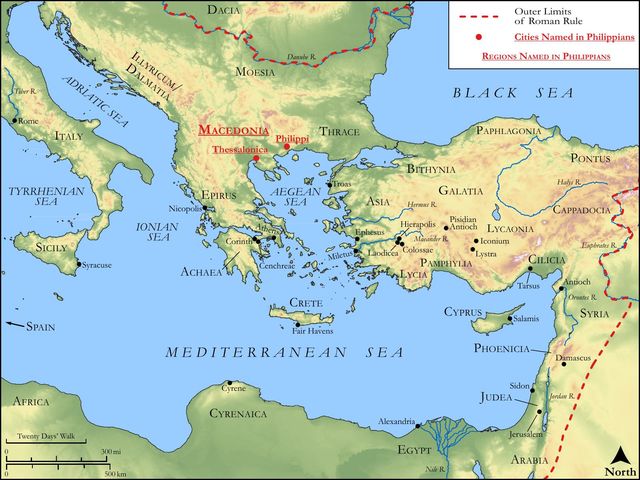
See on the biblical-era map

Study this verse
Public-domain commentary
Matthew Henry
From his Commentary on the Whole Bible. Henry comments on passages, not single verses — this entry covers Philippians 4:10–19. His two-level outline is real structure in the source text, so it is rendered as structure.
In these verses we have the thankful grateful acknowledgment which the apostle makes of the kindness of the Philippians in sending him a present for his support, now that he was a prisoner at Rome. And here,
I.He takes occasion to acknowledge their former kindnesses to him, and to make mention of them, Phi 4:15, Phi 4:16.
Paul had a grateful spirit; for, though what his friends did for him was nothing in comparison of what he deserved from them and the obligations he had laid upon them, yet he speaks of their kindness as if it had been a piece of generous charity, when it was really far short of a just debt. If they had each of them contributed half their estates to him, they had not given him too much, since they owed to him even their own souls; and yet, when they send a small present to him, how kindly does he take it, how thankfully does he mention it, even in this epistle which was to be left upon record, and read in the churches, through all ages; so that wherever this epistle shall be read there shall this which they did to Paul be told for a memorial of them. Surely never was present so well repaid. He reminds them that in the beginning of the gospel no church communicated with him as to giving and receiving but they only, Phi 4:15. They not only maintained him comfortably while he was with them, but when he departed from Macedonia they sent tokens of their kindness after him; and this when no other church did so. None besides sent after him of their carnal things, in consideration of what they had reaped of his spiritual things. In works of charity, we are ready to ask what other people do. But the church of the Philippians never considered that. It redounded so much the more to their honour that they were the only church who were thus just and generous. Even in Thessalonica (after he had departed from Macedonia) you sent once and again to my necessity, Phi 4:16. Observe,
1.It was but little which they sent; they sent only to his necessity, just such things as he had need of; perhaps it was according to their ability, and he did not desire superfluities nor dainties.
2.It is an excellent thing to see those to whom God has abounded in the gifts of his grace abounding in grateful returns to his people and ministers, according to their own ability and their necessity: You sent once and again. Many people make it an excuse for their charity that they have given once; why should the charge come upon them again? But the Philippians sent once and again; they often relieved and refreshed him in his necessities. He makes this mention of their former kindness, not only out of gratitude, but for their encouragement.
II.He excuses their neglect of late.
It seems, for some time they had not sent to enquire after him, or sent him any present; but now at the last their care of him flourished again (Phi 4:10), like a tree in the spring, which seemed all the winter to be quite dead. Now, in conformity to the example of his great Master, instead of upbraiding them for their neglect, he makes an excuse for them: Wherein you were also careful, but you lacked opportunity. How could they lack opportunity, if they had been resolved upon it? They might have sent a messenger on purpose. But the apostle is willing to suppose, in favour of them, that they would have done it if a fair opportunity had offered. How contrary is this to the behaviour of many to their friends, by whom neglects which really are excusable are resented very heinously, when Paul excused that which he had reason enough to resent.
III.He commends their present liberality:
Notwithstanding, you have well done that you did communicate with my affliction, Phi 4:14. It is a good work to succour and help a good minister in trouble. Here see what is the nature of true Christian sympathy; not only to be concerned for our friends in their troubles, but to do what we can to help them. They communicated with his affliction, in relieving him under it. He who says, Be you warmed, be you filled, and giveth not those things they have need of, what doth it profit? Jam 2:16. He rejoiced greatly in it (Phi 4:10), because it was an evidence of their affection to him and the success of his ministry among them. When the fruit of their charity abounded towards the apostle, it appeared that the fruit of his ministry abounded among them.
IV.He takes care to obviate the bad use some might make of his taking so much notice of what was sent him.
It did not proceed either from discontent and distrust (Phi 4:11) or from covetousness and love of the world, Phi 4:12. 1. It did not come from discontent, or distrust of Providence: Not that I speak in respect of want (Phi 4:11); not in respect of any want he felt, nor of any want he feared. As to the former, he was content with the little he had, and that satisfied him; as to the latter, he depended upon the providence of God to provide for him from day to day, and that satisfied him: so that he did not speak in respect of want any way. For I have learned, in whatsoever state I am, therewith to be content. We have here an account of Paul's learning, not that which he got at the feet of Gamaliel, but that which he got at the feet of Christ. He had learnt to be content; and that was the lesson he had as much need to learn as most men, considering the hardships and sufferings with which he was exercised. He was in bonds, and imprisonments, and necessities, often; but in all he had learnt to be content, that is, to bring his mind to his condition, and make the best of it. - I know both how to be abased and I know how to abound, Phi 4:12. This is a special act of grace, to accommodate ourselves to every condition of life, and carry an equal temper of mind through all the varieties of our state. (1.) To accommodate ourselves to an afflicted condition - to know how to be abased, how to be hungry, how to suffer want, so as not to be overcome by the temptations of it, either to lose our comfort in God or distrust his providence, or to take any indirect course for our own supply. (2.) To a prosperous condition - to know how to abound, how to be full, so as not to be proud, or secure, or luxurious. And this is as hard a lesson as the other; for the temptations of fulness and prosperity are not less than those of affliction and want. But how must we learn it? I can do all things through Christ who strengthens me, Phi 4:13. We have need of strength from Christ, to enable us to perform not only those duties which are purely Christian, but even those which are the fruit of moral virtue. We need his strength to teach us to be content in every condition. The apostle had seemed to boast of himself, and of his own strength: I know how to be abased (Phi 4:12); but here he transfers all the praise to Christ. "What do I talk of knowing how to be abased, and how to abound? It is only through Christ who strengthens me that I can do it, not in my own strength." So we are required to be strong in the Lord, and in the power of his might (Eph 6:10), and to be strong in the grace which is in Christ Jesus (Ti2 2:1); and we are strengthened with might by his Spirit in the inner man, Eph 3:16. The word in the original is a participle of the present tense, en tō endunamounti me Christō, and denotes a present and continued act; as if he had said, "Through Christ, who is strengthening me, and does continually strengthen me; it is by his constant and renewed strength I am enabled to act in every thing; I wholly depend upon him for all my spiritual power." 2. It did not come from covetousness, or an affection to worldly wealth: "Not because I desired a gift (Phi 4:17): that is, I welcome your kindness, not because it adds to my enjoyments, but because it adds to your account." He desired not so much for his own sake, but theirs: "I desire fruit that may abound to your account, that is, that you may be enabled to make such a good use of your worldly possessions that you may give an account of them with joy." It is not with any design to draw more from you, but to encourage you to such an exercise of beneficence as will meet with a glorious reward hereafter. "For my part," says he, "I have all, and abound, Phi 4:18. What can a man desire more than enough? I do not desire a gift for the gift's sake, for I have all, and abound." They sent him a small token, and he desired no more; he was not solicitous for a present superfluity, or a future supply: I am full, having received from Epaphroditus the things which were sent by you. Note, A good man will soon have enough of this world; not only of living in it, but of receiving from it. A covetous worldling, if he has ever so much, would still have more; but a heavenly Christian, though he has little, has enough.
V.The apostle assures them that God did accept, and would recompense, their kindness to him.
1.He did accept it: It is an odour of a sweet smell, a sacrifice acceptable, well-pleasing to God. Not a sacrifice of atonement, for none makes atonement for sin but Christ; but a sacrifice of acknowledgment, and well-pleasing to God. It was more acceptable to God as it was the fruit of their grace than it was to Paul as it was the supply of his want. With such sacrifices God is well pleased, Heb 13:16.
2.He would recompense it: But my God shall supply all your wants according to his riches in glory by Christ Jesus, Phi 4:19. He does as it were draw a bill upon the exchequer in heaven, and leaves it to God to make them amends for the kindness they had shown him. "He shall do it, not only as your God, but as my God, who takes what is done to me as done to himself. You supplied my needs, according to your poverty; and he shall supply yours, according to his riches." But still it is by Christ Jesus; through him we have grace to do that which is good, and through him we must expect the reward of it. Not of debt, but of grace; for the more we do for God the more we are indebted to him, because we receive the more from him.
Historical interpretation
Three Centuries of Reception
3 surviving comments on this verse. Each one is dated, so this reads as a timeline rather than a list.
Select a marker to jump to its quote. Markers stagger vertically where authors wrote within a few decades of each other.
I give you these instructions, beloved, assured that ye also hold the same opinions [as I do]. But I guard you beforehand from those beasts in the shape of men, whom you must not only not receive, but, if it be possible, not even meet with; only you must pray to God for them, if by any means they may be brought to repentance, which, however, will be very difficult. Yet Jesus Christ, who is our true life, has the power of [effecting] this. But if these things were done by our Lord only in appearance, then am I also only in appearance bound. And why have I also surrendered myself to death, to fire, to the sword, to the wild beasts? But, [in fact, ] he who is near to the sword is near to God; he that is among the wild beasts is in company with God; provided only he be so m the name of Jesus Christ. I undergo all these things that I may suffer together with Him, He who became a perfect man inwardly strengthening me.
And the divine apostle furnishes the rule for the Gnostic in these words, writing as follows: "For I have learned, in whatsoever state I am, to be content. I know both how to be abased, and I know how to abound. Everywhere and in all things I am instructed both to be full and to be hungry, both to abound and to lack. I can do all things through Him who strengtheneth me."
But since boasting might seem to have a place here, see how quickly he checks up, and says, "I can do all things in Christ that strengtheneth me." The success is not mine own, but His who has given me strength.
Continue studying Philippians 4:13 across the web’s major study libraries — every link below opens this exact verse, chapter, or book on the destination site.
Read & Compare
 BibleGatewayThis verse in more than 200 translations and 70 languages.
 Bible.comThe YouVersion reader — hundreds of translations, reading plans, and highlights.
 ESV.orgCrossway's official English Standard Version reader.
 NET BibleThe NET translation with 60,000+ translators' notes on every rendering decision.
 STEP BibleTyndale House's free study tool — original text, vocabulary, and scholarly resources.
 BibliaLogos Bible Software's free web reader.
 USCCBThe New American Bible (Revised Edition) with the U.S. bishops' study notes.
Commentaries
 BibleHub CommentariesDozens of classic commentaries on this verse, gathered on one page.
 StudyLightMore than 100 commentary sets — the largest collection on the web.
 BibleRefPlain-English commentary on what this verse means, verse by verse.
 Enduring WordDavid Guzik's free commentary on this chapter, widely used by Bible teachers.
 Bible Study ToolsVerse commentary alongside Greek and Hebrew study aids.
Original Language & Research
- BibleHub InterlinearThe verse word by word — original language, transliteration, and English.
- BibleHub LexiconEvery word's original-language definition and Strong's entry.
 Blue Letter BibleDeep-study tools — Strong's numbers, concordance, and word studies.
 CNTR CollationThe earliest Greek manuscripts of this verse, collated letter by letter.
Sermons, Hymns & Audio


TrulyRandomVerse is not affiliated with these sites and doesn’t control their content. They’re linked because they’re genuinely useful.
Summary
Philippians 4:13 is a profound declaration by the Apostle Paul, asserting his capability to navigate and endure all circumstances—whether abundance or scarcity, strength or weakness—not through his own inherent power, but solely by means of the empowering presence and strength supplied by Jesus Christ. This verse serves as the theological bedrock for Paul's contentment and resilience, redirecting the source of human ability from self to the divine enablement of Christ.
Context
ShowHideLiterary Context
This powerful statement concludes a section (Philippians 4:10-12) where Paul expresses profound gratitude to the Philippian church for their financial support, which had recently reached him. Far from being a mere thank-you note, Paul uses this opportunity to share a profound spiritual truth he had learned: the secret of contentment in every conceivable situation. He states, "Not that I speak in respect of want: for I have learned, in whatsoever state I am, therewith to be content. I know both how to be abased, and I know how to abound: every where and in all things I am instructed both to be full and to be hungry, both to abound and to suffer need" (Philippians 4:11-12). Philippians 4:13, therefore, is not a standalone promise for any personal ambition, but the theological explanation for his learned contentment and his ability to do or endure all these varied experiences. It grounds his spiritual resilience in Christ, presenting a counter-cultural perspective on self-sufficiency.
Historical & Cultural Context
Paul wrote the Epistle to the Philippians while imprisoned, likely in Rome (c. A.D. 60-62). His circumstances were precarious, ranging from periods of relative freedom to strict confinement, and he was dependent on the generosity of others, like the Philippians, for his physical needs. In the Greco-Roman world, philosophers often lauded self-sufficiency (autarkeia) as the pinnacle of human wisdom and virtue, achieved through rigorous self-discipline and mastery over external circumstances. Paul, however, redefines "autarkeia" not as an inherent human quality but as a divine enablement. His ability to "be content" (the very word used for self-sufficiency) is explicitly "through Christ," directly challenging the prevailing pagan philosophical ideals by rooting true contentment and capability in a relationship with the divine rather than in human effort alone. This context highlights the radical nature of Paul's declaration.
Key Themes
ShowHidePhilippians 4:13 contributes significantly to several major themes within the letter and Paul's broader theology. First, it underscores the theme of Christ-sufficiency, asserting that the believer's strength and capability are derived entirely from Christ, not from personal merit or resolve. This contrasts sharply with humanistic notions of self-reliance. Second, it reinforces the theme of joy in all circumstances, a pervasive motif in Philippians, demonstrating that true joy is not contingent on external conditions but on an internal, Christ-empowered resilience. Paul's own life exemplified this, as he wrote from prison, urging the Philippians to "Rejoice in the Lord always: and again I say, Rejoice" (Philippians 4:4). Third, the verse speaks to divine enablement for ministry and endurance, indicating that the "all things" Paul can do include enduring hardship, fulfilling his apostolic calling, and living a life of faithful obedience, even amidst suffering. It is a declaration of spiritual empowerment for the purpose of living out God's will, echoing similar sentiments found in passages like 2 Corinthians 12:9-10, where God's strength is perfected in human weakness.
Exposition and Analysis
ShowHideKey Word Analysis
ShowHideMeaning "to have (or exercise) force (literally or figuratively); to be able, avail, can do(-not), could, be good, might, prevail, be of strength, be whole, + much work." This word denotes an inherent capacity or ability. Paul is declaring a genuine, active capability, not merely a passive endurance. It implies the power to accomplish, to be strong enough, and to prevail over circumstances.
A primary preposition denoting "fixed position (in place, time or state), and (by implication) instrumentality (medially or constructively), i.e. a relation of rest (intermediate between εἰς and ἐκ); 'in,' at, (up-)on, by, etc." This small but crucial word indicates the sphere or source of Paul's power. He doesn't just do things with Christ's help, but in or by means of Christ. It points to a deep, abiding union with Christ as the enabling environment for his strength, highlighting a profound dependence rather than a mere external assistance.
Meaning "to empower; enable, (increase in) strength(-en), be (make) strong." This verb emphasizes the active role of Christ in infusing power into Paul. It is a continuous action (present participle in Greek), signifying that Christ is constantly empowering him. This strength is not self-generated but is an external, divine impartation, making Paul capable of what he otherwise could not do.
Verse Breakdown
ShowHide"I can do all things"
This initial declaration establishes Paul's comprehensive capability. The phrase "all things" (Greek, panta) should be understood within the immediate literary context of Philippians 4:11-12, referring specifically to the ability to be content and to endure in every state—whether abased or abounding, hungry or full. It is not a blanket promise for accomplishing any personal desire or worldly ambition, but rather for fulfilling God's will and enduring life's varied circumstances as a faithful follower of Christ.
"through Christ"
This is the instrumental clause that immediately qualifies and explains the source of Paul's "can do." The preposition "through" (Greek, en) signifies a deep, internal connection and instrumentality. Paul's ability does not originate from himself but flows from his union with Christ. It is a relationship of dependence, where Christ is the enabling power, the sphere in which Paul operates, and the means by which he is empowered.
"which strengtheneth me"
This participial phrase further specifies how Christ enables Paul. The Greek verb endynamóō (strengtheneth) signifies an active, ongoing process of empowerment. Christ is continuously infusing strength into Paul, making him capable. This is not a one-time event but a sustained divine provision of power, enabling Paul to face whatever comes his way with resilience and faithfulness.
Literary Devices
ShowHidePhilippians 4:13 employs several literary devices that enhance its impact and meaning. The phrase "all things" can be understood as Hyperbole, a deliberate exaggeration for emphasis. While Paul is not claiming omnipotence, the hyperbole effectively conveys the comprehensive scope of Christ's enabling power in the context of his life and ministry. The verse also demonstrates powerful Emphasis through its structure, placing "through Christ which strengtheneth me" as the crucial qualifier that reorients the source of strength from human effort to divine intervention. This creates a strong Contrast with any notion of self-reliance, highlighting the radical dependence of the believer on Christ. Furthermore, as a direct, first-person statement ("I can do"), it serves as a powerful Personal Declaration and Testimony, making the theological truth relatable and deeply personal.
Theological and Thematic Connections
ShowHidePhilippians 4:13 stands as a foundational text for understanding Christian empowerment. It teaches us that true spiritual strength is not inherent in human nature but is a divine impartation, flowing from an intimate union with Jesus Christ. This strength enables believers not only to endure hardship but also to live faithfully, fulfill God's purposes, and maintain spiritual contentment regardless of external circumstances. It refutes the idea of self-sufficiency as a Christian virtue, replacing it with Christ-sufficiency, where our weakness becomes the very canvas upon which God's perfect power is displayed. This verse underscores the reality of the indwelling Christ, who actively empowers believers for every good work and for enduring every trial, transforming our limitations into opportunities for His glory.
Reflection and Application
ShowHidePhilippians 4:13 offers profound encouragement and a vital reorientation for the believer's life. It reminds us that our capacity to face life's myriad challenges—from mundane tasks to overwhelming trials, from resisting temptation to pursuing God-given callings—is not dependent on our own finite resources, but on the limitless power of Christ actively at work within us. This truth liberates us from the burden of self-reliance and the despair of inadequacy, inviting us instead to lean fully on the One who is truly sufficient. It calls us to cultivate a deeper reliance on Christ through prayer, Scripture, and communion, recognizing that every step of obedience and every act of endurance is a testament to His empowering presence. This verse does not promise an easy path, but it assures us of an unfailing source of strength for whatever path God calls us to walk.
Questions for Reflection
ShowHideFAQ
ShowHideDoes Philippians 4:13 mean I can achieve any goal I set, like winning the lottery or becoming a famous athlete?
ShowHideNo, this verse is often misinterpreted as a blank check for personal ambition or worldly success. The immediate context (Philippians 4:11-12) clarifies that Paul is speaking about his ability to be content and endure in all circumstances—whether in abundance or in need, hunger or fullness. He is referring to the spiritual strength to live faithfully and fulfill God's will despite external conditions, not a guarantee of achieving any personal desire. The "all things" refers to the comprehensive range of experiences and duties within God's divine plan, enabled by Christ's power, not the fulfillment of every human whim.
How does Christ "strengthen" believers? Is it a feeling, or something more tangible?
ShowHideChrist strengthens believers through multiple facets of His work and presence. Primarily, it is through the indwelling Holy Spirit, whom Christ sent to empower His followers (e.g., Acts 1:8). This strengthening is not merely a feeling, though it can bring peace and courage. It is a tangible enablement that manifests as spiritual resilience, moral fortitude, wisdom for decision-making, perseverance in trials, and the capacity to obey God's commands even when difficult. It is also found in the grace He provides through His Word and through the community of believers (e.g., Ephesians 3:16).
If I can do "all things" through Christ, why do I still struggle with sin or weakness?
ShowHideThe strength provided by Christ is for living a life of faithful obedience and endurance, not for eliminating the human struggle with sin or the reality of our inherent weakness. Paul himself acknowledged his ongoing battle with sin (e.g., Romans 7:15-25) and even gloried in his weaknesses because it was there that Christ's power was most evident (e.g., 2 Corinthians 12:9-10). The "all things" refers to the ability to persevere through these struggles, to resist temptation, to grow in holiness, and to find contentment even amidst personal failings, by continually drawing on Christ's empowering grace. It's about His strength being perfected in our weakness, not our weakness being eradicated.
Christ-Centered Fulfillment
ShowHidePhilippians 4:13 finds its ultimate fulfillment and deepest meaning in the person and work of Jesus Christ. He is not merely a distant helper but the very source and substance of the strength Paul proclaims. Christ, as the incarnate Son of God, perfectly demonstrated what it means to live a life fully dependent on the Father, enduring unimaginable suffering and temptation, yet remaining faithful "unto death, even the death of the cross" (Philippians 2:8). His resurrection from the dead is the ultimate display of divine power, a power now made available to believers through their union with Him. When Paul declares, "I can do all things through Christ," he is testifying to the reality of the Risen Christ indwelling him by the Holy Spirit, enabling him to partake in Christ's own victory and resilience. This strength is not just for personal endurance but empowers believers to live out the very life of Christ—to love, to serve, to forgive, and to proclaim the Gospel—just as Christ Himself was empowered to accomplish His redemptive mission. Our ability to overcome sin, endure trials, and fulfill God's calling is a direct outflow of Christ's finished work on the cross and His ongoing intercession and empowerment from the right hand of God (Hebrews 7:25). Thus, Philippians 4:13 is a profound declaration of the believer's complete sufficiency in Christ, who is "able to do exceeding abundantly above all that we ask or think, according to the power that worketh in us" (Ephesians 3:20).