


2 Corinthians 12:10
- διὸdioThereforeG1352CONJConjunction
- εὐδοκῶeudokōI take pleasureG2106V-PAI-1SVerb Present Active Indicative 1st Singular
- ἐνeninG1722PREPPreposition
- ἀσθενείαιςastheneiaisweaknessesG769N-DPFNoun Dative Plural Feminine
- ἐνeninG1722PREPPreposition
- ὕβρεσινhubresininsultsG5196N-DPFNoun Dative Plural Feminine
- ἐνeninG1722PREPPreposition
- ἀνάγκαιςanagkaishardshipsG318N-DPFNoun Dative Plural Feminine
- ἐνeninG1722PREPPreposition
- διωγμοῖςdiōgmoispersecutionsG1375N-DPMNoun Dative Plural Masculine
- καὶkaiandG2532CONJConjunction
- στενοχωρίαιςstenochōriaisdifficultiesG4730N-DPFNoun Dative Plural Feminine
- ὑπὲρhuperforG5228PREPPreposition
- Χριστοῦ·ChristouChristG5547N-GSM-TNoun Genitive Singular Masculine Title
- ὅτανhotanwhenG3752CONJConjunction
- γὰρgarforG1063CONJConjunction
- ἀσθενῶasthenōI may be weakG770V-PAS-1SVerb Present Active Subjunctive 1st Singular
- τότεtotethenG5119ADVAdverb
- δυνατόςdunatosstrongG1415A-NSMAdjective Nominative Singular Masculine
- εἰμιeimiI amG1510V-PAI-1SVerb Present Active Indicative 1st Singular
English is a literal word-by-word gloss of the Greek, not the KJV's wording. Why?
This is the original text the KJV's translators worked from — each Greek word with its own literal English meaning in this verse, prepared by scholars at Tyndale House, Cambridge. The KJV translates whole sentences, not word by word, so its wording differs: one Greek word can become several English words, and the KJV may choose “charity” where the gloss reads “love”. Both are faithful — they answer different questions. For the KJV's own rendering, switch to the KJV text.
Details
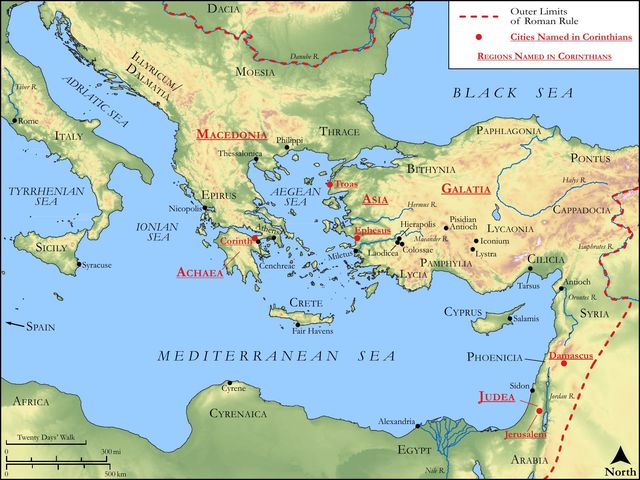
See on the biblical-era map

Study this verse
Public-domain commentary
Matthew Henry
From his Commentary on the Whole Bible. Henry comments on passages, not single verses — this entry covers 2 Corinthians 12:1–10. His three-level outline is real structure in the source text, so it is rendered as structure.
Here we may observe,
I.The narrative the apostle gives of the favours God had shown him, and the honour he had done him; for doubtless he himself is the man in Christ of whom he speaks. Concerning this we may take notice,
1.Of the honour itself which was done to the apostle: he was caught up into the third heaven, Co2 12:2. When this was we cannot say, whether it was during those three days that he lay without sight at his conversion or at some other time afterwards, much less can we pretend to say how this was, whether by a separation of his soul from his body or by an extraordinary transport in the depth of contemplation. It would be presumption for us to determine, if not also to enquire into, this matter, seeing the apostle himself says, Whether in the body or out of the body, I cannot tell. It was certainly a very extraordinary honour done him: in some sense he was caught up into the third heaven, the heaven of the blessed, above the aerial heaven, in which the fowls fly, above the starry heaven, which is adorned with those glorious orbs: it was into the third heaven, where God most eminently manifests his glory. We are not capable of knowing all, nor is it fit we should know very much, of the particulars of that glorious place and state; it is our duty and interest to give diligence to make sure to ourselves a mansion there; and, if that be cleared up to us, then we should long to be removed thither, to abide there for ever. This third heaven is called paradise (Co2 12:4), in allusion to the earthly paradise out of which Adam was driven for his transgression; it is called the paradise of God (Rev 2:7), signifying to us that by Christ we are restored to all the joys and honours we lost by sin, yea, to much better. The apostle does not mention what he saw in the third heaven or paradise, but tells us that he heard unspeakable words, such as it is not possible for a man to utter - such are the sublimity of the matter and our unacquaintedness with the language of the upper world: nor was it lawful to utter those words, because, while we are here in this world, we have a more sure word of prophecy than such visions and revelations. Pe2 1:19. We read of the tongue of angels as well as men, and Paul knew as much of that as ever any man upon earth did, and yet preferred charity, that is, the sincere love of God and our neighbour. This account which the apostle gives us of his vision should check our curious desires after forbidden knowledge, and teach us to improve the revelation God has given us in his word. Paul himself, who had been in the third heaven, did not publish to the world what he had heard there, but adhered to the doctrine of Christ: on this foundation the church is built, and on this we must build our faith and hope.
2.The modest and humble manner in which the apostle mentions this matter is observable. One would be apt to think that one who had had such visions and revelations as these would have boasted greatly of them; but, says he, It is not expedient for me doubtless to glory, Co2 12:1. He therefore did not mention this immediately, nor till above fourteen years after, Co2 12:2. And then it is not without some reluctancy, as a thing which in a manner he was forced to by the necessity of the case. Again, he speaks of himself in the third person, and does not say, I am the man who was thus honoured above other men. Again, his humility appears by the check he seems to put upon himself (Co2 12:6), which plainly shows that he delighted not to dwell upon this theme. Thus was he, who was not behind the chief of the apostles in dignity, very eminent for his humility. Note, It is an excellent thing to have a lowly spirit in the midst of high advancements; and those who abase themselves shall be exalted.
II.The apostle gives an account of the methods God took to keep him humble, and to prevent his being lifted up above measure; and this he speaks of to balance the account that was given before of the visions and revelations he had had. Note, When God's people communicate their experiences, let them always remember to take notice of what God has done to keep them humble, as well as what he has done in favour to them and for their advancement. Here observe,
1.The apostle was pained with a thorn in the flesh, and buffeted with a messenger of Satan, Co2 12:7. We are much in the dark what this was, whether some great trouble or some great temptation. Some think it was an acute bodily pain or sickness; others think it was the indignities done him by the false apostles, and the opposition he met with from them, particularly on the account of his speech, which was contemptible. However this was, God often brings this good out of evil, that the reproaches of our enemies help to hide pride from us; and this is certain, that what the apostle calls a thorn in his flesh was for a time very grievous to him: but the thorns Christ wore for us, and with which he was crowned, sanctify and make easy all the thorns in the flesh we may at any time be afflicted with; for he suffered, being tempted, that he might be able to succour those that are tempted. Temptations to sin are most grievous thorns; they are messengers of Satan, to buffet us. Indeed it is a great grievance to a good man to be so much as tempted to sin.
2.The design of this was to keep the apostle humble: Lest he should be exalted above measure, Co2 12:7. Paul himself knew he had not yet attained, neither was already perfect; and yet he was in danger of being lifted up with pride. If God love us, he will hide pride from us, and keep us from being exalted above measure; and spiritual burdens are ordered, to cure spiritual pride. This thorn in the flesh is said to be a messenger of Satan, which he did not send with a good design, but on the contrary, with ill intentions, to discourage the apostle (who had been so highly favoured of God) and hinder him in his work. But God designed this for good, and he overruled it for good, and made this messenger of Satan to be so far from being a hindrance that it was a help to the apostle.
3.The apostle prayed earnestly to God for the removal of this sore grievance. Note, Prayer is a salve for every sore, a remedy for every malady; and when we are afflicted with thorns in the flesh we should give ourselves to prayer. Therefore we are sometimes tempted that we may learn to pray. The apostle besought the Lord thrice, that it might depart from him, Co2 12:8. Note, Though afflictions are sent for our spiritual benefit, yet we may pray to God for the removal of them: we ought indeed to desire also that they may reach the end for which they are designed. The apostle prayed earnestly, and repeated his requests; he besought the Lord thrice, that is, often. So that if an answer be not given to the first prayer, nor to the second, we must hold on, and hold out, till we receive an answer. Christ himself prayed to his Father thrice. As troubles are sent to teach us to pray, so they are continued to teach us to continue instant in prayer.
4.We have an account of the answer given to the apostle's prayer, that, although the trouble was not removed, yet an equivalent should be granted: My grace is sufficient for thee. Note,
(1.)Though God accepts the prayer of faith, yet he does not always answer it in the letter; as he sometimes grants in wrath, so he sometimes denies in love.
(2.)When God does not remove our troubles and temptations, yet, if he gives us grace sufficient for us, we have no reason to complain, nor to say that he deals ill by us. It is a great comfort to us, whatever thorns in the flesh we are pained with, that God's grace is sufficient for us. Grace signifies two things: - [1.] The good-will of God towards us, and this is enough to enlighten and enliven us, sufficient to strengthen and comfort us, to support our souls and cheer up our spirits, in all afflictions and distresses. [2.] The good work of God in us, the grace we receive from the fulness that is in Christ our head; and from him there shall be communicated that which is suitable and seasonable, and sufficient for his members. Christ Jesus understands our case, and knows our need, and will proportion the remedy to our malady, and not only strengthen us, but glorify himself. His strength is made perfect in our weakness. Thus his grace is manifested and magnified; he ordains his praise out of the mouths of babes and sucklings.
III.Here is the use which the apostle makes of this dispensation:
He gloried in his infirmities (Co2 12:9), and took pleasure in them, Co2 12:10. He does not mean his sinful infirmities (those we have reason to be ashamed of and grieved at), but he means his afflictions, his reproaches, necessities, persecutions, and distresses for Christ's sake, Co2 12:10. And the reason of his glory and joy on account of these things was this - they were fair opportunities for Christ to manifest the power and sufficiency of his grace resting upon him, by which he had so much experience of the strength of divine grace that he could say, When I am weak, then am I strong. This is a Christian paradox: when we are weak in ourselves, then we are strong in the grace of our Lord Jesus Christ; when we see ourselves weak in ourselves, then we go out of ourselves to Christ, and are qualified to receive strength from him, and experience most of the supplies of divine strength and grace.
Historical interpretation
Two Centuries of Reception
7 surviving comments on this verse. Each one is dated, so this reads as a timeline rather than a list.
Select a marker to jump to its quote. Markers stagger vertically where authors wrote within a few decades of each other.
And if these severities will seem to be more grievous than martyrdoms, yet once more he says: "Therefore I take pleasure in infirmities, in reproaches, in necessities, in persecutions, in distresses for Christ's sake." He also says, in verses occurring in a previous part of the epistle: "Our condition is such, that we are troubled on every side, yet not distressed; and are in need, but not in utter want; since we are harassed by persecutions, but not forsaken; it is such that we are east down, but not destroyed; always bearing about in our body the dying of Christ.
Plainly, a Christian will "glory" even in the flesh; but (it will be) when it has endured laceration for Christ's sake, in order that the spirit may be crowned in it, not in order that it may draw the eyes and sighs of youths after it.
Not in the amount of money, not in the pride of power, not in the height of glory is victory gained, but the Lord freely gives his help to those who seek him through excessive affliction. Such was Paul, who made his afflictions his boast. Therefore he was able to say, “When I am weak, then I am strong.” … Do you see where affliction leads you? To hope that does not disappoint..
This weakness is mighty in Christ, as the Apostle has said, When I am weak, then I am strong. This humility excludes frailty.
Where affliction is, there is also consolation; where consolation, there is grace also. For instance when he was thrown into the prison, then it was he wrought those marvellous things; when he was shipwrecked and cast away upon that barbarous country, then more than ever was he glorified. When he went bound into the judgment-hall, then he overcame even the judge. And so it was too in the Old Testament; by their trials the righteous flourished. So it was with the three children, so with Daniel, with Moses, and Joseph; thence did they all shine and were counted worthy of great crowns. For then the soul also is purified, when it is afflicted for God's sake: it then enjoys greater assistance as needing more help and worthy of more grace. And truly, before the reward which is proposed to it by God, it reaps a rich harvest of good things by becoming philosophic. For affliction rends pride away and prunes out all listlessness and exerciseth unto patience: it revealeth the meanness of human things and leads unto much philosophy. For all the passions give way before it, envy, emulation, lust, rule desire of riches, of beauty, boastfulness, pride, anger; and the whole remaining swarm of these distempers. And if thou desirest to see this in actual working, I shall be able to show thee both a single individual and a whole people, as well under affliction as at ease; and so to teach thee how great advantage cometh of the one, and how great listlessness from the other.
"Wherefore I take pleasure in many weaknesses." Of what sort? tell me. "In injuries, in persecutions, in necessities, in distresses."
Seest thou how he has now revealed it in the clearest manner? For in mentioning the species of the infirmity he spake not of fevers, nor any return of that sort, nor any other bodily ailment, but of "injuries, persecutions, distresses." Seest thou a single-minded soul? He longs to be delivered from those dangers; but when he heard God's answer that this befitteth not, he was not only not sorry that he was disappointed of his prayer, but was even glad. Wherefore he said, "I take pleasure," 'I rejoice, I long, to be injured, persecuted, distressed for Christ's sake.' And he said these things both to check those, and to raise the spirits of these that they might not be ashamed at Paul's sufferings. For that ground was enough to make them shine brighter than all men. Then he mentions another reason also.
"For when I am weak, then am I strong." 'Why marvellest thou that the power of God is then conspicuous? I too am strong "then;"' for then most of all did grace come upon him. "For as His sufferings abound, so doth our consolation abound also."
Paul does not say that he enjoyed these things but that he had learned to cope with them.
Continue studying 2 Corinthians 12:10 across the web’s major study libraries — every link below opens this exact verse, chapter, or book on the destination site.
Read & Compare
 BibleGatewayThis verse in more than 200 translations and 70 languages.
 Bible.comThe YouVersion reader — hundreds of translations, reading plans, and highlights.
 ESV.orgCrossway's official English Standard Version reader.
 NET BibleThe NET translation with 60,000+ translators' notes on every rendering decision.
 STEP BibleTyndale House's free study tool — original text, vocabulary, and scholarly resources.
 BibliaLogos Bible Software's free web reader.
 USCCBThe New American Bible (Revised Edition) with the U.S. bishops' study notes.
Commentaries
 BibleHub CommentariesDozens of classic commentaries on this verse, gathered on one page.
 StudyLightMore than 100 commentary sets — the largest collection on the web.
 BibleRefPlain-English commentary on what this verse means, verse by verse.
 Enduring WordDavid Guzik's free commentary on this chapter, widely used by Bible teachers.
 Bible Study ToolsVerse commentary alongside Greek and Hebrew study aids.
Original Language & Research
- BibleHub InterlinearThe verse word by word — original language, transliteration, and English.
- BibleHub LexiconEvery word's original-language definition and Strong's entry.
 Blue Letter BibleDeep-study tools — Strong's numbers, concordance, and word studies.
 CNTR CollationThe earliest Greek manuscripts of this verse, collated letter by letter.
Sermons, Hymns & Audio


TrulyRandomVerse is not affiliated with these sites and doesn’t control their content. They’re linked because they’re genuinely useful.
Summary
In 2 Corinthians 12:10, the Apostle Paul articulates a profound spiritual paradox: finding joy and strength in the midst of suffering and weakness endured for Christ's sake. This verse serves as a powerful summation of his theological understanding that God's power is most clearly manifested not through human strength or self-sufficiency, but precisely through human frailty and vulnerability, thereby ensuring that all glory redounds to God alone.
Context
ShowHideLiterary Context
This verse is the climactic declaration following Paul's deeply personal and vulnerable account of his "thorn in the flesh" in 2 Corinthians 12:7-9. Having been granted extraordinary revelations, Paul was given this mysterious affliction to prevent him from becoming conceited. He recounts his fervent pleas to the Lord to remove it, only to receive the divine answer: "My grace is sufficient for thee: for my strength is made perfect in weakness" (2 Corinthians 12:9). Verse 10 is Paul's immediate and joyful embrace of this divine principle, transitioning from a plea for relief to a profound acceptance and even "pleasure" in his weaknesses, understanding them as conduits for God's power. It stands as a testament to his authentic apostleship, contrasting with the self-aggrandizing claims of false apostles in Corinth.
Historical & Cultural Context
The Corinthian church, to whom Paul writes, was heavily influenced by Greco-Roman culture, which highly valued strength, eloquence, worldly wisdom, and social status. In this environment, weakness, suffering, and humility were often seen as signs of failure or divine disfavor. Paul's opponents in Corinth likely boasted of their own impressive credentials and abilities, implicitly or explicitly criticizing Paul's apparent lack of these qualities, his physical ailments, and his experiences of hardship. Paul's declaration in 2 Corinthians 12:10 directly challenges these cultural norms and the false apostles' self-exalting theology. He redefines strength not as human capability but as divine power made manifest through human weakness, a concept utterly counter-cultural and scandalous to many in his audience.
Key Themes
ShowHideThe central theme is the Paradox of Strength in Weakness, a cornerstone of Paul's theology. This theme directly confronts worldly notions of power, asserting that true spiritual efficacy is found not in human self-sufficiency but in utter dependence on God. When human resources are exhausted, divine power flows unhindered, making God's glory evident, as seen in 1 Corinthians 1:27-29. Another key theme is Joy in Suffering for Christ. Paul's "pleasure" in various hardships is not masochism but a transcendent joy rooted in the knowledge that these trials are endured "for Christ's sake," uniting him with Christ's own sufferings and advancing the Kingdom. This perspective on Christian suffering is echoed throughout his epistles, notably in Romans 5:3-5, where he speaks of boasting in tribulations. Lastly, the verse highlights the Sufficiency of God's Grace and Power, emphasizing that God's strength is not merely adequate but "perfected" (made complete) in human frailty, ensuring that God alone receives the glory.
Exposition and Analysis
ShowHideKey Word Analysis
ShowHideThis word (G2106) means "to think well of, i.e., approve (an act); specially, to approbate (a person or thing)." Paul's "pleasure" is not a superficial happiness but a deep, settled approval and contentment with his circumstances, recognizing them as divinely ordained opportunities for God's power to be displayed. It signifies a profound spiritual alignment with God's will, even when that will involves hardship.
This term (G769) denotes "feebleness (of mind or body); by implication, malady; morally, frailty." It encompasses physical ailments, emotional vulnerabilities, and general human limitations. Paul's willingness to embrace these "infirmities" underscores his understanding that God's strength is made perfect precisely in these areas of human weakness.
This adjective (G1415) means "powerful or capable (literally or figuratively); neuter possible." When Paul declares, "then am I strong," he is not referring to a newfound human resilience but to the divine power and capability that indwells and works through him, enabling him to accomplish God's purposes despite his weaknesses. This strength is God's, not his own.
Verse Breakdown
ShowHide"Therefore I take pleasure in infirmities, in reproaches, in necessities, in persecutions, in distresses for Christ's sake:"
Paul begins with "Therefore" (G1352, dió), linking this declaration directly to the Lord's revelation in the preceding verse. His "pleasure" (G2106, eudokéō) is a deliberate, joyful acceptance, not a passive endurance, of a litany of hardships: "infirmities" (G769, asthéneia - physical weakness, sickness), "reproaches" (G5196, hýbris - insults, indignities), "necessities" (G318, anánkē - unavoidable hardships, severe pressure), "persecutions" (G1375, diōgmós - active harassment for faith), and "distresses" (G4730, stenochōría - extreme pressure, anguish). The crucial qualifier "for Christ's sake" (G5228, hypér Christós) transforms these trials from mere suffering into purposeful participation in the redemptive work of Christ.
"for when I am weak, then am I strong."
This second clause, introduced by "for" (G1063, gár), provides the theological rationale for Paul's paradoxical pleasure. The word "weak" (G770, asthenéō) refers to his state of human feebleness and vulnerability. The phrase "then am I strong" (G5119, tóte G1510, eimí G1415, dynatós) reveals the divine exchange: it is precisely when Paul's human strength is depleted and his reliance on God is absolute that God's omnipotent power (G1415, dynatós) is fully manifested through him. This is not a human achievement but a divine enablement.
Literary Devices
ShowHideThe most prominent literary device in 2 Corinthians 12:10 is Paradox. Paul's statement, "for when I am weak, then am I strong," presents a seemingly contradictory truth that defies conventional logic. It highlights a divine principle where human insufficiency becomes the very condition for divine sufficiency, challenging the world's understanding of power and success. This paradox is further emphasized by the Juxtaposition of Paul taking "pleasure" in a list of negative experiences (infirmities, reproaches, necessities, persecutions, distresses). This stark contrast underscores the counter-intuitive nature of the Christian life, where suffering for Christ's sake is transformed into a source of joy and spiritual empowerment. The verse also functions as a powerful Personal Testimony, providing Paul's firsthand witness to the truth of God's grace and strength, making the theological concept deeply relatable and impactful.
Theological and Thematic Connections
ShowHidePaul's declaration in 2 Corinthians 12:10 is a profound theological statement on the nature of God's power and human dependence. It asserts that God's strength is not merely a supplement to human ability but is perfected and fully displayed in human weakness. This principle ensures that all glory belongs to God, preventing human boasting and fostering radical reliance on divine grace. It redefines suffering, transforming it from a punitive experience into a purposeful pathway for spiritual growth, Christ-like conformity, and the demonstration of God's surpassing power. This theological truth liberates believers from the pressure to appear strong or self-sufficient, inviting them instead to embrace their limitations as opportunities for God to work mightily through them.
Reflection and Application
ShowHideFor believers today, 2 Corinthians 12:10 offers immense encouragement and a transformative perspective on personal struggles. Instead of despairing over our weaknesses—be they physical limitations, emotional vulnerabilities, financial hardships, or spiritual struggles—we are invited to see them as fertile ground for God's strength to flourish. This verse calls us to move beyond a performance-based faith and embrace a radical dependence on God's grace. It teaches us that true spiritual power is found not in our self-sufficiency but in our utter reliance on Christ, allowing His divine power to be made perfect in our imperfections. When we are weak, we are reminded of our need for God, and it is in that very space of need that His power can most profoundly manifest, bringing glory to His name and building unwavering trust in His provision.
Questions for Reflection
ShowHideFAQ
ShowHideWhat was Paul's "thorn in the flesh" mentioned in the preceding verses?
ShowHideWhile 2 Corinthians 12:7 explicitly mentions Paul's "thorn in the flesh," its exact nature remains a mystery. Scholars have proposed various possibilities, including a chronic physical illness (like an eye ailment or malaria), a speech impediment, persistent opposition from false teachers, or even spiritual attacks. Paul deliberately leaves it unnamed, perhaps to allow every believer to identify their own "thorn"—whatever persistent weakness or affliction God allows for their humility and reliance on His grace. The specific nature is less important than its divine purpose: to keep Paul humble and to demonstrate that God's strength is made perfect in weakness, as stated in 2 Corinthians 12:9.
Does this verse mean Christians should actively seek out suffering or weakness?
ShowHideNo, 2 Corinthians 12:10 does not advocate for masochism or intentionally seeking out suffering. Instead, it teaches us how to respond when suffering and weakness inevitably come our way, especially "for Christ's sake." Paul's "pleasure" is not in the pain itself, but in the divine purpose and outcome of that pain—that through it, Christ's power is revealed. The Christian life, by its very nature, involves trials and opposition (see John 16:33 and 1 Peter 4:12-13). The verse encourages us to embrace these inevitable hardships with a God-centered perspective, recognizing them as opportunities for deeper reliance on Him and for His strength to be magnified.
Christ-Centered Fulfillment
ShowHide2 Corinthians 12:10 finds its ultimate Christ-centered fulfillment in the person and work of Jesus Himself. Christ, though fully God, willingly emptied Himself, taking on the form of a servant and becoming obedient to death, even death on a cross (Philippians 2:5-8). His ultimate act of weakness and vulnerability on the cross, where He bore the sins of humanity, was precisely the means through which God's ultimate power and victory over sin and death were achieved. The crucifixion, a symbol of profound weakness and humiliation, became the very instrument of God's strength and salvation. Jesus's identification with human suffering and weakness (Hebrews 4:15) allows Him to perfectly sympathize with our infirmities. Thus, Paul's experience of strength in weakness is a participation in the pattern of Christ's own life, death, and resurrection. Through Christ, believers are empowered to find joy in their weaknesses, knowing that His life-giving power is made perfect in their frailty, enabling them to live lives that reflect the triumph of the Lamb of God (Revelation 5:12).