


Romans 8:28
Bible text: King James Version (1769 Blayney text) · Public domain
Bible text: Berean Standard Bible · Public domain
Bible text: American Standard Version (1901) · Public domain
Bible text: World English Bible, Messianic edition · Public domain
Bible text: Geneva Bible (1599) · Public domain
Bible text: Young's Literal Translation · Public domain
- ΟἴδαμενOidamenWe knowG1492V-RAI-1PVerb Perfect Active Indicative 1st Plural
- δὲdenowG1161CONJConjunction
- ὅτιhotithatG3754CONJConjunction
- τοῖςtoisto thoseG3588T-DPMDefinite article Dative Plural Masculine
- ἀγαπῶσινagapōsinlovingG25V-PAP-DPMVerb Present Active Participle Dative Plural Masculine
- τὸνton<the>G3588T-ASMDefinite article Accusative Singular Masculine
- θεὸνtheonGodG2316N-ASM-TNoun Accusative Singular Masculine Title
- πάνταpantaall thingsG3956A-APNAdjective Accusative Plural Neuter
- συνεργεῖsunergeiworks togetherG4903V-PAI-3SVerb Present Active Indicative 3rd Singular
- εἰςeisforG1519PREPPreposition
- ἀγαθόνagathongoodG18A-ASNAdjective Accusative Singular Neuter
- τοῖςtoisto thoseG3588T-DPMDefinite article Dative Plural Masculine
- κατὰkataaccording toG2596PREPPreposition
- πρόθεσινprothesin[His] purposeG4286N-ASFNoun Accusative Singular Feminine
- κλητοῖςklētoiscalledG2822A-DPMAdjective Dative Plural Masculine
- οὖσινousinbeingG1510V-PAP-DPMVerb Present Active Participle Dative Plural Masculine
English is a literal word-by-word gloss of the Greek, not the KJV's wording. Why?
This is the original text the KJV's translators worked from — each Greek word with its own literal English meaning in this verse, prepared by scholars at Tyndale House, Cambridge. The KJV translates whole sentences, not word by word, so its wording differs: one Greek word can become several English words, and the KJV may choose “charity” where the gloss reads “love”. Both are faithful — they answer different questions. For the KJV's own rendering, switch to the KJV text.
Details
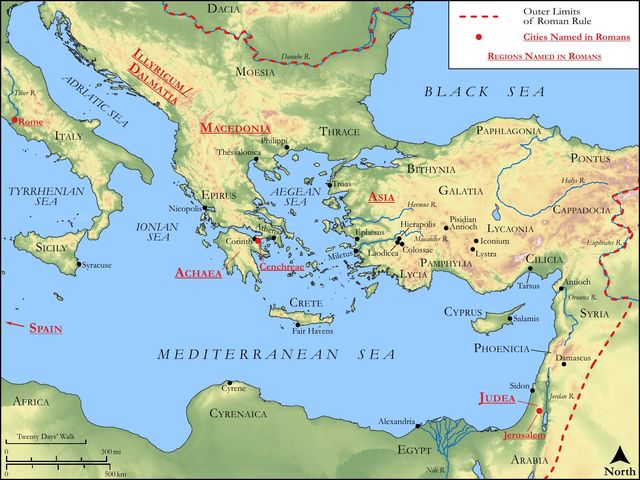
See on the biblical-era maps

Study this verse
Public-domain commentary
Matthew Henry
From his Commentary on the Whole Bible. Henry comments on passages, not single verses — this entry covers Romans 8:26–28. His three-level outline is real structure in the source text, so it is rendered as structure.
The apostle here suggests two privileges more to which true Christians are entitled: -
I.The help of the Spirit in prayer.
While we are in this world, hoping and waiting for what we see not, we must be praying. Hope supposes desire, and that desire offered up to God is prayer; we groan. Now observe,
1.Our weakness in prayer: We know not what we should pray for as we ought.
(1.)As to the matter of our requests, we know not what to ask. We are not competent judges of our own condition. Who knows what is good for a man in this life? Ecc 6:12. We are short-sighted, and very much biassed in favour of the flesh, and apt to separate the end from the way. You know not what you ask, Mat 20:22. We are like foolish children, that are ready to cry for fruit before it is ripe and fit for them; see Luk 9:54, Luk 9:55.
(2.)As to the manner, we know not how to pray as we ought. It is not enough that we do that which is good, but we must do it well, seek in a due order; and here we are often at a loss - graces are weak, affections cold, thoughts wandering, and it is not always easy to find the heart to pray, Sa2 7:27. The apostle speaks of this in the first person: We know not. He puts himself among the rest. Folly, and weakness, and distraction in prayer, are what all the saints are complaining of. If so great a saint as Paul knew not what to pray for, what little reason have we to go forth about that duty in our own strength!
2.The assistances which the Spirit gives us in that duty. He helps our infirmities, meant especially of our praying infirmities, which most easily beset us in that duty, against which the Spirit helps. The Spirit in the world helps; many rules and promises there are in the word for our help. The Spirit in the heart helps, dwelling in us, working in us, as a Spirit of grace and supplication, especially with respect to the infirmities we are under when we are in a suffering state, when our faith is most apt to fail; for this end the Holy Ghost was poured out. Helpeth, sumantilambanetai - heaves with us, over against us, helps as we help one that would lift up a burden, by lifting over against him at the other end - helps with us, that is, with us doing our endeavour, putting forth the strength we have. We must not sit still, and expect that the Spirit should do all; when the Spirit goes before us we must bestir ourselves. We cannot without God, and he will not without us. What help? Why, the Spirit itself makes intercession for us, dictates our requests, indites our petitions, draws up our plea for us. Christ intercedes for us in heaven, the Spirit intercedes for us in our hearts; so graciously has God provided for the encouragement of the praying remnant. The Spirit, as an enlightening Spirit, teaches us what to pray for, as a sanctifying Spirit works and excites praying graces, as a comforting Spirit silences our fears, and helps us over all our discouragements. The Holy Spirit is the spring of all our desires and breathings towards God. Now this intercession which the Spirit makes is,
(1.)With groanings that cannot be uttered. The strength and fervency of those desires which the Holy Spirit works are hereby intimated. There may be praying in the Spirit where there is not a word spoken; as Moses prayed (Exo 14:15), and Hannah, Sa1 1:13. It is not the rhetoric and eloquence, but the faith and fervency, of our prayers, that the Spirit works, as an intercessor, in us. Cannot be uttered; they are so confused, the soul is in such a hurry with temptations and troubles, we know not what to say, nor how to express ourselves. Here is the Spirit interceding with groans that cannot be uttered. When we can but cry, Abba, Father, and refer ourselves to him with a holy humble boldness, this is the work of the Spirit.
(2.)According to the will of God, Rom 8:27. The Spirit in the heart never contradicts the Spirit in the word. Those desires that are contrary to the will of God do not come from the Spirit. The Spirit interceding in us evermore melts our wills into the will of God. Not as I will, but as thou wilt.
3.The sure success of these intercessions: He that searches the heart knoweth what is the mind of the Spirit, Rom 8:27. To a hypocrite, all whose religion lies in his tongue, nothing is more dreadful than that God searches the heart and sees through all his disguises. To a sincere Christian, who makes heart-work of his duty, nothing is more comfortable than that God searches the heart, for then he will hear and answer those desires which we want words to express. He knows what we have need of before we ask, Mat 6:8. He knows what is the mind of his own Spirit in us. And, as he always hears the Son interceding for us, so he always hears the Spirit interceding in us, because his intercession is according to the will of God. What could have been done more for the comfort of the Lord's people, in all their addresses to God? Christ had said, "Whatever you ask the Father according to his will he will give it you." But how shall we learn to ask according to his will? Why, the Spirit will teach us that. Therefore it is that the seed of Jacob never seek in vain.
II.The concurrence of all providences for the good of those that are Christ's, Rom 8:28.
It might be objected that, notwithstanding all these privileges, we see believers compassed about with manifold afflictions; though the Spirit makes intercession for them, yet their troubles are continued. It is very true; but in this the Spirit's intercession is always effectual, that, however it goes with them, all this is working together for their good. Observe here.
1.The character of the saints, who are interested in this privilege; they are here described by such properties as are common to all that are truly sanctified.
(1.)They love God. This includes all the out-goings of the soul's affections towards God as the chief good and highest end. It is our love to God that makes every providence sweet, and therefore profitable. Those that love God make the best of all he does, and take all in good part.
(2.)They are the called according to his purpose, effectually called according to the eternal purpose. The call is effectual, not according to any merit or desert of ours, but according to God's own gracious purpose.
2.The privilege of the saints, that all things work together for good to them, that is, all the providences of God that concern them. All that God performs he performs for them, Psa 57:2. Their sins are not of his performing, therefore not intended here, though his permitting sin is made to work for their good, Ch2 32:31. But all the providences of God are theirs - merciful providences, afflicting providences, personal, public. They are all for good; perhaps for temporal good, as Joseph's troubles; at least, for spiritual and eternal good. That is good for them which does their souls good. Either directly or indirectly, every providence has a tendency to the spiritual good of those that love God, breaking them off from sin, bringing them nearer to God, weaning them from the world, fitting them for heaven. Work together. They work, as physic works upon the body, various ways, according to the intention of the physician; but all for the patient's good. They work together, as several ingredients in a medicine concur to answer the intention. God hath set the one over against the other (Ecc 7:14): sunergei, a very singular, with a noun plural, denoting the harmony of Providence and its uniform designs, all the wheels as one wheel, Eze 10:13. He worketh all things together for good; so some read it. It is not from any specific quality in the providences themselves, but from the power and grace of God working in, with, and by, these providences. All this we know - know it for a certainty, from the word of God, from our own experience, and from the experience of all the saints.
Historical interpretation
Eleven Centuries of Reception
11 surviving comments on this verse. Each one is dated, so this reads as a timeline rather than a list.
Select a marker to jump to its quote. Markers stagger vertically where authors wrote within a few decades of each other.
And we know that all things work together for good to them that love God, to them that are called according to the purpose. For whom He did foreknow, He also did predestinate to be conformed to the image of His Son, that He might be the first-born among many brethren. And whom He did predestinate, them He also called; and whom He called, them He also justified; and whom He justified, them He also glorified.
It is not that God, knowing the intention of their heart and their ignorance, gives them the opposite of what they ask for. Rather he teaches them what ought to be given to people who love God. This is what the Lord says in the Gospel: “For your Father knows what you need, even before you ask him.” Those who are called according to the promise are those whom God knew would believe in the future.
Here he seems to me to have mooted this whole topic with a view to those who were in danger; or, rather, not this only, but also what was said a little before this. For the words, "the sufferings of this present time are not worthy to be compared with the glory which shall be revealed in us;" and those, that "the whole creation groaneth;" and the saying, that "we are saved by hope;" and the phrase, "we with patience wait for;" and that, "we know not what we should pray for as we ought;" are all of them said to these. For he instructs them not to choose just what they may think, themselves, to be useful, but what the Spirit may suggest; for many things that seem to one's self profitable, do sometimes even cause much harm.
Now when he speaks of "all things," he mentions even the things that seem painful. For should even tribulation, or poverty, or imprisonment, or famines, or deaths, or anything else whatsoever come upon us, God is able to change all these things into the opposite. For this is quite an instance of His unspeakable power, His making things seemingly painful to be lightsome to us, and turning them into that which is helpful to us. And so he does not say, that "them that love God," no grievance approacheth, but, that it "works together for good," that is to say, that He useth the grievous things themselves to make the persons so plotted against approved. And this is a much greater thing than hindering the approach of such grievances, or stopping them when they have come.
And this is why He did even with the furnace at Babylon. For He did not either prevent their falling into it, or extinguish the flame after those saints were cast into it, but let it burn on, and made them by this very flame greater objects of wonder, and with the Apostles too He wrought other like wonders continually. For if men who have learnt to be philosophic can use the things of nature to the opposite of their intention, and appear even when living in poverty in easier circumstances than the rich, and shine through disgrace: much more will God work for those that love Him both these and also greater things by far. For one needs only one thing, a genuine love of Him, and all things follow that.
Even opposition and disappointment are turned into good, which is exactly what happened with this remarkable man, the apostle Paul.
Whatever we do or suffer out of love for God will grow into a reward for us.
When Job lost all his wealth, when he lost his sons, everything seemed to militate against him, but since he loved the Lord, the evils that befell him worked together for his good. The vermin of his body were preparing for him the crown of heaven. Before the time he is tempted, God has never spoken to him; after he is tempted, however, God comes to him and speaks familiarly with him, as a friend with his friend. Let calamity strike, let every kind of disaster fall, as long as after the catastrophe Christ comes.
We must not worry if we find that things which we expect to turn out for our good are unexpectedly evil in the present life, because we know that in the end everything works together for good for those who love God.
There is, in the foreknowledge of God, a predetermined limit and number of saints who love God as he has given them to do through the Holy Spirit poured forth in their hearts, and for them everything works together for good.
To be called according to God’s purpose is to be called according to the will. But is this the will of the one who calls or the will of those who are called? Naturally, every impulse which leads to righteousness comes from God the Father. Christ himself once said: “No one can come to me unless the Father draws him.” Nevertheless it is not wrong to say that some are called according to God’s purpose and according to their own intentions as well.
This is not true of everyone but only of believers. Nor do things simply work together—they work together for good. If someone asks for something which will not contribute to his good, he will not get it, because it is not good for him to get it.
Having shown that the Holy Spirit helps us in the weaknesses of the present life in regard to fulfilling our desires [n. 686], the Apostle now shows how he helps us in relation to external events by directing them to our good. First, he states his proposition; secondly, he proves it [v. 29; n. 701]; thirdly, he draws a conclusion [v. 35; n. 721]. 696. In regard to the first there are two things to consider [cf. n. 699]. First, the greatness of the benefit conferred on us by the Holy Spirit, namely, that all things work together for good. To realize this we should consider that whatever happens in the world, even if it be evil, accrues to the good of the universe; because, as Augustine says in Enchiridion: "God is so good that he would permit no evil, unless he were powerful enough to draw some good out of any evil." However, the evil does not always accrue to the good of that in which it is. Thus, the death of one animal accrues to the good of the universe, inasmuch as by the destruction of one thing something else begins to be, although it does not accrue to the good of that which ceases to be; because the good of the universe is willed by God according to itself and to this good all the parts of the universe are ordained. 697. The same seems to apply to the relationship of the noblest parts to the other parts, because the evil affecting the other parts is ordained to the good of the noblest parts. But whatever happens to the noblest parts is ordained only to their good, because his care for them is for their sake, whereas his care for the others is for the sake of the noblest: as a physician allows a malady in the foot that he might cure the head. 341 But the most excellent parts of the universe are God’s saints to each of whom applies the word of Mt (25:23): "He will set him over all his goods." Therefore, whatever happens to them or to other things, it all accrues to the benefit of the former. This verifies the statement in Pr (11:20): "The fool will be servant to the wise," namely, because even the evil of sinners accrues to the good of the just. Hence, God is said to exercise a special care over the just, as it says in Ps 34 (v.15): "The eyes of the Lord are toward the righteous," inasmuch as he takes care of them in such a way as to permit no evil to affect them without converting it to their good. This is obvious in regard to the penal evils which they suffer, hence it says in the Gloss [of Lombard, col. 1488 D] that "because in their weakness humility is exercised, in affliction patience, in contradictions wisdom and in hatred good will." Hence it says in 1 Pt (3:14): "If you suffer for righteousness’ sake, you will be blessed." It might be asked whether their sins also work together for their good. Some say that sins are not included when he says, all things, because according to Augustine: "Sin is nothing and men become nothing, when they sin." But contrary to this a Gloss says: "God makes all things work together for their good to the extent that if they deviate and stray from the path, he even makes this contribute to their good." Hence it says in Ps 37 (v.24): "Though the righteous man fall, he shall not be cast headlong, for the Lord is the stay of his hand." But according to this it seems that they always arise with greater love, because man’s good consists in love in such a way that without it the Apostle says that he is nothing (1 Cor 13:2). 342 The answer is that man’s good consists not only in the amount of love but especially in his perseverance until death, as it says in Mt (24:13): "He who endures to the end will be saved." Furthermore, because he has fallen, he rises more cautious and more humble; hence, the Gloss adds that this makes them progress, because they return to themselves more humble and wiser; for they fear extolling themselves or trusting in their powers to persevere. 699. Secondly, we consider the recipients of this benefit and see something on God’s part and on man’s part. He indicates what is involved on man’s part when he says: for those who love God. For the love of God is in us through the indwelling Spirit. But it is the Holy Spirit who directs us in the right path; hence it says in 1 Pt (3:13): "Who is there to harm you, if you are zealous for what is right?" and in Ps 119 (v. 165): "Great peace have they who love your law; nothing can make them stumble." And this is reasonably so, because, as it says in Pr (8:17): "I love those who love me." To love is to will good to the beloved; but for God to will is to accomplish, for "whatever the Lord wills he does" (Ps. 135:6). Therefore, God turns all things to the good of those who love him. 700. Then he considers what is involved on God’s part who, first of all, predestined believers from all eternity; secondly, calls them in time; thirdly, sanctifies them. He touches on these three things when he says: Who are called according to his purpose, i.e., the predestined, the called and the sanctified; "purpose" here refers to predestination which, according to Augustine, is the resolve to be merciful: "according to the purpose of him who accomplishes all things according to the counsel of his will" 343 (Eph 1:11). "Called" refers to calling: "He called him to follow him" (Is 41:2). "Saints" refers to sanctification: "I am the Lord who sanctifies you" (Lev 21:8). The Apostle says that he knows this, saying: we know: "He gave him knowledge of holy things" (Wis 10:10). This knowledge arises from experience and from considering the efficacy of love: "Love is as strong as death" (S of S 8:6) and of eternal predestination: "My counsel shall stand, and I will accomplish all my purpose" (Is 46:10). 701. Then (v.29) he proves what he had said with the following proof: No one can harm those whom God advances; but God advances the predestined who love him. Therefore, nothing can harm them, but everything works for their good. First, therefore, he proves the minor, namely, that God advances them; secondly, the major [v. 31; n. 710]. In regard to the first he does two things: first, he mentions things that refer to advancement of the saints from all eternity; secondly, those that occur in time [v. 30; n. 707]. 702. First, therefore, he presents two things, namely, foreknow1ede and predestination when he says: Those whom he foreknew he also predestined. Now some say that predestination is taken here for the preparation which occurs in time, during which God prepares the saints for grace. They say this in order to distinguish foreknowledge from predestination. But closer examination shows that both are eternal and that they differ in notion. For, as was stated above, predestination implies the mental preordaining of things which a person intends to do. But from all eternity God has predestined the benefits which he intends to give his saints. Hence, predestination is eternal. But foreknowledge differs 344 conceptually from predestination; because foreknowledge implies only the knowledge of future things, whereas predestination implies causality in regard to them. Consequently, God has foreknowledge even of sins, but predestination bears on salutary goods. Hence The Apostle says in Eph (1:5): "Predestined according to the purpose of his will, to the praise and glorious grace which he freely bestowed." 703. Regarding the order between foreknowledge and predestination some say that foreknowledge of good and of evil merits is the reason for predestination and reprobation, in the sense that God predestines certain ones, because he foresees that they will act well and believe in Christ. According to this the present text reads: "Those whom he foreknew to be conformed to the image of his Son, he also predestined." This interpretation would be reasonable, if predestination were restricted to eternal life which is bestowed for merits. But under predestination falls every salutary benefit prepared for man from all eternity by God; hence all the benefits he confers on us in time he prepared for us from all eternity. Hence, to claim that some merit on our part is presupposed, the foreknowledge of which is the reason for predestination, is nothing less than to claim that grace is given because of our merits, and that the source of our good works is from us and their consummation from God. Hence, it is more suitable to interpret the present text as stating that those whom he foreknew he also predestined to be conformed to the image of his Son. Then this conformity is not the reason for predestination, but its terminus or effect. For the Apostle says: "He destined us to be his adopted sons through Jesus Christ" (Eph 1:5). 704. For the adoption as sons is nothing more than that conformity, because a person adopted into the sonship of God is conformed to his true Son. 345 First, in the right to the inheritance, as was stated above (v. 17): If sons, then heirs, heirs of God and fellow heirs with Christ." Secondly, in sharing his splendor. For he is begotten of the Father as the splendor of his glory (Heb 1:3). Hence by enlightening the saints with the light of wisdom and grace, he makes them be conformed to himself. 705. The phrase, to the image of his Son, can be interpreted in two ways: in one way so that it means: conformed to the image of his Son, who is an image: "He is the image of the invisible God" (Col 1:15). In another way so that the sense is this: He predestined us to be conformed to his Son in the fact that we bear his image: "Just as we have borne the image of the man of dust, we shall also bear the image of the man of heaven" (1 Cor 15:49). He says, those whom he foreknew he also predestined not because he predestines all the foreknown, but because he could not predestine them, unless he foreknew them: "Before I formed you in the womb I knew you" (Jer 1:5). 706. Then he indicates what follows from this predestination, when he says: in order that he might be the first-born among many brethren. For just as God willed to communicate His natural goodness to others by imparting to them a likeness of his goodness, so that he is not only good but the author of good things, so the Son of God willed to communicate to others conformity to his sonship, so that he would not only be the Son but the first-born among sons. Thus, he who is the only-begotten through an eternal origin, as it says in Jn (1:18): "The only Son who is in the bosom of the Father," is the first-born among many brethren by the bestowal of grace: "He is the first-born of the dead, and ruler of kings on earth" (Rev 1:5). 346 Therefore, Christ has us as brothers, both because he communicated to us a likeness of his sonship and because he assumed the likeness of our nature, as it says in Heb (2:17): "He had to be made like his brethren in every respect." 707. Then (v. 30) he mentions what happens on the part of the saint as a consequence of predestination. First, he mentions the call, when he says: Those whom he predestined he also called. For predestination cannot be voided: "The Lord of hosts has sworn, ‘As I have planned, so shall it be, and as I have purposed, so shall it stand" (Is 14:24). Predestination begins to be carried out with the person’s being called. This call is twofold: one is external and is made by the mouth of a preacher: "She has sent out her maids to call from the highest places" (Pr 9:3). In this way God called Peter and Andrew, as it says in Mt (4:18). The other call is internal and is nothing less than an impulse of the mind whereby a man’s heart is moved by God to assent to the things of faith or of virtue: "Who stirred up one from the east and called him to follow?" (Is 41:2). This call is necessary, because our heart would not turn itself to God, unless God himself drew us to him: "No one can come to me unless the Father who sent me draws him" (Jn 6:44); "Turn us to thyself, O Lord, that we may be turned" (Lam 5:21). Furthermore, this call is efficacious in the predestined, because they assent to the call: "Everyone who has heard and learned from the Father comes to me" (Jn 6:45). 708. Hence secondly, he mentions justification when he says: those whom he called he also justified by infusing grace: "They are justified by his grace as a gift" (Rom 3:24). 347 Although this justification is frustrated in certain persons, because they do not persevere to the end, in the predestined it is never frustrated. 709. Thirdly, he mentions glorification, when he adds: and those he also glorified and this in two ways, namely, by growth in virtue and grace and by exaltation to glory: "In all things, O Lord, thou hast exalted and glorified thy people" (Wis 19:22). He uses the past for the future, either because the future is certain, or because what is future in some is already fulfilled in others. 710. Then (v. 31) he clarifies the major premise, namely, that nothing can harm those advanced by God: first, he shows that they cannot suffer any loss through the evil of punishment; secondly, nor through the evil of guilt [v. 33; n. 715]. 711. The evil of punishment is twofold: one consists in the imposition of evils, the other in the removal of good things. First he shows that those who are advanced by God do not suffer harm from the efforts of persecutors, saying: What then shall we say? As if to say: since God bestows so many good things on his elect, what can be said against this, so as to nullify it? As if to say: Nothing. "No wisdom, no understanding, no counsel, can avail against the Lord" (Pr 21:30). Or: What shall we say? For one is struck with amazement, when he considers these things: "I considered thy works and became terrified" (Hab 3:2). Or: What shall we say to this? i.e., what return could we make to God for such great blessings: "What shall I render to the Lord for all his bounty to me" (Ps 116:12). Then he continues, If God is for us by predestining, calling, justifying and glorifying, who is against us, i.e., successfully? "Let us stand up together, who is my 348 adversary?" (Is 50:8); "Place me next to you, and let anyone’s hand fight against me" (Jb 17:3). 712. Secondly, he shows that God’s holy ones cannot suffer loss by the removal of good things, saying: He who did not spare his own Son. But whereas he spoke earlier about adopted sons, he separates this Son from all others, saying: his own Son, i.e., not adopted, as heretics pretend, but natural and co-eternal: "That we may be in his true son, Jesus Christ" (1 Jn 5:20) of whom the Father says in Mt (3:17): "This is my beloved Son, with whom I am well pleased." 713. He says, did not spare, to indicate that he did not exempt him from punishment. For there was no guilt in him to forgive: "He who spares the rod hates his son" (Pr l3:24). However, God the Father did not spare his Son, as though to add something to him who is in all things perfect God; rather he subjected him to the passion for our benefit. And this is what he adds: but gave him up for us all, i.e., in expiation for our sins: "He was put to death for our trespasses" (Rom 3:25); "The Lord put on him the iniquity of us all" (Is 53:6). God the Father gave him up to death by appointing him to become incarnate and suffer and by inspiring his human will with such love that he would willingly undergo the passion. Hence he is said to have given himself over: "He gave himself up for us" (Eph 5:2). Judas, too, and the Jews gave him up, as was explained at the end of ch. 4. 714. It should be noted that in saying, He did not spare his own Son, it is as though he were saying: He not only exposed other holy men to tribulation for their 349 salvation: "I have hewn them by the prophets" (Hos 6:5); "If we are afflicted, it is for your comfort and salvation" (2 Cor 1:6), but even his own Son. But in the Son of God all things exist as in their primordial and preoperative cause: "He is before all things and in him all things hold together" (Col 1:17). Therefore, when he was given up for us, all things were given to us; hence he adds: how has not had also, with him, given us all things, the highest things, namely, the divine persons to enjoy, rational spirits to live with, all lower things to use, not only prosperity but adversity as well: "All are yours and you are Christ’s and Christ is God’s" (l Cor 3:23). Hence, it is clear that, as it says in Ps 34 (v.9): "Those who fear him have no want."
Continue studying Romans 8:28 across the web’s major study libraries — every link below opens this exact verse, chapter, or book on the destination site.
Read & Compare
 BibleGatewayThis verse in more than 200 translations and 70 languages.
 Bible.comThe YouVersion reader — hundreds of translations, reading plans, and highlights.
 ESV.orgCrossway's official English Standard Version reader.
 NET BibleThe NET translation with 60,000+ translators' notes on every rendering decision.
 STEP BibleTyndale House's free study tool — original text, vocabulary, and scholarly resources.
 BibliaLogos Bible Software's free web reader.
 USCCBThe New American Bible (Revised Edition) with the U.S. bishops' study notes.
Commentaries
 BibleHub CommentariesDozens of classic commentaries on this verse, gathered on one page.
 StudyLightMore than 100 commentary sets — the largest collection on the web.
 BibleRefPlain-English commentary on what this verse means, verse by verse.
 Enduring WordDavid Guzik's free commentary on this chapter, widely used by Bible teachers.
 Bible Study ToolsVerse commentary alongside Greek and Hebrew study aids.
Original Language & Research
- BibleHub InterlinearThe verse word by word — original language, transliteration, and English.
- BibleHub LexiconEvery word's original-language definition and Strong's entry.
 Blue Letter BibleDeep-study tools — Strong's numbers, concordance, and word studies.
 CNTR CollationThe earliest Greek manuscripts of this verse, collated letter by letter.
Sermons, Hymns & Audio


TrulyRandomVerse is not affiliated with these sites and doesn’t control their content. They’re linked because they’re genuinely useful.
Summary
Romans 8:28 stands as a profound declaration of divine sovereignty and unwavering hope for believers, asserting that in the overarching plan of God, all circumstances—both favorable and adverse—cooperate for the ultimate good of those who genuinely love Him and are called according to His eternal purpose. This verse serves as a cornerstone of Christian assurance, transforming the perception of suffering and uncertainty into an affirmation of God's meticulous care and benevolent design for His children, ensuring that every experience is ultimately woven into a tapestry of redemptive grace.
Context
ShowHideLiterary Context
Romans 8:28 is a pivotal declaration within Paul's profound theological discourse in the eighth chapter of Romans, often celebrated as the apex of his letter, moving from justification to sanctification and glorification. The chapter begins with the triumphant assurance of no condemnation for those in Christ Jesus. Paul then elaborates on the struggle between the flesh and the Spirit, the empowering presence of the Holy Spirit in the believer's life, and the glorious hope that awaits both believers and creation itself. He describes the universal "groaning" of creation awaiting redemption and the Spirit's intercession for believers in their weakness, aligning their prayers with God's will (Romans 8:26-27). Amidst these realities of present suffering and spiritual longing, verse 28 offers a powerful anchor of assurance, serving as a theological bridge that leads directly into the "golden chain" of salvation in the subsequent verses, outlining God's complete work from foreknowledge to glorification (Romans 8:29-30).
Historical & Cultural Context
Paul wrote his Epistle to the Romans from Corinth, likely around A.D. 57, addressing a diverse Christian community in Rome composed of both Jewish and Gentile believers. This community faced internal tensions regarding Jewish law and Gentile freedom, as well as external pressures from the Roman Empire, including potential persecution. Christians lived in a world where suffering, illness, and death were common, often without modern medical or social support systems. The concept of a sovereign God actively working through all circumstances would have been a radical departure from pagan polytheism, which often depicted capricious gods, or even from some Jewish understandings that might attribute suffering solely to sin. Paul's message provided profound comfort and stability, reminding them that their trials were not random or meaningless, but were integrated into God's purposeful plan, distinct from the stoicism of the day which advocated for passive endurance.
Key Themes
ShowHideRomans 8:28 powerfully contributes to several major theological and narrative themes prevalent in Romans and the broader Pauline corpus. It underscores Divine Sovereignty, asserting God's ultimate control over all circumstances and His active working in the lives of His people, not merely as a passive observer but as a benevolent orchestrator. This leads to the theme of Unwavering Assurance for Believers, as the phrase "And we know" expresses a deep, confident conviction rooted in God's faithfulness, offering immense comfort in an unpredictable world. Furthermore, the verse highlights the Transformative Power of God, demonstrating His unique ability to redeem and transform seemingly negative experiences into good outcomes. This transformation is intrinsically linked to the Purpose of God, which is to conform believers to the image of His Son, Jesus Christ (Romans 8:29). Finally, the verse implicitly touches upon the theme of Perseverance in Suffering, providing a theological framework for enduring trials with hope, knowing that God is at work even in the midst of pain and adversity, as Paul often emphasizes throughout his letters (e.g., 2 Corinthians 4:16-18).
Exposition and Analysis
ShowHideKey Word Analysis
ShowHideThis word, G1492, derived from a primary verb meaning "to see" (literally or figuratively), implies a deep, experiential knowledge rather than mere intellectual assent. In the perfect tense, as used here, it signifies a settled, assured understanding or awareness. It's not a hopeful wish, but a firm conviction based on revelation and spiritual insight, indicating a truth that has been perceived and fully grasped by the believer.
From which we derive "synergy," means "to be a fellow-worker," "to cooperate," or "to help in work." While some textual variants and interpretations suggest "all things" are the subject working together, the more robust and theologically consistent understanding, especially considering the context of God's active role in the surrounding verses, is that God is the one who works all things together for good. This verb emphasizes God's active, purposeful involvement in orchestrating circumstances.
A primary word, signifies "good" in any sense – morally, beneficially, or intrinsically. It refers to that which is inherently excellent, profitable, and virtuous. Here, it refers to the ultimate, divine good that God purposes for His children, which, as subsequent verses clarify, is their conformity to the image of Christ and their glorification.
Derived from "a setting forth," means "proposal" or "intention." It denotes a pre-arranged plan or a settled intention. In the context of God, it signifies His eternal, predetermined design or will, emphasizing that His actions are not reactive but are part of an overarching, sovereign blueprint for salvation and the destiny of His people.
Verse Breakdown
ShowHide"And we know"
This opening phrase establishes a foundational truth for believers. The "we" refers to Christians, those indwelt by the Holy Spirit, who possess an inner conviction and spiritual discernment. The "know" (from eídō) is not a guess or a hope, but a settled, confident assurance, indicating a revealed truth that has been grasped and accepted by faith. It implies a certainty that transcends mere human understanding or observation of circumstances.
"that all things work together for good"
This is the core declaration. "All things" (Greek, pâs) is comprehensive, encompassing every aspect of life – joys, sorrows, successes, failures, trials, and triumphs. The verb "work together" (Greek, synergéō) signifies an active, cooperative process. Theologically, the subject of this working is God Himself, who orchestrates and integrates every element of life. The "good" (Greek, agathós) is not necessarily immediate comfort or worldly prosperity, but the ultimate spiritual and eternal benefit for the believer, particularly their sanctification and glorification, as clarified in the subsequent verses.
"to them that love God"
This clause introduces the first condition or qualification for whom this promise applies. It is not a universal declaration for all humanity, but specifically for those who possess a genuine, active love for God (Greek, agapáō). This love is not merely an emotion but a commitment of the will, expressed through obedience and devotion. It signifies a true relationship with the Divine.
"to them who are the called according to his purpose"
This second qualifying phrase further specifies the recipients of the promise. "The called" (Greek, klētós) refers to those whom God has sovereignly invited and drawn into a saving relationship with Himself, an election that is "according to his purpose" (Greek, katá próthesis). This emphasizes that their calling is not arbitrary or based on human merit, but is part of God's eternal, pre-arranged, and benevolent design. This divine initiative ensures the ultimate fulfillment of the promise.
Literary Devices
ShowHideRomans 8:28 functions as a powerful Declarative Statement, presenting a fundamental truth with absolute certainty ("And we know"). Its placement in the chapter serves as a Climax or Summary Statement, gathering the preceding discussions on suffering and the Spirit's intercession and offering a definitive answer to the question of God's involvement in human experience. The verse employs Conditional Promise, clearly delineating the beneficiaries of this divine orchestration ("to them that love God, to them who are the called according to his purpose"). The phrase "all things work together" implies a profound Divine Orchestration or Providence, where God is depicted as the active agent weaving disparate elements into a coherent, beneficial whole. This also hints at Teleology, the idea that there is an ultimate end or purpose towards which all things are moving under God's guidance.
Theological and Thematic Connections
ShowHideRomans 8:28 is a profound theological statement on divine providence, asserting that God's sovereign hand is actively at work in every aspect of a believer's life, orchestrating even adverse circumstances for their ultimate spiritual good. This "good" is not merely temporal comfort but the deeper, eternal purpose of conforming believers to the image of His Son, Jesus Christ, and leading them to glorification. The verse highlights the intimate and unbreakable bond between God's eternal purpose and the loving response of His elect, assuring them that His benevolent design will prevail despite any present suffering or confusion. It underscores that God's plan is not reactive but proactive, a pre-determined intention that guarantees the security and ultimate triumph of those He has called.
Reflection and Application
ShowHideRomans 8:28 offers profound comfort and a robust framework for navigating the complexities of the Christian life. It challenges us to move beyond a superficial understanding of "good" and to trust in God's eternal perspective, especially when circumstances are painful or bewildering. This verse encourages a radical shift in mindset: rather than asking "Why is this happening to me?", we can ask "How will God use this for His good purpose in me?" It fosters a deep reliance on God's sovereignty, reminding us that no experience, no matter how devastating, is outside of His redemptive power. This truth empowers believers to persevere through trials with hope, knowing that God is actively at work, weaving together every thread of joy and sorrow, success and failure, into a beautiful tapestry that ultimately serves His higher purposes and conforms us to the image of His Son. It calls us to live with intentionality, recognizing that our lives are part of a grander, divine narrative, and to respond to God's calling with a genuine, active love that trusts His unfailing faithfulness.
Questions for Reflection
ShowHideFAQ
ShowHideDoes Romans 8:28 mean that everything that happens is inherently good, or that bad things are good?
ShowHideNo, Romans 8:28 does not mean that everything that happens is inherently good, nor does it suggest that evil or suffering are good in themselves. The verse states that "all things work together for good," implying an active divine orchestration. It means that God, in His infinite wisdom and power, takes all circumstances—including pain, loss, and adversity—and supernaturally integrates them into His sovereign plan to bring about a beneficial outcome for His beloved children. The "good" is defined by God's ultimate purpose, which, as Romans 8:29 clarifies, is to conform believers to the image of Jesus Christ. Therefore, while the individual events may be genuinely bad or painful, God redeems them by weaving them into a larger, redemptive design.
Who are "them that love God" and "the called according to his purpose"?
ShowHideThese two phrases describe the specific recipients of this profound promise. "Them that love God" refers to those who have a genuine, active, and committed relationship with God, characterized by a heart of devotion and obedience, as commanded in passages like Deuteronomy 6:5 and exemplified throughout the New Testament. This love is a response to God's prior love for them. "The called according to his purpose" refers to those whom God has sovereignly chosen and drawn to Himself, not based on their merit but on His eternal, predetermined plan (His "purpose"). This calling is an act of divine grace, initiating and securing their salvation. Together, these phrases describe true believers, those who are genuinely in Christ and part of God's elect.
How can I apply Romans 8:28 when I am experiencing deep suffering or loss?
ShowHideApplying Romans 8:28 in deep suffering requires profound faith and trust in God's character and sovereignty. It means holding onto the truth that even when you cannot see or understand God's hand at work, He is actively engaged in your situation. It doesn't negate the pain or require you to pretend that suffering is pleasant, but it offers a divine perspective: your suffering is not meaningless or wasted. God is capable of redeeming even the most tragic circumstances, using them to refine your character, deepen your faith, draw you closer to Him, or accomplish His greater purposes in ways you may only fully grasp in eternity. Lean into the truth that God's ultimate "good" for you is conformity to Christ, which often involves sharing in His sufferings (Philippians 3:10), knowing that His faithfulness guarantees a glorious outcome.
Christ-Centered Fulfillment
ShowHideRomans 8:28 finds its ultimate Christ-centered fulfillment in the person and work of Jesus Christ, who is the very embodiment of God's purpose and the means by which "all things work together for good." The "good" that God works is precisely our conformity to the image of His Son, as explicitly stated in Romans 8:29. Christ's life, death, and resurrection are the supreme example of how God took the greatest evil—the crucifixion of His innocent Son—and worked it together for the greatest good: the redemption of humanity and the defeat of sin and death. The "purpose" of God, mentioned in the verse, is eternally centered on Christ, for it was "in Christ" that God chose us before the foundation of the world (Ephesians 1:4). Furthermore, it is through Christ that we are "called" and enabled to "love God," as His Spirit indwells us, empowering us to live according to God's will. Jesus Himself intercedes for us at the right hand of God (Romans 8:34), ensuring that God's good purpose for us will never be thwarted. Thus, Romans 8:28 is not merely a comforting promise, but a profound theological statement rooted in the finished work and ongoing ministry of Christ, guaranteeing our ultimate glorification with Him (Romans 8:17).