


Luke 9:55
Bible text: King James Version (1769 Blayney text) · Public domain
Bible text: Berean Standard Bible · Public domain
Bible text: American Standard Version (1901) · Public domain
Bible text: World English Bible, Messianic edition · Public domain
Bible text: Geneva Bible (1599) · Public domain
Bible text: Young's Literal Translation · Public domain
- στραφεὶςstrapheisHaving turnedG4762V-2APP-NSMVerb 2nd Aorist Passive Participle Nominative Singular Masculine
- δὲdethenG1161CONJConjunction
- ἐπετίμησενepetimēsenHe rebukedG2008V-AAI-3SVerb Aorist Active Indicative 3rd Singular
- αὐτοῖςautoisthemG846P-DPMPersonal pronoun Dative Plural Masculine
- καὶkaiandG2532CONJConjunction
- εἶπενeipensaidG2036V-2AAI-3SVerb 2nd Aorist Active Indicative 3rd Singular
- οὐκouknotG3756PRT-NNegative Particle Negative
- οἰδατεoidateyou knowG1492V-RAI-2PVerb Perfect Active Indicative 2nd Plural
- οἵουoiousuch asG3634K-GSNCorrelative pronoun Genitive Singular Neuter
- πνεύματόςpneumatosspiritG4151N-GSNNoun Genitive Singular Neuter
- ἐστεesteareG1510V-PAI-2PVerb Present Active Indicative 2nd Plural
- ὑμεῖςhumeisyou yourselvesG4771P-2NPPersonal pronoun Nominative 2nd Plural
English is a literal word-by-word gloss of the Greek, not the KJV's wording. Why?
This is the original text the KJV's translators worked from — each Greek word with its own literal English meaning in this verse, prepared by scholars at Tyndale House, Cambridge. The KJV translates whole sentences, not word by word, so its wording differs: one Greek word can become several English words, and the KJV may choose “charity” where the gloss reads “love”. Both are faithful — they answer different questions. For the KJV's own rendering, switch to the KJV text.
Details
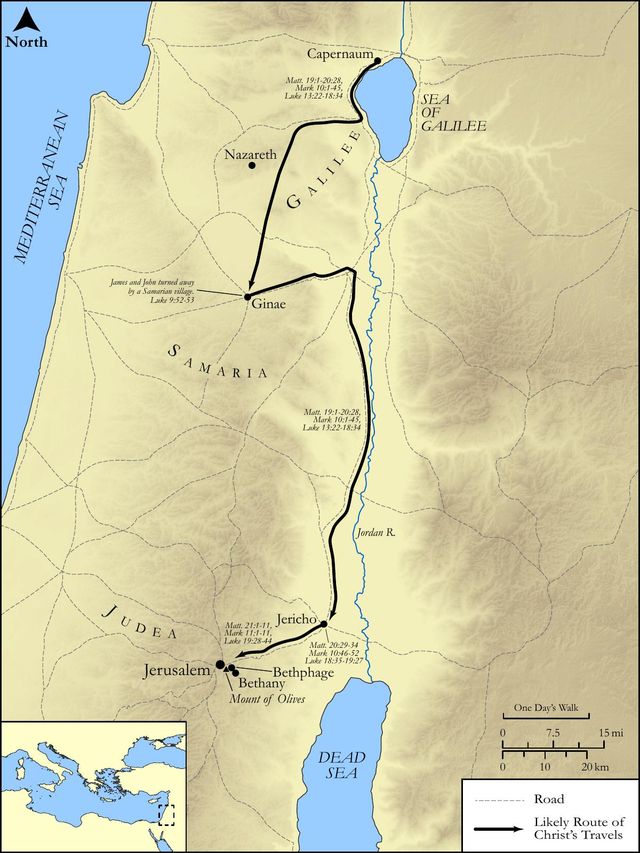
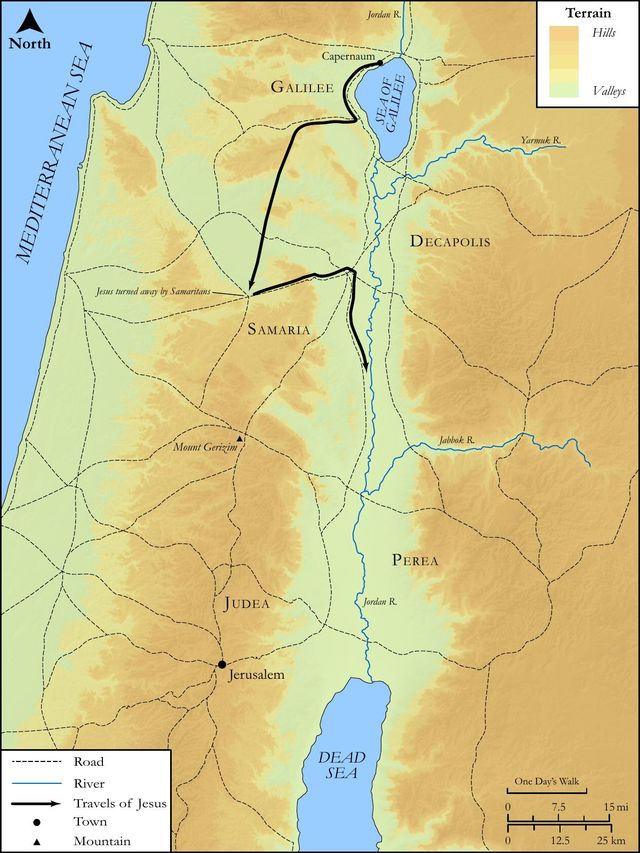
See on the biblical-era maps

Study this verse
Public-domain commentary
Matthew Henry
From his Commentary on the Whole Bible. Henry comments on passages, not single verses — this entry covers Luke 9:51–56. His three-level outline is real structure in the source text, so it is rendered as structure.
This passage of story we have not in any other of the evangelists, and it seems to come in here for the sake of its affinity with that next before, for in this also Christ rebuked his disciples, because they envied for his sake. There, under colour of zeal for Christ, they were for silencing and restraining separatists: here, under the same colour, they were for putting infidels to death; and, as for that, so for this also, Christ reprimanded them, for a spirit of bigotry and persecution is directly contrary to the spirit of Christ and Christianity. Observe here,
I.The readiness and resolution of our Lord Jesus, in prosecuting his great undertaking for our redemption and salvation.
Of this we have an instance, Luk 9:51 : When the time was come that he should be received up, he stedfastly set his face to go to Jerusalem. Observe 1. There was a time fixed for the sufferings and death of our Lord Jesus, and he knew well enough when it was, and had a clear and certain foresight of it, and yet was so far from keeping out of the way that then he appeared most publicly of all, and was most busy, knowing that his time was short. 2. When he saw his death and sufferings approaching, he looked through them and beyond them, to the glory that should follow; he looked upon it as the time when he should be received up into glory (Ti1 3:16), received up into the highest heavens, to be enthroned there. Moses and Elias spoke of his death as his departure out of this world, which made it not formidable; but he went further, and looked upon it as his translation to a better world, which made it very desirable. All good Christians may frame to themselves the same notion of death, and may call it their being received up, to be with Christ where he is; and, when the time of their being received up is at hand, let them lift up their heads, knowing that their redemption draws nigh. 3. On this prospect of the joy set before him, he stedfastly set his face to go to Jerusalem the place where he was to suffer and die. He was fully determined to go, and would not be dissuaded; he went directly to Jerusalem, because there now his business lay, and he did not go about to other towns, or fetch a compass, which if he had done, as commonly he did, he might have avoided going through Samaria. He went cheerfully and courageously thither, though he knew the things that should befall him there. He did not fail nor was discouraged, but set his face as a flint, knowing that he should be not only justified, but glorified (Isa 50:7), not only not run down, but received up. How should this shame us for, and shame us out of, our backwardness to do and suffer for Christ! We draw back, and turn our faces another way from his service who stedfastly set his face against all opposition, to go through with the work of our salvation.
II.The rudeness of the Samaritans in a certain village (not named, nor deserving to be so) who would not receive him, nor suffer him to bait in their town, though his way lay through it. Observe here,
1.How civil he was to them: He sent messengers before his face, some of his disciples, that went to take up lodgings, and to know whether he might have leave to accommodate himself and his company among them; for he would not come to give offence, or if they took any umbrage at the number of his followers. He sent some to make ready for him, not for state, but convenience, and that his coming might be no surprise.
2.How uncivil they were to him, Luk 9:53. They did not receive him, would not suffer him to come into their village, but ordered their watch to keep him out. He would have paid for all he bespoke, and been a generous guest among them, would have done them good, and preached the gospel to them, as he had done some time ago to another city of the Samaritans, Joh 4:41. He would have been, if they pleased, the greatest blessing that ever came to their village, and yet they forbid him entrance. Such treatment his gospel and ministers have often met with. Now the reason was because his face was as though he would go to Jerusalem; they observed, by his motions, that he was steering his course that way. The great controversy between the Jews and the Samaritans was about the place of worship - whether Jerusalem or mount Gerizim near Sychar; see Joh 4:20. And so hot was the controversy between them that the Jews would have no dealings with the Samaritans, nor they with them, Joh 4:9. Yet we may suppose that they did not deny other Jews lodgings among them, no, not when they went up to the feast; for if that had been their constant practice Christ would not have attempted it, and it would have been a great way about for some of the Galileans to go to Jerusalem any other way than through Samaria. But they were particularly incensed against Christ, who was a celebrated teacher, for owning and adhering to the temple at Jerusalem, when the priests of that temple were such bitter enemies to him, which, they hoped, would have driven him to come and worship at their temple, and bring that into reputation; but when they saw that he would go forward to Jerusalem, notwithstanding this, they would not show him the common civility which probably they used formerly to show him in his journey thither.
III.The resentment which James and John expressed of this affront, Luk 9:54.
When these two heard this message brought, they were all in a flame presently, and nothing will serve them but Sodom's doom upon this village: "Lord," say they, "give us leave to command fire to come down from heaven, not to frighten them only, but to consume them."
1.Here indeed was something commendable, for they showed,
(1.)A great confidence in the power they had received from Jesus Christ; though this had not been particularly mentioned in their commission, yet they could with a word's speaking fetch fire from heaven. Theleis eipōmen - Wilt thou that we speak the word, and the thing will be done.
(2.)A great zeal for the honour of their Master. They took it very ill that he who did good wherever he came and found a hearty welcome should be denied the liberty of the road by a parcel of paltry Samaritans; they could not think of it without indignation that their Master should be thus slighted.
(3.)A submission, notwithstanding, to their Master's good will and pleasure. They will not offer to do such a thing, unless Christ give leave: Wilt thou that we do it?
(4.)A regard to the examples of the prophets that were before them. It is doing as Elias did? they would not have thought of such a thing if Elijah had not done it upon the soldiers that came to take him, once and again, Kg2 1:10, Kg2 1:12. They thought that this precedent would be their warrant; so apt are we to misapply the examples of good men, and to think to justify ourselves by them in the irregular liberties we give ourselves, when the case is not parallel.
2.But though there was something right in what they said, yet there was much more amiss, for (1.) This was not the first time, by a great many, that our Lord Jesus had been thus affronted, witness the Nazarenes thrusting him out of their city, and the Gadarenes desiring him to depart out of their coast; and yet he never called for any judgment upon them, but patiently put up with the injury. (2.) These were Samaritans, from whom better was not to be expected, and perhaps they had heard that Christ had forbidden his disciples to enter into any of the cities of the Samaritans (Mat 10:5), and therefore it was not so bad in them as in others who knew more of Christ, and had received so many favours from him. (3.) Perhaps it was only some few of the town that knew any thing of the matter, or that sent that rude message to him, while, for aught they knew, there were many in the town who, if they had heard of Christ's being so near them, would have gone to meet him and welcomed him; and must the whole town be laid in ashes for the wickedness of a few? Will they have the righteous destroyed with the wicked? (4.) Their Master had never yet upon any occasion called for fire from heaven, nay, he had refused to give the Pharisees any sign from heaven when they demanded it (Mat 16:1, Mat 16:2); and why should they think to introduce it? James and John were the two disciples whom Christ had called Boanerges - sons of thunder (Mar 3:17); and will not that serve them, but they must be sons of lightning too? (5.) The example of Elias did not reach the case. Elijah was sent to display the terrors of the law, and to give proof of that, and to witness as a bold reprover against the idolatries and wickednesses of the court of Ahab, and it was agreeable enough to him to have his commission thus proved; but it is a dispensation of grace that is now to be introduced, to which such a terrible display of divine justice will not be at all agreeable. Archbishop Tillotson suggests that their being now near Samaria, where Elijah called for fire from heaven, might help to put it in their heads; perhaps at the very place; but, though the place was the same, the times were altered.
IV.The reproof he gave to James and John for their fiery, furious zeal (Luk 9:55):
He turned with a just displeasure, and rebuked them; for as many as he loves he rebukes and chastens, particularly for what they do, that is irregular and unbecoming them, under colour of zeal for him.
1.He shows them in particular their mistake: Ye know not what manner of spirit ye are of; that is, (1.) "You are not aware what an evil spirit and disposition you are of; how much there is of pride, and passion, and personal revenge, covered under this pretence of zeal for your Master." Note, There may be much corruption lurking, nay, and stirring too, in the hearts of good people, and they themselves not be sensible of it. (2.) "You do not consider what a good spirit, directly contrary to this, you should be of. Surely you have yet to learn, though you have been so long learning, what the spirit of Christ and Christianity is. Have you not been taught to love your enemies, and to bless them that curse you, and to call for grace from heaven, not fire from heaven, upon them? You know not how contrary your disposition herein is to that which it was the design of the gospel you should be delivered into. You are not now under the dispensation of bondage, and terror, and death, but under the dispensation of love, and liberty, and grace, which was ushered in with a proclamation of peace on earth and good will toward men, to which you ought to accommodate yourselves, and not by such imprecations as these oppose yourselves."
2.He shows them the general design and tendency of his religion (Luk 9:56): The Son of man is not himself come, and therefore does not send you abroad to destroy men's lives, but to save them. He designed to propagate his holy religion by love and sweetness, and every thing that is inviting and endearing, not by fire and sword, and blood and slaughter; by miracles of healing, not by plagues and miracles of destruction, as Israel was brought out of Egypt. Christ came to slay all enmities, not to foster them. Those are certainly destitute of the spirit of the gospel that are for anathematizing and rooting out by violence and persecution all that are not of their mind and way, that cannot in conscience say as they say, and do as they do. Christ came, not only to save men's souls, but to save their lives too - witness the many miracles he wrought for the healing of diseases that would otherwise have been mortal, by which, and a thousand other instances of beneficence, it appears that Christ would have his disciples do good to all, to the utmost of their power, but hurt to none, to draw men into his church with the cords of a man and the bands of love, but not think to drive men into it with a rod of violence or the scourge of the tongue.
V.His retreat from this village.
Christ would not only not punish them for their rudeness, but would not insist upon his right of travelling the road (which was as free to him as to his neighbours), would not attempt to force his way, but quietly and peaceably went to another village, where they were not so stingy and bigoted, and there refreshed himself, and went on his way. Note, When a stream of opposition is strong, it is wisdom to get out of the way of it, rather than to contend with it. If some be very rude, instead of revenging it, we should try whether others will not be more civil.
Historical interpretation
Nine Centuries of Reception
9 surviving comments on this verse. Each one is dated, so this reads as a timeline rather than a list.
Select a marker to jump to its quote. Markers stagger vertically where authors wrote within a few decades of each other.
Therefore God does not here take the semblance of man, but of a dove, because He wished to show the simplicity and gentleness of the new manifestation of the Spirit by the likeness of the dove. For the law was stern, and punished with the sword; but grace is joyous, and trains by the word of meekness. Hence the Lord also says to the apostles, who said that He should punish with fire those who would not receive Him, after the manner of Elias: "You know not what manner of spirit you are of." [Luke 9:55]
Because it was necessary that the true Lamb should there be offered, where the typical lamb was sacrificed; but it is said, he stedfastly set his face, that is, He went not here and there traversing the villages and towns, but kept on His way straight towards Jerusalem.
(v. Theophyl. in loc.) They thought it much juster that the Samaritans should perish for not admitting our Lord, than the fifty soldiers who tried to thrust down Elijah.
Mark that He was unwilling to be received by those who He knew had not turned to Him with a simple heart. For if He had wished, He might have made them devout, who were undevout. But God calls those whom He thinks worthy, and whom He wills He makes religious. But why they did not receive Him the Evangelist mentions, saying, Because his face was as if he would go to Jerusalem.
For they knew both that when Phineas had slain the idolaters it was counted to him for righteousness; (Numb. 25:8, Ps. 107:31) and that at the prayer of Elijah fire came down from heaven, that the injuries of the prophet might be avenged. (2 Kings 1:10, 12.)
But let him be avenged who fears. He who fears not, seeks not vengeance. At the same time the merits of the Prophets are likewise shown to have been in the Apostles, seeing that they claim to themselves the right of obtaining the same power of which the Prophet was thought worthy; and fitly do they claim that at their command fire should come down from heaven, for they were the sons of thunder.
But the Lord is not moved against them, that He might show that perfect virtue has no feeling of revenge, nor is there any anger where there is fulness of love. For weakness must not be thrust out, but assisted. Let indignation be far from the religious, let the high-souled have no desire of vengeance. Hence it follows, But he turned and rebuked them, and said, Ye know not what manner of spirit ye are of.
For we must not always punish the offender, since mercy sometimes does more good, leading thee to patience, the sinner to repentance. Lastly, those Samaritans believed the sooner, who were in this place saved from fire.
It also benefited them in another way. They were to be the instructors of the whole world and to travel through the cities and villages, proclaiming everywhere the good tidings of salvation. Of necessity, while seeking to fulfill their mission, they must fall in with wicked people who would reject the divine tidings and not receive Jesus to stay with them.… Christ rebuked them for their own good when they were enraged beyond measure at the hatred of the Samaritans. He did this so they might learn that as ministers of the divine tidings, they must rather be full of longsuffering and gentleness, not revengeful. They must not be given to wrath or savagely attack those who offend them.
When the time was near at hand in which it behoved our Lord to accomplish His life-giving Passion, and ascend up to heaven, He determines to go up to Jerusalem, as it is said, And it came to pass, &c.
And He sends messengers to make a place for Him and His companions, who when they came to the country of the Samaritans were not admitted, as it follows, And sent messengers before his face: and they went, and altered into a village of the Samaritans, to make ready for him. And they did not receive him.
But our Lord, Who knew all things before they came to pass, knowing that His messengers would not be received by the Samaritans, nevertheless commanded them to go before Him, because it was His practice to make all things conduce to the good of His disciples. Now He went up to Jerusalem as the time of His suffering drew near. In order then that they might not be offended, when they saw Him suffer, bearing in mind that they must also endure patiently when men persecute them, He ordained beforehand as a kind of prelude this refusal of the Samaritans. It was good for them also in another way. For they were to be the teachers of the world, going through towns and villages, to preach the doctrine of the Gospel, meeting sometimes with men who would not receive the sacred doctrine, allowing not that Jesus sojourned on earth with them. He therefore taught them, that in announcing the divine doctrine, they ought to be filled with patience and meekness, without bitterness, and wrath, and fierce enmity against those who had done any wrong to them. But as yet they were not so, nay, being stirred up with fervid zeal, they wished to bring down fire from heaven upon them. It follows, And when his disciples James and John saw this, they said, Lord, will thou that we command fire to come down from heaven, &c.
It would be false to affirm that our Savior did not know what was about to happen, because he knows all things. He knew, of course, that the Samaritans would not receive his messengers. There can be no doubt of this. Why then did he command them to go before him? It was his custom to benefit diligently the holy apostles in every possible way, and because of this, it was his practice sometimes to test them.… On this occasion, he also tested them. He knew that the Samaritans would not receive those who went forward to announce that he would stay with them. He still permitted them to go that this again might be a way of benefiting the holy apostles.What was the purpose of this occurrence? He was going up to Jerusalem, as the time of his passion was already drawing near. He was about to endure the scorn of the Jews. He was about to be destroyed by the scribes and Pharisees and to suffer those things that they inflicted upon him when they went to accomplish all of violence and wicked boldness. He did not want them to be offended when they saw him suffering. He also wanted them to be patient and not to complain greatly, although people would treat them rudely. He, so to speak, made the Samaritans’ hatred a preparatory exercise in the matter. They had not received the messengers.…
For their benefit, he rebuked the disciples and gently restrained the sharpness of their wrath, not permitting them to grumble violently against those who sinned. He rather persuaded them to be patient and to cherish a mind that is unmovable by anything like this.
Let then the Heathen cease to mock the Crucified, as if He were a man, who it is plain, as God, both foresaw the time of His crucifixion, and going voluntarily to be crucified, sought with stedfast face, that is, with resolute and undaunted mind, the spot where He was to be crucified.
Or the Samaritans see that our Lord is going to Jerusalem, and do not receive Him. For the Jews have no dealings with the Samaritans, (John 4:9.) as John shows.
For holy men who well knew that that death which detaches the soul from the body was not to be feared, still because of their feelings who feared it, punished some sins with death, that both the living might be struck with a wholesome dread, and those who were punished with death might receive harm not from death itself but from sin, which would be increased were they to live.
The Lord blames them, not for following the example of the holy Prophet, but for their ignorance in taking vengeance while they were yet inexperienced, perceiving that they did not desire correction from love, but vengeance from hatred. After that He had taught them what it was to love their neighbour as themselves, and the Holy Ghost also had been infused into them, there were not lacking these punishments, though far less frequent than in the Old Testament, because the Son of man came not to destroy men's lives, but to save them. As if He said, And do you therefore who are sealed with His Spirit, imitate also His actions, now determining charitably, hereafter judging justly.
But when his disciples James and John saw this, they said, "Lord, do you want us to command fire to come down from heaven and consume them?" And he turned and rebuked them, and said, "You do not know what kind of spirit you are of. Great and holy men, who already knew very well that this death, which separates the soul from the body, is not to be feared, according to their spirit who feared it, punished some sins with death, so that fear might be instilled in the living, and to those who were punished with death, death itself would not harm them, but the sin, which could increase if they lived, was not recklessly judged by those to whom God had given such judgment. From this it is that Elijah put many to death, both by his own hand and by fire called down from heaven. In his example, when the apostles wanted to call fire from heaven to consume those who would not give them lodging, the Lord rebuked in them not the example of the holy prophet, but the ignorance of vindicating, which was still in the novices, observing that they desired vengeance not out of love but out of hate. Therefore, after he had taught them to love their neighbor as themselves, and after the Holy Spirit was poured out upon them, such acts of vengeance were still found, although much more rarely than in the Old Testament. For there, serving more under fear, they were pressed; but here, being nurtured more in love, they were made free. For even at the words of the apostle Peter, Ananias and his wife fell down dead, nor were they raised up, but buried, and Paul says of a certain sinner: "Whom I have delivered to Satan for the destruction of the flesh, that the spirit may be saved" (1 Corinthians 5).
But if one understands that they did not receive Him for this reason, because He had determined to go to Jerusalem, an excuse is found for them, who did not receive Him. But we must say, that in the words of the Evangelist, And they did not receive him, is implied that He did not go into Samaria, but afterwards as if some one had asked St. Luke, he explained in these words, why they did not receive Him. And He went not to them, i. e. not that He was unable, but that He did not wish to go there, but rather to Jerusalem.
Continue studying Luke 9:55 across the web’s major study libraries — every link below opens this exact verse, chapter, or book on the destination site.
Read & Compare
 BibleGatewayThis verse in more than 200 translations and 70 languages.
 Bible.comThe YouVersion reader — hundreds of translations, reading plans, and highlights.
 ESV.orgCrossway's official English Standard Version reader.
 NET BibleThe NET translation with 60,000+ translators' notes on every rendering decision.
 STEP BibleTyndale House's free study tool — original text, vocabulary, and scholarly resources.
 BibliaLogos Bible Software's free web reader.
 USCCBThe New American Bible (Revised Edition) with the U.S. bishops' study notes.
Commentaries
 BibleHub CommentariesDozens of classic commentaries on this verse, gathered on one page.
 StudyLightMore than 100 commentary sets — the largest collection on the web.
 BibleRefPlain-English commentary on what this verse means, verse by verse.
 Enduring WordDavid Guzik's free commentary on this chapter, widely used by Bible teachers.
 Bible Study ToolsVerse commentary alongside Greek and Hebrew study aids.
Original Language & Research
- BibleHub InterlinearThe verse word by word — original language, transliteration, and English.
- BibleHub LexiconEvery word's original-language definition and Strong's entry.
 Blue Letter BibleDeep-study tools — Strong's numbers, concordance, and word studies.
 CNTR CollationThe earliest Greek manuscripts of this verse, collated letter by letter.
Sermons, Hymns & Audio


TrulyRandomVerse is not affiliated with these sites and doesn’t control their content. They’re linked because they’re genuinely useful.
Summary
Luke 9:55 captures a profound moment of divine correction where Jesus rebukes His disciples James and John for their desire to call down fire on a Samaritan village that rejected Him. This pivotal verse reveals Jesus's true mission of salvation, not destruction, and challenges His followers to examine the underlying spirit of their reactions, emphasizing that the nature of their zeal must align with the compassionate and patient character of God.
Context
ShowHideLiterary Context
This verse is situated within a crucial turning point in Luke's Gospel, immediately following Jesus's resolute decision to begin His final journey to Jerusalem, as stated in Luke 9:51. As Jesus and His disciples pass through a Samaritan village, the inhabitants refuse to receive Him, likely due to the deep-seated animosity between Jews and Samaritans, particularly regarding Jerusalem as the rightful place of worship versus Mount Gerizim. In response to this rejection, James and John, known as "Sons of Thunder" (Mark 3:17), impulsively suggest calling down fire from heaven to consume the villagers, echoing the actions of the prophet Elijah in 2 Kings 1:10-12. Jesus's sharp rebuke in Luke 9:55 directly counters their vengeful impulse, setting the tone for the nature of His kingdom and the spirit of His disciples.
Historical & Cultural Context
The historical tension between Jews and Samaritans was profound, stemming from ancient religious and ethnic divisions. Samaritans were descendants of Israelites who intermarried with foreign settlers after the Assyrian conquest, leading to a distinct religious practice centered on Mount Gerizim rather than Jerusalem. Jews generally viewed Samaritans as heretics and half-breeds, avoiding contact with them. Jesus's decision to travel through Samaria, and His subsequent interactions with Samaritans (e.g., the woman at the well in John 4), challenged these deeply ingrained prejudices. James and John's proposal to call down fire reflects a common Old Testament understanding of divine judgment against enemies, particularly drawing on the precedent of Elijah, a highly revered prophet. Their zeal, while perhaps rooted in a desire to defend Jesus's honor, was misdirected and failed to grasp the new covenant's emphasis on grace and a different kind of divine intervention.
Key Themes
ShowHideLuke 9:55 contributes significantly to several major themes within Luke's Gospel and the broader biblical narrative. Firstly, it underscores The Nature of Christ's Mission, clarifying that His purpose is one of salvation and reconciliation, not immediate judgment or destruction (Luke 9:56). This contrasts sharply with the Old Testament prophetic tradition of judgment. Secondly, the passage highlights Misunderstanding Discipleship, demonstrating that even close disciples struggled to align their understanding of God's kingdom with Jesus's teachings. Their desire for retribution reveals a spirit contrary to the love and patience Jesus embodied, emphasizing that true discipleship involves adopting Christ's character, not merely wielding divine power. Finally, it addresses the theme of Discernment of Motives, as Jesus's statement, "Ye know not what manner of spirit ye are of," compels the disciples—and by extension, all believers—to critically examine the underlying motivations and spiritual disposition behind their actions and reactions, especially in the face of rejection or opposition.
Exposition and Analysis
ShowHideKey Word Analysis
ShowHideThis verb signifies a strong censure, admonition, or even a prohibition. Jesus's "rebuke" here is not merely a gentle correction but a firm, authoritative condemnation of their attitude and suggestion. It highlights the seriousness with which Jesus viewed their misguided zeal and the profound disconnect between their spirit and His mission.
Derived from a verb meaning "to see" (literally or figuratively), in its perfect tense, it means "to know" or "to understand." Jesus's statement, "Ye know not," indicates a profound lack of spiritual perception or understanding on the disciples' part. They failed to grasp the true nature of God's redemptive purpose in Christ, mistaking a spirit of vengeance for righteous zeal.
In this context, "spirit" refers to the inner disposition, attitude, or animating principle that drives a person's actions and character. Jesus is not merely addressing their words but the very essence of their internal motivation. He implies that their desire for destruction stemmed from an ungodly spirit, one that was contrary to the Holy Spirit and His own compassionate nature.
Verse Breakdown
ShowHide"But he turned, and rebuked them,"
This clause emphasizes Jesus's deliberate and decisive action. The act of "turning" suggests a focused attention and a clear intention to address the disciples directly and firmly. The "rebuke" itself signifies Jesus's authority and His intolerance for a spirit of vengeance, even when His own honor or mission might seem to be at stake. It demonstrates His immediate and strong opposition to their violent impulse.
"and said, 'Ye know not what manner of spirit ye are of.'"
This is the core of Jesus's correction, revealing the depth of the disciples' misunderstanding. Jesus points to their internal disposition, indicating that their desire for retribution stemmed from a spirit that was not aligned with God's character or the purpose of His kingdom. It's a profound statement about the source of their misguided zeal, implying a lack of discernment regarding the true nature of their own hearts and the Spirit of God.
Literary Devices
ShowHideLuke 9:55 employs several significant literary devices. The most prominent is Rebuke, where Jesus directly and authoritatively corrects His disciples' misguided zeal. This serves to highlight the stark contrast between the disciples' vengeful spirit and Christ's mission of salvation. There is also a strong element of Contrast established between the Old Testament precedent of Elijah calling down fire and Jesus's New Covenant approach of grace and patience. The phrase "what manner of spirit ye are of" functions as a form of Indirect Statement or a challenging revelation, rather than a direct question, forcing the disciples to confront their own internal motivations. The word "spirit" itself operates as Symbolism or Metaphor, representing not just a general attitude but the animating principle or disposition of their hearts, which Jesus identifies as being contrary to His own. This verse therefore serves as a critical teaching moment, using direct confrontation to reveal deeper theological truths about the nature of God's kingdom.
Theological and Thematic Connections
ShowHideLuke 9:55 profoundly shapes our understanding of the character of God as revealed in Christ. It underscores that the divine power Jesus possesses is primarily for salvation and restoration, not for immediate judgment or vengeance against those who reject Him. This moment serves as a crucial theological pivot, distinguishing the new covenant's emphasis on grace, love, and patience from a more immediate, retributive justice often seen in the Old Testament. It teaches that true spiritual power is manifested in self-control, compassion, and a desire for reconciliation, even in the face of hostility. The disciples' misguided zeal reveals a common human tendency to equate righteousness with punitive action, a notion Jesus decisively corrects by revealing the true "spirit" that should animate His followers: one of redemptive love.
Reflection and Application
ShowHideLuke 9:55 offers a timeless and piercing challenge for all who claim to follow Christ. It compels us to deeply examine the wellsprings of our own reactions, especially when faced with opposition, rejection, or perceived injustice. Are our responses truly rooted in the Spirit of Christ—a spirit of love, patience, and a desire for the salvation of others—or are they driven by a "spirit" of anger, self-righteousness, or vengeance? This verse reminds us that genuine discipleship is not merely about professing faith, but about embodying the very character of Jesus, who came not to destroy but to save. It calls us to temper our zeal with discernment, ensuring that our passion for God's truth is always expressed through His love and mercy. In a world often characterized by division and quick condemnation, Jesus's rebuke to James and John serves as a vital call to cultivate a spirit that seeks to build up, reconcile, and extend grace, even to those who oppose us.
Questions for Reflection
ShowHideFAQ
ShowHideWhat was the "spirit" James and John were exhibiting that Jesus rebuked?
ShowHideThe "spirit" James and John exhibited was one of misguided zeal, vengeance, and a desire for immediate, destructive judgment. Their impulse to call down fire on the Samaritan village stemmed from anger and intolerance due to the rejection of Jesus. Jesus's rebuke in Luke 9:55 implies that their reaction was not from the Holy Spirit, which is characterized by love, patience, and a desire for salvation, but rather from a human, perhaps even demonic, spirit of retribution. Their actions were contrary to Christ's mission, which was "not to destroy men's lives, but to save them" (Luke 9:56).
Why did Jesus not want to call down fire, even though Elijah did in the Old Testament?
ShowHideJesus's refusal to call down fire, despite Elijah's precedent (2 Kings 1:10-12), highlights a fundamental shift in God's redemptive plan. While Elijah acted under the Old Covenant, where divine judgment was often immediate and visible, Jesus inaugurated the New Covenant, characterized by grace, mercy, and a focus on spiritual transformation rather than physical destruction. Jesus explicitly states His mission: "For the Son of Man did not come to destroy people's lives but to save them" (Luke 9:56). His first advent was for salvation, not judgment (John 3:17). This demonstrates the patient and long-suffering nature of God, who desires all to come to repentance (2 Peter 3:9).
Christ-Centered Fulfillment
ShowHideLuke 9:55 finds its profound Christ-centered fulfillment in Jesus's consistent demonstration of a Spirit entirely opposite to that of His disciples. While James and John desired immediate destruction for those who rejected Him, Jesus steadfastly pursued a mission of salvation, even unto death. His journey to Jerusalem, which began in Luke 9:51, culminates not in calling down fire upon His enemies, but in offering Himself as the ultimate sacrifice for them. On the cross, instead of summoning legions of angels to avenge Himself, Jesus prayed, "Father, forgive them; for they know not what they do" (Luke 23:34). This embodies the very "spirit" He calls His followers to possess: a spirit of self-sacrificial love, forgiveness, and a relentless pursuit of reconciliation, even for those who reject Him. Jesus, the Lamb of God (John 1:29), came to take away the sin of the world, not to condemn it (John 3:17). His rebuke in Luke 9:55 foreshadows the new covenant's emphasis on grace, mercy, and the transformative power of the Holy Spirit, which empowers believers to love their enemies and bless those who curse them (Matthew 5:44).