


Mark 3:17
Bible text: King James Version (1769 Blayney text) · Public domain
Bible text: King James Version with Strong's numbers · Public domain
Bible text: Berean Standard Bible · Public domain
Bible text: American Standard Version (1901) · Public domain
Bible text: World English Bible, Messianic edition · Public domain
Bible text: Geneva Bible (1599) · Public domain
Bible text: Young's Literal Translation · Public domain
- καὶkaiandG2532CONJConjunction
- ἸάκωβονIakōbonJamesG2385N-ASM-PNoun Accusative Singular Masculine Individual
- τὸνtonthe [son]G3588T-ASMDefinite article Accusative Singular Masculine
- τοῦtou<the>G3588T-GSMDefinite article Genitive Singular Masculine
- ΖεβεδαίουZebedaiouof ZebedeeG2199N-GSM-PNoun Genitive Singular Masculine Individual
- καὶkaiandG2532CONJConjunction
- ἸωάννηνIōannēnJohnG2491N-ASM-PNoun Accusative Singular Masculine Individual
- τὸνtontheG3588T-ASMDefinite article Accusative Singular Masculine
- ἀδελφὸνadelphonbrotherG80N-ASMNoun Accusative Singular Masculine
- τοῦtou<the>G3588T-GSMDefinite article Genitive Singular Masculine
- ἸακώβουIakōbouof JamesG2385N-GSM-PNoun Genitive Singular Masculine Individual
- καὶkaiandG2532CONJConjunction
- ἐπέθηκενepethēkenHe addedG2007V-2AAI-3SVerb 2nd Aorist Active Indicative 3rd Singular
- αὐτοῖςautoisto them [the]G846P-DPMPersonal pronoun Dative Plural Masculine
- ὀνόματαonomatanamesG3686N-APNNoun Accusative Plural Neuter
- ΒοανηργέςBoanērgesBoanergesG993N-APM-PNoun Accusative Plural Masculine Individual
- ὅhowhichG3739R-NSNRelative pronoun Nominative Singular Neuter
- ἐστινestinisG1510V-PAI-3SVerb Present Active Indicative 3rd Singular
- υἱοὶhuioiSonsG5207N-NPMNoun Nominative Plural Masculine
- βροντῆς·brontēsof thunderG1027N-GSFNoun Genitive Singular Feminine
English is a literal word-by-word gloss of the Greek, not the KJV's wording. Why?
This is the original text the KJV's translators worked from — each Greek word with its own literal English meaning in this verse, prepared by scholars at Tyndale House, Cambridge. The KJV translates whole sentences, not word by word, so its wording differs: one Greek word can become several English words, and the KJV may choose “charity” where the gloss reads “love”. Both are faithful — they answer different questions. For the KJV's own rendering, switch to the KJV text.
Details
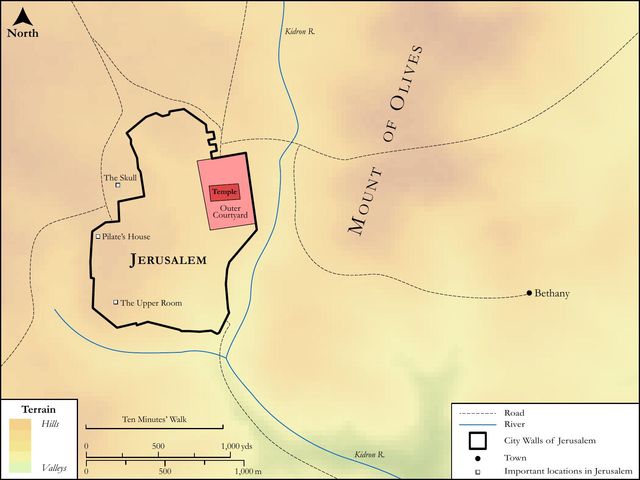
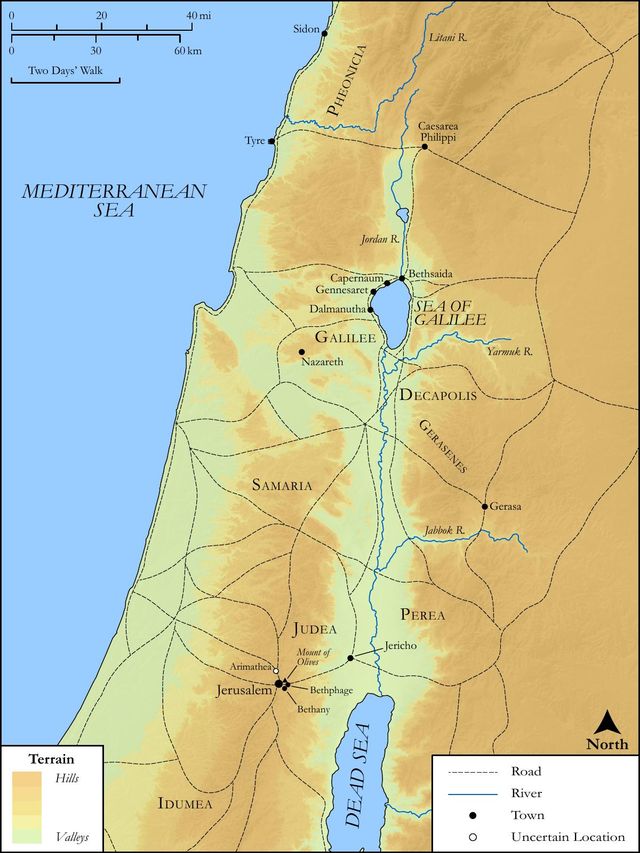
See on the biblical-era maps
Study this verse
Public-domain commentary
Matthew Henry
From his Commentary on the Whole Bible. Henry comments on passages, not single verses — this entry covers Mark 3:13–21. His two-level outline is real structure in the source text, so it is rendered as structure.
In these verses, we have,
I.The choice Christ made of the twelve apostles to be his constant followers and attendants, and to be sent abroad as there was occasion, to preach the gospel. Observe,
1.The introduction to this call or promotion of disciples; He goes up into a mountain, and his errand thither was to pray. Ministers must be set apart with solemn prayer for the pouring out of the Spirit upon them; though Christ had authority to confer the gifts of the Holy Ghost, yet, to set us an example, he prayed for them.
2.The rule he went by in his choice, and that was his own good pleasure; He called unto him whom he would. Not such as we should have thought fittest to be called, looking upon the countenance, and the height of the stature; but such as he thought fit to call, and determined to make fit for the service to which he called them: even so, blessed Jesus, because it seemed good in thine eyes. Christ calls whom he will; for he is a free Agent, and his grace is his own.
3.The efficacy of the call; He called them to separate themselves from the crowd, and stand by him, and they came unto him. Christ calls those who were given him (Joh 17:6); and all that the Father gave him, shall come to him, Joh 6:37. Those whom it was his will to call, he made willing to come; his people shall be willing in the day of his power. Perhaps they came to him readily enough, because they were in expectation of reigning with him in temporal pomp and power; but when afterward they were undeceived in that matter, yet they had such a prospect given them of better things, that they would not say they were deceived in their Master, nor repented their leaving all to be with him.
4.The end and intention of this call; He ordained them (probably by the imposition of hands, which was a ceremony used among the Jews), that they should be with him constantly, to be witnesses of his doctrine, manner of life, and patience, that they might fully know it, and be able to give an account of it; and especially that they might attest the truth of his miracles; they must be with him to receive instructions from him, that they might be qualified to give instructions to others. It would require time to fit them for that which he designed them for; for they must be sent forth to preach; not to preach till they were sent, and not to be sent till by a long and intimate acquaintance with Christ they were fitted. Note, Christ's ministers must be much with him.
5.The power he gave them to work miracles; and hereby he put a very great honour upon them, beyond that of the great men of the earth. He ordained them to heal sicknesses and to cast out devils. This showed that the power which Christ had to work these miracles was an original power; that he had it not as a Servant, but as a Son in his own house, in that he could confer it upon others, and invest them with it: they have a rule in the law, Deputatus non potest deputare - He that is only deputed himself, cannot depute another; but our Lord Jesus had life in himself, and the Spirit without measure; for he could give this power even to the weak and foolish things of the world.
6.Their number and names; He ordained twelve, according to the number of the twelve tribes of Israel. They are here named not just in the same order as they were in Matthew, nor by couples, as they were there; but as there, so here, Peter is put first and Judas last. Here Matthew is put before Thomas, probably being called in that order; but in that catalogue which Matthew himself drew up, he puts himself after Thomas; so far was he from insisting upon the precedency of his consecration. But that which Mark only takes notice of in this list of the apostles, is, that Christ called James and John Boanerges, which is, The sons of thunder; perhaps they were remarkable for a loud commanding voice, they were thundering preachers; or, rather, it denotes the zeal and fervency of their spirits, which would make them active for God above their brethren. These two (saith Dr. Hammond) were to be special eminent ministers of the gospel, which is called a voice shaking the earth, Heb 12:26. Yet John, one of those sons of thunder, was full of love and tenderness, as appears by his epistles, and was the beloved disciple.
7.Their retirement with their Master, and close adherence to him; They went into a house. Now that this jury was impanelled, they stood together, to hearken to their evidence. They went together into the house, to settle the orders of their infant college; and now, it is likely, the bag was given to Judas, which pleased him, and made him easy.
II.The continual crowds that attended Christ's motions (Mar 3:20); The multitude cometh together again, unsent for, and unseasonably pressing upon him, some with one errand and some with another; so that he and his disciples could not get time so much as to eat bread, much less for a set and full meal. Yet he did not shut his doors against the petitioners, but bade them welcome, and gave to each of them an answer of peace. Note, They whose hearts are enlarged in the work of God, can easily bear with great inconveniences to themselves, in the prosecution of it, and will rather lose a meal's meat at any time than slip an opportunity of doing good. It is happy when zealous hearers and zealous preachers thus meet, and encourage one another. Now the kingdom of God was preached, and men pressed into it, Luk 16:16. This was a gale of opportunity worth improving; and the disciples might well afford to adjourn their meals, to lay hold on it. It is good striking while the iron is hot.
III.The care of his relations concerning him (Mar 3:21); When his friends in Capernaum heard how he was followed, and what pains he took, they went out, to lay hold on him, and fetch him home, for they said, He is beside himself.
1.Some understand it of an absurd preposterous care, which had more in it of reproach to him than of respect; and so we must take it as we read it, He is beside himself; either they suspected it themselves, or it was suggested to them, and they gave credit to the suggestion, that he was gone distracted, and therefore his friends ought to bind him, and put him in a dark room, to bring him to his right mind again. His kindred, many of them, had mean thoughts of him (Joh 7:5), and were willing to hearken to this ill construction which some put upon his great zeal, and to conclude him crazed in his intellects, and under that pretence to take him off from his work. The prophets were called mad fellows, Kg2 9:11.
2.Others understand it of a well-meaning care; and then they read exestē - "He fainteth, he has no time to eat bread, and therefore his strength will fail him; he will be stifled with the crowd of people, and will have his spirits quite exhausted with constant speaking, and the virtue that goes out of him in his miracles; and therefore let us use a friendly violence with him, and get him a little breathing-time." In his preaching-work, as well as his suffering-work, he was attacked with, Master, spare thyself. Note, They who go on with vigour and zeal in the work of God, must expect to meet with hindrances, both from the groundless disaffection of their enemies, and the mistaken affections of their friends, and they have need to stand upon their guard against both.
Historical interpretation
Eight Centuries of Reception
9 surviving comments on this verse. Each one is dated, so this reads as a timeline rather than a list.
Select a marker to jump to its quote. Markers stagger vertically where authors wrote within a few decades of each other.
Or spiritually, Christ is the mount, from which living waters flow, and milk is procured for the health of infants; whence the spiritual feast of fat things is made known, and whatsoever is believed to be most highly good is established by the grace of that Mountain. Those therefore who are highly exalted in merits and in words are called up into a mountain, that the place may correspond to the loftiness of their merits. It goes on: And they came unto him, &c. For the Lord loved the beauty of Jacob, (Ps. 46 Vulg.) that they might sit upon twelve thrones, judging the twelve tribes of Israel, (Matt. 19:28) who also in bands of threes and fours watch around the tabernacle of the Lord, and carry the holy words of the Lord, bearing them forward on their actions, as men do burdens on their shoulders.
Thus from obedience, which Simon signifies, the ascent is made to knowledge, which is meant by Peter. It goes on: And James the son of Zebedee, and John his brother.
Namely, James who has supplanted all the desires of the flesh, and John, who received by grace what others held by labour. There follows: And he surnamed them, Boanerges. (Gen. 27:36. v. Aur. Cat. in Matt. 10:2)
Or by this the lofty merit of the three mentioned above is shown, who merited to hear in the mountain the thunders of the Father, when he proclaimed in thunder through a cloud concerning the Son, This is my beloved Son; that they also through the cloud of the flesh and the fire of the word1, (Matt. 17:1) might as it were scatter the thunderbolts in rain on the earth, since the Lord turned the thunderbolts into rain, so that mercy extinguishes what judgment sets on fire. It goes on: And Andrew, who manfully does violence to perdition, so that he had ever ready within him his own death, to give as an answer, and his soul was ever in his hands. (1 Pet. 3:15. Ps. 119:109. Bede ubi sup.)
Or, 'the mouth of a lamp,' that is, one who can throw light by his mouth upon what he has conceived in his heart, to whom the Lord gave the opening of a mouth, which diffused light. We know that this mode of speaking belongs to holy Scripture; for Hebrew names are put down in order to intimate a mystery. There follows: And Bartholomew, which means, the son of him who suspends the waters; of him, that is, who said, I will also command the clouds that they rain no rain upon it. (Is. 5:6) But the name of son of God is obtained by peace and loving one's enemy; for, Blessed are the peacemakers, for they are the sons of God. (Matt. 5:9, 44, 45) And, Love your enemies, that ye may be the sons of God. There follows: And Matthew, that is, 'given,' to whom it is given by the Lord, not only to obtain remission of sins, but to be enrolled in the number of the Apostles. And Thomas, which means, 'abyss;' for men who have knowledge by the power of God, put forward many deep things. It goes on: And James the son of Alphæus, that is, of 'the learned' or 'the thousandth,' (Ps. 91:7) beside whom a thousand will fall. This other James is he, whose wrestling is not against flesh and blood, but against spiritual wickedness. (Eph. 6:12) There follows, And Thaddæus, that is, 'corculum,' (qu. cordis cultor) which means 'he who guards the heart,' one who keeps his heart in all watchfulness.
But Simon is interpreted, 'laying aside sorrow;' for blessed are they that mourn, for they shall be comforted. (Matt. 5:4) And he is called Canaanite, that is, Zealot, because the zeal of the Lord ate him up. But Judas Iscariot is one who does not do away his sins by repentance. For Judas means 'boaster,' or vain-glorious. And Iscariot, 'the memory of death.' But many are the proud and vain-glorious confessors in the Church, as Simon Magus, and Arius, and other heretics, whose deathlike memory is celebrated in the Church, that it may be avoided.
Thunder here refers to the preaching of the gospel. For as a heavenly shout occurs like a voice of thunder, surpassing all human power, in the same way also the preaching of the gospel, which is a heavenly happening, does not consist of human strength. The gospel did not fill the world by human planning, but by divine power.
Thunder is produced when a dry and violent wind, closed up in the hollows of a cloud and violently hurled around in the cavities of the clouds, seeks a passage to the outside. The clouds, offering resistance under the excessive pressure, produce that harsh sound from the friction of the wind. But when, like bubbles distended by the air, they are unable to resist and endure any longer, but are violently torn apart and give the air a passage to the outer breeze, they produce the noises of the thunder. And this normally causes the flash of lightning. It is the Lord who is upon the waters and who arouses the mighty noises of the thunder, causing such an exceedingly great noise through the delicate medium of air. The eloquent teaching which leads from baptism to sanctification is like thunder to the soul. That the gospel is like thunder is made evident by the disciples who were given a new name by the Lord: sons of thunder.
James and John his brother he called “sons of thunder.” Why? To show that he was the same One who, in giving the old covenant, altered names, who called Abram “Abraham,” and Sarai “Sarah” and Jacob “Israel.” … It was also a custom of the patriarchs to give descriptive names to persons, as Leah did. This is not mere arbitrariness, but in order that they may have a hallmark to remind them of the goodness of God. By this means, a perpetual memory of the prophecy conveyed by the name sounds forth in the ears of those who receive it. HOMILIES ON ST.
Verse 7. "And the overseer of the eunuchs imposed names upon them, calling Daniel Belteshazzar (Balthasar), and Hananiah Shadrach, and Mishael Meshach, and Azariah Abednego." It was not only the overseer or master of the eunuchs (as others have rendered it, the "chief-eunuch") who changed the names of saints, but also Pharaoh called Joseph in Egypt Somtonphanec (Genesis 41:45), for neither of them wished them to have Jewish names in the land of captivity. Wherefore the prophet says in the Psalm: "How shall we sing the Lord's song in a strange land?" (Psalm 137:4). Furthermore the Lord Himself changes names benignly, and on the basis of events imposes names of special significance, so as to call Abram Abraham (Genesis 17:5), and Sarai Sarah (Genesis 17:15). Also in the Gospel, the former Simon received the name of Peter (Mark 3:16), and the sons of Zebedee are called "sons of thunder" (Mark 3:17) - which is not boanerges, as most people suppose, but is more correctly read benereem.
(Vict. Ant. e Cat. in Marc.) He also instructs the Prelates of the Church to pass the night in prayer before they ordain, that their office be not impeded. When therefore, according to Luke, it was day, He called whom He would; for there were many who followed Him.
(Vict. Ant. e Cat. in Marc.) He calls the sons of Zebedee by this name, because they were to spread over the world the mighty and illustrious decrees of the Godhead.
(in Marc. i. 16) After having forbidden the evil spirits to preach Him, He chose holy men, to cast out the unclean spirits, and to preach the Gospel; wherefore it is said, And he went up into a mountain, &c. (Luke 6)
(ubi sup.) For it was not a matter of their choice and zeal, but of Divine condescension and grace, that they should be called to the Apostleship. The mount also in which the Lord chose His Apostles, shows the lofty righteousness in which they were to be instructed, and which they were about to preach to men.
(ubi sup.) For as a sacrament of this the children of Israel once used to encamp about the Tabernacle, so that on each of the four sides of the square three tribes were stationed. Now three times four are twelve, and in three bands of four the Apostles were sent to preach, that through the four quarters of the whole world they might baptize the nations in the name of the Father, the Son, and the Holy Ghost. It goes on: And he gave them power, &c. That is, in order that the greatness of their deeds might bear witness to the greatness of their heavenly promises, and that they, who preached unheard-of things, might do unheard-of actions.
(ubi sup.) And the reason that the Lord willed that he should at first be called otherwise, was that from the change itself of the name, a mystery might be conveyed to us. Peter then in Latin or in Greek means the same thing as Cephas in Hebrew, and in each language the name is drawn from a stone. Nor can it be doubted that is the rock of which Paul spoke, And this rock was Christ. (1 Cor. 10:4) For as Christ was the true light, and allowed also that the Apostles should be called the light of the world, (Matt. 5:14.) so also to Simon, who believed on the rock Christ, He gave the name of Rock.
(ubi sup.) We must connect this with what went before, He goeth up into a mountain, and calleth.
For Andrew is a Greek name, which means 'manly,' from ἀνὴδ, that is, man, for he manfully adhered to the Lord. There follows, And Philip.
(ubi sup.) But Thaddæus is the same person, as Luke calls in the Gospel and in the Acts, Jude of James, for he was the brother of James, the brother of the Lord, as he himself has written in his Epistle. There follows, And Simon the Canaanite, and Judas Iscariot, who betrayed him. He has added this by way of distinction from Simon Peter, and Jude the brother of James. Simon is called the Canaanite from Cana, a village in Galilee, and Judas, Scariotes, from the village from which he had his origin, or he is so called from the tribe of Issachar.
And James, the son of Zebedee, and John, the brother of James (it is understood from the previous verses that he called them to him when he went up into the mountain). And he gave them the names Boanerges, which means sons of thunder. They were aptly named sons of thunder, as one of them, resounding with that theological voice from heaven, which no one had known how to utter before, said: In the beginning was the Word, and the Word was with God, and the Word was God, etc. (John I). It left such weighty power within it, that if he ever desired to thunder more, the world itself could not contain it. And both often deserved to be led apart and into the mountain by the Lord, and at times to perceive the terrifying sound from the cloud: This is my beloved son, listen to him (Mark IX). They also bore names most fitting to their merits. For James means supplanter. John, in whom is both grace, or the Lord's grace, as he is called. For he rejoiced to supplant the care of the flesh when the Lord called, and to despise the flesh itself when Herod killed him; and the latter, because of the grace of special love which he deserved through virginal glory, reclined on the chest of his Redeemer at the supper.
Luke, however, says that He went up to pray, for after the showing forth of miracles He prays, teaching us that we should give thanks, when we obtain any thing good, and refer it to Divine grace.
Further, He gives the names of the Apostles, that the true Apostles might be known, so that men might avoid the false. And therefore it continues: And Simon he surnamed Cephas.
Whom he reckons amongst the Apostles, that we may learn that God does not repel any man for wickedness, which is future, but counts him worthy on account of his present virtue.
Continue studying Mark 3:17 across the web’s major study libraries — every link below opens this exact verse, chapter, or book on the destination site.
Read & Compare
 BibleGatewayThis verse in more than 200 translations and 70 languages.
 Bible.comThe YouVersion reader — hundreds of translations, reading plans, and highlights.
 ESV.orgCrossway's official English Standard Version reader.
 NET BibleThe NET translation with 60,000+ translators' notes on every rendering decision.
 STEP BibleTyndale House's free study tool — original text, vocabulary, and scholarly resources.
 BibliaLogos Bible Software's free web reader.
 USCCBThe New American Bible (Revised Edition) with the U.S. bishops' study notes.
Commentaries
 BibleHub CommentariesDozens of classic commentaries on this verse, gathered on one page.
 StudyLightMore than 100 commentary sets — the largest collection on the web.
 BibleRefPlain-English commentary on what this verse means, verse by verse.
 Enduring WordDavid Guzik's free commentary on this chapter, widely used by Bible teachers.
 Bible Study ToolsVerse commentary alongside Greek and Hebrew study aids.
Original Language & Research
- BibleHub InterlinearThe verse word by word — original language, transliteration, and English.
- BibleHub LexiconEvery word's original-language definition and Strong's entry.
 Blue Letter BibleDeep-study tools — Strong's numbers, concordance, and word studies.
 CNTR CollationThe earliest Greek manuscripts of this verse, collated letter by letter.
Sermons, Hymns & Audio


TrulyRandomVerse is not affiliated with these sites and doesn’t control their content. They’re linked because they’re genuinely useful.
Summary
Mark 3:17 recounts Jesus' specific naming of two of His chosen apostles, James and John, the sons of Zebedee, bestowing upon them the Aramaic surname "Boanerges," which translates to "Sons of Thunder." This pivotal moment occurs during the formal selection of the twelve disciples, highlighting Jesus' divine authority to discern and characterize His followers, and foreshadowing the intense zeal and impactful ministry that these brothers would exhibit as they were transformed by His teaching and the power of the Holy Spirit.
Context
ShowHideLiterary Context
This verse is situated within the broader narrative of Jesus' early ministry in Galilee, specifically following a period of intense teaching, healing, and the growing opposition from the religious authorities. Mark 3:13-19 describes Jesus' deliberate act of withdrawing to a mountain to choose and appoint twelve men, whom He called "apostles," to be with Him, to be sent out to preach, and to have authority to cast out demons. The naming of Simon as Peter ("Rock") in Mark 3:16 immediately precedes the naming of James and John, establishing a pattern of Jesus' sovereign insight into the character and future roles of His disciples. This selection marks a significant shift, moving from a general following to the establishment of an inner core who would carry on His mission. The subsequent verses detail the increasing demands on Jesus and His disciples, leading to accusations from His family and the scribes from Jerusalem, further emphasizing the critical nature of this apostolic commissioning.
Historical & Cultural Context
The act of renaming individuals holds profound significance in biblical tradition, often signifying a new identity, a special calling, or a change in destiny, as seen with Abram becoming Abraham or Jacob becoming Israel. In the Semitic culture of Jesus' time, a "son of" idiom (e.g., "sons of Belial") was commonly used to denote a characteristic or quality inherent in a person or group, rather than merely biological parentage. Thus, "Sons of Thunder" was not just a whimsical nickname but a deeply meaningful descriptor. The Aramaic term "Boanerges" itself reflects the linguistic landscape of Galilee, where Aramaic was the common vernacular, even as the Gospel was recorded in Greek. The disciples, being Galileans, would have been familiar with such idioms. Furthermore, the political and religious climate was charged, with various factions vying for influence and a widespread expectation of a Messiah who would bring about dramatic change. The temperament implied by "thunder" would have been a potent characteristic in such an environment.
Key Themes
ShowHideMark 3:17 contributes significantly to several key themes within Mark's Gospel and the broader New Testament. Firstly, it underscores the theme of Divine Authority and Insight. Jesus' ability to rename and characterize His disciples demonstrates His sovereign authority not only over creation and disease but also over human identity and destiny. He sees beyond the superficial to the core nature of individuals. Secondly, the verse highlights the theme of Character Revelation and Transformation. The "Sons of Thunder" moniker points to a fiery, zealous, and potentially impetuous temperament in James and John, a characteristic evident in their later desire to call down fire on a Samaritan village in Luke 9:54 or their ambitious request for prominent seats in Jesus' kingdom in Mark 10:37. Yet, Jesus chose them, indicating His intention to refine and channel their raw passion for His purposes, demonstrating the transformative power of discipleship. Finally, it speaks to the theme of Apostolic Commissioning and the Establishment of the New Community, as these men, despite their flaws, are called to be foundational pillars of the burgeoning Christian movement, tasked with proclaiming the powerful, "thundering" message of the Gospel.
Exposition and Analysis
ShowHideKey Word Analysis
ShowHideOf Chaldee origin, meaning "sons of commotion." This epithet, given by Jesus to James and John, points to a temperament characterized by intensity, fervor, and perhaps a volatile or impetuous nature. It signifies a powerful, impactful presence, akin to the force of a storm.
From epi (upon) and tithēmi (to place), meaning "to impose" or "to place upon." In this context, it signifies Jesus' authoritative act of bestowing a name or title upon them. This is not merely a casual nickname but a divinely appointed designation that speaks to their character and future ministry.
Akin to a word meaning "to roar," this term literally refers to the loud, rumbling sound associated with a storm. Symbolically, it conveys a sense of power, awe, and perhaps a disruptive or forceful impact. When applied to James and John, it suggests a personality capable of powerful, even vehement, expression.
Verse Breakdown
ShowHide"And James the son of Zebedee, and John the brother of James;"
This clause identifies the two disciples by their familial relationship. James and John were biological brothers, and sons of Zebedee, a fisherman who was prosperous enough to employ hired servants (Mark 1:20). Their close relationship is often highlighted in the Gospels, as they frequently appear together in the inner circle of Jesus' disciples alongside Peter.
"and he surnamed them Boanerges,"
This is the central action of the verse. "He" refers to Jesus, emphasizing His active role and authority in assigning this unique name. The act of "surnaming" (or renaming) is significant, signifying a divine insight into their character and a prophetic declaration of their future identity or role. "Boanerges" is the Aramaic term Jesus used, indicating the authenticity of the historical encounter.
"which is, The sons of thunder:"
This explanatory phrase, provided by the Gospel writer Mark for his Greek-speaking audience, translates the Aramaic "Boanerges" into Greek. The idiom "sons of thunder" powerfully conveys the essence of their character—a strong, fervent, and perhaps explosive temperament. This description hints at their zeal, passion, and potential for forceful proclamation, which, under Christ's guidance, would be channeled for the powerful spread of the Gospel.
Literary Devices
ShowHideMark 3:17 effectively employs Naming/Renaming as a significant literary device. The act of Jesus bestowing a new name upon James and John, following His renaming of Simon as Peter, underscores His divine authority and prophetic insight into their character and destiny. This is not merely a descriptive label but a transformative act, signaling a new identity and purpose within God's redemptive plan. The phrase "Sons of Thunder" itself is a powerful example of Symbolism and Metaphor. "Thunder" symbolizes power, intensity, and a forceful, perhaps even disruptive, presence. By associating James and John with thunder, Jesus metaphorically describes their inherent temperament—a fiery zeal and passionate disposition. This symbolic naming also carries a degree of Irony, as these "sons of thunder," known for their impetuousness, would ultimately be refined by Christ to become powerful, yet controlled, instruments for the "thundering" proclamation of the Gospel message.
Theological and Thematic Connections
ShowHideThe naming of James and John as "Sons of Thunder" profoundly illustrates Jesus' unique authority not only to call disciples but also to discern their deepest character and to providentially guide their transformation. This act signifies that God sees our raw, untamed nature—our passions, our zeal, our flaws—and rather than rejecting us, He chooses to refine and channel these very traits for His kingdom purposes. It speaks to the divine sovereignty in calling and the transformative power of discipleship, where natural human tendencies, even those that seem volatile, can be sanctified and harnessed for powerful, Spirit-led ministry. This demonstrates that God uses diverse personalities, not just those who conform to a specific mold, to accomplish His will, revealing His patient work in shaping His chosen vessels.
Reflection and Application
ShowHideMark 3:17 offers a profound mirror for self-reflection and a powerful message of hope for believers today. Just as Jesus saw the "thunder" in James and John—their raw zeal, their potential for intensity, and perhaps their impetuousness—He sees us fully, with all our unique temperaments, strengths, and weaknesses. This passage encourages us to recognize that our natural inclinations, even those that seem challenging or unrefined, are not barriers to God's calling but rather raw material for His transformative work. The "thunder" in us, whether it be passion, assertiveness, or a strong will, can be sanctified by the Holy Spirit and redirected for powerful, Spirit-led ministry rather than destructive impulsiveness. We are called to surrender our innate character to Christ, trusting that He will refine and channel our unique attributes for His glory, making us effective instruments in His hands. This verse reminds us that God's call is not based on our perfection, but on His purpose to shape and use us, empowering us to become bold and impactful witnesses for His truth.
Questions for Reflection
ShowHideFAQ
ShowHideWhy did Jesus give James and John the specific nickname "Boanerges" or "Sons of Thunder"?
ShowHideJesus gave James and John the nickname "Boanerges," which means "Sons of Thunder," likely to characterize their fiery, zealous, and intense personalities. This was not a derogatory label but a descriptive one, reflecting their inherent temperament. We see instances of this "thunderous" nature in the Gospels, such as their desire to call down fire on a Samaritan village (Luke 9:54) or their ambitious request for positions of prominence in Jesus' kingdom (Mark 10:37). Jesus, with His divine insight, recognized this powerful potential and intended to refine and channel their zeal for the bold and impactful proclamation of the Gospel. It signifies a powerful, authoritative presence that would be used for His kingdom.
What is the significance of Jesus renaming His disciples, like Simon to Peter and James and John to "Boanerges"?
ShowHideThe act of renaming in biblical tradition carries profound significance, often indicating a new identity, a special calling, or a change in destiny. When Jesus renames Simon as Peter ("Rock") in Mark 3:16 and James and John as "Sons of Thunder," it demonstrates His divine authority and prophetic insight. It's not just a casual nickname but a declaration of their character and future role in God's plan. This act signifies that Jesus knows His disciples intimately, sees their potential, and sovereignly appoints them for specific purposes, often transforming their natural inclinations to serve His kingdom. It underscores His role as the Lord who shapes and empowers His followers.
Christ-Centered Fulfillment
ShowHideMark 3:17, with Jesus' authoritative naming of James and John as "Boanerges" or "Sons of Thunder," finds its ultimate Christ-centered fulfillment in the person and work of Jesus Himself. While James and John embodied a raw, human "thunder" of zeal and passion, Jesus is the true and perfect "Son of Thunder," the very embodiment of divine power, authority, and impactful truth. He is the one whose voice "thunders" with authority, silencing demons (Mark 1:27), calming storms (Mark 4:39), and proclaiming the kingdom of God with unparalleled force. The "thunder" in James and John was a reflection of their human temperament, needing refinement; but in Christ, divine power and perfect wisdom are intrinsically united. He is the one who, through His death and resurrection, unleashes the ultimate "thunder" of God's redemptive power, conquering sin and death. Furthermore, it is through His transformative work, powered by the Holy Spirit (the "thunder" of Pentecost in Acts 2:2-4), that the natural, unrefined "thunder" of His disciples is sanctified and channeled, enabling them to become powerful, yet humble, proclaimers of His truth, echoing His own authoritative voice to the ends of the earth. Thus, the naming of Boanerges points not only to the character of the disciples but, more profoundly, to the sovereign, transformative power of the Son of God, Jesus Christ, who alone can perfect and utilize every human trait for His glory.