


Mark 1:27
- καὶkaiAndG2532CONJConjunction
- ἐθαμβήθησανethambēthēsanwere astonishedG2284V-API-3PVerb Aorist Passive Indicative 3rd Plural
- ἅπαντεςhapantesallG537A-NPMAdjective Nominative Plural Masculine
- ὥστεhōsteso asG5620CONJConjunction
- συζητεῖνsuzēteinto questionG4802V-PANVerb Present Active Infinitive
- πρὸςprosamongG4314PREPPreposition
- ἑαυτοὺςhe'autousthemselvesG1438F-3APMReflexive pronoun Accusative 3rd Plural Masculine
- λέγοντας·legontassayingG3004V-PAP-APMVerb Present Active Participle Accusative Plural Masculine
- τίtiWhatG5101I-NSNInterrogative pronoun Nominative Singular Neuter
- ἐστινestinisG1510V-PAI-3SVerb Present Active Indicative 3rd Singular
- τοῦτο;toutothis?G3778D-NSNDemonstrative pronoun Nominative Singular Neuter
- τίςtiswhatG5101I-NSFInterrogative pronoun Nominative Singular Feminine
- ἡhē<the>G3588T-NSFDefinite article Nominative Singular Feminine
- διδαχὴdidachēteachingG1322N-NSFNoun Nominative Singular Feminine
- ἡhē<the>G3588T-NSFDefinite article Nominative Singular Feminine
- καινὴkainēnewG2537A-NSFAdjective Nominative Singular Feminine
- αὕτηhautēthisG3778D-NSFDemonstrative pronoun Nominative Singular Feminine
- ὅτιhotithatG3754CONJConjunction
- κατ᾽kat᾽WithG2596PREPPreposition
- ἐξουσίαν·exousianauthorityG1849N-ASFNoun Accusative Singular Feminine
- καὶkaievenG2532CONJConjunction
- τοῖςtoisto theG3588T-DPNDefinite article Dative Plural Neuter
- πνεύμασινpneumasinspiritsG4151N-DPNNoun Dative Plural Neuter
- τοῖςtois<the>G3588T-DPNDefinite article Dative Plural Neuter
- ἀκαθάρτοιςakathartoisuncleanG169A-DPNAdjective Dative Plural Neuter
- ἐπιτάσσειepitasseiHe commandsG2004V-PAI-3SVerb Present Active Indicative 3rd Singular
- καὶkaiandG2532CONJConjunction
- ὑπακούουσινhupakouousinthey obeyG5219V-PAI-3PVerb Present Active Indicative 3rd Plural
- αὐτῷautōHim!G846P-DSMPersonal pronoun Dative Singular Masculine
English is a literal word-by-word gloss of the Greek, not the KJV's wording. Why?
This is the original text the KJV's translators worked from — each Greek word with its own literal English meaning in this verse, prepared by scholars at Tyndale House, Cambridge. The KJV translates whole sentences, not word by word, so its wording differs: one Greek word can become several English words, and the KJV may choose “charity” where the gloss reads “love”. Both are faithful — they answer different questions. For the KJV's own rendering, switch to the KJV text.
Details
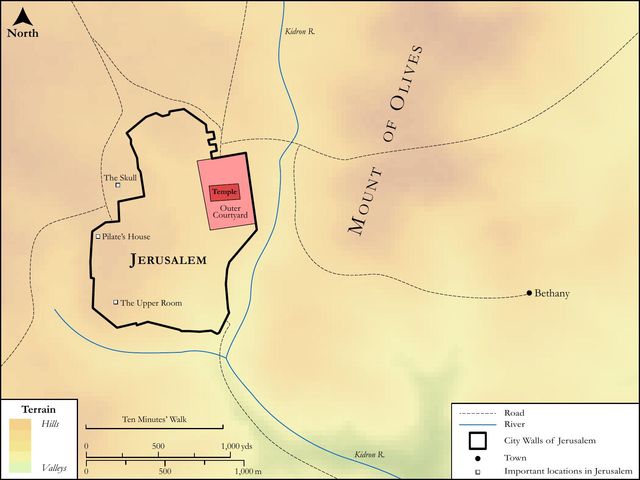
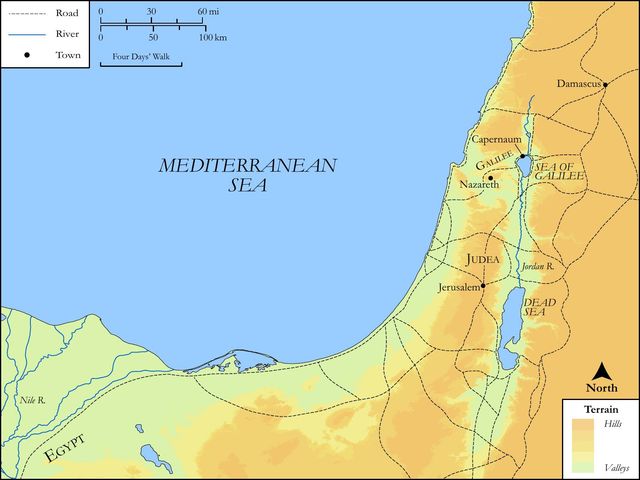
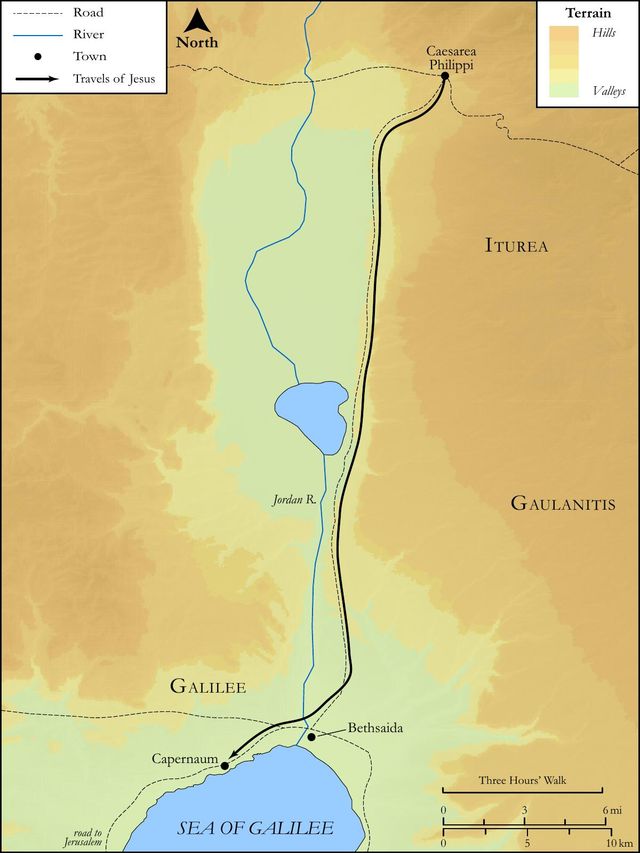
See on the biblical-era map
Study this verse
Public-domain commentary
Matthew Henry
From his Commentary on the Whole Bible. Henry comments on passages, not single verses — this entry covers Mark 1:23–28. His three-level outline is real structure in the source text, so it is rendered as structure.
As soon as Christ began to preach, he began to work miracles for the confirmation of his doctrine; and they were such as intimated the design and tendency of his doctrine, which were to conquer Satan, and cure sick souls.
In these verses, we have,
I.Christ's casting the devil out of a man that was possessed, in the synagogue at Capernaum.
This passage was not related in Matthew, but is afterward in Luk 4:33. There was in the synagogue a man with an unclean spirit, en pneumati akathartō - in an unclean spirit; for the spirit had the man in his possession, and led him captive at his will. So the whole world is said to lie en tō ponerō - in the wicked one. And some have thought it more proper to say, The body is in the soul, because it is governed by it, than the soul in the body. He was in the unclean spirit, as a man is said to be in a fever, or in a frenzy, quite overcome by it. Observe, The devil is here called an unclean spirit, because he has lost all the purity of his nature, because he acts in direct opposition to the Holy Spirit of God, and because with his suggestions he pollutes the spirits of men. This man was in the synagogue; he did not come either to be taught or to be healed, but, as some think, to confront Christ and oppose him, and hinder people from believing on him. Now here we have,
1.The rage which the unclean spirit expressed at Christ; He cried out, as one in an agony, at the presence of Christ, and afraid of being dislodged; thus the devils believe and tremble, have a horror of Christ, but no hope in him, nor reverence for him. We are told what he said, Mar 1:24, where he doth not go about to capitulate with him, or make terms (so far was he from being in league or compact with him), but speaks as one that knew his doom.
(1.)He calls him Jesus of Nazareth; for aught that appears, he was the first that called him so, and he did it with design to possess the minds of the people with low thoughts of him, because no good thing was expected out of Nazareth; and with prejudices against him as a Deceiver, because every body knew the Messiah must be of Bethlehem.
(2.)Yet a confession is extorted from him - that he is the holy One of God, as was from the damsel that had the spirit of divination concerning the apostles - that they were the servants of the most high God, Act 16:16, Act 16:17. Those who have only a notion of Christ - that he is the holy One of God, and have no faith in him, or love to him, go no further than the devil doth.
(3.)He in effect acknowledgeth that Christ was too hard for him, and that he could not stand before the power of Christ; "Let us alone; for if thou take us to task, we are undone, thou canst destroy us." This is the misery of those wicked spirits, that they persist in their rebellion, and yet know it will end in their destruction.
(4.)He desires to have nothing to do with Jesus Christ; for he despairs of being saved by him, and dreads being destroyed by him. "What have we to do with thee? If thou wilt let us alone, we will let thee alone." See whose language they speak, that say to the Almighty, Depart from us. This, being an unclean spirit, therefore hated and dreaded Christ, because he knew him to be a holy One; for the carnal mind is enmity against God, especially against his holiness.
2.The victory which Jesus Christ obtained over the unclean spirit; for this purpose was the Son of God manifested, that he might destroy the works of the devil, and so he makes it to appear; nor will he be turned back from prosecuting this war, either by his flatteries or by his menaces. It is in vain for Satan to beg and pray, Let us alone; his power must be broken, and the poor man must be relieved; and therefore,
(1.)Jesus commands. As he taught, so he healed, with authority. Jesus rebuked him; he chid him and threatened him, imposed silence upon him; Hold thy peace; phimōthēti - be muzzled. Christ has a muzzle for that unclean spirit when he fawns as well as when he barks; such acknowledgments of him as this was, Christ disdains, so far is he from accepting them. Some confess Christ to be the holy One of God, that under the cloak of that profession they may carry on malicious mischievous designs; but their confession is doubly an abomination to the Lord Jesus, as it sues in his name for a license to sin, and shall therefore be put to silence and shame. But this is not all, he must not only hold his peace, but he must come out of the man; this was it he dreaded - his being restrained from doing further mischief. But,
(2.)The unclean spirit yields, for there is no remedy (Mar 1:26); He tore him, put him into a strong convulsion; that one could have thought he had been pulled in pieces; when he would not touch Christ, in fury at him he grievously disturbed this poor creature. Thus, when Christ by his grace delivers poor souls out of the hands of Satan, it is not without a grievous toss and tumult in the soul; for that spiteful enemy will disquiet those whom he cannot destroy. He cried with a loud voice, to frighten the spectators, and make himself seem terrible, as if he would have it thought that though he was conquered, he was but just conquered, and that he hopes to rally again, and recover his ground.
II.The impression which this miracle made upon the minds of the people, Mar 1:27, Mar 1:28.
1.It astonished them that saw it; They were all amazed. It was evident, beyond contradiction, that the man was possessed - witness the tearing of him, and the loud voice with which the spirit cried; it was evident that he was forced out by the authority of Christ; this was surprising to them, and put them upon considering with themselves, and enquiring of one another, "What is this new doctrine? For it must certainly be of God, which is thus confirmed. He hath certainly an authority to command us, who hath ability to command even the unclean spirits, and they cannot resist him, but are forced to obey him." The Jewish exorcists pretended by charm or invocation to drive away evil spirits; but this was quite another thing, with authority he commands them. Surely it is our interest to make him our Friend, who has the control of infernal spirits.
2.It raised his reputation among all that heard it; Immediately his fame spread abroad into the whole adjacent region of Galilee, which was a third part of the land of Canaan. The story was presently got into every one's mouth, and people wrote it to their friends all the country over, together with the remark made upon it, What new doctrine is this? So that it was universally concluded, that he was a Teacher come from God, and under that character he shone more bright than if he had appeared in all the external pomp and power which the Jews expected their Messiah to appear in; and thus he prepared his own way, now that John, who was his harbinger, was clapped up; and the fame of this miracle spread the further, because as yet the Pharisees, who envied his fame, and laboured to eclipse it, had not advanced their blasphemous suggestion, that he cast out devils by compact with the prince of the devils.
Historical interpretation
Eight Centuries of Reception
6 surviving comments on this verse. Each one is dated, so this reads as a timeline rather than a list.
Select a marker to jump to its quote. Markers stagger vertically where authors wrote within a few decades of each other.
Moreover, Capernaum is mystically interpreted the town of consolation, and the sabbath as rest. The man with an evil spirit is healed by rest and consolation, that the place and time may agree with his healing. This man with an unclean spirit is the human race, in which uncleanness reigned from Adam to Moses; for they sinned without law, and perished without law. (v. Rom. 5:14. 2:12) And he, knowing the Holy One of God, is ordered to hold his peace, for they knowing God did not glorify him as God, but rather served the creature than the Creator. (1:21.25) The spirit tearing the man came out of him. When salvation is near, temptation is at hand also. Pharaoh, when about to leti Israel go, pursues Israel; the devil, when despised, rises up to create scandals.
(Vict. Ant. e Cat. in Marc.) The word Spirit is applied to an Angel, the air, the soul, and even the Holy Ghost. Lest therefore by the sameness of the name we should fall into error, he adds, unclean. And he is called unclean on account of his impiousness and far removal from God, and because he employs himself in all unclean and wicked works.
(Vict. Ant. e Cat. in Marc.) Or else the devil so speaks, as if he said, 'by taking away uncleanness, and giving to the souls of men divine knowledge, Thou allowest us no place in men.'
(Vict. Ant. e Cat. in Marc.) As if he said, Methinks that Thou art come; for he had not a firm and certain knowledge of the coming of God. But he calls Him holy not as one of many, for every prophet was also holy, but he proclaims that He was the One holy; by the article in Greek he shows Him to be the One, but by his fear he shows Him to be Lord of all.
(Vict. Ant. e Cat. in Marc.) Further, the Truth did not wish to have the witness of unclean spirits; wherefore there follows, And Jesus threatened him, saying, &c. Whence a healthful precept is given to us; let us not believe devils, howsoever they may proclaim the truth. It goes on, And the unclean spirit tearing him, &c. For, because the man spoke as one in his senses and uttered his words with discretion, lest it should be thought that he put together his words not from the devil but out of his own heart, He permitted the man to be torn by the devil, that He might show that it was the devil who spoke.
And they were all amazed, such that they questioned among themselves, etc. Seeing the virtue of the miracle, they marvel at the newness of the Lord's teaching, and are stirred to inquire about the things they had heard through the things they had seen. For certainly the signs that either the Lord himself did in the assumed man, or that he gave to the disciples to do, were done so that through these, faith in the Gospel of the kingdom of God, which was being preached, might be more certain, while those who promised future heavenly joys to the earthborn demonstrated heavenly and divine works on earth. Truly, the disciples conducted everything as pure men with the Lord granting. But the Lord himself singularly operated in the virtue of power and worked healings and miracles, and spoke in the world what He heard from the Father. For even before (as the Gospel testifies) he was teaching them as one having authority, and not as the scribes (Matt. VII). And now, with the crowd attesting, he commands the unclean spirits with authority, and they obey him (Mark I).
(in Marc. i. 7) Since by the envy of the devil death first entered into the world, it was right that the medicine of healing should first work against the author of death; and therefore it is said, And there was in their synagogue a man, &c.
(ubi sup.) For the devils, seeing the Lord on the earth, thought that they were immediately to be judged.
(ubi sup.) But it may appear to be a discrepancy, that he should have gone out of him, tearing him, or, as some copies have it, vexing him, when, according to Luke, he did not hurt him. But Luke himself says, When he had, cast him into the midst, he came out from him, without hurting him. (Luke 4:35) Wherefore it is inferred that Mark meant by vexing or tearing him, what Luke expresses, in the words, When he had cast him into the midst; so that what he goes on to say, And did not hurt him, may be understood to mean, that the tossing of his limbs and vexing, did not weaken him, as devils are wont to come out even with the cutting off and tearing away of limbs. But seeing the power of the miracle, they wonder at the newness of our Lord's doctrine, and are roused to search into what they had heard by what they had seen. Wherefore there follows, And they all wondered &c. For miracles were done that they might more firmly believe the Gospel of the kingdom of God, which was being preached, since those who were promising heavenly joys to men on earth, were showing forth heavenly things and divine works even on earth. For before (as the Evangelist says) He was teaching them as one who had power, and now, as the crowd witnesses, with power He commands the evil spirits, and they obey Him. (1 John 5:20. John 17:3) It goes on, And immediately His fame spread abroad, &c.
For to come out of man the devil considers as his own perdition; for devils are ruthless, thinking that they suffer some evil, so long as they are not troubling men. There follows, I know that thou art the Holy One of God.
That they might know, when they saw it, from how great an evil the man was freed, and on account of the miracle might believe.
(non occ.) For those things which men wonder at they soon divulge, for out of the abundance of the heart the mouth speaketh. (Mat. 12:24)
Continue studying Mark 1:27 across the web’s major study libraries — every link below opens this exact verse, chapter, or book on the destination site.
Read & Compare
 BibleGatewayThis verse in more than 200 translations and 70 languages.
 Bible.comThe YouVersion reader — hundreds of translations, reading plans, and highlights.
 ESV.orgCrossway's official English Standard Version reader.
 NET BibleThe NET translation with 60,000+ translators' notes on every rendering decision.
 STEP BibleTyndale House's free study tool — original text, vocabulary, and scholarly resources.
 BibliaLogos Bible Software's free web reader.
 USCCBThe New American Bible (Revised Edition) with the U.S. bishops' study notes.
Commentaries
 BibleHub CommentariesDozens of classic commentaries on this verse, gathered on one page.
 StudyLightMore than 100 commentary sets — the largest collection on the web.
 BibleRefPlain-English commentary on what this verse means, verse by verse.
 Enduring WordDavid Guzik's free commentary on this chapter, widely used by Bible teachers.
 Bible Study ToolsVerse commentary alongside Greek and Hebrew study aids.
Original Language & Research
- BibleHub InterlinearThe verse word by word — original language, transliteration, and English.
- BibleHub LexiconEvery word's original-language definition and Strong's entry.
 Blue Letter BibleDeep-study tools — Strong's numbers, concordance, and word studies.
 CNTR CollationThe earliest Greek manuscripts of this verse, collated letter by letter.
Sermons, Hymns & Audio


TrulyRandomVerse is not affiliated with these sites and doesn’t control their content. They’re linked because they’re genuinely useful.
Summary
Mark 1:27 vividly portrays the astonished reaction of the synagogue crowd in Capernaum after Jesus authoritatively cast out an unclean spirit. Their amazement stemmed not only from the miraculous act itself but also from the profound authority with which Jesus commanded spiritual forces, leading them to question the nature of this "new doctrine" that was powerfully demonstrated rather than merely taught. This pivotal moment underscores Jesus' unique divine power and the groundbreaking nature of His ministry, setting Him apart from all previous religious teachers.
Context
ShowHideLiterary Context
This verse immediately follows Jesus' initial public ministry in Capernaum. Mark 1:21-22 describes Jesus teaching in the synagogue, where the people were already "astonished at his doctrine: for he taught them as one that had authority, and not as the scribes." The subsequent narrative (Mark 1:23-26) details the dramatic confrontation with an unclean spirit that interrupts Jesus' teaching. The demon, recognizing Jesus as "the Holy One of God," is commanded by Jesus to "Hold thy peace, and come out of him" (Mark 1:25). The spirit's violent departure, followed by the man's immediate healing, serves as a powerful, tangible demonstration of the authority the crowd had just perceived in His teaching. Mark 1:27, therefore, is the immediate and climactic response to this exorcism, confirming and amplifying the earlier observation about Jesus' authority. It sets the stage for the rapid spread of Jesus' fame throughout Galilee, as narrated in the following verses.
Historical & Cultural Context
In first-century Judaism, synagogues served as central community hubs for worship, teaching, and social gathering. Scribes, or teachers of the Law, derived their authority from their meticulous study and interpretation of the Torah and the traditions of the elders, often quoting revered rabbis to support their teachings. Their authority was derivative and interpretive. Exorcism was not unknown in this period, but it was typically performed through elaborate rituals, incantations, and appeals to God or powerful names, often with uncertain outcomes. The idea of someone commanding a spirit with a simple word, and the spirit immediately obeying, was utterly unprecedented. This challenged their established understanding of religious authority, spiritual power, and even the nature of God's interaction with humanity. The term "unclean spirits" (δαιμόνια) referred to malevolent spiritual entities believed to cause various afflictions, both physical and mental, and to lead people astray.
Key Themes
ShowHideMark 1:27 powerfully contributes to several key themes in Mark's Gospel. The most prominent is Jesus' unparalleled authority (exousia), which is introduced in Mark 1:22 and dramatically demonstrated here over spiritual forces. This authority is shown to be inherent and divine, contrasting sharply with the derivative authority of the scribes. Secondly, the verse highlights the arrival of the Kingdom of God and its direct confrontation with the kingdom of darkness. Jesus' ability to command demons signifies the inbreaking of God's reign and His victory over evil, a recurring motif throughout Mark (e.g., Mark 3:22-27). Finally, the crowd's question about a "new doctrine" points to the revolutionary nature of Jesus' teaching and ministry. His "doctrine" is not merely intellectual instruction but a dynamic, living truth validated by miraculous power, demonstrating that the new covenant era has dawned, as prophesied in passages like Isaiah 61:1-3.
Exposition and Analysis
ShowHideKey Word Analysis
ShowHideThis word (G2284) signifies a profound state of stupefaction, astonishment, or awe, often accompanied by fear or dread. It describes a reaction so intense that it leaves one bewildered and speechless. In this context, it conveys the overwhelming impact of witnessing Jesus' power, far beyond mere surprise, indicating a recognition of something extraordinary and perhaps terrifyingly divine.
The Greek term (G2537) refers to something new in quality, freshness, or kind, rather than merely new in time (for which neos would be used). The "new doctrine" is not just recent, but fundamentally different, unprecedented, and superior to what came before. It implies a qualitative shift, suggesting a fresh revelation or a radically different approach to truth and power.
This crucial word (G1849) denotes not just raw power or ability (dynamis), but legitimate, inherent power, privilege, and freedom to act. It implies a rightful dominion, a delegated influence, or mastery. When applied to Jesus, it signifies that His power is not borrowed or earned, but intrinsic to His being, making Him the ultimate source of command and control, particularly over spiritual entities.
Verse Breakdown
ShowHide"And they were all amazed"
This clause emphasizes the universal and profound reaction of the entire synagogue assembly. The use of "all" (πᾶς, pas) highlights the collective, undeniable impact of Jesus' actions, leaving no one untouched by the demonstration of His power. Their amazement goes beyond simple surprise, indicating a deep sense of awe and wonder.
"insomuch that they questioned among themselves, saying, What thing is this?"
The amazement was so overwhelming that it prompted immediate, internal discussion and bewildered questioning. The phrase "questioned among themselves" (συνεζήτουν πρὸς ἑαυτούς, syzētéō pros heautous) suggests a fervent, almost agitated, debate as they tried to comprehend what they had just witnessed. The rhetorical question "What thing is this?" expresses their utter bewilderment and inability to categorize or explain Jesus' actions within their existing frameworks.
"what new doctrine is this?"
This second question reveals the core of their perplexity. They connect the miraculous exorcism directly to Jesus' teaching, perceiving that His "doctrine" (διδαχή, didachḗ) is not merely words but is inextricably linked to, and validated by, His power. The "new" (καινός, kainós) aspect signifies that this teaching is unprecedented in its nature and efficacy, unlike anything they had encountered from the scribes or other religious leaders.
"for with authority commandeth he even the unclean spirits, and they do obey him."
This final clause provides the reason for their astonishment and questions. It directly identifies the source of Jesus' uniqueness: He commands (ἐπιτάσσω, epitássō – to order with force) even the malevolent "unclean spirits" (πνεύματα ἀκάθαρτα, pneûma akáthartos), and, remarkably, "they do obey him" (ὑπακούουσιν αὐτῷ, hypakoúō autō – they listen attentively and conform to His command). This immediate and absolute obedience from spiritual entities demonstrates Jesus' inherent, divine authority (ἐξουσία, exousía) over the spiritual realm, distinguishing Him profoundly from all others.
Literary Devices
ShowHideMark 1:27 employs several Literary Devices to heighten the dramatic impact and underscore Jesus' unique power. The immediate and collective reaction of the crowd, described as "all amazed," functions as Hyperbole, emphasizing the extraordinary nature of the event and ensuring the reader grasps its profound significance. The two successive Rhetorical Questions—"What thing is this? what new doctrine is this?"—serve to draw the reader into the crowd's bewilderment and highlight the unprecedented nature of Jesus' authority. These questions are not seeking answers from an external source but express the internal struggle of the witnesses to reconcile what they have seen with their established understanding. Furthermore, the verse utilizes Contrast by implicitly setting Jesus' authority against that of the scribes, who taught without such inherent power (as noted in Mark 1:22). The explicit statement that Jesus "commandeth he even the unclean spirits, and they do obey him" provides the irrefutable evidence for this contrast, functioning as a Demonstration of His divine power. Finally, there's an element of Dramatic Irony, as the demons recognize Jesus' true identity ("Holy One of God" in Mark 1:24) before the human observers fully comprehend who He is, even as they marvel at His authority.
Theological and Thematic Connections
ShowHideMark 1:27 is a foundational text for understanding the nature of Jesus' messianic ministry. It unequivocally establishes Jesus' divine authority, not merely as a teacher of profound truths, but as the sovereign Lord over all creation, including the spiritual realm. This power over unclean spirits is a tangible manifestation of the Kingdom of God breaking into the world, directly confronting the dominion of evil. The "new doctrine" is thus not just a set of teachings, but a dynamic reality of God's redemptive power being unleashed through His Son. This event signifies that in Jesus, God is actively reclaiming His creation from the grip of sin and spiritual oppression, inaugurating a new era where divine authority is visibly present and active among humanity.
Reflection and Application
ShowHideMark 1:27 invites us to reflect on the nature of true authority and the transformative power of Jesus Christ. In a world often swayed by human opinions, fleeting trends, and various forms of spiritual darkness, this verse reminds us that Jesus' authority is ultimate and unwavering. His power to command even the most malevolent spiritual forces assures us that no opposition, visible or invisible, can ultimately stand against Him. For believers, this means we can live with confidence, knowing that we serve a Lord who has triumphed over all powers of darkness. His "new doctrine" continues to bring liberation, healing, and truth to those who embrace it. This passage challenges us to move beyond mere intellectual assent to Jesus' teachings and to truly marvel at, and submit to, His living, active authority in every area of our lives. It calls us to trust in His word as powerful and effective, capable of bringing order out of chaos and light into darkness.
Questions for Reflection
ShowHideFAQ
ShowHideWhat does "new doctrine" mean in this context?
ShowHideThe phrase "new doctrine" (Greek: kainos didachē) refers to a teaching that is not merely recent in time, but fundamentally different in quality and nature from what the people were accustomed to. Unlike the scribes who taught by quoting previous authorities, Jesus' teaching was accompanied by an inherent, divine authority that was immediately demonstrated through His power over unclean spirits. It was "new" because it was validated by direct, miraculous action, signifying the inbreaking of God's Kingdom and a fresh, dynamic revelation of truth and power, as seen throughout Mark's Gospel.
Why were the people "amazed" by Jesus' authority over unclean spirits?
ShowHideThe people were "amazed" (Greek: thambéō) because Jesus' authority over unclean spirits was utterly unprecedented. While exorcism was practiced in their time, it was typically done through rituals, incantations, and appeals to God, often with uncertain results. Jesus, however, commanded the spirit with a simple word, and it immediately obeyed Him with no resistance. This direct, inherent power, without any elaborate ritual or appeal, profoundly distinguished Him from all other religious figures and demonstrated a level of divine authority they had never witnessed, confirming the observation made earlier in Mark 1:22 about His teaching.
Christ-Centered Fulfillment
ShowHideMark 1:27 provides a powerful glimpse into the Christ-centered fulfillment of God's redemptive plan. The "new doctrine" is ultimately the good news of the Kingdom of God, embodied in Jesus Christ Himself. His authority over unclean spirits foreshadows His ultimate victory over sin, death, and all the powers of darkness, as prophesied in the Old Testament (e.g., Genesis 3:15). This demonstration of power is not merely an isolated miracle but a revelation of His divine identity as the Son of God, who came to destroy the works of the devil (1 John 3:8). Through His death and resurrection, Jesus disarmed the spiritual powers and authorities, triumphing over them by the cross (Colossians 2:15). Therefore, the amazement of the crowd in Mark 1:27 points forward to the universal dominion of the resurrected Christ, to whom all authority in heaven and on earth has been given (Matthew 28:18), and in whose name believers are empowered to overcome evil (Luke 10:19).