


Colossians 2:15
Bible text: King James Version (1769 Blayney text) · Public domain
Bible text: Berean Standard Bible · Public domain
Bible text: American Standard Version (1901) · Public domain
Bible text: World English Bible, Messianic edition · Public domain
Bible text: Geneva Bible (1599) · Public domain
Bible text: Young's Literal Translation · Public domain
- ἀπεκδυσάμενοςapekdusamenosHaving disarmedG554V-ADP-NSMVerb Aorist Middle Deponent Participle Nominative Singular Masculine
- τὰςtastheG3588T-APFDefinite article Accusative Plural Feminine
- ἀρχὰςarchasrulersG746N-APFNoun Accusative Plural Feminine
- καὶkaiandG2532CONJConjunction
- τὰςtastheG3588T-APFDefinite article Accusative Plural Feminine
- ἐξουσίαςexousiasauthoritiesG1849N-APFNoun Accusative Plural Feminine
- ἐδειγμάτισενedeigmatisenHe disgraced [them]G1165V-AAI-3SVerb Aorist Active Indicative 3rd Singular
- ἐνeninG1722PREPPreposition
- παρρησίᾳparrēsiapublicG3954N-DSFNoun Dative Singular Feminine
- θριαμβεύσαςthriambeusashaving triumphedG2358V-AAP-NSMVerb Aorist Active Participle Nominative Singular Masculine
- αὐτοὺςautousover themG846P-APMPersonal pronoun Accusative Plural Masculine
- ἐνeninG1722PREPPreposition
- αὐτῷautōitG846P-DSMPersonal pronoun Dative Singular Masculine
English is a literal word-by-word gloss of the Greek, not the KJV's wording. Why?
This is the original text the KJV's translators worked from — each Greek word with its own literal English meaning in this verse, prepared by scholars at Tyndale House, Cambridge. The KJV translates whole sentences, not word by word, so its wording differs: one Greek word can become several English words, and the KJV may choose “charity” where the gloss reads “love”. Both are faithful — they answer different questions. For the KJV's own rendering, switch to the KJV text.
Details
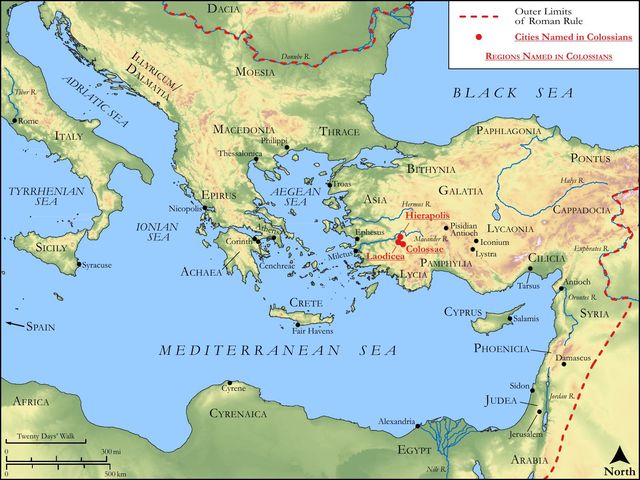
See on the biblical-era maps

Study this verse
Public-domain commentary
Matthew Henry
From his Commentary on the Whole Bible. Henry comments on passages, not single verses — this entry covers Colossians 2:13–15. His two-level outline is real structure in the source text, so it is rendered as structure.
The apostle here represents the privileges we Christians have above the Jews, which are very great.
I.Christ's death is our life:
And you, being dead in your sins and the uncircumcision of your flesh, hath he quickened together with him, Col 2:13. A state of sin is a state of spiritual death. Those who are in sin are dead in sin. As the death of the body consists in its separation from the soul, so the death of the soul consists in its separation from God and the divine favour. As the death of the body is the corruption and putrefaction of it, so sin is the corruption or depravation of the soul. As a man who is dead is unable to help himself by any power of his own, so an habitual sinner is morally impotent: though he has a natural power, or the power of a reasonable creature, he has not a spiritual power, till he has the divine life or a renewed nature. It is principally to be understood of the Gentile world, who lay in wickedness. They were dead in the uncircumcision of their flesh, being aliens to the covenant of promise, and without God in the world, Eph 2:11, Eph 2:12. By reason of their uncircumcision they were dead in their sins. It may be understood of the spiritual uncircumcision or corruption of nature; and so it shows that we are dead in law, and dead in state. Dead in law, as a condemned malefactor is called a dead man because he is under a sentence of death; so sinners by the guilt of sin are under the sentence of the law and condemned already, Joh 3:18. And dead in state, by reason of the uncircumcision of our flesh. An unsanctified heart is called an uncircumcised heart: this is our state. Now through Christ we, who were dead in sins, are quickened; that is, effectual provision is made for taking away the guilt of sin, and breaking the power and dominion of it. Quickened together with him - by virtue of our union to him, and in conformity to him. Christ's death was the death of our sins; Christ's resurrection is the quickening of our souls.
II.Through him we have the remission of sin:
Having forgiven you all trespasses. This is our quickening. The pardon of the crime is the life of the criminal: and this is owing to the resurrection of Christ, as well as his death; for, as he died for our sins, so he rose again for our justification, Rom 4:25.
III.Whatever was in force against us is taken out of the way.
He has obtained for us a legal discharge from the hand-writing of ordinances, which was against us (Col 2:14), which may be understood,
1.Of that obligation to punishment in which consists the guilt of sin. The curse of the law is the hand-writing against us, like the hand-writing on Belshazzar's wall. Cursed is every one who continues not in every thing. This was a hand-writing which was against us, and contrary to us; for it threatened our eternal ruin. This was removed when he redeemed us from the curse of the law, being made a curse for us, Gal 3:13. He cancelled the obligation for all who repent and believe. "Upon me be the curse, my father." He vacated and disannulled the judgment which was against us. When he was nailed to the cross, the curse was as it were nailed to the cross. And our indwelling corruption is crucified with Christ, and by virtue of his cross. When we remember the dying of the Lord Jesus, and see him nailed to the cross, we should see the hand-writing against us taken out of the way. Or rather,
2.It must be understood of the ceremonial law, the hand-writing of ordinances, the ceremonial institutions or the law of commandments contained in ordinances (Eph 2:15), which was a yoke to the Jews and a partition-wall to the Gentiles. The Lord Jesus took it out of the way, nailed it to his cross; that is, disannulled the obligation of it, that all might see and be satisfied that it was no more binding. When the substance came, the shadows fled away. It is abolished (Co2 3:13), and that which decayeth and waxeth old is ready to vanish away, Heb 8:13. The expressions are in allusion to the ancient methods of cancelling a bond, either by crossing the writing or striking it through with a nail.
IV.He has obtained a glorious victory for us over the powers of darkness:
And, having spoiled principalities and powers, he made a show of them openly, triumphing over them in it, Col 2:15. As the curse of the law was against us, so the power of Satan was against us. He treated with God as the Judge, and redeemed us out of the hands of his justice by a price; but out of the hands of Satan the executioner he redeemed us by power and with a high hand. He led captivity captive. The devil and all the powers of hell were conquered and disarmed by the dying Redeemer. The first promise pointed at this; the bruising of the heel of Christ in his sufferings was the breaking of the serpent's head, Gen 3:15. The expressions are lofty and magnificent: let us turn aside and see this great sight. The Redeemer conquered by dying. See his crown of thorns turned into a crown of laurels. He spoiled them, broke the devil's power, and conquered and disabled him, and made a show of them openly - exposed them to public shame, and made a show of them to angels and men. Never had the devil's kingdom such a mortal blow given to it as was given by the Lord Jesus. He tied them to his chariot-wheels, and rode forth conquering and to conquer - alluding to the custom of a general's triumph, who returned victorious. - Triumphing over them in it; that is, either in his cross and by his death; or, as some read it, in himself, by his own power; for he trod the wine-press alone, and of the people there was none with him.
Historical interpretation
Historical reception
6 surviving comments on this verse. Each one is dated, so this reads as a timeline rather than a list.
Select a marker to jump to its quote. Markers stagger vertically where authors wrote within a few decades of each other.
But if a man is gone down even to Hades and stands in awe of the heroes who have descended there, regarding them as gods, yet he may see the fact of Christ’s resurrection and victory over death. He may infer that among them also Christ alone is true God and Lord. For the Lord touched all parts of creation and freed and undeceived all of them from every illusion. As Paul says, “Having put off from himself the principalities and the powers, he triumphed on the cross”; that no one might by any possibility be any longer deceived but everywhere might find the true Word of God.
Let us not be ashamed to confess the Crucified. Let the cross, as our seal, be boldly made with our fingers upon our brow, and on all occasions; over the bread we eat, over the cups we drink; in our comings and in our goings; before sleep; on lying down and rising up; when we are on the way and when we are still. It is a powerful safeguard; it is without price, for the sake of the poor; without toil, because of the sick; for it is a grace from God, a badge of the faithful, and a terror to devils; for “he displayed them openly, leading them away in triumph by force of it.” For when they see the cross, they are reminded of the Crucified.
"Having forgiven us," he saith, "all our trespasses," those which produced that deadness. What then? Did He allow them to remain? No, He even wiped them out; He did not scratch them out merely; so that they could not be seen. "In doctrines" [ordinances], he saith. What doctrines? The Faith. It is enough to believe. He hath not set works against works, but works against faith. And what next? Blotting out is an advance upon remission; again he saith, "And hath taken it out of the way." Nor yet even so did He preserve it, but rent it even in sunder, "by nailing it to His Cross." "Having put off from himself the principalities and the powers, He made a show of them openly, triumphing over them in it." Nowhere has he spoken in so lofty a strain.
Seest thou how great His earnestness that the bond should be done away? To wit, we all were under sin and punishment. He Himself, through suffering punishment, did away with both the sin and the punishment, and He was punished on the Cross. To the Cross then He affixed it; as having power, He tore it asunder. What bond? He means either that which they said to Moses, namely, "All that God hath said will we do, and be obedient" (Ex. xxiv. 3), or, if not that, this, that we owe to God obedience; or if not this, he means that the devil held possession of it, the bond which God made for Adam, saying, "In the day thou eatest of the tree, thou shalt die." (Gen. ii. 17.) This bond then the devil held in his possession. And Christ did not give it to us, but Himself tore it in two, the action of one who remits joyfully.
"Having put off from himself the principalities and the powers." He means the diabolical powers; because human nature had arrayed itself in these, or because they had, as it were, a hold, when He became Man He put away from Himself that hold. What is the meaning of "He made a show of them"? And well said he so; never yet was the devil in so shameful a plight. For whilst expecting to have Him, he lost even those he had; and when That Body was nailed to the Cross, the dead arose. There death received his wound, having met his death-stroke from a dead body. And as an athlete, when he thinks he has hit his adversary, himself is caught in a fatal grasp; so truly doth Christ also show, that to die with confidence is the devil's shame.
For he would have done everything to persuade men that He did not die, had he had the power. For seeing that of His Resurrection indeed all succeeding time was proof demonstrative; whilst of His death, no other time save that whereat it happened could ever furnish proof; therefore it was, that He died publicly in the sight of all men, but He arose not publicly, knowing that the aftertime would bear witness to the truth. For, that whilst the world was looking on, the serpent should be slain on high upon the Cross, herein is the marvel. For what did not the devil do, that He might die in secret? Hear Pilate saying, "Take ye Him away, and crucify Him, for I find no fault in Him" (John xix. 6), and withstanding them in a thousand ways. And again the Jews said unto Him, "If Thou art the Son of God, come down from the Cross." (Matt. xxvii. 40.) Then further, when He had received a mortal wound, and He came not down, for this reason He was also committed to burial; for it was in His power to have risen immediately: but He did not, that the fact might be believed. And yet in cases of private death indeed, it is possible to impute them to a swoon, but here, it is not possible to do this either. For even the soldiers brake not His legs, like those of the others, that it might be made manifest that He was dead. And those who buried The Body are known; and therefore too the Jews themselves seal the stone along with the soldiers. For, what was most of all attended to, was this very thing, that it should not be in obscurity. And the witnesses to it are from enemies, from the Jews. Hear them saying to Pilate, "That deceiver said, while he was yet alive, After three days I rise again. Command therefore that the sepulchre" (Matt. xxvi. 63, 64) be guarded by the soldiers. This was accordingly done, themselves also sealing it. Hear them further saying even afterwards to the Apostles, "Ye intend to bring this Man's blood upon us." (Acts v. 28.) He suffered not the very fashion of His Cross to be put to shame. For since the Angels have suffered nothing like it, He therefore doth everything for this, showing that His death achieved a mighty work. There was, as it were, a single combat. Death wounded Christ: but Christ, being wounded, did afterwards kill death. He that seemed to be immortal, was destroyed by a mortal body; and this the whole world saw. And what is truly wonderful is, that He committed not this thing to another. But there was made again a second bond of another kind than the former.
Through the exposing and putting off of the flesh Christ subdued the opposing powers…. For until his cross and death it was not clearly known that Christ was their Lord, that he was both God and Son of God. This was because he exercised his wonderworking powers in a way that was hidden in his body. This is why Satan made an attempt on him, wishing to learn if he was truly the one proclaimed by the prophets. This was with the intention that if it was so, Satan might hinder the outworking of salvation [i.e., the “economy”]. But the evil one accomplished nothing, nor was he able to learn anything; for a while the Christ escaped his notice. But when Christ was beaten and died and was buried and rose, God’s plan of salvation was completed, his being unnoticed was over, his divinity became visible and was seen in his head and body. .
And where the devil could do something, there he met with defeat on every side. While from the cross he received the power to slay the Lord’s body outwardly, it was also from the cross that the inward power, by which he held us fast, was put to death. For it came to pass that the chains of many sins in many deaths were broken by the one death of the One who himself had no previous sin that would merit death. And, therefore, for our sake the Lord paid the tribute to death which was not his due, in order that the death which was due might not injure us. For he was not stripped of the flesh by any obligation to any power whatsoever, but he willed his own death, for he who could not die unless he willed doubtless died because he willed; and therefore he openly exposed the principalities and the powers, confidently triumphing over them in himself. .
As renowned victor over the devil and most powerful conqueror of hostile spirits, in an admirable spectacle, he carried the trophy of his “victory.” On the shoulders of his unconquered endurance, he bore the sign of salvation to be worshiped in every kingdom. Even then he encouraged all his imitators by the sight of his labor, saying, “Any who do not take up their cross and follow me do not deserve me.”
Continue studying Colossians 2:15 across the web’s major study libraries — every link below opens this exact verse, chapter, or book on the destination site.
Read & Compare
 BibleGatewayThis verse in more than 200 translations and 70 languages.
 Bible.comThe YouVersion reader — hundreds of translations, reading plans, and highlights.
 ESV.orgCrossway's official English Standard Version reader.
 NET BibleThe NET translation with 60,000+ translators' notes on every rendering decision.
 STEP BibleTyndale House's free study tool — original text, vocabulary, and scholarly resources.
 BibliaLogos Bible Software's free web reader.
 USCCBThe New American Bible (Revised Edition) with the U.S. bishops' study notes.
Commentaries
 BibleHub CommentariesDozens of classic commentaries on this verse, gathered on one page.
 StudyLightMore than 100 commentary sets — the largest collection on the web.
 BibleRefPlain-English commentary on what this verse means, verse by verse.
 Enduring WordDavid Guzik's free commentary on this chapter, widely used by Bible teachers.
 Bible Study ToolsVerse commentary alongside Greek and Hebrew study aids.
Original Language & Research
- BibleHub InterlinearThe verse word by word — original language, transliteration, and English.
- BibleHub LexiconEvery word's original-language definition and Strong's entry.
 Blue Letter BibleDeep-study tools — Strong's numbers, concordance, and word studies.
 CNTR CollationThe earliest Greek manuscripts of this verse, collated letter by letter.
Sermons, Hymns & Audio


TrulyRandomVerse is not affiliated with these sites and doesn’t control their content. They’re linked because they’re genuinely useful.
Summary
Colossians 2:15 powerfully declares the absolute and public victory of Jesus Christ over all spiritual forces of evil through His death on the cross. This verse reveals that Christ, by His atoning work, completely disarmed and stripped the hostile "principalities and powers" of their authority, parading them as conquered foes in a cosmic triumphal procession, thereby securing the freedom and spiritual dominion of believers.
Context
ShowHideLiterary Context
Colossians 2:15 is the climactic statement in a dense theological argument that Paul builds regarding the supremacy and sufficiency of Christ. It immediately follows Colossians 2:14, where Paul explains that Christ "blotted out the handwriting of ordinances that was against us, which was contrary to us, and took it out of the way, nailing it to his cross." This act of canceling the legal debt of humanity through the cross is directly linked to the disarming of spiritual powers in verse 15. The "it" in "triumphing over them in it" refers back to the cross, establishing the cross as the instrument of both redemption from sin and victory over spiritual adversaries. This passage serves as a theological foundation for Paul's subsequent warnings against false teachings, such as legalism, asceticism, and angel worship, which were prevalent in Colossae and threatened to diminish the centrality of Christ.
Historical & Cultural Context
The church in Colossae was facing a syncretistic blend of Jewish legalism, pagan mysticism, and early Gnostic-like philosophies that emphasized special knowledge, ascetic practices, and the veneration of intermediary spiritual beings (often referred to as "elemental spirits of the world" in Colossians 2:8 and Colossians 2:20). These teachings suggested that Christ's work was insufficient and that believers needed to engage in additional rituals or placate spiritual entities to attain spiritual maturity or salvation. Paul's vivid imagery of a "triumph" in verse 15 draws upon the well-known Roman triumphal procession, a public spectacle where a victorious general would parade his defeated enemies, spoils, and captives through the streets of Rome, demonstrating his absolute conquest. This imagery would have been immediately recognizable and powerfully impactful to the Colossian audience, conveying the totality and public nature of Christ's victory.
Key Themes
ShowHideThis verse contributes significantly to several overarching themes in Colossians. Firstly, it underscores the Supremacy and Sufficiency of Christ, asserting that Christ's work on the cross is complete and utterly effective, leaving no room for additional rituals or intermediaries. Secondly, it highlights Christ's Decisive Victory over Spiritual Powers, assuring believers that the cosmic forces of evil, which once held humanity captive through sin and the law, have been utterly defeated and disarmed. This theme is crucial in a letter combating teachings that elevated spiritual beings or human philosophies above Christ. Thirdly, it emphasizes Freedom and Deliverance for Believers, as Christ's victory means that those who are "in Him" are no longer subject to the dominion of these defeated powers or the legalistic demands they once enforced. This freedom is a direct result of Christ's work, as seen in the broader context of Colossians 2.
Exposition and Analysis
ShowHideKey Word Analysis
ShowHideThis verb, G554, means "to divest wholly oneself, or (for oneself) despoil." In the context of Colossians 2:15, it signifies that Christ completely stripped the "principalities and powers" of their weapons, authority, and power. It's not merely a partial disarming but a total and decisive removal of their ability to hold humanity captive or accuse believers.
This noun, G3954, derived from "all out-spokenness," refers to frankness, bluntness, publicity, and by implication, assurance. When Christ "made a shew of them openly," it means His victory was not hidden or secret but was a public, undeniable, and bold declaration. It emphasizes the visibility and undeniable nature of the spiritual forces' defeat.
This verb, G2358, means "to make an acclamatory procession," or figuratively, "to conquer" or "to give victory." It directly alludes to the Roman triumphal procession (triumphus), where a victorious general would parade his vanquished enemies through the streets. This word paints a vivid picture of Christ as the conquering general, leading the defeated spiritual powers in a public procession, showcasing their utter subjugation.
Verse Breakdown
ShowHide"And having spoiled principalities and powers"
This clause describes Christ's decisive act of disarming and stripping hostile spiritual entities. "Principalities and powers" (Greek: archas kai exousias) refer to various ranks of unseen, malevolent spiritual authorities that once held sway over humanity, often through sin and the law. Christ's action of "spoiling" them signifies a complete and total removal of their power and authority, rendering them impotent against those in Christ.
"he made a shew of them openly"
This phrase emphasizes the public and undeniable nature of Christ's victory. The Greek term for "made a shew" (G1165, deigmatízō) means to exhibit or display. Combined with "openly" (G3954, parrhēsía), it conveys that Christ's triumph was not a hidden spiritual battle but a public demonstration of His absolute sovereignty over these defeated foes. It's akin to a public shaming or humiliation of the vanquished.
"triumphing over them in it"
This final clause clarifies the means and nature of Christ's victory. The verb "triumphing over" (G2358, thriambeúō) evokes the imagery of a Roman triumphal procession, where the conquering general parades his captives. The crucial phrase "in it" refers back to the cross mentioned in Colossians 2:14. This means that Christ's apparent weakness and death on the cross were, paradoxically, the very instrument and arena of His greatest triumph over the forces of darkness. It was on the cross that He secured both redemption from sin and decisive victory over all spiritual opposition.
Literary Devices
ShowHideColossians 2:15 is rich in Imagery and Metaphor, drawing a powerful picture of Christ's victory. The central metaphor is that of a Roman Triumphal Procession, where Christ is depicted as the victorious general leading His defeated enemies, the "principalities and powers," in a public parade. This imagery conveys the totality, public nature, and finality of His conquest. The act of "spoiling" or stripping these powers is a form of Personification, treating abstract spiritual forces as if they were physical adversaries who could be disarmed and humiliated. There is also a profound Irony at play: the cross, which appeared to be an instrument of defeat and weakness for Christ, was in reality the very means by which He achieved His ultimate and decisive victory over the forces of evil.
Theological and Thematic Connections
ShowHideColossians 2:15 is a cornerstone for understanding the cosmic scope of Christ's redemptive work. It expands on the concept of salvation beyond mere forgiveness of sins to include a decisive victory over the spiritual forces that held humanity in bondage. This verse asserts that the cross was not just a transaction for sin but a cosmic battleground where Christ utterly defeated the unseen powers of darkness. This victory means that believers are no longer under the dominion of these forces, nor are they subject to the legalistic demands or spiritual intermediaries that false teachers promoted. Our freedom in Christ is comprehensive, encompassing liberation from sin, the law, and all spiritual opposition.
Reflection and Application
ShowHideColossians 2:15 offers profound assurance and a robust foundation for Christian living. It reminds us that the spiritual battle has already been decisively won by Christ on the cross. We do not fight for victory, but from victory. This truth liberates us from fear of spiritual oppression, demonic influence, or the need to appease any spiritual entity other than God. Our security and freedom are found solely in Christ's finished work. Therefore, we are called to live in the reality of this triumph, standing firm against the schemes of the enemy, knowing that their power has been broken. Our focus should remain steadfast on Christ, His sufficiency, and the complete liberation He has secured for us, empowering us to walk in confidence and boldness.
Questions for Reflection
ShowHideFAQ
ShowHideWho are the "principalities and powers" that Christ spoiled?
ShowHideThe "principalities and powers" (Greek: archas kai exousias) refer to various ranks of spiritual beings, often understood as malevolent angelic or demonic forces. These are the unseen, cosmic adversaries that, before Christ's work, held humanity in spiritual bondage through sin, death, and the law. Paul uses similar terminology in Ephesians 6:12 to describe the spiritual opposition believers face. Colossians 2:15 declares that Christ decisively defeated these very forces, stripping them of their authority and power over those who believe in Him.
What does it mean that Christ "made a shew of them openly, triumphing over them in it"?
ShowHideThis powerful imagery draws from the Roman custom of a triumphal procession. When a Roman general returned victorious from battle, he would parade his defeated enemies, captives, and spoils through the streets of Rome as a public display of his conquest. In this verse, Christ is depicted as the victorious general, and the "principalities and powers" are His humiliated captives. The phrase "in it" refers to the cross (mentioned in Colossians 2:14), meaning that the cross, which appeared to be a place of defeat, was actually the very instrument and arena where Christ secured His ultimate, public, and undeniable victory over all spiritual opposition.
Christ-Centered Fulfillment
ShowHideColossians 2:15 profoundly articulates the Christ-centered fulfillment of God's redemptive plan, revealing that Jesus's death on the cross was not merely an atonement for sin but a decisive cosmic victory. In His crucifixion, Christ, as the Lamb of God who takes away the sin of the world, simultaneously disarmed and publicly humiliated the spiritual "principalities and powers" that held humanity captive. This act foreshadows and is intrinsically linked to His resurrection, which definitively proved His triumph over death and Satan's power, as seen in Acts 2:24. His subsequent ascension to the right hand of God, where He is now seated far above all principality and power and might and dominion, confirms His supreme authority over every spiritual realm. Therefore, Colossians 2:15 highlights that Christ, through His finished work, has not only secured our forgiveness and new life but has also broken the spiritual chains that bound us, enabling believers to live in the freedom and authority of their risen and reigning Lord.