


John 12:32
Bible text: King James Version (1769 Blayney text) · Public domain
Bible text: Berean Standard Bible · Public domain
Bible text: American Standard Version (1901) · Public domain
Bible text: World English Bible, Messianic edition · Public domain
Bible text: Geneva Bible (1599) · Public domain
Bible text: Young's Literal Translation · Public domain
- κἀγὼkagōAnd I myselfG2532P-1NS + G2532=CONJ
- ἐὰνeanifG1437CONDConjunction
- ὑψωθῶhupsōthōI shall be lifted upG5312V-APS-1SVerb Aorist Passive Subjunctive 1st Singular
- ἐκekfromG1537PREPPreposition
- τῆςtēstheG3588T-GSFDefinite article Genitive Singular Feminine
- γῆςgēsearthG1093N-GSFNoun Genitive Singular Feminine
- πάνταςpantasallG3956A-APMAdjective Accusative Plural Masculine
- ἑλκύσωhelkusōwill drawG1670V-FAI-1SVerb Future Active Indicative 1st Singular
- πρὸςprostoG4314PREPPreposition
- ἐμαυτόνemautonMyselfG1473F-1ASMReflexive pronoun Accusative 1st Singular Masculine
English is a literal word-by-word gloss of the Greek, not the KJV's wording. Why?
This is the original text the KJV's translators worked from — each Greek word with its own literal English meaning in this verse, prepared by scholars at Tyndale House, Cambridge. The KJV translates whole sentences, not word by word, so its wording differs: one Greek word can become several English words, and the KJV may choose “charity” where the gloss reads “love”. Both are faithful — they answer different questions. For the KJV's own rendering, switch to the KJV text.
Details
See on the biblical-era maps
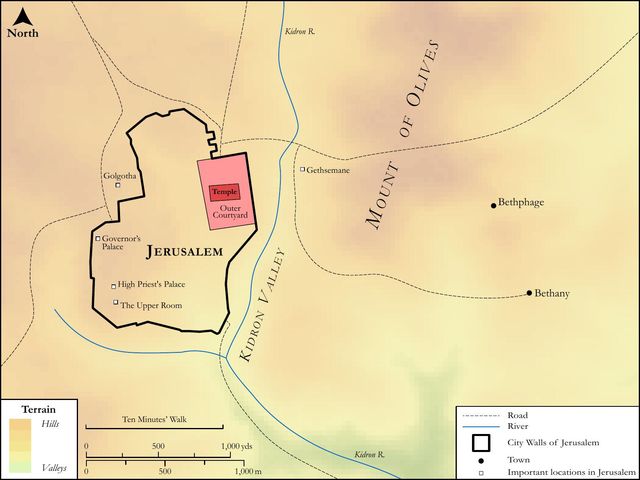
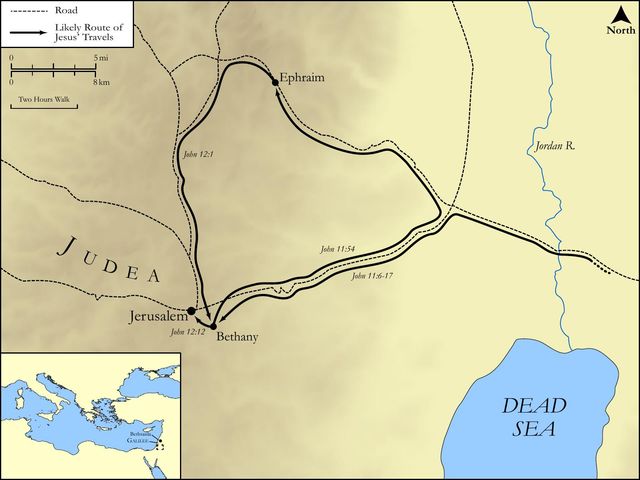
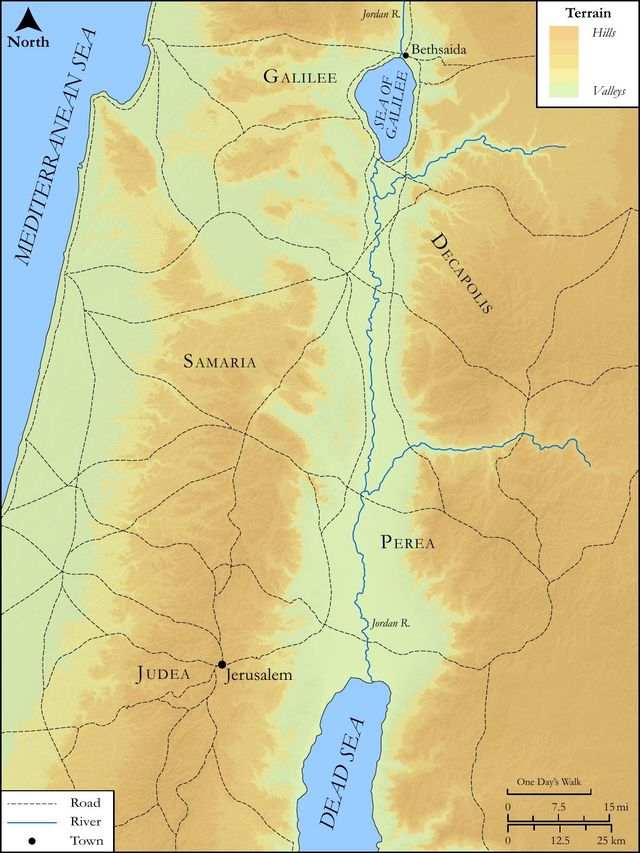
Study this verse
Public-domain commentary
Matthew Henry
From his Commentary on the Whole Bible. Henry comments on passages, not single verses — this entry covers John 12:27–36. His four-level outline is real structure in the source text, so it is rendered as structure.
Honour is here done to Christ by his Father in a voice from heaven, occasioned by the following part of his discourse, and which gave occasion to a further conference with the people. In these verses we have,
I.Christ's address to his Father, upon occasion of the trouble which seized his spirit at this time:
Now is my soul troubled, Joh 12:27. A strange word to come from Christ's mouth, and at this time surprising, for it comes in the midst of divers pleasing prospects, in which, one would think, he should have said, Now is my soul pleased. Note, Trouble of soul sometimes follows after great enlargements of spirit. In this world of mixture and change we must expect damps upon our joy, and the highest degree of comfort to be the next degree to trouble. When Paul had been in the third heavens, he had a thorn in the flesh. Observe,
1.Christ's dread of his approaching sufferings: Now is my soul troubled. Now the black and dismal scene began, now were the first throes of the travail of his soul, now his agony began, his soul began to be exceedingly sorrowful. Note,
(1.)The sin of our soul was the trouble of Christ's soul, when he undertook to redeem and save us, and to make his soul an offering for our sin.
(2.)The trouble of his soul was designed to ease the trouble of our souls; for, after this, he said to his disciples (Joh 14:1), "Let not your hearts be troubled; why should yours be troubled and mine too?" Our Lord Jesus went on cheerfully in his work, in prospect of the joy set before him, and yet submitted to a trouble of soul. Holy mourning is consistent with spiritual joy, and the way to eternal joy. Christ was now troubled, now in sorrow, now in fear, now for a season; but it would not be so always, it would not be so long. The same is the comfort of Christians in their troubles; they are but for a moment, and will be turned into joy.
2.The strait he seems to be in hereupon, intimated in those words, And what shall I say? This does not imply his consulting with any other, as if he needed advice, but considering with himself what was fit to be said now. When our souls are troubled we must take heed of speaking unadvisedly, but debate with ourselves what we shall say. Christ speaks like one at a loss, as if what he should choose he wot not. There was a struggle between the work he had taken upon him, which required sufferings, and the nature he had taken upon him, which dreaded them; between these two he here pauses with, What shall I say? He looked, and there was none to help, which put him to a stand. Calvin observes this as a great instance of Christ's humiliation, that he should speak thus like one at a loss. Quo se magis exinanivit gloriae Dominus, eo luculentius habemus erga nos amoris specimen - The more entirely the Lord of glory emptied himself, the brighter is the proof of the love he bore us. Thus he was in all points tempted like as we are, to encourage us, when we know not what to do, to direct our eyes to him.
3.His prayer to God in this strait: Father, save me from this hour, ek tēs ōras tautēs - out of this hour, praying, not so much that it might not come as that he might be brought through it. Save me from this hour; this was the language of innocent nature, and its feelings poured forth in prayer. Note, It is the duty and interest of troubled souls to have recourse to God by faithful and fervent prayer, and in prayer to eye him as a Father. Christ was voluntary in his sufferings, and yet prayed to be saved from them. Note, Prayer against a trouble may very well consist with patience under it and submission to the will of God in it. Observe, He calls his suffering this hour, meaning the expected events of the time now at hand. Hereby he intimates that the time of his suffering was,
(1.)A set time, set to an hour, and he knew it. It was said twice before that his hour was not yet come, but it was now so near that he might say it was come.
(2.)A short time. An hour is soon over, so were Christ's sufferings; he could see through them to the joy set before him.
4.His acquiescence in his Father's will, notwithstanding. He presently corrects himself, and, as it were, recals what he had said: But for this cause came I to this hour. Innocent nature got the first word, but divine wisdom and love got the last. Note, those who would proceed regularly must go upon second thoughts. The complainant speaks first; but, if we would judge righteously, we must hear the other side. With the second thought he checked himself: For this cause came I to this hour; he does not silence himself with this, that he could not avoid it, there was no remedy; but satisfies himself with this, that he would not avoid it, for it was pursuant to his own voluntary engagement, and was to be the crown of his whole undertaking; should he now fly off, this would frustrate all that had been done hitherto. Reference is here had to the divine counsels concerning his sufferings, by virtue of which it behoved him thus to submit and suffer. Note, This should reconcile us to the darkest hours of our lives, that we were all along designed for them; see Th1 3:3.
5.His regard to his Father's honour herein. Upon the withdrawing of his former petition, he presents another, which he will abide by: Father, glorify thy name, to the same purport with Father, thy will be done; for God's will is for his own glory. This expresses more than barely a submission to the will of God; it is a consecration of his sufferings to the glory of God. It was a mediatorial word, and was spoken by him as our surety, who had undertaken to satisfy divine justice for our sin. The wrong which by sin we have done to God is in his glory, his declarative glory; for in nothing else are we capable of doing him injury. We were never able to make him satisfaction for this wrong done him, nor any creature for us; nothing therefore remained but that God should get him honour upon us in our utter ruin. Here therefore our Lord Jesus interposed, undertook to satisfy God's injured honour, and he did it by his humiliation; he denied himself in, and divested himself of, the honours due to the Son of God incarnate, and submitted to the greatest reproach. Now here he makes a tender of this satisfaction as an equivalent: "Father, glorify thy name; let thy justice be honoured upon the sacrifice, not upon the sinner; let the debt be levied upon me, I am solvent, the principal is not." Thus he restored that which he took not away.
II.The Father's answer to this address; for he heard him always, and does still. Observe,
1.How this answer was given. By a voice from heaven. The Jews speak much of a Bath-kôl - the daughter of a voice, as one of those divers manners by which God in time past spoke to the prophets; but we do not find any instance of his speaking thus to any but to our Lord Jesus; it was an honour reserved for him (Mat 3:17; Mat 17:5), and here, probably, this audible voice was introduced by some visible appearance, either of light or darkness, for both have been used as vehicles of the divine glory.
2.What the answer was. It was an express return to that petition, Father, glorify thy name: I have glorified it already, and I will glorify it yet again. When we pray as we are taught, Our Father, hallowed be thy name, this is a comfort to us, that is it an answered prayer; answered to Christ here, and in him to all true believers.
(1.)The name of God had been glorified in the life of Christ, in his doctrine and miracles, and all the examples he gave of holiness and goodness.
(2.)It should be further glorified in the death and sufferings of Christ. His wisdom and power, his justice and holiness, his truth and goodness, were greatly glorified; the demands of a broken law were fully answered; the affront done to God's government satisfied for; and God accepted the satisfaction, and declared himself well pleased. What God has done for the glorifying of his own name is an encouragement to us to expect what he will yet further do. He that has secured the interests of his own glory will still secure them.
III.The opinion of the standers-by concerning this voice, Joh 12:29.
We may hope there were some among them whose minds were so well prepared to receive a divine revelation that they understood what was said and bore record of it. But notice is here taken of the perverse suggestion of the multitude: some of them said that it thundered: others, who took notice that there was plainly an articulate intelligible voice, said that certainly an angel spoke to him. Now this shows,
1.That it was a real thing, even in the judgment of those that were not at all well affected to him.
2.That they were loth to admit so plain a proof of Christ's divine mission. They would rather say that it was this, or that, or any thing, than that God spoke to him in answer to his prayer; and yet, if it thundered with articulate sounds (as Rev 10:3, Rev 10:4), was not that God's voice? Or, if angels spoke to him, are not they God's messengers? But thus God speaks once, yea twice, and man perceives it not.
IV.The account which our Saviour himself gives of this voice.
1.Why it was sent (Joh 12:30): "It came not because of me, not merely for my encouragement and satisfaction" (then it might have been whispered in his ear privately), "but for your sakes." (1.) "That all you who heard it may believe that the Father hath sent me." What is said from heaven concerning our Lord Jesus, and the glorifying of the Father in him, is said for our sakes, that we may be brought to submit to him and rest upon him. (2.) "That you my disciples, who are to follow me in sufferings, may therein be comforted with the same comforts that carry me on." Let this encourage them to part with life itself for his sake, if they be called to it, that it will redound to the honour of God. Note, The promises and supports granted to our Lord Jesus in his sufferings were intended for our sakes. For our sakes he sanctified himself, and comforted himself.
2.What was the meaning of it. He that lay in the Father's bosom knew his voice, and what was the meaning of it; and two things God intended when he said that he would glorify his own name: -
(1.)That by the death of Christ Satan should be conquered (Joh 12:31): Now is the judgment. He speaks with a divine exultation and triumph. "Now the year of my redeemed is come, and the time prefixed for breaking the serpent's head, and giving a total rent to the powers of darkness; now for that glorious achievement: now, now, that great work is to be done which has been so long thought of in the divine counsels, so long talked of in the written word, which has been so much the hope of saints and the dread of devils." The matter of the triumph is,
[1.]That now is the judgment of the world; krisis, take it as a medical term: "Now is the crisis of this world." The sick and diseased world is now upon the turning point; this is the critical day upon which the trembling scale will turn for life or death, to all mankind; all that are not recovered by this will be left helpless and hopeless. Or, rather, it is a law term, as we take it: "Now, judgment is entered, in order to the taking out of execution against the prince of this world." Note, The death of Christ was the judgment of this world. First, It is a judgment of discovery and distinction - judicium discretionis; so Austin. Now is the trial of this world, for men shall have their character according as the cross of Christ is to them; to some it is foolishness and a stumbling-block, to others it is the wisdom and power of God; of which there was a figure in the two thieves that were crucified with him. By this men are judged, what they think of the death of Christ. Secondly, It is a judgment of favour and absolution to the chosen ones that are in the world. Christ upon the cross interposed between a righteous God and a guilty world as a sacrifice for sin and a surety for sinners, so that when he was judged, and iniquity laid upon him, and he was wounded for our transgressions, it was as it were the judgment of this world, for an everlasting righteousness was thereby brought in, not for Jews only, but the whole world, Jo1 2:1, Jo1 2:2; Dan 9:24. Thirdly, It is a judgment of condemnation given against the powers of darkness; see Joh 16:11. Judgment is put for vindication and deliverance, the asserting of an invaded right. At the death of Christ there was a famous trial between Christ and Satan, the serpent and the promised seed; the trial was for the world, and the lordship of it; the devil had long borne sway among the children of men, time out of mind; he now pleads prescription, grounding his claim also upon the forfeiture incurred by sin. We find him willing to have come to a composition (Luk 4:6, Luk 4:7); he would have given the kingdoms of this world to Christ, provided he would hold them by, fRom. and under him. But Christ would try it out with; by dying he takes off the forfeiture to divine justice, and then fairly disputes the title, and recovers it in the court of heaven. Satan's dominion is declared to be a usurpation, and the world adjudged to the Lord Jesus as his right, Psa 2:6, Psa 2:8. The judgment of this world is, that it belongs to Christ, and not to Satan; to Christ therefore let us all atturn tenants.
[2.]That now is the prince of this world cast out. First, It is the devil that is here called the prince of this world, because he rules over the men of the world by the things of the world; he is the ruler of the darkness of this world, that is, of this dark world, of those in it that walk in darkness, Co2 4:4; Eph 4:12. Secondly, He is said to be cast out, to be now cast out; for, whatever had been done hitherto towards the weakening of the devil's kingdom was done in the virtue of a Christ to come, and therefore is said to be done now. Christ, reconciling the world to God by the merit of his death, broke the power of death, and cast out Satan as a destroyer; Christ, reducing the world to God by the doctrine of his cross, broke the power of sin, and cast out Satan as a deceiver. The bruising of his heel was the breaking of the serpent's head, Gen 3:15. When his oracles were silenced, his temples forsaken, his idols famished, and the kingdoms of the world became Christ's kingdoms, then was the prince of the world cast out, as appears by comparing this with John's vision (Rev 12:8-11), where it is said to be done by the blood of the Lamb. Christ's frequent casting of devils out of the bodies of people was an indication of the great design of his whole undertaking. Observe, With what assurance Christ here speaks of the victory over Satan; it is as good as done, and even when he yields to death he triumphs over it.
(2.)That by the death of Christ souls should be converted, and this would be the casting out of Satan (Joh 12:32): If I be lifted up from the earth, I will draw all men unto me. Here observe two things: -
[1.]The great design of our Lord Jesus, which was to draw all men to him, not the Jews only, who had been long in a profession a people near to God, but the Gentiles also, who had been afar off; for he was to be the desire of all nations (Hag 2:7), and to him must the gathering of the people be. That which his enemies dreaded was that the world would go after him; and he would draw them to him, notwithstanding their opposition. Observe here how Christ himself is all in all in the conversion of a soul. First, It is Christ that draws: I will draw. It is sometimes ascribed to the Father (Joh 6:44), but here to the Son, who is the arm of the Lord. He does not drive by force, but draws with the cords of a man (Hos 11:4; Jer 31:3), draws as the loadstone; the soul is made willing, but it is in a day of power. Secondly, It is to Christ that we are drawn: "I will draw them to me as the centre of their unity." The soul that was at a distance from Christ is brought into an acquaintance with him, he that was shy and distrustful of him is brought to love him and trust in him, - drawn up to his terms, into his arms. Christ was now going to heaven, and he would draw men's hearts to him thither.
[2.]The strange method he took to accomplish his design by being lifted up from the earth. What he meant by this, to prevent mistake, we are told (Joh 12:33): This he spoke signifying by what death he should die, the death of the cross, though they had designed and attempted to stone him to death. He that was crucified was first nailed to the cross, and then lifted up upon it. He was lifted up as a spectacle to the world; lifted up between heaven and earth, as unworthy of either; yet the word here used signifies an honourable advancement, ean hupsōthō - If I be exalted; he reckoned his sufferings his honour. Whatever death we die, if we die in Christ we shall be lifted up out of this dungeon, this den of lions, into the regions of light and love. We should learn of our Master to speak of dying with a holy pleasantness, and to say, "We shall then be lifted up." Now Christ's drawing all men to him followed his being lifted up from the earth. First, It followed after it in time. The great increase of the church was after the death of Christ; while Christ lived, we read of thousands at a sermon miraculously fed, but after his death we read of thousands at a sermon added to the church. Israel began to multiply in Egypt after the death of Joseph. Secondly, It followed upon it as a blessed consequence of it. Note, There is a powerful virtue and efficacy in the death of Christ to draw souls to him. The cross of Christ, though to some a stumbling-stone, is to others a loadstone. Some make it an allusion to the drawing of fish into a net; the lifting up of Christ was as the spreading of the net (Mat 13:47, Mat 13:48); or to the setting up of a standard, which draws soldiers together; or, rather, it refers to the lifting up of the brazen serpent in the wilderness, which drew all those to it who were stung with fiery serpents, as soon as ever it was known that it was lifted up, and there was healing virtue in it. O what flocking was there to it! So there was to Christ, when salvation through him was preached to all nations; see Joh 3:14, Joh 3:15. Perhaps it has some reference to the posture in which Christ was crucified, with his arms stretched out, to invite all to him, and embrace all that come. Those that put Christ to that ignominious death thought thereby to drive all men from him; but the devil was outshot in his own bow. Out of the eater came forth meat.
V.The people's exception against what he said, and their cavil at it, Joh 12:34.
Though they had heard the voice from heaven, and the gracious words that proceeded out of his mouth, yet they object, and pick quarrels with him. Christ had called himself the Son of man (Joh 12:23), which they knew to be one of the titles of the Messiah, Dan 7:13. He had also said that the Son of man must be lifted up, which they understood of his dying, and probably he explained himself so, and some think he repeated what he said to Nicodemus (Joh 3:14), So must the Son of man be lifted up. Now against this,
1.They alleged those scriptures of the Old Testament which speak of the perpetuity of the Messiah, that he should be so far from being cut off in the midst of his days that he should be a priest for ever (Psa 110:4), and a king for ever (Psa 89:29, etc.), that he should have length of days for ever and ever, and his years as many generations (Psa 21:4; Psa 61:6), from all which they inferred that the Messiah should not die. Thus great knowledge in the letter of the scripture, if the heart be unsanctified, is capable of being abused to serve the cause of infidelity, and to fight against Christianity with its own weapons. Their perverseness in opposing this to what Jesus had said will appear if we consider,
(1.)That, when they vouched the scripture to prove that the Messiah abideth for ever, they took no notice of those texts which speak of the Messiah's death and sufferings: they had heard out of the law that Messiah abideth for ever; and had they never heard out of the law that Messiah should be cut off (Dan 9:26), and that he should pour out his soul unto death (Isa 53:12), and particularly that his hands and feet should be pierced? Why then do they make so strange of the lifting up of the Son of man? Note, We often run into great mistakes, and then defend them with scripture arguments, by putting those things asunder which God in his word has put together, and opposing one truth under pretence of supporting another. We have heard out of the gospel that which exalts free grace, we have heard also that which enjoins duty, and we just cordially embrace both, and not separate them, nor set them at variance.
(2.)That, when they opposed what Christ said concerning the sufferings of the Son of man, they took no notice of what he had said concerning his glory and exaltation. They had heard out of the law that Christ abideth for ever; and had they not heard our Lord Jesus say that he should be glorified, that he should bring forth much fruit, and draw all men to him? Had he not just now promised immortal honours to his followers, which supposed his abiding for ever? But this they overlooked. Thus unfair disputants oppose some parts of the opinion of an adversary, to which, if they would but take it entire, they could not but subscribe; and in the doctrine of Christ there are paradoxes, which to men of corrupt minds are stones of stumbling - as Christ crucified, and yet glorified; lifted up from the earth, and yet drawing all men to him.
2.They asked hereupon, Who is the Son of man? This they asked, not with a desire to be instructed, but tauntingly and insultingly, as if now they had baffled him, and run him down. "Thou sayest, The Son of man must die; we have proved the Messiah must not, and where is then thy Messiahship? This Son of man, as thou callest thyself, cannot be the Messiah, thou must therefore think of something else to pretend to." Now that which prejudiced them against Christ was his meanness and poverty; they would rather have no Christ than a suffering one.
VI.What Christ said to this exception, or rather what he said upon it.
The objection was a perfect cavil; they might, if they pleased, answer it themselves: man dies, and yet is immortal, and abideth for ever, so the Son of man. Therefore, instead of answering these fools according to their folly, he gives them a serious caution to take heed of trifling away the day of their opportunities in such vain and fruitless cavils as these (Joh 12:35, Joh 12:36): "Yet a little while, and but a little while, is the light with you; therefore be wise for yourselves, and walk while you have the light."
1.In general, we may observe here,
(1.)The concern Christ has for the souls of men, and his desire of their welfare. With what tenderness does he here admonish those to look well to themselves who were contriving ill against him! Even when he endured the contradiction of sinners, he sought their conversion. See Pro 29:10.
(2.)The method he takes with these objectors, with meekness instructing those that opposed themselves, Ti2 2:25. Were but men's consciences awakened with a due concern about their everlasting state, and did they consider how little time they have to spend, and none to spare, they would not waste precious thoughts and time in trifling cavils.
2.Particularly we have here,
(1.)The advantage they enjoyed in having Christ and his gospel among them, with the shortness and uncertainty of their enjoyment of it: Yet a little while is the light with you. Christ is this light; and some of the ancients suggest that, in calling himself the light, he gives a tacit answer to their objection. His dying upon the cross was as consistent with his abiding for ever as the setting of the sun every night is with his perpetuity. The duration of Christ's kingdom is compared to that of the sun and moon, Psa 72:17; Psa 89:36, Psa 89:37. The ordinances of heaven are unchangeably fixed, and yet the sun and moon set and are eclipsed; so Christ the Sun of righteousness abides for ever, and yet was eclipsed by his sufferings, and was but a little while within our horizon. Now,
[1.]The Jews at this time had the light with them; they had Christ's bodily presence, heard his preaching, saw his miracles. The scripture is to us a light shining in a dark place.
[2.]It was to be but a little while with them; Christ would shortly leave them, their visible church state would soon after be dissolved and the kingdom of God taken from them, and blindness and hardness would happen unto Israel. Note, It is good for us all to consider what a little while we are to have the light with us. Time is short, and perhaps opportunity not so long. The candlestick may be removed; at least, we must be removed shortly. Yet a little while is the light of life with us; yet a little while is the light of the gospel with us, the day of grace, the means of grace, the Spirit of grace, yet a very little while.
(2.)The warning given them to make the best of this privilege while they enjoyed it, because of the danger they were in of losing it: Walk while you have the light; as travellers who make the best of their way forward, that they may not be benighted in their journey, because travelling in the night is uncomfortable and unsafe. "Come," say they, "let us mend our pace, and get forward, while we have day-light." Thus wise should we be for our souls who are journeying towards eternity. Note,
[1.]It is our business to walk, to press forward towards heaven, and to get nearer to it by being made fitter for it. Our life is but a day, and we have a day's journey to go.
[2.]The best time of walking is while we have the light. The day is the proper season for work, as the night is for rest. The proper time for getting grace is when we have the word of grace preached to us, and the Spirit of grace striving with us, and therefore then is the time to be busy.
[3.]We are highly concerned thus to improve our opportunities, for fear lest our day be finished before we have finished our day's work and our day's journey: "Lest darkness come upon you, lest you lose your opportunities, and can neither recover them nor despatch the business you have to do without them." Then darkness comes, that is, such an utter incapacity to make sure the great salvation as renders the state of the careless sinner quite deplorable; so that, if his work be undone then, it is likely to be undone for ever.
(3.)The sad condition of those who have sinned away the gospel, and are come to the period of their day of grace. They walk in darkness, and know neither where they go, nor whither they go; neither the way they are walking in, nor the end they are walking towards. He that is destitute of the light of the gospel, and is not acquainted with its discoveries and directions, wanders endlessly in mistakes and errors, and a thousand crooked paths, and is not aware of it. Set aside the instructions of the Christian doctrine, and we know little of the difference between good and evil. He is going to destruction, and knows not his danger, for he is either sleeping or dancing at the pit's brink.
(4.)The great duty and interest of every one of us inferred from all this (Joh 12:36): While you have light, believe in the light. The Jews had now Christ's presence with them, let them improve it; afterwards they had the first offers of the gospel made to them by the apostles wherever they came; now this is an admonition to them not to out-stand their market, but to accept the offer when it was made to them: the same Christ saith to all who enjoy the gospel. Note,
[1.]It is the duty of every one of us to believe in the gospel light, to receive it as a divine light, to subscribe to the truths it discovers, for it is a light to our eyes, and to follow its guidance, for it is a light to our feet. Christ is the light, and we must believe in him as he is revealed to us; as a true light that will not deceive us, a sure light that will not misguide us.
[2.]We are concerned to do this while we have the light, to lay hold on Christ while we have the gospel to show us the way to him and direct us in that way.
[3.]Those that believe in the light shall be the children of light; they shall be owned as Christians, who are called children of light (Luk 16:8; Eph 5:8) and of the day, Th1 5:5. Those that have God for their Father are children of light, for God is light; they are born from above, and heirs of heaven, and children of light, for heaven is light.
VII.Christ's retiring from them, hereupon:
These things spoke Jesus, and said no more at this time, but left this to their consideration, and departed, and did hide himself from them. And this he did,
1.For their conviction and awakening. If they will not regard what he hath said, he will have nothing more to say to them. They are joined to their infidelity, as Ephraim to idols; let them alone. Note, Christ justly removes the means of grace from those that quarrel with him, and hides his face from a froward generation, Deu 32:20.
2.For his own preservation. He hid himself from their rage and fury, retreating, it is probable, to Bethany, where he lodged. By this it appears that what he said irritated and exasperated them, and they were made worse by that which should have made them better.
Historical interpretation
Five Centuries of Reception
11 surviving comments on this verse. Each one is dated, so this reads as a timeline rather than a list.
Select a marker to jump to its quote. Markers stagger vertically where authors wrote within a few decades of each other.
Ye are the stones of the temple of the Father, prepared for the building of God the Father, and drawn up on high by the instrument of Jesus Christ, which is the cross, making use of the Holy Spirit as a rope, while your faith was the means by which you ascended, and your love the way which led up to God. And once more, "If I be lifted up from the earth, I will draw all men unto Me."
He took up humanity into himself, the invisible becoming visible, the incomprehensible being made comprehensible, the impassible becoming capable of suffering and the Word being made human, thus summing up all things in himself: so that as in supercelestial, spiritual and invisible things, the Word of God is supreme, so also in things visible and corporeal he might possess the supremacy, and, taking to himself the preeminence, as well as constituting himself head of the church, he might draw all things to himself at the proper time.
For it is only on the cross that a man dies with his hands spread out. And so it was fitting for the Lord to bear this also and to spread out his hands, that with the one he might draw the ancient people and with the other those from the Gentiles and unite both in himself. For this is what he himself has said, signifying by what manner of death he was to ransom all: “I, when I am lifted up,” he says, “shall draw all unto me.”
(Hom. lxvii. 2) But that none may say, How will he be cast out, if he overcome thee? He adds, And I, if I be lifted up from the earth, will draw all men unto Me. How can He be overcome, who draws others unto Him? This is more than saying, I shall rise again. Had He said this, it would not have proved that He would draw all things unto Him; but, I shall draw, includes the resurrection, and this besides.
(Hom. lxvii. 3.) Why then did He say above, that the Father drew men? (c. 6:46.) Because the Father draws, by the Son who draws. I shall draw, He says, as if men were in the grasp of some tyrant, from which they could not extricate themselves.
"And I, if I be lifted up, will draw all men unto Me." That is, "even those of the Gentiles." And that no one may ask, "How shall he be cast down, if he is stronger even than Thou art?" He saith, "He is not stronger; how can he be stronger than One who draweth others to Him?" And He speaketh not of the Resurrection, but of what is more than the Resurrection, "I will draw all men to Myself." For had He said, "I shall rise again," it was not yet clear that they would believe; but by His saying, "they shall believe," both are proved at once, both this, and also that He must rise again. For had He continued dead, and been a mere man, no one would have believed.
"I will draw all men to Myself." How then said He that the Father draweth? Because when the Son draweth, the Father draweth also. He saith, "I will draw them," as though they were detained by a tyrant, and unable of themselves alone to approach Him, and to escape the hands of him who keepeth hold of them. In another place He calleth this "spoiling; no man can spoil a strong man's goods, except he first bind the strong man, and then spoil his goods." (Matt. xii. 29.) This He said to prove His strength, and what there He calleth "spoiling," He hath here called "drawing."
I know certain men for whom the king of Nineveh, (who is the last to hear the proclamation and who descends from his throne, and forgoes the ornaments of his former vices and dressed in sackcloth sits on the ground, he is not content with his own conversion, preaches penitence to others with his leaders, saying, "let the men and beasts, big and small of size, be tortured by hunger, let them put on sackcloth, condemn their former sins and betake themselves without reservation to penitence!) is the symbol of the devil, who at the end of the world, (because no spiritual creature that is made reasoning by God will perish), will descend from his pride and do penitence and will be restored to his former position. To support this opinion they use this example of Daniel in which Nebuchadnezzar after seven years of penitence is returned to his former reign. [Dan. 4:24, 29, 33] But because this idea is not in the Holy Scripture and since it completely destroys the fear of God, (for men will slide easily into vices if they believe that even the devil, the creator of wickedness and the source of all sins, can be saved if he does penitence), we must eradicate this from our spirits. Let us remember though that the sinners in the Gospel are sent to the eternal fire [Mt. 25:41], which is prepared for the devil and his angels, about whom is said, "their worm will not die and their fire will not be extinguished" [Is. 66:24]... Moreover if all spiritual creatures are equal and if they raise themselves up by their virtues to heaven, or by their vices take themselves to the depths, then after a long circuit and infinite centuries, if all are returned to their original state with the same worthiness to all conflicting, what difference will there be between the virgin and the prostitute? What distinction will there be between the mother of the Lord and (it is wicked to say) the victims of public pleasures? Will Gabriel be like the devil? Will the apostles be as demons? Will the prophets be as pseudoprophets? Martyrs as their persecutors? Imagine all that you will, increase by two-fold the years and the time, take infinite time for torture: if the end for all is the same, all the past is then nothing, for what is of importance to us is not what we are at any given moment, but what we will be forever more.
(Tr. lii. 11) What is this all that He draweth, but that from which the devil is cast out? He does not say, All men, but, All things; for all men have not faith. He does not mean then all mankind, but the whole of a man, i. e. spirit, soul, and body; by which respectively we understand, and live, and are visible. Or, if all means all men, it means those who are predestined to salvation: or all kinds of men, all varieties of character, excepting in the article of sin.
(Tr. lii. 11) If I be lifted up from the earth, He says, i. e. when I shall be lifted up. He does not doubt that the work will be accomplished which He came to do. By His being lifted up, He means His passion on the cross, as the Evangelist adds: This He said, signifying by what death He should die.
Accordingly, after saying, "Now shall the prince of this world be cast out," He added, "And I, if I be lifted up from the earth, will draw all things after me." And what "all" is that, but those out of which the other is ejected? But He did not say, All men, but "all things;" for all men have not faith. And, therefore, He did not allude to the totality of men, but to the creature in its personal integrity, that is, to spirit, and soul, and body; or all that which makes us the intelligent, living, visible, and palpable beings we are. For He who said, "Not a hair of your head shall perish," is He who draweth all things after Him. Or if by "all things" it is men that are to be understood, we can speak of all things that are foreordained to salvation: of all which He declared, when previously speaking of His sheep, that not one of them would be lost. And of a certainty all classes of men, both of every language and every age, and all grades of rank, and all diversities of talents, and all the professions of lawful and useful arts, and all else that can be named in accordance with the innumerable differences by which men, save in sin alone, are mutually separated, from the highest to the lowest, and from the king to the beggar, "all," He says, "will I draw after me;" that He may be their head, and they His members. But this will be, He adds, "if I be lifted up from the earth," that is, when I am lifted up; for He has no doubt of the future accomplishment of that which He came to fulfill. He here alludes to what He said before: "But if the corn of wheat die, it bringeth forth much fruit." For what else did He signify by His lifting up, than His suffering on the cross, an explanation which the evangelist himself has not omitted; for he has appended the words, "And this He said signifying what death He should die."
Howbeit, after that Christ had given Himself unto the Father for our salvation as a Spotless Victim, and was now on the point of paying the penalties that He suffered on our behalf, we were ransomed from the accusations of sin. And so, when the beast has been removed from our midst, and the tyrant is deposed, then Christ brings unto Himself the race that had strayed away, calling not only Jews but all mankind as well unto salvation through the faith that is in Him. For whereas the calling through the Law was partial, that through Christ was universal. For Christ alone, as God, was able to procure all good things for us. And with exceeding good omen, He speaks of being "uplifted" instead of being "crucified." For He would keep the mystery invisible to those intent on killing Him; for they were not worthy to learn it: nevertheless, He allowed them that were wiser to understand that He would suffer because of all and on behalf of all. And especially I suppose any one might take it in this way, and very fitly; that the Death on the Cross was an exaltation which is ever associated in our thoughts with honour and glory. For on this account too Christ is glorified, forasmuch as the benefits He procured for humanity thereby are many. And by these He draws men unto Himself, and does not, like the disciples, lead them to another. He shows therefore that He is Himself by Nature God, in that He does not put the Father outside Himself. For it is through the Son that a man is drawn unto the knowledge of the Father.
From this solemnity indeed the example of resurrection was given to us, the hope of the heavenly homeland was opened, and the glory of the supernal kingdom was made something we might already anticipate. Through this, the elect, who although they were in the bosom of tranquility, were nevertheless held in the confines of hell, were led back to the delights of paradise. What the Lord said before His passion, He fulfilled in His resurrection: "If I am lifted up from the earth," He said, "I will draw all things to myself." For He drew all things, He who left none of His elect in the underworld. He took away all things—that is, all the elect. For He did not restore to pardon by rising again any unbelievers or those consigned to eternal punishments for their crimes; but He snatched from the confines of hell those whom He recognized as His own in faith and in deeds.
Continue studying John 12:32 across the web’s major study libraries — every link below opens this exact verse, chapter, or book on the destination site.
Read & Compare
 BibleGatewayThis verse in more than 200 translations and 70 languages.
 Bible.comThe YouVersion reader — hundreds of translations, reading plans, and highlights.
 ESV.orgCrossway's official English Standard Version reader.
 NET BibleThe NET translation with 60,000+ translators' notes on every rendering decision.
 STEP BibleTyndale House's free study tool — original text, vocabulary, and scholarly resources.
 BibliaLogos Bible Software's free web reader.
 USCCBThe New American Bible (Revised Edition) with the U.S. bishops' study notes.
Commentaries
 BibleHub CommentariesDozens of classic commentaries on this verse, gathered on one page.
 StudyLightMore than 100 commentary sets — the largest collection on the web.
 BibleRefPlain-English commentary on what this verse means, verse by verse.
 Enduring WordDavid Guzik's free commentary on this chapter, widely used by Bible teachers.
 Bible Study ToolsVerse commentary alongside Greek and Hebrew study aids.
Original Language & Research
- BibleHub InterlinearThe verse word by word — original language, transliteration, and English.
- BibleHub LexiconEvery word's original-language definition and Strong's entry.
 Blue Letter BibleDeep-study tools — Strong's numbers, concordance, and word studies.
 CNTR CollationThe earliest Greek manuscripts of this verse, collated letter by letter.
Sermons, Hymns & Audio


TrulyRandomVerse is not affiliated with these sites and doesn’t control their content. They’re linked because they’re genuinely useful.
Summary
John 12:32 is a pivotal declaration by Jesus, uttered shortly before His crucifixion, revealing the profound purpose and universal impact of His impending death and subsequent exaltation. In this statement, Jesus prophesies that His "lifting up" – a dual reference to His crucifixion on the cross and His ultimate glorification – will serve as the divine magnet, drawing all humanity to Himself for salvation and reconciliation with God. This verse encapsulates the core of His redemptive mission, demonstrating how suffering leads to glory and how a singular act of sacrifice has universal, eternal implications.
Context
ShowHideLiterary Context
This profound statement by Jesus occurs at a critical juncture in His ministry, immediately following His triumphal entry into Jerusalem and the symbolic cleansing of the temple. The narrative in John 12 builds towards the Passion Week. Jesus has just spoken of His "hour" having come (John 12:23), signaling the culmination of His earthly ministry and the commencement of His redemptive suffering. He uses the parable of a grain of wheat dying to bear much fruit (John 12:24) to illustrate the necessity of His death for the sake of life for others. The immediate preceding verses (John 12:27-28) show Jesus wrestling with the agony of His impending suffering, yet resolute in His commitment to glorify the Father through it. The crowd, hearing a voice from heaven, remains perplexed by His talk of being "lifted up" (John 12:34), highlighting their misunderstanding of the Messiah's true mission, which Jesus clarifies in this verse.
Historical & Cultural Context
The concept of "lifting up" would have had multiple connotations in the first-century Jewish and Roman world. For the Romans, crucifixion was a public, humiliating form of execution, designed to display power and deter rebellion. For the Jews, being "lifted up" or hung on a tree was associated with a curse (Deuteronomy 21:22-23). However, Jesus redefines this act, transforming a symbol of shame into one of ultimate glory and universal salvation. His reference to being "lifted up from the earth" also subtly contrasts with earthly power structures and human expectations of a conquering Messiah, redirecting focus to a heavenly, redemptive purpose. The presence of Greeks seeking Jesus (John 12:20-22) immediately preceding this discourse further underscores the universal scope of Jesus' mission, foreshadowing the "all men" He would draw.
Key Themes
ShowHideThis verse powerfully encapsulates several key themes central to the Gospel of John and broader biblical theology. Foremost is the theme of Glorification through Suffering, where Jesus' ultimate exaltation and victory are achieved precisely through the ignominious act of crucifixion. This paradox is a hallmark of God's redemptive plan. Another crucial theme is the Universal Scope of Salvation, as Jesus declares His intention to "draw all men" to Himself, transcending ethnic and national boundaries, a concept further elaborated in John 3:16. The Sovereignty of God in orchestrating salvation is also evident, as Jesus' death is not a tragic accident but a divinely appointed means to a glorious end. Finally, the theme of Divine Attraction is prominent, portraying Christ's sacrifice as the ultimate magnet that compels humanity towards Him, not through coercion, but through the irresistible power of His love and truth.
Exposition and Analysis
ShowHideKey Word Analysis
ShowHideFrom the Strong's data, this verb means "to elevate (literally or figuratively):--exalt, lift up." In the context of John's Gospel, particularly in verses like John 3:14 and John 8:28, "lifted up" carries a crucial double meaning. It refers primarily to Jesus' physical elevation on the cross during His crucifixion, but simultaneously points to His subsequent exaltation and glorification by God, including His resurrection, ascension, and enthronement at the Father's right hand. Thus, the cross, though an instrument of death, becomes the means of His ultimate triumph and glory.
As per Strong's, this term refers to "soil; by extension a region, or the solid part or the whole of the terrene globe (including the occupants in each application):--country, earth(-ly), ground, land, world." In this context, "from the earth" signifies His removal from the earthly realm of human existence and limitations, specifically through death, but also implies a broader separation from the earthly, fallen system. It contrasts with His heavenly origin and ultimate return to glory.
This word, meaning "to drag (literally or figuratively):--draw," denotes a powerful, compelling, and effective attraction. It is not merely an invitation but an active, sovereign act of God through Christ. While it doesn't imply coercion against one's will, it speaks to the profound spiritual magnetic force of the cross, which, when revealed by the Holy Spirit, overcomes human resistance and draws individuals to faith. This drawing power is rooted in the Father's initiative (John 6:44).
This comprehensive term means "all, any, every, the whole." In this context, "all men" signifies the universal scope of Christ's redemptive work, extending beyond the Jewish nation to include Gentiles, people from all nations, backgrounds, and walks of life. It emphasizes the sufficiency and availability of salvation through Christ to all humanity, rather than suggesting universal salvation for every individual regardless of faith. The cross is the focal point for the ingathering of God's elect from all corners of the world.
Verse Breakdown
ShowHide"And I, if I be lifted up from the earth,"
This clause introduces Jesus' personal declaration and the condition for the subsequent outcome. The "I" emphasizes His unique role and divine agency. "If I be lifted up" refers both to His crucifixion – His physical elevation on the cross, an act of profound humiliation and suffering – and simultaneously to His exaltation and glorification by God. The phrase "from the earth" signifies His departure from the earthly realm through death, but also hints at His transcending earthly limitations and expectations, moving into a realm of divine authority and glory. This "lifting up" is the necessary prerequisite for His redemptive work to be fully realized.
"will draw all [men] unto me."
This is the profound consequence of Jesus' "lifting up." The verb "draw" (Greek helkýō) implies a powerful, compelling attraction, not a passive invitation. It describes the irresistible spiritual magnetism of Christ crucified and glorified. The phrase "all [men]" signifies the universal scope of this drawing power. It means that people from every nation, ethnicity, and background will be drawn to Christ, demonstrating that His sacrifice is not limited to one group but is sufficient and effective for all who believe. This drawing is unto Himself, indicating that salvation is found in personal relationship with Christ, who is the source and object of faith.
Literary Devices
ShowHideThe verse John 12:32 is rich with literary devices that amplify its theological depth. Symbolism is paramount, particularly in the phrase "lifted up." While literally referring to crucifixion, it simultaneously symbolizes Jesus' exaltation and glorification, transforming an instrument of shame into a throne of victory. This creates a powerful paradox, where the ultimate act of humiliation becomes the ultimate act of divine power and attraction. The word "draw" functions as a metaphor, depicting Christ's magnetic appeal, a spiritual force that pulls humanity towards Him, much like a powerful current or an irresistible gravitational pull. This drawing is not coercive but speaks to the profound spiritual conviction and love that the cross inspires. Furthermore, the verse serves as a prophecy or foreshadowing, as Jesus speaks of a future event (His death) and its universal consequence, demonstrating His divine foreknowledge and sovereign control over His destiny. The inclusion of "all men" highlights the universalism of God's redemptive plan, contrasting with previous nationalistic understandings of salvation.
Theological and Thematic Connections
ShowHideJohn 12:32 stands as a profound theological statement, linking the suffering of the cross directly to the universal scope of God's redemptive plan. It reveals that the crucifixion, far from being a defeat, is the very means by which Christ accomplishes His mission to reconcile humanity to God. The "lifting up" signifies not only the physical act of being nailed to a cross but also the subsequent exaltation of Christ as Lord and Savior, demonstrating that true glory is achieved through self-sacrificial love. This act of divine love and sacrifice becomes the ultimate magnet, drawing people from every corner of the earth to Himself, fulfilling God's long-held purpose to gather a people for Himself from all nations. It underscores the sufficiency of Christ's atonement for all humanity and the powerful, Spirit-enabled attraction of the gospel.
Reflection and Application
ShowHideJohn 12:32 invites us to gaze upon the cross not merely as a historical event, but as the pulsating heart of God's redemptive work, the ultimate display of divine love and power. For believers, this verse deepens our understanding of Christ's sacrifice and its cosmic implications. It reminds us that our salvation is rooted in His "lifting up," a paradoxical act of both suffering and triumph. This truth should ignite within us a profound gratitude and a renewed commitment to live lives that reflect the drawing power of Christ. As those who have been drawn to Him, we are called to participate in His mission, recognizing that the gospel is for "all men." This compels us to share the good news with boldness and compassion, trusting that the crucified and exalted Christ continues to draw people to Himself through the proclamation of His truth. It challenges us to examine our own lives: are we truly drawn to Christ in all His fullness, or are we still clinging to earthly attachments? Are we living in a way that makes the drawing power of Christ evident to others?
Questions for Reflection
ShowHideFAQ
ShowHideWhat does "lifted up from the earth" specifically mean in this verse?
ShowHideIn John 12:32, the phrase "lifted up from the earth" carries a profound dual meaning. Primarily, it refers to Jesus' physical crucifixion, where He would be literally raised on a cross, separated from the ground. This was a common method of execution in the Roman Empire. However, in John's Gospel, this phrase also symbolically points to Jesus' exaltation and glorification. The very act of His public, humiliating death becomes the means by which He is exalted to the highest place of honor and authority, fulfilling prophecy and demonstrating His divine power. This dual meaning is also seen in John 3:14 and John 8:28, where Jesus similarly speaks of being "lifted up."
Does "draw all men unto me" imply universal salvation for everyone?
ShowHideWhile the phrase "draw all men unto me" highlights the universal scope and sufficiency of Christ's redemptive work, it does not imply that every single individual will automatically be saved regardless of their response. The Greek word for "draw" (helkýō) signifies a powerful, compelling attraction, an active work of God that enables people to come to faith. It means that Christ's sacrifice is sufficient for all humanity and that His drawing power extends to people from every nation, tribe, and tongue (Revelation 5:9). It signifies that the invitation to salvation is open to all, and that the Holy Spirit works to overcome human resistance, enabling those whom the Father draws to come to Christ (John 6:44). Therefore, it emphasizes the boundless reach of the gospel and the availability of salvation to all who respond in faith, rather than a forced or automatic salvation for every person.
Christ-Centered Fulfillment
ShowHideJohn 12:32 finds its ultimate Christ-centered fulfillment in the person and work of Jesus Christ, particularly in His crucifixion, resurrection, and ascension. The "lifting up from the earth" is first and foremost the cross, the pivotal event where the Son of God bore the sins of the world, becoming the perfect atoning sacrifice. This act of profound self-humiliation, as described in Philippians 2:8, paradoxically became the means of His ultimate exaltation and glorification by the Father (Philippians 2:9-11). From the cross, Jesus indeed began to "draw all men unto me," not through earthly power or coercion, but through the irresistible power of divine love displayed in His suffering. The outpouring of the Holy Spirit at Pentecost (Acts 2:33) was a direct consequence of His exaltation, empowering the apostles to proclaim the message that would draw thousands to faith. This drawing continues today as the gospel is preached throughout the world, gathering people from every nation, tribe, people, and language into His kingdom (Revelation 7:9-10). Thus, the cross is not merely an ancient historical event, but the eternal magnetic center of God's redemptive plan, continually drawing hearts to the crucified and risen Christ, who reigns supreme as Lord of all.