


John 1:7
- οὗτοςhoutosHeG3778D-NSMDemonstrative pronoun Nominative Singular Masculine
- ἦλθενēlthencameG2064V-2AAI-3SVerb 2nd Aorist Active Indicative 3rd Singular
- εἰςeisasG1519PREPPreposition
- μαρτυρίανmarturiana witnessG3141N-ASFNoun Accusative Singular Feminine
- ἵναinathatG2443CONJConjunction
- μαρτυρήσῃmarturēsēhe may testifyG3140V-AAS-3SVerb Aorist Active Subjunctive 3rd Singular
- περὶpericoncerningG4012PREPPreposition
- τοῦtoutheG3588T-GSNDefinite article Genitive Singular Neuter
- φωτόςphōtosLightG5457N-GSNNoun Genitive Singular Neuter
- ἵναinathatG2443CONJConjunction
- πάντεςpantesallG3956A-NPMAdjective Nominative Plural Masculine
- πιστεύσωσινpisteusōsinmay believeG4100V-AAS-3PVerb Aorist Active Subjunctive 3rd Plural
- δι᾽di᾽throughG1223PREPPreposition
- αὐτοῦautouhimG846P-GSMPersonal pronoun Genitive Singular Masculine
English is a literal word-by-word gloss of the Greek, not the KJV's wording. Why?
This is the original text the KJV's translators worked from — each Greek word with its own literal English meaning in this verse, prepared by scholars at Tyndale House, Cambridge. The KJV translates whole sentences, not word by word, so its wording differs: one Greek word can become several English words, and the KJV may choose “charity” where the gloss reads “love”. Both are faithful — they answer different questions. For the KJV's own rendering, switch to the KJV text.
Details
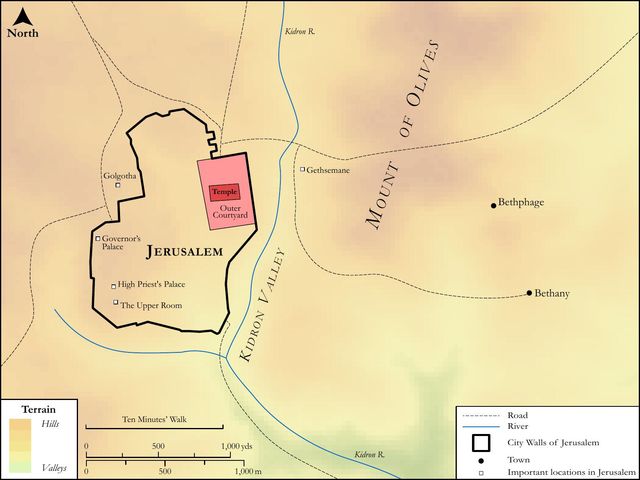
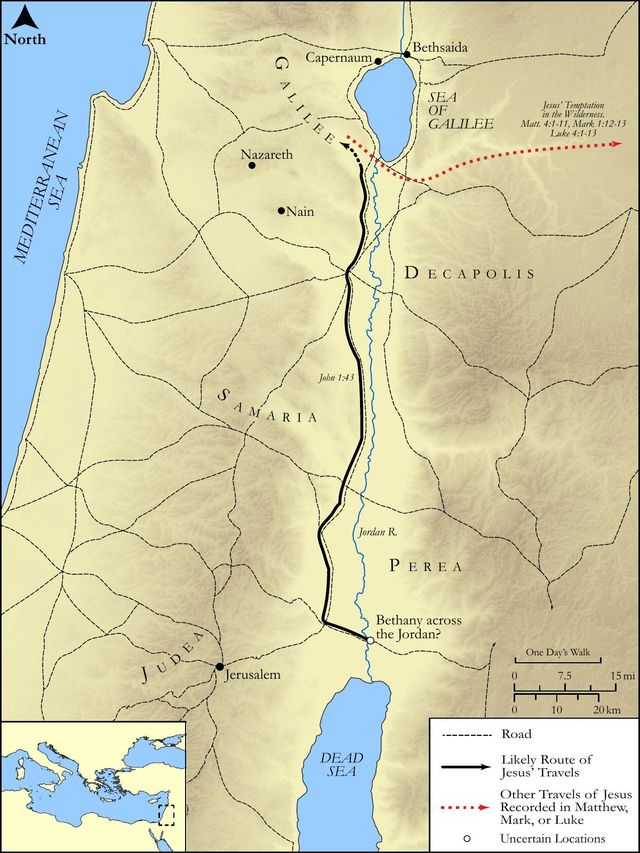
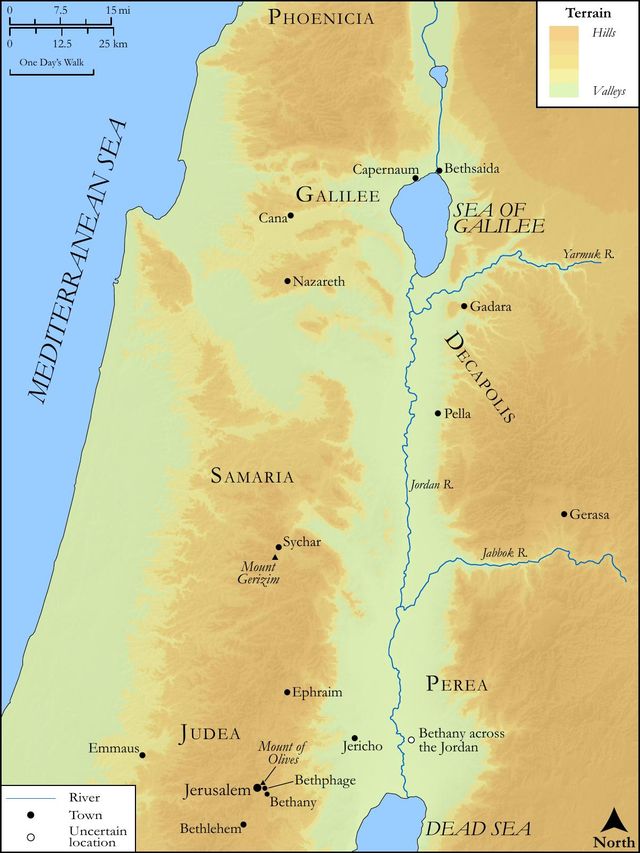
See on the biblical-era map
Study this verse
Public-domain commentary
Matthew Henry
From his Commentary on the Whole Bible. Henry comments on passages, not single verses — this entry covers John 1:6–14. His four-level outline is real structure in the source text, so it is rendered as structure.
The evangelist designs to bring in John Baptist bearing an honourable testimony to Jesus Christ, Now in these verses, before he does this,
I.He gives us some account of the witness he is about to produce.
His name was John, which signifies gracious; his conversation was austere, but he was not the less gracious. Now,
1.We are here told concerning him, in general, that he was a man sent of God. The evangelist had said concerning Jesus Christ that he was with God and that he was God; but here concerning John that he was a man, a mere man. God is pleased to speak to us by men like ourselves. John was a great man, but he was a man, a son of man; he was sent from God, he was God's messenger, so he is called, Mal 3:1. God gave him both his mission and his message, both his credentials and his instructions. John wrought no miracle, nor do we find that he had visions and revelations; but the strictness and purity of his life and doctrine, and the direct tendency of both to reform the world, and to revive the interests of God's kingdom among men, were plain indications that he was sent of God.
2.We are here told what his office and business were (Joh 1:7): The same came for a witness, an eye-witness, a leading witness. He came eis marturian - for a testimony. The legal institutions had been long a testimony for God in the Jewish church. By them revealed religion was kept up; hence we read of the tabernacle of the testimony, the ark of the testimony, the law and the testimony: but now divine revelation is to be turned into another channel; now the testimony of Christ is the testimony of God, Co1 1:6; Co1 2:1. Among the Gentiles, God indeed had not left himself without witness (Act 14:17), but the Redeemer had no testimonies borne him among them. There was a profound silence concerning him, till John Baptist came for a witness to him. Now observe,
(1.)The matter of his testimony: He came to bear witness to the light. Light is a thing which witnesses for itself, and carries its own evidence along with it; but to those who shut their eyes against the light it is necessary there should be those that bear witness to it. Christ's light needs not man's testimony, but the world's darkness does. John was like the night watchman that goes round the town, proclaiming the approach of the morning light to those that have closed their eyes, and are not willing themselves to observe it; or like that watchman that was set to tell those who asked him what of the night that the morning comes, and, if you will enquire, enquire ye, Isa 21:11, Isa 21:12. He was sent of God to tell the world that the long-looked-for Messiah was now come, who should be a light to enlighten the Gentiles and the glory of his people Israel; and to proclaim that dispensation at hand which would bring life and immortality to light.
(2.)The design of his testimony: That all men through him might believe; not in him, but in Christ, whose way he was sent to prepare. He taught men to look through him, and pass through him, to Christ; through the doctrine of repentance for sin to that of faith in Christ. He prepared men for the reception and entertainment of Christ and his gospel, by awakening them to a sight and sense of sin; and that, their eyes being thereby opened, they might be ready to admit those beams of divine light which, in the person and doctrine of the Messiah, were now ready to shine in their faces. If they would but receive this witness of man, they would soon find that the witness of God was greater, Jo1 5:9. See Joh 10:41. Observe, it was designed that all men through him might believe, excluding none from the kind and beneficial influences of his ministry that did not exclude themselves, as multitudes did, who rejected the counsel of God against themselves, and so received the grace of God in vain.
3.We are here cautioned not to mistake him for the light who only came to bear witness to it (Joh 1:8): He was not that light that was expected and promised, but only was sent to bear witness of that great and ruling light. He was a star, like that which guided the wise men to Christ, a morning star; but he was not the Sun; not the Bridegroom, but a friend of the Bridegroom; not the Prince, but his harbinger. There were those who rested in John's baptism, and looked no further, as those Ephesians, Act 19:3. To rectify this mistake, the evangelist here, when he speaks very honourably of him, yet shows that he must give place to Christ. He was great as the prophet of the Highest, but not the Highest himself. Note, We must take heed of over-valuing ministers, as well as of under-valuing them; they are not our lords, nor have they dominion over our faith, but ministers by whom we believe, stewards of our Lord's house. We must not give up ourselves by an implicit faith to their conduct, for they are not that light; but we must attend to, and receive, their testimony; for they are sent to bear witness of that light; so then let us esteem them, and not otherwise. Had John pretended to be that light he had not been so much as a faithful witness of that light. Those who usurp the honour of Christ forfeit the honour of being the servants of Christ; yet John was very serviceable as a witness to the light, though he was not that light. Those may be of great use to us who yet shine with a borrowed light.
II.Before he goes on with John's testimony, he returns to give us a further account of this Jesus to whom John bore record.
Having shown in the beginning of the chapter the glories of his Godhead, he here comes to show the graces of his incarnation, and his favours to man as Mediator.
1.Christ was the true Light (Joh 1:9); not as if John Baptist were a false light, but, in comparison with Christ, he was a very small light. Christ is the great light that deserves to be called so. Other lights are but figuratively and equivocally called so: Christ is the true light. The fountain of all knowledge and of all comfort must needs be the true light. He is the true light, for proof of which we are not referred to the emanations of his glory in the invisible world (the beams with which he enlightens that), but to those rays of his light which are darted downwards, and with which this dark world of ours is enlightened. But how does Christ enlighten every man that comes into the world?
(1.)By his creating power he enlightens every man with the light of reason; that life which is the light of men is from him; all the discoveries and directions of reason, all the comfort it gives us, and all the beauty it puts upon us, are from Christ.
(2.)By the publication of his gospel to all nations he does in effect enlighten every man. John Baptist was a light, but he enlightened only Jerusalem and Judea, and the region round about Jordan, like a candle that enlightens one room; but Christ is the true light, for he is a light to enlighten the Gentiles. His everlasting gospel is to be preached to every nation and language, Rev 14:6. Like the sun which enlightens every man that will open his eyes, and receive its light (Psa 19:6), to which the preaching of the gospel is compared. See Rom 10:18. Divine revelation is not now to be confined, as it had been, to one people, but to be diffused to all people, Mat 5:15.
(3.)By the operation of his Spirit and grace he enlightens all those that are enlightened to salvation; and those that are not enlightened by him perish in darkness. The light of the knowledge of the glory of God is said to be in the face of Jesus Christ, and is compared with that light which was at the beginning commanded to shine out of darkness, and which enlightens every man that comes into the world. Whatever light any man has, he is indebted to Christ for it, whether it be natural or supernatural.
2.Christ was in the world, Joh 1:10. He was in the world, as the essential Word, before his incarnation, upholding all things; but this speaks of his being in the world when he took our nature upon him, and dwelt among us; see Joh 16:28. I am come into the world. The Son of the Highest was here in this lower world; that light in this dark world; that holy thing in this sinful polluted world. He left a world of bliss and glory, and was here in this melancholy miserable world. He undertook to reconcile the world to God, and therefore was in the world, to treat about it, and settle that affair; to satisfy God's justice for the world, and discover God's favour to the world. He was in the world, but not of it, and speaks with an air of triumph when he can say, Now I am no more in it, Joh 17:11. The greatest honour that ever was put upon this world, which is so mean and inconsiderable a part of the universe, was that the Son of God was once in the world; and, as it should engage our affections to things above that there Christ is, so it should reconcile us to our present abode in this world that once Christ was here. He was in the world for awhile, but it is spoken of as a thing past; and so it will be said of us shortly, We were in the world. O that when we are here no more we may be where Christ is! Now observe here,
(1.)What reason Christ had to expect the most affectionate and respectful welcome possible in this world; for the world was made by him. Therefore he came to save a lost world because it was a world of his own making. Why should he not concern himself to revive the light that was of his own kindling, to restore a life of his own infusing, and to renew the image that was originally of his own impressing? The world was made by him, and therefore ought to do him homage.
(2.)What cold entertainment he met with, notwithstanding: The world knew him not. The great Maker, Ruler, and Redeemer of the world was in it, and few or none of the inhabitants of the world were aware of it. The ox knows his owner, but the more brutish world did not. They did not own him, did not bid him welcome, because they did not know him; and they did not know him because he did not make himself known in the way that they expected - in external glory and majesty. His kingdom came not with observation, because it was to be a kingdom of trail and probation. When he shall come as a Judge the world shall know him.
3.He came to his own (Joh 1:11); not only to the world, which was his own, but to the people of Israel, that were peculiarly his own above all people; of them he came, among them he lived, and to them he was first sent. The Jews were at this time a mean despicable people; the crown was fallen from their head; yet, in remembrance of the ancient covenant, bad as they were, and poor as they were, Christ was not ashamed to look upon them as his own. Ta idia - his own things; not tous idious - his own persons, as true believers are called, Joh 13:1. The Jews were his, as a man's house, and lands, and goods are his, which he uses and possesses; but believers are his as a man's wife and children are his own, which he loves and enjoys. He came to his own, to seek and save them, because they were his own. He was sent to the lost sheep of the house of Israel, for it was he whose own the sheep were. Now observe,
(1.)That the generality rejected him: His own received him not. He had reason to expect that those who were his own should have bidden him welcome, considering how great the obligations were which they lay under to him, and how fair the opportunities were which they had of coming to the knowledge of him. They had the oracles of God, which told them beforehand when and where to expect him, and of what tribe and family he should arise. He came among them himself, introduced with signs and wonders, and himself the greatest; and therefore it is not said of them, as it was of the world (Joh 1:10), that they knew him not; but his own, though they could not but know him, yet received him not; did not receive his doctrine, did not welcome him as the Messiah, but fortified themselves against him. The chief priests, that were in a particular manner his own (for the Levites were God's tribe), were ring-leaders in this contempt put upon him. Now this was very unjust, because they were his own, and therefore he might command their respect; and it was very unkind and ungrateful, because he came to them, to seek and save them, and so to court their respect. Note, Many who in profession are Christ's own, yet do not receive him, because they will not part with their sins, nor have him to reign over them.
(2.)That yet there was a remnant who owned him, and were faithful to him. Though his own received him not, yet there were those that received him (Joh 1:12): But as many as received him. Though Israel were not gathered, yet Christ was glorious. Though the body of that nation persisted and perished in unbelief, yet there were many of them that were wrought upon to submit to Christ, and many more that were not of that fold. Observe here,
[1.]The true Christian's description and property; and that is, that he receives Christ, and believes on his name; the latter explains the former. Note, First, To be a Christian indeed is to believe on Christ's name; it is to assent to the gospel discovery, and consent to the gospel proposal, concerning him. His name is the Word of God; the King of kings, the Lord our righteousness; Jesus a Saviour. Now to believe on his name is to acknowledge that he is what these great names bespeak him to be, and to acquiesce in it, that he may be so to us. Secondly, Believing in Christ's name is receiving him as a gift from God. We must receive his doctrine as true and good; receive his law as just and holy; receive his offers as kind and advantageous; and we must receive the image of his grace, and impressions of his love, as the governing principle of our affections and actions.
[2.]The true Christian's dignity and privilege are twofold: -
First, The privilege of adoption, which takes them into the number of God's children: To them gave he power to become the sons of God. Hitherto, the adoption pertained to the Jews only (Israel is my son, my first-born); but now, by faith in Christ, Gentiles are the children of God, Gal 3:26. They have power, exousian - authority; for no man taketh this power to himself, but he who is authorized by the gospel charter. To them gave he a right; to them gave he this pre-eminence. This power have all the saints. Note, 1. It is the unspeakable privilege of all good Christians, that they are become the children of God. They were by nature children of wrath, children of this world. If they be the children of God, they become so, are made so Fiunt, non nascuntur Christiani - Persons are not born Christians, but made such. - Tertullian. Behold what manner of love is this, Jo1 3:1. God calls them his children, they call him Father, and are entitled to all the privileges of children, those of their way and those of their home. 2. The privilege of adoption is entirely owing to Jesus Christ; he gave this power to them that believe on his name. God is his Father, and so ours; and it is by virtue of our espousals to him, and union with him, that we stand related to God as a Father. It was in Christ that we were predestinated to the adoption; from him we receive both the character and the Spirit of adoption, and he is the first-born among many brethren. The Son of God became a Son of man, that the sons and daughters of men might become the sons and daughters of God Almighty.
Secondly, The privilege of regeneration (Joh 1:13): Which were born. Note, All the children of God are born again; all that are adopted are regenerated. This real change evermore attends that relative one. Wherever God confers the dignity of children, he creates the nature and disposition of children. Men cannot do so when they adopt. Now here we have an account of the original of this new birth. 1. Negatively. (1.) It is not propagated by natural generation from our parents. It is not of blood, nor of the will of the flesh, nor of corruptible seed, Pe1 1:23. Man is called flesh and blood, because thence he has his original: but we do not become the children of God as we become the children of our natural parents. Note, Grace does not run in the blood, as corruption does. Man polluted begat a son in his own likeness (Gen 5:3); but man sanctified and renewed does not beget a son in that likeness. The Jews gloried much in their parentage, and the noble blood that ran in their veins: We are Abraham's seed; and therefore to them pertained the adoption because they were born of that blood; but this New Testament adoption is not founded in any such natural relation. (2.) It is not produced by the natural power of our own will. As it is not of blood, nor of the will of the flesh, so neither is it of the will of man, which labours under a moral impotency of determining itself to that which is good; so that the principles of the divine life are not of our own planting, it is the grace of God that makes us willing to be his. Nor can human laws or writings prevail to sanctify and regenerate a soul; if they could, the new birth would be by the will of man. But, 2. Positively: it is of God. This new birth is owing to the word of God as the means (Pe1 1:23), and to the Spirit of God as the great and sole author. True believers are born of God, Jo1 3:9; Jo1 5:1. And this is necessary to their adoption; for we cannot expect the love of God if we have not something of his likeness, nor claim the privileges of adoption if we be not under the power of regeneration.
4.The word was made flesh, Joh 1:14. This expresses Christ's incarnation more clearly than what went before. By his divine presence he always was in the world, and by his prophets he came to his own. But now that the fulness of time was come he was sent forth after another manner, made of a woman (Gal 4:4); God manifested in the flesh, according to the faith and hope of holy Job; Yet shall I see God in my flesh, Job 19:26. Observe here,
(1.)The human nature of Christ with which he was veiled; and that expressed two ways.
[1.]The word was made flesh. Forasmuch as the children, who were to become the sons of God, were partakers of flesh and blood, he also himself likewise took part of the same, Heb 2:14. The Socinians agree that Christ is both God and man, but they say that he was man, and was made a God, as Moses (Exo 7:1), directly contrary to John here, who saith, Theos ēn - He was God, but sarxegeneto - He was made flesh. Compare v. 1 with this. This intimates not only that he was really and truly man, but that he subjected himself to the miseries and calamities of the human nature. He was made flesh, the meanest part of man. Flesh bespeaks man weak, and he was crucified through weakness, Co2 13:4. Flesh bespeaks man mortal and dying (Psa 78:39), and Christ was put to death in the flesh Pe1 3:18. Nay, flesh bespeaks man tainted with sin (Gen 6:3), and Christ, though he was perfectly holy and harmless, yet appeared in the likeness of sinful flesh (Rom 8:3), and was made sin for us, Co2 5:21. When Adam had sinned, God said to him, Dust thou art; not only because made out of the dust, but because by sin he was sunk into dust. His fall did, sōmatoun tēn psuchēn, turn him as it were all into body, made him earthly; therefore he that was made a curse for us was made flesh, and condemned sin in the flesh, Rom 8:3. Wonder at this, that the eternal Word should be made flesh, when flesh was come into such an ill name; that he who made all things should himself be made flesh, one of the meanest things, and submit to that from which he was at the greatest distance. The voice that ushered in the gospel cried, All flesh is grass (Isa 40:6), to make the Redeemer's love the more wonderful, who, to redeem and save us, was made flesh, and withered as grass; but the Word of the Lord, who was made flesh, endures for ever; when made flesh, he ceased not to be the Word of God.
[2.]He dwelt among us, here in this lower world. Having taken upon him the nature of man, he put himself into the place and condition of other men. The Word might have been made flesh, and dwelt among the angels; but, having taken a body of the same mould with ours, in it he came, and resided in the same world with us. He dwelt among us, us worms of the earth, us that he had no need of, us that he got nothing by, us that were corrupt and depraved, and revolted from God. The Lord God came and dwelt even among the rebellious, Psa 68:18. He that had dwelt among angels, those noble and excellent beings, came and dwelt among us that are a generation of vipers, us sinners, which was worse to him than David's swelling in Mesech and Kedar, or Ezekiel's dwelling among scorpions, or the church of Pergamus dwelling where Satan's seat is. When we look upon the upper world, the world of spirits, how mean and contemptible does this flesh, this body, appear, which we carry about with us, and this world in which our lot is cast, and how hard is it to a contemplative mind to be reconciled to them! But that the eternal Word was made flesh, was clothed with a body as we are, and dwelt in this world as we do, this has put an honour upon them both, and should make us willing to abide in the flesh while God has any work for us to do; for Christ dwelt in this lower world, bad as it is, till he had finished what he had to do here, Joh 17:4. He dwelt among the Jews, that the scripture might be fulfilled, He shall dwell in the tents of Shem, Gen 9:27. And see Zac 2:10. Though the Jews were unkind to him, yet he continued to dwell among them; though (as some of the ancient writers tell us) he was invited to better treatment by Abgarus king of Edessa, yet he removed not to any other nation. He dwelt among us. He was in the world, not as a wayfaring man that tarries but for a night, but he dwelt among us, made a long residence, the original word is observable, eskēnōsen en hēmin - he dwelt among us, he dwelt as in a tabernacle, which intimates, First, That he dwelt here in very mean circumstances, as shepherds that dwell in tents. He did not dwell among us as in a palace, but as in a tent; for he had not where to lay his head, and was always upon the remove. Secondly, That his state here was a military state. Soldiers dwell in tents; he had long since proclaimed war with the seed of the serpent, and now he takes the field in person, sets up his standard, and pitches his tent, to prosecute this war. Thirdly, That his stay among us was not to be perpetual. He dwelt here as in a tent, not as at home. The patriarchs, by dwelling in tabernacles, confessed that they were strangers and pilgrims on earth, and sought the better country, and so did Christ, leaving us an example, Heb 13:13, Heb 13:14. Fourthly, That as of old God dwelt in the tabernacle of Moses, by the shechinah between the cherubim, so now he dwells in the human nature of Christ; that is now the true shechinah, the symbol of God's peculiar presence. And we are to make all our addresses to God through Christ, and from him to receive divine oracles.
(2.)The beams of his divine glory that darted through this veil of flesh: We beheld his glory, the glory as of the only begotten of the Father, full of grace and truth. The sun is still the fountain of light, though eclipsed or clouded; so Christ was still the brightness of his Father's glory, even when he dwelt among us in this lower world. And how slightly soever the Jews thought of him there were those that saw through the veil. Observe,
[1.]Who were the witnesses of this glory: we, his disciples and followers, that conversed most freely and familiarly with him; we among whom he dwelt. Other men discover their weaknesses to those that are most familiar with them, but it was not so with Christ; those that were most intimate with him saw most of his glory. As it was with his doctrine, the disciples knew the mysteries of it, while others had it under the veil of parables; so it was with his person, they saw the glory of his divinity, while others saw only the veil of his human nature. He manifested himself to them, and not unto the world. These witnesses were a competent number, twelve of them, a whole jury of witnesses; men of plainness and integrity, and far from any thing of design or intrigue.
[2.]What evidence they had of it: We saw it. They had not their evidence by report, at second hand, but were themselves eye-witnesses of those proofs on which they built their testimony that he was the Son of the living God: We saw it. The word signifies a fixed abiding sight, such as gave them an opportunity of making their observations. This apostle himself explains this: What we declare unto you of the Word of life is what we have seen with our eyes, and what we have looked upon, Jo1 1:1.
[3.]What the glory was: The glory as of the only begotten of the Father. The glory of the Word made flesh was such a glory as became the only begotten Son of God, and could not be the glory of any other. Note, First, Jesus Christ is the only begotten of the Father. Believers are the children of God by the special favour of adoption and the special grace of regeneration. They are in a sense homoiousioi - of a like nature (Pe2 1:4), and have the image of his perfections; but Christ is homousios - of the same nature, and is the express image of his person, and the Son of God by an eternal generation. Angels are sons of God, but he never said to any of them, This day have I begotten thee, Heb 1:5. Secondly, He was evidently declared to be the only begotten of the Father, by that which was seen of his glory when he dwelt among us. Though he was in the form of a servant, in respect of outward circumstances, yet, in respect of graces, his form was as that of the fourth in the fiery furnace, like the Son of God. His divine glory appeared in the holiness and heavenliness of his doctrine; in his miracles, which extorted from many this acknowledgment, that he was the Son of God; it appeared in the purity, goodness, and beneficence, of his whole conversation. God's goodness is his glory, and he went about doing good; he spoke and acted in every thing as an incarnate Deity. Perhaps the evangelist had a particular regard to the glory of his transfiguration, of which he was an eye-witness; see Pe2 1:16-18. God's calling him his beloved Son, in whom he was well pleased, intimated that he was the only begotten of the Father; but the full proof of this was at his resurrection.
[4.]What advantage those he dwelt among had from this. He dwelt among them, full of grace and truth. In the old tabernacle wherein God dwelt was the law, in this was grace; in that were types, in this was truth. The incarnate Word was every way qualified for his undertaking as Mediator; for he was full of grace and truth, the two great things that fallen man stands in need of; and this proved him to be the Son of God as much as the divine power and majesty that appeared in him. First, He has a fulness of grace and truth for himself; he had the Spirit without measure. He was full of grace, fully acceptable to his Father, and therefore qualified to intercede for us; and full of truth, fully apprized of the things he was to reveal, and therefore fit to instruct us. He had a fulness of knowledge and a fulness of compassion. Secondly, He has a fulness of grace and truth for us. He received, that he might give, and God was well pleased in him, that he might be well pleased with us in him; and this was the truth of the legal types.
Historical interpretation
Ten Centuries of Reception
12 surviving comments on this verse. Each one is dated, so this reads as a timeline rather than a list.
Select a marker to jump to its quote. Markers stagger vertically where authors wrote within a few decades of each other.
Nor is He a mere man, by whom and in whom all things were made; for "all things were made by Him." "When He made the heaven, I was present with Him; and I was there with Him, forming [the world along with Him], and He rejoiced in me daily." And how could a mere man be addressed in such words as these: "Sit Thou at My right hand? " And how, again, could such an one declare: "Before Abraham was, I am? " And, "Glorify Me with Thy glory which I had before the world was? " What man could ever say, "I came down from heaven, not to do Mine own will, but the will of Him that sent Me? " And of what man could it be said, "He was the true Light, which lighteth every man that cometh into the world: He was in the world, and the world was made by Him, and the world knew Him not. He came unto His own, and His own received Him not? " How could such a one be a mere man, receiving the beginning of His existence from Mary, and not rather God the Word, and the only-begotten Son? For "in the beginning was the Word, and the Word was with God, and the Word was God." And in another place, "The Lord created Me, the beginning of His ways, for His ways, for His works. Before the world did He found Me, and before all the hills did He beget Me."
(t. ii. c. 28) Some try to undo the testimonies of the Prophets to Christ, by saying that the Son of God had no need of such witnesses; the wholesome words which He uttered and His miraculous acts being sufficient to produce belief; just as Moses deserved belief for his speech and goodness, and wanted no previous witnesses. To this we may reply, that, where there are a number of reasons to make people believe, persons are often impressed by one kind of proof, and not by another, and God, Who for the sake of all men became man, can give them many reasons for belief in Him. And with respect to the doctrine of the Incarnation, certain it is that some have been forced by the Prophetical writings into an admiration of Christ by the fact of so many prophets having, before His advent, fixed the place of His nativity; and by other proofs of the same kind. It is to be remembered too, that, though the display of miraculous powers might stimulate the faith of those who lived in the same age with Christ, they might, in the lapse of time, fail to do so; as some of them might even get to be regarded as fabulous. Prophecy and miracles together are more convincing than simply past miracles by themselves. We must recollect too that men receive honour themselves from the witness which they bear to God. He deprives the Prophetical choir of immeasurable honour, whoever denies that it was their office to bear witness to Christ. John when he comes to bear witness to the light, follows in the train of those who went before him.
Some try to undo the testimonies of the prophets to Christ by saying that the Son of God had no need of such witnesses.… To this we may reply that where there are a number of reasons to make people believe, persons are often impressed by one kind of proof and not by another.And with respect to the doctrine of the incarnation, it is certain that some have been forced by the prophetical writings into an admiration of Christ by the fact of so many prophets having, before his advent, fixed the place of his birth [and by other proofs of the same kind].…
It is to be remembered too, that, though the display of miraculous powers might stimulate the faith of those who lived in the same age with Christ, they might, in the lapse of time, fail to do so; as some of them might even get to be regarded as fabulous. Prophecy and miracles together are more convincing than simply past miracles by themselves.… We must remember too that people receive honor themselves from the witness that they bear to God.…
He, therefore, who maintains that there is no need for the prophetic witness to Christ deprives the choir of prophets of their greatest gift. For what would prophecy, which is inspired by the Holy Spirit, have that is so great, if one exclude from it those matters related to the dispensation of our Lord?… John, too, therefore came to bear witness concerning the light.
(Hom. vi. [v.] in Joh. c. 1) Not because the light wanted the testimony, but for the reason which John himself gives, viz. that all might believe on Him. For as He put on flesh to save all men from death; so He sent before Him a human preacher, that the sound of a voice like their own, might the readier draw men to Him.
"The same came for a witness, to bear witness of that Light."
What is this, perhaps one may say, the servant bear witness to his Master? When then you see Him not only witnessed to by His servant, but even coming to him, and with Jews baptized by him, will you not be still more astonished and perplexed? Yet you ought not to be troubled nor confused, but amazed at such unspeakable goodness... And the Evangelist using the same language as his Master, after saying, "to bear witness of that Light," adds, "That all men through Him might believe." All but saying, Think not that the reason why John the Baptist came to bear witness, was that he might add aught to the trustworthiness of his Master. No; (He came,) that by his means beings of his own class might believe.
Therefore, because He was so man, that the God lay hid in Him, there was sent before Him a great man, by whose testimony He might be found to be more than man. And who is this? "He was a man." And how could that man speak the truth concerning God? "He was sent by God." What was he called? "Whose name was John." Wherefore did he come? "He came for a witness, that he might bear witness concerning the light, that all might believe through him." What sort of man was he who was to bear witness concerning the light? Something great was that John, vast merit, great grace, great loftiness! Admire, by all means, admire; but as it were a mountain. But a mountain is in darkness unless it be clothed with light. Therefore only admire John that you may hear what follows, "He was not that light;" lest if, when thou thinkest the mountain to be the light, thou make shipwreck on the mountain, and find not consolation. But what oughtest thou to admire? The mountain as a mountain. But lift thyself up to Him who illuminates the mountain, which for this end was elevated that it might be the first to receive the rays, and make them known to your eyes. Therefore, "he was not that light."
(Tr. ii. c. 6) Wherefore came he? The same came for a witness, to bear witness of the Light.
The word This is full of declaration of virtue and praise of person. For he that was sent, he says, from God, he that with reason struck with astonishment the whole of Judaea, by the gravity of his life and its marvellous exercise in virtue, he that is fore-announced by the voice of the holy Prophets: called by Isaiah, The voice of him that crieth in the wilderness, and by the blessed David, a lamp fore-ordained for Christ; This man came for a witness to hear witness of the Light. He here calls God the Word Light, and shows that He is One and strictly the very actual Light, with Whom there is by nature nought else that has the property of illumining, and that is not lacking light. Therefore foreign and, so to say, of other nature than the creature is the Word of God, since verily and truly is He strictly Light, the creature participate of light. He then that is unclassed with things made, and conceived of therefore as being of other nature than they, how will He be originate, rather how will He not be within the limits of Deity and replete with the Good Nature of Him who begat Him?
Since, according to what was said by God through Moses, “At the mouth of two and three witnesses shall every word be established,” wisely does [John the Evangelist] bring in addition to himself the blessed Baptist.… For he did not suppose that he ought, even if of gravest weight, to demand of the readers in his book concerning our Savior credence above that of the law, and that they should believe him by himself when declaring things above our understanding and sense.
(Bed. in loc.) He saith not, that all men should believe in him; for, cursed be the man that trusteth in man; (Jer. 17:5) but, that all men through him might believe; i. e. by his testimony believe in the Light.
This man was sent by God in order to bear witness of the Light. Lest anyone imagine that the Only-begotten was in need of this witness because He Himself lacked in something, the Evangelist immediately follows his statement, that John came to bear witness to the Son of God, with the reason, namely, that all men through him might believe. Did all men in fact believe through him? No. In what sense, then, did the Evangelist say, that all men ...might believe? As much as it was his part to do, John gave witness in order to draw all men to the Light; if some did not believe, he is not to blame. The sun rises each day for the purpose of giving light to all. If a man shuts himself up in a gloomy dwelling and does not enjoy the sun's rays, is the sun at fault? So it is here. John was sent so that all might believe. It is not his fault that it turned out otherwise.
Though some however might not believe, he is not accountable for them. When a man shuts himself up in a dark room, so as to receive no light from the sun's rays, he is the cause of the deprivation, not the sun. In like manner John was sent, that all men might believe; but if no such result followed, he is not the cause of the failure.
Continue studying John 1:7 across the web’s major study libraries — every link below opens this exact verse, chapter, or book on the destination site.
Read & Compare
 BibleGatewayThis verse in more than 200 translations and 70 languages.
 Bible.comThe YouVersion reader — hundreds of translations, reading plans, and highlights.
 ESV.orgCrossway's official English Standard Version reader.
 NET BibleThe NET translation with 60,000+ translators' notes on every rendering decision.
 STEP BibleTyndale House's free study tool — original text, vocabulary, and scholarly resources.
 BibliaLogos Bible Software's free web reader.
 USCCBThe New American Bible (Revised Edition) with the U.S. bishops' study notes.
Commentaries
 BibleHub CommentariesDozens of classic commentaries on this verse, gathered on one page.
 StudyLightMore than 100 commentary sets — the largest collection on the web.
 BibleRefPlain-English commentary on what this verse means, verse by verse.
 Enduring WordDavid Guzik's free commentary on this chapter, widely used by Bible teachers.
 Bible Study ToolsVerse commentary alongside Greek and Hebrew study aids.
Original Language & Research
- BibleHub InterlinearThe verse word by word — original language, transliteration, and English.
- BibleHub LexiconEvery word's original-language definition and Strong's entry.
 Blue Letter BibleDeep-study tools — Strong's numbers, concordance, and word studies.
 CNTR CollationThe earliest Greek manuscripts of this verse, collated letter by letter.
Sermons, Hymns & Audio


TrulyRandomVerse is not affiliated with these sites and doesn’t control their content. They’re linked because they’re genuinely useful.
Summary
John 1:7 precisely articulates the divine purpose of John the Baptist's ministry: he was sent as a divinely appointed witness to the "Light"—a profound descriptor for Jesus Christ—with the ultimate goal that through John's testimony, all humanity might come to believe in this Light. This verse establishes John's crucial, yet subordinate, role in God's redemptive plan, setting the stage for the revelation of the incarnate Word.
Context
ShowHideLiterary Context
John 1:7 is an integral part of the profound prologue to John's Gospel, spanning John 1:1-18. This section masterfully introduces the pre-existent, divine Word (Jesus Christ) as the "Light" and "Life" of humanity. Verse 7 immediately follows the introduction of John the Baptist in John 1:6, where he is identified as "a man sent from God, whose name was John." The literary flow here is crucial: after establishing the identity of the Light, the narrative pivots to explain the role of the one sent to testify about Him. This distinction is further solidified in John 1:8, which explicitly states, "He was not that Light, but was sent to bear witness of that Light," preventing any confusion about John's identity versus that of Jesus. The prologue systematically builds the theological framework for the entire Gospel, emphasizing Jesus's deity, His role as the source of life and light, and the necessity of belief.
Historical & Cultural Context
In the first century Jewish world, the concept of a "witness" (Greek: martys) held significant weight, often associated with legal testimony. A witness was someone who could provide verifiable, firsthand evidence to establish truth. Prophets in the Old Testament often functioned as witnesses to God's truth and covenant faithfulness. John the Baptist emerged in a period of intense messianic expectation among the Jewish people, who longed for the fulfillment of prophecies concerning a deliverer. His ascetic lifestyle, prophetic preaching, and baptismal ministry resonated with Old Testament prophetic traditions (e.g., Elijah, as seen in Malachi 4:5). His ministry took place in the wilderness of Judea and along the Jordan River, geographically significant areas for prophetic activity and national renewal. The cultural context also includes the prevailing spiritual darkness and moral decay, against which the "Light" of Christ would shine. John's role was to prepare a people for the Lord, a task deeply rooted in Jewish eschatological hopes.
Key Themes
ShowHideThis verse contributes significantly to several overarching themes in John's Gospel. Firstly, it underscores Theology of Witness, establishing John the Baptist as the divinely appointed forerunner whose sole mission is to point away from himself and toward Jesus. This theme of testimony is central to John's Gospel, where Jesus himself bears witness to the Father (John 8:14) and the Holy Spirit bears witness to Jesus (John 15:26). Secondly, it reinforces the Identity of Jesus as the Light, a pervasive metaphor in John's Gospel that portrays Jesus as the source of truth, life, and revelation, contrasting sharply with the spiritual darkness of the world (John 8:12). Lastly, the verse highlights the Primacy of Belief, revealing that the ultimate purpose of John's witness, and indeed the entire Gospel, is to lead people to faith in Jesus Christ for eternal life (John 20:31). This belief is not merely intellectual assent but a transformative trust in the person and work of Jesus.
Exposition and Analysis
ShowHideKey Word Analysis
ShowHideThis primary verb denotes motion, "to come or go," but in this context, it signifies a purposeful arrival or appearance. John did not merely happen upon the scene; his coming was divinely orchestrated and intentional, fulfilling a specific role in God's plan. It implies a sense of divine sending and commission, as highlighted in John 1:6.
Derived from martys (witness), this noun refers to "evidence given," "testimony," or "record." It carries a strong connotation of a truthful, verifiable declaration, often with legal or judicial weight. John's martyría was not his personal opinion but a solemn, divinely authorized declaration about the true identity of the Light.
This verb signifies "to have faith (in, upon, or with respect to, a person or thing)," or "to credit." In the Johannine context, pisteúō is more than intellectual assent; it denotes a profound, saving trust and commitment to Jesus Christ, leading to spiritual well-being and eternal life. It is the desired outcome of John's entire ministry.
Verse Breakdown
ShowHide"The same came for a witness"
This clause directly links back to John the Baptist, introduced in John 1:6. His arrival into the world was not accidental but had a singular, divinely ordained purpose: to serve as a witness. The Greek preposition eis (G1519, "for") emphasizes this clear purpose or result. John's very existence and ministry were oriented towards this specific function.
"to bear witness of the Light"
This expands on the nature of John's witness. His testimony was not about himself, his teachings, or his baptism, but specifically "of the Light." The Greek preposition perí (G4012, "of" or "concerning") indicates the subject matter of his testimony. "The Light" is a profound theological metaphor in John's Gospel, unequivocally referring to Jesus Christ, who embodies truth, life, and divine revelation. John's role was to illuminate, to point to, and to authenticate the true source of spiritual illumination.
"that all [men] through him might believe"
This final clause reveals the ultimate goal and universal scope of John's witness. The conjunction hína (G2443, "in order that") clearly states the divine intention behind John's mission. The phrase "all [men]" (Greek: pâs, G3956) emphasizes the universal invitation to salvation, extending beyond a specific group. Crucially, belief was to come "through him" (Greek: diá, G1223, "through" or "by means of"). This signifies that John was the divinely appointed channel or instrument through whom people would be led to faith in the Light. His testimony was the catalyst, not the object, of faith.
Literary Devices
ShowHideJohn 1:7 employs several significant literary devices. Symbolism is paramount, with "the Light" serving as a profound metaphor for Jesus Christ. This symbol contrasts sharply with the spiritual darkness and ignorance of humanity, emphasizing Jesus's role as the source of truth, life, and divine revelation. The verse also utilizes Purpose Clause construction ("that all [men] through him might believe"), explicitly stating the divine intention behind John's mission and highlighting the teleological nature of God's plan. Furthermore, there is an implicit Contrast between John and the Light. While John is a witness to the Light, he is not the Light itself, a distinction made explicit in John 1:8. This contrast underscores the unique and supreme identity of Jesus. The use of the term "witness" (and "bear witness") also carries strong Legal Connotation, suggesting a formal, verifiable testimony given to establish truth, thereby lending authority and credibility to John's proclamation about Jesus.
Theological and Thematic Connections
ShowHideJohn 1:7 is foundational for understanding the relationship between the forerunner and the Messiah, and the divine economy of salvation. It establishes that God orchestrates human history, raising up individuals like John the Baptist with specific, divinely appointed roles to prepare the way for His ultimate redemptive work in Christ. John's ministry was not an end in itself but a means to an end: leading people to belief in Jesus. This highlights God's desire for all humanity to come to saving faith, providing a clear channel (John's witness) through which that faith might be ignited. The verse underscores the crucial theological truth that salvation is universally offered, yet contingent upon belief in Jesus, the true Light.
Reflection and Application
ShowHideJohn 1:7 serves as a powerful paradigm for the mission of every believer today. Just as John was "sent from God" to bear witness to the Light, so too are we, as followers of Christ, commissioned to point others to Him. Our lives, words, and actions are meant to be a testimony, not to ourselves or our own achievements, but to the transformative power and truth of Jesus Christ. The ultimate goal of our witness, like John's, is "that all [men] through him might believe." This calls us to a humble, Christ-centered approach to evangelism and discipleship, recognizing that we are merely instruments in God's hands, channels through whom His light can shine into a darkened world. It reminds us that our effectiveness is not in our eloquence or charisma, but in faithfully directing attention to the true Light, Jesus. Our purpose is to facilitate genuine belief, leading others to a saving relationship with the Savior.
Questions for Reflection
ShowHideFAQ
ShowHideWhat is the significance of John the Baptist being called a "witness" to the Light?
ShowHideThe term "witness" (Greek: martyría or martyréō) carries significant weight, implying a truthful, verifiable testimony given to establish a fact, often in a legal context. John's significance as a witness lies in his divine appointment to authenticate Jesus's identity and mission. He was not merely a prophet proclaiming a message, but a divinely commissioned individual whose life and ministry served as undeniable evidence for who Jesus was—the long-awaited Messiah, the very "Light" of the world. His witness was crucial because it provided external, objective confirmation of Jesus's claims, preparing people's hearts and minds to receive Him. This is emphasized throughout John's Gospel, where John consistently points away from himself and towards Jesus, as seen in John 3:30.
Christ-Centered Fulfillment
ShowHideJohn 1:7, by defining John the Baptist's singular purpose as bearing witness to "the Light," powerfully foreshadows the full revelation of Jesus Christ as the ultimate fulfillment of all divine purpose. John's role as a witness finds its ultimate meaning in the one he testifies about—Jesus, who is explicitly identified as "the true Light, which lighteth every man that cometh into the world" in John 1:9. John's testimony prepared the way for the Incarnation, where the Word became flesh (John 1:14), bringing grace and truth. The "belief" that John sought to cultivate through his witness culminates in faith in Christ, which grants eternal life, as Jesus himself declares in John 3:16. Thus, John's mission was completely Christ-centered, serving as the divinely appointed herald who directed all attention to the Lamb of God who takes away the sin of the world (John 1:29), thereby fulfilling the prophetic anticipation of the Messiah's arrival and the inauguration of God's redemptive plan.