


John 3:30
“John the Baptist Testifies to Jesus’ Supremacy”John 3:27–30
Bible text: King James Version (1769 Blayney text) · Public domain
Bible text: Berean Standard Bible · Public domain
Bible text: American Standard Version (1901) · Public domain
Bible text: World English Bible, Messianic edition · Public domain
Bible text: Geneva Bible (1599) · Public domain
Bible text: Young's Literal Translation · Public domain
- ἐκεῖνονekeinonHimG1565D-ASMDemonstrative pronoun Accusative Singular Masculine
- δεῖdeiit behoovesG1163V-PAI-3SVerb Present Active Indicative 3rd Singular
- αὐξάνεινauxaneinto increaseG837V-PANVerb Present Active Infinitive
- ἐμὲememe myselfG1473P-1ASPersonal pronoun Accusative 1st Singular
- δὲdehoweverG1161CONJConjunction
- ἐλαττοῦσθαιelattousthaito decreaseG1642V-PENVerb Present Middle Or Passive Infinitive
English is a literal word-by-word gloss of the Greek, not the KJV's wording. Why?
This is the Greek text the KJV’s translators worked from, with each word given its own literal English meaning in this verse. The word-by-word meanings were prepared by scholars at Tyndale House, Cambridge. The KJV translates whole sentences rather than single words, so its wording often differs: one Greek word can become several English words, and the KJV may say “charity” where the word-by-word meaning reads “love”. The two are made for different purposes, and both are faithful to the Greek. To read the KJV’s own wording, switch to the KJV text.
Words in [ ] are added by the English.
Details
See on the biblical-era maps
Study this verse
Public-domain commentary
Matthew Henry
From his Commentary on the Whole Bible. Henry wrote on whole passages, and this entry covers John 3:22–36. He set out his notes in a four-level outline, kept here as he numbered it.
In these verses we have,
I.Christ's removal into the land of Judea (v. 22), and there he tarried with his disciples. Observe,
1.Our Lord Jesus, after he entered upon his public work, travelled much, and removed often, as the patriarchs in their sojournings. As it was a good part of his humiliation that he had no certain dwelling-place, but was, as Paul, in journeyings often, so it was an instance of his unwearied industry, in the work for which he came into the world, that he went about in prosecution of it; many a weary step he took to do good to souls. The Sun of righteousness took a large circuit to diffuse his light and heat, Ps. xix. 6.
2.He was not wont to stay long at Jerusalem. Though he went frequently thither, yet he soon returned into the country; as here. After these things, after he had had this discourse with Nicodemus, he came into the land of Judea; not so much for greater privacy (though mean and obscure places best suited the humble Jesus in his humble state) as for greater usefulness. His preaching and miracles, perhaps, made most noise at Jerusalem, the fountain-head of news, but did least good there, where the most considerable men of the Jewish church had so much the ascendant.
3.When he came into the land of Judea his disciples came with him; for these were they that continued with him in his temptations. Many that flocked to him at Jerusalem could not follow his motions into the country, they had no business there; but his disciples attended him. If the ark remove, it is better to remove and go after it (as those did, Josh. iii. 3) than sit still without it, though it be in Jerusalem itself.
4.There he tarried with them, dietribe—He conversed with them, discoursed with them. He did not retire into the country for his ease and pleasure, but for more free conversation with his disciples and followers. See Cant. vii. 11, 12. Note, Those that are ready to go with Christ shall find him as ready to stay with them. It is supposed that he now staid five or six months in this country. 5. There he baptized; he admitted disciples, such as believed in him, and had more honesty and courage than those had at Jerusalem, ch. ii. 24. John began to baptize in the land of Judea (Matt. iii. 1), therefore Christ began there, for John had said, There comes one after me. He himself baptized not, with his own hand, but his disciples by his orders and directions, as appears, ch. iv. 2. But his disciples' baptizing was his baptizing. Holy ordinances are Christ's, though administered by weak men.
II.John's continuance in his work, as long as his opportunities lasted, v. 23, 24. Here we are told,
1.That John was baptizing. Christ's baptism was, for substance, the same with John's, for John bore witness to Christ, and therefore they did not at all clash or interfere with one another. But,
(1.)Christ began the work of preaching and baptizing before John laid it down, that he might be ready to receive John's disciples when he should be taken off, and so the wheels might be kept going. It is a comfort to useful men, when they are going off the stage, to see those rising up who are likely to fill up their place.
(2.)John continued the work of preaching and baptizing though Christ had taken it up; for he would still, according to the measure given to him, advance the interests of God's kingdom. There was still work for John to do, for Christ was not yet generally known, nor were the minds of people thoroughly prepared for him by repentance. From heaven John had received his command, and he would go on in his work till he thence received his countermand, and would have his dismission from the same hand that gave him his commission. He does not come in to Christ, lest what had formerly passed should look like a combination between them; but he goes on with his work, till Providence lays him aside. The greater gifts of some do not render the labours of others, that come short of them, needless and useless; there is work enough for all hands. They are sullen that will sit down and do nothing when they see themselves out-shone. Though we have but one talent, we must account for that: and, when we see ourselves going off, must yet go on to the last.
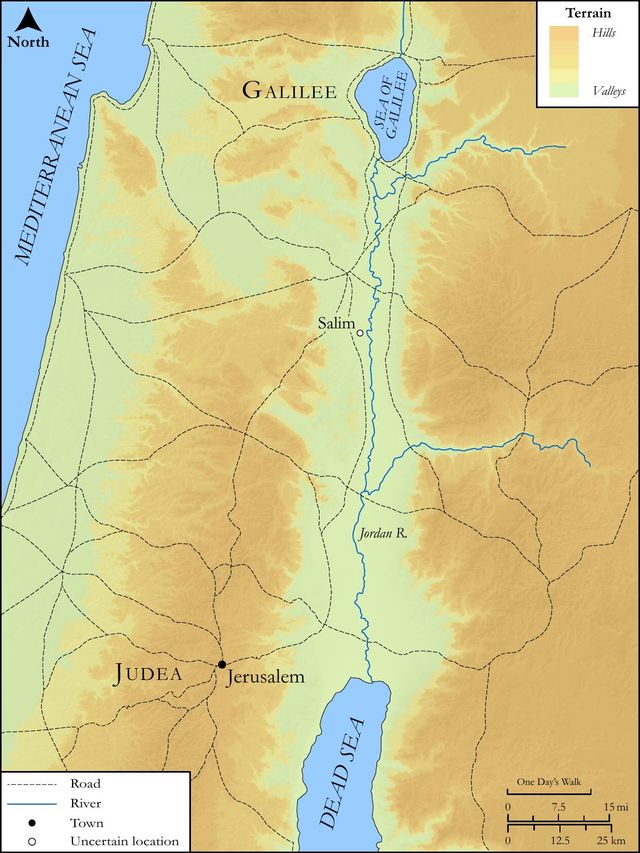
2.That he baptized in Enon near Salim, places we find nowhere else mentioned, and therefore the learned are altogether at a loss where to find them. Wherever it was, it seems that John removed from place to place; he did not think that there was any virtue in Jordan, because Jesus was baptized there, which should engage him to stay there, but as he saw cause he removed to other waters. Ministers must follow their opportunities. He chose a place where there was much water, hydata polla—many waters, that is, many streams of water; so that wherever he met with any that were willing to submit to his baptism water was at hand to baptize them with, shallow perhaps, as is usual where there are many brooks, but such as would serve his purpose. And in that country plenty of water was a valuable thing.
3.That thither people came to him and were baptized. Though they did not come in such vast crowds as they did when he first appeared, yet now he was not without encouragement, but there were still those that attended and owned him. Some refer this both to John and to Jesus: They came and were baptized; that is, some came to John, and were baptized by him, some to Jesus, and were baptized by him, and, as their baptism was one, so were their hearts.
4.It is noted (v. 24) that John was not yet cast into prison, to clear the order of the story, and to show that these passages are to come in before Matt. vi. 12. John never desisted from his work as long as he had his liberty; nay, he seems to have been the more industrious, because he foresaw his time was short; he was not yet cast into prison, but he expected it ere long, ch. ix. 4.
III.A contest between John's disciples and the Jews about purifying, v.
25. See how the gospel of Christ came not to send peace upon earth, but division. Observe, 1. Who were the disputants: some of John's disciples, and the Jews who had not submitted to his baptism of repentance. Penitents and impenitents divide this sinful world. In this contest, it should seem, John's disciples were the aggressors, and gave the challenge; and it is a sign that they were novices, who had more zeal than discretion. The truths of God have often suffered by the rashness of those that have undertaken to defend them before they were able to do it. 2. What was the matter in dispute: about purifying, about religious washing. (1.) We may suppose that John's disciples cried up his baptism, his purifying, as instar omnium—superior to all others, and gave the preference to that as perfecting and superseding all the purifications of the Jews, and they were in the right; but young converts are too apt to boast of their attainments, whereas he that finds the treasure should hide it till he is sure that he has it, and not talk of it too much at first. (2.) No doubt the Jews with as much assurance applauded the purifyings that were in use among them, both those that were instituted by the law of Moses and those that were imposed by the tradition of the elders; for the former they had a divine warrant, and for the latter the usage of the church. Now it is very likely that the Jews in this dispute, when they could not deny the excellent nature and design of John's baptism, raised an objection against it from Christ's baptism, which gave occasion for the complaint that follows here (v. 26): "Here is John baptizing in one place." say they, "and Jesus at the same time baptizing in another place; and therefore John's baptism, which his disciples so much applaud, is either," [1.] "Dangerous, and of ill consequence to the peace of the church and state, for you see it opens a door to endless parties. Now that John has begun, we shall have every little teacher set up for a baptist presently. Or," [2.] "At the best it is defective and imperfect. If John's baptism, which you cry up thus, have any good in it, yonder the baptism of Jesus goes beyond it, so that for your parts you are shaded already by a greater light, and your baptism is soon gone out of request." Thus objections are made against the gospel from the advancement and improvement of gospel light, as if childhood and manhood were contrary to each other, and the superstructure were against the foundation. There was no reason to object Christ's baptism against John's, for they consisted very well together.
IV.A complaint which John's disciples made to their master concerning Christ and his baptizing, v.
26. They, being nonplussed by the fore-mentioned objection, and probably ruffled and put into a heat by it, come to their master, and tell him, "Rabbi, he that was with thee, and was baptized of thee, is now set up for himself; he baptizeth, and all men come to him; and wilt thou suffer it?" Their itch for disputing occasioned this. It is common for men, when they find themselves run aground in the heat of disputation, to fall foul upon those that do them no harm. If these disciples of John had not undertaken to dispute about purifying, before they understood the doctrine of baptism, they might have answered the objection without being put into a passion. In their complaint, they speak respectfully to their own master, Rabbit; but speak very slightly of our Saviour, though they do not name him. 1. They suggest that Christ's setting up a baptism of his own was a piece of presumption, very unaccountable; as if John, having first set up this rite of baptizing, must have the monopoly of it, and, as it were, a patent for the invention: "He that was with thee beyond Jordan, as a disciple of thine, behold, and wonder, the same, the very same, baptizes, and takes thy work out of thy hand." Thus the voluntary condescensions of the Lord Jesus, as that of his being baptized by John, are often unjustly and very unkindly turned to his reproach. 2. They suggest that it was a piece of ingratitude to John. He to whom thou barest witness baptizes; as if Jesus owed all his reputation to the honourable character John gave of him, and yet had very unworthily improved it to the prejudice of John. But Christ needed not John's testimony, ch. v. 36. He reflected more honour upon John than he received from him, yet thus it is incident to us to think that others are more indebted to us than really they are. And besides, Christ's baptism was not in the least an impeachment, but indeed the greatest improvement, of John's baptism, which was but to lead the way to Christ's. John was just to Christ, in bearing witness to him; and Christ's answering his testimony did rather enrich than impoverish John's ministry. 3. They conclude that it would be a total eclipse to John's baptism: "All men come to him; they that used to follow with us now flock after him, it is therefore time for us to look about us." It was not indeed strange that all men came to him. As far as Christ is manifested he will be magnified; but why should John's disciples grieve at this? Note, Aiming at the monopoly of honour and respect has been in all ages the bane of the church, and the shame of its members and ministers; as also a vying of interests, and a jealousy of rivalship and competition. We mistake if we think that the excelling gifts and graces, and labours and usefulness, of one, are a diminution and disparagement to another that has obtained mercy to be faithful; for the Spirit is a free agent, dispensing to every one severally as he will. Paul rejoiced in the usefulness even of those that opposed him, Phil. i. 18. We must leave it to God to choose, employ, and honour his own instruments as he pleaseth, and not covet to be placed alone.
V.Here is John's answer to this complaint which his disciples made, v.
27, &c. His disciples expected that he would have resented this matter as they did; but Christ's manifestation to Israel was no surprise to John, but what he looked for; it was not disturbance to him, but what he wished for. He therefore checked the complaint, as Moses, Enviest thou for my sake? and took this occasion to confirm the testimonies he had formerly borne to Christ as superior to him, cheerfully consigning and turning over to him all the interest he had in Israel. In this discourse here, the first minister of the gospel (for so John was) is an excellent pattern to all ministers to humble themselves and to exalt the Lord Jesus.
1.John here abases himself in comparison with Christ, v. 27-30. The more others magnify us, the more we must humble ourselves, and fortify ourselves against the temptation of flattery and applause, and the jealousy of our friends for our honour, by remembering our place, and what we are, 1 Cor. iii. 5.
(1.)John acquiesces in the divine disposal, and satisfies himself with that (v. 27): A man can receive nothing except it be given him from heaven, whence every good gift comes (James i. 17), a general truth very applicable in this case. Different employments are according to the direction of divine Providence, different endowments according to the distribution of the divine grace. No man can take any true honour to himself, Heb. v. 4. We have as necessary and constant a dependence upon the grace of God in all the motions and actions of the spiritual life as we have upon the providence of God in all the motions and actions of the natural life: now this comes in here as a reason,
[1.]Why we should not envy those that have a larger share of gifts than we have, or move in a larger sphere of usefulness. John reminds his disciples that Jesus would not have thus excelled him except he had received it from heaven, for, as man and Mediator, he received gifts; and, if God gave him the Spirit without measure (v. 34), shall they grudge at it? The same reason will hold as to others. If God is pleased to give to others more ability and success than to us, shall we be displeased at it, and reflect upon him as unjust, unwise, and partial? See Matt. xx. 15.
[2.]Why we should not be discontented, though we be inferior to others in gifts and usefulness, and be eclipsed by their excellencies. John was ready to own that it was the gift, the free gift, of heaven, that made him a preacher, a prophet, a baptist: it was God that gave him the interest he had in the love and esteem of the people; and, if now his interest decline, God's will be done! He that gives may take. What we receive from heaven we must take as it is given. Now John never received a commission for a standing perpetual office, but only for a temporary one, which must soon expire; and therefore, when he has fulfilled his ministry, he can contentedly see it go out of date. Some give quite another sense of these words: John had taken pains with his disciples, to teach them the reference which his baptism had to Christ, who should come after him, and yet be preferred before him, and do that for them which he could not do; and yet, after all, they dote upon John, and grudge this preference of Christ above him: Well saith John, I see a man can receive (that is, perceive) nothing, except it be given him from heaven. The labour of ministers if all lost labour, unless the grace of God make it effectual. Men do not understand that which is made most plain, nor believe that which is made most evident, unless it be given them from heaven to understand and believe it.
(2.)John appeals to the testimony he had formerly given concerning Christ (v. 28): You can bear me witness that I said, again and again, I am not the Christ, but I am sent before him. See how steady and constant John was in his testimony to Christ, and not as a reed shaken with the wind; neither the frowns of the chief priests, nor the flatteries of his own disciples, could make him change his note. Now this serves here, [1.] As a conviction to his disciples of the unreasonableness of their complaint. They had spoken of the witness which their master bore to Jesus (v. 26): "Now," saith John, "do you not remember what the testimony was that I did bear? Call that to mind, and you will see your own cavil answered. Did I not say, I am not the Christ? Why then do you set me up as a rival with him that is? Did I not say, I am sent before him? Why then does it seem strange to you that I should stand by and give way to him?" [2.] It is a comfort to himself that he had never given his disciples any occasion thus to set him up in competition with Christ; but, on the contrary, had particularly cautioned them against this mistake, though he might have made a hand of it for himself. It is a satisfaction to faithful ministers when they have done what they could in their places to prevent any extravagances that their people ran into. John had not only not encouraged them to hope that he was the Messiah, but had plainly told them the contrary, which was now a satisfaction to him. It is a common excuse for those who have undue honour paid them, Si populus vult decipi, decipiatur—If the people will be deceived, let them; but that is an ill maxim for those to go by whose business it is to undeceive people. The lip of truth shall be established.
(3.)John professes the great satisfaction he had in the advancement of Christ and his interest. He was so far from regretting it, as his disciples did, that he rejoiced in it. This he expresses (v. 29) by an elegant similitude.
[1.]He compares our Saviour to the bridegroom: "He that hath the bride is the bridegroom. Do all men come to him? It is well, whither else should they go? Has he got the throne in men's affections? Who else should have it? It is his right; to whom should the bride be brought but to the bridegroom?" Christ was prophesied of in the Old Testament as a bridegroom, Ps. xlv. The Word was made flesh, that the disparity of nature might not be a bar to the match. Provision is made for the purifying of the church, that the defilement of sin might be no bar. Christ espouses his church to himself; he has the bride, for he has her love, he has her promise; the church is subject to Christ. As far as particular souls are devoted to him in faith and love, so far the bridegroom has the bride.
[2.]He compares himself to the friend of the bridegroom, who attends upon him, to do him honour and service, assists him in prosecuting the match, speaks a good word for him, uses his interest on his behalf, rejoices when the match goes on, and most of all when the point is gained, and he has the bride. All that John had done in preaching and baptizing was to introduce him; and, now that he was come, he had what he wished for: The friend of the bridegroom stands, and hears him; stands expecting him, and waiting for him; rejoices with joy because of the bridegroom's voice, because he is come to the marriage after he had been long expected. Note, First, Faithful ministers are friends of the bridegroom, to recommend him to the affections and choice of the children of men; to bring letters and messages from him, for he courts by proxy; and herein they must be faithful to him. Secondly, The friends of the bridegroom must stand, and hear the bridegroom's voice; must receive instructions from him, and attend his orders; must desire to have proofs of Christ speaking in them, and with them (2 Cor. xiii. 3); that is the bridegroom's voice. Thirdly, The espousing of souls to Jesus Christ, in faith and love, is the fulfilling of the joy of every good minister. If the day of Christ's espousals be the day of the gladness of his heart (Cant. iii. 11), it cannot but be of their too who love him and wish well to his honour and kingdom. Surely they have no greater joy.
(4.)He owns it highly fit and necessary that the reputation and interest of Christ should be advanced, and his own diminished (v. 30): He must increase, but I must decrease. If they grieve at the growing greatness of the Lord Jesus, they will have more and more occasion to grieve, as those have that indulge themselves in envy and emulation. John speaks of Christ's increase and his own decrease, not only as necessary and unavoidable, which could not be helped and therefore must be borne, but as highly just and agreeable, and affording him entire satisfaction.
[1.]He was well pleased to see the kingdom of Christ getting ground: "He must increase. You think he has gained a great deal, but it is nothing to what he will gain." Note, The kingdom of Christ is, and will be, a growing kingdom, like the light of the morning, like the grain of mustard-seed.
[2.]He was not at all displeased that the effect of this was the diminishing of his own interest: I must decrease. Created excellencies are under this law, they must decrease. I have seen an end of all perfection. Note, First, The shining forth of the glory of Christ eclipses the lustre of all other glory. The glory that stands in competition with Christ, that of the world and the flesh, decreases and loses ground in the soul as the knowledge and love of Christ increase and get ground; but it is here spoken of that which is subservient to him. As the light of the morning increases, that of the morning star decreases. Secondly, If our diminution or abasement may but in the least contribute to the advancement of Christ's name, we must cheerfully submit to it, and be content to be any thing, to be nothing, so that Christ may be all.
2.John Baptist here advances Christ, and instructs his disciples concerning him, that, instead of grieving that so many come to him, they might come to him themselves.
(1.)He instructs them concerning the dignity of Christ's person (v. 31): He that cometh from above, that cometh from heaven, is above all. Here,
[1.]He supposes his divine origin, that he came from above, from heaven, which bespeaks not only his divine extraction, but his divine nature. He had a being before his conception, a heavenly being. None but he that came from heaven was fit to show us the will of heaven, or the way to heaven. When God would save man, he sent from above.
[2.]Hence he infers his sovereign authority: he is above all, above all things and all persons, God over all, blessed for evermore. It is daring presumption to dispute precedency with him. When we come to speak of the honours of the Lord Jesus, we find they transcend all conception and expression, and we can say but this, He is above all. It was said of John Baptist, There is not a greater among them that are born of women. But the descent of Christ from heaven put such a dignity upon him as he was not divested of by his being made flesh; still he was above all. This he further illustrates by the meanness of those who stood in competition with him: He that is of the earth, is earthly, ho on ek tes ges, ek tes ges esti—He that is of the earth is of the earth; he that has his origin of the earth has his food out of the earth, has his converse with earthly things, and his concern is for them. Note, First, Man has his rise out of the earth; not only Adam at first, but we also still are formed out of the clay, Job xxxiii. 6. Look to the rock whence we were hewn. Secondly, Man's constitution is therefore earthly; not only his body frail and mortal, but his soul corrupt and carnal, and its bent and bias strong towards earthly things. The prophets and apostles were of the same mould with other men; they were but earthen vessels, though they had a rich treasure lodged in them; and shall these be set up as rivals with Christ? Let the potsherds strive with the potsherds of the earth; but let them not cope with him that came from heaven.
(2.)Concerning the excellency and certainty of his doctrine. His disciples were displeased that Christ's preaching was admired, and attended upon, more than his; but he tells them that there was reason enough for it. For,
[1.]He, for his part, spoke of the earth, and so do all those that are of the earth. The prophets were men and spoke like men; of themselves they could not speak but of the earth, 2 Cor. iii. 5. The preaching of the prophets and of John was but low and flat compared with Christ's preaching; as heaven is high above the earth, so were his thoughts above theirs. By them God spoke on earth, but in Christ he speaketh from heaven.
[2.]But he that cometh from heaven is not only in his person, but in his doctrine, above all the prophets that ever lived on earth; none teacheth like him. The doctrine of Christ is here recommended to us,
First, As infallibly sure and certain, and to be entertained accordingly (v. 32): What he hath seen and heard, that he testifieth. See here, 1. Christ's divine knowledge; he testified nothing but what he had seen and heard, what he was perfectly apprized of and thoroughly acquainted with. What he discovered of the divine nature and of the invisible world was what he had seen; what he revealed of the mind of God was what he had heard immediately from him, and not at second hand. The prophets testified what was made known to them in creams and visions by the mediation of angels, but not what they had seen and heard. John was the crier's voice, that said, "Make room for the witness, and keep silence while the charge is given," but then leaves it to the witness to give in his testimony himself, and the judge to give the charge himself. The gospel of Christ is not a doubtful opinion, like an hypothesis or new notion in philosophy, which every one is at liberty to believe or not; but it is a revelation of the mind of God, which is of eternal truth in itself, and of infinite concern to us. 2. His divine grace and goodness: that which he had seen and heard he was pleased to make known to us, because he knew it nearly concerned us. What Paul had seen and heard in the third heavens he could not testify (2 Cor. xii. 4), but Christ knew how to utter what he had seen and heard. Christ's preaching is here called his testifying, to denote, (1.) The convincing evidence of it; it was not reported as news by hearsay, but it was testified as evidence given in court, with great caution and assurance. (2.) The affectionate earnestness of the delivery of it: it was testified with concern and importunity, as Acts xviii. 5.
From the certainty of Christ's doctrine, John takes occasion, [1.] To lament the infidelity of the most of men: though he testifies what is infallibly true, yet no man receiveth his testimony, that is, very few, next to none, none in comparison with those that refuse it. They receive it not, they will not hear it, they do not heed it, or give credit to it. This he speaks of not only as a matter of wonder, that such a testimony should not be received (Who hath believed our report? How stupid and foolish are the greatest part of mankind, what enemies to themselves!) but as matter of grief; John's disciples grieved that all men came to Christ (v. 26); they thought his followers too many. But John grieves that no man came to him; he thought them too few. Note, The unbelief of sinners is the grief of saints. It was for this that St. Paul had great heaviness, Rom. ix. 2. [2.] He takes occasion to commend the faith of the chosen remnant (v. 33): He that hath received his testimony (and some such there were, though very few) hath set to his seal that God is true. God is true, though we do not set our seal to it; let God be true, and every man a liar; his truth needs not our faith to support it, but by faith we do ourselves the honour and justice to subscribe to his truth, and hereby God reckons himself honoured. God's promises are all yea and amen; by faith we put our amen to them, as Rev. xxii. 20. Observe, He that receives the testimony of Christ subscribes not only to the truth of Christ, but to the truth of God, for his name is the Word of God; the commandments of God and the testimony of Christ are put together, Rev. xii. 17. By believing in Christ we set to our seal, First, That God is true to all the promises which he has made concerning Christ, that which he spoke by the mouth of all his holy prophets; what he swore to our fathers is all accomplished, and not one iota or tittle of it fallen to the ground, Luke i. 70, &c. Acts xiii. 32, 33. Secondly, That he is true to all the promises he has made in Christ; we venture our souls upon God's veracity, being satisfied that he is true; we are willing to deal with him upon trust, and to quit all in this world for a happiness in reversion and out of sight. By this we greatly honour God's faithfulness. Whom we give credit to we give honour to.
Secondly, It is recommended to us as a divine doctrine; not his own, but his that sent him (v. 34): For he whom God hath sent speaketh the word of God, which he was sent to speak, and enabled to speak; for God giveth not the Spirit by measure unto him. The prophets were as messengers that brought letters from heaven; but Christ came under the character of an ambassador, and treats with us as such; for, 1. He spoke the words of God, and nothing he said savoured of human infirmity; both substance and language were divine. He proved himself sent of God (ch. iii. 2), and therefore his words are to be received as the words of God. By this rule we may try the spirits: those that speak as the oracles of God, and prophesy according to the proportion of faith, are to be received as sent of God. 2. He spoke as no other prophet did; for God giveth not the Spirit by measure to him. None can speak the words of God without the Spirit of God, 1 Cor. ii. 10, 11. The Old-Testament prophets had the Spirit, and in different degrees, 2 Kings ii. 9, 10. But, whereas God gave them the Spirit by measure (1 Cor. xii. 4), he gave him to Christ without measure; all fulness dwelt in him, the fulness of the Godhead, an immeasurable fulness. The Spirit was not in Christ as in a vessel, but as in a fountain, as in a bottomless ocean. "The prophets that had the Spirit in a limited manner, only with respect to some particular revelation, sometimes spoke of themselves; but he that had the Spirit always residing in him, without stint, always spoke the words of God." So Dr. Whitby.
(3.)Concerning the power and authority he is invested with, which gives him the pre-eminence above all others, and a more excellent name than they.
[1.]He is the beloved Son of the Father (v. 35): The Father loveth the Son. The prophets were faithful as servants, but Christ as a Son; they were employed as servants, but Christ beloved as a son, always his delight, Prov. viii. 30. The Father was well pleased in him; not only he did love him, but he doth love him; he continued his love to him even in his estate of humiliation, loved him never the less for his poverty and sufferings.
[2.]He is Lord of all. The Father, as an evidence of his love for him, hath given all things into his hand. Love is generous. The Father took such a complacency and had such a confidence in him that he constituted him the great feoffee in trust for mankind. Having given him the Spirit without measure, he gave him all things; for he was hereby qualified to be master and manager of all. Note, It is the honour of Christ, and the unspeakable comfort of all Christians, that the Father hath given all things into the hands of the Mediator. First, All power; so it is explained, Matt. xxviii. 18. All the works of creation being put under his feet, all the affairs of redemption are put into his hand; he is Lord of all. Angels are his servants; devils are his captives. He has power over all flesh, the heathen given him for his inheritance. The kingdom of providence is committed to his administration. He has power to settle the terms of the covenant of peace as the great plenipotentiary, to govern his church as the great lawgiver, to dispense divine favours as the great almoner, and to call all to account as the great Judge. Both the golden sceptre and the iron rod are given into his hand. Secondly, All grace is given into his hand as the channel of conveyance; all things, all those good things which God intended to give to the children of men; eternal life, and all its preliminaries. We are unworthy that the Father should give those things into our hands, for we have made ourselves the children of his wrath; he hath therefore appointed the Son of his love to be trustee for us, and the things he intended for us he gives into his hands, who is worthy, and has merited both honours for himself and favours for us. They are given into his hands, by him to be given into ours. This is a great encouragement to faith, that the riches of the new covenant are deposited in so sure, so kind, so good a hand, the hand of him that purchased them for us, and us for himself, who is able to keep all that which both God and believers have agreed to commit to him.
[3.]He is the object of that faith which is made the great condition of eternal happiness, and herein he has the pre-eminence above all others: He that believeth on the Son, hath life, v. 36. We have here the application of what he had said concerning Christ and his doctrine; and it is the conclusion of the whole matter. If God has put this honour upon the Son, we must by faith give honour to him. As God offers and conveys good things to us by the testimony of Jesus Christ, whose word is the vehicle of divine favours, so we receive and partake of those favours by believing the testimony, and entertaining that word as true and good; this way of receiving fitly answers that way of giving. We have here the sum of that gospel which is to be preached to every creature, Mark xvi. 16. Here is,
First, The blessed state of all true Christians: He that believes on the Son hath everlasting life. Note, 1. It is the character of every true Christian that he believes on the Son of God; not only believes him, that what he saith is true, but believes on him, consents to him, and confides in him. The benefit of true Christianity is no less than everlasting life; this is what Christ came to purchase for us and confer upon us; it can be no less than the happiness of an immortal soul in an immortal God. 2. True believers, even now, have everlasting life; not only they shall have it hereafter, but they have it now. For, (1.) They have very good security for it. The deed by which it passeth is sealed and delivered to them, and so they have it; it is put into the hands of their guardian for them, and so they have it, though the use be not yet transferred into possession. They have the Son of God, and in him they have life; and the Spirit of God, the earnest of this life. (2.) They have the comfortable foretastes of it, in present communion with God and the tokens of his love. Grace is glory begun.
Historical interpretation
Nine Centuries of Reception
13 surviving comments on this verse. Each one is dated, so this reads as a timeline rather than a list.
Select a marker to jump to its quote. Markers stagger vertically where authors wrote within a few decades of each other.
"I must decrease," said the prophet John, and the Word of the Lord alone, in which the law terminates, "increase."
John himself professes that the celestial things are not his, but Christ's, by saying, "He who is from the earth speaketh concerning the earth; He who comes from the realms above is above all; " and again, by saying that he "baptized in repentance only, but that One would shortly come who would baptize in the Spirit and fire; " -of course because true and stable faith is baptized with water, unto salvation; pretended and weak faith is baptized with fire, unto judgment.
In speech, by which prayer is enunciated, in spirit, by which alone it prevails, even John had taught his disciples to pray, but all John's doings were laid as groundwork for Christ, until, when "He had increased "-just as the same John used to fore-announce "that it was needful" that "He should increase and himself decrease" -the whole work of the forerunner passed over, together with his spirit itself, unto the Lord.
(Hom. xxix. 3) He next dismisses the motions of envy, not only as regards the present, but also the future, saying, He must increase, but I must decrease: as if he said, My office hath ceased, and is ended; but His advanceth.
"He must increase, but I must decrease."
That is to say, "What is mine has now come to a stand, and has henceforth ceased, but what is His increaseth; for that which ye fear shall not be now only, but much more as it advances. And it is this especially which shows what is mine the brighter! for this end I came, and I rejoice that what is His hath made so great progress, and that those things have come to pass on account of which all that I did was done." Seest thou how gently and very wisely he softened down their passion, quenched their envy, showed them that they were undertaking impossibilities, a method by which wickedness is best checked? For this purpose it was ordained, that these things should take place while John was yet alive and baptizing, in order that his disciples might have him as a witness of the superiority of Christ, and that if they should not believe, they might be without excuse. For John came not to say these words of his own accord, nor in answer to other enquirers, but they asked the question themselves, and heard the answer. For if he had spoken of himself, their belief would not have been equal to the self-condemning judgment which they received when they heard him answer to their question; just as the Jews also, in that they sent to him from their homes, heard what they did, and yet would not believe, by this especially deprived themselves of excuse.
What means, then, "He must increase, but I must decrease"? This is a great mystery! Before the Lord Jesus came, men were glorying of themselves; He came a man, to lessen man's glory, and to increase the glory of God. Now He came without sin, and found all men in sin. If thus He came to put away sin, God may freely give, man may confess. For man's confession is man's lowliness: God's pity is God's loftiness. Therefore, since He came to forgive man his sins, let man acknowledge his own lowliness and let God show His pity. "He must increase, but I must decrease:" that is, He must give, but I must receive; He must be glorified, but I must confess. Let man know his own condition, and confess to God; and hear the apostle as he says to a proud, elated man, bent on extolling himself: "What hast thou that thou didst not receive? And if thou didst receive it, why dost thou glory as if thou didst not receive it?" Then let man understand that he has received; and when he would call that his own which is not his, let him decrease: for it is good for him that God be glorified in him. Let him decrease in himself, that he may be increased in God.
These testimonies and this truth, Christ and John signified by their deaths. For John was lessened by the head: Christ was exalted on the cross; so that even there it appeared what this is, "He must increase, but I must decrease." Again, Christ was born when the days were just beginning to lengthen; John was born when they began to shorten. Thus their very creation and deaths testify to the words of John, when he says, "He must increase, but I must decrease." May the glory of God then increase in us, and our own glory decrease, that even ours may increase in God! For this is what the apostle says, this is what Holy Scripture says: "He that glorieth, let him glory in the Lord." Wilt thou glory in thyself? Thou wilt grow; but grow worse in thy evil. For whoso grows worse is justly decreased. Let God, then, who is ever perfect, grow, and grow in thee. For the more thou understandest God, and apprehendest Him, He seems to be growing in thee; but in Himself He grows not, being ever perfect. Thou didst understand a little yesterday; thou understandest more to-day, wilt understand much more to-morrow: the very light of God increases in thee: as if thus God increases, who remains ever perfect. It is as if one's eyes were being cured of former blindness, and he began to see a little glimmer of light, and the next day he saw more, and the third day still more: to him the light would seem to grow; yet the light is perfect, whether he see it or not. Thus it is also with the inner man: he makes progress indeed in God, and God seems to be increasing in him; yet man himself is decreasing, that he may fall from his own glory, and rise into the glory of God.
(Tr. xxv. c. 4, 5) What meaneth this, He must increase? God neither increases, nor decreases. And John and Jesus, according to the flesh, were of the same age: for the six months' difference between them is of no consequence. This is a great mystery. Before our Lord came, men gloried in themselves; He came in no man's nature, that the glory of man might be diminished, and the glory of God exalted. For He came to remit sins upon man's confession: a man's confession, a man's humility, is God's pity, God's exaltation. This truth Christ and John proved, even by their modes of suffering: John was beheaded, Christ was lifted up on the cross. Then Christ was born, when the days begin to lengthen; John, when they begin to shorten. Let God's glory then increase in us, and our own decrease, that ours also may increase in God. But it is because thou understandest God more and more, that He seemeth to increase in thee: for in His own nature He increaseth not, but is ever perfect: even as to a man cured of blindness, who beginneth to see a little, and daily seeth more, the light seemeth to increase, whereas it is in reality always at the fall, whether he seeth it or not. In like manner the inner man maketh advancement in God, and it seemeth as if God were increasing in Him; but it is He Himself that decreaseth, falling from the height of His own glory, and rising in the glory of God.
"He must increase, but I must decrease." What is this? He must be exalted, but I must be humbled. How is Jesus to increase? How is God to increase? The perfect does not increase. God neither increases nor decreases. For if He increases, He is not perfect; if He decreases, he is not God. And how can Jesus increase, being God? If to man's estate, since He deigned to be man and was a child; and, though the Word of God, lay an infant in a manger; and, though His mother's Creator, yet sucked the milk of infancy of her: then Jesus having grown in age of the flesh, that perhaps is the reason why it is said, "He must increase, but I must decrease." But why in this? As regards the flesh, John and Jesus were of the same age, there being six months between them: they had grown up together; and if our Lord Jesus Christ had willed to be here longer before His death, and that John should be here with Him, then, as they had grown up together, so would they have grown old together: in what way, then, "He must increase but I must decrease"? Above all, our Lord Jesus Christ being now thirty years old, does a man who is already thirty years old still grow? From that same age, men begin to go downward, and to decline to graver age, thence to old age. Again, even had they both been lads, he would not have said, "He must increase," but, We must increase together. But now each is thirty years of age. The interval of six months makes no difference in age; the difference is discovered by reading rather than by the look of the persons.
He convicts his disciples of being yet troubled about trifles, and of taking unseasonable offence at what they by no means ought, and of not yet knowing accurately, Who and whence Emmanuel is. For not thus far, saith he, shall His Deeds be marvelled at, nor because more are baptized by Him, shall He for this alone surpass my honour, but He shall attain to so great a measure of honour, as befitteth God. For He must needs come to increase of glory, and, through daily additions of miracles, ever mount up to the greater, and shine forth with greater splendour to the world: but I must decrease, abiding in that measure wherein I appear, not sinking from what was once given me, but in such a degree inferior to Him That advanceth ever to an increase of glory, as He hasteth and passeth on.
And this the blessed Baptist interpreteth to us. But our discourse will advance profitably through examples, making the force of what has been said clearer. Let then a stake two cubits long be fixed in the ground: let there lie near a plant too, just peeping above the ground, putting forth green shoots into the air, and ever thrust up to a greater height by the resistless vigour from the roots; if then one could put voice into the stake, and it should then say of itself and its neighbour the plant, This must increase, but I decrease; one would not reasonably suppose that it indicated any harm to itself, nor that its existing measure would be clipped, but it would be affirming its decrease in that sort only, in which it is found less than that which is ever advancing towards increase. Again you may take an example akin to this one, and suppose the brightest of the stars to cry out saying of the sun, It must increase, but I decrease. For while in the gloom of night the depth of the atmosphere is darkened, one may well admire the morning star flashing forth its golden light, and conspicuous in its full glory: but when the sun now gives notice of its rising, and bedews the world with a moderate light, the star is surpassed by the greater, and gives place to him advancing little by little. And it too might well speak the words of John, being in that same state, which he says he is enduring.
And he adds: "He must increase, but I must decrease." In this matter we must ask in what way Christ increased and in what way John decreased, unless it be that the people, seeing John's abstinence and observing that he was withdrawn from men, thought he was Christ; but seeing Christ eating with tax collectors and walking among sinners, they believed he was not Christ but a prophet. But as time passed, Christ who was thought to be a prophet was recognized as Christ, and John who was believed to be Christ became known to be a prophet, and thus was fulfilled what his forerunner predicted about Christ: "He must increase, but I must decrease." Indeed, in the estimation of the people Christ increased because he was recognized as what he was; and John decreased because he ceased to be called what he was not.
The crowd believed that [John] was the Christ because of the greatness of his power, while some people supposed that our Lord was not the Christ but a prophet because of the weakness of his flesh. John himself revealed the secret meaning of this difference.… Our Lord increased because it became known to believers throughout the entire world that he who was believed to be a prophet was the Christ. John diminished and decreased because it became apparent that he who was judged to be the Christ was not himself the Christ but the herald of the Christ.
As, on the sun rising, the light of the other heavenly bodies seems to be extinguished, though in reality it is only obscured by the greater light: thus the forerunner is said to decrease; as if he were a star hidden by the sun. Christ increases in proportion as he gradually discloses Himself by miracles; not in the sense of increase, or advancement in virtue, (the opinion of Nestorius,) but only as regards the manifestation of His divinity.
Continue studying John 3:30 across the web’s major study libraries — every link below opens this exact verse, chapter, or book on the destination site.
Read & Compare
 BibleGatewayThis verse in more than 200 translations and 70 languages.
 Bible.comThe YouVersion reader — hundreds of translations, reading plans, and highlights.
 ESV.orgCrossway's official English Standard Version reader.
 NET BibleThe NET translation with 60,000+ translators' notes on every rendering decision.
 STEP BibleTyndale House's free study tool — original text, vocabulary, and scholarly resources.
 BibliaLogos Bible Software's free web reader.
 USCCBThe New American Bible (Revised Edition) with the U.S. bishops' study notes.
Commentaries
 BibleHub CommentariesDozens of classic commentaries on this verse, gathered on one page.
 StudyLightMore than 100 commentary sets — the largest collection on the web.
 BibleRefPlain-English commentary on what this verse means, verse by verse.
 Enduring WordDavid Guzik's free commentary on this chapter, widely used by Bible teachers.
 Bible Study ToolsVerse commentary alongside Greek and Hebrew study aids.
Original Language & Research
- BibleHub InterlinearThe verse word by word — original language, transliteration, and English.
- BibleHub LexiconEvery word's original-language definition and Strong's entry.
 Blue Letter BibleDeep-study tools — Strong's numbers, concordance, and word studies.
 CNTR CollationThe earliest Greek manuscripts of this verse, collated letter by letter.
Sermons, Hymns & Audio


TrulyRandomVerse is not affiliated with these sites and does not control their content.
Written with AI assistance. Always check it against Scripture.
This verse
John says that it is necessary for Jesus to grow greater and for himself to grow less, and he says it gladly.
“He must increase,”
Deî, “it is necessary”, with auxánō, to grow. The growth of Christ’s influence and honour is necessary, and it belongs to who he is as the Messiah.
“but I must decrease.”
Elattóō, to make less. The two halves are set against each other on purpose, and the necessity covers both. John’s lessening is part of the same plan as Christ’s growth, and he consents to it willingly.
Passage studyJohn 3:27–30
John the Baptist’s Joy in Christ’s Increase
Summary
John’s disciples are troubled because the crowds are leaving their teacher for Jesus. John answers them in four short sentences. Everything a servant of God has is given to him from heaven. He himself always said that he was the one sent ahead of the Christ. He is like the friend at a wedding, whose happiness is complete when the bridegroom is heard. And so he ends with the words he is best remembered for: “He must increase, but I must decrease.”
What John was answering
John’s disciples had come to him with a report: “He that was with thee beyond Jordan, to whom thou barest witness, behold, the same baptizeth, and all men come to him” (John 3:26). In first-century Jewish life it was common for disciples to follow a revered teacher, learning what he taught and copying how he lived. John was a prophet with a large following, and his baptizing was widely known. When a new teacher began to draw the people away, loyalty to John turned easily into rivalry, and his disciples felt the loss on his behalf.
John’s reply is calm and glad, with no jealousy in it. He uses their complaint to say once more what his whole ministry had been for, which was to point to One greater than himself. This reply is the high point of his last public testimony to Jesus.
“A man can receive nothing, except it be given him from heaven”
John begins with a general rule. “A man” means any human being, so the rule covers John, his disciples and everyone else. The verb for “receive”, lambánō, means to take or to receive, and here it is receiving, where the giver acts first. The verb for “given”, dídōmi, is the ordinary word for giving, and the Greek speaks of something that has been given, a gift already made and still standing. “From heaven” was a familiar Jewish way of saying “from God”.
People receive many things from earthly sources, so John is speaking of the matter his disciples raised: authority to teach and baptize, spiritual gifts, and fruit in God’s work. Israel already knew that a prophet spoke by God’s word and that his authority came from heaven, whatever his credentials or his popularity. John applies that to the news they have brought him. If all men are coming to Jesus, it is because God has given this to Jesus. John’s own ministry was given in the same way, and its measure was set by the same Giver.
The rest of Scripture says the same. Jesus teaches that no one can come to him unless the Father draws him (John 6:44). Paul asks the Corinthians what they have that they did not receive (1 Corinthians 4:7), and tells the Romans that our gifts differ according to the grace given to us (Romans 12:6). James says that every good and perfect gift comes down from above (James 1:17).
How the rule applies to Jesus
John’s rule describes every servant, and it prepares us to see how Jesus stands above every servant. A prophet receives gifts from heaven. Jesus is himself the one who came down from heaven (John 3:13), the one through whom all things were made (John 1:3). His authority to teach, to heal, to forgive sins, and to lay down his life and take it again (John 10:18) belongs to him as the Son, and the Father affirmed it openly at his baptism (Matthew 3:17).
He is also the one through whom heaven’s gifts reach us. Through Christ we receive the Holy Spirit (John 14:16–17), the gifts the Spirit distributes (1 Corinthians 12:4–11), and eternal life itself, given to those who believe in him (John 3:16). So the “nothing” of this verse reaches as far as salvation: we have it only because God gave it.
“I am not the Christ, but that I am sent before him”
John now calls his own disciples as witnesses. The verb martyréō means to testify, to be a witness, and John says that they themselves can testify to what he has always said. He is reminding them of something they heard from him many times. When priests and Levites came from Jerusalem to ask who he was, he gave the same answer (John 1:19–23).
Christós means “Anointed One” and is the Greek for the Hebrew “Messiah”, the deliverer, king and saviour promised in the Old Testament. John refuses that title for himself and takes another: he is “sent before him”. The verb apostéllō means to send someone out on a mission, with the sender’s authority. John had been commissioned by God, and his commission was to go ahead of someone else.
The prophets had promised such a forerunner. Malachi spoke of a messenger who would prepare the way before the Lord (Malachi 3:1), and Isaiah of a voice crying in the wilderness (Isaiah 40:3–5). Before John was born, the angel said that he would go before the Lord in the spirit and power of Elijah (Luke 1:17). John carried out that task by preaching repentance, by baptizing, and by pointing to Jesus as “the Lamb of God, which taketh away the sin of the world” (John 1:29). He was sent to bear witness of the Light, as the opening of this Gospel says (John 1:6–8).
Why did it matter that John denied being the Christ?
Judea in those days was full of expectation, and John’s denial kept that expectation fixed on the right person. The people were waiting for the Messiah to restore Israel and bring in God’s kingdom, and various men had arisen claiming to be prophets or even the Messiah. John drew such crowds that people wondered in their hearts whether he was the Christ (Luke 3:15). His plain answer cleared away the confusion and set him apart from false claimants. It also showed his integrity, because a man who turns down an honour he could have had is a witness worth believing. By it he directed all eyes to Jesus, “the author and finisher of our faith” (Hebrews 12:2).
The friend of the bridegroom
John then gives his disciples a picture from a wedding. “He that hath the bride is the bridegroom.” The bridegroom, nymphíos, is Jesus, and the bride is God’s people. John is the bridegroom’s friend. The word phílos means a friend, someone dear, and “the friend of the bridegroom” was an honoured place at a Jewish wedding, much like a best man.
Jewish weddings were elaborate celebrations lasting several days. The bridegroom’s friend helped arrange the betrothal, negotiated the dowry, prepared the feast and saw that everything went smoothly. His happiness lay in the marriage of his friend, and once the groom arrived his own part was finished. John’s hearers would have understood at once what he was saying about himself. His work was honourable, it was preparatory, and it was meant to end.
The friend “standeth and heareth him”, waiting attentively and ready to serve. When he hears the bridegroom’s voice, he knows that the groom has come. The voice John hears is the voice of the Son of God, who calls his own sheep by name (John 10:3), and it means that Jesus is present and at work.
John’s joy fulfilled
“Rejoiceth greatly” translates a Greek expression that joins the verb chaírō, to rejoice or be glad, with its own noun chará, joy, so that John literally “rejoices with joy”. It is a way of saying that the gladness is very great. He adds that this joy “is fulfilled”. The verb plēróō means to fill up, to complete or to finish a task, and it is also used of a prediction coming true. John’s joy has reached its full measure, because the Christ he was sent to announce has come and begun his work. The news that grieved his disciples is the very thing that completes his happiness.
Why Jesus is called the bridegroom
In the Old Testament God speaks of himself as the husband of Israel. “For thy Maker is thine husband,” says Isaiah (Isaiah 54:5). Through Jeremiah the LORD remembers Israel’s early love as a bride (Jeremiah 2:2), and through Hosea he promises to betroth his people to himself for ever (Hosea 2:19–20). When John calls Jesus the bridegroom, he gives him the place that the LORD holds in those passages.
The New Testament carries the picture forward. Christ loved the church and gave himself for it, “that he might sanctify and cleanse it with the washing of water by the word, that he might present it to himself a glorious church” (Ephesians 5:25–27). Paul speaks of presenting believers to Christ as a pure bride to one husband (2 Corinthians 11:2). And history ends with the marriage supper of the Lamb (Revelation 19:7–9), when Christ and his redeemed people are united for ever. The bridegroom whose voice John heard is the one who would lay down his life for his bride.
“He must increase, but I must decrease”
The word behind “must” is deî, which means “it is necessary”. It is used of what has to take place and of what is right and fitting to do. Both senses fit here. John has just said that every ministry is given from heaven, so the change his disciples lament is God’s own arrangement, and John accepts it as his duty and his delight.
“Increase” is auxánō, to grow or become greater. Jesus must grow in influence, in the number who hear him, and in the recognition of who he is. “Decrease” is elattóō, to make less. John’s public place must shrink as Christ’s light comes into view. John was the last and greatest of the old covenant prophets, the bridge between them and the new covenant that Christ brings in, and a forerunner’s work is complete when the one he announced has arrived. His decrease was the success of his mission.
Christ’s increase did not stop with the crowds at the Jordan. After his resurrection God set him at his own right hand, far above every power and dominion (Ephesians 1:20–21). All power in heaven and on earth has been given to him (Matthew 28:18). He is the head of the church, with the first place in all things (Colossians 1:18), and his kingdom keeps growing through the Holy Spirit. His glory and his reign will increase for ever.
What does this mean for a believer?
It means that our aim is to see Jesus honoured and his influence grow in the world and in other people’s lives, even when our own reputation, recognition or comfort grows smaller. In practice that is serving others humbly, passing praise on to God, and pointing people to Jesus by what we say and do. Paul lived this way. He hoped that Christ would be magnified in his body, whether by life or by death (Philippians 1:20). He reminded the Corinthians that one plants and another waters, while God gives the increase (1 Corinthians 3:6–7). And he set before the Philippians the mind of Christ himself, who humbled himself and counted others above himself (Philippians 2:3–8). God resists the proud and gives grace to the humble.
The freedom in John’s answer
John’s four sentences show us a God who gives. Every gift, every opening to serve and every bit of fruit comes from his hand, and he decides its size. That truth takes away the ground for pride, since what we have was given to us. It also lifts a weight, because the outcome of our work rests with the Giver. And it ends the comparing that troubled John’s disciples, for the person who has more than we do received it from the same heaven.
John also shows where lasting joy is found. His happiness was full on the day his crowds grew thin, because it had always rested on the Bridegroom and never on his own standing. Joy that depends on being noticed fades when the notice does. Joy in Christ’s honour grows as his kingdom grows, and that kingdom will never decrease. Those who belong to Christ are the bride John spoke of, loved by the one who gave himself for her, and each of us may gladly take the friend’s place, standing near, listening for his voice, and content that he is the one people see.
John 3:27
“John answered and said,”
John is replying to his disciples’ report in verse 26 that everyone is going to Jesus. He answers as their teacher, with a principle before he says anything about himself.
“A man can receive nothing,”
A short saying that is easy to remember, and it is absolute. “A man” is anyone at all. To receive, lambánō, leaves the first move with the giver, so in the things of God we stand as dependants.
“except it be given him from heaven.”
The one condition, and it turns the saying into praise of the Giver. Dídōmi is “to give”, and “from heaven” names God as the source. Jesus’ growing following and John’s own calling both come under it.
John 3:28
“Ye yourselves bear me witness,”
Martyréō, to testify. John appeals to their own memory. His message had been public and consistent, so they already knew the answer to their complaint.
“that I said, I am not the Christ,”
Christós is the Anointed One, the Messiah. John had turned the title down before the delegation from Jerusalem and turns it down again here.
“but that I am sent before him.”
Apostéllō, to send out on a mission. John’s work was given to him by God, and it was the herald’s work that Malachi and Isaiah had foretold.
John 3:29
“He that hath the bride is the bridegroom:”
The bride belongs to the bridegroom, nymphíos. God’s people belong to Jesus, which sets him apart from every other servant, John included.
“but the friend of the bridegroom, which standeth and heareth him,”
John’s place. The phílos stands ready and listens, a posture of attention and willing service.
“rejoiceth greatly because of the bridegroom’s voice:”
The Greek joins chaírō with chará, “rejoices with joy”. The voice stands for the bridegroom himself, present and at work, and the friend’s gladness is entirely on his account.
“this my joy therefore is fulfilled.”
Plēróō, to fill up or complete. John’s own testimony about his heart: Jesus’ rising popularity completes his joy.
John 3:30 This verse
“He must increase,”
Deî, “it is necessary”, with auxánō, to grow. The growth of Christ’s influence and honour is necessary, and it belongs to who he is as the Messiah.
“but I must decrease.”
Elattóō, to make less. The two halves are set against each other on purpose, and the necessity covers both. John’s lessening is part of the same plan as Christ’s growth, and he consents to it willingly.
Last revised