


1 Corinthians 4:7
Bible text: King James Version (1769 Blayney text) · Public domain
Bible text: King James Version with Strong's numbers · Public domain
Bible text: Berean Standard Bible · Public domain
Bible text: American Standard Version (1901) · Public domain
Bible text: World English Bible, Messianic edition · Public domain
Bible text: Geneva Bible (1599) · Public domain
Bible text: Young's Literal Translation · Public domain
- τίςtisWhoG5101I-NSMInterrogative pronoun Nominative Singular Masculine
- γάρgarforG1063CONJConjunction
- σεseyouG4771P-2ASPersonal pronoun Accusative 2nd Singular
- διακρίνει;diakrineimakes different?G1252V-PAI-3SVerb Present Active Indicative 3rd Singular
- τίtiWhatG5101I-ASNInterrogative pronoun Accusative Singular Neuter
- δὲdenowG1161CONJConjunction
- ἔχειςecheishave youG2192V-PAI-2SVerb Present Active Indicative 2nd Singular
- ὃhowhichG3739R-ASNRelative pronoun Accusative Singular Neuter
- οὐκouknotG3756PRT-NNegative Particle Negative
- ἔλαβες;elabesyou did receive?G2983V-2AAI-2SVerb 2nd Aorist Active Indicative 2nd Singular
- εἰeiIfG1487CONDConjunction
- δὲdenowG1161CONJConjunction
- καὶkaievenG2532CONJConjunction
- ἔλαβεςelabesyou did receive [it]G2983V-2AAI-2SVerb 2nd Aorist Active Indicative 2nd Singular
- τίtiwhyG5101I-ASNInterrogative pronoun Accusative Singular Neuter
- καυχᾶσαιkauchasaiboast youG2744V-PNI-2SVerb Present Middle Or Passive Deponent Indicative 2nd Singular
- ὡςhōsasG5613PRTParticle or Disjunctive
- μὴmēnotG3361PRT-NNegative Particle Negative
- λαβών;labōnhaving received [it]?G2983V-2AAP-NSMVerb 2nd Aorist Active Participle Nominative Singular Masculine
English is a literal word-by-word gloss of the Greek, not the KJV's wording. Why?
This is the original text the KJV's translators worked from — each Greek word with its own literal English meaning in this verse, prepared by scholars at Tyndale House, Cambridge. The KJV translates whole sentences, not word by word, so its wording differs: one Greek word can become several English words, and the KJV may choose “charity” where the gloss reads “love”. Both are faithful — they answer different questions. For the KJV's own rendering, switch to the KJV text.
Details
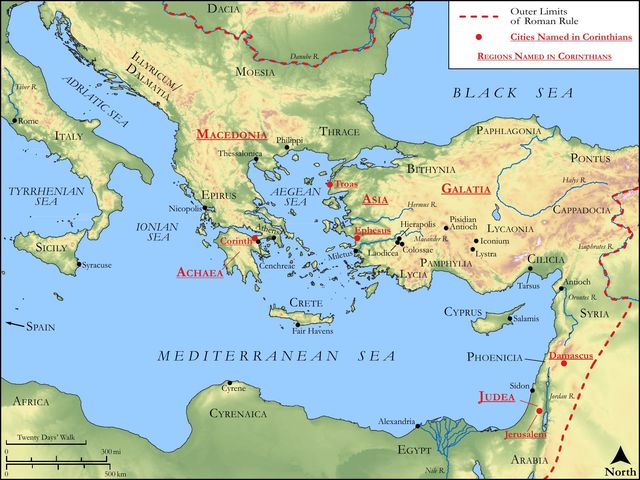
See on the biblical-era maps

Study this verse
Public-domain commentary
Matthew Henry
From his Commentary on the Whole Bible. Henry comments on passages, not single verses — this entry covers 1 Corinthians 4:7–13. His two-level outline is real structure in the source text, so it is rendered as structure.
Here the apostle improves the foregoing hint to a caution against pride and self-conceit, and sets forth the temptations the Corinthians had to despise him, from the difference of their circumstances.
I.He cautions them against pride and self-conceit by this consideration, that all the distinction made among them was owing to God:
Who maketh thee to differ? And what hast thou that thou didst not receive? Co1 4:7. Here the apostle turns his discourse to the ministers who set themselves at the head of these factions, and did but too much encourage and abet the people in those feuds. What had they to glory in, when all their peculiar gifts were from God? They had received them, and could not glory in them as their own, without wronging God. At the time when they reflected on them to feed their vanity, they should have considered them as so many debts and obligations to divine bounty and grace. But it may be taken as a general maxim: We have no reason to be proud of our attainments, enjoyments, or performances; all that we have, or are, or do, that is good, is owing to the free and rich grace of God. Boasting is for ever excluded. There is nothing we have that we can properly call our own: all is received from God. It is foolish in us therefore, and injurious to him, to boast of it; those who receive all should be proud of nothing, Psa 115:1. Beggars and dependents may glory in their supports; but to glory in themselves is to be proud at once of meanness, impotence, and want. Note, Due attention to our obligations to divine grace would cure us of arrogance and self-conceit.
II.He presses the duty of humility upon them by a very smart irony, or at least reproves them for their pride and self-conceit:
"You are full, you are rich, you have reigned as kings without us. You have not only a sufficiency, but an affluence, of spiritual gifts; nay, you can make them the matter of your glory without us, that is, in my absence, and without having any need of me." There is a very elegant gradation from sufficiency to wealth, and thence to royalty, to intimate how much the Corinthians were elated by the abundance of their wisdom and spiritual gifts, which was a humour that prevailed among them while the apostle was away from them, and made them forget what an interest he had in all. See how apt pride is to overrate benefits and overlook the benefactor, to swell upon its possessions and forget from whom they come; nay, it is apt to behold them in a magnifying-glass: "You have reigned as kings," says the apostle, "that is, in your own conceit; and I would to God you did reign, that we also might reign with you. I wish you had as much of the true glory of a Christian church upon you as you arrogate to yourselves. I should come in then for a share of the honour: I should reign with you: I should not be overlooked by you as now I am, but valued and regarded as a minister of Christ, and a very useful instrument among you." Note, Those do not commonly know themselves best who think best of themselves, who have the highest opinion of themselves. The Corinthians might have reigned, and the apostle with them, if they had not been blown up with an imaginary royalty. Note, Pride is a great prejudice to our improvement. He is stopped from growing wiser or better who thinks himself at the height; not only full, but rich, nay, a king.
III.He comes to set forth his own circumstances and those of the other apostles, and compares them with theirs.
1.To set forth the case of the apostles: For I think it hath pleased God to set forth us the apostles last, as it were appointed to death. For we are made a spectacle to the world, and to angels, and to men. Paul and his fellow-apostles were exposed to great hardships. Never were any men in this world so hunted and worried. They carried their lives in their hands: God hath set forth us the apostles last, as it were appointed to death, Co1 4:9. An allusion is made to some of the bloody spectacles in the Roman amphitheatres, where men were exposed to fight with wild beasts, or to cut one another to pieces, to make diversion for the populace, where the victor did not escape with his life, though he should destroy his adversary, but was only reserved for another combat, and must be devoured or cut in pieces at last; so that such wretched criminals (for they were ordinarily condemned persons that were thus exposed) might very properly be called epithanatioi - persons devoted or appointed to death. They are said to be set forth last, because the meridian gladiators, those who combated one another in the after-part of the day, were most exposed, being obliged to fight naked; so that (as Seneca says, epist. 7) this was perfect butchery, and those exposed to beasts in the morning were treated mercifully in comparison with these. The general meaning is that the apostles were exposed to continual danger of death, and that of the worst kinds, in the faithful discharge of their office. God had set them forth, brought them into view, as the Roman emperors brought their combatants into the arena, the place of show, though not for the same purposes. They did it to please the populace, and humour their own vanity, and sometimes a much worse principle. The apostles were shown to manifest the power of divine grace, to confirm the truth of their mission and doctrine, and to propagate religion in the world. These were ends worthy of God-noble views, fit to animate them to the combat. But they had like difficulties to encounter, and were in a manner as much exposed as these miserable Roman criminals. Note, The office of an apostle was, as an honourable, so a hard and hazardous one: "For we are made a spectacle to the world, and to angels, and to men, Co1 4:9. A show. We are brought into the theatre, brought out to the public view of the world. Angels and men are witnesses to our persecutions, sufferings, patience, and magnanimity. They all see that we suffer for our fidelity to Christ, and how we suffer; how great and imminent are our dangers, and how bravely we encounter them; how sharp our sufferings, and how patiently we endure them, by the power of divine grace and our Christian principles. Ours is hard work, but honourable; it is hazardous, but glorious. God will have honour from us, religion will be credited by us. The world cannot but see and wonder at our undaunted resolution, our invincible patience and constancy." And how contentedly could they be exposed, both to sufferings and scorn, for the honour of their Master! Note, The faithful ministers and disciples of Christ should contentedly undergo any thing for his sake and honour.
2.He compares his own case with that of the Corinthians: "We are fools for Christ's sake, but you are wise in Christ; we are weak, but you are strong; you are honourable, but we are despised, Co1 4:10. We are fools for Christ's sake; such in common account, and we are well content to be so accounted. We can pass for fools in the world, and be despised as such, so that the wisdom of God and the honour of the gospel may by this means be secured and displayed." Note, Faithful ministers can bear being despised, so that the wisdom of God and the power of his grace be thereby displayed. "But you are wise in Christ. You have the fame of being wise and learned Christians, and you do not a little value yourselves upon it. We are under disgrace for delivering the plain truths of the gospel, and in as plain a manner: you are in reputation for your eloquence and human wisdom, which among many make you pass for wise men in Christ. We are weak, but you are strong. We are suffering for Christ's sake" (so being weak plainly signifies, Co2 12:10), "when you are in easy and flourishing circumstances." Note, All Christians are not alike exposed. Some suffer greater hardships than others who are yet engaged in the same warfare. The standard-bearers in an army are most struck at. So ministers in a time of persecution are commonly the first and greatest sufferers. Or else, "We pass upon the world for persons of but mean endowments, mere striplings in Christianity; but you look upon yourselves, and are looked upon by others, as men, as those of a much more advanced growth and confirmed strength." Note, Those are not always the greatest proficients in Christianity who think thus of themselves, or pass for such upon others. It is but too easy and common for self-love to commit such a mistake. The Corinthians may think themselves, and be esteemed by others, as wiser and stronger men in Christ than the apostles themselves. But O! how gross is the mistake!
IV.He enters into some particularities of their sufferings:
Even to this present hour; that is, after all the service we have been doing among you and other churches, we hunger and thirst, and are naked, and are buffeted, and have no certain dwelling-place, and labour, working with our own hands, Co1 4:11, Co1 4:12. Nay, they were made as the filth of the world, and the off-scouring of all things, Co1 4:13. They were forced to labour with their own hands to get subsistence, and had so much, and so much greater, business to mind, that they could not attend enough to this, to get a comfortable livelihood, but were exposed to hunger, thirst, and nakedness - many times wanted meat, and drink, and clothes. They were driven about the world, without having any fixed abode, any stated habitation. Poor circumstances indeed, for the prime ministers of our Saviour's kingdom to have no house nor home, and to be destitute of food and raiment! But yet no poorer than his who had not where to lay his head, Luk 9:58. But O glorious charity and devotion, that would carry them through all these hardships! How ardently did they love God, how vehemently did they thirst for the salvation of souls! Theirs was voluntary, it was pleasing poverty. They thought they had a rich amends for all the outward good things they wanted, if they might but serve Christ and save souls. Nay, though they were made the filth of the world, and the off-scouring of all things. They were treated as men not fit to live, perikatharmata. It is reasonably thought by the critics that an allusion is here made to a common custom of many heathen nations, to offer men in sacrifice in a time of pestilence, or other like grievous calamity. These were ordinarily the vilest of men, persons of the lowest rank and worst character. Thus, in the first ages, Christians were counted the source of all public calamities, and were sacrificed to the people's rage, if not to appease their angry deities. And apostles could not meet with better usage. They suffered in their persons and characters as the very worst and vilest men, as the most proper to make such a sacrifice: or else as the very dirt of the world, that was to be swept away: nay, as the off-scouring of all things, the dross, the filings of all things. They were the common-sewer into which all the reproaches of the world were to be poured. To be the off-scouring of any thing is bad, but what is it to be the off-scouring of all things! How much did the apostles resemble their Master, and fill up that which was behind of his afflictions, for his body's sake, which is the church! Col 1:24. They suffered for him, and they suffered after his example. Thus poor and despised was he in his life and ministry. And every one who would be faithful in Christ Jesus must prepare for the same poverty and contempt. Note, Those may be very dear to God, and honourable in his esteem, whom men may think unworthy to live, and use and scorn as the very dirt and refuse of the world. God seeth not as man seeth, Sa1 16:7.
V.We have here the apostles' behaviour under all; and the return they made for this mal-treatment:
Being reviled, we bless; being persecuted, we suffer it; being defamed, we entreat, Co1 4:12, Co1 4:13. They returned blessings for reproaches, and entreaties and kind exhortations for the rudest slanders and defamation, and were patient under the sharpest persecutions. Note, The disciples of Christ, and especially his ministers, should hold fast their integrity, and keep a good conscience, whatever opposition of hardships they meet with from the world. Whatever they suffer from men, they must follow the example, and fulfil the will and precepts, of their Lord. They must be content, with him and for him, to be despised and abused.
Historical interpretation
Two Centuries of Reception
7 surviving comments on this verse. Each one is dated, so this reads as a timeline rather than a list.
Select a marker to jump to its quote. Markers stagger vertically where authors wrote within a few decades of each other.
And if it is by God that the virtue of continence is conferred, "why gloriest thou, as if thou have not received? " If, however, you have not received it, "what hast thou which has not been given thee? "But by this very fact it is plain that it has not been given you by God-that it is not to God alone that you offer it.
Why do you denude before God what you cover before men? Will you be more modest in public than in the church? If your self-devotion is a grace of God, and you have received it, "why do you boast," saith he, "as if you have not received it? " Why, by your ostentation of yourself, do you judge others? Is it that, by your boasting, you invite others unto good? Nay, but even you yourself run the risk of losing, if you boast; and you drive others unto the same perils What is assumed from love of boasting is easily destroyed.
"Know ye not that we are to judge angels? " Again, of how open censure (does) the free expression (find utterance), how manifest the edge of the spiritual sword, (in words like these): "Ye are already enriched! ye are already satiated! ye are already reigning!" and, "If any thinks himself to know, he knoweth not yet how it behaves him to know I" Is he not even then "smiting some one's face," in saying, "For who maketh thee to differ? What, moreover, hast thou which thou hast not received? Why gloriest thou as if thou have not received? " Is he not withal "smiting them upon the mouth," (in saying): "But some, in (their) conscience, even until now eat (it) as if (it were) an idol-sacrifice.
That we must boast in nothing, since nothing is our own. In the Gospel according to John: "No one can receive anything, except it were given him from heaven." Also in the first Epistle of Paul to the Corinthians: "For what hast thou that thou hast not received? But if thou hast received it, why boastest thou, as if thou hadst not received it? " Also in the first of Kings: "Boast not, neither speak lofty things, and let not great speeches proceed out of your mouth, for the Lord is a God of knowledge." Also in the same place: "The bow of the mighty men has been made weak, and the weak are girt about with strength." Of this same thing in the Maccabees: "It is just to be subjected to God, and that a mortal should not think things equal to God." Also in the same place: "And fear not the words of a man that is a sinner, because his glory shall be filth and worms. Today he shall be lifted up, and to-morrow he shall not be found; because he is turned into his earth, and his thought has perished."
Paul wrote this to people who thought that it was better to be baptized by some people rather than by others, who had been led astray by their eloquence and who by some trick believed that perverse teachings were right. In fact, everything these people had they had received from the apostle.
"For who maketh thee to differ? For what hast thou which thou didst not receive?"
From this point, dismissing the governed, he turns to the governors. What he saith comes to this: From whence is evident that thou art worthy of being praised? Why, hath any judgment taken place? any inquiry proceeded? any essay? any severe testing? Nay, thou canst not say it: and if men give their votes, their judgment is not upright. But let us suppose that thou really art worthy of praise and hast indeed the gracious gift, and that the judgment of men is not corrupt: yet not even in this case were it right to be high-minded; for thou hast nothing of thyself but from God didst receive it. Why then dost thou pretend to have that which thou hast not? Thou wilt say, "thou hast it:" and others have it with thee: well then, thou hast it upon receiving it: not merely this thing or that, but all things whatsoever thou hast.
For not to thee belong these excellencies, but to the grace of God. Whether you name faith, it came of His calling; or whether it be the forgiveness of sins which you speak of, or spiritual gifts, or the word of teaching, or the miracles; thou didst receive all from thence. Now what hast thou, tell me, which thou hast not received, but hast rather achieved of thine own self? Thou hast nothing to say. Well: thou hast received; and does that make thee high-minded? Nay, it ought to make thee shrink back into thyself. For it is not thine, what hath been given, but the giver's. What if thou didst receive it? thou receivedst it of him. And if thou receivedst of him, it was not thine which thou receivedst: and if thou didst but receive what was not thine own, why art thou exalted as if thou hadst something of thine own? Wherefore he added also, "Now if thou didst receive it, why dost thou glory, as if thou hadst not received it?"
Thus having made good his argument by concession, he indicates that they have their deficiencies; and those not a few: and saith, "In the first place, though ye had received all things, it were not meet to glory, for nothing is your own; but as the case really stands there are many things of which ye are destitute." And in the beginning he did but hint at this, saying, "I could not speak unto you as unto spiritual:" and, "I determined to know nothing among you, save Jesus Christ and Him crucified." But here he doth it in a way to abash them.
The people who boast imagine that they are justified by their own efforts, and therefore they glory in themselves, not in the Lord.
Continue studying 1 Corinthians 4:7 across the web’s major study libraries — every link below opens this exact verse, chapter, or book on the destination site.
Read & Compare
 BibleGatewayThis verse in more than 200 translations and 70 languages.
 Bible.comThe YouVersion reader — hundreds of translations, reading plans, and highlights.
 ESV.orgCrossway's official English Standard Version reader.
 NET BibleThe NET translation with 60,000+ translators' notes on every rendering decision.
 STEP BibleTyndale House's free study tool — original text, vocabulary, and scholarly resources.
 BibliaLogos Bible Software's free web reader.
 USCCBThe New American Bible (Revised Edition) with the U.S. bishops' study notes.
Commentaries
 BibleHub CommentariesDozens of classic commentaries on this verse, gathered on one page.
 StudyLightMore than 100 commentary sets — the largest collection on the web.
 BibleRefPlain-English commentary on what this verse means, verse by verse.
 Enduring WordDavid Guzik's free commentary on this chapter, widely used by Bible teachers.
 Bible Study ToolsVerse commentary alongside Greek and Hebrew study aids.
Original Language & Research
- BibleHub InterlinearThe verse word by word — original language, transliteration, and English.
- BibleHub LexiconEvery word's original-language definition and Strong's entry.
 Blue Letter BibleDeep-study tools — Strong's numbers, concordance, and word studies.
 CNTR CollationThe earliest Greek manuscripts of this verse, collated letter by letter.
Sermons, Hymns & Audio


TrulyRandomVerse is not affiliated with these sites and doesn’t control their content. They’re linked because they’re genuinely useful.
Summary
The Apostle Paul, in 1 Corinthians 4:7, delivers a profound rhetorical challenge to the Corinthian believers, compelling them to confront the true source of their perceived superiority, spiritual gifts, and accomplishments. He asserts that any distinction or advantage they possess is not inherent or self-generated but is a gracious endowment from God. This foundational truth serves as a powerful antidote to pride and factionalism, demanding a posture of humility and gratitude, as boasting in what one has merely received is illogical and dishonors the Divine Giver.
Context
ShowHideLiterary Context
This verse is a pivotal moment in Paul's ongoing address to the Corinthian church, which was deeply divided by factions aligning themselves with different spiritual leaders like Paul, Apollos, and Cephas. In the preceding chapters, Paul meticulously dismantles their worldly wisdom and boasting, emphasizing the foolishness of the cross and the spiritual nature of true wisdom (1 Corinthians 1-3). Immediately prior to this verse, Paul defines himself and Apollos not as leaders to be boasted in, but as "servants of Christ and stewards of the mysteries of God" (1 Corinthians 4:1). He stresses that their ultimate judgment rests with the Lord, not human opinion (1 Corinthians 4:3-5). Therefore, 1 Corinthians 4:7 directly confronts the Corinthians' self-exaltation, which was the root cause of their schisms, by exposing the illogical nature of pride in received gifts.
Historical & Cultural Context
The city of Corinth was a bustling, cosmopolitan hub known for its wealth, diverse population, and a strong emphasis on rhetoric, philosophy, and social status. In such an environment, personal achievement, eloquence, and perceived wisdom were highly valued and often a source of pride and competition. The Corinthian church, unfortunately, mirrored some of these cultural values, leading to internal rivalries where believers boasted about their preferred teachers, their spiritual gifts, or their perceived spiritual superiority. Paul's argument in 1 Corinthians directly challenges this ethos, advocating for a counter-cultural humility rooted in the understanding that all true worth and ability come from God, not from human effort or social standing.
Key Themes
ShowHideThe verse powerfully contributes to several overarching themes in 1 Corinthians and Pauline theology. Foremost is the Divine Source of All Gifts, asserting that every good thing, whether natural ability, spiritual endowment, or even one's very existence, originates from God's gracious hand. This truth inherently fosters Humility, as it strips away any basis for human boasting or self-glory. If everything is received, then there is no ground for pride in oneself or comparison with others. This also undergirds the theme of Stewardship, Not Ownership, reminding believers that they are merely custodians of God's resources and abilities, entrusted to them for His purposes, not for personal aggrandizement. Finally, by dismantling the basis for individual pride, the verse implicitly promotes Unity within the body of Christ, as it undermines the factionalism that arises from self-exaltation and competition among believers.
Exposition and Analysis
ShowHideKey Word Analysis
ShowHideThis word (G1252) means "to separate thoroughly," "to discriminate," or "to judge." In this context, it carries the sense of distinguishing oneself as superior or setting oneself apart from others, often with an implied sense of judgment or pride. Paul uses it to challenge the Corinthians' self-perception of being inherently better or more gifted than their fellow believers, highlighting that any such distinction is not of their own making.
This verb (G2983) signifies "to take," "to get hold of," or "to obtain." Here, it emphasizes the passive nature of acquisition – something is given to you, rather than earned or self-generated. The repetition of this word underscores Paul's central point: if all you possess has been "received," then it is a gift, not a personal achievement, fundamentally undermining any basis for boasting.
This term (G2744) means "to vaunt," "to boast," or "to brag," and can be used in both a good and a bad sense. In this verse, it is clearly used in a negative sense, referring to inappropriate self-exaltation. Paul questions the logic of boasting about something that was freely given, exposing the absurdity of taking credit for a divine endowment.
Verse Breakdown
ShowHide"For who maketh thee to differ [from another]?"
Paul opens with a powerful rhetorical question, challenging the very notion of self-derived superiority. The implied answer is "no one" or "God alone." This directly confronts the Corinthian tendency to compare and boast, asking what inherent quality or action on their part made them distinct or superior to others. The implication is that any difference or advantage is not due to their own merit but to an external, divine source.
"and what hast thou that thou didst not receive?"
This second rhetorical question broadens the scope, moving from "difference" to "possession." It asserts that every single thing a person "has" – whether talent, spiritual gift, knowledge, or even life itself – is not an innate possession but something that has been "received." This universal principle applies to all aspects of human existence, leaving no room for self-sufficiency or self-congratulation.
"now if thou didst receive [it], why dost thou glory, as if thou hadst not received [it]?"
This final clause synthesizes the previous two questions into a logical conclusion, exposing the profound inconsistency and illogic of pride. If the premise is accepted that everything is a gift, then boasting ("glorying") is irrational. To "glory as if thou hadst not received it" means to act as if one earned or originated the gift, thereby taking credit that rightly belongs to the Giver. Paul highlights the absurdity of such a posture, which is both ungrateful and self-deceptive.
Literary Devices
ShowHidePaul masterfully employs several rhetorical questions throughout this verse, particularly "For who maketh thee to differ?" and "what hast thou that thou didst not receive?". These questions are not posed to elicit information but to provoke deep introspection and reveal an undeniable truth, leading the audience to the only logical conclusion. The verse also utilizes hypophora, where Paul asks a question and then immediately provides the implicit answer or the logical consequence, as seen in the progression from "what hast thou that thou didst not receive?" to "why dost thou glory, as if thou hadst not received it?". This structure effectively builds his argument. Furthermore, there is a strong element of irony and sarcasm in Paul's tone, as he highlights the sheer absurdity of the Corinthians' pride by contrasting their self-exaltation with the undeniable reality of their dependence on God. The verse also employs contrast between "receiving" and "glorying," underscoring the incongruity of boasting about something that was not earned.
Theological and Thematic Connections
ShowHide1 Corinthians 4:7 serves as a foundational statement on divine sovereignty and human dependence, echoing a pervasive biblical truth that all good things originate from God. This verse challenges any notion of self-made success or inherent superiority, redirecting all praise and glory to the Creator. Theologically, it undergirds the doctrine of grace, emphasizing that salvation, spiritual gifts, and every blessing are unmerited favors, not achievements. This truth is essential for fostering true humility, combating pride, and promoting unity within the body of Christ, as it reminds every believer that their standing and abilities are solely by divine endowment.
Reflection and Application
ShowHide1 Corinthians 4:7 is a timeless mirror, reflecting back to us the true source of all our blessings and challenging our innate human tendency towards pride and self-sufficiency. In a world that champions individual achievement, self-made success, and personal branding, this verse radically reorients our perspective. It calls us to a profound and continuous posture of gratitude, recognizing that our talents, opportunities, spiritual gifts, and even our very breath are not earned entitlements but gracious endowments from a benevolent God. This understanding should dismantle any basis for boasting, envy, or comparison, fostering instead a deep humility that acknowledges our utter dependence on God. When we truly grasp that everything we have is a gift, our impulse shifts from self-aggrandizement to glorifying the Giver, leading to a life lived in humble service and joyful stewardship of what has been entrusted to us.
Questions for Reflection
ShowHideFAQ
ShowHideHow does this verse relate to the concept of earning one's salvation or spiritual merit?
ShowHide1 Corinthians 4:7 directly contradicts any idea that salvation or spiritual merit can be earned through human effort or inherent worth. The verse's core argument, "what hast thou that thou didst not receive?", emphasizes that everything good, including spiritual standing and gifts, is a divine endowment. This aligns perfectly with the biblical doctrine of grace, which teaches that salvation is a free gift from God, not something we achieve through works (Ephesians 2:8-9). Our spiritual life, from justification to sanctification and the exercise of spiritual gifts, is entirely dependent on God's initiative and provision. Therefore, boasting in one's spiritual state or accomplishments is illogical and unbiblical, as it denies the gracious source of all blessings.
Christ-Centered Fulfillment
ShowHide1 Corinthians 4:7, while directly addressing the Corinthian believers' pride in their received gifts, finds its ultimate Christ-centered fulfillment in several profound ways. Firstly, Jesus Christ Himself is the ultimate embodiment of receiving all from the Father and yet never boasting in a self-serving way, but always glorifying the Father (John 5:19). He "emptied himself, by taking the form of a servant" (Philippians 2:7), demonstrating the very humility Paul calls for. Secondly, all the spiritual gifts and blessings we receive are "in Christ" (Ephesians 1:3) and are distributed by the Holy Spirit, who is the Spirit of Christ (1 Corinthians 12:4-11). Our very identity as children of God is a received gift through faith in Him (John 1:12). Therefore, when we boast, we are not only denying God as the Giver but also diminishing the work of Christ, through whom all these blessings flow. The humble recognition that all we have is from God, received through Christ, leads us to live not for our own glory, but for the glory of Him who gave Himself for us (2 Corinthians 5:15).