


1 Corinthians 4:12
- καὶkaiandG2532CONJConjunction
- κοπιῶμενkopiōmenwe toilG2872V-PAI-1PVerb Present Active Indicative 1st Plural
- ἐργαζόμενοιergazomenoiworkingG2038V-PNP-NPMVerb Present Middle Or Passive Deponent Participle Nominative Plural Masculine
- ταῖςtais<the>G3588T-DPFDefinite article Dative Plural Feminine
- ἰδίαιςidiaiswith [our] ownG2398A-DPFAdjective Dative Plural Feminine
- χερσίν·chersinhandsG5495N-DPFNoun Dative Plural Feminine
- λοιδορούμενοιloidoroumenoiBeing reviledG3058V-PPP-NPMVerb Present Passive Participle Nominative Plural Masculine
- εὐλογοῦμενeulogoumenwe blessG2127V-PAI-1PVerb Present Active Indicative 1st Plural
- διωκόμενοιdiōkomenoibeing persecutedG1377V-PPP-NPMVerb Present Passive Participle Nominative Plural Masculine
- ἀνεχόμεθαanechomethawe endureG430V-PNI-1PVerb Present Middle Or Passive Deponent Indicative 1st Plural
English is a literal word-by-word gloss of the Greek, not the KJV's wording. Why?
This is the original text the KJV's translators worked from — each Greek word with its own literal English meaning in this verse, prepared by scholars at Tyndale House, Cambridge. The KJV translates whole sentences, not word by word, so its wording differs: one Greek word can become several English words, and the KJV may choose “charity” where the gloss reads “love”. Both are faithful — they answer different questions. For the KJV's own rendering, switch to the KJV text.
Details
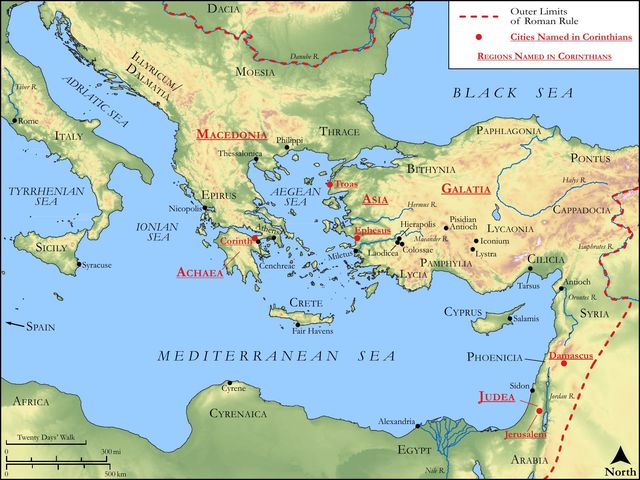
See on the biblical-era map

Study this verse
Public-domain commentary
Matthew Henry
From his Commentary on the Whole Bible. Henry comments on passages, not single verses — this entry covers 1 Corinthians 4:7–13. His two-level outline is real structure in the source text, so it is rendered as structure.
Here the apostle improves the foregoing hint to a caution against pride and self-conceit, and sets forth the temptations the Corinthians had to despise him, from the difference of their circumstances.
I.He cautions them against pride and self-conceit by this consideration, that all the distinction made among them was owing to God:
Who maketh thee to differ? And what hast thou that thou didst not receive? Co1 4:7. Here the apostle turns his discourse to the ministers who set themselves at the head of these factions, and did but too much encourage and abet the people in those feuds. What had they to glory in, when all their peculiar gifts were from God? They had received them, and could not glory in them as their own, without wronging God. At the time when they reflected on them to feed their vanity, they should have considered them as so many debts and obligations to divine bounty and grace. But it may be taken as a general maxim: We have no reason to be proud of our attainments, enjoyments, or performances; all that we have, or are, or do, that is good, is owing to the free and rich grace of God. Boasting is for ever excluded. There is nothing we have that we can properly call our own: all is received from God. It is foolish in us therefore, and injurious to him, to boast of it; those who receive all should be proud of nothing, Psa 115:1. Beggars and dependents may glory in their supports; but to glory in themselves is to be proud at once of meanness, impotence, and want. Note, Due attention to our obligations to divine grace would cure us of arrogance and self-conceit.
II.He presses the duty of humility upon them by a very smart irony, or at least reproves them for their pride and self-conceit:
"You are full, you are rich, you have reigned as kings without us. You have not only a sufficiency, but an affluence, of spiritual gifts; nay, you can make them the matter of your glory without us, that is, in my absence, and without having any need of me." There is a very elegant gradation from sufficiency to wealth, and thence to royalty, to intimate how much the Corinthians were elated by the abundance of their wisdom and spiritual gifts, which was a humour that prevailed among them while the apostle was away from them, and made them forget what an interest he had in all. See how apt pride is to overrate benefits and overlook the benefactor, to swell upon its possessions and forget from whom they come; nay, it is apt to behold them in a magnifying-glass: "You have reigned as kings," says the apostle, "that is, in your own conceit; and I would to God you did reign, that we also might reign with you. I wish you had as much of the true glory of a Christian church upon you as you arrogate to yourselves. I should come in then for a share of the honour: I should reign with you: I should not be overlooked by you as now I am, but valued and regarded as a minister of Christ, and a very useful instrument among you." Note, Those do not commonly know themselves best who think best of themselves, who have the highest opinion of themselves. The Corinthians might have reigned, and the apostle with them, if they had not been blown up with an imaginary royalty. Note, Pride is a great prejudice to our improvement. He is stopped from growing wiser or better who thinks himself at the height; not only full, but rich, nay, a king.
III.He comes to set forth his own circumstances and those of the other apostles, and compares them with theirs.
1.To set forth the case of the apostles: For I think it hath pleased God to set forth us the apostles last, as it were appointed to death. For we are made a spectacle to the world, and to angels, and to men. Paul and his fellow-apostles were exposed to great hardships. Never were any men in this world so hunted and worried. They carried their lives in their hands: God hath set forth us the apostles last, as it were appointed to death, Co1 4:9. An allusion is made to some of the bloody spectacles in the Roman amphitheatres, where men were exposed to fight with wild beasts, or to cut one another to pieces, to make diversion for the populace, where the victor did not escape with his life, though he should destroy his adversary, but was only reserved for another combat, and must be devoured or cut in pieces at last; so that such wretched criminals (for they were ordinarily condemned persons that were thus exposed) might very properly be called epithanatioi - persons devoted or appointed to death. They are said to be set forth last, because the meridian gladiators, those who combated one another in the after-part of the day, were most exposed, being obliged to fight naked; so that (as Seneca says, epist. 7) this was perfect butchery, and those exposed to beasts in the morning were treated mercifully in comparison with these. The general meaning is that the apostles were exposed to continual danger of death, and that of the worst kinds, in the faithful discharge of their office. God had set them forth, brought them into view, as the Roman emperors brought their combatants into the arena, the place of show, though not for the same purposes. They did it to please the populace, and humour their own vanity, and sometimes a much worse principle. The apostles were shown to manifest the power of divine grace, to confirm the truth of their mission and doctrine, and to propagate religion in the world. These were ends worthy of God-noble views, fit to animate them to the combat. But they had like difficulties to encounter, and were in a manner as much exposed as these miserable Roman criminals. Note, The office of an apostle was, as an honourable, so a hard and hazardous one: "For we are made a spectacle to the world, and to angels, and to men, Co1 4:9. A show. We are brought into the theatre, brought out to the public view of the world. Angels and men are witnesses to our persecutions, sufferings, patience, and magnanimity. They all see that we suffer for our fidelity to Christ, and how we suffer; how great and imminent are our dangers, and how bravely we encounter them; how sharp our sufferings, and how patiently we endure them, by the power of divine grace and our Christian principles. Ours is hard work, but honourable; it is hazardous, but glorious. God will have honour from us, religion will be credited by us. The world cannot but see and wonder at our undaunted resolution, our invincible patience and constancy." And how contentedly could they be exposed, both to sufferings and scorn, for the honour of their Master! Note, The faithful ministers and disciples of Christ should contentedly undergo any thing for his sake and honour.
2.He compares his own case with that of the Corinthians: "We are fools for Christ's sake, but you are wise in Christ; we are weak, but you are strong; you are honourable, but we are despised, Co1 4:10. We are fools for Christ's sake; such in common account, and we are well content to be so accounted. We can pass for fools in the world, and be despised as such, so that the wisdom of God and the honour of the gospel may by this means be secured and displayed." Note, Faithful ministers can bear being despised, so that the wisdom of God and the power of his grace be thereby displayed. "But you are wise in Christ. You have the fame of being wise and learned Christians, and you do not a little value yourselves upon it. We are under disgrace for delivering the plain truths of the gospel, and in as plain a manner: you are in reputation for your eloquence and human wisdom, which among many make you pass for wise men in Christ. We are weak, but you are strong. We are suffering for Christ's sake" (so being weak plainly signifies, Co2 12:10), "when you are in easy and flourishing circumstances." Note, All Christians are not alike exposed. Some suffer greater hardships than others who are yet engaged in the same warfare. The standard-bearers in an army are most struck at. So ministers in a time of persecution are commonly the first and greatest sufferers. Or else, "We pass upon the world for persons of but mean endowments, mere striplings in Christianity; but you look upon yourselves, and are looked upon by others, as men, as those of a much more advanced growth and confirmed strength." Note, Those are not always the greatest proficients in Christianity who think thus of themselves, or pass for such upon others. It is but too easy and common for self-love to commit such a mistake. The Corinthians may think themselves, and be esteemed by others, as wiser and stronger men in Christ than the apostles themselves. But O! how gross is the mistake!
IV.He enters into some particularities of their sufferings:
Even to this present hour; that is, after all the service we have been doing among you and other churches, we hunger and thirst, and are naked, and are buffeted, and have no certain dwelling-place, and labour, working with our own hands, Co1 4:11, Co1 4:12. Nay, they were made as the filth of the world, and the off-scouring of all things, Co1 4:13. They were forced to labour with their own hands to get subsistence, and had so much, and so much greater, business to mind, that they could not attend enough to this, to get a comfortable livelihood, but were exposed to hunger, thirst, and nakedness - many times wanted meat, and drink, and clothes. They were driven about the world, without having any fixed abode, any stated habitation. Poor circumstances indeed, for the prime ministers of our Saviour's kingdom to have no house nor home, and to be destitute of food and raiment! But yet no poorer than his who had not where to lay his head, Luk 9:58. But O glorious charity and devotion, that would carry them through all these hardships! How ardently did they love God, how vehemently did they thirst for the salvation of souls! Theirs was voluntary, it was pleasing poverty. They thought they had a rich amends for all the outward good things they wanted, if they might but serve Christ and save souls. Nay, though they were made the filth of the world, and the off-scouring of all things. They were treated as men not fit to live, perikatharmata. It is reasonably thought by the critics that an allusion is here made to a common custom of many heathen nations, to offer men in sacrifice in a time of pestilence, or other like grievous calamity. These were ordinarily the vilest of men, persons of the lowest rank and worst character. Thus, in the first ages, Christians were counted the source of all public calamities, and were sacrificed to the people's rage, if not to appease their angry deities. And apostles could not meet with better usage. They suffered in their persons and characters as the very worst and vilest men, as the most proper to make such a sacrifice: or else as the very dirt of the world, that was to be swept away: nay, as the off-scouring of all things, the dross, the filings of all things. They were the common-sewer into which all the reproaches of the world were to be poured. To be the off-scouring of any thing is bad, but what is it to be the off-scouring of all things! How much did the apostles resemble their Master, and fill up that which was behind of his afflictions, for his body's sake, which is the church! Col 1:24. They suffered for him, and they suffered after his example. Thus poor and despised was he in his life and ministry. And every one who would be faithful in Christ Jesus must prepare for the same poverty and contempt. Note, Those may be very dear to God, and honourable in his esteem, whom men may think unworthy to live, and use and scorn as the very dirt and refuse of the world. God seeth not as man seeth, Sa1 16:7.
V.We have here the apostles' behaviour under all; and the return they made for this mal-treatment:
Being reviled, we bless; being persecuted, we suffer it; being defamed, we entreat, Co1 4:12, Co1 4:13. They returned blessings for reproaches, and entreaties and kind exhortations for the rudest slanders and defamation, and were patient under the sharpest persecutions. Note, The disciples of Christ, and especially his ministers, should hold fast their integrity, and keep a good conscience, whatever opposition of hardships they meet with from the world. Whatever they suffer from men, they must follow the example, and fulfil the will and precepts, of their Lord. They must be content, with him and for him, to be despised and abused.
Historical interpretation
Two Centuries of Reception
2 surviving comments on this verse. Each one is dated, so this reads as a timeline rather than a list.
Select a marker to jump to its quote. Markers stagger vertically where authors wrote within a few decades of each other.
Does not the apostle then plainly add the following, to show the contempt for faith in the case of the multitude? "For I think that God hath set forth us the apostles last, as appointed to death: we are made a spectacle to the world, and to angels, and to men. Up to this present hour we both hunger, and thirst, and are naked, and are beaten, and are feeble, and labour, working with our hands. Being reviled, we bless; being persecuted, we endure; being defamed, we entreat; we are become as it were the offscourings of the world."
"And labor;" now against the false apostles who endure neither toil nor peril, while they themselves receive the fruits. "But not so are we," saith he: "but together with our perils from without, we also strain ourselves to the utmost with perpetual labor. And what is still more, no one can say that we fret at these things, for the contrary is our requital to them that so deal with us: this, I say, is the main point, not our suffering evil, for that is common to all, but our suffering without despondency or vexation. But we so far from desponding are full of exultation. And a sure proof of this is our requiting with the contrary those who do us wrong."
Now as to the fact that so they did, hear what follows.
"Being reviled, we bless; being persecuted, we endure; being defamed, we entreat; we are made as the filth of the world." This is the meaning of "fools for Christ's sake." For whoso suffers wrong and avenges not himself nor is vexed, is reckoned a fool by the heathen; and dishonored and weak. And in order that he might not render his speech too unpalatable by referring the sufferings he was speaking of to their city, what saith he? "We are made the filth," not, "of your city," but, "of the world." And again, "the off-scouring of all men;" not of you alone, but of all. As then when he is discoursing of the providential care of Christ, letting pass the earth, the heaven, the whole creation, the Cross is what he brings forward; so also when he desires to attract them to himself hurrying by all his miracles, he speaks of his sufferings on their account. So also it is our method when we be injured by any and despised, whatsoever we have endured for them, to bring the same forward.
"The offscouring of all men, even until now." This is a vigorous blow which he gave at the end, "of all men;" "not of the persecutors only," saith he, "but of those also for whom we suffer these things: Oh greatly am I obliged to them." It is the expression of one seriously concerned; not in pain himself, but desiring to make them feel, that he who hath innumerable complaints to make should even salute them. And therefore did Christ command us to bear insults meekly that we might both exercise ourselves in a high strain of virtue, and put the other party to the more shame. For that effect one produces not so well by reproach as by silence.
Continue studying 1 Corinthians 4:12 across the web’s major study libraries — every link below opens this exact verse, chapter, or book on the destination site.
Read & Compare
 BibleGatewayThis verse in more than 200 translations and 70 languages.
 Bible.comThe YouVersion reader — hundreds of translations, reading plans, and highlights.
 ESV.orgCrossway's official English Standard Version reader.
 NET BibleThe NET translation with 60,000+ translators' notes on every rendering decision.
 STEP BibleTyndale House's free study tool — original text, vocabulary, and scholarly resources.
 BibliaLogos Bible Software's free web reader.
 USCCBThe New American Bible (Revised Edition) with the U.S. bishops' study notes.
Commentaries
 BibleHub CommentariesDozens of classic commentaries on this verse, gathered on one page.
 StudyLightMore than 100 commentary sets — the largest collection on the web.
 BibleRefPlain-English commentary on what this verse means, verse by verse.
 Enduring WordDavid Guzik's free commentary on this chapter, widely used by Bible teachers.
 Bible Study ToolsVerse commentary alongside Greek and Hebrew study aids.
Original Language & Research
- BibleHub InterlinearThe verse word by word — original language, transliteration, and English.
- BibleHub LexiconEvery word's original-language definition and Strong's entry.
 Blue Letter BibleDeep-study tools — Strong's numbers, concordance, and word studies.
 CNTR CollationThe earliest Greek manuscripts of this verse, collated letter by letter.
Sermons, Hymns & Audio


TrulyRandomVerse is not affiliated with these sites and doesn’t control their content. They’re linked because they’re genuinely useful.
Summary
The Apostle Paul continues his poignant contrast between the self-exalting attitudes prevalent in the Corinthian church and the genuine, self-sacrificial nature of true apostolic ministry. He outlines the practical hardships endured by himself and his fellow apostles, emphasizing their commitment to diligent labor, their counter-cultural response of blessing in the face of revilement, and their patient endurance of persecution, thereby modeling a profound humility and Christ-like resilience for the believers.
Context
ShowHideLiterary Context
This verse is an integral part of Paul's broader argument in 1 Corinthians 4 concerning the nature of true spiritual leadership and the Corinthians' misguided pride. Following his discussion of unity and the dangers of factionalism in 1 Corinthians 1-3, Paul shifts to defend his own apostolic authority, which had been questioned or undervalued. In 1 Corinthians 4:1-5, he asserts that apostles are merely "servants of Christ and stewards of the mysteries of God," accountable only to the Lord. The immediate context of 1 Corinthians 4:9-13 presents a stark, almost theatrical, portrayal of the apostles as "fools for Christ's sake," enduring public shame, hunger, thirst, and homelessness, in stark contrast to the Corinthians' self-perceived wisdom, strength, and honor. Verse 12 specifically details some of these hardships and the apostles' counter-intuitive, Christ-like responses.
Historical & Cultural Context
Paul's practice of "working with our own hands" (Gk. ergázomai) points to his well-documented trade as a tentmaker (Acts 18:3). In the Greco-Roman world, manual labor was generally disdained by the elite and educated classes, often associated with slaves or the lowest social strata. Paul's choice to support himself, rather than relying solely on the financial support of the churches he ministered to, was counter-cultural and served several purposes: it prevented accusations of greed or exploitation, it demonstrated his commitment to the gospel's free proclamation, and it modeled diligence and self-sufficiency. The "reviling" and "persecution" mentioned were common experiences for early Christians, who faced social ostracism, verbal abuse, and sometimes physical violence from both Jewish and pagan communities for their refusal to conform to prevailing religious and social norms (Acts 17:5-9).
Key Themes
ShowHideThe verse powerfully contributes to several key themes within 1 Corinthians and Paul's broader theology. Humility and Self-Sacrifice are paramount, as Paul exemplifies a leadership that embraces lowliness and suffering rather than worldly status or comfort, directly challenging the Corinthians' spiritual arrogance. The theme of Christ-like Suffering is evident in the apostles' willingness to endure hardship and their radical response to opposition, mirroring Jesus' own example of suffering and non-retaliation (1 Peter 2:21-23). Apostolic Authenticity is also underscored; Paul argues that true divine authority is not demonstrated through worldly power or ease, but through faithful endurance and suffering for the sake of the gospel, aligning with his later teachings on strength in weakness (2 Corinthians 12:9-10). Finally, Christian Ethics and Response to Evil are highlighted, as the command to "bless" those who revile embodies the radical love and grace central to the Christian faith, echoing Jesus' Sermon on the Mount (Matthew 5:44).
Exposition and Analysis
ShowHideKey Word Analysis
ShowHideFrom a derivative of kópos, meaning "to feel fatigue; by implication, to work hard." This word signifies strenuous, exhausting effort, often to the point of weariness. Paul uses it to describe the intense physical and mental exertion involved in his self-supporting ministry, indicating a profound dedication and willingness to expend all energy for the gospel.
From loídoros, meaning "to reproach, i.e., vilify." This term describes being verbally abused, insulted, slandered, or subjected to scornful language. It captures the experience of being publicly shamed and dishonored through malicious speech.
Middle voice from aná and échō, meaning "to hold oneself up against, i.e., (figuratively) put up with." This word conveys the idea of patiently bearing with, enduring, or tolerating something difficult without retaliating or giving in. It implies active resilience and steadfastness in the face of adversity.
Verse Breakdown
ShowHide"And labour, working with our own hands"
This clause highlights the apostles' commitment to self-sufficiency and diligence. Paul, as a tentmaker, engaged in physically demanding labor to provide for his needs, avoiding being a financial burden on the Corinthian church. This practice served as a powerful example of humility and dedication, countering any perception that spiritual leaders should live lives of ease or entitlement. It underscores the dignity of honest work and the principle of not exploiting one's ministry for personal gain.
"being reviled, we bless;"
This presents a radical, counter-intuitive response to verbal abuse. When subjected to insults, slander, or vilification, the apostles did not retaliate in kind but instead offered blessings. This reflects a profound commitment to Christ's teaching to love enemies and pray for persecutors, demonstrating a reliance on God's justice and a spirit of grace that transcends human anger and vengeance. It is a testament to the transformative power of the gospel in shaping one's character.
"being persecuted, we suffer it:"
This clause describes the apostles' patient endurance in the face of active harassment, ill-treatment, or pursuit for their faith. Rather than resisting, complaining, or seeking immediate relief, they chose to bear the suffering with resilience and steadfastness. This is not passive resignation but an active, faith-filled decision to remain firm in their mission and trust in God's sovereign plan, even amidst adversity. It signifies a willingness to embrace hardship as part of the apostolic calling.
Literary Devices
ShowHidePaul employs several powerful Literary Devices in this concise verse to underscore his message. The primary device is Antithesis, as Paul juxtaposes the apostles' humble, suffering existence with the Corinthians' perceived prosperity and arrogance, which he has been subtly critiquing throughout the chapter. This contrast highlights the true nature of spiritual authority. There is also a strong element of Paradox, particularly in the phrase "being reviled, we bless." This presents a seemingly contradictory action that defies conventional human logic, yet it is central to Christian ethics and demonstrates the transformative power of the Spirit. Paul also uses Exemplum, presenting his own life and the lives of the other apostles as a living illustration of genuine Christian discipleship and leadership, providing a tangible model for the Corinthians to emulate. The verse's structure, moving from physical labor to spiritual responses to persecution, creates a vivid Juxtaposition of the mundane and the profound, showing how everyday hardships are met with supernatural grace.
Theological and Thematic Connections
ShowHideThis verse profoundly articulates a theology of suffering and response that is central to the New Testament. It teaches that true spiritual power and authority are often manifested not in worldly success or comfort, but in humble service, self-sacrifice, and patient endurance of hardship for the sake of the gospel. The command to "bless" those who revile is a radical ethical principle rooted in the very character of God, who shows grace to the undeserving. It underscores the call for believers to transcend natural human reactions of retaliation and instead embody divine love and forgiveness, trusting God to be the ultimate arbiter of justice. This counter-cultural response serves as a powerful witness to the world, demonstrating the transformative power of Christ in the lives of His followers.
Reflection and Application
ShowHide1 Corinthians 4:12 offers timeless and challenging principles for contemporary believers. It calls us to re-evaluate our understanding of success, leadership, and our responses to adversity. Are we willing to embrace diligent, even humble, labor, avoiding a spirit of entitlement or laziness, and seeking to be a blessing rather than a burden? More profoundly, when faced with criticism, insults, or unfair treatment, do we instinctively retaliate, or do we, by the power of the Holy Spirit, choose the radical path of blessing and prayer for those who mistreat us? This verse reminds us that following Christ does not promise a life free from opposition, but rather equips us with the grace to patiently endure suffering, trusting in God's ultimate purposes and demonstrating the resilience of faith. It challenges us to cultivate a character that reflects Christ's own humility and sacrificial love, making our lives a powerful testimony to the gospel in a world often consumed by self-interest and retaliation.
Questions for Reflection
ShowHideFAQ
ShowHideWhy was it important for Paul to work with his own hands, even as an apostle?
ShowHidePaul's decision to "labour, working with our own hands" was significant for several reasons. First, it demonstrated his personal integrity and commitment to the gospel, preventing accusations that he was preaching for financial gain (1 Thessalonians 2:9). In a culture where many philosophers and religious teachers charged fees, Paul's self-sufficiency underscored the freeness of the gospel message. Second, it provided a powerful example of diligence and humility, especially in a Greco-Roman society that often disdained manual labor. Paul modeled a strong work ethic for new converts, countering any notion that Christian faith exempted one from honest toil. Finally, it allowed him to avoid being a financial burden on nascent churches, particularly in Corinth where some members were wealthy and others poor, thus maintaining his independence and preventing potential divisions or accusations of patronage.
How can believers "bless" those who revile them, especially when it feels impossible?
ShowHideTo "bless" those who revile us (Gk. eulogéō, to speak well of or invoke divine favor upon) is one of the most challenging commands in the New Testament, echoing Jesus' teaching in the Sermon on the Mount. It is not a natural human response but a supernatural one, empowered by the Holy Spirit. Practically, it means refusing to retaliate with insults or curses, choosing instead to speak kindly, pray for their well-being, and desire God's good for them, even if they remain hostile. This act stems from a heart that trusts God for justice and seeks the transformation of the enemy, rather than their condemnation. It is a radical demonstration of Christ's love and a powerful witness to the world, as it reveals a character shaped by divine grace, not human vengeance (Luke 6:28).
What does it mean to "suffer it" when persecuted? Is it passive resignation?
ShowHideTo "suffer it" (Gk. anéchomai, to put up with, endure, bear with) in the context of persecution is not passive resignation but active, patient endurance. It means choosing to remain steadfast in faith and mission despite ill-treatment, harassment, or opposition, rather than retaliating, complaining, or abandoning one's convictions. It implies a resilient spirit that trusts in God's sovereignty and purposes even amidst adversity. The apostles were not advocating for a lack of self-defense or justice where appropriate, but rather a spirit that would not be deterred from its gospel mission by external pressures or personal discomfort. This endurance demonstrates a deep reliance on God's strength and a commitment to Christ's example of suffering for righteousness' sake (1 Peter 2:20-21).
Christ-Centered Fulfillment
ShowHide1 Corinthians 4:12 finds its ultimate fulfillment and deepest meaning in the person and work of Jesus Christ. Paul's life of self-sacrificial labor, his non-retaliatory response to revilement, and his patient endurance of persecution are not merely moral imperatives but direct reflections of Christ's own earthly ministry. Jesus, though God, "made himself nothing, taking the very nature of a servant" (Philippians 2:7), embodying the ultimate humility and willingness to "labour" for the salvation of humanity, even to the point of death on a cross. When "reviled," Jesus "did not revile in return; when he suffered, he did not threaten, but continued entrusting himself to him who judges justly" (1 Peter 2:23). He blessed those who cursed Him, even praying for His executioners from the cross (Luke 23:34). Furthermore, Jesus "suffered" the ultimate persecution, enduring the cross "for the joy that was set before him" (Hebrews 12:2), demonstrating perfect endurance. Thus, Paul's apostolic experience in 1 Corinthians 4:12 is not just a model to imitate, but a Spirit-empowered participation in the very life and suffering of Christ, revealing the true nature of the kingdom where strength is found in weakness, and victory through sacrificial love.