


Philippians 2:7
- ἀλλ᾽all᾽butG235CONJConjunction
- ἑαυτὸνhe'autonHimselfG1438F-3ASMReflexive pronoun Accusative 3rd Singular Masculine
- ἐκένωσενekenōsenemptiedG2758V-AAI-3SVerb Aorist Active Indicative 3rd Singular
- μορφὴνmorphēn[the] formG3444N-ASFNoun Accusative Singular Feminine
- δούλουdoulouof a servantG1401N-GSMNoun Genitive Singular Masculine
- λαβώνlabōnhaving takenG2983V-2AAP-NSMVerb 2nd Aorist Active Participle Nominative Singular Masculine
- ἐνeninG1722PREPPreposition
- ὁμοιώματιhomoiōmati[the] likenessG3667N-DSNNoun Dative Singular Neuter
- ἀνθρώπωνanthrōpōnof menG444N-GPMNoun Genitive Plural Masculine
- γενόμενοςgenomenoshaving been madeG1096V-2ADP-NSMVerb 2nd Aorist Middle Deponent Participle Nominative Singular Masculine
English is a literal word-by-word gloss of the Greek, not the KJV's wording. Why?
This is the original text the KJV's translators worked from — each Greek word with its own literal English meaning in this verse, prepared by scholars at Tyndale House, Cambridge. The KJV translates whole sentences, not word by word, so its wording differs: one Greek word can become several English words, and the KJV may choose “charity” where the gloss reads “love”. Both are faithful — they answer different questions. For the KJV's own rendering, switch to the KJV text.
Details
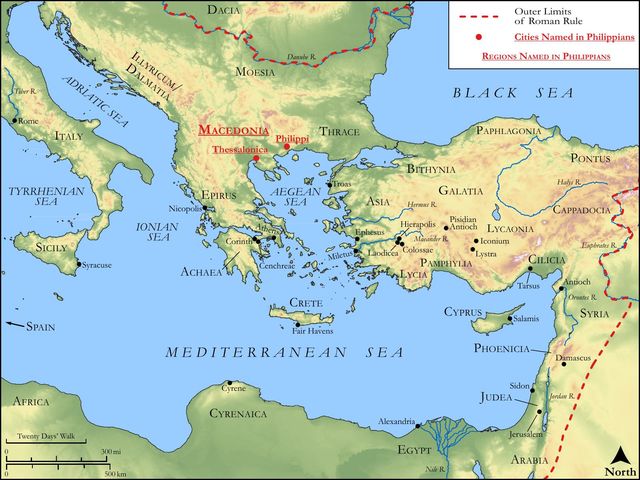
See on the biblical-era maps

Study this verse
Public-domain commentary
Matthew Henry
From his Commentary on the Whole Bible. Henry comments on passages, not single verses — this entry covers Philippians 2:1–11. His three-level outline is real structure in the source text, so it is rendered as structure.
The apostle proceeds in this chapter where he left off in the last, with further exhortations to Christian duties. He presses them largely to like-mindedness and lowly-mindedness, in conformity to the example of the Lord Jesus, the great pattern of humility and love. Here we may observe,
I.The great gospel precept passed upon us; that is, to love one another.
This is the law of Christ's kingdom, the lesson of his school, the livery of his family. This he represents (Phi 2:2) by being like-minded, having the same love, being of one accord, of one mind. We are of a like mind when we have the same love. Christians should be one in affection, whether they can be one in apprehension or no. This is always in their power, and always their duty, and is the likeliest way to bring them nearer in judgment. Having the same love. Observe, The same love that we are required to express to others, others are bound to express to us. Christian love ought to be mutual love. Love, and you shall be loved. Being of one accord, and of one mind; not crossing and thwarting, or driving on separate interests, but unanimously agreeing in the great things of God and keeping the unity of the Spirit in other differences. Here observe,
1.The pathetic pressing of the duty. He is very importunate with them, knowing what an evidence it is of our sincerity, and what a means of the preservation and edification of the body of Christ. The inducements to brotherly love are these: - (1.) "If there is any consolation in Christ. Have you experienced consolation in Christ? Evidence that experience by loving one another." The sweetness we have found in the doctrine of Christ should sweeten our spirits. Do we expect consolation in Christ? If we would not be disappointed, we must love one another. If we have not consolation in Christ, where else can we expect it? Those who have an interest in Christ have consolation in him, strong and everlasting consolation (Heb 6:18; Th2 2:16), and therefore ought to love one another. (2.) "Comfort of love. If there is any comfort in Christian love, in God's love to you, in your love to God, or in your brethren's love to us, in consideration of all this, be you like-minded. If you have ever found that comfort, if you would find it, if you indeed believe that the grace of love is a comfortable grace, abound in it." (3.) "Fellowship of the Spirit. If there is such a thing as communion with God and Christ by the Spirit, such a thing as the communion of saints, by virtue of their being animated and actuated by one and the same Spirit, be you like-minded; for Christian love and like-mindedness will preserve to us our communion with God and with one another." (4.) "Any bowels and mercies, in God and Christ, towards you. If you expect the benefit of God's compassions to yourselves, be you compassionate one to another. If there is such a thing as mercy to be found among the followers of Christ, if all who are sanctified have a disposition to holy pity, make it appear this way." How cogent are these arguments! One would think them enough to tame the most fierce, and mollify the hardest, heart. (5.) Another argument he insinuates is the comfort it would be to him: Fulfil you my joy. It is the joy of ministers to see people like-minded and living in love. He had been instrumental in bringing them to the grace of Christ and the love of God. "Now," says he, "if you have found any benefit by your participation of the gospel of Christ, if you have any comfort in it, or advantage by it, fulfil the joy of your poor minister, who preached the gospel to you."
2.He proposes some means to promote it.
(1.)Do nothing through strife and vain glory, Phi 2:3. There is no greater enemy to Christian love than pride and passion. If we do things in contradiction to our brethren, this is doing them through strife; if we do them through ostentation of ourselves, this is doing them through vain-glory: both are destructive of Christian love and kindle unchristian heats. Christ came to slay all enmities; therefore let there not be among Christians a spirit of opposition. Christ came to humble us, and therefore let there not be among us a spirit of pride.
(2.)We must esteem others in lowliness of mind better than ourselves, be severe upon our own faults and charitable in our judgments of others, be quick in observing our own defects and infirmities, but ready to overlook and make favourable allowances for the defects of others. We must esteem the good which is in others above that which is in ourselves; for we best know our own unworthiness and imperfections.
(3.)We must interest ourselves in the concerns of others, not in a way of curiosity and censoriousness, or as busy-bodies in other men's matters, but in Christian love and sympathy: Look not every man on his own things, but every man also on the things of others, Phi 2:4. A selfish spirit is destructive of Christian love. We must be concerned not only for our own credit, and ease, and safety, but for those of others also; and rejoice in the prosperity of others as truly as in our own. We must love our neighbour as ourselves, and make his case our own.
II.Here is a gospel pattern proposed to our imitation, and that is the example of our Lord Jesus Christ:
Let this mind be in you which was also in Christ Jesus, Phi 2:5. Observe, Christians must be of Christ's mind. We must bear a resemblance to his life, if we would have the benefit of his death. If we have not the Spirit of Christ, we are none of his, Rom 8:9. Now what was the mind of Christ? He was eminently humble, and this is what we are peculiarly to learn of him. Learn of me, for I am meek and lowly in heart, Mat 11:29. If we were lowly-minded, we should be like-minded; and, if we were like Christ, we should be lowly-minded. We must walk in the same spirit and in the same steps with the Lord Jesus, who humbled himself to sufferings and death for us; not only to satisfy God's justice, and pay the price of our redemption, but to set us an example, and that we might follow his steps. Now here we have the two natures and the two states of our Lord Jesus. It is observable that the apostle, having occasion to mention the Lord Jesus, and the mind which was in him, takes the hint to enlarge upon his person, and to give a particular description of him. It is a pleasing subject, and a gospel minister needs not think himself out of the way when he is upon it; any fit occasion should be readily taken.
1.Here are the two natures of Christ: his divine nature and his human nature.
(1.)Here is his divine nature: Who being in the form of God (Phi 2:6), partaking of the divine nature, as the eternal and only begotten Son of God. This agrees with Joh 1:1, In the beginning was the Word, and the Word was with God: it is of the same import with being the image of the invisible God (Col 1:15), and the brightness of his glory, and express image of his person, Heb 1:3. He thought it no robbery to be equal with God; did not think himself guilty of any invasion of what did not belong to him, or assuming another's right. He said, I and my Father are one, Joh 10:30. It is the highest degree of robbery for any mere man or mere creature to pretend to be equal with God, or profess himself one with the Father. This is for a man to rob God, not in tithes and offerings, but of the rights of his Godhead, Mal 3:8. Some understand being in the form of God - en morphē Theou huparchōn, of his appearance in a divine majestic glory to the patriarchs, and the Jews, under the Old Testament, which was often called the glory, and the Shechinah. The word is used in such a sense by the Septuagint and in the New Testament. He appeared to the two disciples, en hetera morphē - In another form, Mar 16:12. Metemorphōthē - he was transfigured before them, Mat 17:2. And he thought it no robbery to be equal with God; he did not greedily catch at, nor covet and affect to appear in that glory; he laid aside the majesty of his former appearance while he was here on earth, which is supposed to be the sense of the peculiar expression, ouk harpagmon hēgēsato. Vid. Bishop Bull's Def. cap. 2 sect. 4 et alibi, and Whitby in loc.
(2.)His human nature: He was made in the likeness of men, and found in fashion as a man. He was really and truly man, took part of our flesh and blood, appeared in the nature and habit of man. And he voluntarily assumed human nature; it was his own act, and by his own consent. We cannot say that our participation of the human nature is so. Herein he emptied himself, divested himself of the honours and glories of the upper world, and of his former appearance, to clothe himself with the rags of human nature. He was in all things like to us, Heb 2:17.
2.Here are his two estates, of humiliation and exaltation.
(1.)His estate of humiliation. He not only took upon him the likeness and fashion of a man, but the form of a servant, that is, a man of mean estate. He was not only God's servant whom he had chosen, but he came to minister to men, and was among them as one who serveth in a mean and servile state. One would think that the Lord Jesus, if he would be a man, should have been a prince, and appeared in splendour. But quite the contrary: He took upon him the form of a servant. He was brought up meanly, probably working with his supposed father at his trade. His whole life was a life of humiliation, meanness, poverty, and disgrace; he had nowhere to lay his head, lived upon alms, was a man of sorrows and acquainted with grief, did not appear with external pomp, or any marks of distinction from other men. This was the humiliation of his life. But the lowest step of his humiliation was his dying the death of the cross. He became obedient to death, even the death of the cross. He not only suffered, but was actually and voluntarily obedient; he obeyed the law which he brought himself under as Mediator, and by which he was obliged to die. I have power to lay down my life, and I have power to take it again: this commandment have I received of my Father, Joh 10:18. And he was made under the law, Gal 4:4. There is an emphasis laid upon the manner of his dying, which had in it all the circumstances possible which are humbling: Even the death of the cross, a cursed, painful, and shameful death, - a death accursed by the law (Cursed is he that hangeth on a tree) - full of pain, the body nailed through the nervous parts (the hands and feet) and hanging with all its weight upon the cross, - and the death of a malefactor and a slave, not of a free-man, - exposed as a public spectacle. Such was the condescension of the blessed Jesus.
(2.)His exaltation: Wherefore God also hath highly exalted him. His exaltation was the reward of his humiliation. Because he humbled himself, God exalted him; and he highly exalted him, huperupsōse, raised him to an exceeding height. He exalted his whole person, the human nature as well as the divine; for he is spoken of as being in the form of God as well as in the fashion of man. As it respects the divine nature, it could only be the recognizing of his rights, or the display and appearance of the glory he had with the Father before the world was (Joh 17:5), not any new acquisition of glory; and so the Father himself is said to be exalted. But the proper exaltation was of his human nature, which alone seems to be capable of it, though in conjunction with the divine. His exaltation here is made to consist in honour and power. In honour; so he had a name above every name, a title of dignity above all the creatures, men and angels. And in power: Every knee must bow to him. The whole creation must be in subjection to him: things in heaven, and things in earth, and things under the earth, the inhabitants of heaven and earth, the living and the dead. At the name of Jesus; not at the sound of the word, but the authority of Jesus; all should pay a solemn homage. And that every tongue should confess that Jesus Christ is Lord - every nation and language should publicly own the universal empire of the exalted Redeemer, and that all power in heaven and earth is given to him, Mat 28:18. Observe the vast extent of the kingdom of Christ; it reaches to heaven and earth, and to all the creatures in each, to angels as well as men, and to the dead as well as the living. - To the glory of God the Father. Observe, It is to the glory of God the Father to confess that Jesus Christ is Lord; for it is his will that all men should honour the Son as they honour the Father, Joh 5:23. Whatever respect is paid to Christ redounds to the honour of the Father. He who receiveth me receiveth him who sent me, Mat 10:40.
Historical interpretation
Four Centuries of Reception
49 surviving comments on this verse. Each one is dated, so this reads as a timeline rather than a list.
Select a marker to jump to its quote. Markers stagger vertically where authors wrote within a few decades of each other.
"Hear," he answered: "the Son of God is not in the form of a slave, but in great power and might." "How so, sir?" I said; "I do not understand." "Because," he answered, "God planted the vineyard, that is to say, He created the people, and gave them to His Son; and the Son appointed His angels over them to keep them; and He Himself purged away their sins, having suffered many trials and undergone many labours, for no one is able to dig without labour and toil."
And the flesh being a slave, as Paul testifies, how can one with any reason adorn the handmaid like a pimp? For that which is of flesh has the form of a servant. Paul says, speaking of the Lord, "Because He emptied Himself, taking the form of a servant"
God did all things through him. Therefore he is also said to have "taken the form of a slave." It is not only the flesh of the slave that he assumed but the very nature of a slave that he assumed. He became a slave so that he could share human suffering in the flesh.
Now Christ prayed all this economically as man; being, however, true God. But, as I have already said, it was the "form of the servant" that spake and suffered these things. Wherefore He added, "My soul looked for reproach and trouble," that is, I suffered of my own will, (and) not by any compulsion. Yet "I waited for one to mourn with me, and there was none," for all my disciples forsook me and fled; and for a "comforter, and I found none."
Nor is this the only thing that proves the dignity of the water. But there is also that which is more honourable than all-the fact that Christ, the Maker of all, came down as the rain, and was known as a spring, and diffused Himself as a river, and was baptized in the Jordan. For you have just heard how Jesus came to John, and was baptized by him in the Jordan. Oh things strange beyond compare! How should the boundless River that makes glad the city of God have been dipped in a little water! The illimitable Spring that bears life to all men, and has no end, was covered by poor and temporary waters! He who is present everywhere, and absent nowhere-who is incomprehensible to angels and invisible to men-comes to the baptism according to His own good pleasure. When you hear these things, beloved, take them not as if spoken literally, but accept them as presented in a figure. Whence also the Lord was not unnoticed by the watery element in what He did in secret, in the kindness of His condescension to man. "For the waters saw Him, and were afraid." They wellnigh broke from their place, and burst away from their boundary. Hence the prophet, having this in his view many generations ago, puts the question, "What aileth thee, O sea, that thou reddest; and thou, Jordan, that thou wast driven back? " And they in reply said, We have seen the Creator of all things in the "form of a servant," and being ignorant of the mystery of the economy, we were lashed with fear.
The word of prophecy passes again to Immanuel Himself. For, in my opinion, what is intended by it is just what has been already stated in the words, "giving increase of beauty in the case of the shoot." For he means that He increased and grew up into that which He had been from the beginning, and indicates the return to the glory which He had by nature. This, if we apprehend it correctly, is (we should say) just "restored" to Him. For as the only begotten Word of God, being God of God, emptied Himself, according to the Scriptures, humbling Himself of His own will to that which He was not before, and took unto Himself this vile flesh, and appeared in the "form of a servant," and "became obedient to God the Father, even unto death," so hereafter He is said to be "highly exalted; "and as if well-nigh He had it not by reason of His humanity, and as if it were in the way of grace, He "receives the name which is above every name," according to the word of the blessed Paul. But the matter, in truth, was not a "giving," as for the first time, of what He had not by nature; far otherwise. But rather we must understand a return and restoration to that which existed in Him at the beginning, essentially and inseparably. And it is for this reason that, when He had assumed, by divine arrangement, the lowly estate of humanity, He said, "Father, glorify me with the glory which I had," etc. For He who was co-existent with His Father before all time. and before the foundation of the world, always had the glory proper to Godhead. "He" too may very well be understood as the "youngest (son)." For He appeared in the last times, after the glorious and honourable company of the holy prophets, and simply once, after all those who, previous to the time of His sojourn, were reckoned in the number of sons by reason of excellence. That Immanuel, however, was an" object of envy," is a somewhat doubtful phrase. Yet He is an "object of envy" or "emulation" to the saints, who aspire to follow His footsteps, and conform themselves to His divine beauty, and make Him the pattern of their conduct, and win thereby their highest glory. And again, He is an "object of envy" in another sense,-an "object of ill-will," namely, to those who are declared not to love Him. I refer to the leading parties among the Jews,-the scribes, in sooth, and the Pharisees,-who travailed with bitter envy against Him, and made the glory of which He could not be spoiled the ground of their slander, and assailed Him in many ways. For Christ indeed raised the dead to life again, when they already stank and were corrupt; and He displayed other signs of divinity. And these should have filled them with wonder, and have made them ready to believe, and to doubt no longer. Yet this was not the case with them; but they were consumed with ill-will, and nursed its bitter pangs in their mind.
In “emptying himself,” he became a man and was incarnate while remaining truly God. Having become a man, he remained the God that he was. He assumed a body like our own, differing only in that it was born from the Virgin by the Holy Spirit.
The Son, “emptying himself,” of his equality with the Father and showing us a way of knowing him, was made an express image of his substance, so that we who were unable to see the glory of pure light that inhered in the greatness of his divinity might, through that which was made splendor for us, find a way of contemplating the divine light through the sight of that splendor.
If he “therefore emptied himself, assuming the form of a slave,” he was not coerced but was of his own accord made the Son of Man, existing as God’s equal in the form of God. Therefore you have the Son expressing in himself the faith proper to humans.
The sovereignty of the divine Word temporarily submitted to assume a man and for a season “humbled himself” and abased himself, not exercising his nature through his powers, while he bore the man that he had assumed. He “emptied himself” when he bowed to injuries and slanders, when he heard unspeakable insults and suffered indignities.
Now the numbers into which it is divided, when put together, make seven, and one is wanting to its completion, not being in all points harmonious with itself, like six, which has reference to the Son of God, who came from tile fulness of the Godhead into a human life. For having emptied Himself,
Read the record of his compassion. It pleased him, being the Word of God, to “take the form of a slave.” So he willed to be joined to our common human condition. He took to himself the toils of the members who suffer. He made our human maladies his own. He suffered and toiled on our behalf. This is in accord with his great love of humankind.
Note well the breathtaking economy by which the Son assumed flesh: Through the obedience of the one who was in the form of God [and] was emptying himself of the form of God, [he] was born as a man. In doing so, he took a new nature upon himself! This occurred not by a loss of his power and nature but by an assumption of a new condition.… Though he retained the power of his nature as God, he was in much of his earthly ministry temporarily relinquishing his exercise of the power of his nature as God as he walked as a man. The effect of this economy of order was this: The Son in his entirety, namely, as both man and God, was now, through the indulgence of the Father’s will, in union with the nature of the Father. This is what occurred to God the Son: that he became a man.
To assume “the form of a slave,” he “emptied himself” through obedience. He emptied himself, that is, from the “form of God,” which means “equality with God.”
Remaining “in the form of God,” he “took the form of a slave,” not being changed but “emptying himself” and hiding within himself and being made empty within his own power. He tempered himself to the form of the human state as far as was necessary to ensure that the weakness of the assumed humility would not fail to bear his immeasurable power. He went even so far as to tolerate conjunction with a human body. Just this far did his goodness moderate itself with an appropriate degree of obedience. But in making himself empty and restraining himself within himself, he did nothing detrimental to his own power, since even within this lowliness of his self-emptying he nonetheless used the resources of the evacuated power within him.
The Son was sent by the Father and fulfills the Father’s will. The mystery stated here is that it was by his own will that he came and assumed the form and image of a slave.… The Father is in the Son and the Son in the Father.… So what the Father willed the Son also willed, and what the Son willed the Father willed.
We must understand this “emptying himself” to consist not in any loss or privation of his power but in the fact that he lowered himself to the basest level and condescended to the meanest tasks. By fulfilling these he momentarily emptied himself of his power. Assuming flesh and human form and likeness, he suffered, died and fulfilled all the things that belong to humanity.
How could he possibly have taken only human form and not human substance? For he put on the flesh and was in the flesh and suffered in the flesh. This is the mystery and the means of our salvation.… What therefore does it mean, “he emptied himself?” That the universal Logos was not universal in his actual being as the logos of the flesh and becoming flesh. Therefore he did not merely pretend to become a man but became a man.
It is not as though Paul was in the slightest uncertain about Christ’s identity that he said Christ was “found in human likeness.” He did not say “in human likeness” as though our Lord maybe was not truly a man but a phantom. Rather he was found in human likeness while still being God yet at the same time being truly a man in the flesh, with a physical human body that he had assumed.
How then did he “empty himself”? When the “form of God accepted the form of a slave,” when he who is preeminently the Lord deigned to take on himself what belongs to a slave. The Word was made flesh by bearing and doing what was beneath him in his indulgence and compassion toward us. All that he possessed by nature is emptied into this his person. Having been made obedient as a man in the true “fashion of humanity,” he has restored to our nature by his own humility and obedience what had perished through disobedience in Adam.
“Taking the form of a slave.” He indeed was taken captive, bound and driven with blows. His obedience to the Father took him even as far as the cross. Yet throughout he knew himself to be the Father’s Son, equal in divine dignity. Yet he did not make a display of this equality. Rather he willingly subjected himself. This patience and humility he teaches us to imitate. We are to refrain from making a display of our claims to equal dignity, but even more so we are called to lower ourselves into service as we follow the example of our Maker.
Christ, therefore, knowing himself to be “in the form of God,” showed himself equal to God. But in order to teach the law of humility when the Jews were binding him, he not only refrained from resistance but “emptied himself,” that is, withheld his power from taking effect, so that in his humiliation he seemed to be weakened as his power lay idle.
He is said not to have taken the form of God but to have been in the form of God. What he is said to have taken is the form of a slave when he was humbled like a sinner. People become slaves through sin, like Ham the son of Noah, who first received the title of slave through his own actions. His “taking the form of a slave” was not simply his becoming human but his profound identification with sinners, voluntarily “taking the form of a slave.”
Since he is emptied on our account when he came down (and by emptying I mean as it were the reduction and lessening of his glory), he is for this reason able to be received.
We do not believe that he was so emptied that he himself as Spirit became something else. Rather he, having put aside for this time the honor of his majesty, put on a human body. Only by assuming human form could he become the Savior of humanity. Note that when the sun is covered by a cloud its brilliance is suppressed but not darkened. The sun’s light, which is suffused throughout the whole earth, penetrating all with its brilliant splendor, is presently obscured by a small obstruction of cloud but not taken away. So too that man, whom our Lord Jesus Christ put on, being our Savior, which means God and the Son of God, does not lessen but momentarily hides the divinity in him.
He “emptied himself,” as the Scripture says, so that as much as nature could hold it might receive.
The Godhead is emptied so that the human nature may accommodate it. What is human, on the other hand, is made new, becoming divine through mingling with the divine.
He says of the Son that he has “come to be in the likeness and form of men.” If he “came to be” in this likeness, this obviously implies that he was not invested with it from the beginning. Before coming to be in that likeness he was not fashioned according to some corporeal pattern. For no embodied form could become the pattern for what is previously not embodied.
The Word who appeared in the flesh was the same as the Word that was with God. But the earthly flesh he assumed was not the same as the Godhead until this too was changed into Godhead, so that necessarily some attributes belonged to God the Word, others to the form of a slave.
The one who says that he “took the form of a slave”—and this form is flesh—is saying that, being himself something else according to his divine form, something else in his nature, he assumed the servile form.
You see that he reveals Christ to be a man but not merely so, since he is the mediator of God and humanity.… He is trueborn God by nature with respect to his Father, but with respect to humanity he is Mary’s trueborn son by nature, begotten without the seed of a man.
If it were through a natural inferiority that he undertook to bear "the form of a slave," this would not be an instance of humility. Yet Paul makes excellent use of this example as an exhortation precisely to humility.
What shall we say against Arius, who asserts the Son is of a different substance? Tell me now, what means, "He took the form of a servant"? It means, He became man. Wherefore "being in the form of God," He was God. For one "form" and another "form" is named; if the one be true, the other is also. "The form of a servant" means, Man by nature, wherefore "the form of God" means, God by nature.
I said that the "form of a servant" was a true form, and nothing less. Therefore "the form of God" also is perfect, and no less. Why says he not, "being made in the form of God," but "being in the form of God"? This is the same as the saying, "I am that I am." "Form" implies unchangeableness, so far as it is form. It is not possible that things of one substance should have the form of another, as no man has the form of an angel, neither has a beast the form of a man. How then should the Son?
Wherefore "He emptied Himself." Where be they who affirm, that He underwent constraint, that He was subjected? Scripture says, "He emptied Himself, He humbled Himself, and became obedient unto death." How did He empty Himself? By taking "the form of a servant, being made in the likeness of men, and being found in fashion as a man." It is written, "He emptied Himself" in reference to the text, "each counting other better than himself." Since had He been subjected, had He not chosen it of His own accord, and of His own free will, it would not have been an act of humility. For if He knew not that so it must be, He would have been imperfect. If, not knowing it, He had waited for the time of action, then would He not have known the season. But if He both knew that so it must be, and when it must be, wherefore should He submit to be subjected? To show, they say, the superiority of the Father. But this shows not the superiority of the Father, but His own inferiority. For is not the name of the Father sufficient to show the priority of the Father? For apart from Him, the son has all the same things. For this honor is not capable of passing from the Father to the Son.
What then say the heretics? See, say they, He did not become man. The Marcionites, I mean. But why? He was "made in the likeness of man." But how can one be "made in the likeness of men"? by putting on a shadow? But this is a phantom, and no longer the likeness of a man, for the likeness of a man is another man. And what wilt thou answer to John, when he says, "The Word became flesh"? (John i. 14.) But this same blessed one himself also says in another place, "in the likeness of sinful flesh." (Rom. viii. 3.)
"And being found in fashion as a man." See, they say, both "in fashion," and "as a man." To be as a man, and to be a man in fashion, is not to be a man indeed. To be a man in fashion is not to be a man by nature. See with what ingenuousness I lay down what our enemies say, for that is a brilliant victory, and amply gained, when we do not conceal what seem to be their strong points. For this is deceit rather than victory. What then do they say? let me repeat their argument. To be a man in fashion is not to be a man by nature; and to be as a man, and in the fashion of a man, this is not to be a man. So then to take the form of a servant, is not to take the form of a servant. Here then is an inconsistency; and wherefore do you not first of all solve this difficulty? For as you think that this contradicts us, so do we say that the other contradicts you. He says not, "as the form of a servant," nor "in the likeness of the form of a servant," nor "in the fashion of the form of a servant," but "He took the form of a servant." What then is this? for there is a contradiction. There is no contradiction. God forbid! it is a cold and ridiculous argument of theirs. He took, say they, the form of a servant, when He girded Himself with a towel, and washed the feet of His disciples. Is this the form of a servant? Nay, this is not the form, but the work of a servant. It is one thing that there should be the work of a servant, and another to take the form of a servant. Why did he not say, He did the work of a servant, which were clearer? But nowhere in Scripture is "form" put for "work," for the difference is great: the one is the result of nature, the other of action. In common speaking, too, we never use "form" for "work." Besides, according to them, He did not even take the work of a servant, nor even gird Himself. For if all was a mere shadow, there was no reality. If He had not real hands, how did He wash their feet? If He had not real loins, how did He gird Himself with a towel? and what kind of garments did he take? for Scripture says, "He took His garments." (John xiii. 12.) So then not even the work is found to have really taken place, but it was all a deception, nor did He even wash the disciples. For if that incorporeal nature did not appear, it was not in a body. Who then washed the disciples' feet?
Again, what in opposition to Paul of Samosata? for what did he affirm? The very same. But it is no emptying of Himself, that one who is of human nature, and a mere man, should wash his fellow-servants. For what we said against the Arians, we must repeat against these too, for they differ not from one another, save by a little space of time; both the one and the other affirm the Son of God to be a creature. What then shall we say to them? If He being a man washed man, He emptied not, He humbled not Himself. If He being a man seized not on being equal with God, He is not deserving of praise. That God should become man, is great, unspeakable, inexpressible humility; but what humility is there in that one, who was a man should do the works of men? And where is the work of God ever called "the form of God"? for if he were a mere man, and was called the form of God by reason of His works, why do we not do the same of Peter, for he wrought greater deeds than Christ Himself? Why say you not of Paul, that he had the form of God? Why did not Paul give an example of himself, for he wrought a thousand servile works, and did not even refuse to say, "For we preach not ourselves, but Christ Jesus as Lord, and ourselves as your servants for Jesus' sake." (2 Cor. iv. 5.)
These are absurdities and trifles! Scripture says, He "emptied Himself." How did He empty Himself? tell me. What was His emptying? what His humiliation? was it because He wrought wonders? This both Paul and Peter did, so that this was not peculiar to the Son. What then means, "Being made in the likeness of men"? He had many things belonging to us, and many He had not; for instance, He was not born of wedlock. He did no sin. These things had He which no man has. He was not what he seemed only, but He was God also; He seemed to be a man, but He was not like the mass of men. For He was like them in flesh. He means then, that He was not a mere man. Wherefore he says, "in the likeness of men." For we indeed are soul and body, but He was God, and soul and body, wherefore he says, "in the likeness." For lest when you hear that He emptied Himself, you should think that some change, and degeneracy, and loss is here; he says, whilst He remained what He was, He took that which He was not, and being made flesh He remained God, in that He was the Word. (John i. 14.)
In this then He was like man, and for this cause Paul says, "and in fashion." Not that His nature degenerated, nor that any confusion arose, but He became man in fashion. For when He had said that "He took the form of a servant," he made bold to say this also, seeing that the first would silence all objectors; since when he says, "In the likeness of sinful flesh," he says not that He had not flesh, but that that flesh sinned not, but was like to sinful flesh. Like in what? in nature, not in sin, therefore was His like a sinful soul. As then in the former case the term similarity was used, because He was not equal in everything, so here also there is similarity, because He is not equal in everything, as His not being born of wedlock, His being without sin, His being not a mere man. And he well said "as a man," for He was not one of the many, but "as" one of the many. The Word who was God did not degenerate into man, nor was His substance changed, but he appeared as a man; not to delude us with a phantom, but to instruct us in humility. When therefore he says, "as a man," this is what He means; since he calls Him a man elsewhere also, when he says, "there is one God, one Mediator also between God and men, Himself man, Christ Jesus." (1 Tim. ii. 5.)
Thus much against these heretics. I must now speak against such as deny that He took a soul. If "the form of God" is "perfect God," then the "form of a servant" is "a perfect servant." Again, against the Arians. Here concerning His divinity, we no longer find "He became," "He took," but "He emptied Himself, taking the form of a servant, being made in the likeness of men"; here concerning his humanity we find "He took, He became." He became the latter, He took the latter; He was the former. Let us not then confound nor divide the natures. There is one God, there is one Christ, the Son of God; when I say "One," I mean a union, not a confusion; the one Nature did not degenerate into the other, but was united with it.
[Daniel 7:13-14] "And behold, there came One with the clouds of heaven like unto the Son of man." He who was described in the dream of Nebuchadnezzar as a rock cut without hands, which also grew to be a large mountain, and which smashed the earthenware, the iron, the bronze, the silver, and the gold is now introduced as the very person of the Son of man, so as to indicate in the case of the Son of God how He took upon Himself human flesh; according to the statement which we read in the Acts of the Apostles: "Ye men of Galilee, why stand ye gazing up towards heaven? This Jesus who has been taken up from you into heaven, shall so come in like manner as ye have seen Him going into heaven" (Acts 1:11).
"...And He arrived unto the Ancient of days, and they brought Him before His presence, and He gave unto Him authority and honor and royal power." All that is said here concerning His being brought before Almighty God and receiving authority and honor and royal power is to be understood in the light of the Apostle's statement: "Who, although He was in the form of God, thought it not robbery to be equal with God; but emptied Himself, taking the form of a servant, being made in the likeness of men, and was found in His condition to be as a man: He humbled Himself, becoming obedient unto death, even to the death of the cross" (Philippians 2:6-8). And if the sect of the Arians were willing to give heed to all this Scripture with a reverent mind, they would never direct against the Son of God the calumny that He is not on an equality with God.
"...And He is the one whom all the peoples, tribes, and language-groups shall serve. His authority is an eternal authority which shall not be removed, and His kingdom shall be one that shall never be destroyed..." Let Porphyry answer the query of whom out of all mankind this language might apply to, or who this person might be who was so powerful as to break and smash to pieces the little horn, whom he interprets to be Antiochus? If he replies that the princes of Antiochus were defeated by Judas Maccabaeus, then he must explain how Judas could be said to come with the clouds of heaven like unto the Son of man, and to be brought unto the Ancient of days, and how it could be said that authority and royal power was bestowed upon him, and that all peoples and tribes and language-groups served him, and that his power is eternal and not terminated by any conclusion.
By “emptying” the holy Scripture signifies becoming of no account, just as in Corinthians Paul speaks of faith as if it had been made of no account, or emptied of significance, if Christ be not raised. So “our preaching has been made empty” means that it is of no account and futile.… Thus the phrase “he emptied himself” means that he did not yet reveal himself. Assuming the form of a slave, he concealed that dignity which was his. So he was deemed by onlookers to be what he seemed.
He “emptied himself,” not because as eternal Wisdom he underwent change. For as eternal Wisdom he is absolutely changeless. Rather without changing he chose to become known to humanity in such a humble form.
The Son humbled himself, taking the form of a slave. But meanwhile he remained above any slavery because he had no stain of sin.
The Lord Jesus Christ came in flesh and, having “accepted the form of a slave, became obedient even to death on the cross.” He has no other purpose than that by this dispensation of his most merciful grace he might give life to those who have become, as it were, members of his body. He is their head in order to obtain for them the kingdom of heaven. This he did to save and set free. He redeemed and enlightened those who had formerly been consigned to the death of sin. They had been languishing in slavery, captivity and darkness under the power of the devil, the prince of sinners.
He is said to have “emptied himself” in no other way than by taking the form of a servant, not by losing the form of God. For that nature by which he is equal to the Father in the form of God remained immutable while he took our mutable nature, through which he was born of the Virgin.
He did not take on his humanity in the simple way that a person puts on clothes, as something exterior to him. Rather he took on human form in a manner inexpressibly more excellent and more intimate than that. The apostle has made it sufficiently clear what he meant “He was made to appear in human likeness.” He was not exhaustively reduced to being a man. He rather assumed the true human estate when he put on the man.
If we take him simply and solely to be a man made from a woman, how could he be said to be in the form equal to the Father? If only a man, how could he have the fullness that would make sense of his being emptied? What height could he have occupied before that he might be said to have “humbled himself?” How did he “come to be in the likeness of men” if he was already so by nature?
What sort of emptying is this? To assume the flesh, even in the form of a slave, a likeness to ourselves while not being like us in his own nature but superior to the whole creation. Thus he humbled himself, descending by his economy into mortal bounds.
He let himself be “emptied.” It was not through any compulsion by the Father. He complied of his own accord with the Father’s good pleasure.
By this alone let the difference between the divinity and humanity in him be perceived. For Godhead and humanity are not the same in natural quality. Otherwise how has the Word, being God, been “emptied,” having let himself fall among lesser beings such as ourselves? But when we speculate on the mode of incarnation the human mind inevitably sees two things commingled by an inexpressible and unconfused union yet in no way divides the united elements but believes and firmly accepts that there is one from both, who is God, Son, Christ and Lord.
See how the varied attestors agree. The Evangelist says “the Word became flesh.” The apostle says that he, being in the form of God, “came to be in the form of a man” The Evangelist says “he pitched his tent among us.” The apostle says “he took the form of a slave.” The Evangelist says “we saw his glory, as of the only begotten of the Father.” The apostle speaks of One “who being in the form of God thought it no robbery to be equal with God.” In a word, both teach the same: that, being God and the Son of God, and clothed in the Father’s glory and having the same nature and power as his Begetter, the One who “in the beginning was with God and was was God” and wrought the creation “took the form of slave.”
He says of the divine Word that, being God, he was not seen to be God but wore a human appearance. Yet the words “in the likeness of men” are appropriate to him, for the nature that he assumed was truly human, and yet he was not [merely] a man, though he at first glance appeared to be only a man.
He “assumed the form of a slave” without the stain of sin, enhancing the human without diminishing the divine. That emptying by which the invisible One offered himself to be seen and the Creator and Lord of all things elected to be one among mortals was a sovereign act of stooping in majestic pity, not a defect of power.
Even in this he has what is supernatural and superessential, not only because he underwent no change or confusion in his communion with us, suffering no detriment to his exceeding fullness from his ineffable emptying but because also—the newest of all new things—he was supernatural even while in our natural condition. He was above the realm of essences while being in the realm of essences. He possessed our properties from us in a manner superior to ourselves.
Continue studying Philippians 2:7 across the web’s major study libraries — every link below opens this exact verse, chapter, or book on the destination site.
Read & Compare
 BibleGatewayThis verse in more than 200 translations and 70 languages.
 Bible.comThe YouVersion reader — hundreds of translations, reading plans, and highlights.
 ESV.orgCrossway's official English Standard Version reader.
 NET BibleThe NET translation with 60,000+ translators' notes on every rendering decision.
 STEP BibleTyndale House's free study tool — original text, vocabulary, and scholarly resources.
 BibliaLogos Bible Software's free web reader.
 USCCBThe New American Bible (Revised Edition) with the U.S. bishops' study notes.
Commentaries
 BibleHub CommentariesDozens of classic commentaries on this verse, gathered on one page.
 StudyLightMore than 100 commentary sets — the largest collection on the web.
 BibleRefPlain-English commentary on what this verse means, verse by verse.
 Enduring WordDavid Guzik's free commentary on this chapter, widely used by Bible teachers.
 Bible Study ToolsVerse commentary alongside Greek and Hebrew study aids.
Original Language & Research
- BibleHub InterlinearThe verse word by word — original language, transliteration, and English.
- BibleHub LexiconEvery word's original-language definition and Strong's entry.
 Blue Letter BibleDeep-study tools — Strong's numbers, concordance, and word studies.
 CNTR CollationThe earliest Greek manuscripts of this verse, collated letter by letter.
Sermons, Hymns & Audio


TrulyRandomVerse is not affiliated with these sites and doesn’t control their content. They’re linked because they’re genuinely useful.
Summary
Philippians 2:7 stands as a profound articulation of Christ's voluntary humiliation, forming the heart of the "Christ Hymn" (Philippians 2:5-11). Following the declaration of His pre-existent divine equality, this verse meticulously details the Son of God's self-emptying act (kenosis), His willing embrace of human form, and His deliberate assumption of the role and nature of a servant. It encapsulates the astonishing condescension of the Incarnation, setting the stage for His ultimate obedience unto death and subsequent exaltation.
Context
ShowHideLiterary Context
Philippians 2:7 is nestled within one of the most significant Christological passages in the New Testament, often referred to as the "Christ Hymn" (Philippians 2:5-11). Paul introduces this hymn as the ultimate example of the humility and selflessness he is exhorting the Philippian believers to embody. The preceding verses, Philippians 2:3-4, call for unity, mutual regard, and prioritizing others' interests above one's own. Philippians 2:5 then directly commands, "Let this mind be in you, which was also in Christ Jesus," immediately leading into the description of Christ's unparalleled condescension. This verse, therefore, serves as the pivotal point where Christ's divine glory (described in Philippians 2:6) transitions into His profound abasement, forming a striking contrast that magnifies the depth of His love and obedience.
Historical & Cultural Context
The city of Philippi was a Roman colony, proud of its Roman citizenship and status. Honor and status were paramount in Roman and Greco-Roman society, and self-promotion was often expected. The concept of a deity "emptying" himself or taking the "form of a servant" would have been utterly counter-cultural and scandalous to both Roman and Greek sensibilities, where gods were typically depicted as powerful, aloof, and demanding service, not offering it. Furthermore, "servant" (doûlos) in this context often implied a slave, the lowest rung of society, possessing no rights or reputation. For Paul to present Jesus, the divine Son, as one who willingly embraced such a position, directly challenged the prevailing values of power, prestige, and self-advancement. This radical example was intended to reorient the Philippians' understanding of true greatness and leadership within the Christian community, away from worldly standards and towards Christ's humble service.
Key Themes
ShowHideThis verse powerfully contributes to several overarching themes within Philippians and broader Christian theology. The central theme is Kenosis, the voluntary self-emptying of Christ, which is not a divestment of divine attributes but a laying aside of divine prerogatives and glory for a time. This act is intrinsically linked to the Incarnation, the miraculous event where God the Son took on full humanity, dwelling among us (as seen in John 1:14). Furthermore, the verse highlights Servanthood as the defining characteristic of Christ's earthly ministry, emphasizing His mission not to be served but to serve and give His life (as He declared in Mark 10:45). Finally, it underscores the True Humanity of Jesus, affirming that He was genuinely made "in the likeness of men," experiencing human existence fully, yet without sin, enabling Him to truly empathize with our weaknesses (as articulated in Hebrews 4:15). These themes collectively portray Christ as the supreme model of humility and sacrificial love.
Exposition and Analysis
ShowHideKey Word Analysis
ShowHideThis conjunction serves as a strong adversative, marking a sharp contrast with the preceding verse. While Philippians 2:6 describes Christ's inherent divine equality and refusal to exploit it, "but" introduces His active and voluntary decision to humble Himself, setting up the profound act of kenosis.
This verb, kenóō, literally means "to make empty" or "to abase." In this context, it signifies Christ's voluntary act of emptying Himself, not of His divine nature or essential attributes, but of the outward manifestation of His divine glory, prerogatives, and privileges. He did not cease to be God, but He willingly constrained the exercise of His divine power and status, embracing the limitations and vulnerabilities of human existence. This is the theological concept of kenosis.
This verb means "to take" or "to receive." It implies an active, deliberate choice on Christ's part to assume something. He didn't merely appear to be a servant; He actively and willingly took on the very form and nature of one, indicating a profound and intentional identification with humanity in its lowest state.
This word denotes not merely an outward shape or appearance, but the essential nature or characteristics of a thing. When Christ took the "form of a servant," it means He truly became a servant in His very being and actions, embodying the essence of servanthood, rather than simply adopting a disguise. This contrasts with "likeness" (homoíōma) which can imply similarity without identity.
This term refers to a slave or bond-servant, indicating the lowest social status in the ancient world. By taking the "form of a servant," Christ embraced a life of humble, self-sacrificial service, identifying with the most lowly and vulnerable, rather than asserting His divine authority or demanding honor. This was a radical reversal of expectations for a divine being.
This verb means "to become" or "to come into being." It signifies a real, existential change or transition. Christ genuinely became human, not merely appearing as one. This underscores the reality and completeness of His Incarnation.
This preposition denotes position, state, or manner. Here, "in the likeness of men" emphasizes that Christ's humanity was real and genuine, existing within the sphere of human experience and nature.
This term signifies "resemblance" or "similitude." When Christ was made "in the likeness of men," it affirms His true humanity, sharing in every aspect of human nature, including its physical, emotional, and mental dimensions. However, it also subtly distinguishes Him from sinful humanity, implying that while fully human, He was without sin (as Hebrews 4:15 confirms), thus not identical to fallen humanity in every respect.
This refers to human beings in general, encompassing all humanity. Christ's identification was with the entirety of the human race.
Verse Breakdown
ShowHide"But made himself of no reputation"
This clause introduces the astounding act of Christ's self-emptying (kenosis). Despite His inherent equality with God (as stated in Philippians 2:6), Christ voluntarily relinquished the outward display of His divine glory and the privileges associated with His divine status. This was not a loss of deity, but a profound and deliberate act of humility and self-limitation, setting aside the exercise of His divine prerogatives to fully enter into human experience.
"and took upon him the form of a servant"
This phrase further elaborates on the nature of Christ's self-abasement. He did not merely appear to be a servant; He genuinely assumed the essential nature and characteristics of one. This signifies His complete identification with humanity in its lowest and most vulnerable state, embracing a life of humble service rather than one of power or prestige. It foreshadows His entire earthly ministry, which was characterized by selfless service to others.
"and was made in the likeness of men"
This final clause affirms the reality and completeness of Christ's Incarnation. He genuinely became human, sharing in our flesh and blood, experiencing life, temptation, and suffering as a human being. The term "likeness" (homoíōma) emphasizes that while fully human, He was distinct from sinful humanity, being without sin. This true humanity was essential for Him to represent humanity and offer Himself as a perfect sacrifice.
Literary Devices
ShowHidePhilippians 2:7 is rich in literary devices that amplify its profound theological message. The most prominent is Kenosis, the theological concept derived directly from the Greek verb kenóō ("made himself of no reputation"). This describes Christ's voluntary act of self-emptying, highlighting His divine humility and self-limitation. There is a powerful Contrast established between Christ's pre-existent equality with God (Philippians 2:6) and His profound abasement in this verse, underscoring the magnitude of His condescension. The verse also employs Parallelism in its three clauses, each describing a facet of the same downward movement: "made himself of no reputation," "took upon him the form of a servant," and "was made in the likeness of men." This tripartite structure emphasizes the comprehensive nature of Christ's humility. Furthermore, there is a profound Paradox at play: the divine Son of God, the Lord of all, willingly takes on the form of a lowly servant, demonstrating that true power and glory in God's kingdom are found in humble service and self-sacrifice, not in worldly status or assertion.
Theological and Thematic Connections
ShowHidePhilippians 2:7 is a cornerstone for understanding the Incarnation and the very nature of God's love. It reveals that God's power is not merely displayed in creation or judgment, but supremely in humble self-giving. The "self-emptying" of Christ is not a divestment of deity but a profound redefinition of divine prerogative, where the Son willingly limits the exercise of His divine attributes to fully enter into human experience and accomplish redemption. This act of kenosis, taking the form of a servant, is the ultimate expression of divine love and solidarity with fallen humanity, demonstrating that God is not distant or aloof, but intimately involved in our suffering and redemption. It sets the stage for the cross, where this servanthood reaches its ultimate expression in obedience unto death.
Reflection and Application
ShowHidePhilippians 2:7 presents us with the most radical example of humility and self-sacrifice ever witnessed. Christ, who possessed all the rights and glories of divinity, chose to lay them aside, not for personal gain, but for the salvation of humanity. This challenges us profoundly to re-evaluate our own priorities and ambitions. In a world that often values self-promotion, power, and status, Christ's kenosis calls us to embrace a counter-cultural mindset of humble servanthood. It means being willing to relinquish our own perceived rights, privileges, and comforts for the sake of others and the advancement of God's kingdom. It invites us to consider how we can "empty" ourselves of pride, self-interest, and the need for recognition, so that we might truly serve those around us, reflecting the very mind of Christ. This verse reminds us that true greatness in God's eyes is found not in what we accumulate or assert, but in how deeply we are willing to humble ourselves and serve, just as our Lord did.
Questions for Reflection
ShowHideFAQ
ShowHideWhat does "made himself of no reputation" truly mean in the context of Christ's divinity?
ShowHideThe phrase "made himself of no reputation" translates the Greek word ekenōsen (from kenóō), which means "to empty." Theologically, this is known as the Kenosis. It does not mean that Jesus emptied Himself of His divine nature or ceased to be God. Rather, it signifies that He voluntarily laid aside the outward display of His divine glory and the independent exercise of His divine prerogatives and privileges that He possessed as God. He willingly embraced the limitations and vulnerabilities of human existence, submitting Himself to the Father's will and relying on the Holy Spirit. He remained fully God, but in His Incarnation, He chose not to exploit His divine status for His own benefit, but to humble Himself completely for the sake of humanity's redemption, as further explained in Philippians 2:8.
Did Jesus truly become a human being, or was it just an appearance?
ShowHidePhilippians 2:7 explicitly states that Jesus "was made in the likeness of men," confirming His genuine and complete humanity. The Greek word for "was made" (gínomai) indicates a real coming into being or becoming, not a mere illusion. While "likeness" (homoíōma) emphasizes His full identification with humanity, it also subtly distinguishes Him from sinful humanity, implying He was fully human yet without sin (as seen in Hebrews 4:15). The New Testament consistently affirms that Jesus was truly God and truly man, possessing both natures perfectly united in one person. He experienced human hunger, thirst, weariness, sorrow, and temptation, demonstrating that His humanity was not a facade but a fundamental reality of the Incarnation, essential for Him to be our sympathetic High Priest and the perfect sacrifice for sin.
Christ-Centered Fulfillment
ShowHidePhilippians 2:7 is not merely a historical account of Christ's humility; it is the very heart of the Gospel and the foundation of our salvation. The "self-emptying" of Christ, His willing descent from divine glory to the "form of a servant" and "likeness of men," is the necessary prerequisite for His atoning work. By embracing true humanity, Jesus became qualified to represent humanity, fulfilling the righteous requirements of the law and offering Himself as the perfect, sinless sacrifice for our sins (as foreshadowed in John 1:29). His servanthood culminated in His obedience "unto death, even the death of the cross" (Philippians 2:8), a path He willingly chose out of profound love. This act of profound humility and obedience reversed the disobedience of Adam (Romans 5:19), securing righteousness for all who believe. Ultimately, this very act of abasement led to His glorious exaltation by the Father (Philippians 2:9-11), demonstrating that His servanthood was not weakness but the ultimate display of divine power and love, through which He became our reigning Lord and Savior.