


Matthew 20:28
- ὥσπερhōspereven asG5618CONJConjunction
- ὁhotheG3588T-NSMDefinite article Nominative Singular Masculine
- υἱὸςhuiosSonG5207N-NSM-TNoun Nominative Singular Masculine Title
- τοῦtou<the>G3588T-GSMDefinite article Genitive Singular Masculine
- ἀνθρώπουanthrōpouof ManG444N-GSM-TNoun Genitive Singular Masculine Title
- οὐκouknotG3756PRT-NNegative Particle Negative
- ἦλθενēlthencameG2064V-2AAI-3SVerb 2nd Aorist Active Indicative 3rd Singular
- διακονηθῆναιdiakonēthēnaito be servedG1247V-APNVerb Aorist Passive Infinitive
- ἀλλὰallabutG235CONJConjunction
- διακονῆσαιdiakonēsaito serveG1247V-AANVerb Aorist Active Infinitive
- καὶkaiandG2532CONJConjunction
- δοῦναιdounaito giveG1325V-2AANVerb 2nd Aorist Active Infinitive
- τὴνtēntheG3588T-ASFDefinite article Accusative Singular Feminine
- ψυχὴνpsuchēnlifeG5590N-ASFNoun Accusative Singular Feminine
- αὐτοῦautouof HimG846P-GSMPersonal pronoun Genitive Singular Masculine
- λύτρονlutron[as] a ransomG3083N-ASNNoun Accusative Singular Neuter
- ἀντὶantiforG473PREPPreposition
- πολλῶνpollōnmanyG4183A-GPMAdjective Genitive Plural Masculine
English is a literal word-by-word gloss of the Greek, not the KJV's wording. Why?
This is the original text the KJV's translators worked from — each Greek word with its own literal English meaning in this verse, prepared by scholars at Tyndale House, Cambridge. The KJV translates whole sentences, not word by word, so its wording differs: one Greek word can become several English words, and the KJV may choose “charity” where the gloss reads “love”. Both are faithful — they answer different questions. For the KJV's own rendering, switch to the KJV text.
Details
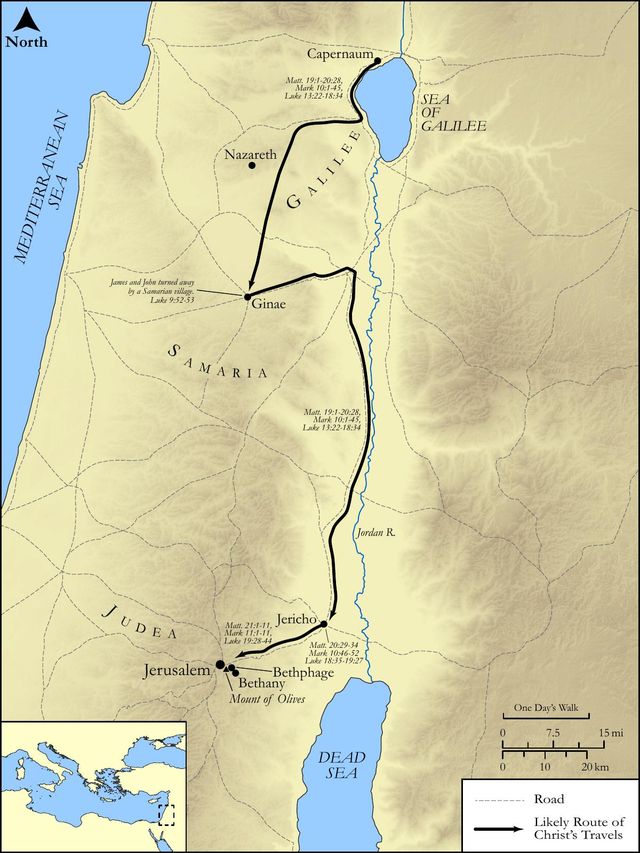
See on the biblical-era map


Study this verse
Historical interpretation
Nine Centuries of Reception
10 surviving comments on this verse. Each one is dated, so this reads as a timeline rather than a list.
Select a marker to jump to its quote. Markers stagger vertically where authors wrote within a few decades of each other.
For though the Angels and Martha ministered to Him, (Mat. 4:11), yet did He not come to be ministered unto, but to minister (John 12:2); yea, His ministry extended so far, that He fulfilled even what follows, And to give his life a ransom for many, they, that is, who believed on Him; and gave it, i. e. to death. But since He was alone free among the dead, and mightier than the power of death, He has set free from death all who were willing to follow Him. The heads of the Church ought therefore to imitate Christ in being affable, adapting Himself to women, laying His hands on children, and washing His disciples' feet, that they also should do the same to their brethren. But we are such, that we seem to go beyond the pride even of the great ones of this world; as to the command of Christ, either not understanding it, or setting it at nought. Like princes we seek hosts to go before us, we make ourselves awful and difficult of access, especially to the poor, neither approaching them, nor suffering them to approach us.
"Then were the ten moved with indignation with respect to the two." Then. When? When He had reproved them. So long as the judgment was Christ's, they were not moved with indignation; but seeing them preferred, they were contented, and held their peace, out of reverence and honor to their Master.
And if they were vexed in mind, yet they dared not utter this. And when they had some feeling of human weakness towards Peter, at the time that He gave the didrachmas, they did not give way to anger, but asked only, "Who then is greatest?" But since here the request was the disciples', they are moved with indignation. And not even here are they straightway moved with indignation, when they asked, but when Christ had reproved them, and had said they should not enjoy the first honors, unless they showed themselves worthy of these.
Seest thou how they were all in an imperfect state, when both these were lifting themselves up above the ten, and those envying the two? But, as I said, show me them after these things, and thou wilt see them delivered from all these passions. Hear at least how this same John, he who now came to Him for these things, everywhere gives up the first place to Peter, both in addressing the people, and in working miracles, in the Acts of the Apostles.
And he conceals not Peter's good deeds, but relates both the confession, which he openly made when all were silent, and his entering into the tomb, and puts the apostle before himself. For, because both continued with Him at His crucifixion, taking away the ground of his own commendation, he saith, "That disciple was known unto the high priest."
But James survived not a long time, but from the beginning he was so greatly filled with warmth, and so forsook all the things of men, and mounted up to an height unutterable, as straightway to be slain. Thus, in all respects, they after these things became excellent.
But then, "they were moved with indignation." What then saith Christ? "He called them unto Him, and said, The princes of the Gentiles exercise dominion over them." For, as they were disturbed and troubled, He soothes them by His call before His word, and by drawing them near Him. For the two having separated themselves from the company of the ten, had stood nearer Him, pleading their own interests. Therefore He brings near Him these also, by this very act, and by exposing and revealing it before the rest, soothing the passion both of the one and of the other.
And not as before, so now also doth He check them. For whereas before He brings little children into the midst, and commands to imitate their simplicity and lowliness; here He reproves them in a sharper way from the contrary side, saying, "The princes of the Gentiles exercise dominion over them, and their great ones exercise authority upon them, but it shall not be so among you; but he that will be great among you, let this man be minister to all; and he that will be first, let him be last of all;" showing that such a feeling as this is that of heathens, I mean, to love the first place. For the passion is tyrannical, and is continually hindering even great men; therefore also it needs a severer stripe. Whence He too strikes deeper into them, by comparison with the Gentiles shaming their inflamed soul, and removes the envy of the one and the arrogance of the other, all but saying, "Be not moved with indignation, as insulted. For they harm and disgrace themselves most, who on this wise seek the first places, for they are amongst the last. For matters with us are not like matters without. 'For the princes of the Gentiles exercise dominion over them,' but with me the last, even he is first."
"And in proof that I say not these things without cause, by the things which I do and suffer, receive the proof of my sayings. For I have myself done something even more. For being King of the powers above, I was willing to become man, and I submitted to be despised, and despitefully entreated. And not even with these things was I satisfied, but even unto death did I come. Therefore," He saith,
"Even as the Son of Man came not to be ministered unto, but to minister, and to give His life a ransom for many." "For not even at this did I stop," saith He, "but even my life did I give a ransom; and for whom? For enemies. But thou if thou art abused, it is for thyself, but I for thee."
Be not then afraid, as though thine honor were plucked down. For how much soever thou humblest thyself, thou canst not descend so much as thy Lord. And yet His descent hath become the ascent of all, and hath made His own glory shine forth. For before He was made man, He was known amongst angels only; but after He was made man and was crucified, so far from lessening that glory, He acquired other besides, even that from the knowledge of the world.
Fear not then, as though thine honor were put down, if thou shouldest abase thyself, for in this way is thy glory more exalted, in this way it becomes greater. This is the door of the kingdom. Let us not then go the opposite way, neither let us war against ourselves. For if we desire to appear great, we shall not be great, but even the most dishonored of all.
Seest thou how everywhere He urges them by the opposite things, giving them what they desire? For in the preceding parts also we have shown this in many instances, and in the cases of the covetous, and of the vain-glorious, He did thus. For wherefore, He saith, dost thou give alms before men? That thou mayest enjoy glory? Thou must then not do so, and thou shall surely enjoy it. Wherefore dost thou lay up treasures? That thou mayest be rich? Thou must then not lay up treasures, and thou shalt be rich. Even so here too, wherefore dost thou set thy heart on the first places? That thou mayest be before others? Choose then the last place, and then thou wilt enjoy the first. So that if it be thy will to become great, seek not to become great, and then thou wilt be great. For the other is to be little.
Seest thou how He drew them off from the disease, by showing them both from thence failing of their object, and from hence gaining, that they might flee the one, and follow after the other.
And of the Gentiles, too, He for this cause reminded them, that in this way again He might show the thing to be disgraceful and to be abhorred.
For the arrogant is of necessity base, and, on the contrary, the lowly-minded is high. For this is the height that is true and genuine, and exists not in name only, nor in manner of address. And that which is from without is of necessity and fear, but this is like to God's. Such a one, though he be admired by no one, continues high; even as again the other, though he be courted by all, is of all men the basest. And the one is an honor rendered of necessity, whence also it easily passes away; but the other is of principle, whence also it continues steadfast. Since for this we admire the saints also, that being greater than all, they humbled themselves more than all. Wherefore even to this day they continue to be high, and not even death hath brought down that height.
So long as the judgment of Christ upon this request was in suspense, the other disciples were not indignant; but when they heard Him rebuke them, they were sorrowful; whence it is said, And when the ten heard it, they had indignation against the two brethren.
For when the Lord rebuked them, then they perceived that this request was from the disciples. For though they were grieved in their hearts when they saw them so especially honoured in the transfiguration, they yet dared not so express themselves, out of respect to their teacher.
By thus calling them to Him, and speaking to them face to face, he sooths them in their discomposure; for the two had been speaking with the Lord apart by themselves. But not now as before does He it by bringing forward a child, but He proves it to them by reasoning from contraries; Ye know that the princes of the Gentiles exercise dominion over them.
He shows here that it is of the Gentiles to desire preeminence; and by this comparison of the Gentiles He calms their troubled souls.
How much soever you humble yourself, you cannot descend so far as did your Lord.
(Verse 19 onwards) And as they were departing from Jericho, a great crowd followed him. And behold, two blind men sitting by the roadside, heard that Jesus was passing by, and they cried out, saying: Lord, have mercy on us, Son of David. But the crowd rebuked them, telling them to be silent. Yet they cried out even more, saying: Lord, have mercy on us, Son of David. There were many robbers in Jericho who used to attack and harm those who were coming in and going out of Jerusalem; therefore the Lord came to Jericho with his disciples, to heal the wounded and to bring a large crowd with him. Finally, after they want to leave from Jericho, a large crowd followed him. If he had stayed in Jerusalem and never descended to the lowly things, the crowd would still be sitting in darkness and in the shadow of death until today. But there were also two blind men by the road. He calls blind those who could not yet speak: In your light we will see light (Ps. XXXV, 10). Along the road, because they seemed to have knowledge of the Law: but they were ignorant of the way, which is Christ: whom most understand as the Pharisees and Sadducees, and others as both the people, the old Testament and the New: because one, following the written Law, was blind without Christ. Because they could not see by themselves, they heard the proclamations of the Savior, and confessed him as the son of David. But if both blind men are referred to the Jewish people, what follows, 'The crowd rebuked them,' should be understood in relation to the Gentiles: whom the Apostle warns not to boast and be arrogant against their own root (Rom. 11); but since they themselves were grafted in by the error of those before them from the wild olive tree into the good olive tree, they should by no means envy the salvation of those before them. Have mercy on us, O son of David. They are reproached by the crowds, and yet they do not remain silent: but rather they repeat the same thing more frequently, so that they may show the desire for the fullness of true light.
(Verse 28) Just as the Son of Man came not to be served, but to serve. Note that we have frequently said that the one who serves is called the Son of Man.
And to give his life as a ransom for many. When he assumed the form of a servant, in order to shed his blood for the world (Philippians 2). He did not say that he would give his life as a ransom for all, but for many, that is, for those who would be willing to believe.
They do not lay it upon the forwardness of the mother who spoke the request, but upon her sons, who, not knowing their measure, burned with so immoderate desires.
But the meek and lowly Master neither charges the two with ambition, nor rebukes the ten for their spleen and jealousy; but, Jesus called them unto him.
Lastly, He sets before them His own example, that so should they little weigh His words, His deeds might shame them, whence He adds, As also the Son of Man cometh not to be ministered unto, but to minister.
(de Trin i. 12.) Or otherwise; The Lord makes answer to His disciples in His character of servant; though whatever is prepared by the Father is also prepared by the Son, for He and the Father are one.
A hermit was asked, ‘What is humility?’ He answered, ‘Humility is a great work, and a work of God. The way of humility is to undertake bodily labour, and believe yourself a sinner, and make yourself the servant of all.’ A brother said, ‘What does it mean, to be the servant of all?’ He answered, ‘To be the servant of all is not to look at the sins of others, always to look at your own sins, and to pray to God without ceasing.’
But as the two had asked carnally, so now the ten are grieved carnally. For as to seek to be above all is blame-worthy, so to have another above us is mortifying to our vanity.
Indeed, to desire a good work is good, for it is within our will, and ours is the reward; but to desire a primacy of honour is vanity. For when we attain this we are judged of God, because we know not whether in our precedence of honour we deserve the reward of righteousness. For not even an Apostle will have praise with God, because he is an Apostle, but if he has well fulfilled the duties of his Apostleship; nor was an Apostle placed in honour as an Apostle, for any previous merit of his; but was judged meet for that ministry, on account of the disposition of his mind. For high place courts him who flies from it, and shuns him who courts it. A better life then, and not a more worthy degree, should be our object. The Lord therefore, willing to check the ambition of the two sons of Zebedee, and the indignation of the others, points out this distinction between the chief men of the world, and those of the Church, showing that the primacy in Christ is neither to be sought by him who has it not, nor envied by him who has it. For men become masters in this world that they may exercise domination over their inferiors, and reduce them to slavery, and rob them, and employ them even to death for their own profit and glory. But men become governors in the Church, that they may serve those who are under them, and minister to them whatever they have received of Christ, that they may postpone their own convenience, and mind that of others, and not refuse even to die for the sake of those beneath them. To seek therefore a command in the Church is neither righteous, nor profitable. No prudent man will voluntarily subject himself to slavery, nor to stand in such peril wherein he will have to render account for the whole Church; unless it be one perchance who fears not God's judgment, who abuses His ecclesiastical primacy to a secular end, so that He converts it into a secular primacy.
When the ten saw the two being rebuked by the Lord, then they, too, became indignant, revealing that even prior to this they had been annoyed at the honor which these two were given. For they were yet imperfect, the two rising up against the ten, and the ten envious of the two. As the ten were stirred up when they heard this, He called them to Himself, and by His calling, before any words were spoken, He calmed them. For the sons of Zebedee spoke to Him after they had separated themselves from the others. Therefore He speaks to them all together. Knowing how tyrannical is the pride of status, requiring a severe rebuke, He touches them to the quick by consigning them to the lot of Gentiles and infidels if they would be vainglorious. So He shames them by saying, "Other men are renowned as princes and rulers, and the lust for high position is a passion of the Gentiles; but My disciples are made honorable by their humility. So that he who would be great ought to serve the most inferior in rank; this is the mark of extreme humility. I Myself show this. I am the Prince and King of those who dwell in the heavens, Who humbled Myself to minister to you for your salvation, and I am your servant to the extent that I even give My life as a ransom for many, that is, for all." For "all" are "many."
Continue studying Matthew 20:28 across the web’s major study libraries — every link below opens this exact verse, chapter, or book on the destination site.
Read & Compare
 BibleGatewayThis verse in more than 200 translations and 70 languages.
 Bible.comThe YouVersion reader — hundreds of translations, reading plans, and highlights.
 ESV.orgCrossway's official English Standard Version reader.
 NET BibleThe NET translation with 60,000+ translators' notes on every rendering decision.
 STEP BibleTyndale House's free study tool — original text, vocabulary, and scholarly resources.
 BibliaLogos Bible Software's free web reader.
 USCCBThe New American Bible (Revised Edition) with the U.S. bishops' study notes.
Commentaries
 BibleHub CommentariesDozens of classic commentaries on this verse, gathered on one page.
 StudyLightMore than 100 commentary sets — the largest collection on the web.
 BibleRefPlain-English commentary on what this verse means, verse by verse.
 Enduring WordDavid Guzik's free commentary on this chapter, widely used by Bible teachers.
 Bible Study ToolsVerse commentary alongside Greek and Hebrew study aids.
Original Language & Research
- BibleHub InterlinearThe verse word by word — original language, transliteration, and English.
- BibleHub LexiconEvery word's original-language definition and Strong's entry.
 Blue Letter BibleDeep-study tools — Strong's numbers, concordance, and word studies.
 CNTR CollationThe earliest Greek manuscripts of this verse, collated letter by letter.
Sermons, Hymns & Audio


TrulyRandomVerse is not affiliated with these sites and doesn’t control their content. They’re linked because they’re genuinely useful.
Summary
Matthew 20:28 encapsulates the core purpose of Jesus Christ's earthly ministry, revealing His radical redefinition of leadership and the ultimate goal of His incarnation. In stark contrast to worldly aspirations for power and recognition, Jesus declares that He, the Son of Man, did not come to be served, but rather to serve others, culminating in the sacrificial giving of His life as a redemptive payment for the liberation of many from the bondage of sin.
Context
ShowHideLiterary Context
This profound declaration by Jesus immediately follows a pivotal moment of misunderstanding and ambition among His disciples. James and John, through their mother, petition Jesus for positions of unparalleled honor and authority in His coming kingdom, requesting to sit at His right and left hand (Matthew 20:20-21). This request sparks indignation among the other ten disciples (Matthew 20:24), highlighting their continued struggle to grasp the true nature of Jesus' messianic mission. In response, Jesus gathers them to deliver a foundational teaching on true greatness, contrasting the oppressive, hierarchical rule of Gentile leaders with the divine standard of humble, self-sacrificing servant leadership, which He Himself embodies and summarizes in this verse (Matthew 20:25-27).
Historical & Cultural Context
The concept of "greatness" in the ancient world was typically associated with power, dominion, and the ability to exact service from others. Roman and Hellenistic rulers, along with many Jewish religious leaders, exercised authority from a position of privilege, expecting deference and tribute. Slavery was a pervasive institution, and the idea of a king or a divine figure humbling himself to serve, let alone to die as a "ransom" for others, was utterly counter-cultural and scandalous. The term "ransom" (Greek: lytron) would have been understood in the context of freeing slaves or prisoners of war through a payment, making Jesus' statement about His life a direct challenge to prevailing notions of power and worth.
Key Themes
ShowHideMatthew 20:28 is a cornerstone for several overarching themes in Matthew's Gospel and the broader New Testament. It powerfully articulates the theme of Radical Servant Leadership, directly challenging the disciples' (and our) worldly ambitions by presenting Jesus' own life as the ultimate paradigm of leadership defined by humble service rather than domination. This theme is further developed in passages such as Philippians 2:5-8. Secondly, the verse introduces the critical theme of Sacrificial Atonement, clearly stating that Jesus' death was not an unfortunate accident but the divinely appointed purpose of His coming – to offer His life as a redemptive payment for sin. This points forward to the crucifixion and resurrection, which are central to the Gospel's narrative and the entire Christian message of salvation, as seen in Romans 5:8. Finally, it succinctly defines the Purpose of the Incarnation, explaining why the Son of God became the Son of Man: to fulfill God's redemptive plan through active service and ultimate self-sacrifice. This ties into the broader narrative of God's saving work throughout history, foreshadowed even in the Old Testament, such as the suffering servant passages in Isaiah 53.
Exposition and Analysis
ShowHideKey Word Analysis
ShowHideFrom the root meaning "to be an attendant," this word signifies active, humble service, waiting upon others, often in a menial or practical capacity. It emphasizes a disposition of self-giving and practical assistance rather than receiving service or holding a position of authority for personal gain. This is the root of our English word "deacon," signifying one who serves.
This verb is broad in its application, meaning "to give" in a very wide sense, often implying a deliberate bestowal or surrender. In this context, it highlights the volitional and intentional nature of Jesus' act – He was not forced, but freely and purposefully gave His life. It underscores the active agency of Christ in His redemptive work.
Derived from a word meaning "to loosen," lytron refers to a price paid to secure the release or liberation of a slave, prisoner, or captive. It denotes a payment made for redemption from bondage. Here, it explicitly defines the nature of Jesus' death: it was a substitutionary payment, a means of liberation for humanity from the dominion of sin and death.
Verse Breakdown
ShowHide"Even as the Son of man came"
This opening phrase establishes the essential nature and purpose of Jesus' incarnation. The title "Son of Man" (Greek: ho huios tou anthrōpou) is Jesus' preferred self-designation, linking Him to humanity while simultaneously carrying profound messianic and eschatological significance, drawing from Daniel's vision of a divine figure given everlasting dominion (Daniel 7:13-14). His "coming" refers to His entire earthly sojourn, from birth to crucifixion.
"not to be ministered unto, but to minister"
This is a radical declaration of purpose, directly contrasting with the disciples' aspirations and the world's understanding of greatness. Jesus explicitly states His mission was not to be served or to receive honor, but to actively serve others. This redefines leadership as humble, self-giving service, turning conventional power structures on their head.
"and to give his life a ransom for many"
This climactic clause reveals the ultimate act of Jesus' ministry. The "giving of His life" points directly to His sacrificial death on the cross. This death is not a tragedy or an accident, but a deliberate, purposeful act. It is a "ransom" (lytron), a payment made to liberate humanity from the bondage of sin, death, and the devil. The phrase "for many" signifies that this redemptive act is effective for all who believe, providing a vast and inclusive scope for His atoning work.
Literary Devices
ShowHideMatthew 20:28 is rich in literary devices that amplify its profound message. The most prominent is Contrast, as Jesus explicitly states what He did not come to do ("not to be ministered unto") in opposition to what He did come to do ("but to minister, and to give his life a ransom for many"). This stark juxtaposition highlights the radical nature of His mission compared to worldly expectations. There is also an element of Paradox, as the one who is truly great, the Son of Man, achieves His greatness not through being served, but through serving and ultimately sacrificing Himself. This subverts conventional wisdom about power and authority. Finally, the term "ransom" functions as a powerful Metaphor (or a Simile if "as" is emphasized in the broader context) for the atoning work of Christ, likening His life to a payment that secures freedom. This metaphor draws on familiar concepts of liberation through payment, making the abstract concept of atonement tangible and understandable.
Theological and Thematic Connections
ShowHideMatthew 20:28 stands as a theological linchpin, connecting the person and work of Jesus Christ to the broader narrative of God's redemptive plan. It profoundly shapes our understanding of Christology, particularly His roles as the humble Servant-King and the atoning Lamb. This verse underscores that Jesus' identity as the Son of Man is inextricably linked to His mission of self-sacrifice, fulfilling Old Testament prophecies of a suffering servant who would bear the iniquities of many. It establishes the substitutionary nature of His death, where His life is given in exchange for the freedom of humanity from sin's dominion, thereby laying the groundwork for the doctrine of atonement and the justification of believers by grace through faith.
Reflection and Application
ShowHideMatthew 20:28 provides a profound challenge and a liberating paradigm for all who follow Christ. It compels us to re-evaluate our understanding of leadership, success, and purpose, shifting our focus from self-aggrandizement to selfless service. If the Son of God, in His divine majesty, came not to be served but to minister, how much more should His followers embrace a life marked by humility, compassion, and active service to others? This verse calls us to lay aside personal ambition for the sake of the kingdom, to seek opportunities to uplift and empower, rather than to be elevated ourselves. Furthermore, the immense truth that Jesus gave His life as a "ransom for many" should evoke profound gratitude and awe. It reminds us of the immeasurable cost of our salvation and the depth of God's love, inspiring us to live lives worthy of such a sacrifice, characterized by worship, obedience, and a passionate desire to share this liberating truth with the world.
Questions for Reflection
ShowHideFAQ
ShowHideWhat does "Son of Man" mean in this context?
ShowHide"Son of Man" (Greek: ho huios tou anthrōpou) is Jesus' most frequent self-designation. It emphasizes His true humanity, His solidarity with mankind, and His identification with the human race. However, it also carries profound theological weight, drawing from the Old Testament, particularly Daniel 7:13-14, where a "Son of Man" figure is presented as a divine, messianic figure who receives everlasting dominion and glory. In Matthew 20:28, it signifies that the one who is both fully human and divinely appointed is the one who comes to serve and to offer His life as a ransom.
Why does Jesus say "for many" instead of "for all"?
ShowHideThe phrase "for many" (Greek: hyper pollōn) does not necessarily imply a limited atonement, but rather emphasizes the vast scope and efficacy of Christ's sacrifice. In biblical usage, "many" can often refer to an innumerable multitude or all who are encompassed by a particular action, rather than a restricted number. For example, in Romans 5:19, Paul states that "by the obedience of the one man the many will be made righteous," where "the many" clearly refers to all who are justified. The emphasis is on the effectiveness of the ransom for a multitude, rather than on an exclusion of others. Other passages, like 1 Timothy 2:6, explicitly state that Christ gave Himself as a "ransom for all."
Christ-Centered Fulfillment
ShowHideMatthew 20:28 is a profound Christ-centered statement, encapsulating the very essence of Jesus' redemptive mission and His identity as the promised Messiah. The title "Son of Man" points directly to His unique dual nature – fully God and fully human – fulfilling Old Testament prophecies of a coming deliverer who would share in our humanity yet possess divine authority, as seen in Daniel 7:13-14. His declaration that He "came not to be ministered unto, but to minister" is a radical redefinition of messianic expectation, revealing Him not as a conquering king who demands homage, but as the humble Servant of Yahweh, echoing the suffering servant songs of Isaiah 53. The climax of the verse, "and to give his life a ransom for many," is the ultimate fulfillment of God's redemptive plan. It foreshadows the cross, where Jesus, the spotless Lamb of God, willingly offered Himself as the perfect, once-for-all sacrifice to pay the debt of sin that humanity could not pay. His death is not merely an example of selfless love, but a substitutionary atonement, liberating those who believe from the bondage of sin and death, thereby fulfilling the Old Testament sacrificial system and paving the way for new covenant life in Him (Hebrews 9:11-14). Thus, Matthew 20:28 is a concise theological summary of the Gospel itself, revealing Jesus as the Servant-King who redeems His people through His ultimate act of self-giving love.