


2 Corinthians 5:21
- τὸνtonThe [One]G3588T-ASMDefinite article Accusative Singular Masculine
- γὰρgarforG1063CONJConjunction
- μὴmēnotG3361PRT-NNegative Particle Negative
- γνόνταgnontahaving knownG1097V-2AAP-ASMVerb 2nd Aorist Active Participle Accusative Singular Masculine
- ἁμαρτίανhamartiansinG266N-ASFNoun Accusative Singular Feminine
- ὑπὲρhuperforG5228PREPPreposition
- ἡμῶνhēmōnusG3165P-1GPPersonal pronoun Genitive 1st Plural
- ἁμαρτίανhamartiansinG266N-ASFNoun Accusative Singular Feminine
- ἐποίησενepoiēsenHe madeG4160V-AAI-3SVerb Aorist Active Indicative 3rd Singular
- ἵναinaso thatG2443CONJConjunction
- ἡμεῖςhēmeiswe ourselvesG3165P-1NPPersonal pronoun Nominative 1st Plural
- γενώμεθαgenōmethamay becomeG1096V-2ADS-1PVerb 2nd Aorist Middle Deponent Subjunctive 1st Plural
- δικαιοσύνηdikaiosunē[the] righteousnessG1343N-NSFNoun Nominative Singular Feminine
- θεοῦtheouof GodG2316N-GSM-TNoun Genitive Singular Masculine Title
- ἐνeninG1722PREPPreposition
- αὐτῷautōHimG846P-DSMPersonal pronoun Dative Singular Masculine
English is a literal word-by-word gloss of the Greek, not the KJV's wording. Why?
This is the original text the KJV's translators worked from — each Greek word with its own literal English meaning in this verse, prepared by scholars at Tyndale House, Cambridge. The KJV translates whole sentences, not word by word, so its wording differs: one Greek word can become several English words, and the KJV may choose “charity” where the gloss reads “love”. Both are faithful — they answer different questions. For the KJV's own rendering, switch to the KJV text.
Details
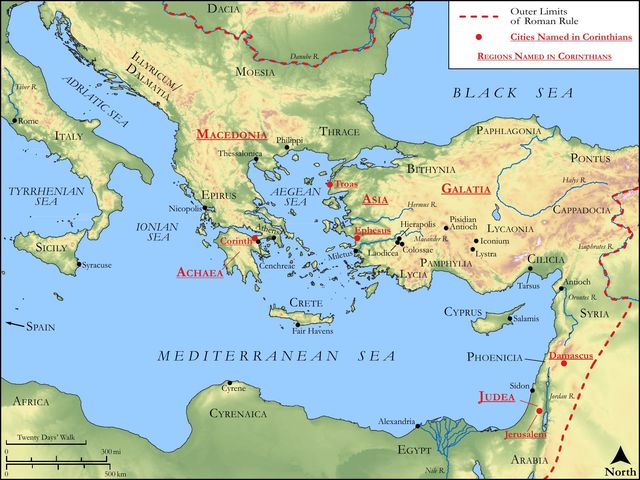
See on the biblical-era map

Study this verse
Public-domain commentary
Matthew Henry
From his Commentary on the Whole Bible. Henry comments on passages, not single verses — this entry covers 2 Corinthians 5:16–21. His four-level outline is real structure in the source text, so it is rendered as structure.
In these verses the apostle mentions two things that are necessary in order to our living to Christ, both of which are the consequences of Christ's dying for us; namely, regeneration and reconciliation.
I.Regeneration, which consists of two things; namely,
1.Weanedness from the world: "Henceforth we know no man after the flesh, Co2 5:16. We do not own nor affect any person or thing in this world for carnal ends and outward advantage: we are enabled, by divine grace, not to mind nor regard this world, nor the things of this world, but to live above it. The love of Christ is in our hearts, and the world is under our feet." Note, Good Christians must enjoy the comforts of this life, and their relations in this world, with a holy indifference. Yea, though we have known Christ after the flesh, yet, says the apostle, we know him no more. It is questioned whether Paul had seen Christ in the flesh. However, the rest of the apostles had, and so might some among those he was now writing to. However, he would not have them value themselves upon that account; for even the bodily presence of Christ is not to be desired nor doted upon by his disciples. We must live upon his spiritual presence, and the comfort it affords. Note, Those who make images of Christ, and use them in their worship, do not take the way that God has appointed for strengthening their faith and quickening their affections; for it is the will of God that we should not know Christ any more after the flesh.
2.A thorough change of the heart: For if any man be in Christ, if any man be a Christian indeed, and will approve himself such, he is, or he must be, a new creature, Co2 5:17. Some read it, Let him be a new creature. This ought to be the care of all who profess the Christian faith, that they be new creatures; not only that they have a new name, and wear a new livery, but that they have a new heart and new nature. And so great is the change the grace of God makes in the soul, that, as it follows, old things are passed away - old thoughts, old principles, and old practices, are passed away; and all these things must become new. Note, Regenerating grace creates a new world in the soul; all things are new. The renewed man acts from new principles, by new rules, with new ends, and in new company.
II.Reconciliation, which is here spoken of under a double notion: -
1.As an unquestionable privilege, Co2 5:18, Co2 5:19. Reconciliation supposes a quarrel, or breach of friendship; and sin has made a breach, it has broken the friendship between God and man. The heart of the sinner is filled with enmity against God, and God is justly offended with the sinner. Yet, behold, there may be a reconciliation; the offended Majesty of heaven is willing to be reconciled. And observe, 1. He has appointed the Mediator of reconciliation. He has reconciled us to himself by Jesus Christ, Co2 5:18. God is to be owned from first to last in the undertaking and performance of the Mediator. All things relating to our reconciliation by Jesus Christ are of God, who by the mediation of Jesus Christ has reconciled the world to himself, and put himself into a capacity of being actually reconciled to offenders, without any wrong or injury to his justice or holiness, and does not impute to men their trespasses, but recedes from the rigour of the first covenant, which was broken, and does not insist upon the advantage he might justly take against us for the breach of that covenant, but is willing to enter into a new treaty, and into a new covenant of grace, and, according to the tenour thereof, freely to forgive us all our sins, and justify freely by his grace all those who do believe. 2. He has appointed the ministry of reconciliation, Co2 5:18. By the inspiration of God the scriptures were written, which contain the word of reconciliation, showing us that peace was made by the blood of the cross, that reconciliation is wrought, and directing us how we may be interested therein. And he has appointed the office of the ministry, which is a ministry of reconciliation: ministers are to open and proclaim to sinners the terms of mercy and reconciliation, and persuade them to comply therewith. For,
2.Reconciliation is here spoken of as our indispensable duty, Co2 5:20. As God is willing to be reconciled to us, we ought to be reconciled to God. And it is the great end and design of the gospel, that word of reconciliation, to prevail upon sinners to lay aside their enmity against God. Faithful ministers are Christ's ambassadors, sent to treat with sinners on peace and reconciliation: they come in God's name, with his entreaties, and act in Christ's stead, doing the very thing he did when he was upon this earth, and what he wills to be done now that he is in heaven. Wonderful condescension! Though God can be no loser by the quarrel, nor gainer by the peace, yet by his ministers he beseeches sinners to lay aside their enmity, and accept of the terms he offers, that they would be reconciled to him, to all his attributes, to all his laws, and to all his providences, to believe in the Mediator, to accept the atonement, and comply with his gospel, in all the parts of it and in the whole design of it. And for our encouragement so to do the apostle subjoins what should be well known and duly considered by us (Co2 5:21), namely,
(1.)The purity of the Mediator: He knew no sin.
(2.)The sacrifice he offered: He was made sin; not a sinner, but sin, that is, a sin-offering, a sacrifice for sin.
(3.)The end and design of all this: that we might be made the righteousness of God in him, might be justified freely by the grace of God through the redemption which is in Christ Jesus. Note,
[1.]As Christ, who knew no sin of his own, was made sin for us, so we, who have no righteousness of our own, are made the righteousness of God in him.
[2.]Our reconciliation to God is only through Jesus Christ, and for the sake of his merit: on him therefore we must rely, and make mention of his righteousness and his only.
Historical interpretation
Historical reception
12 surviving comments on this verse. Each one is dated, so this reads as a timeline rather than a list.
Select a marker to jump to its quote. Markers stagger vertically where authors wrote within a few decades of each other.
And he, since he understood at once his Father’s divine counsel, and because he discerned better than any other why he was forsaken by the Father, humbled himself even more. He embraced death for us with all willingness and “became a curse for us,” holy and all-blessed though he was.… “He that knew no sin, became sin, that we might become the righteousness of God in him.” Yet more—to wash away our sins he was crucified, suffering what we who were sinful should have suffered, as our sacrifice and ransom, so that we may well say with the prophet, he bears our sins and is pained for us, and he was wounded for our sins and bruised for our iniquities, so that by his stripes we might be healed, for the Lord has given him for our sins. So, as delivered up by the Father, as bruised, as bearing our sins, he was led as a sheep to the slaughter.
In yet another passage, contemplating the still more wonderful benevolence of God in Christ, he says: “Him who knew no sin, he has made sin for us, that we might be made the justice of God in him.” In view of these utterances and other similar ones, we are under the strictest obligation, unless we have received in vain the grace of God, first, to free ourselves from the dominion of the devil who leads a slave of sin into evils even against his will. Secondly, each of us, after denying himself present satisfactions and breaking off his attachment to this life, must become a disciple of the Lord, as he himself said: “If any man will come after me, let him deny himself and take up his cross and follow me.”.
Christ did not have to be born as a man, but he became man because of sin. It was only because all flesh was subject to sin that he was made sin for us. In view of the fact that he was made an offering for sins, it is not wrong for him to be said to have been made “sin,” because in the law the sacrifice which was offered for sins used to be called a “sin.” After his death on the cross Christ descended to hell, because it was death, working through sin, which gave hell its power. Christ defeated death by his death and brought such benefit to sinners that now death cannot hold those who are marked with the sign of the cross.
But look at it in this manner: that as for my sake he was called a curse who destroyed my curse, and sin who takes away the sin of the world, and became a new Adam to take the place of the old, just so he makes my disobedience his own as head of the whole body. As long, then, as I am disobedient and rebellious, both by denial of God and by my passions, so long Christ is also called disobedient on my account. But when all things shall be subdued to him on the one hand by acknowledgment of him and on the other by a reformation, then he himself also will have fulfilled his submission, bringing me whom he has saved to God.
And so the passage “The Word was made flesh” seems to me to be equivalent to that in which it is said that he was made sin or a curse for us; not that the Lord was transformed into either of these—how could he be? But because by taking them upon him he took away our sins and bore our iniquities.
But if you hold to the letter, as you think, from what is written, that the Word was made flesh, that the Word of God was made flesh; do you deny that it is written about the Lord, that he did not commit sin, but became sin? Therefore, the Lord was not turned into sin? Not so; but because he took on our sins, he was called sin. For the Lord was also called cursed, not because the Lord was turned into a curse, but because he himself took on our curse: Cursed is he who hangs on a tree. Therefore, you marvel because it is written: The Word was made flesh, when flesh was assumed by the Word of God; for when it is written that he was made sin, it means that he was made sin in the likeness of sinful flesh, not in nature or operation of sin, but in order to crucify our sin in his own flesh, he assumed the reception of the weaknesses of our guilty body, which is carnal.
For God himself, the Word, in his flesh, was not a rational and intelligent soul, but a rational and intelligent soul, and the same human, and of the same substance as our souls, and a flesh similar to our own, and of the same substance as our flesh. The Word of God, assuming this, was also a perfect man, without any stain of sin; for he himself did not sin, but was made sin for us, so that we might become the righteousness of God in him. Therefore, the flesh is of the same essence as the soul, and our soul and flesh are of the same substance.
I say nothing of what has gone before, that ye have outraged Him, Him that had done you no wrong, Him that had done you good, that He exacted not justice, that He is first to beseech, though first outraged; let none of these things be set down at present. Ought ye not in justice to be reconciled for this one thing only that He hath done to you now? And what hath He done? "Him that knew no sin He made to be sin, for you." For had He achieved nothing but done only this, think how great a thing it were to give His Son for those that had outraged Him. But now He hath both well achieved mighty things, and besides, hath suffered Him that did no wrong to be punished for those who had done wrong. But he did not say this: but mentioned that which is far greater than this. What then is this? "Him that knew no sin," he says, Him that was righteousness itself, "He made sin," that is suffered as a sinner to be condemned, as one cursed to die. "For cursed is he that hangeth on a tree." For to die thus was far greater than to die; and this he also elsewhere implying, saith, "Becoming obedient unto death, yea the death of the cross." For this thing carried with it not only punishment, but also disgrace. Reflect therefore how great things He bestowed on thee. For a great thing indeed it were for even a sinner to die for any one whatever; but when He who undergoes this both is righteous and dieth for sinners; and not dieth only, but even as one cursed; and not as cursed dieth only, but thereby freely bestoweth upon us those great goods which we never looked for; (for he says, that "we might become the righteousness of God in Him;") what words, what thought shall be adequate to realize these things? For the righteous, saith he, He made a sinner; that He might make the sinners righteous. Yea rather, he said not even so, but what was greater far; for the word he employed is not the habit, but the quality itself. For he said not "made" Him a sinner, but "sin;" not, Him that had not sinned only, but "that had not even known sin; that we" also "might become," he did not say righteous, but, "righteousness," and, "the righteousness of God." For this is the righteousness "of God" when we are justified not by works, (in which case it were necessary that not a spot even should be found,) but by grace, in which case all sin is done away. And this at the same time that it suffers us not to be lifted up, (seeing the whole is the free gift of God,) teaches us also the greatness of that which is given. For that which was before was a righteousness of the Law and of works, but this is "the righteousness of God."
Paul shows here how much he grieved for those who obstinately kept the law. For by keeping the law, he says, we become sinners. Christ became sin in order to deliver us from the law. God says to us that we should accept this freedom by no longer remaining in bondage to the commands of the law.
We do not say that Christ became a sinner, far from it, but being righteous (or rather, righteousness, because he did not know sin at all), the Father made him a victim for the sins of the world.
For this reason, we say that he was named sin; wherefore, the all-wise Paul writes, “For our sakes he made him to be sin who knew nothing of sin,” that is to say, God the Father. For we do not say that Christ became a sinner. Far from it, but being just, or rather in actuality justice, for he did not know sin, the Father made him a victim for the sins of the world.
Christ was called what we are in order to call us to be what he is.
Continue studying 2 Corinthians 5:21 across the web’s major study libraries — every link below opens this exact verse, chapter, or book on the destination site.
Read & Compare
 BibleGatewayThis verse in more than 200 translations and 70 languages.
 Bible.comThe YouVersion reader — hundreds of translations, reading plans, and highlights.
 ESV.orgCrossway's official English Standard Version reader.
 NET BibleThe NET translation with 60,000+ translators' notes on every rendering decision.
 STEP BibleTyndale House's free study tool — original text, vocabulary, and scholarly resources.
 BibliaLogos Bible Software's free web reader.
 USCCBThe New American Bible (Revised Edition) with the U.S. bishops' study notes.
Commentaries
 BibleHub CommentariesDozens of classic commentaries on this verse, gathered on one page.
 StudyLightMore than 100 commentary sets — the largest collection on the web.
 BibleRefPlain-English commentary on what this verse means, verse by verse.
 Enduring WordDavid Guzik's free commentary on this chapter, widely used by Bible teachers.
 Bible Study ToolsVerse commentary alongside Greek and Hebrew study aids.
Original Language & Research
- BibleHub InterlinearThe verse word by word — original language, transliteration, and English.
- BibleHub LexiconEvery word's original-language definition and Strong's entry.
 Blue Letter BibleDeep-study tools — Strong's numbers, concordance, and word studies.
 CNTR CollationThe earliest Greek manuscripts of this verse, collated letter by letter.
Sermons, Hymns & Audio


TrulyRandomVerse is not affiliated with these sites and doesn’t control their content. They’re linked because they’re genuinely useful.
Summary
Second Corinthians 5:21 stands as a profound declaration of the gospel, encapsulating the essence of substitutionary atonement and divine imputation. It reveals how God, in His infinite wisdom and love, orchestrated a "great exchange": He treated His sinless Son as the embodiment of human sin, allowing Him to bear its full penalty, so that those who believe might be clothed with God's own perfect righteousness through their union with Christ. This verse provides the theological bedrock for the ministry of reconciliation, demonstrating the unparalleled depth of God's redemptive work.
Context
ShowHideLiterary Context
This pivotal verse concludes a significant theological section in Paul's letter, building directly upon the themes introduced in 2 Corinthians 5:17. Paul has just declared that "if any man be in Christ, he is a new creature: old things are passed away; behold, all things are become new." This "new creation" is fundamentally rooted in God's reconciling work. Verses 2 Corinthians 5:18-20 then introduce the "ministry of reconciliation," emphasizing that God has reconciled the world to Himself through Christ and has entrusted this message to believers as "ambassadors for Christ." Verse 21 provides the indispensable theological foundation for how this reconciliation was achieved, explaining the divine mechanism by which sinful humanity can be made righteous before a holy God. It is the climax of Paul's explanation of the new covenant and the believer's new identity in Christ.
Historical & Cultural Context
Paul is writing to the church in Corinth, a bustling, cosmopolitan city known for its diverse religious practices and moral challenges. The Corinthians struggled with various issues, including internal divisions, moral laxity, and challenges to Paul's apostolic authority. In this section, Paul is defending his ministry and the integrity of the gospel message he preaches. The concept of substitutionary sacrifice was not entirely foreign to the Jewish mind, given the elaborate sacrificial system of the Old Testament (e.g., Leviticus 16). However, Christ's sacrifice, as presented by Paul, transcends and fulfills these types, being a unique, once-for-all act of divine initiative. The idea of "righteousness" (δικαιοσύνη) was a key concept in both Jewish and Hellenistic thought, but Paul redefines it as a divine gift received through faith, not earned through human effort or adherence to the Law.
Key Themes
ShowHideSecond Corinthians 5:21 powerfully articulates several core theological themes central to Paul's theology and the Christian faith. Firstly, it underscores Substitutionary Atonement, where Christ stands in the place of humanity, bearing the penalty for sin. This is explicitly stated in the phrase "For he hath made him [to be] sin for us." Secondly, it highlights the Sinlessness of Christ, a crucial prerequisite for His atoning work, as affirmed by "who knew no sin." Thirdly, the verse reveals the profound doctrine of Imputation, a "great exchange" where human sin is credited to Christ, and Christ's perfect righteousness is credited to believers. This is the essence of "that we might be made the righteousness of God in him." This imputed righteousness is not inherent in believers but is a legal declaration based on their union with Christ, providing the basis for their Reconciliation with God, a theme Paul extensively develops in 2 Corinthians 5:18-20. Finally, it speaks to the Divine Initiative in salvation, emphasizing that this entire redemptive plan is God's doing ("For he hath made him...").
Exposition and Analysis
ShowHideKey Word Analysis
ShowHideThis verb, G4160, signifies an active, deliberate act of creation or causation. In this context, it emphasizes that God Himself was the agent who "made" or "caused" Christ to be "sin for us." This is not a passive event but a sovereign, intentional divine decree. It highlights God's active role in orchestrating salvation, demonstrating His purposeful design in the atoning work of Christ.
Meaning "a sin (properly abstract)." Here, "sin" does not imply that Jesus became morally corrupt or inherently sinful in His nature. Instead, it conveys that God treated Christ as the embodiment or representative of human sin, allowing Him to bear the full legal guilt, penalty, and consequences of humanity's transgressions. While hamartía can sometimes refer to a "sin offering" in the Septuagint, the primary force here is the identification of Christ with the totality of human sin, making Him the object of divine judgment on our behalf.
Meaning "equity (of character or act); specially (Christian) justification." This refers to God's own perfect, unblemished righteousness. When believers are "made the righteousness of God," it means they are declared righteous by God, not based on their own merits or works, but through their union with Christ. It is an alien righteousness, originating from God and imputed to them, making them acceptable in His sight. This is the legal and spiritual standing that enables reconciliation with a holy God.
Verse Breakdown
ShowHide"For he hath made him [to be] sin for us,"
This clause reveals the divine initiative and the nature of Christ's identification with humanity's fallen state. "He" refers to God the Father. God actively "made" or appointed His Son, Jesus, to be "sin." As explained in the key word analysis, this means Christ was treated as the representative and bearer of human sin, absorbing its penalty. The phrase "for us" (ὑπὲρ ἡμῶν, hyper hēmōn) signifies substitution – Christ acted on our behalf, in our place, for our benefit. He bore the judgment that was due to us.
"who knew no sin;"
This crucial parenthetical phrase underscores the absolute purity and moral perfection of Jesus. He was personally without any sin, either in thought, word, or deed. This sinlessness is indispensable for His atoning work; only a spotless sacrifice could effectively bear the sins of others and satisfy God's holy demands. His perfect obedience and pure nature made Him the only qualified substitute for sinful humanity.
"that we might be made the righteousness of God in him."
This final clause states the glorious purpose and result of Christ's substitutionary work. The "that" (ἵνα, hína) indicates the divine purpose. Just as Christ was "made sin" (treated as sin) for us, so we, through faith in Him, are "made the righteousness of God." This is not an inherent righteousness we achieve, but a divine declaration, an imputed righteousness that originates from God and is given to us. The phrase "in him" (ἐν αὐτῷ, en autō) signifies our vital union with Christ; our new righteous standing is entirely dependent on and found within our relationship with Him.
Literary Devices
ShowHideSecond Corinthians 5:21 is rich in literary devices that amplify its theological weight. The most prominent is Antithesis, or sharp contrast. The verse sets up a powerful opposition between "sin" and "righteousness," and between Christ's perfect sinlessness and humanity's inherent sinfulness. This contrast highlights the radical nature of God's redemptive plan. Closely related is Paradox, as it presents the seemingly contradictory idea of the sinless Son of God being "made sin." This paradox underscores the mysterious and miraculous nature of the atonement, defying human logic yet revealing divine wisdom. The language also employs Metonymy or Representation, where "sin" stands not just for sinful acts but for the entire burden, guilt, and penalty of sin itself, which Christ represents and bears. Similarly, "righteousness of God" represents the perfect legal standing and acceptance before God that believers receive. Finally, the verse is a concise Summary Statement, encapsulating the entire gospel message of substitution and imputation in a single, powerful declaration.
Theological and Thematic Connections
ShowHideThis verse is a cornerstone of Christian soteriology, revealing the profound mechanism by which God reconciles sinful humanity to Himself. It underscores the concept of imputed righteousness, where our sin is attributed to Christ, and His perfect righteousness is attributed to us. This divine exchange is not merely a legal fiction but a transformative reality rooted in the person and work of Jesus Christ. It highlights God's unwavering justice, which demands a penalty for sin, and His boundless love, which provides the perfect sacrifice in His Son. This reconciliation is entirely God's initiative and gift, not something earned by human merit, leading to a new standing before God and a new identity in Christ.
Reflection and Application
ShowHideSecond Corinthians 5:21 is not merely a theological statement; it is a profound declaration of our identity and standing before God. To grasp its truth is to be liberated from the burden of self-righteousness and the despair of unworthiness. Our acceptance by God is not based on our performance, our good deeds, or our moral striving, but entirely on the perfect work of Christ. This should cultivate deep gratitude, humility, and confidence in our relationship with God. It empowers us to live not for righteousness, but from righteousness – the righteousness we have been freely given in Christ. This truth should motivate us to live lives that reflect the holiness and love of the God who made such an exchange possible, compelling us to participate in the ministry of reconciliation, sharing this glorious news with others. It also provides immense comfort in times of failure, reminding us that our standing is secure in Him, not in our fluctuating obedience.
Questions for Reflection
ShowHideFAQ
ShowHideDid Jesus literally become sinful in His nature?
ShowHideNo, the phrase "made him [to be] sin" does not mean Jesus became inherently sinful in His nature or character. The verse explicitly states that He "knew no sin," emphasizing His perfect moral purity and sinlessness. Rather, it means that God treated Jesus as the legal representative and embodiment of human sin, allowing Him to bear the full guilt, penalty, and consequences of sin on the cross. He was imputed with our sin, meaning our sin was credited to Him, so that He could suffer the judgment we deserved. This is a legal and substitutionary identification, not a moral transformation of His divine or human nature.
What does "the righteousness of God" mean in this context?
ShowHide"The righteousness of God" refers to a righteousness that originates from God Himself and is acceptable to Him. It is not a righteousness that we achieve or earn through our own efforts or good works. Instead, it is a perfect, divine righteousness that is imputed (credited) to believers through their faith and union with Christ. Because Christ bore our sin and perfectly fulfilled God's righteous demands, His righteousness is now legally and spiritually applied to those who believe in Him. This means that in God's eyes, believers are declared righteous, not based on their own merit, but on the perfect standing of Christ. This imputed righteousness is the basis for our reconciliation and acceptance with a holy God, as described throughout Paul's letters, particularly in Romans 4.
Christ-Centered Fulfillment
ShowHideSecond Corinthians 5:21 stands as the quintessential statement of Christ's redemptive work, revealing Him as the ultimate fulfillment of God's plan for salvation. He is the sinless Lamb of God, foreshadowed in the Old Testament sacrificial system (e.g., Isaiah 53:7), who perfectly offered Himself once for all. In Christ, the paradox of divine justice and mercy finds its resolution: God, who is perfectly holy and must punish sin, simultaneously provides the means for reconciliation by making His Son "to be sin for us." This act demonstrates Jesus' unparalleled love and obedience to the Father, willingly taking upon Himself the curse due to humanity (Galatians 3:13). Through His death and resurrection, Christ secures for believers a new identity and standing, allowing them to be "made the righteousness of God in him." This is the core of the gospel, where Christ's perfect life and atoning death become the sole basis for humanity's reconciliation with God, making Him the focus of all hope and the source of eternal life (John 14:6). He is not merely a moral example or a prophet, but the very means by which God's righteousness is both upheld and bestowed upon humanity, ushering in the reality of the "new creation" found only "in Christ" (2 Corinthians 5:17).