


John 1:29
- ΤῇTēaOn theG3588T-DSFDefinite article Dative Singular Feminine
- ἐπαύριονepaurionnext dayG1887ADVAdverb
- βλέπειblepeihe seesG991V-PAI-3SVerb Present Active Indicative 3rd Singular
- ὁho<the>G3588T-NSMDefinite article Nominative Singular Masculine
- ἸωάννηςIōannēsJohnG2491N-NSM-PNoun Nominative Singular Masculine Individual
- τὸνton<the>G3588T-ASMDefinite article Accusative Singular Masculine
- ἸησοῦνIēsounJesusG2424N-ASM-PNoun Accusative Singular Masculine Individual
- ἐρχόμενονerchomenoncomingG2064V-PNP-ASMVerb Present Middle Or Passive Deponent Participle Accusative Singular Masculine
- πρὸςprostoG4314PREPPreposition
- αὐτὸνautonhimG846P-ASMPersonal pronoun Accusative Singular Masculine
- καὶkaiandG2532CONJConjunction
- λέγει·legeisaysG3004V-PAI-3SVerb Present Active Indicative 3rd Singular
- ἴδεideBeholdG2396INJInterjection
- ὁhotheG3588T-NSMDefinite article Nominative Singular Masculine
- ἀμνὸςamnosLambG286N-NSMNoun Nominative Singular Masculine
- τοῦtou<the>G3588T-GSMDefinite article Genitive Singular Masculine
- θεοῦtheouof GodG2316N-GSM-TNoun Genitive Singular Masculine Title
- ὁhowhoG3588T-NSMDefinite article Nominative Singular Masculine
- αἴρωνairōnis taking awayG142V-PAP-NSMVerb Present Active Participle Nominative Singular Masculine
- τὴνtēntheG3588T-ASFDefinite article Accusative Singular Feminine
- ἁμαρτίανhamartiansinG266N-ASFNoun Accusative Singular Feminine
- τοῦtouof theG3588T-GSMDefinite article Genitive Singular Masculine
- κόσμουkosmouworldG2889N-GSMNoun Genitive Singular Masculine
English is a literal word-by-word gloss of the Greek, not the KJV's wording. Why?
This is the original text the KJV's translators worked from — each Greek word with its own literal English meaning in this verse, prepared by scholars at Tyndale House, Cambridge. The KJV translates whole sentences, not word by word, so its wording differs: one Greek word can become several English words, and the KJV may choose “charity” where the gloss reads “love”. Both are faithful — they answer different questions. For the KJV's own rendering, switch to the KJV text.
Details
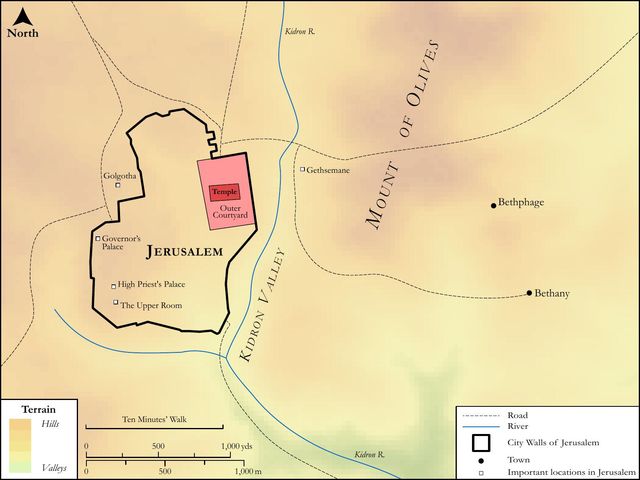
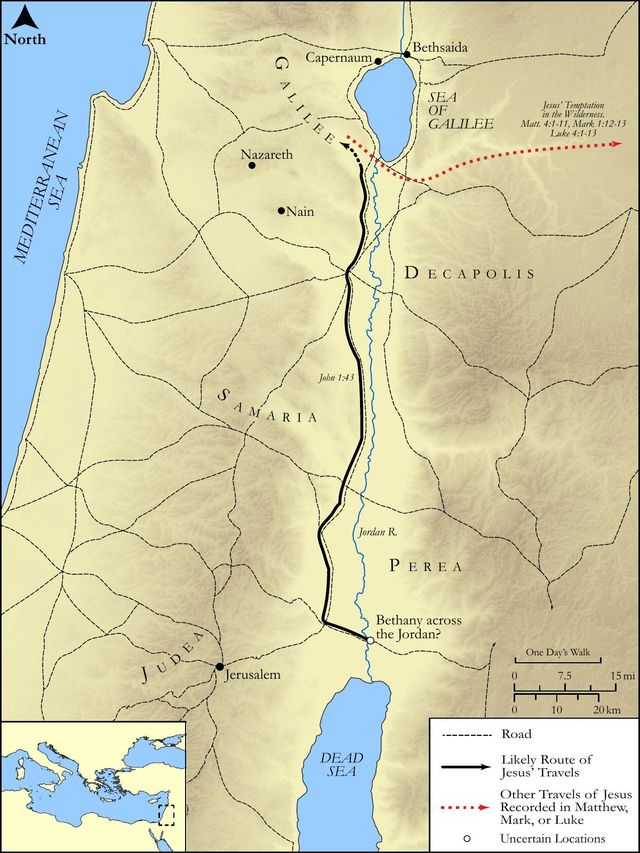
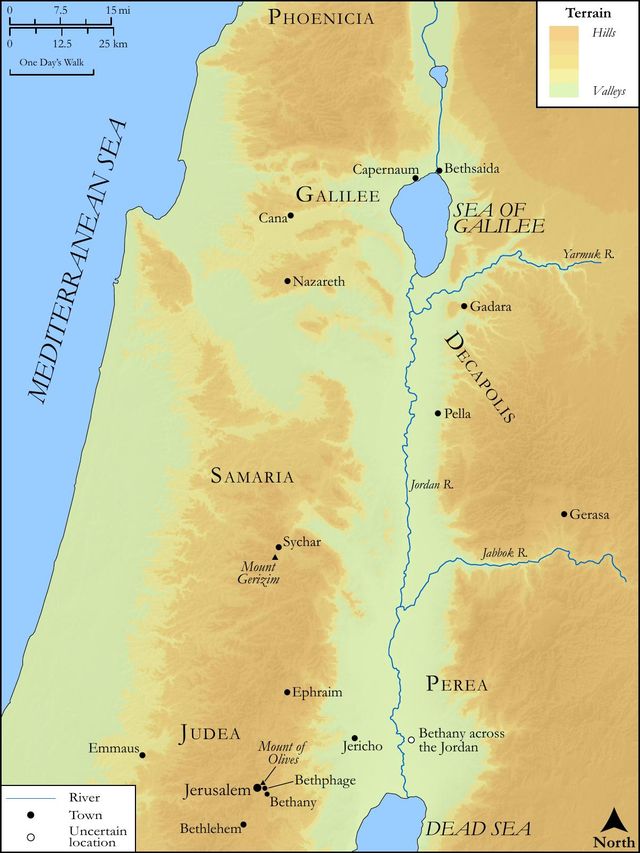
See on the biblical-era map
Study this verse
Public-domain commentary
Matthew Henry
From his Commentary on the Whole Bible. Henry comments on passages, not single verses — this entry covers John 1:29–36. His four-level outline is real structure in the source text, so it is rendered as structure.
We have in these verses an account of John's testimony concerning Jesus Christ, which he witnessed to his own disciples that followed him. As soon as ever Christ was baptized he was immediately hurried into the wilderness, to be tempted; and there he was forty days. During his absence John had continued to bear testimony to him, and to tell the people of him; but now at last he sees Jesus coming to him, returning from the wilderness of temptation. As soon as that conflict was over Christ immediately returned to John, who was preaching and baptizing. Now Christ was tempted for example and encouragement to us; and this teaches us, 1. That the hardships of a tempted state should engage us to keep close to ordinances; to go into the sanctuary of God, Psa 73:17. Our combats with Satan should oblige us to keep close to the communion of saints: two are better than one. 2. That the honours of a victorious state must not set us above ordinances. Christ had triumphed over Satan, and been attended by angels, and yet, after all, he returns to the place where John was preaching and baptizing. As long as we are on this side heaven, whatever extraordinary visits of divine grace we may have here at any time, we must still keep close to the ordinary means of grace and comfort, and walk with God in them. Now here are two testimonies borne by John to Christ, but those two agree in one.
I.Here is his testimony to Christ on the first day that he saw him coming from the wilderness; and here four things are witnessed by him concerning Christ, when he had him before his eyes: -
1.That he is the Lamb of God which taketh away the sin of the world, Joh 1:29. Let us learn here,
(1.)That Jesus Christ is the Lamb of God, which bespeaks him the great sacrifice, by which atonement is made for sin, and man reconciled to God. Of all the legal sacrifices he chooses to allude to the lambs that were offered, not only because a lamb is an emblem of meekness, and Christ must be led as a lamb to the slaughter (Isa 53:7), but with a special reference,
[1.]To the daily sacrifice, which was offered every morning and evening continually, and that was always a lamb (Exo 29:38), which was a type of Christ, as the everlasting propitiation, whose blood continually speaks.
[2.]To the paschal lamb, the blood of which, being sprinkled upon the door-posts, secured the Israelites from the stroke of the destroying angel. Christ is our passover, Co1 5:7. He is the Lamb of God; he is appointed by him (Rom 3:25), he was devoted to him (Joh 17:19), and he was accepted with him; in him he was well pleased. The lot which fell on the goat that was to be offered for a sin-offering was called the Lord's lot (Lev 16:8, Lev 16:9); so Christ, who was to make atonement for sin, is called the Lamb of God.
(2.)That Jesus Christ, as the Lamb of God, takes away the sin of the world. This was his undertaking; he appeared, to put away sin by the sacrifice of himself, Heb 9:26. John Baptist had called people to repent of their sins, in order to the remission of them. Now here he shows how and by whom that remission was to be expected, what ground of hope we have that our sins shall be pardoned upon our repentance, though our repentance makes no satisfaction for them. This ground of hope we have - Jesus Christ is the Lamb of God.
[1.]He takes away sin. He, being Mediator between God and man, takes away that which is, above any thing, offensive to the holiness of God, and destructive to the happiness of man. He came, First, To take away the guilt of sin by the merit of his death, to vacate the judgment, and reverse the attainder, which mankind lay under, by an act of indemnity, of which all penitent obedient believers may claim the benefit. Secondly, To take away the power of sin by the Spirit of his grace, so that it shall not have dominion, Rom 6:14. Christ, as the Lamb of God, washes us from our sins in his own blood; that is, he both justifies and sanctifies us: he takes away sin. He is ho airōn - he is taking away the sin of the world, which denotes it not a single but a continued act; it is his constant work and office to take away sin, which is such a work of time that it will never be completed till time shall be no more. He is always taking away sin, by the continual intercession of his blood in heaven, and the continual influence of his grace on earth.
[2.]He takes away the sin of the world; purchases pardon for all those that repent, and believe the gospel, of what country, nation, or language, soever they be. The legal sacrifices had reference only to the sins of Israel, to make atonement for them; but the Lamb of God was offered to be a propitiation for the sin of the whole world; see Jo1 2:2. This is encouraging to our faith; if Christ takes away the sin of the world, then why not my sin? Christ levelled his force at the main body of sin's army, struck at the root, and aimed at the overthrow, of that wickedness which the whole world lay in. God was in him reconciling the world to himself.
[3.]He does this by taking it upon himself. He is the Lamb of God, that bears the sin of the world; so the margin reads it. He bore sin for us, and so bears it from us; he bore the sin of many, as the scape-goat had the sins of Israel put upon his head, Lev 16:21. God could have taken away the sin by taking away the sinner, as he took away the sin of the old world; but he has found out a way of abolishing the sin, and yet sparing the sinner, by making his Son sin for us.
(3.)That it is our duty, with an eye of faith, to behold the Lamb of God thus taking away the sin of the world. See him taking away sin, and let that increase our hatred of sin, and resolutions against it. Let not us hold that fast which the Lamb of God came to take away: for Christ will either take our sins away or take us away. Let it increase our love to Christ, who loved us, and washed us from our sins in his own blood, Rev 1:5. Whatever God is pleased to take away from us, if withal he take away our sins, we have reason to be thankful, and no reason to complain.
2.That this was he of whom he had spoken before (Joh 1:30, Joh 1:31): This is he, this person whom I now point at, you see where he stands, this is he of whom I said, After me cometh a man. Observe,
(1.)This honour John had above all the prophets, that, whereas they spoke of him as one that should come, he saw him already come. This is he. He sees him now, he sees him nigh, Num 24:17. Such a difference there is between present faith and future vision. Now we love one whom we have not seen; then we shall see him whom our souls love, shall see him, and say, This is he of whom I said, my Christ, and my all, my beloved, and my friend.
(2.)John calls Christ a man; after me comes a man - anēr, a strong man: like the man, the branch, or the man of God's right hand.
(3.)He refers to what he had himself said of him before: This is he of whom I said. Note, Those who have said the most honourable things of Christ will never see cause to unsay them; but the more they know him the more they are confirmed in their esteem of him. John still thinks as meanly of himself, and as highly of Christ, as ever. Though Christ appeared not in any external pomp or grandeur, yet John is not ashamed to own, This is he whom I meant, who is preferred before me. And it was necessary that John should thus show them the person, otherwise they could not have believed that one who made so mean a figure should be he of whom John had spoken such great things.
(4.)He protests against any confederacy or combination with this Jesus: And I knew him not. Though there was some relation between them (Elisabeth was cousin to the virgin Mary), yet there was no acquaintance at all between them; John had no personal knowledge of Jesus till he saw him come to his baptism. Their manner of life had been different: John had spent his time in the wilderness, in solitude; Jesus at Nazareth, in conversation. There was no correspondence, no interview between them, that the matter might appear to be wholly carried on by the direction and disposal of Heaven, and not by any design or concert of the persons themselves. And as he hereby disowns all collusion, so also all partiality and sinister regard in it; he could not be supposed to favour him as a friend, for there was no friendship or familiarity between them. Nay, as he could not be biassed to speak honourably of him because he was a stranger to him, he was not able to say any thing of him but what he received from above, to which he appeals, Joh 3:27. Note, They who are taught believe and confess one whom they have not seen, and blessed are they who yet have believed.
(5.)The great intention of John's ministry and baptism was to introduce Jesus Christ. That he should be made manifest to Israel, therefore am I come baptizing with water. Observe,
[1.]Though John did not know Jesus by face, yet he knew that he should be made manifest. Note, We may know the certainty of that which yet we do not fully know the nature and intention of. We know that the happiness of heaven shall be made manifest to Israel, but cannot describe it.
[2.]The general assurance John had that Christ should be made manifest served to carry him with diligence and resolution through his work, though he was kept in the dark concerning particulars: Therefore am I come. Our assurance of the reality of things, though they are unseen, is enough to quicken us to our duty.
[3.]God reveals himself to his people by degrees. At first, John knew no more concerning Christ but that he should be made manifest; in confidence of that, he came baptizing, and now he is favoured with a sight of him. They who, upon God's word, believe what they do not see, shall shortly see what they now believe.
[4.]The ministry of the word and sacraments is designed for no other end than to lead people to Christ, and to make him more and more manifest.
[5.]Baptism with water made way for the manifesting of Christ, as it supposed our corruption and filthiness, and signified our cleansing by him who is the fountain opened.
3.That this was he upon whom the Spirit descended from heaven like a dove. For the confirming of his testimony concerning Christ, he here vouches the extraordinary appearance at his baptism, in which God himself bore witness to him. This was a considerable proof of Christ's mission. Now, to assure us of the truth of it, we are here told (Joh 1:32-34),
(1.)That John Baptist saw it: He bore record; did not relate it as a story, but solemnly attested it, with all the seriousness and solemnity of witness-bearing. He made affidavit of it: I saw the Spirit descending from heaven. John could not see the Spirit, but he saw the dove which was a sign and representation of the Spirit. The Spirit came now upon Christ, both to make him fir for his work and to make him known to the world. Christ was notified, not by the descent of a crown upon him, or by a transfiguration, but by the descent of the Spirit as a dove upon him, to qualify him for his undertaking. Thus the first testimony given to the apostles was by the descent of the Spirit upon them. God's children are made manifest by their graces; their glories are reserved for their future state. Observe,
[1.]The spirit descended from heaven, for every good and perfect gift is from above.
[2.]He descended like a dove - an emblem of meekness, and mildness, and gentleness, which makes him fit to teach. The dove brought the olive-branch of peace, Gen 8:11.
[3.]The Spirit that descended upon Christ abode upon him, as was foretold, Isa 11:2. The Spirit did not move him at times, as Samson (Jdg 13:25), but at all times. The Spirit was given to him without measure; it was his prerogative to have the Spirit always upon him, so that he could at no time be found either unqualified for his work himself or unfurnished for the supply of those that seek to him for his grace.
(2.)That he was told to expect it, which very much corroborates the proof. It was not John's bare conjecture, that surely he on whom he saw the Spirit descending was the Son of God; but it was an instituted sign given him before, by which he might certainly know it (Joh 1:33): I knew him not. He insists much upon this, that he knew no more of him than other people did, otherwise than by revelation. But he that sent me to baptize gave me this sign, Upon whom thou shalt see the Spirit descending, the same is he.
[1.]See here what sure grounds John went upon in his ministry and baptism, that he might proceed with all imaginable satisfaction. First, He did not run without sending: God sent him to baptize. He had a warrant from heaven for what he did. When a minister's call is clear, his comfort is sure, though his success is not always so. Secondly, He did not run without speeding; for, when he was sent to baptize with water, he was directed to one that should baptize with the Holy Ghost. Under this notion John Baptist was taught to expect Christ, as one who would give that repentance and faith which he called people to, and would carry on and complete that blessed structure of which he was now laying the foundation. Note, It is a great comfort to Christ's ministers, in their administration of the outward signs, that he whose ministers they are can confer the grace signified thereby, and so put life, and soul, and power into their ministrations; can speak to the heart what they speak to the ear, and breathe upon the dry bones to which they prophesy.
[2.]See what sure grounds he went upon in his designation of the person of the Messiah. God had before given him a sign, as he did to Samuel concerning Saul: "On whom thou shalt see the Spirit descend, that same is he." This not only prevented any mistakes, but gave him boldness in his testimony. When he had such assurance as this given him, he could speak with assurance. When John was told this before, his expectations could not but be very much raised; and, when the event exactly answered the prediction, his faith could not but be much confirmed: and these things are written that we may believe.
4.That he is the Son of God. This is the conclusion of John's testimony, that in which all the particulars centre, as the quod erat demonstrandum - the fact to be demonstrated (Joh 1:34): I saw, and bore record, that this is the Son of God.
(1.)The truth asserted is, that this is the Son of God. The voice from heaven proclaimed, and John subscribed to it, not only that he should baptize with the Holy Ghost by a divine authority, but that he has a divine nature. This was the peculiar Christian creed, that Jesus is the Son of God (Mat 16:16), and here is the first framing of it.
(2.)John's testimony to it: "I saw, and bore record. Not only I now bear record of it, but I did so as soon as I had seen it." Observe,
[1.]What he saw he was forward to bear record of, as they, Act 4:20 : We cannot but speak the things which we have seen.
[2.]What he bore record of was what he saw. Christ's witnesses were eye-witnesses, and therefore the more to be credited: they did not speak by hear-say and report, Pe2 1:16.
II.Here is John's testimony to Christ, the next day after, Joh 1:35, Joh 1:36. Where observe,
1.He took every opportunity that offered itself to lead people to Christ: John stood looking upon Jesus as he walked. It should seem, John was now retired from the multitude, and was in close conversation with two of his disciples. Note, Ministers should not only in their public preaching, but in their private converse, witness to Christ, and serve his interests. He saw Jesus walking at some distance, yet did not go to him himself, because he would shun every thing that might give the least colour to suspect a combination. He was looking upon Jesus - emblepsas; he looked stedfastly, and fixed his eyes upon him. Those that would lead others to Christ must be diligent and frequent in the contemplation of him themselves. John had seen Christ before, but now looked upon him, Jo1 1:1.
2.He repeated the same testimony which he had given to Christ the day before, though he could have delivered some other great truth concerning him; but thus he would show that he was uniform and constant in his testimony, and consistent with himself. His doctrine was the same in private that it was in public, as Paul's was, Act 20:20, Act 20:21. It is good to have that repeated which we have heard, Phi 3:1. The doctrine of Christ's sacrifice for the taking away of the sin of the world ought especially to be insisted upon by all good ministers: Christ, the Lamb of God, Christ and him crucified.
3.He intended this especially for his two disciples that stood with him; he was willing to turn them over to Christ, for to this end he bore witness to Christ in their hearing that they might leave all to follow him, even that they might leave him. He did not reckon that he lost those disciples who went over from him to Christ, any more than the schoolmaster reckons that scholar lost whom he sends to the university. John gathered disciples, not for himself, but for Christ to prepare them for the Lord, Luk 1:17. So far was he from being jealous of Christ's growing interest, that there was nothing he was more desirous of. Humble generous souls will give others their due praise without fear of diminishing themselves by it. What we have of reputation, as well as of other things, will not be the less for our giving every body his own.
Historical interpretation
Eleven Centuries of Reception
27 surviving comments on this verse. Each one is dated, so this reads as a timeline rather than a list.
Select a marker to jump to its quote. Markers stagger vertically where authors wrote within a few decades of each other.
First of all, the Scripture about the Hebrew Exodus has been read and the words of the mystery have been explained as to how the sheep was sacrificed and the people were saved.
Therefore, understand this, O beloved: The mystery of the passover is new and old, eternal and temporal, corruptible and incorruptible, mortal and immortal...
The sheep was corruptible, but the Lord is incorruptible, who was crushed as a lamb, but who was resurrected as God. For although he was led to sacrifice as a sheep, yet he was not a sheep; and although he was as a lamb without voice, yet indeed he was not a lamb. The one was the model; the other was found to be the finished product.
For God replaced the lamb, and a man the sheep; but in the man was Christ, who contains all things...
For the one who was born as Son, and led to slaughter as a lamb, and sacrificed as a sheep, and buried as a man, rose up from the dead as God, since he is by nature both God and man.
He is everything... in that he is begotten he is Son, in that he suffers he is sheep, in that he is buried he is man, in that he comes to life again he is God.
Such is Jesus Christ, to whom be the glory forever. Amen.
John made known, saying, "Behold the Lamb of God, who taketh away the sin of the world. This is He of whom I said, After me cometh a man who was made before me; because He was prior to me: and of His fulness have all we received." This, therefore, was the knowledge of salvation; but it did not consist in another God, nor another Father, nor Bythus, nor the Pleroma of thirty Aeons, nor the Mother of the Ogdoad: but the knowledge of salvation was the knowledge of the Son of God, who is both called and actually is, salvation, and Saviour, and salutary.
In fact, they say that Jesus Christ descended, that is, that the dove came down on Jesus; and, since the dove is styled by the Greek name peristera/-(peristera), it has in itself this number DCCCI.
Then, again, when He is designated by John (the Baptist) as "the Lamb of God," He is not described as Himself the same with Him of whom He is the beloved Son.
"He was," He says, "the burning and shining lamp; " as being he who not merely "prepared His ways in the desert," but withal, by pointing out "the Lamb of God," illumined the minds of men by his heralding, so that they understood Him to be that Lamb whom Moses was wont to announce as destined to suffer.
In order, then, to show the time when He is to come whom the blessed Daniel desired to see, he says, "And after seven weeks there are other threescore and two weeks," which period embraces the space of 434 years. For after the return of the people from Babylon under the leadership of Jesus the son of Josedech, and Ezra the scribe, and Zerubbabel the son of Salathiel, of the tribe of David, there were 434 years unto the coming of Christ, in order that the Priest of priests might be manifested in the world, and that He who taketh away the sins of the world might be evidently set forth, as John speaks concerning Him: "Behold the Lamb of God, that taketh away the sin of the world!" And in like manner Gabriel says: "To blot out transgressions, and make reconciliation for sins." But who has blotted out our transgressions? Paul the apostle teaches us, saying, "He is our peace who made both one; " and then, "Blotting out the handwriting of sins that was against us."
Now, as our Lord Jesus Christ, who is also God, was prophesied of under the figure of a lion, on account of His royalty and glory, in the same way have the Scriptures also aforetime spoken of Antichrist as a lion, on account of his tyranny and violence. For the deceiver seeks to liken himself in all things to the Son of God. Christ is a lion, so Antichrist is also a lion; Christ is a king, so Antichrist is also a king. The Saviour was manifested as a lamb; so he too, in like manner, will appear as a lamb, though within he is a wolf. The Saviour came into the World in the circumcision, and he will come in the same manner. The Lord sent apostles among all the nations, and he in like manner will send false apostles. The Saviour gathered together the sheep that were scattered abroad, and he in like manner will bring together a people that is scattered abroad. The Lord gave a seal to those who believed on Him, and he will give one like manner. The Saviour appeared in the form of man, and he too will come in the form of a man. The Saviour raised up and showed His holy flesh like a temple, and he will raise a temple of stone in Jerusalem. And his seductive arts we shall exhibit in what follows. But for the present let us turn to the question in hand.
He, on hearing the salutation addressed to Elisabeth, leaped with joy in his mother's womb, recognising God the Word conceived in the womb of the Virgin. Thereafter he came forward preaching in the wilderness, proclaiming the baptism of repentance to the people, (and thus) announcing prophetically salvation to the nations living in the wilderness of the world. After this, at the Jordan, seeing the Saviour with his own eye, he points Him out, and says, "Behold the Lamb of God, that taketh away the sin of the world!" He also first preached to those in Hades, becoming a forerunner there when he was put to death by Herod, that there too he might intimate that the Saviour would descend to ransom the souls of the saints from the hand of death.
There are five animals that are offered on the altar, three being land animals and two winged. It seems worthwhile to me to ask why the Savior is said to be a "lamb" by John and none of the rest. But also, in the case of the land animals, since three types of animal are offered according to each species, why did he name the lamb from the species of sheep? Now these are the five animals: a young bull, a sheep, a goat, a turtledove, a pigeon.And the three types of sheep are a ram, the ewe and the lamb.… It is the lamb, however, that we find offered in the perpetual sacrifices. … What other perpetual sacrifice can be spiritual to a spiritual being than the Word in his prime, the Word symbolically called "lamb"?… But if we examine the declaration about Jesus, who is pointed out by John in the words "Behold the Lamb of God who takes away the sin of the world," from the standpoint of the plan of salvation when the Son of God bodily lived among the human race, we will assume that the lamb is none other than his humanity. For he "was led as a sheep to the slaughter and was dumb as a lamb before its shearer," saying, "I was an innocent lamb being led to be sacrificed."
This is why in the Apocalypse, too, a little lamb is seen "standing as though slain." This lamb, indeed, which was slain according to certain secret reasons, has become the expiation of the whole world. According to the Father's love for humanity, he also submitted to slaughter on behalf of the world, purchasing us with his own blood from him who bought us when we had sold ourselves into sin. He, however, who led this lamb to the sacrifice was God in man, the great high priest, who reveals this through the saying, "No one takes my life from me, but I lay it down of myself. I have power to lay it down, and I have power to take it up again."
(tom. vi. c. 30) After this testimony, Jesus is seen coming to John, not only persevering in his confession, but also advanced in goodness: as is intimated by the second day. Wherefore it is said, The next day John seeth Jesus coming to him. Long before this, the Mother of Jesus, as soon as she had conceived Him, went to see the mother of John then pregnant; and as soon as the sound of Mary's salutation reached the ears of Elisabeth, John leaped in the womb: but now the Baptist himself after his testimony seeth Jesus coming. Men are first prepared by hearing from others, and then see with their own eyes. The example of Mary going to see Elisabeth her inferior, and the Son of God going to see the Baptist, should teach us modesty and fervent charity to our inferiors. What place the Saviour came from when He came to the Baptist we are not told here; but we find it in Matthew, Then cometh Jesus from Galilee to Jordan unto John to be baptized of him. (Matt. 3:13)
(tom. vi. c. 32. et seq.) But whereas five kinds of animals are offered in the temple, three beasts of the field, a calf, a sheep, and a goat; and two fowls of the air, a turtle dove and a pigeon; and of the sheep kind three are introduced, the ram, the ewe, the lamb; of these three he mentions only the lamb; the lamb, as we know, being offered in the daily sacrifice, one in the morning, and one in the evening. But what other daily offering can there be, that can be meant to be offered by a reasonable nature, except the perfect Word, typically called the Lamb? This sacrifice, which is offered up as soon as the soul begins to be enlightened, shall be accounted as a morning sacrifice, referring to the frequent exercise of the mind in divine things; for the soul cannot continually apply to the highest objects because of its union with an earthly and gross body. By this Word too, Which is Christ the Lamb, we shall be able to reason on many things, and shall in a manner attain to Him in the evening, while engaged with things of the bodyt. But He Who offered the lamb for a sacrifice, was God hid in human form, the great Priest, He who saith below, No man taketh it (My life) from Me, but I lay it down of Myself: (John 10:18) whence this name, the Lamb of God: for He carrying our sorrows, (Isaiah 53:4. 1 Pet. 2:24.) and taking away the sins of the whole world, hath undergone death, as it were baptism. (Luke 12:50.) For God suffers no fault to pass uncorrected; but punishes it by the sharpest discipline.
(tom. vi. c. 36) As there was a connection between the other sacrifices of the law, and the daily sacrifice of the lamb, in the same way the sacrifice of this Lamb has its reflexion in the pouring out of the blood of the Martyrs, by whose patience, confession, and zeal for goodness, the machinations of the ungodly are frustrated.
That Christ is called a sheep and a lamb who was to be slain, and concerning the sacrament (mystery) of the passion. In Isaiah: "He was led as a sheep to the slaughter, and as a lamb before his shearer is dumb, so He opened not His mouth. In His humiliation His judgment was taken away: who shall relate His nativity? Because His life shall be taken away from the earth. By the transgressions of my people He was led to death; and I will give the wicked for His burial, and the rich themselves for His death; because He did no wickedness, nor deceits with His mouth. Wherefore He shall gain many, and shall divide the spoils of the strong; because His soul was delivered up to death, and He was counted among transgressors. And He bare the sins of many, and was delivered for their offences." Also in Jeremiah: "Lord, give me knowledge, and I shall know it: then I saw their meditations. I was led like a lamb without malice to the slaughter; against me they devised a device, saying, Come, let us cast the tree into His bread, and let us erase His life from the earth, and His name shall no more be a remembrance." Also in Exodus God said to Moses: "Let them take to themselves each man a sheep, through the houses of the tribes, a sheep without blemish, perfect, male, of a year old it shall be to you. Ye shall take it from the lambs and from the goats, and all the congregation of the synagogue of the children of Israel shall kill it in the evening; and they shall take of its blood, and shall place it upon the two posts, and upon the threshold in the houses, in the very houses in which they shall eat it. And they shall eat the flesh on the same night, roasted with fire; and they shall eat unleavened bread with bitter herbs. Ye shall not eat of them raw nor dressed in water, but roasted with fire; the head with the feet and the inward parts. Ye shall leave nothing of them to the morning; and ye shall not break a bone of it. But what of it shall be left to the morning shall be burnt with fire. But thus ye shall eat it; your loins girt, and your sandals on your feet, and your staff in your hands; and ye shall eat it in haste: for it is the Lord's passover." Also in the Apocalypse: "And I saw in the midst of the throne, and of the four living creatures, and in the midst of the elders, a Lamb standing as if slain, having seven horns and seven eyes, which are the seven spirits of God sent forth throughout all the earth. And He came and took the book from the right. hand of God, who sate on the throne. And when He had taken the book, the four living creatures and the four and twenty elders cast themselves before the Lamb, having every one of them harps and golden cups full of odours of supplications, which are the prayers of the saints; and they sang a new song, saying, Worthy art Thou, O Lord, to take the book, and to open its seals: for Thou wast slain, and hast redeemed us with Thy blood from every tribe, anti and people, and nation; and Thou hast made us a kingdom unto our God, and hast made us priests, and they shall reign upon the earth." Also in the Gospel: "On the next day John saw Jesus coming to him, and saith, Behold the Lamb of God, and behold Him that taketh away the sins of the world!"
The sacrifice was the Christ of God, foretold in ancient times as coming to human beings, to be sacrificed like a sheep for the whole human race. As Isaiah the prophet says of him: “As a sheep he was led to slaughter, and as a lamb before her shearers he did not open his mouth.” And he adds, “He bears our sins and is pained for us; yet we accounted him to be in trouble, and in suffering, and our sins, and he was made sick on account of our iniquities, the chastisement of our peace was upon him, and with his stripes we are healed.… And the Lord has given him up for our iniquities.… For he himself did not sin, nor was guile found in his mouth.” Jeremiah, another Hebrew prophet, speaks similarly in the person of Christ: “I was led as a lamb to the slaughter.”John the Baptist sets the seal on their predictions at the appearance of our Savior. For beholding him, and pointing him out to those present as the one foretold by the prophets, he cried, “Behold, the Lamb of God, who takes away the sin of the world.”
Abel knew how to divide when he offered a sacrifice from “the firstlings of his flock,” teaching that the gifts of the earth, which had degenerated in the sinner, will not please God. But those in which the grace of the divine mystery shone forth will please him. And so he prophesied that we were to be redeemed from fault through the passion of the Lord, of whom it is written: “Here is the lamb of God who takes away the sin of the world.” Thus, too, he made an offering from the firstlings, that he might signify the firstborn. Therefore, he shows that God’s true sacrifice would be us, of whom the prophet says, “Bring to the Lord the offspring of rams.” And worthily is he confirmed by the judgment of God.
(Hom. xvii. [al. xvi.]) Or; Matthew relates directly Christ's coming to His baptism, John His coming a second time subsequent to His baptism, as appears from what follows: I saw the Spirit descending, &c. The Evangelists have divided the periods of the history between them; Matthew passing over the part before John's imprisonment, and hastening to that event; John chiefly dwelling on what took place before the imprisonment. Thus he says, The next day John seeth Jesus coming to him. But why did He come to him the next day after His baptism? Having been baptized with the multitude, He wished to prevent any from thinking that He came to John for the same reason that others did, viz. to confess His sins, and be washed in the river unto repentance. He comes therefore to give John an opportunity of correcting this mistake; which John accordingly did correct; viz. by those words, Behold the Lamb of God, which taketh away the sin of the world. For He Who was so pure, as to be able to absolve other men's sins, evidently could not have come thither for the sake of confessing His own; but only to give John an opportunity of speaking of Him. He came too the next day, that those who had heard the former testimonies of John, might hear them again more plainly; and other besides. For he saith, Behold the Lamb of God, signifying that He was the one of old sought after, and reminding them of the prophecy of Isaiah, and of the shadows of the Mosaic law, in order that through the figure he might the easier lead them to the substance.
(Hom. xvii. [al. xvi.] 2) That He might not seem however to give His testimony from any motive of friendship or kindred, in consequence of his being related to our Lord according to the flesh, he says, I knew Him not. John could not of course know Him, having lived in the desert. And the miraculous events of Christ's childhood, the journey of the Magi, and such like, were now a long time past; John having been quite an infant, when they happened. And throughout the whole of the interval, He had been absolutely unknown: insomuch that John proceeds, But that He should be made manifest to Israel, therefore am I come baptizing with water. (And hence it is clear that the miracles said to have been performed by Christ in His childhood, are false and fictitious. For if Jesus had performed miracles at this early age, he would not have been unknown to John, nor would the multitude have wanted a teacher to point Him out.) Christ Himself then did not want baptism; nor was that washing for any other reason, than to give a sign beforehand of faith in Christ. For John saith not, in order to change men, and deliver from sin, but, that he should be made manifest in Israel, have I come baptizing. But would it not have been lawful for him to preach, and bring crowds together, without baptizing? Yes: but this was the easier way, for he would not have collected such numbers, had he preached without baptizing.
"The next day he seeth Jesus coming to him, and saith, Behold the Lamb of God, which taketh away the sin of the world."
Wherefore then did He come to John? In order that since John had baptized Him with many (others), no one might suppose that He had hastened to John for the same reason as the rest to confess sins, and to wash in the river unto repentance. For this He comes, to give John an opportunity of setting this opinion right again, for by saying, "Behold the Lamb of God, that taketh away the sin of the world," he removes the whole suspicion. For very plain it is that One so pure as to be able to wash away the sins of others, does not come to confess sins, but to give opportunity to that marvelous herald to impress what he had said more definitely on those who had heard his former words, and to add others besides. The word "Behold" is used, because many had been seeking Him by reason of what had been said, and for a long time. For this cause, pointing Him out when present, he said, "Behold," this is He so long sought, this is "the Lamb." He calls Him "Lamb," to remind the Jews of the prophecy of Isaiah, and of the shadow under the law of Moses, that he may the better lead them from the type to the reality. That Lamb of Moses took not at once away the sin of any one; but this took away the sin of all the world; for when it was in danger of perishing, He quickly delivered it from the wrath of God.
As appears from the narrative of the Evangelist, John the Baptist said his previous words as if the Lord had come already and walked among crowds who still ignored him. Now, since he is coming to be baptized, he is described with the words “this is the Lamb of God.” Let us consider how Scripture likes to place words in the appropriate context of facts. By saying in this passage, “This is the one who takes away the sin of the world,” he did not say “the only begotten Son,” or the “Son of God” or “the one who is close to the father’s bosom,” which appear in what he said above. Although now it would have seemed right to express the greatness of his nature, in order to confirm the promise of the things he was going to give. But this is not what he said. Instead, he called him “lamb,” and with this name he signifies his passion. In fact, he was called lamb and sheep to signify his death when he washed away sin. Since the sin reigned in our mortality, and death was gaining strength in us because of sin, Jesus Christ, our Lord and Savior came and remitted all these things to us. And after destroying death through his death, he also destroyed the sin rooted in our nature because of mortality. Through his promise he made us immortal, and he will render us so in reality when he defeats sin with the gift of immortality.
"These things were done in Bethany, beyond Jordan, where John was baptizing. The next day John saw Jesus coming unto him, and saith, Behold the Lamb of God; behold Him who taketh away the sin of the world!" Let no one so arrogate to himself as to say that he taketh away the sin of the world. Give heed now to the proud men at whom John pointed the finger. The heretics were not yet born, but already were they pointed out; against them he then cried from the river, against whom he now cries from the Gospel. Jesus comes, and what says he? "Behold the Lamb of God!" If to be innocent is to be a lamb, then John was a lamb, for was not he innocent? But who is innocent? To what extent innocent? All come from that branch and shoot, concerning which David sings, even with groanings, "Behold, I was shapen in iniquity; and in sin did my mother conceive me." Alone, then, was He, the Lamb who came, not so. For He was not conceived in iniquity, because not conceived of mortality; nor did His mother conceive Him in sin, whom the Virgin conceived, whom the Virgin brought forth; because by faith she conceived, and by faith received Him. Therefore, "Behold the Lamb of God." He is not a branch derived from Adam: flesh only did he derive from Adam, Adam's sin He did not assume. He who took not upon Him sin from our lump, He it is who taketh away our sin. "Behold the Lamb of God, who taketh away the sin of the world!"
You know that certain men say sometimes, We take away sin from men, we who are holy; for if he be not holy who baptizeth, how taketh he away the sin of another, when he is a man himself full of sin? In opposition to these disputations, let us not speak our own words, let us read what John says: "Behold the Lamb of God; behold Him who taketh away the sin of the world!" Let there not be presumptuous confidence of men upon men: let not the sparrow flee to the mountains, but let it trust in the Lord; and if it lift its eyes to the mountains, from whence cometh aid to it, let it understand that its aid is from the Lord who made heaven and earth. So great is the excellence of John, that to him it is said, "Art thou the Christ?" He says, No. Art thou Elias? He says, No. Art thou a prophet? He says, No. Wherefore then dost thou baptize? "Behold the Lamb of God; behold Him who taketh away the sin of the world!"
(Tr. iv. c. 10) If the Lamb of God is innocent, and John is the lamb, must he not be innocent? But all men come of that stock of which David sings sorrowing, Behold, I was conceived in wickedness. (Ps. 51:5) He then alone was the Lamb, who was not thus conceived; for He was not conceived in wickedness, nor in sin did His mother bear Him in her womb, Whom a virgin conceived, a virgin brought forth, because that in faith she conceived, and in faith received.
(Tr. iv. c. 10, 11) For He Who took not sin from our nature, He it is Who taketh away our sin. Some say, We take away the sins of men, because we are holy; for if he, who baptizes, is not holy, how can he take away the other's sin, seeing he himself is full of sin? Against these reasoners let us point to the text; Behold Him Who taketh away the sin of the world; in order to do away with such presumption in man towards man.
It was Christ that was represented by a ram, Christ by a lamb, Christ by a calf, Christ by a goat—everything was Christ. He was represented by the ram because it leads the flock. It was found in the thorns when our father Abraham was ordered to spare his son but not to depart without offering any sacrifice. Isaac was Christ, and the ram was Christ. Isaac carried the wood for sacrificing himself; Christ was burdened with his own cross. The ram was substituted for Isaac; but not of course Christ for Christ. But Christ was in both Isaac and the ram. The ram was caught by its horns in the thorn bush; ask the Jews what they crowned the Lord with that time. He is the lamb: "Behold, the Lamb of God, who takes away the sins of the world."
No longer does John need to “prepare the way,” since the one for whom the preparation was being made is right there before his eyes.… But now he who of old was dimly pictured, the very Lamb, the spotless Sacrifice, is led to the slaughter for all, that he might drive away the sin of the world, that he might overturn the destroyer of the earth, that dying for all he might annihilate death, that he might undo the curse that is upon us.… For one Lamb died for all, saving the whole flock on earth to God the Father, one for all, that he might subject all to God.
And saith, Behold the Lamb of God, Which taketh away the sin of the world.
No longer has prepare ye the way fit place, since He at length is seen and is before the eyes for Whom the preparation is made: the nature of the thing began to need other words. It needed to explain, Who He is Who is come, and to whom He maketh His descent Who hath come to us from Heaven. Behold, therefore, saith he, the Lamb of God Which taketh away the sin of the world, Whom the Prophet Isaiah did signify to us, saying, He is brought as a lamb to the slaughter, and as a sheep before her shearers is dumb: Whom of old, too, saith he, the law of Moses typified, but then it saved in part, not extending mercy to all (for it was a type and shadow): but now He Who of old was dimly pictured, the very Lamb, the spotless Sacrifice, is led to the slaughter for all, that He might drive away the sin of the world, that He might overturn the destroyer of the earth, that dying for all He might bring to nought death, that He might undo the curse that is upon us, that He might at length end Dust thou art, and unto dust shalt thou return, that He might become the second Adam, not of the earth, but from heaven, and might be the beginning of all good to the nature of man, deliverance from the imported corruption, Bestower of eternal life, foundation of our reconciliation to God, beginning of godliness and righteousness, way to the Kingdom of Heaven. For one Lamb died for all, saving the whole flock on earth to God the Father, One for all, that He might subject all to God, One for all, that He might gain all: that at length all should not henceforth live to themselves but to Him Which died for them and rose again. For since we were in many sins, and therefore due to death and corruption, the Father hath given the Son a redemption for us, One for all, since all are in Him, and He above all. One died for all, that all should live in Him. For death having swallowed up the Lamb for all, hath vomited forth all in Him and with Him. For all we were in Christ, Who on account of us and for us died and rose again. But sin being destroyed, how could it be that death which was of it and because of it should not altogether come to nothing? The root dying, how could the shoot yet survive? wherefore should we yet die, now that sin hath been destroyed? therefore jubilant in the Sacrifice of the Lamb of God we say: O death, where is thy sting? O grave, where is thy victory? For all iniquity, as the Psalmist sings somewhere, shall stop her mouth, no longer able to accuse those who have sinned from infirmity. For it is God that justifieth, who is he that condemneth? Christ hath redeemed us from the curse of the law, being made a curse for us, that we might escape the curse from transgression.
The next day he seeth Jesus coming to him.
In a very little time, the Baptist is declared to be Prophet alike and Apostle. For Whom he was heralding as coming, Him now come he points out. Therefore, he bounded beyond even the measure of prophets, as the Saviour Himself saith when discoursing with the Jews concerning him, What went ye out into the wilderness for to see? A prophet, yea, I say unto you and more than a prophet. For they in their times prophesied that Christ should be revealed, but he, crying that He shall come, also pointed Him out come. For the next day, saith he, he seeth Jesus coming to him.
Now the the garment of mourning is rent; we have put on the white robe
Which the spirit has woven for us from the lamb’s fleece of our Lamb and our God;
Sin is taken away, and immortality is given us, our restoration is clear.
The Forerunner has proclaimed it.…
O, the message of the Baptist, and the mystery in it!
He calls the shepherd lamb, and not only a lamb, but one to free from mistakes.
He showed the lawless that the goat which they sent into the desert was ineffective.
“Lo,” he said, “the lamb; there is no longer need of the goat;
Put your hands on him,
All of you who confess your sins,
For He has come to take them away, those of the people, and of the whole world.
For lo, the One whom the Father has sent to us is the One who carries away evil,
Who appeared and illumined all things.”
But then only will sin be entirely taken away from the human race, when our corruption has been turned to a glorious incorruption. We cannot be free from sin, so long as we are held in the death of the body.
[Jesus] gave his blood as the price for our salvation, and by undergoing death for a time he condemned the sovereignty of death forever. The Lamb that was innocent was killed. But by a wonderful and longed-for display [of his power] he efficaciously weakened the strength of the lion that had killed him. The Lamb that took away the sins of the world brought to naught the lion that had brought sins into the world. It was the Lamb that restored us by the offering of his flesh and blood, so that we would not perish.
(in loc.) He is called the Lamb of God, because God the Father accepted His death for our salvation, or, in other words, because He delivered Him up to death for our sakes. For just as we say, This is the offering of such a man, meaning the offering made by him; in the same sense Christ is called the Lamb of God Who gave His Son to die for our salvation. And whereas that typical lamb did not take away any man's sin, this one hath taken away the sin of the whole world, rescuing it from the danger it was in from the wrath of God. Behold Him1 Who taketh away the sin of the world: he saith not, who will take, but, Who taketh away the sin of the world; as if He were always doing this. For He did not then only take it away when He suffered, but from that time to the present, He taketh it away; not by being always crucified, for He made one sacrifice for sins, but by ever washing it by means of that sacrifice.
(in loc.) Why does he say the sin of the world, not sins? Because he wished to express sin universally: just as we say commonly, that man was cast out of paradise; meaning the whole human race.
Or by the sin of the world is meant original sin, which is common to the whole world: which original sin, as well as the sins of every one individually, Christ by His grace remits.
Continue studying John 1:29 across the web’s major study libraries — every link below opens this exact verse, chapter, or book on the destination site.
Read & Compare
 BibleGatewayThis verse in more than 200 translations and 70 languages.
 Bible.comThe YouVersion reader — hundreds of translations, reading plans, and highlights.
 ESV.orgCrossway's official English Standard Version reader.
 NET BibleThe NET translation with 60,000+ translators' notes on every rendering decision.
 STEP BibleTyndale House's free study tool — original text, vocabulary, and scholarly resources.
 BibliaLogos Bible Software's free web reader.
 USCCBThe New American Bible (Revised Edition) with the U.S. bishops' study notes.
Commentaries
 BibleHub CommentariesDozens of classic commentaries on this verse, gathered on one page.
 StudyLightMore than 100 commentary sets — the largest collection on the web.
 BibleRefPlain-English commentary on what this verse means, verse by verse.
 Enduring WordDavid Guzik's free commentary on this chapter, widely used by Bible teachers.
 Bible Study ToolsVerse commentary alongside Greek and Hebrew study aids.
Original Language & Research
- BibleHub InterlinearThe verse word by word — original language, transliteration, and English.
- BibleHub LexiconEvery word's original-language definition and Strong's entry.
 Blue Letter BibleDeep-study tools — Strong's numbers, concordance, and word studies.
 CNTR CollationThe earliest Greek manuscripts of this verse, collated letter by letter.
Sermons, Hymns & Audio


TrulyRandomVerse is not affiliated with these sites and doesn’t control their content. They’re linked because they’re genuinely useful.
Summary
John 1:29 marks a pivotal moment in the Gospel narrative, as John the Baptist, divinely inspired, publicly identifies Jesus of Nazareth as "the Lamb of God, which taketh away the sin of the world." This profound declaration serves as the initial, authoritative revelation of Jesus' unique identity and redemptive mission, shifting the focus from John's preparatory ministry to the person and work of the Messiah, who is presented as the ultimate sacrifice for humanity's sin.
Context
ShowHideLiterary Context
This declaration immediately follows John the Baptist's encounter with the Jewish religious authorities from Jerusalem, where he steadfastly denied being the Christ, Elijah, or "the Prophet" but affirmed his role as "the voice of one crying in the wilderness, Make straight the way of the Lord" (John 1:23). John's humility and consistent pointing away from himself and towards the coming Messiah set the stage for this momentous revelation. The subsequent verses in John 1:30-34 further elaborate on John's witness, explaining that he himself did not initially know Jesus' identity but was sent to baptize with water so that Jesus "should be made manifest to Israel" (John 1:31). The Holy Spirit's descent upon Jesus, which John witnessed, confirmed Jesus' identity as the Son of God.
Historical & Cultural Context
The phrase "Lamb of God" would have resonated deeply with a Jewish audience steeped in the Old Testament sacrificial system. The most prominent association would be with the Passover lamb, whose blood protected Israel from the angel of death in Egypt. Daily sacrifices in the Temple also involved lambs, offered for the atonement of sin. Furthermore, the concept of a suffering servant who would be "led as a lamb to the slaughter" and "bear the sin of many" (Isaiah 53:7-12) was a significant prophetic theme, though often misunderstood in the context of a conquering Messiah. John's proclamation thus reorients the Messianic expectation, highlighting a redemptive, sacrificial role rather than a political one, drawing on rich theological imagery familiar to his listeners.
Key Themes
ShowHideThe central theme in John 1 is the revelation of Jesus as the incarnate Word of God, the Light of the world, and the Son of God. John 1:29 specifically introduces the theme of Jesus as the sacrificial Lamb, connecting His identity directly to the atonement for sin. This verse also establishes the universal scope of salvation, emphasizing that Jesus' work is for "the world," not exclusively for Israel. It underscores the theme of divine initiative and provision, as God Himself provides the ultimate sacrifice. Finally, it highlights the role of witness, as John faithfully points others to Jesus, fulfilling his prophetic calling to prepare the way for the Lord.
Exposition and Analysis
ShowHideKey Word Analysis
ShowHideThis word directly translates to "lamb" and carries immense theological weight. In the Old Testament, lambs were central to the sacrificial system, particularly the Passover (Exodus 12), and daily sin offerings. By calling Jesus "the Lamb," John immediately connects Him to these ancient rituals, signaling that Jesus is the ultimate, divinely appointed sacrifice for sin, fulfilling and superseding all previous offerings.
This primary root verb means "to lift up," "to take up or away," or "to bear." In the context of sin, it implies not merely covering or atoning for sin, but actively removing, bearing the burden of, and expiating it. This suggests a complete and decisive action, signifying a definitive removal of sin's guilt and power, rather than a temporary covering.
This term refers to "a sin" or "sin" in an abstract sense, encompassing both individual acts of transgression and the inherent sinful nature of humanity. The singular form "sin" (rather than "sins") emphasizes the collective, pervasive problem of humanity's rebellion against God, which Jesus addresses comprehensively.
This word denotes an "orderly arrangement," and by implication, "the world" in a wide or narrow sense, including its inhabitants, literally or figuratively (morally). Its use here signifies the universal scope of Jesus' redemptive work, extending beyond the Jewish people to all humanity, highlighting God's boundless love and desire for all people to be reconciled to Him.
Verse Breakdown
ShowHide"The next day John seeth Jesus coming unto him"
This phrase establishes the temporal and spatial context. "The next day" links this event directly to the preceding interrogation of John by the Jewish leaders, emphasizing the immediate divine revelation following John's clear declaration of his subservient role. John's act of "seeing" Jesus is not casual observation but a divinely guided recognition, preparing him for his public proclamation.
"and saith, Behold the Lamb of God"
This is the core declaration. John's immediate proclamation, "Behold!" (a call to attention), indicates the profound significance of what he is about to reveal. The title "Lamb of God" is a direct, Spirit-inspired identification of Jesus' unique identity and mission, immediately linking Him to the Old Testament sacrificial system and the concept of atonement. It reveals Jesus as the one provided by God Himself for the redemption of humanity.
"which taketh away the sin of the world."
This clause explains the purpose and effect of Jesus being the Lamb of God. The phrase "taketh away" signifies a complete removal or bearing away of sin. The singular "sin" points to the totality of humanity's fallen condition, while "of the world" underscores the universal reach of Jesus' atoning work, extending God's saving grace to all people, not just a select group.
Literary Devices
ShowHideThe verse employs significant Symbolism and Metaphor. The phrase "Lamb of God" is a powerful metaphor, drawing on the rich symbolic imagery of the Old Testament sacrificial system, particularly the Passover lamb and the suffering servant of Isaiah. This metaphor immediately communicates Jesus' role as the ultimate, innocent sacrifice for sin. The verb "taketh away" functions as a Synecdoche, where the action of removing sin represents the broader concept of atonement, reconciliation, and redemption. The phrase "sin of the world" uses Hyperbole to emphasize the comprehensive and universal nature of the problem of sin that Jesus addresses, encompassing all humanity and all forms of transgression. The entire declaration is a form of Prophetic Proclamation, as John, acting as God's messenger, reveals a profound truth about the Messiah.
Theological and Thematic Connections
ShowHideJohn 1:29 is a foundational theological statement that profoundly shapes Christian understanding of Jesus' identity and mission. It establishes Jesus as the divinely appointed, perfect sacrifice for humanity's sin, fulfilling the Old Testament sacrificial system and prophetic anticipations. This declaration underscores the concept of substitutionary atonement, where Jesus, the innocent Lamb, bears the guilt and penalty of humanity's sin. The universal scope ("of the world") highlights God's expansive love and desire for the salvation of all people, laying the groundwork for the Gospel's global reach.
Reflection and Application
ShowHideJohn 1:29 calls us to "Behold!" Jesus, inviting us to fix our gaze upon Him and grasp the profound truth of His identity and purpose. In a world perpetually burdened by the weight of guilt, shame, and the consequences of sin, this verse offers unparalleled hope and liberation. It assures us that in Jesus, God has provided the perfect, complete, and final solution to the problem of sin, making true reconciliation with God possible. Recognizing Jesus as the Lamb of God compels us to place our complete faith in His finished work on the cross, trusting that He alone has the power to cleanse us from all unrighteousness, grant us forgiveness, and empower us to live a life transformed by His grace and dedicated to His glory. This truth should inspire deep gratitude, humble worship, and a fervent desire to share this Good News with a world desperately in need of the Lamb who takes away sin.
Questions for Reflection
ShowHideFAQ
ShowHideWhat is the significance of John the Baptist calling Jesus "the Lamb of God"?
ShowHideThe title "Lamb of God" is profoundly significant because it immediately connects Jesus to the Old Testament sacrificial system, particularly the Passover lamb (Exodus 12) and the daily sin offerings. It identifies Jesus as the ultimate, divinely appointed sacrifice whose blood would atone for sin, fulfilling and superseding all previous animal sacrifices. It also echoes the prophetic imagery of the suffering servant in Isaiah 53, who would bear the sins of many. John's declaration reveals Jesus' true mission: not as a political liberator, but as a spiritual redeemer.
What does "taketh away the sin of the world" imply about Jesus' work?
ShowHideThe phrase "taketh away" (Greek: aírō) means to lift up, bear away, or remove. This implies a complete and decisive action. Unlike the temporary covering of sins provided by Old Testament sacrifices, Jesus' work definitively removes the guilt, power, and penalty of sin. The singular "sin" refers to humanity's collective fallen state, and "of the world" emphasizes the universal scope of His redemptive work, making salvation available to all people (John 3:16). It signifies a once-for-all sacrifice that permanently deals with the problem of sin.
Christ-Centered Fulfillment
ShowHideJohn 1:29 stands as a foundational Christ-centered declaration, revealing Jesus as the ultimate fulfillment of God's redemptive plan. The Old Testament sacrificial system, from the Passover lamb to the daily Temple offerings and the Day of Atonement, consistently pointed forward to a perfect, final sacrifice. Jesus, identified by John as "the Lamb of God," perfectly embodies this typology. He is the innocent, unblemished Lamb whose shed blood provides true and lasting atonement for sin, unlike the repeated sacrifices of the Old Covenant that could never fully take away sins (Hebrews 10:4). His sacrifice on the cross is the once-for-all event that cleanses believers from all unrighteousness (1 John 1:7) and reconciles humanity to God (2 Corinthians 5:19). The "sin of the world" that He takes away is not merely a collection of individual transgressions but the pervasive, damning power of sin itself, offering universal redemption to all who believe in Him (Romans 3:23-24). Thus, John's proclamation is a direct pointer to the cross and resurrection, where the Lamb of God fully accomplishes His saving mission.