


Acts 4:20
Bible text: King James Version (1769 Blayney text) · Public domain
Bible text: Berean Standard Bible · Public domain
Bible text: American Standard Version (1901) · Public domain
Bible text: World English Bible, Messianic edition · Public domain
Bible text: Geneva Bible (1599) · Public domain
Bible text: Young's Literal Translation · Public domain
- οὐounotG3756PRT-NNegative Particle Negative
- δυνάμεθαdunamethawe are ableG1410V-PNI-1PVerb Present Middle Or Passive Deponent Indicative 1st Plural
- γὰρgarforG1063CONJConjunction
- ἡμεῖςhēmeiswe ourselvesG3165P-1NPPersonal pronoun Nominative 1st Plural
- ἃhawhatG3739R-APNRelative pronoun Accusative Plural Neuter
- εἴδαμενeidamenwe have seenG1492V-2AAI-1PVerb 2nd Aorist Active Indicative 1st Plural
- καὶkaiandG2532CONJConjunction
- ἠκούσαμενēkousamenwe heardG191V-AAI-1PVerb Aorist Active Indicative 1st Plural
- μὴmēnotG3361PRT-NNegative Particle Negative
- λαλεῖνlaleinto speakG2980V-PANVerb Present Active Infinitive
English is a literal word-by-word gloss of the Greek, not the KJV's wording. Why?
This is the original text the KJV's translators worked from — each Greek word with its own literal English meaning in this verse, prepared by scholars at Tyndale House, Cambridge. The KJV translates whole sentences, not word by word, so its wording differs: one Greek word can become several English words, and the KJV may choose “charity” where the gloss reads “love”. Both are faithful — they answer different questions. For the KJV's own rendering, switch to the KJV text.
Details
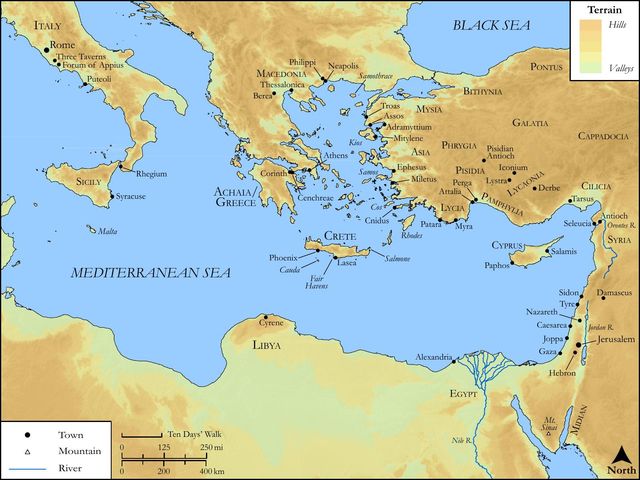
See on the biblical-era map
Study this verse
Public-domain commentary
Matthew Henry
From his Commentary on the Whole Bible. Henry comments on passages, not single verses — this entry covers Acts 4:15–22. His four-level outline is real structure in the source text, so it is rendered as structure.
We have here the issue of the trial of Peter and John before the council. They came off now with flying colours, because they must be trained up to sufferings by degrees, and by less trials be prepared for greater. They now but run with the footmen; hereafter we shall have them contending with horses, Jer 12:5.
I.Here is the consultation and resolution of the court about this matter, and their proceeding thereupon.
1.The prisoners were ordered to withdraw (Act 4:15): They commanded them to go aside out of the council, willing enough to get clear of them (they spoke so home to their consciences), and not willing they should hear the acknowledgements that were extorted from them; but, though they might not hear from them, we have them here upon record. The designs of Christ's enemies are carried on in close cabals, and they dig deep, as if they would hide their counsels from the Lord.
2.A debate arose upon this matter: They conferred among themselves; every one is desired to speak his mind freely, and to give advice upon this important affair. Now the scripture was fulfilled that the rulers would take counsel together against the Lord, and against his anointed, Psa 2:2. The question proposed was, What shall we do to these men? Act 4:16. If they would have yielded to the convincing commanding power of truth, it had been easy to say what they should do to these men. They should have placed them at the head of their council, and received their doctrine, and been baptized by them in the name of the Lord Jesus, and joined in fellowship with them. But, when men will not be persuaded to do what they should do, it is no marvel that they are ever and anon at a loss what to do. The truths of Christ, if men would but entertain them as they should, would give them no manner of trouble or uneasiness; but, if they hold them or imprison them in unrighteousness (Rom 1:18), they will find them a burdensome stone that they will not know what to do with, Zac 12:3.
3.They came at last to a resolution, in two things: -
(1.)That it was not safe to punish the apostles for what they had done. Very willingly would they have done it, but they had not courage to do it, because the people espoused their cause, and cried up the miracle; and they stood now in as much awe of them as they had done formerly, when they durst not lay hands of Christ for fear of the people. By this it appears that the outcry of the mob against our Saviour was a forced or managed thing, the stream soon returned to its former channel. Now they could not find how they might punish Peter and John, what colour they might have for it, because of the people. They knew it would be an unrighteous thing to punish them, and therefore should have been restrained from it by the fear of God; but they considered it only as a dangerous thing, and therefore were held in from it only by the fear of the people. For,
[1.]The people were convinced of the truth of the miracle; it was a notable miracle, gnōston sēmeion - a known miracle; it was known that they did it in Christ's name, and that Christ himself had often the like before. This was a known instance of the power of Christ, and a proof of his doctrine. That it was a great miracle, and wrought for the confirmation of the doctrine they preached (for it was a sign), was manifest to all that dwelt in Jerusalem: it was an opinion universally received, and, the miracle being wrought at the gate of the temple, universal notice was taken of it; and they themselves, with all the craftiness and all the effrontery they had, could not deny it to be a true miracle; every body would have hooted at them if they had. They could easily deny it to their own consciences, but not to the world. The proofs of the gospel were undeniable.
[2.]They went further, and were not only convinced of the truth of the miracle, but all men glorified God for that which was done. Even those that were not persuaded by it to believe in Christ were yet so affected with it, as a mercy to a poor man and an honour to their country, that they could not but give praise to God for it; even natural religion taught them to do this. And, if the priests had punished Peter and John for that for which all men glorified God, they would have lost all their interest in the people, and been abandoned as enemies both to God and man. Thus therefore their wrath shall be made to praise God, and the remainder thereof shall be restrained.
(2.)That it was nevertheless necessary to silence them for the future, Act 4:17, Act 4:18. They could not prove that they had said or done any thing amiss, and yet they must no more say nor do what they have done. All their care is that the doctrine of Christ spread no further among the people; as if that healing institution were a plague begun, the contagion of which must be stopped. See how the malice of hell fights against the counsels of heaven; God will have the knowledge of Christ to spread all the world over, but the chief priests would have it spread no further, which he that sits in heaven laughs at. Now, to prevent the further spreading of this doctrine,
[1.]They charge the apostles never to preach it any more. Be it enacted by their authority (which they think every Israelite is bound in conscience to submit to) that no man speak at all nor teach in the name of Jesus, Act 4:18. We do not find that they give them any reason why the doctrine of Christ must be suppressed; they cannot say it is false or dangerous, or of any ill tendency, and they are ashamed to own the true reason, that it testifies against their hypocrisy and wickedness, and shocks their tyranny. But, Stat pro ratione voluntas - They can assign no reason but their will. "We strictly charge and command you, not only that you do not preach this doctrine publicly, but that you speak henceforth to no man, not to any particular person privately, in this name," Act 4:17. There is not a greater service done to the devil's kingdom than the silencing of faithful ministers; and putting those under a bushel that are the lights of the world.
[2.]They threaten them if they do, strictly threaten them: it is at their peril. This court will reckon itself highly affronted if they do, and they shall fall under its displeasure. Christ had not only charged them to preach the gospel to every creature, but had promised to bear them out in it, and reward them for it. Now these priests not only forbid the preaching of the gospel, but threaten to punish it as a heinous crime; but those who know how to put a just value upon the world's threatenings, though they be threatenings of slaughter that it breathes out, Act 9:1.
II.Here is the courageous resolution of the prisoners to go on in their work, notwithstanding the resolutions of this court, and their declaration of this resolution, Act 4:19, Act 4:20. Peter and John needed not confer together to know one another's minds (for they were both actuated by one and the same Spirit), but agree presently in the same sentiments, and jointly put in the answer: "Whether it be right in the sight of God, to whom both you and we are accountable, to hearken unto you more than unto God, we appeal to yourselves, judge you; for we cannot forbear speaking to every body the things which we have seen and heard, and are ourselves full of, and are charged to publish." The prudence of the serpent would have directed them to be silent, and, though they could not with a good conscience promise that they would not preach the gospel any more, yet they needed not tell the rulers that they would. But the boldness of the lion directed them thus to set both the authority and the malignity of their persecutors at defiance. They do, in effect, tell them that they are resolved to go on in preaching, and justify themselves in it with two things: - 1. The command of God: "You charge us not to preach the gospel; he has charged us to preach it, has committed it to us as a trust, requiring us upon our allegiance faithfully to dispense it; now whom must we obey, God or you?" Here they appeal to one of the communes notitiae - to a settled and acknowledged maxim in the law of nature, that if men's commands and God's interfere God's commands must take place. It is a rule in the common law of England that if any statute be made contrary to the law of God it is null and void. Nothing can be more absurd than to hearken unto weak and fallible men, that are fellow-creatures and fellow-subjects, more than unto a God that is infinitely wise and holy, our Creator and sovereign Lord, and the Judge to whom we are all accountable. The case is so plain, so uncontroverted and self-evident, that we will venture to leave it to yourselves to judge of it, though you are biassed and prejudiced. Can you think it right in the sight of God to break a divine command in obedience to a human injunction? That is right indeed which is right in the sight of God; for his judgment, we are sure, is according to truth, and therefore by that we ought to govern ourselves. 2. The convictions of their consciences. Even if they had not had such an express command from heaven to preach the doctrine of Christ, yet they could not but speak, and speak publicly, those things which they had seen and heard. Like Elihu, they were full of this matter, and the Spirit within them constrained them, they must speak, that they might be refreshed, Job 32:18, Job 32:20. (1.) They felt the influence of it upon themselves, what a blessed change it had wrought upon them, had brought them into a new world, and therefore they could not but speak of it: and those speak the doctrine of Christ best that have felt the power of it, and tasted the sweetness of it, and have themselves been deeply affected with it; it is as a fire in their bones, Jer 20:9. (2.) They knew the importance of it to others. They look with concern upon perishing souls, and know that they cannot escape eternal ruin but by Jesus Christ, and therefore will be faithful to them in giving them warning, and showing them the right way. They are things which we have seen and heard, and therefore will be faithful to them in giving them warning, and showing them the right way. They are things which we only have seen and heard, and therefore, if we do not publish them, who will? Who can? Knowing the favour, as well as the terror of the Lord, we persuade men; for the love of Christ and the love of souls constrain us, Co2 5:11, Co2 5:14.
III.Here is the discharge of the prisoners (Act 4:21):
They further threatened them, and thought they frightened them, and then let them go. There were many whom they terrified into an obedience to their unrighteous decrees; they knew how to keep men in awe with their excommunication (Joh 9:22), and thought they could have the same influence upon the apostles that they had upon other men; but they were deceived, for they had been with Jesus. They threatened them, and that was all they did now: when they had done this they let them go,
1.Because they durst not contradict the people, who glorified God for that which was done, and would have been ready (at least they thought so) to pull them out of their seats, if they had punished the apostles for doing it. As rulers by the ordinance of God are made a terror and restraint to wicked people, so people are sometimes by the providence of God made a terror and restrain to wicked rulers.
2.Because they could not contradict the miracle: For (Act 4:22) the man was above forty years old on whom this miracle of healing was shown. And therefore,
(1.)The miracle was so much the greater, he having been lame from his mother's womb, Act 3:2. The older he grew the more inveterate the disease was, and the more hardly cured. If those that are grown into years, and have been long accustomed to evil, are cured of their spiritual impotency to good, and thereby of their evil customs, the power of divine grace is therein so much the more magnified.
(2.)The truth of it was so much the better attested; for the man being above forty years old, he was able, like the blind man whom Christ healed, when he was asked, to speak for himself, Joh 9:21.
Historical interpretation
Two Centuries of Reception
5 surviving comments on this verse. Each one is dated, so this reads as a timeline rather than a list.
Select a marker to jump to its quote. Markers stagger vertically where authors wrote within a few decades of each other.
Already these as martyrs have borne testimony: set in the battle against all, they said, "We cannot but speak the things we have seen and heard." If the things we speak be false, reprehend them; if true, why hinderest thou? Such is philosophy! Those, in perplexity, these in gladness: those covered with exceeding shame, these doing all with boldness: those in fear, these in confidence. For who, I would ask, were the frightened? those who said, "That it spread no further among people," or these who said, "we cannot but speak the things we have seen and heard?" And these had a delight, a freedom of speech, a joy surpassing all; those a despondency, a shame, a fear; for they feared the people. But these were not afraid of those; on the contrary, while these spake what they would, those did not what they would. Which were in chains and dangers? was it not these last?
"But Peter and John answered and said unto them, Whether it be right in the sight of God to hearken unto you more than unto God, judge ye. For we cannot but speak the things which we have seen and heard. So when they had further threatened them, they let them go, finding nothing how they might punish them, because of the people." The miracles shut their mouths: they would not so much as let them finish their speech, but cut them short in the middle, most insolently.
For better than all others he knows the nature of things. He knows that fierceness is not quenched by fierceness but by meekness. If you wish to see this in action, read the book of the Acts of the apostles and you will see how often, when the people of the Jews was rebelling and sharpening their teeth, these men, imitating the dove and answering with suitable meekness, released their wrath, quenched their madness and dissolved their impetuosity. For when they said, “We gave you strict orders not to teach in this name,” the disciples, although they were able to work countless miracles, neither said nor did anything harsh but answered with all gentleness, saying, “Whether it is right to listen to you rather than to God, you must judge.”
"And Peter and John answered and said unto them, Whether it be right in the sight of God to hearken unto you more than unto God, judge ye." When the terror was abated (for that command was tantamount to their being dismissed), then also the Apostles speak more mildly: so far were they from mere bravery: "Whether it be right," says he: and "We cannot but speak." "Whether it be right in the sight of God to obey you rather than God." Here by "God" they mean Christ, for He it was that commanded them. And once more they confirm the fact of His Resurrection. "For we cannot but speak the things we have seen and heard:" so that we are witnesses who have a right to be believed.
"Whether it is right in the sight of God to listen to you rather than to God, you judge. For we cannot but speak of what we have seen and heard." And they went rejoicing from the presence of the council, because they were counted worthy to suffer insults for the name of Jesus. Behold, Peter rejoices in beatings, who before was afraid at mere words. And he who previously feared when questioned by the voice of a servant girl, after the coming of the Holy Spirit, though beaten, tramples down the powers of rulers.
Continue studying Acts 4:20 across the web’s major study libraries — every link below opens this exact verse, chapter, or book on the destination site.
Read & Compare
 BibleGatewayThis verse in more than 200 translations and 70 languages.
 Bible.comThe YouVersion reader — hundreds of translations, reading plans, and highlights.
 ESV.orgCrossway's official English Standard Version reader.
 NET BibleThe NET translation with 60,000+ translators' notes on every rendering decision.
 STEP BibleTyndale House's free study tool — original text, vocabulary, and scholarly resources.
 BibliaLogos Bible Software's free web reader.
 USCCBThe New American Bible (Revised Edition) with the U.S. bishops' study notes.
Commentaries
 BibleHub CommentariesDozens of classic commentaries on this verse, gathered on one page.
 StudyLightMore than 100 commentary sets — the largest collection on the web.
 BibleRefPlain-English commentary on what this verse means, verse by verse.
 Enduring WordDavid Guzik's free commentary on this chapter, widely used by Bible teachers.
 Bible Study ToolsVerse commentary alongside Greek and Hebrew study aids.
Original Language & Research
- BibleHub InterlinearThe verse word by word — original language, transliteration, and English.
- BibleHub LexiconEvery word's original-language definition and Strong's entry.
 Blue Letter BibleDeep-study tools — Strong's numbers, concordance, and word studies.
 CNTR CollationThe earliest Greek manuscripts of this verse, collated letter by letter.
Sermons, Hymns & Audio


TrulyRandomVerse is not affiliated with these sites and doesn’t control their content. They’re linked because they’re genuinely useful.
Summary
Acts 4:20 encapsulates the unwavering resolve of the apostles Peter and John, who, despite facing severe threats and commands from the Jewish Sanhedrin to cease their preaching, declared their absolute inability to remain silent about the transformative truths they had personally witnessed and heard concerning Jesus Christ. This verse serves as a powerful testament to the divine compulsion to bear witness to the Gospel, prioritizing God's authority over any human decree.
Context
ShowHideLiterary Context
This declaration by Peter and John occurs at a pivotal moment immediately following their miraculous healing of a lame man at the Temple's Beautiful Gate, as recorded in Acts 3:1-10. This astounding miracle, performed in the name of Jesus Christ, led to a large gathering and Peter's subsequent sermon, which resulted in thousands coming to faith. The Jewish religious authorities, the Sadducees and priests, were deeply disturbed by the apostles' teaching, particularly their proclamation of Jesus' resurrection from the dead. Consequently, Peter and John were arrested and brought before the Sanhedrin, the supreme Jewish judicial council, as detailed in Acts 4:1-7. After being commanded "not to speak at all nor teach in the name of Jesus" (Acts 4:18), Acts 4:20 stands as their bold and defiant response, asserting a higher allegiance.
Historical & Cultural Context
The Sanhedrin, composed of chief priests, elders, and scribes, represented the highest religious and civil authority for the Jewish people under Roman rule. Their primary concern was maintaining order and preserving their interpretation of Jewish law and tradition, which they felt was threatened by the burgeoning Christian movement. The Sadducees, a prominent faction within the Sanhedrin, specifically denied the resurrection of the dead, making Peter and John's central message about Jesus' resurrection particularly offensive and subversive to them. The apostles, on the other hand, were Galilean fishermen, considered uneducated and ordinary by the elite Sanhedrin (Acts 4:13). Their boldness in the face of such powerful opposition would have been shocking and culturally defiant, underscoring the supernatural empowerment they received from the Holy Spirit, as promised by Jesus in Acts 1:8.
Key Themes
ShowHideActs 4:20 contributes significantly to several overarching themes within the book of Acts. Foremost is the theme of Divine Authority vs. Human Authority, where the apostles unequivocally prioritize obedience to God over human commands, a principle later reiterated in Acts 5:29. This verse also highlights the Compulsion to Witness, demonstrating that for those who have genuinely encountered the resurrected Christ, sharing that truth is not merely an option but an inescapable necessity. It underscores the Power of Personal Testimony, emphasizing that their message was rooted in undeniable, firsthand experience of Jesus' life, death, and resurrection, rather than mere theological speculation. Finally, it powerfully illustrates Boldness in Proclamation, a recurring motif throughout Acts, where believers, empowered by the Holy Spirit, courageously declare the Gospel despite persecution and threats, serving as a model for the church's mission.
Exposition and Analysis
ShowHideKey Word Analysis
ShowHideThe Greek phrase "οὐ δυνάμεθα μὴ λαλεῖν" (ou dynametha mē lalein) literally translates to "we are not able not to speak." The combination of two negative particles (ou and mē) creates a strong double negative, which in Greek idiom functions as an emphatic affirmation. It signifies an absolute impossibility of refraining from speaking. Peter and John are declaring that they are utterly compelled; it is beyond their capacity to do otherwise. This is not merely a strong preference but an internal, divinely imposed necessity.
This verb means "to talk, i.e., utter words." In this context, it refers specifically to the act of proclaiming, teaching, and testifying about Jesus. It implies a vocal, public declaration of the Gospel message. The apostles were not merely talking among themselves, but actively communicating the "things which we have seen and heard" to others, particularly to the authorities who sought to silence them.
These two verbs emphasize the personal, sensory, and direct nature of the apostles' experience. "Seen" refers to their eyewitness accounts of Jesus' life, miracles, crucifixion, resurrection, and ascension. "Heard" refers to His teachings, commands, and the direct voice of God or the Holy Spirit. Together, they underscore that their testimony was not based on hearsay, speculation, or tradition, but on undeniable, verifiable, firsthand encounters. The perfect tense of "have seen" and "have heard" indicates a completed action with ongoing results, meaning their experiences were foundational and continued to shape their present reality and compulsion.
Verse Breakdown
ShowHide"For we cannot but speak"
This clause reveals the profound inner compulsion felt by Peter and John. The double negative in the Greek ("we are not able not to speak") intensifies their declaration, indicating that silence is an absolute impossibility for them. Their experience of Christ and the Holy Spirit has created an unyielding necessity to proclaim the truth, demonstrating that their obedience to God supersedes any human command or threat.
"the things which we have seen"
This part specifies the nature of their testimony. It refers to their direct, personal eyewitness accounts of Jesus' life, His miracles, His crucifixion, and most crucially, His resurrection from the dead. As apostles, they were chosen witnesses to these foundational events, providing verifiable proof for their message. Their faith was not blind but based on empirical observation.
"and heard"
Complementing "seen," this phrase emphasizes their direct auditory experience. This includes Jesus' teachings, His authoritative words, the voice of God at His baptism and transfiguration, and possibly the sound of the rushing wind and tongues of fire at Pentecost. Together, "seen and heard" form the irrefutable foundation of their apostolic witness, making their message credible and powerful.
Literary Devices
ShowHideThe verse employs several powerful literary devices. Apostolic Boldness is evident in the direct and unyielding nature of Peter and John's response to the Sanhedrin, contrasting sharply with the fear that might be expected from ordinary men facing such authority. This boldness is underpinned by Eyewitness Testimony, as the phrase "seen and heard" grounds their proclamation in verifiable, personal experience, lending immense credibility and authority to their message. The use of a Double Negative ("cannot but speak") serves as a powerful Rhetorical Negation, creating an emphatic affirmation of their inability to be silent. This grammatical construction highlights the profound internal and divine compulsion they feel, transforming a simple statement into a declaration of absolute necessity. Furthermore, the verse functions as a Declaration of Conscience, asserting a moral and spiritual imperative that transcends human law, embodying the principle of obeying God over men.
Theological and Thematic Connections
ShowHideActs 4:20 is a foundational statement on the nature of Christian witness and the supremacy of divine authority. It articulates the theological truth that genuine encounter with the living God creates an undeniable internal impetus to share that experience. The apostles' refusal to be silenced underscores the non-negotiable priority of obeying God's commission to proclaim the Gospel, even when it leads to conflict with human institutions. Their testimony is not a matter of opinion or preference, but a compelled declaration of objective truth based on direct revelation and experience. This verse thus establishes a precedent for believers throughout history to prioritize their allegiance to Christ and His truth above all earthly pressures.
Reflection and Application
ShowHideActs 4:20 remains a timeless challenge and encouragement for believers today. It compels us to examine the depth of our own convictions and the source of our faith. Like Peter and John, our witness is most powerful when it stems from a personal, transformative encounter with Jesus Christ—what we have "seen and heard" of His work in our lives and in the world through His Word and Spirit. This verse calls us to cultivate a faith so vibrant and real that silence becomes an impossibility, not out of human arrogance, but out of divine compulsion. It reminds us that our ultimate allegiance is to God, and when His commands conflict with societal norms or human decrees, our obedience must unequivocally rest with Him. This requires courage, a reliance on the Holy Spirit, and a deep conviction that the truth of the Gospel is too vital to be suppressed, regardless of the cost. We are called to be unashamed witnesses, allowing our personal experience of Christ to fuel an unquenchable desire to share His love and truth with a world desperately in need.
Questions for Reflection
ShowHideFAQ
ShowHideWhat does "we cannot but speak" truly mean in the context of Acts 4:20?
ShowHideThe phrase "we cannot but speak" (Greek: οὐ δυνάμεθα μὴ λαλεῖν, ou dynametha mē lalein) is a powerful double negative. It literally means "we are not able not to speak." This grammatical construction is an emphatic affirmation, conveying that Peter and John were under an absolute, divinely imposed compulsion to speak. It wasn't a matter of choice or preference, but an internal necessity stemming from their profound, undeniable experience of Jesus' resurrection and the power of the Holy Spirit. Their conscience, illuminated by God's truth, would not permit silence, making it impossible for them to obey the Sanhedrin's command to stop proclaiming Christ.
Christ-Centered Fulfillment
ShowHideActs 4:20, while a declaration by Peter and John, finds its ultimate Christ-centered fulfillment in the very nature of the Gospel message and the mission Christ entrusted to His followers. Peter and John's "cannot but speak" is a direct outflow of their encounter with the resurrected Christ, who commanded His disciples to be His witnesses "in Jerusalem, and in all Judea and Samaria, and to the ends of the earth" (Acts 1:8). Their testimony is not about themselves, but about the "things which we have seen and heard" concerning Jesus—His life, death, resurrection, and ascension. This compulsion to speak about Christ is the Spirit-empowered overflow of knowing Him, reflecting the very heart of God, who "so loved the world that he gave his one and only Son" (John 3:16). The apostles' unwavering commitment foreshadows the ongoing mission of the Church, which is called to proclaim the "good news of Jesus Christ" (Mark 1:1) until His return. Their witness is a microcosm of the divine imperative for all believers to share the transformative power of the cross and resurrection, making disciples of all nations, teaching them to obey everything Jesus commanded (Matthew 28:18-20). Thus, Acts 4:20 is not merely a historical anecdote of apostolic courage, but a timeless embodiment of the Christ-given mandate to bear witness to His saving grace.