


Acts 4:13
Bible text: King James Version (1769 Blayney text) · Public domain
Bible text: King James Version with Strong's numbers · Public domain
Bible text: Berean Standard Bible · Public domain
Bible text: American Standard Version (1901) · Public domain
Bible text: World English Bible, Messianic edition · Public domain
Bible text: Geneva Bible (1599) · Public domain
Bible text: Young's Literal Translation · Public domain
- ΘεωροῦντεςTheōrountesSeeingG2334V-PAP-NPMVerb Present Active Participle Nominative Plural Masculine
- δὲdenowG1161CONJConjunction
- τὴνtēntheG3588T-ASFDefinite article Accusative Singular Feminine
- τοῦtou<the>G3588T-GSMDefinite article Genitive Singular Masculine
- ΠέτρουPetrouof PeterG4074N-GSM-PNoun Genitive Singular Masculine Individual
- παρρησίανparrēsianboldnessG3954N-ASFNoun Accusative Singular Feminine
- καὶkaiandG2532CONJConjunction
- ἸωάννουIōannouof JohnG2491N-GSM-PNoun Genitive Singular Masculine Individual
- καὶkaiandG2532CONJConjunction
- καταλαβόμενοιkatalabomenoihaving graspedG2638V-2AMP-NPMVerb 2nd Aorist Middle Participle Nominative Plural Masculine
- ὅτιhotithatG3754CONJConjunction
- ἄνθρωποιanthrōpoimenG444N-NPMNoun Nominative Plural Masculine
- ἀγράμματοίagrammatoiunschooledG62A-NPMAdjective Nominative Plural Masculine
- εἰσινeisinthey areG1510V-PAI-3PVerb Present Active Indicative 3rd Plural
- καὶkaiandG2532CONJConjunction
- ἰδιῶταιidiōtaiordinaryG2399N-NPMNoun Nominative Plural Masculine
- ἐθαύμαζονethaumazonthey were astonishedG2296V-IAI-3PVerb Imperfect Active Indicative 3rd Plural
- ἐπεγίνωσκόνepeginōskonThey were recognizingG1921V-IAI-3PVerb Imperfect Active Indicative 3rd Plural
- τεtethenG5037CONJConjunction
- αὐτοὺςautousthemG846P-APMPersonal pronoun Accusative Plural Masculine
- ὅτιhotithatG3754CONJConjunction
- σὺνsunwithG4862PREPPreposition
- τῷtō<the>G3588T-DSMDefinite article Dative Singular Masculine
- ἸησοῦIēsouJesusG2424N-DSM-PNoun Dative Singular Masculine Individual
- ἦσανēsanthey were beingG1510V-IAI-3PVerb Imperfect Active Indicative 3rd Plural
English is a literal word-by-word gloss of the Greek, not the KJV's wording. Why?
This is the original text the KJV's translators worked from — each Greek word with its own literal English meaning in this verse, prepared by scholars at Tyndale House, Cambridge. The KJV translates whole sentences, not word by word, so its wording differs: one Greek word can become several English words, and the KJV may choose “charity” where the gloss reads “love”. Both are faithful — they answer different questions. For the KJV's own rendering, switch to the KJV text.
Details
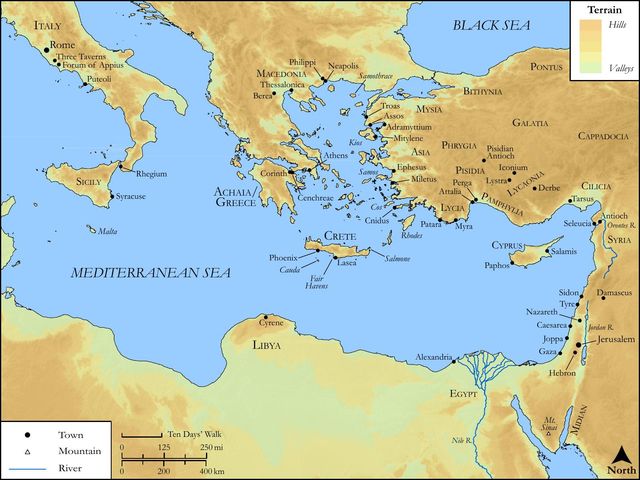
See on the biblical-era map
Study this verse
Public-domain commentary
Matthew Henry
From his Commentary on the Whole Bible. Henry comments on passages, not single verses — this entry covers Acts 4:5–14. His four-level outline is real structure in the source text, so it is rendered as structure.
We have here the trial of Peter and John before the judges of the ecclesiastical court, for preaching a sermon concerning Jesus Christ, and working a miracle in his name. This is charged upon them as a crime, which was the best service they could do to God or men.
I.Here is the court set.
An extraordinary court, it should seem, was called on purpose upon this occasion. Observe,
1.The time when the court sat (Act 4:5) - on the morrow; not in the night, as when Christ was to be tried before them, for they seem not to have been so hot upon this prosecution as they were upon that; it was well if they began to relent. But they adjourned it to the morrow, and no longer; for they were impatient to get them silenced, and would lose no time.
2.The place where - in Jerusalem (Act 4:6); there it was that he told his disciples they must expect to suffer hard things, as he had done before them in that place. This seems to come in here as an aggravation of their sin, that in Jerusalem, where there were so many that looked for redemption before it came, yet there were more that would not look upon it when it did come. How is that faithful city become a harlot! See Mat 23:37. It was in the foresight of Jerusalem's standing in her own light that Christ beheld the city, and wept over it.
3.The judges of the court.
(1.)Their general character: they were rulers, elders, and scribes, Act 4:5. The scribes were men of learning, who came to dispute with the apostles, and hoped to confute them. The rulers and elders were men in power, who, if they could not answer them, thought they could find some cause or other to silence them. If the gospel of Christ had not been of God, it could not have made its way, for it had both the learning and power of the world against it, both the colleges of the scribes and the courts of the elders.
(2.)The names of some of them, who were most considerable. Here were Annas and Caiaphas, ringleaders in this persecution; Annas the president of the sanhedrim, and Caiaphas the high priest (though Annas is here called so) and father of the house of judgment. It should seem that Annas and Caiaphas executed the high priest's office alternately, year for year. These two were most active against Christ; then Caiaphas was high priest, now Annas was; however they were both equally malignant against Christ and his gospel. John is supposed to be the son of Annas; and Alexander is mentioned by Josephus as a man that made a figure at that time. There were others likewise that were of the kindred of the high priest, who having dependence on him, and expectations from him, would be sure to say as he said, and vote with him against the apostles. Great relations, and not good, have been a snare to many.
II.The prisoners are arraigned, Act 4:7.
1.They are brought to the bar; they set them in the midst, for the sanhedrim sat in a circle, and those who had any thing to do in the court stood or sat in the midst of them (Luk 2:46), so Dr. Lightfoot. Thus the scripture was fulfilled, The assembly of the wicked has enclosed me, Psa 22:16. They compassed me about like bees, Psa 118:12. They were seated on every side.
2.The question they asked them was, "By what power, or by what name, have you done this? By what authority do you these things?" (the same question that they had asked their Master, Mat 21:23): "Who commissioned you to preach such a doctrine as this, and empowered you to work such a miracle as this? You have no warrant nor license from us, and therefore are accountable to us whence you have your warrant." Some think this question was grounded upon a fond conceit that the very naming of some names might do wonders, as Act 19:13. The Jewish exorcists made use of the name of Jesus. Now they would know what name they made use of in their cure, and consequently what name they set themselves to advance in their preaching. They knew very well that they preached Jesus, and the resurrection of the dead, and the healing of the sick, through Jesus (Act 4:2), yet they asked them, to tease them, and try if they could get any thing out of them that looked criminal.
III.The plea they put in, the design of which was not so much to clear and secure themselves as to advance the name and honour of their Master, who had told them that their being brought before governors and kings would give them an opportunity of preaching the gospel to those to whom otherwise they could not have had access, and it should be a testimony against them. Mar 13:19. Observe,
1.By whom this plea was drawn up: it was dictated by the Holy Ghost, who fitted Peter more than before for this occasion. The apostles, with a holy negligence of their own preservation, set themselves to preach Christ as he had directed them to do in such a case, and then Christ made good to them his promise, that the Holy Ghost should give them in that same hour what they should speak. Christ's faithful advocates shall never want instructions, Mar 13:11.
2.To whom it was given in: Peter, who is still the chief speaker, addresses himself to the judges of the court, as the rulers of the people, and elders of Israel; for the wickedness of those in power does not divest them of their power, but the consideration of the power they are entrusted with should prevail to divest them of their wickedness. "You are rulers and elders, and should know more than others of the signs of the times, and not oppose that which you are bound by the duty of your place to embrace and advance, that is, the kingdom of the Messiah; you are rulers and elders of Israel, God's people, and if you mislead them, and cause them to err, you will have a great deal to answer for."
3.What the plea is: it is a solemn declaration,
(1.)That what they did was in the name of Jesus Christ, which was a direct answer to the question the court asked them (Act 4:9, Act 4:10): "If we this day be examined, be called to an account as criminals, so the word signifies, for a good deed (as any one will own it to be) done to the impotent man, - if this be the ground of the commitment, this the matter of the indictment, - if we are put to the question, by what means, or by whom, he is made whole, we have an answer ready, and it is the same we gave to the people (Act 3:16), we will repeat it to you, as that which we will stand by. Be it known to you all who pretend to be ignorant of this matter, and not to you only, but to all the people of Israel, for they are all concerned to know it, that by the name of Jesus Christ, that precious, powerful, prevailing name, that name above every name, even by him whom you in contempt called Jesus of Nazareth, whom you crucified, both rulers and people, and whom God hath raised from the dead and advanced to the highest dignity and dominion, even by him doth this man stand here before you whole, a monument of the power of the Lord Jesus." Here,
[1.]He justifies what he and his colleague had done in curing the lame man. It was a good deed; it was a kindness to the man that had begged, but could not work for his living; a kindness to the temple, and to those that went in to worship, who were now freed from the noise and clamour of this common beggar. "Now, if we be reckoned with for this good deed, we have no reason to be ashamed, Pe1 2:20; Pe1 4:14, Pe1 4:16. Let those be ashamed who bring us into trouble for it." Note, It is no new thing for good men to suffer ill for doing well. Bene agere et male pati vere Christianum est - To do well and to suffer punishment is the Christian's lot.
[2.]He transfers all the praise and glory of this good deed to Jesus Christ. "It is by him, and not by any power of ours, that this man is cured." The apostles seek not to raise an interest for themselves, nor to recommend themselves by this miracle to the good opinion of the court; but, "Let the Lord alone be exalted, no matter what becomes of us." [3.] He charges it upon the judges themselves, that they had been the murderers of this Jesus: "It is he whom you crucified, look how you will answer it;" in order to the bringing of them to believe in Christ (for he aims at no less than this) he endeavours to convince them of sin, of that sin which, one would think, of all others, was most likely to startle conscience - their putting Christ to death. Let them take it how they will, Peter will miss no occasion to tell them of it. [4.] He attests the resurrection of Christ as the strongest testimony for him, and against his persecutors: "They crucified him, but God raised him from the dead; they took away his life, but God gave it to him again, and your further opposition to his interest will speed no better." He tells them that God raised him from the dead, and they could not for shame answer him with that foolish suggestion which they palmed upon the people, that his disciples came by night and stole him away. [5.] He preaches this to all the bystanders, to be by them repeated to all their neighbours, and commands all manner of persons, from the highest to the lowest, to take notice of it at their peril: "Be it known to you all that are here present, and it shall be made known to all the people of Israel, wherever they are dispersed, in spite of all your endeavours to stifle and suppress the notice of it: as the Lord God of gods knows, so Israel shall know, all Israel shall know, that wonders are wrought in the name of Jesus, not by repeating it as a charm, but believing in it as a divine revelation of grace and good-will to men."
(2.)That the name of this Jesus, by the authority of which they acted, is that name alone by which we can be saved. He passes from this particular instance to show that it is not a particular sect or party that is designed to be set up by the doctrine they preached, and the miracle they wrought, which people might either join with or keep off from at their pleasure, as it was with the sects of the philosophers and those among the Jews; but that it is a sacred and divine institution that is hereby ratified and confirmed, and which all people are highly concerned to submit to and come into the measures of. It is not an indifferent thing, but of absolute necessity, that people believe in this name, and call upon it.
[1.]We are obliged to it in duty to God, and in compliance with his designs (Act 4:11): "This is the stone which was set at nought of your builders, you that are the rulers of the people, and the elders of Israel, that should be the builders of the church, that pretend to be so, for the church is God's building. Here was a stone offered you, to be put in the chief place of the building, to be the main pillar on which the fabric might entirely rest; but you set it at nought, rejected it, would not make use of it, but threw it by as good for nothing but to make a stepping-stone of; but this stone is now become the head of the corner; God has raised up this Jesus whom you rejected, and, by setting him at his right hand, has made him both the corner stone and the head stone, the centre of unity and the fountain of power." Probably St. Peter here chose to make use of this quotation because Christ had himself made use of it, in answer to the demand of the chief priests and the elders concerning his authority, not long before this, Mat 21:42. Scripture is a tried weapon in our spiritual conflicts: let us therefore stick to it.
[2.]We are obliged to it for our own interest. We are undone if we do not take shelter in this name, and make it our refuge and strong tower; for we cannot be saved but by Jesus Christ, and, if we be not eternally saved, we are eternally undone (Act 4:12): Neither is there salvation in any other. As there is no other name by which diseased bodies can be cured, so there is no other by which sinful souls can be saved. "By him, and him only, by receiving and embracing his doctrine, salvation must now be hoped for by all. For there is no other religion in the world, no, not that delivered by Moses, by which salvation can be had for those that do not now come into this, at the preaching of it." So. Dr. Hammond. Observe here, First, Our salvation is our chief concern, and that which ought to lie nearest to our hearts - our rescue from wrath and the curse, and our restoration to God's favour and blessing. Secondly, Our salvation is not in ourselves, nor can be obtained by any merit or strength of our own; we can destroy ourselves, but we cannot save ourselves. Thirdly, There are among men many names that pretend to be saving names, but really are not so; many institutions in religion that pretend to settle a reconciliation and correspondence between God and man, but cannot do it. Fourthly, It is only by Christ and his name that those favours can be expected from God which are necessary to our salvation, and that our services can be accepted with God. This is the honour of Christ's name, that it is the only name whereby we must be saved, the only name we have to plead in all our addresses to God. This name is given. God has appointed it, and it is an inestimable benefit freely conferred upon us. It is given under heaven. Christ has not only a great name in heaven, but a great name under heaven; for he has all power both in the upper and in the lower world. It is given among men, who need salvation, men who are ready to perish. We may be saved by his name, that name of his, The Lord our righteousness; and we cannot be saved by any other. How far those may find favour with God who have not the knowledge of Christ, nor any actual faith in him, yet live up to the light they have, it is not our business to determine. But this we know, that whatever saving favour such may receive it is upon the account of Christ, and for his sake only; so that still there is no salvation in any other. I have surnamed thee, though thou hast not known me, Isa 45:4.
IV.The stand that the court was put to in the prosecution, by this plea, Act 4:13, Act 4:14.
Now was fulfilled that promise Christ made, that he would give them a mouth and wisdom, such as all their adversaries should not be able to gainsay nor resist.
1.They could not deny the cure of the lame man to be both a good deed and a miracle. He was there standing with Peter and John, ready to attest the cure, if there were occasion, and they had nothing to say against it (Act 4:14), either to disprove it or to disparage it. It was well that it was not the sabbath day, else they would have had that to say against it.
2.They could not, with all their pomp and power, face down Peter and John. This was a miracle not inferior to the cure of the lame man, considering both what cruel bloody enemies these priests had been to the name of Christ (enough to make any one tremble that appeared for him), and considering what cowardly faint-hearted advocates those disciples had lately been for him, Peter particularly, who denied him for fear of a silly maid; yet now they see the boldness of Peter and John, Act 4:13. Probably there was something extraordinary and very surprising in their looks; they appeared not only undaunted by the rulers, but daring and daunting to them; they had something majestic in their foreheads, sparkling in their eyes, and commanding, if not terrifying, in their voice. They set their faces like a flint, as the prophet, Isa 50:7; Eze 3:9. The courage of Christ's faithful confessors has often been the confusion of their cruel persecutors. Now,
(1.)We are here told what increased their wonder: They perceived that they were unlearned and ignorant men. They enquired either of the apostles or themselves or of others, and found that they were of mean extraction, born in Galilee, that they were bred fishermen, and had no learned education, had never been at any university, were not brought up at the feet of any of the rabbin, had never been conversant in courts, camps, or colleges; nay, perhaps, talk to them at this time upon any point in natural philosophy, mathematics, or politics, and you will find they know nothing of the matter; and yet speak to them of the Messiah and his kingdom, and they speak with so much clearness, evidence, and assurance, so pertinently and so fluently, and are so ready in the scriptures of the Old Testament relating to it, that the most learned judge upon the bench is not able to answer them, nor to enter the lists with them. They were ignorant men - idiōtai, private men, men that had not any public character nor employment; and therefore they wondered they should have such high pretensions. They were idiots (so the word signifies): they looked upon them with as much contempt as if they had been mere naturals, and expected no more from them, which made them wonder to see what freedom they took.
(2.)We are told what made their wonder in a great measure to cease: they took knowledge of them that they had been with Jesus; they, themselves, it is probable, had seen them with him in the temple, and now recollected that they had seen them; or some of their servants or those about them informed them of it, for they would not be thought themselves to have taken notice of such inferior people. But when they understood that they had been with Jesus, had been conversant with him, attendant on him, and trained up under him, they knew what to impute their boldness to; nay, their boldness in divine things was enough to show with whom they had had their education. Note, Those that have been with Jesus, in converse and communion with him, have been attending on his word, praying in his name, and celebrating the memorials of his death and resurrection, should conduct themselves, in every thing, so that those who converse with them may take knowledge of them that they have been with Jesus; and this makes them so holy, and heavenly, and spiritual, and cheerful; this has raised them so much above this world, and filled them with another. One may know that they have been in the mount by the shining of their faces.
Historical interpretation
Three Centuries of Reception
4 surviving comments on this verse. Each one is dated, so this reads as a timeline rather than a list.
Select a marker to jump to its quote. Markers stagger vertically where authors wrote within a few decades of each other.
Behold another miracle not less than the former. "And beholding the boldness of Peter and John," etc. "And they took knowledge of them that they had been with Jesus." Not without a meaning has the Evangelist set down this passage; but in saying, "they recognized them that they had been with Jesus," he means, in His Passion: for only these were with Him at that time, and then indeed they had seen them humble, dejected: and this it was that most surprised them: the greatness of the change. For in fact Annas and Caiaphas with their company were there, and these then also had stood by Him, and their boldness now amazed them. "And beholding the boldness." For not only their words; their very bearing showed it; that they should stand there so intrepidly to be tried in a cause like this, and with uttermost peril impending over them! Not only by their words, but by their gesture also, and their look and voice, and, in short, by everything about them, they manifested the boldness with which they confronted the people. From the things they uttered, they marvelled, perhaps: "that they were unlearned and common men:" for one may be unlearned, yet not a common or private man, and a common man, yet not unlearned. "Having perceived," it says. Whence? From what they said? Peter does not draw out long speeches, but then by his very manner and method he declares his confidence. "And they recognized them that they had been with Jesus." Which circumstance made them believe that it was from Him they had learned these things, and that they did all in the character of His disciples.
"Now when they saw the boldness of Peter and John, and perceived that they were unlearned and ignorant men, they marvelled and they took knowledge of them, that they had been with Jesus." The two unlearned men beat down with their rhetoric them and the chief priests. For it was not they that spake, but the grace of the Spirit.
But seeing the boldness of Peter and John, and realizing that they were unlettered and ordinary men, they marveled. "Unlettered" is said, not because they were ignorant of letters, but because they were not skilled in the art of grammar. For in Greek, it is more clearly, for this word, "ἀγράμματοι," that is, unlettered, and "idiotae" are called unskilled. Finally, in the Epistle to the Corinthians, where it is written: "And if unskilled in speech, yet not in knowledge" (2 Cor. XI), for "unskilled" in Greek it is "ἰδιώτης."
Finding out that these men were unlettered and ignorant, they marveled. Illiterate men are sent to preach, so that the faith of believers might not be thought to have been brought about by human eloquence and learning, but by the power of God, as the Apostle says: "Not in the wisdom of words, lest the cross of Christ should be made of no effect" (I Cor. I). For those were called idiotae who, content with their own language and natural knowledge, were unacquainted with the study of letters. Indeed, the Greeks call their own, ἴδιον.
Continue studying Acts 4:13 across the web’s major study libraries — every link below opens this exact verse, chapter, or book on the destination site.
Read & Compare
 BibleGatewayThis verse in more than 200 translations and 70 languages.
 Bible.comThe YouVersion reader — hundreds of translations, reading plans, and highlights.
 ESV.orgCrossway's official English Standard Version reader.
 NET BibleThe NET translation with 60,000+ translators' notes on every rendering decision.
 STEP BibleTyndale House's free study tool — original text, vocabulary, and scholarly resources.
 BibliaLogos Bible Software's free web reader.
 USCCBThe New American Bible (Revised Edition) with the U.S. bishops' study notes.
Commentaries
 BibleHub CommentariesDozens of classic commentaries on this verse, gathered on one page.
 StudyLightMore than 100 commentary sets — the largest collection on the web.
 BibleRefPlain-English commentary on what this verse means, verse by verse.
 Enduring WordDavid Guzik's free commentary on this chapter, widely used by Bible teachers.
 Bible Study ToolsVerse commentary alongside Greek and Hebrew study aids.
Original Language & Research
- BibleHub InterlinearThe verse word by word — original language, transliteration, and English.
- BibleHub LexiconEvery word's original-language definition and Strong's entry.
 Blue Letter BibleDeep-study tools — Strong's numbers, concordance, and word studies.
 CNTR CollationThe earliest Greek manuscripts of this verse, collated letter by letter.
Sermons, Hymns & Audio


TrulyRandomVerse is not affiliated with these sites and doesn’t control their content. They’re linked because they’re genuinely useful.
Summary
The Sanhedrin, observing the remarkable confidence and articulate speech of Peter and John, was astonished to realize that these apostles, whom they perceived as uneducated and common men, possessed such profound spiritual authority and insight. Their amazement culminated in the recognition that the source of Peter and John's extraordinary demeanor and wisdom was their intimate association and transformative relationship with Jesus.
Context
ShowHideLiterary Context
Acts 4:13 is situated immediately after Peter and John's arrest and appearance before the Sanhedrin, the highest Jewish judicial body. This confrontation was triggered by their miraculous healing of a lame man at the Temple gate, followed by Peter's bold proclamation of Jesus as the resurrected Messiah to the gathered crowd (Acts 3:1-26). The religious authorities, particularly the Sadducees, were "greatly annoyed" by the apostles' teaching of the resurrection of the dead through Jesus (Acts 4:1-2). Peter, "filled with the Holy Spirit," then delivered a powerful defense before the Sanhedrin, affirming Jesus as the "stone that was rejected by you, the builders, which has become the cornerstone" (Acts 4:8-12). Verse 13 captures the Sanhedrin's astonished reaction to this Spirit-empowered testimony, setting the stage for their subsequent deliberation and command for the apostles to cease speaking in Jesus' name.
Historical & Cultural Context
The Sanhedrin was composed of chief priests, elders, and scribes, representing the religious and political elite of Jerusalem. They were highly educated in the Mosaic Law and rabbinic traditions, and they held significant authority under Roman rule. In this context, formal education, particularly in the Torah and oral traditions, was highly valued and a prerequisite for public religious teaching or leadership. Peter and John, likely Galilean fishermen, would have been considered agrammatoi (unlettered) and idiōtai (common men) by these standards, lacking formal rabbinic training. Their ability to speak with such authority and theological depth, therefore, was profoundly counter-cultural and perplexing to the Sanhedrin, who expected such wisdom only from formally trained scholars.
Key Themes
ShowHideThis verse powerfully highlights several core themes within the book of Acts and the broader New Testament. It underscores the theme of Divine Empowerment Over Human Qualification, demonstrating that God equips ordinary individuals with supernatural abilities for His purposes, rather than relying on human credentials or social standing. The apostles' "boldness" (Acts 4:31) is a recurring motif, showcasing the Courageous Witness of the Spirit-Filled Church in the face of opposition. Most significantly, the Sanhedrin's realization that Peter and John "had been with Jesus" emphasizes the Transformative Power of Personal Discipleship, where intimate fellowship with Christ profoundly shapes one's character, wisdom, and ability to proclaim the Gospel. This theme resonates with Jesus' own teaching about the necessity of abiding in Him to bear fruit (John 15:4-5).
Exposition and Analysis
ShowHideKey Word Analysis
ShowHideFrom the Strong's data, this term signifies "all out-spokenness, i.e. frankness, bluntness, publicity; by implication, assurance." In this context, it describes Peter and John's fearless, unreserved, and confident manner of speaking before the powerful Sanhedrin. It's not merely courage, but an open, public declaration of truth without hesitation or fear of reprisal.
Derived from a negative particle and "letter," this word means "unlettered, i.e. illiterate." It specifically refers to a lack of formal scribal or rabbinic education, indicating that Peter and John had not undergone the rigorous theological training expected of Jewish religious leaders of their time.
This term, from "private person," implies a "private person, i.e. (by implication) an ignoramus." However, in this context, it's better understood as "common" or "laymen," contrasting them with those holding public office or professional expertise. It does not suggest a lack of intelligence, but rather a lack of formal training or professional standing in rhetoric or public discourse, making their articulate defense all the more surprising.
This verb means "to know upon some mark, i.e. recognize; by implication, to become fully acquainted with, to acknowledge." The Sanhedrin didn't just 'know' about Peter and John; they recognized something specific about them, a quality or characteristic that pointed to their prior association with Jesus. It implies a deeper, more complete understanding or realization.
Verse Breakdown
ShowHide"Now when they saw the boldness of Peter and John"
The Sanhedrin's initial observation was the apostles' remarkable confidence and unreserved speech. This "boldness" (parrhesía) was striking, especially given the intimidating setting and the gravity of the accusations.
"and perceived that they were unlearned and ignorant men"
This clause reveals the Sanhedrin's assessment of Peter and John's social and educational standing. They recognized them as common individuals, lacking the formal rabbinic training (agrammatoi) and professional oratorical skills (idiōtai) expected of public teachers. This perception intensified their astonishment at the apostles' articulate and authoritative defense.
"they marvelled"
The direct result of this cognitive dissonance – the contrast between the apostles' humble background and their powerful demeanor – was profound astonishment. The Sanhedrin was utterly amazed and perplexed by what they witnessed.
"and they took knowledge of them, that they had been with Jesus"
This final, crucial clause reveals the Sanhedrin's ultimate conclusion and the source of the apostles' extraordinary qualities. Through their observation, they "recognized" (epiginṓskō) the undeniable evidence of Peter and John's intimate association and transformative discipleship under Jesus. This recognition was the key to understanding the source of their boldness and wisdom.
Literary Devices
ShowHideThe verse effectively employs Juxtaposition to highlight the striking contrast between the apostles' perceived lack of formal qualifications ("unlearned and ignorant men") and their evident spiritual authority and courage ("boldness"). This contrast amplifies the miraculous nature of their transformation. Irony is also present, as the very religious leaders who condemned and crucified Jesus are now forced to acknowledge the profound impact He had on His followers, even recognizing His presence in their transformed lives. Furthermore, the phrase "had been with Jesus" serves as a powerful Metonymy, where physical proximity and shared experience stand in for the deep spiritual formation, teaching, and empowerment that Peter and John received from their Lord. This phrase encapsulates the essence of their discipleship and the source of their extraordinary abilities.
Theological and Thematic Connections
ShowHideActs 4:13 serves as a profound testament to the transformative power of a personal relationship with Jesus Christ, highlighting that divine empowerment transcends human qualifications. The Sanhedrin, representatives of a system that valued formal training and social standing, were forced to confront a reality where God's power flowed through seemingly unqualified individuals. This encounter underscores the New Testament emphasis on spiritual authority derived from God, rather than earthly credentials. It challenges the notion that only the educated or privileged can be effective witnesses for Christ, demonstrating that genuine spiritual impact stems from an intimate fellowship with the Savior, equipping believers with boldness and wisdom that confounds human expectations.
Reflection and Application
ShowHideActs 4:13 offers immense encouragement and a vital challenge for believers today. It powerfully reminds us that our effectiveness in God's kingdom is not contingent upon our academic degrees, social status, or natural eloquence, but entirely on our willingness to be filled and used by the Holy Spirit, stemming from a deep, abiding relationship with Jesus Christ. This passage calls us to prioritize time in His presence—through prayer, Scripture, and worship—recognizing that it is this intimate fellowship that transforms our character, equips us with wisdom, and instills the divine boldness necessary to share the Gospel in a world often hostile to its message. Our lives, like those of Peter and John, should bear the unmistakable mark of having "been with Jesus," making our witness compelling and confounding to those who observe us. It invites us to step out in faith, trusting that God will empower us to speak His truth, regardless of our perceived limitations, and to be unashamed of the Gospel.
Questions for Reflection
ShowHideFAQ
ShowHideWhat does "unlearned and ignorant men" mean in this context?
ShowHideThe terms "unlearned" (Greek: agrammatoi) and "ignorant" (Greek: idiōtai) refer to Peter and John's lack of formal rabbinic or scribal education and their status as common, private citizens, rather than trained religious scholars or public officials. They were not illiterate in the modern sense, but they lacked the specialized theological and rhetorical training that was highly valued by the Sanhedrin. This made their articulate and bold defense all the more surprising to the religious leaders, highlighting that their wisdom came from a divine source, not human schooling. The Sanhedrin's astonishment was precisely because these men, who lacked the expected credentials, spoke with such authority, a clear sign of the Holy Spirit's empowerment.
How did the Sanhedrin "take knowledge" that Peter and John had been with Jesus?
ShowHideThe Sanhedrin "took knowledge" (Greek: epiginṓskō, meaning to recognize or fully acknowledge) by observing the undeniable evidence of Peter and John's transformed lives and the supernatural authority with which they spoke. It wasn't just a casual observation; it was a profound realization based on the apostles' boldness, their unwavering conviction, their deep understanding of Scripture, and the clear spiritual power accompanying their words. This recognition likely stemmed from the Sanhedrin's own prior encounters with Jesus, as well as the distinct qualities that characterized His disciples. Their transformed demeanor and message bore the unmistakable imprint of their time spent in intimate discipleship with the Lord, a transformation that could only be explained by their association with Jesus of Nazareth.
Christ-Centered Fulfillment
ShowHideActs 4:13 powerfully points to Christ as the ultimate source of all spiritual authority, wisdom, and transformative power. The Sanhedrin's astonished recognition that Peter and John "had been with Jesus" is a profound theological statement, revealing that the apostles' extraordinary boldness and insight were not inherent to them, but were a direct overflow of their intimate relationship with the resurrected Lord. This foreshadows the truth that all genuine spiritual fruit in the life of a believer flows from abiding in Christ, as Jesus Himself taught in John 15:5. Peter and John, once common fishermen, were living testimonies to the transformative power of the Incarnate God. Their lives became a visible manifestation of Christ's continued work through His Spirit, demonstrating that the same power that raised Jesus from the dead was now empowering His disciples to boldly proclaim His name (Romans 8:11). The boldness they displayed was not human bravado, but the very courage of Christ working through them, fulfilling His promise that His followers would do "greater works" because He was going to the Father (John 14:12). Thus, this verse beautifully illustrates that the church's power and witness are entirely Christ-centered, derived from His presence, His Spirit, and His ongoing Lordship.