


John 1:45
“Jesus Gathers His First Disciples”John 1:35–51
Bible text: King James Version (1769 Blayney text) · Public domain
Bible text: King James Version with Strong's numbers · Public domain
Bible text: Berean Standard Bible · Public domain
Bible text: American Standard Version (1901) · Public domain
Bible text: World English Bible, Messianic edition · Public domain
Bible text: Geneva Bible (1599) · Public domain
Bible text: Young's Literal Translation · Public domain
- ΕὑρίσκειHeuriskeiFindsG2147V-PAI-3SVerb Present Active Indicative 3rd Singular
- ΦίλιπποςPhilipposPhilipG5376N-NSM-PNoun Nominative Singular Masculine Individual
- τὸνton[the]G3588T-ASMDefinite article Accusative Singular Masculine
- ΝαθαναὴλNathanaēlNathanaelG3482N-ASM-PNoun Accusative Singular Masculine Individual
- καὶkaiandG2532CONJConjunction
- λέγειlegeisaysG3004V-PAI-3SVerb Present Active Indicative 3rd Singular
- αὐτῷ·autōto himG846P-DSMPersonal pronoun Dative Singular Masculine
- ὃνhon[Him] whomG3739R-ASMRelative pronoun Accusative Singular Masculine
- ἔγραψενegrapsenwrote ofG1125V-2AAI-3SVerb 2nd Aorist Active Indicative 3rd Singular
- ΜωϋσῆςMōusēsMosesG3475N-NSM-PNoun Nominative Singular Masculine Individual
- ἐνeninG1722PREPPreposition
- τῷtōtheG3588T-DSMDefinite article Dative Singular Masculine
- νόμῳnomōLawG3551N-DSMNoun Dative Singular Masculine
- καὶkaialsoG2532CONJConjunction
- οἱhoitheG3588T-NPMDefinite article Nominative Plural Masculine
- προφῆταιprophētaiprophetsG4396N-NPMNoun Nominative Plural Masculine
- εὑρήκαμενheurēkamenwe have foundG2147V-RAI-1PVerb Perfect Active Indicative 1st Plural
- ἸησοῦνIēsounJesusG2424N-ASM-PNoun Accusative Singular Masculine Individual
- τὸνton[the]G3588T-ASMDefinite article Accusative Singular Masculine
- υἱὸνhuionsonG5207N-ASMNoun Accusative Singular Masculine
- τοῦtou[the]G3588T-GSMDefinite article Genitive Singular Masculine
- ἸωσὴφIōsēphof JosephG2501N-GSM-PNoun Genitive Singular Masculine Individual
- τὸνton[the]G3588T-ASMDefinite article Accusative Singular Masculine
- ἀπὸapoofG575PREPPreposition
- ΝαζαρέτNazaretNazarethG3478N-GSF-LNoun Genitive Singular Feminine Location
English is a literal word-by-word gloss of the Greek, not the KJV's wording. Why?
This is the original text the KJV's translators worked from — each Greek word with its own literal English meaning in this verse, prepared by scholars at Tyndale House, Cambridge. The KJV translates whole sentences, not word by word, so its wording differs: one Greek word can become several English words, and the KJV may choose “charity” where the gloss reads “love”. Both are faithful — they answer different questions. For the KJV's own rendering, switch to the KJV text.
Words in [ ] are added by the English.
Details
See on the biblical-era maps
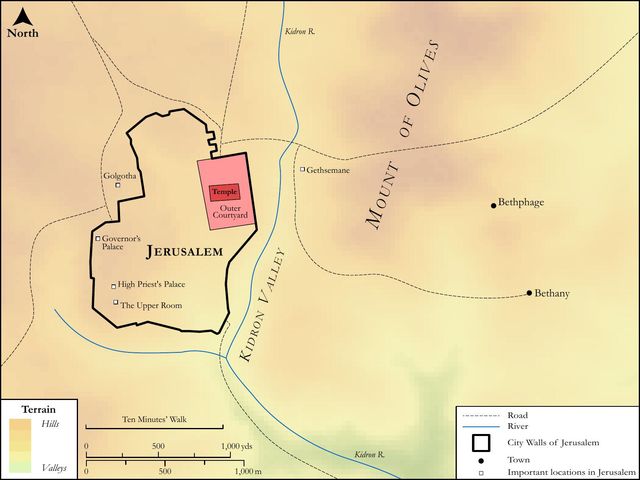
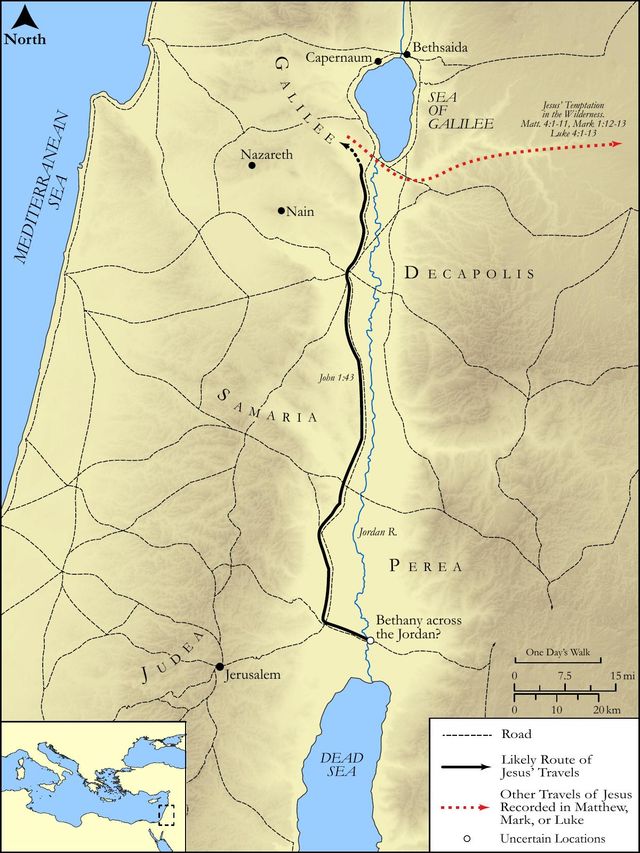
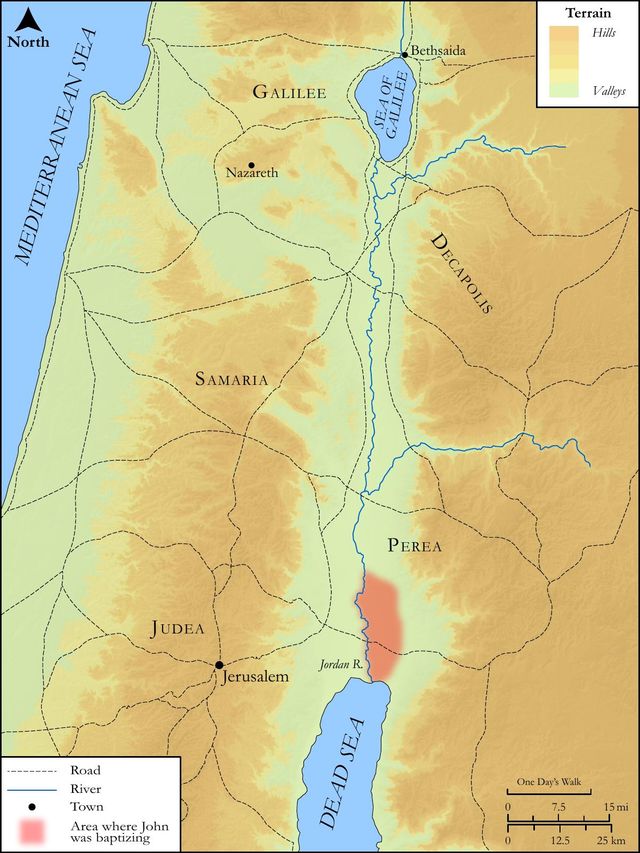
Study this verse
Public-domain commentary
Matthew Henry
From his Commentary on the Whole Bible. Henry wrote on whole passages, and this entry covers John 1:43–51. He set out his notes in a four-level outline, kept here as he numbered it.
We have here the call of Philip and Nathanael.
I.Philip was called immediately by Christ himself, not as Andrew, who was directed to Christ by John, or Peter, who was invited by his brother. God has various methods of bringing his chosen ones home to himself. But, whatever means he uses, he is not tied to any.
1.Philip was called in a preventing was: Jesus findeth Philip. Christ sought us, and found us, before we made any enquiries after him. The name Philip is of Greek origin, and much used among the Gentiles, which some make an instance of the degeneracy of the Jewish church at this time, and their conformity to the nations; yet Christ changed not his name.
2.He was called the day following. See how closely Christ applied himself to his business. When work is to be done for God, we must not lose a day. Yet observe, Christ now called one or two a day; but, after the Spirit was poured out, there were thousands a day effectually called, in which was fulfilled John 14:12.
3.Jesus would go forth into Galilee to call him. Christ will find out all those that are given to him, wherever they are, and none of them shall be lost.
4.Philip was brought to be a disciple by the power of Christ going along with that word, Follow me. See the nature of true Christianity; it is following Christ, devoting ourselves to his converse and conduct, attending his movements, and treading in his steps. See the efficacy of the grace of it is the rod of his strength.
5.We are told that Philip was of Bethsaida, and Andrew and Peter were so too, John 1:44. These eminent disciples received not honour from the place of their nativity, but reflected honour upon it. Bethsaida signifies the house of nets, because inhabited mostly by fishermen; thence Christ chose disciples, who were to be furnished with extraordinary gifts, and therefore needed not the ordinary advantages of learning. Bethsaida was a wicked place (Matthew 11:21), yet even there was a remnant, according to the election of grace.
II.Nathanael was invited to Christ by Philip, and much is said concerning him. In which we may observe,
1.What passed between Philip and Nathanael, in which appears an observable mixture of pious zeal with weakness, such as is usually found in beginners, that are yet but asking the way to Zion. Here is,
(1.)The joyful news that Philip brought to Nathanael, John 1:45. As Andrew before, so Philip here, having got some knowledge of Christ himself, rests not till he has made manifest the savour of that knowledge. Philip, though newly come to an acquaintance with Christ himself, yet steps aside to seek Nathanael. Note, When we have the fairest opportunities of getting good to our own souls, yet ever then we must seek opportunities of doing good to the souls of others, remembering the words of Christ, It is more blessed to give than to receive, Acts 20:35. O, saith Philip, we have found him of whom Moses and the prophets did write, Observe here, [1.] What a transport of joy Philip was in, upon this new acquaintance with Christ: "We have found him whom we have so often talked of, so long wished and waited for; at last, he is come he is come, and we have found him!" [2.] What an advantage it was to him that he was so well acquainted with the scriptures of the Old Testament, which prepared his mind for the reception of evangelical light, and made the entrance of it much the more easy: Him of whom Moses and the prophets did write. What was written entirely and from eternity in the book of the divine counsels was in part, at sundry times and in divers manners, copied out into the book of the divine revelations. Glorious things were written there concerning the Seed of the woman, the Seed of Abraham, Shiloh, the prophet like Moses, the Son of David, Emmanuel, the Man, the Branch, Messiah the Prince. Philip had studied these things, and was full of them, which made him readily welcome Christ. [3.] What mistakes and weaknesses he laboured under: he called Christ Jesus of Nazareth, whereas he was of Bethlehem; and the Son of Joseph, whereas he as but his supposed Son. Young beginners in religion are subject to mistakes, which time and the grace of God will rectify. It was his weakness to say, We have found him, for Christ found them before they found Christ. He did not yet apprehend, as Paul did, how he was apprehended of Christ Jesus, Philippians 3:12.
(2.)The objection which Nathanael made against this, Can any good thing come out of Nazareth? John 1:46. Here,
[1.]His caution was commendable, that he did not lightly assent to every thing that was said, but took it into examination; our rule is, Prove all things. But,
[2.]His objection arose from Ignorance. If he meant that no good thing could come out of Nazareth it was owing to his ignorance of the divine grace, as if that were less affected to one place than another, or tied itself to men's foolish and ill-natured observations. If he meant that the Messiah, that great good thing, could not come out of Nazareth, so far he was right (Moses, in the law, said that he should come out of Judah, and the prophets had assigned Bethlehem for the place of his nativity); but then he was ignorant of the matter of fact, that this Jesus was born at Bethlehem; so that the blunder Philip made, in calling him Jesus of Nazareth, occasioned this objection. Note, The mistakes of preachers often give rise to the prejudices of hearers.
(3.)The short reply which Philip gave to this objection: Come and see.
[1.]It was his weakness that he could not give a satisfactory answer to it; yet it is the common case of young beginners in religion. We may know enough to satisfy ourselves, and yet not be able to say enough to silence the cavils of a subtle adversary.
[2.]It was his wisdom and zeal that, when he could not answer the objection himself, he would have him go to one that could: Come and see. Let us not stand arguing here, and raising difficulties to ourselves which we cannot get over; let us go and converse with Christ himself, and these difficulties will all vanish presently. Note, It is folly to spend that time in doubtful disputation which might be better spent, and to much better purpose, in the exercises of piety and devotion. Come and see; not, Go and see, but, "Come, and I will go along with thee;" as Isaiah 2:3; Jeremiah 1:5. From this parley between Philip and Nathanael, we may observe, First, That many people are kept from the ways of religion by the unreasonable prejudices they have conceived against religion, upon the account of some foreign circumstances which do not at all touch the merits of the case. Secondly, The best way to remove the prejudices they have entertained against religion is to prove themselves, and make trial of it. Let us not answer this matter before we hear it.
2.What passed between Nathanael and our Lord Jesus. He came and saw, not in vain.
(1.)Our Lord Jesus bore a very honourable testimony to Nathanael's integrity: Jesus saw him coming, and met him with favourable encouragement; he said of him to those about him, Nathanael himself being within hearing, Behold an Israelite indeed. Observe,
[1.]That he commended him; not to flatter him, or puff him up with a good conceit of himself, but perhaps because he knew him to be a modest man, if not a melancholy man, one that had hard and mean thoughts of himself, was ready to doubt his own sincerity; and Christ by this testimony put the matter out of doubt. Nathanael had, more than any of the candidates, objected against Christ; but Christ hereby showed that he excused it, and was not extreme to mark what he had said amiss, because he knew his heart was upright. He did not retort upon him, Can any good thing come out of Cana (John 21:2), an obscure town in Galilee? But kindly gives him this character, to encourage us to hope for acceptance with Christ, notwithstanding our weakness, and to teach us to speak honourably of those who without cause have spoken slightly of us, and to give them their due praise.
[2.]That he commended him for his integrity. First, Behold an Israelite indeed. It is Christ's prerogative to know what men are indeed; we can but hope the best. The whole nation were Israelites in name, but all are not Israel that are of Israel (Romans 9:6); here, however, was an Israelite indeed. 1. A sincere follower of the good example of Israel, whose character it was that he was a plain man, in opposition to Esau's character of a cunning man. He was a genuine son of honest Jacob, not only of his seed, but of his spirit. 2. A sincere professor of the faith of Israel; he was true to the religion he professed, and lived up to it: he was really as good as he seemed, and his practice was of a piece with his profession. He is the Jew that is one inwardly (Romans 2:29), so is he the Christian. Secondly, He is one in whom is no guile - that is the character of an Israelite indeed, a Christian indeed: no guile towards men; a man without trick or design; a man that one may trust; no guile towards God, that is, sincere in his repentance for sin; sincere in his covenanting with God; in whose spirit is no guile, Psalm 32:2. He does not say without guilt, but without guile. Though in many things he is foolish and forgetful, yet in nothing false, nor wickedly departing from God: there is no allowed approved guilt in him; not painted, though he have his spots: "Behold this Israelite indeed." 1. "Take notice of him, that you may learn his way, and do like him." 2. "Admire him; behold, and wonder." The hypocrisy of the scribes and Pharisees had so leavened the Jewish church and nation, and their religion was so degenerated into formality or state-policy, that an Israelite indeed was a man wondered at, a miracle of divine grace, like Job, Job 1:8.
(2.)Nathanael is much surprised at this, upon which Christ gives him a further proof of his omnisciency, and a kind memorial of his former devotion.
[1.]Here is Nathanael's modesty, in that he was soon put out of countenance at the kind notice Christ was pleased to take of him: "Whence knowest thou me, me that am unworthy of thy cognizance? who am I, O Lord God?" 2 Samuel 7:18. This was an evidence of his sincerity, that he did not catch at the praise he met with, but declined it. Christ knows us better than we know ourselves; we know not what is in a man's heart by looking in his face, but all things are naked and open before Christ, Hebrews 4:12, Hebrews 4:13. Doth Christ know us? Let us covet to know him.
[2.]Here is Christ's further manifestation of himself to him: Before Philip called thee, I saw thee. First, He gives him to understand that he knew him, and so manifests his divinity. It is God's prerogative infallibly to know all persons and all things; by this Christ proved himself to be God upon many occasions. It was prophesied concerning the Messiah that he should be of quick understanding in the fear of the Lord, that is, in judging the sincerity and degree of the fear of God in others, and that he should not judge after the sight of his eyes, Isaiah 11:2, Isaiah 11:3. Here he answers that prediction. See 2 Timothy 2:19. Secondly, That before Philip called him he saw him under the fig-tree; this manifests a particular kindness for him. 1. His eye was towards him before Philip called him, which was the first time that ever Nathanael was acquainted with Christ. Christ has knowledge of us before we have any knowledge of him; see Isaiah 45:4; Galatians 4:9. 2. His eye was upon him when he as under the fig-tree; this was a private token which nobody understood but Nathanael: "When thou wast retired under the fig-tree in thy garden, and thoughtest that no eye saw thee, I have then my eye upon thee, and saw that which was very acceptable." It is most probable that Nathanael under the fig-tree was employed, as Isaac in the field, in meditation, and prayer, and communion with God. Perhaps then and there it was that he solemnly joined himself to the Lord in an inviolable covenant. Christ saw in secret, and by this public notice of it did in part reward him openly. Sitting under the fig-tree denotes quietness and composedness of spirit, which much befriend communion with God. See Micah 4:4; Zechariah 3:10. Nathanael herein was an Israelite indeed, that, like Israel, he wrestled with God alone (Genesis 32:24), prayed not like the hypocrites, in the corners of the streets, but under the fig-tree.
(3.)Nathanael hereby obtained a full assurance of faith in Jesus Christ, expressed in that noble acknowledgment (John 1:49): Rabbi, thou art the Son of God, thou art the king of Israel; that is, in short, thou art the true Messiah. Observe here,
[1.]How firmly he believed with the heart. Though he had lately laboured under some prejudices concerning Christ, they had now all vanished. Note, The grace of God, in working faith, casts down imaginations. Now he asks no more, Can any good thing come out of Nazareth? For he believes Jesus of Nazareth to be the chief good, and embraces him accordingly.
[2.]How freely he confessed with the mouth. His confession is made in form of an adoration, directed to our Lord Jesus himself, which is a proper way of confessing our faith. First, He confesses Christ's prophetical office, in calling him Rabbi, a title which the Jews commonly gave to their teachers. Christ is the great rabbi, at whose feet we must all be brought up. Secondly, He confesses his divine nature and mission, in calling him the Son of God (that Son of God spoken of Psalm 2:7); though he had but a human form and aspect, yet having a divine knowledge, the knowledge of the heart, and of things distant and secret, Nathanael thence concludes him to be the Son of God. Thirdly, He confesses, "Thou art the king of Israel; that king of Israel whom we have been long waiting for." If he be the Son of God, he is king of the Israel of God. Nathanael hereby proves himself an Israelite indeed that he so readily owns and submits to the king of Israel.
(4.)Christ hereupon raises the hopes and expectations of Nathanael to something further and greater than all this, John 1:50, John 1:51. Christ is very tender of young converts, and will encourage good beginnings, though weak, Matthew 12:20.
[1.]He here signifies his acceptance, and (it should seem) his admiration, of the ready faith of Nathanael: Because I said, I saw thee under the fig-tree, believest thou? He wonders that such a small indication of Christ's divine knowledge should have such an effect; it was a sign that Nathanael's heart was prepared beforehand, else the work had not been done so suddenly. Note, It is much for the honour of Christ and his grace, when the heart is surrendered to him at the first summons.
[2.]He promises him much greater helps for the confirmation and increase of his faith than he had had for the first production of it.
First, In general: "Thou shalt see greater things than these, stronger proofs of my being the Messiah;" the miracles of Christ, and his resurrection. Note, 1. To him that hath, and maketh good use of what he hath, more shall be given. 2. Those who truly believe the gospel will find its evidences grow upon them, and will see more and more cause to believe it. 3. Whatever discoveries Christ is pleased to make of himself to his people while they are here in this world, he hath still greater things than these to make known to them; a glory yet further to be revealed.
Secondly, In particular: "Not thou only, but you, all you my disciples, whose faith this is intended for the confirmation of, you shall see heaven opened;" this is more than telling Nathanael of his being under the fig-tree. This is introduced with a solemn preface, Verily, verily I say unto you, which commands both a fixed attention to what is said as very weighty, and a full assent to it as undoubtedly true: "I say it, whose word you may rely upon, amen, amen." None used this word at the beginning of a sentence but Christ, though the Jews often used it at the close of a prayer, and sometimes doubled it. It is a solemn asseveration. Christ is called the Amen (Revelation 3:14), and so some take it here, I the Amen, the Amen, say unto you. I the faithful witness. Note, The assurances we have of the glory to be revealed are built upon the word of Christ. Now see what it is that Christ assures them of: Hereafter, or within awhile, or ere long, or henceforth, ye shall see heaven opened.
a.It is a mean title that Christ here takes to himself: The Son of man; a title frequently applied to him in the gospel, but always by himself. Nathanael had called him the Son of God and king of Israel: he calls himself Son of man, (1.) To express his humility in the midst of the honours done him. (b.) To teach his humanity, which is to be believed as well as his divinity. (c.) To intimate his present state of humiliation, that Nathanael might not expect this king of Israel to appear in external pomp.
b.Yet they are great things which he here foretels: You shall see heaven opened, and the angels of God ascending and descending upon the Son of man. (a.) Some understand it literally, as pointing at some particular event. Either, [a.] There was some vision of Christ's glory, in which this was exactly fulfilled, which Nathanael was an eye-witness of, as Peter, and James, and John were of his transfiguration. There were many things which Christ did, and those in the presence of his disciples, which were not written (John 20:30), and why not this? Or, [b.] It was fulfilled in the many ministrations of the angels to our Lord Jesus, especially that at his ascension, when heaven was opened to receive him, and the angels ascended and descended, to attend him and to do him honour, and this in the sight of the disciples. Christ's ascension was the great proof of his mission, and much confirmed the faith of his disciples, John 6:62. Or, [c.] It may refer to Christ's second coming, to judge the world, when the heavens shall be open, and every eye shall see him, and the angels of God shall ascend and descend about him, as attendants on him, every one employed; and a busy day it will be. See 2 Thessalonians 1:10. (b.) Others take it figuratively, as speaking of a state or series of things to commence from henceforth; and so we may understand it, [a.] Of Christ's miracles. Nathanael believed, because Christ, as the prophets of old, could tell him things secret; but what is this? Christ is now beginning a dispensation of miracles, much more great and strange than this, as if heaven were opened; and such a power shall be exerted by the Son of man as if the angels, which excel in strength, were continually attending his orders. Immediately after this, Christ began to work miracles, John 2:11. Or, [b.] Of his mediation, and that blessed intercourse which he hath settled between heaven and earth, which his disciples should be degrees be let into the mystery of. First, By Christ, as Mediator, they shall see heaven opened, that we may enter into the holiest by his blood (Hebrews 10:19, Hebrews 10:20); heaven opened, that by faith we may look in, and at length may go in; may now behold the glory of the Lord, and hereafter enter into the joy of our Lord. And, Secondly, They shall see angels ascending and descending upon the Son of man. Through Christ we have communion with and benefit by the holy angels, and things in heaven and things on earth are reconciled and gathered together. Christ is to us as Jacob's ladder (Genesis 28:12), by whom angels continually ascend and descend for the good of the saints.
Historical interpretation
Seven Centuries of Reception
5 surviving comments on this verse. Each one is dated, so this reads as a timeline rather than a list.
Select a marker to jump to its quote. Markers stagger vertically where authors wrote within a few decades of each other.
"Philip findeth Nathanael, and saith unto him, We have found Him of whom Moses in the Law and the Prophets did write, Jesus of Nazareth, the son of Joseph."
He says this, to make his preaching credible, which it must be if it rests on Moses and the Prophets besides, and by this to abash his hearer. For since Nathanael was an exact man, and one who viewed all things with truth, as Christ also testified and the event showed, Philip with reason refers him to Moses and the Prophets, that so he might receive Him who was preached. And he not troubled though he called Him "the son of Joseph"; for still he was supposed to be his son. "And whence, O Philip, is it plain that this is He? What proof dost thou mention to us? for it is not enough merely to assert this. What sign hast thou seen, what miracle? Not without danger is it to believe without cause in such matters. What proof then hast thou?" "The same as Andrew," he replies; for he though unable to produce the wealth which he had found, or to describe his treasure in words, when he had discovered it, led his brother to it. So too did Philip. How this is the Christ, and how the prophets proclaimed Him beforehand, he said not; but he draws him to Jesus, as knowing that he would not afterwards fall off, if he should once taste His words and teaching.
(Hom. xx. 1) Philip is not persuaded himself, but begins preaching to others: Philip findeth Nathanael, and saith unto him, We have found Him of whom Moses in the Law, and the Prophets, did write, Jesus of Nazareth, the Son of Joseph. See how zealous he is, and how constantly he is meditating on the books of Moses, and looking for Christ's coming. That Christ was coming he had known before; but he did not know that this was the Christ, of whom Moses and the Prophets did write: He says this to give credibility to his preaching, and to show his zeal for the Law and the Prophets, and how that he had examined them attentively. Be not disturbed at his calling our Lord the Son of Joseph; this was what He was supposed to be.
(Tr. vii. c. 15) The person to whom our Lord's mother had been betrothed. The Christians know from the Gospel, that He was conceived and born of an undefiled mother. He adds the place too, of Nazareth.
Exceeding swift was the disciple unto the bearing fruit, that hereby he might shew himself akin in disposition to them that had preceded. For he findeth Nathanael, not simply meeting him coming along, but making diligent search for him. For he knew that he was most painstaking and fond of learning. Then he says that he had found the Christ Who was heralded through all the Divine Scripture, addressing himself not as to one ignorant, but as to one exceedingly well instructed in the learning both of all-wise Moses and of the prophets. For a not true supposition was prevailing among the Jews as regards our Saviour Jesus Christ, that He should be of the city or village of Nazareth, albeit the Divine Scripture says that He is a Bethlehemite, as far as pertains to this. And thou, Bethlehem, it says, in the land of Judah, house of Ephrata, art little to be among the thousands of Judah, for out of thee shall He come forth unto Me That is to be ruler in Israel, Whose goings forth have been from of old, from everlasting. For He was brought up in Nazareth, as the Evangelist himself too somewhere testified, saying, And He came to Nazareth, where He had been brought up; but He was not thence, but whence we said before, yea rather, as the voice of the prophet affirmed. Philip therefore following the supposition of the Jews says, Jesus of Nazareth.
He was bred up there: the place of His birth could not have been known generally, but all knew that He was bred up in Nazareth.
And Nathanael said unto him, Can there any good thing come out of Nazareth.
Continue studying John 1:45 across the web’s major study libraries — every link below opens this exact verse, chapter, or book on the destination site.
Read & Compare
 BibleGatewayThis verse in more than 200 translations and 70 languages.
 Bible.comThe YouVersion reader — hundreds of translations, reading plans, and highlights.
 ESV.orgCrossway's official English Standard Version reader.
 NET BibleThe NET translation with 60,000+ translators' notes on every rendering decision.
 STEP BibleTyndale House's free study tool — original text, vocabulary, and scholarly resources.
 BibliaLogos Bible Software's free web reader.
 USCCBThe New American Bible (Revised Edition) with the U.S. bishops' study notes.
Commentaries
 BibleHub CommentariesDozens of classic commentaries on this verse, gathered on one page.
 StudyLightMore than 100 commentary sets — the largest collection on the web.
 BibleRefPlain-English commentary on what this verse means, verse by verse.
 Enduring WordDavid Guzik's free commentary on this chapter, widely used by Bible teachers.
 Bible Study ToolsVerse commentary alongside Greek and Hebrew study aids.
Original Language & Research
- BibleHub InterlinearThe verse word by word — original language, transliteration, and English.
- BibleHub LexiconEvery word's original-language definition and Strong's entry.
 Blue Letter BibleDeep-study tools — Strong's numbers, concordance, and word studies.
 CNTR CollationThe earliest Greek manuscripts of this verse, collated letter by letter.
Sermons, Hymns & Audio


TrulyRandomVerse is not affiliated with these sites and doesn’t control their content. They’re linked because they’re genuinely useful.
Written with AI assistance. Always check it against Scripture.
This verse
Philip finds Nathanael and tells him they have found the one Moses and the prophets wrote about, Jesus of Nazareth, the son of Joseph.
“Philip findeth Nathanael,”
Philip does for his friend what Andrew did for his brother.
“and saith unto him, We have found him, of whom Moses in the law, and the prophets, did write,”
Philip describes Jesus in the words of Scripture.
“Jesus of Nazareth, the son of Joseph.”
How Jesus was known in Galilee, by his town and his family.
Passage studyJohn 1:35–51
Jesus Gathers His First Disciples
Summary
The day after John the Baptist first points out Jesus, he is standing again with two of his disciples. As Jesus walks by, John says, “Behold the Lamb of God!” and the two leave him to follow Jesus. They spend the rest of the day with him, and one of them, Andrew, goes first to his brother Simon with the news, “We have found the Messias.” Jesus looks at Simon and gives him a new name, Cephas. The next day Jesus finds Philip and says, “Follow me,” and Philip finds Nathanael. Nathanael doubts that anything good could come out of Nazareth, yet when Jesus tells him where he was before Philip called him, he confesses Jesus as the Son of God and the King of Israel. Jesus answers with a promise that his disciples will see heaven open and the angels of God ascending and descending upon the Son of man. In a few days the first disciples are gathered, each one brought by someone who had already met Jesus, and each one finds that Jesus already knew him.
Why John Sends His Own Disciples to Jesus
The passage keeps count of days. On the day before this one, John the Baptist saw Jesus coming and said, “Behold the Lamb of God, which taketh away the sin of the world,” and he testified that this is the Son of God (John 1:29–34). Verse 35 opens on the next day, and verse 43 opens on the day after that with “The day following”. The days follow quickly, and each one brings new people to Jesus.
Verse 35 begins with pálin, “again”, the plain adverb for something that happens once more. John is at the place beyond Jordan where he was baptizing (John 1:19–28), and he is about to say again what he said the day before. The verb for “stood”, hístēmi, is the ordinary word for standing, and it pictures John at his post with two of his disciples beside him.
A disciple, mathētḗs, is a learner or pupil, from a root meaning to learn. In Israel at that time pupils (in Hebrew, talmidim) attached themselves to a teacher to learn both his teaching and his way of life, and these two men belonged to John in that way. John’s work had been foretold. Isaiah spoke of a voice crying in the wilderness to prepare the way of the LORD (Isaiah 40:3), and Luke applies those words to John (Luke 3:4). Malachi spoke of a messenger sent to prepare the way before the Lord (Malachi 3:1) and of Elijah the prophet coming before the great day of the LORD (Malachi 4:5–6). John came to bear witness of the Light (John 1:6–8). The crowds that came to him wondered whether he might himself be the Christ (Luke 3:15), so he had a following he could have kept for himself. He used it to send his own disciples to Jesus, which is what he later meant when he said, “He must increase, but I must decrease” (John 3:30).
In verse 36 John is “looking upon Jesus as he walked”. The verb emblépō means to look at or look straight at someone, and John has his eyes fixed on Jesus as he passes. Then he speaks to his disciples: “Behold the Lamb of God!” The word íde, “behold”, is an interjection like “see!” or “lo!”, which calls for attention and puts weight on what comes after it. This time John says it to the two men closest to him, and they take it as his word to them.
They hear, and they act. The verb for “heard”, akoúō, is the common word for hearing, and what they heard moved them, because “they followed Jesus”. akolouthéō comes from a word of union and a word for a road, and Strong’s gives its sense as “to be in the same way with”, to go along with someone, especially as a disciple. The two men walk after Jesus along the road, and that walk is the beginning of their life as his disciples. Their own teacher has pointed them to him, so they go with John’s blessing. Jesus would later put the call in his own words: “Follow me, and I will make you fishers of men” (Matthew 4:19), and “take up his cross daily, and follow me” (Luke 9:23). He says that his sheep hear his voice and follow him (John 10:27), and Peter would one day tell him, “thou hast the words of eternal life” (John 6:68).
Why does John call Jesus the Lamb of God?
John calls Jesus the Lamb of God because Jesus is the sacrifice God himself has provided to take away sin. The word amnós is the plain word for a lamb, and every Jew who heard it knew what lambs were for. Many in Israel, living under Rome, were hoping for a deliverer who would set them free by force, and John’s title points to the deeper bondage of sin. Three strands of the Old Testament meet in it.
The apostles use the same picture. Peter says we were redeemed “with the precious blood of Christ, as of a lamb without blemish and without spot” (1 Peter 1:18–19). Paul says God set Christ forth to be a propitiation through faith in his blood (Romans 3:25). In Revelation, John sees in the midst of the throne a Lamb as it had been slain (Revelation 5:6), praised because by his blood he has redeemed people to God out of every nation (Revelation 5:9).
What Seek Ye? Jesus Turns to the Two
Jesus turns and sees the two following him. The verb stréphō is a turning round, and with it Jesus takes up the meeting himself and speaks to them first. His first words in John’s Gospel are a question: “What seek ye?” The verb zētéō means to seek, to look for, to try to obtain. Jesus already knows them, as his words to Nathanael will show, and the question brings into the open what they are looking for, so that following him becomes their own clear choice.
They answer with a title and a question. “Rabbi” was a title of honour for a teacher in Israel, meaning “my great one” or “my teacher”, and John explains it for his readers: “which is to say, being interpreted, Master”. He does the same with “Messias” in verse 41 and “Cephas” in verse 42. Then they ask, “where dwellest thou?” The verb is ménō, to stay, abide or remain. A disciple lived near his teacher and learned from his daily life, and these men want to stay where Jesus is and learn from him.
Jesus answers, “Come and see.” The verb érchomai is the ordinary word for coming or going, and eídō means to see, with the eyes or with the mind. Jesus offers himself to be known, and they come to know him by being with him. “They came and saw where he dwelt, and abode with him that day”. “Abode” is ménō again, the same verb as in their question, so they ask where he stays and end up staying with him. The word grows large in this Gospel. Jesus later says, “Abide in me, and I in you” (John 15:4), and he promises that the Spirit of truth will dwell with his disciples and be in them (John 14:16–17).
The whole exchange fits what Scripture says about seeking God. David longed to dwell in the house of the LORD all the days of his life (Psalm 27:4), and a psalm calls, “O taste and see that the LORD is good” (Psalm 34:8). Jesus promises that those who seek will find (Matthew 7:7), and he calls all who labour and are heavy laden to come to him for rest (Matthew 11:28–30). In him are hid all the treasures of wisdom and knowledge (Colossians 2:3). John has already told us that the Word was made flesh and dwelt among us (John 1:14), so these two men spend that day in the company of God made man. After his death and resurrection he would make his home in his people by the Spirit, so that Paul could say, “Christ liveth in me” (Galatians 2:20), and call the believer’s body the temple of the Holy Ghost (1 Corinthians 6:19). Eternal life is to know the only true God and Jesus Christ whom he has sent (John 17:3), and for these two that knowing began on this day.
What was the tenth hour?
The tenth hour is about four in the afternoon if the hours are counted from sunrise, as the Jews counted them, and on that reckoning the two stayed with Jesus into the evening and most likely through the night. Believers differ here, because some hold that John counts from midnight, as the Romans did, which puts the hour at ten in the morning and gives the two a whole day with him. Either way, the writer remembered the hour. The other of the two disciples goes unnamed, and he is most likely John himself, the writer of this Gospel, who keeps his own name out of his book and speaks of himself as the disciple whom Jesus loved (John 21:7). The exact hour is the kind of thing a man remembers of the day his life changed.
Andrew Brings His Brother Simon
Verse 40 names one of the two: “Andrew, Simon Peter’s brother.” The verbs are those of verse 37, akoúō and akolouthéō: he heard John speak and followed Jesus. The word adelphós is the ordinary word for a brother. Andrew is introduced by his link to his brother, who would become the better known of the two, yet Andrew met Jesus first and then brought Simon to him. Matthew and Mark tell of Jesus calling Simon and Andrew by the Sea of Galilee (Matthew 4:18–22, Mark 1:16–18).
Verse 41 says, “He first findeth his own brother Simon”. The verb heurískō means to find, and finding runs through these verses: Andrew finds Simon, Jesus finds Philip, and Philip finds Nathanael. “First” (prōtos) marks this as the first thing Andrew did, and “his own brother” shows that he went straight to his family. His message is short: “We have found the Messias”. The “we” takes in the other disciple, who shared Andrew’s conviction after their day with Jesus.
What do Messias and Christ mean?
Both words mean “anointed”. Messías comes from the Hebrew Mashiach, and John gives its Greek equivalent, Christós, for his readers: “which is, being interpreted, the Christ”. In Israel, kings, priests and sometimes prophets were anointed with oil when God set them apart for their office. A psalm speaks of the rulers taking counsel “against the LORD, and against his anointed” (Psalm 2:2), Daniel speaks of “the Messiah the Prince” (Daniel 9:25–26), and the prophets promised a son of David whose government and peace would increase for ever (Isaiah 9:6–7) and one like the Son of man who would receive an everlasting kingdom (Daniel 7:13–14).
Many in Andrew’s day expected the Messiah to be a king who would drive out Rome and restore David’s throne. Jesus is that King, and he told Pilate, “My kingdom is not of this world” (John 18:36). He is also the Prophet that Moses promised (Deuteronomy 18:15) and the Priest who offered himself once for all (Hebrews 9:11–14). Peter preached at Pentecost that God had made Jesus “both Lord and Christ” (Acts 2:36), Paul declared that Jesus is the Christ (Acts 17:3), and John wrote his Gospel so that we might believe “that Jesus is the Christ, the Son of God” (John 20:31).
Why did Jesus give Simon a new name?
Jesus gave Simon a new name to declare what he would make of him. “And he brought him to Jesus” is all that Andrew did, and it was enough. “When Jesus beheld him” uses emblépō, the same verb used of John looking upon Jesus in verse 36. Jesus looks straight at Simon and speaks first: “Thou art Simon the son of Jona”. He names the man as he is, with his father’s name, and then names the man he will make: “thou shalt be called Cephas”. The verb kaléō means to call, and here it means to give a name. Kēphâs is the Aramaic word for a rock (Kepha), from the language Jesus and his disciples spoke in Galilee, and John translates it for his readers: “A stone”, which in Greek is Pétros, Peter. Strong’s defines Pétros as a piece of rock. Cephas and Peter are one name in two languages, and both speak of something solid.
When God renamed people in Scripture, he set them in a new place in his purposes. Abram became Abraham, “for a father of many nations have I made thee” (Genesis 17:5), and Jacob became Israel after he wrestled with God (Genesis 32:28). Jesus does the same at his first meeting with Simon, and it shows his authority over the man and his future. The name looks ahead. Simon was quick to speak and quick to act, and he would fail badly before he was restored, yet Jesus would make a rock of him, a leader of the apostles and a steady witness to the resurrection. The Lord who calls people knows what he is making of them before they do.
Jesus explains the name later, when Simon confesses him as the Christ: “thou art Peter, and upon this rock I will build my church” (Matthew 16:18). Believers differ over what that saying means for the order of the church after Peter, and the verse in John, which records only the giving of the name, leaves that question to Matthew. Scripture is plain that Christ himself is the foundation. Paul says that the one foundation laid is Jesus Christ (1 Corinthians 3:11) and that “that Rock was Christ” (1 Corinthians 10:4). The church is “built upon the foundation of the apostles and prophets, Jesus Christ himself being the chief corner stone” (Ephesians 2:20), and Christ is the head over all things to the church (Ephesians 1:22–23). Peter himself calls Christ the living stone and believers “lively stones” built up into a spiritual house (1 Peter 2:4–5), with Christ the chief corner stone laid in Sion (1 Peter 2:6–8). Isaiah told Israel to look to the rock they were hewn from, to Abraham, whom God called alone and blessed (Isaiah 51:1–2), and Jesus’ call of Simon is a call of the same kind, to one man for the sake of many.
Jesus Finds Philip
On the next day Jesus “would go forth into Galilee”, which is to say he had made up his mind to go. Galilaía, Galilee, is a name of Hebrew origin that Strong’s renders “the heathen circle”, and Isaiah calls it “Galilee of the nations”, the land where the people that walked in darkness would see a great light (Isaiah 9:1–2). The leaders in Jerusalem looked down on it, and the Pharisees would later tell Nicodemus, “out of Galilee ariseth no prophet” (John 7:52). They had already sent men to question John (John 1:19–28), and Galilee, among ordinary people and away from their scrutiny, would be where Jesus did much of his work.
Then Jesus “findeth Philip”. The verb is heurískō again, and this time Jesus is the one who finds. In Israel a student usually chose his rabbi, and here the Teacher goes looking for his student. His word to Philip is “Follow me”, the command form of akolouthéō, the verb used of the first two in verses 37 and 40. Jesus later told his disciples, “Ye have not chosen me, but I have chosen you” (John 15:16). He is the good shepherd who gives his life for the sheep (John 10:11), and he goes out to find his own. Before long he would appoint twelve to be with him (Mark 3:13–19).
Bethsaida, the town of the first disciples
Verse 44 adds a note, joined by dé, the little connective translated “Now”: “Philip was of Bethsaida, the city of Andrew and Peter.” Phílippos, Philip, is a Greek name meaning fond of horses, and both Philip and Andrew bear Greek names, a sign of how much Greek was heard in Galilee. Bēthsaïdá means “fishing-house”, a name of Aramaic origin, and it was a fishing village on the north-eastern shore of the Sea of Galilee, near where the Jordan flows into the lake. John calls it a pólis, a city or town, and Herod Philip had raised it to the rank of a city and renamed it Julias. The first disciples were neighbours who already knew one another, and Jesus gathered them through the ties they already had.
Bethsaida comes up again in the Gospels. Jesus healed a blind man there (Mark 8:22–26), and after feeding the five thousand he sent his disciples by boat toward it (Mark 6:45). Even so, he pronounced woe on it for its lack of repentance after all its mighty works (Matthew 11:21). The other Gospels place Peter and Andrew at Capernaum (Mark 1:21). Bethsaida was most likely their home town, and Capernaum the place where they lived and fished when Jesus called them.
These were fishermen from a small town, far from the learned men of Jerusalem. God chose the foolish and weak things of the world, “that no flesh should glory in his presence” (1 Corinthians 1:26–29).
The One of Whom Moses and the Prophets Wrote
Philip does what Andrew did. He “findeth Nathanael” and tells him, “We have found him, of whom Moses in the law, and the prophets, did write”. gráphō is the ordinary verb to write, and prophḗtēs is a prophet, one who speaks for God. “Moses in the law, and the prophets” names the whole of the Scriptures Israel had, and Philip says all of it was pointing to this man.
Moses wrote that God would raise up a Prophet like him from among his brethren (Deuteronomy 18:15), and Peter applied those words to Jesus (Acts 3:22). The prophets and psalms told of a virgin who would conceive and bear a son (Isaiah 7:14), of one wounded for our transgressions (Isaiah 53:4–6), of the Holy One whom God would keep from corruption (Psalm 16:10), and of the Son of man given everlasting dominion (Daniel 7:13–14). Christ is the end of the law for righteousness to every one that believeth (Romans 10:4). After his resurrection Jesus himself, “beginning at Moses and all the prophets”, expounded in all the scriptures the things concerning himself (Luke 24:27), and he told his disciples that everything written of him in the law of Moses, the prophets and the psalms must be fulfilled (Luke 24:44).
Philip ends with what everyone knew about him: “Jesus of Nazareth, the son of Joseph.” That is how his neighbours spoke of him, by his town and his family. Philip’s faith is real, and it is still young. John has already shown us that this man is the Word who was with God and was God, by whom all things were made (John 1:1–3), and who was made flesh (John 1:14). Later the crowds would stumble over the same facts and ask, “Is not this Jesus, the son of Joseph, whose father and mother we know?” (John 6:42).
Can Any Good Thing Come Out of Nazareth?
Jesus is the good thing that came out of Nazareth, and Nathanael is about to meet him. His question uses agathós, good, and ek, “out of” or “from”, the ordinary preposition for where something comes from. Nazareth was a small village in Galilee, and the Old Testament never mentions it. Micah had named Bethlehem as the place from which the ruler of Israel would come (Micah 5:2), and later the crowds in Jerusalem argued that the Christ must come from Bethlehem and the seed of David, and so could hardly come from Galilee (John 7:41–42). Nathanael came from Cana (John 21:2), another small Galilean town, and his question was the honest prejudice of a man who knew the Scriptures and knew Nazareth.
God’s way has long been to work through what people pass over. Isaiah said of the servant, “he hath no form nor comeliness” (Isaiah 53:2–3), and the Lord told Paul that his strength is made perfect in weakness (2 Corinthians 12:9).
Philip answers with the invitation Jesus gave in verse 39: “Come and see.” The verb for “see” is eídō, as it was there. Philip leaves Nazareth’s reputation alone and brings Nathanael to the one who can answer for himself. To come and see Jesus is to meet the only begotten Son who has declared the Father (John 1:18), the way, the truth, and the life (John 14:6). A Samaritan woman would later do the same for her town, telling them, “Come, see a man, which told me all things that ever I did: is not this the Christ?” (John 4:29).
An Israelite in Whom Is No Guile
Jesus “saw Nathanael coming” (eídō), and before Nathanael says a word, Jesus speaks about him: “Behold an Israelite indeed, in whom is no guile!” An Israēlítēs is a descendant of Israel, and “indeed” (alēthōs) means truly or genuinely. Nathanael is a son of Israel in heart as well as by birth. dólos, guile, is a word Strong’s traces to a decoy, a bait or trick, and so it means craft or deceit. Nathanael is open and straightforward. He said bluntly what he thought of Nazareth, and Jesus counts that honesty to his credit.
The words echo the man Israel was named for. Jacob took his brother’s blessing by deceit, so that Isaac said, “Thy brother came with subtilty, and hath taken away thy blessing” (Genesis 27:35), and only later did God name him Israel (Genesis 32:28). Here stands an Israelite free of the old trickery of Jacob, and in verse 51 Jesus will speak of Jacob’s own dream.
Scripture prizes this kind of heart. “Blessed is the man ... in whose spirit there is no guile” (Psalm 32:2), and God desires “truth in the inward parts” (Psalm 51:6). Peter tells believers to lay aside “all malice, and all guile” (1 Peter 2:1), and of the redeemed who follow the Lamb it is said, “in their mouth was found no guile” (Revelation 14:5). Jesus spoke hard words against religious men whose outward show covered inward corruption (Matthew 23). Christ himself is wholly free of guile: “in him is no sin” (1 John 3:5), and he always did what pleased the Father (John 8:29). Through him we are made new creatures (2 Corinthians 5:17), and he will present his church to himself holy and without blemish (Ephesians 5:27).
Jesus Saw Nathanael Before Philip Called Him
Nathanael’s reply is plain surprise: “Whence knowest thou me?” The verb ginṓskō is the common word for knowing or perceiving, and he simply asks how a stranger can know him. Jesus answers, “Before that Philip called thee, when thou wast under the fig tree, I saw thee.” The verb is eídō again. Jesus saw Nathanael before anyone called him, in a place where he was alone, and Nathanael knows that only he himself knew of that moment.
John says of Jesus that he “knew what was in man” (John 2:24–25), and at the well he told the Samaritan woman about her husbands (John 4:17–19). Scripture gives this knowledge to God. Solomon prayed, “thou, even thou only, knowest the hearts of all the children of men” (1 Kings 8:39), David sang, “O LORD, thou hast searched me, and known me” (Psalm 139:1–4), and all things are naked and opened unto the eyes of him with whom we have to do (Hebrews 4:13). When Jesus sees Nathanael under the fig tree, he does what only God does.
That knowledge is also a comfort. Jesus is the shepherd who calls his own sheep by name (John 10:3) and knows them (John 10:14), the high priest who is touched with the feeling of our infirmities (Hebrews 4:15) and makes intercession for us (Romans 8:34), and the Son of man who came to seek and to save that which was lost (Luke 19:10).
What was Nathanael doing under the fig tree?
The verse tells us where Nathanael was, and that is the point: Jesus saw him in a place of his own, apart from others. Fig trees grew beside homes and in gardens, their thick shade made a quiet place to rest, pray or think, and Jewish teachers are said to have studied the law beneath them. Nathanael may well have been praying or reading the Scriptures there, and Jesus’ words about a true Israelite fit such a man, though John leaves the activity unnamed. What Nathanael heard was that Jesus knew his private moment, and that was enough for him.
Son of God and King of Israel
Nathanael answers at once: “Rabbi, thou art the Son of God; thou art the King of Israel.” rhabbí is the respectful title for a teacher, the one the first two disciples used in verse 38, and Nathanael moves straight on from it to two greater titles. huiós is the word for a son, and “the Son of God” names one who stands in a unique relationship to God. basileús means a king, one with authority to rule, and “the King of Israel” names Jesus as Israel’s promised ruler. God had promised David a son whose throne he would establish for ever (2 Samuel 7), and Isaiah foretold a child on David’s throne whose kingdom would grow for ever (Isaiah 9:6–7).
Nathanael spoke more truly than he yet understood. Many then thought of the Son of God as the anointed king, and John’s readers know from the opening of the Gospel that the Son is the Word who was God (John 1:1). He was in the form of God and took the form of a servant (Philippians 2:6–7), and he is the Son God gave because he so loved the world (John 3:16). Other confessions follow this one. Peter says, “Thou art the Christ, the Son of the living God” (Matthew 16:16), Martha says she believes he is the Christ, the Son of God (John 11:27), and the newly converted Saul preached in the synagogues that Jesus is the Son of God (Acts 9:20).
What are the greater things?
The greater things are the signs, the teaching, the death and the resurrection by which Jesus shows his glory. He receives Nathanael’s faith and points him beyond it: “Because I said unto thee, I saw thee under the fig tree, believest thou? thou shalt see greater things than these.” pisteúō means to believe, to credit what someone says and to trust a person, and Jesus accepts that Nathanael believes. One sign has brought him to faith, and Jesus promises much more. The verb for “shalt see” is optánomai, which Strong’s glosses as to gaze, to look with wide-open eyes as at something remarkable, and what is coming deserves that kind of looking.
The first of these comes within days, at the wedding in Cana, where Jesus turned water into wine, “and manifested forth his glory; and his disciples believed on him” (John 2:1–11). After that come his teaching, his power over sickness and death, his death on the cross, his resurrection and his ascension. In him dwells all the fulness of the Godhead bodily (Colossians 2:9). He even promised that those who believe on him would do greater works, because he goes to the Father (John 14:12), and at Pentecost the Spirit came upon the disciples (Acts 2:1–4).
Heaven Opened Above the Son of Man
Jesus closes with a solemn promise: “Verily, verily, I say unto you”. amḗn is a word of Hebrew origin meaning firm or sure, and as an adverb it means “surely” or “so be it”. In John’s Gospel Jesus doubles it, and it marks what follows as certain truth. He is speaking to Nathanael, “he saith unto him”, yet the promise uses hymîn, the plural “to you”, so it belongs to all the disciples with him. “Hereafter” stands for árti and apó, “from now on”, so what he promises begins now and goes on.
The promise is that “ye shall see heaven open, and the angels of God ascending and descending upon the Son of man.” anabaínō means to go up, and katabaínō means to go or come down. Jesus is speaking of Jacob’s dream at Bethel, where Jacob saw “a ladder set up on the earth, and the top of it reached to heaven: and behold the angels of God ascending and descending on it” (Genesis 28:12). Jacob called the place Bethel, the house of God. Jesus says the angels will go up and come down on the Son of man. He himself is the ladder, the place where heaven and earth meet, and the true house of God. All of God’s dealings with us come down through him, and all our approach to God goes up through him. Paul writes, “For there is one God, and one mediator between God and men, the man Christ Jesus” (1 Timothy 2:5), and Jesus says, “I am the way, the truth, and the life” (John 14:6). The guileless Israelite of verse 47 is promised the reality that Jacob’s dream pointed to.
Heaven opened over Jesus at his baptism, when the Spirit came down upon him (Matthew 3:16), and Stephen, as he faced death, saw the heavens opened and the Son of man standing on the right hand of God (Acts 7:56).
Why does Jesus call himself the Son of man?
Jesus calls himself the Son of man because the name holds both his true humanity and the glory Daniel saw. huiós tou anthrṓpou joins huiós, son, with ánthrōpos, man or human being, and it is the name Jesus uses most for himself in the Gospels. Nathanael has just called him the Son of God, and Jesus answers with the Son of man, the same word for son in both. In Daniel’s vision one like the Son of man comes with the clouds of heaven and is given dominion, glory and an everlasting kingdom (Daniel 7:13–14). In John’s Gospel the Son of man is the one who came down from heaven (John 3:13) and has authority to execute judgment (John 5:27). His coming down to us and his going up to the Father are the true descending and ascending: “He that descended is the same also that ascended up far above all heavens” (Ephesians 4:8–10).
The Names Given to Jesus in These Days
These verses give Jesus one name after another, and together they say who he is. John the Baptist calls him the Lamb of God. The first disciples call him Rabbi, Master. Andrew calls him the Messias, the Christ. Philip calls him the one of whom Moses and the prophets wrote, and also Jesus of Nazareth, the son of Joseph. Nathanael calls him the Son of God and the King of Israel. Jesus calls himself the Son of man. Each disciple says what he has seen so far, and each name is true. The sacrifice for sin, the Teacher, the Anointed One, the fulfilment of Scripture, the man from a small town, the Son of God, Israel’s King and the meeting place of heaven and earth are one person, and the rest of John’s Gospel shows him to be all of them.
Found by Christ and Brought by Friends
This passage shows us how Christ gathers his people. John the Baptist points two of his disciples to Jesus. Andrew goes first to his own brother. Jesus himself finds Philip, and Philip goes to his friend. Each of these witnesses speaks simply, “Behold the Lamb of God”, “We have found the Messias”, “Come and see”, and leaves the rest to Jesus. The same pattern carries on after the resurrection, when the Lord sends his disciples to teach all nations (Matthew 28:19) and to be his witnesses to the ends of the earth (Acts 1:8). Through Abraham’s seed, which is Christ, the blessing promised to all the families of the earth goes out (Genesis 12:3, Galatians 3:16), and it has reached each of us through someone who met him first.
The passage also shows us our Lord. He turns toward people who follow him and asks what they are looking for. He takes them home for the day. He looks at a fisherman and names what he will become. He goes looking for Philip. He sees Nathanael under the fig tree before anyone calls him, and he meets an honest doubter with knowledge that wins him and a promise of more. The one who came out of Nazareth is the Lamb who takes away the sin of the world and the Son of man on whom heaven stands open. Whoever comes to him with the question of verse 38 in their heart finds that he knew them before they came, and he still says, “Come and see.”
John 1:35
“Again the next day after”
The day after John first called Jesus the Lamb of God, and the start of a new day of witness.
“John stood,”
John is still at the place where he baptized, beyond Jordan.
“and two of his disciples;”
Men who had already learned from John. Verse 40 names one of them as Andrew, and the other goes unnamed.
John 1:36
“And looking upon Jesus as he walked,”
Jesus is passing by (peripatéō), and John watches him go.
“he saith,”
He speaks (légō) to the two beside him.
“Behold the Lamb of God!”
The title from the day before, said here without the rest of the sentence, “which taketh away the sin of the world”. For the two who hear it, the title alone is enough.
John 1:37
“And the two disciples heard him speak,”
John spoke the words in their hearing, and they took them as meant for them.
“and they followed Jesus.”
At first this is simply walking after him on the road. By the end of the day they belong to him.
John 1:38
“Then Jesus turned, and saw them following,”
Jesus takes the first step toward the two men.
“and saith unto them, What seek ye?”
Jesus’ first recorded words in this Gospel, a question about what they want.
“They said unto him, Rabbi,”
They give him the teacher’s title at once.
“(which is to say, being interpreted, Master,)”
The writer’s own explanation for his readers.
“where dwellest thou?”
A request to stay with him and learn.
John 1:39
“He saith unto them, Come and see.”
Jesus answers their question with an invitation.
“They came and saw where he dwelt,”
They go with him at once.
“and abode with him that day:”
What was said that day stays between them and Jesus, and what it did shows in verse 41.
“for it was about the tenth hour.”
About four in the afternoon on the Jewish count from sunrise, or ten in the morning on a count from midnight.
John 1:40
“One of the two which heard John speak, and followed him,”
“Him” is Jesus. The second of the two stays unnamed.
“was Andrew,”
Andrew is the first follower of Jesus whom this Gospel names.
“Simon Peter’s brother.”
Simon is already called Peter here, ahead of the naming in verse 42.
John 1:41
“He first findeth his own brother Simon,”
Andrew goes to his own family first.
“and saith unto him, We have found the Messias,”
The news comes in the plural, as the shared conviction of both men.
“which is, being interpreted, the Christ.”
The writer gives the Hebrew title in its Greek form.
John 1:42
“And he brought him to Jesus.”
Andrew’s part is to bring his brother. The rest is Jesus’ work.
“And when Jesus beheld him,”
Jesus looks straight at Simon before he speaks.
“Thou art Simon the son of Jona:”
Jesus already knows Simon’s name and his father’s.
“thou shalt be called Cephas,”
The future tense makes the name a promise.
“which is by interpretation, A stone.”
Cephas in Aramaic is Peter in Greek.
John 1:43
“The day following”
The next day, as Jesus prepares to leave the Jordan.
“Jesus would go forth into Galilee,”
Jesus intends to go north, to the region where he will do much of his work.
“and findeth Philip,”
Jesus seeks Philip out himself.
“and saith unto him, Follow me.”
The call is short, and it asks for everything.
John 1:44
“Now Philip was of Bethsaida,”
Philip’s home town, a fishing village on the Sea of Galilee.
“the city of Andrew and Peter.”
Philip was a neighbour of the brothers who had just met Jesus.
John 1:45 This verse
“Philip findeth Nathanael,”
Philip does for his friend what Andrew did for his brother.
“and saith unto him, We have found him, of whom Moses in the law, and the prophets, did write,”
Philip describes Jesus in the words of Scripture.
“Jesus of Nazareth, the son of Joseph.”
How Jesus was known in Galilee, by his town and his family.
John 1:46
“And Nathanael said unto him, Can there any good thing come out of Nazareth?”
An honest doubt about a small town that Scripture had left unnamed.
“Philip saith unto him, Come and see.”
Philip answers the doubt with an invitation.
John 1:47
“Jesus saw Nathanael coming to him,”
Jesus sees him first and speaks before Nathanael reaches him.
“and saith of him,”
Jesus speaks about him, so that Nathanael and those with him hear it.
“Behold an Israelite indeed,”
A true son of Israel, in heart as well as by birth.
“in whom is no guile!”
Open and honest, free of the deceit that marked Jacob.
John 1:48
“Nathanael saith unto him, Whence knowest thou me?”
Nathanael asks openly how Jesus knows him.
“Jesus answered and said unto him, Before that Philip called thee,”
Jesus knew Nathanael before Philip ever found him.
“when thou wast under the fig tree, I saw thee.”
A private moment, seen by Jesus from far away.
John 1:49
“Nathanael answered and saith unto him, Rabbi,”
He begins with the title the first disciples used.
“thou art the Son of God;”
The first of his two great titles.
“thou art the King of Israel.”
Israel’s promised king, confessed by the man Jesus has just called a true Israelite.
John 1:50
“Jesus answered and said unto him, Because I said unto thee, I saw thee under the fig tree, believest thou?”
Jesus takes up Nathanael’s faith and the sign that led to it.
“thou shalt see greater things than these.”
A promise of more, beginning at Cana.
John 1:51
“And he saith unto him, Verily, verily, I say unto you,”
The doubled amen marks a solemn word, and “you” is plural.
“Hereafter ye shall see heaven open,”
From now on, heaven stands open to them in Jesus.
“and the angels of God ascending and descending”
The words of Jacob’s dream at Bethel.
“upon the Son of man.”
Where Jacob saw a ladder, the disciples will see Jesus.
Last revised