


John 20:30
- ΠολλὰPollaManyG4183A-APNAdjective Accusative Plural Neuter
- μὲνmenindeedG3303PRTParticle or Disjunctive
- οὖνounthereforeG3767CONJConjunction
- καὶkaialsoG2532CONJConjunction
- ἄλλαallaotherG243A-APNAdjective Accusative Plural Neuter
- σημεῖαsēmeiasignsG4592N-APNNoun Accusative Plural Neuter
- ἐποίησενepoiēsendidG4160V-AAI-3SVerb Aorist Active Indicative 3rd Singular
- ὁho<the>G3588T-NSMDefinite article Nominative Singular Masculine
- ἸησοῦςIēsousJesusG2424N-NSM-PNoun Nominative Singular Masculine Individual
- ἐνώπιονenōpionin the presenceG1799PREPPreposition
- τῶνtōnof theG3588T-GPMDefinite article Genitive Plural Masculine
- μαθητῶνmathētōndisciplesG3101N-GPMNoun Genitive Plural Masculine
- αὐτοῦautouof HimG846P-GSMPersonal pronoun Genitive Singular Masculine
- ἃhawhichG3739R-NPNRelative pronoun Nominative Plural Neuter
- οὐκouknotG3756PRT-NNegative Particle Negative
- ἔστινestinareG1510V-PAI-3SVerb Present Active Indicative 3rd Singular
- γεγραμμέναgegrammenawrittenG1125V-RPP-NPNVerb Perfect Passive Participle Nominative Plural Neuter
- ἐνeninG1722PREPPreposition
- τῷtō<the>G3588T-DSNDefinite article Dative Singular Neuter
- βιβλίῳbibliōbookG975N-DSNNoun Dative Singular Neuter
- τούτῳtoutōthisG3778D-DSNDemonstrative pronoun Dative Singular Neuter
English is a literal word-by-word gloss of the Greek, not the KJV's wording. Why?
This is the original text the KJV's translators worked from — each Greek word with its own literal English meaning in this verse, prepared by scholars at Tyndale House, Cambridge. The KJV translates whole sentences, not word by word, so its wording differs: one Greek word can become several English words, and the KJV may choose “charity” where the gloss reads “love”. Both are faithful — they answer different questions. For the KJV's own rendering, switch to the KJV text.
Details
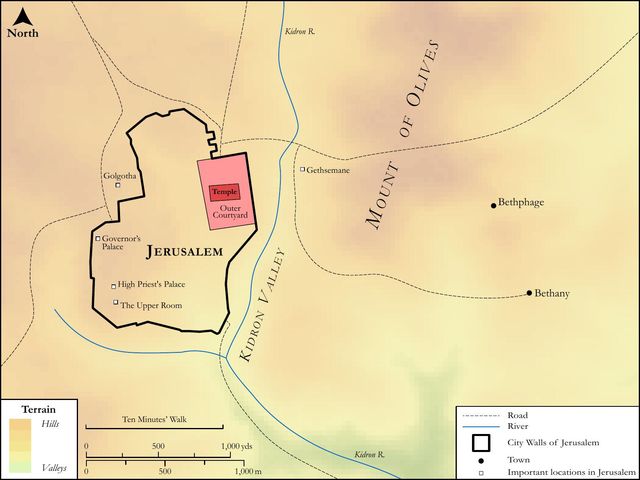
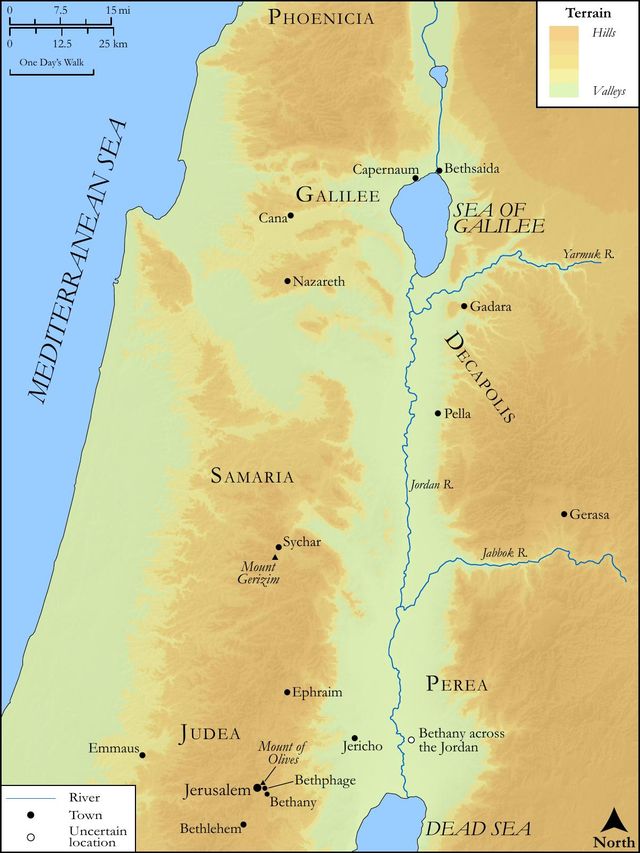
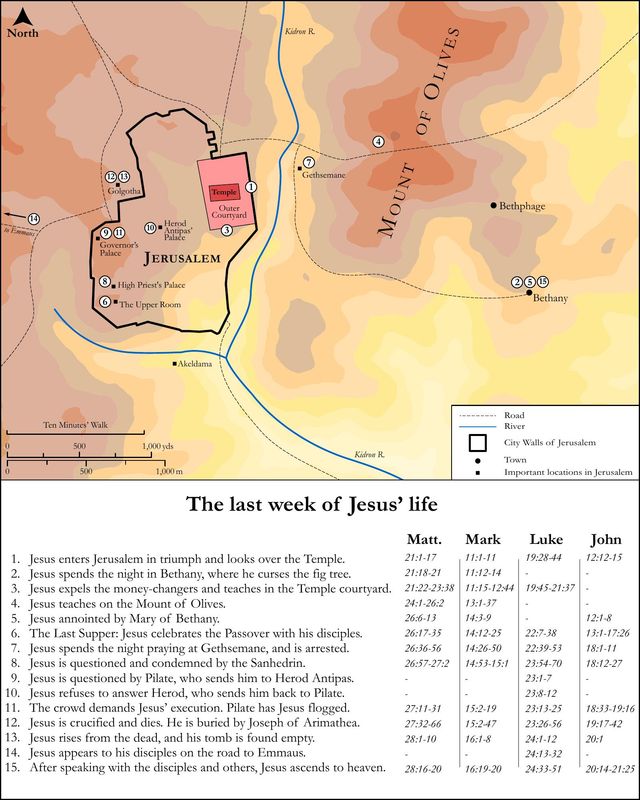
See on the biblical-era map
Study this verse
Public-domain commentary
Matthew Henry
From his Commentary on the Whole Bible. Henry comments on passages, not single verses — this entry covers John 20:26–31. His four-level outline is real structure in the source text, so it is rendered as structure.
We have here an account of another appearance of Christ to his disciples, after his resurrection, when Thomas was now with them. And concerning this we may observe,
I.When it was that Christ repeated his visit to his disciples:
After eight days, that day seven-night after he rose, which must therefore be, as that was, the first day of the week.
1.He deferred his next appearance for some time, to show his disciples that he was not risen to such a life as he had formerly lived, to converse constantly with them but was as one that belonged to another world, and visited this only as angels do, now and then, when there was occasion. Where Christ was during these eight days, and the rest of the time of his abode on earth, it is folly to enquire, and presumption to determine. Wherever he was, no doubt angels ministered unto him. In the beginning of his ministry he had been forty days unseen, tempted by the evil spirit, Mat 4:1, Mat 4:2. And now in the beginning of his glory he was forty days, for the most part unseen, attended by good spirits.
2.He deferred it so long as seven days. And why so?
(1.)That he might put a rebuke upon Thomas for his incredulity. He had neglected the former meeting of the disciples; and, to teach him to prize those seasons of grace better for the future, he cannot have such another opportunity for several days. He that slips one tide must stay a good while for another. A very melancholy week, we have reason to think Thomas had of it, drooping, and in suspense, while the other disciples were full of joy; and it was owing to himself and his own folly.
(2.)That he might try the faith and patience of the rest of the disciples. They had gained a great point when they were satisfied that they had seen the Lord. Then were the disciples glad; but he would try whether they could keep the ground they had got, when they saw no more of him for some days. And thus he would gradually wean them from his bodily presence, which they had doted and depended too much upon.
(3.)That he might put an honour upon the first day of the week, and give a plain intimation of his will, that it should be observed in his church as the Christian sabbath, the weekly day of holy rest and holy convocations. That one day in seven should be religiously observed was an appointment from the beginning, as old as innocency; and that in the kingdom of the Messiah the first day of the week should be that solemn day this was indication enough, that Christ on that day once and again met his disciples in a religious assembly. It is highly probable that in his former appearance to them he appointed them that day seven-night to be together again, and promised to meet them; and also that he appeared to them every first day of the week, besides other times, during the forty days. The religious observance of that day has been thence transmitted down to us through every age of the church. This therefore is the day which the Lord has made.
II.Where, and how, Christ made them this visit.
It was at Jerusalem, for the doors were shut now, as before, for fear of the Jews. There they staid, to keep the feast of unleavened bread seven days, which expired the day before this; yet they would not set out on their journey to Galilee on the first day of the week, because it was the Christian sabbath, but staid till the day after. Now observe,
1.That Thomas was with them; though he had withdrawn himself once, yet not a second time. When we have lost one opportunity, we should give the more earnest heed to lay hold on the next, that we may recover our losses. It is a good sign if such a loss whet our desires, and a bad sign if it cool them. The disciples admitted him among them, and did not insist upon his believing the resurrection of Christ, as they did, because as yet it was but darkly revealed; they did not receive him to doubtful disputation, but bade him welcome to come and see. But observe, Christ did not appear to Thomas, for his satisfaction, till he found him in society with the rest of his disciples, because he would countenance the meetings of Christians and ministers, for there will he be in the midst of them. And, besides, he would have all the disciples witnesses of the rebuke he gave to Thomas, and yet withal of the tender care he had of him.
2.That Christ came in among them, and stood in the midst, and they all knew him, for he showed himself now, just as he had shown himself before (Joh 20:19), still the same, and no changeling. See the condescension of our Lord Jesus. The gates of heaven were ready to be opened to him, and there he might have been in the midst of the adorations of a world of angels; yet, for the benefit of his church, he lingered on earth, and visited the little private meetings of his poor disciples, and is in the midst of them.
3.He saluted them all in a friendly manner, as he had done before; he said, Peace be unto you. This was no vain repetition, but significant of the abundant and assured peace which Christ gives, and of the continuance of his blessings upon his people, for they fail not, but are new every morning, new every meeting.
III.What passed between Christ and Thomas at this meeting; and that only is recorded, though we may suppose he said a great deal to the rest of them. Here is,
1.Christ's gracious condescension to Thomas, Joh 20:27. He singled him out from the rest, and applied himself particularly to him: "Reach hither thy finger, and, since thou wilt have it so, behold my hands, and satisfy thy curiosity to the utmost about the print of the nails; reach hither thy hand, and, if nothing less will convince thee, thrust it into my side." Here we have,
(1.)An implicit rebuke of Thomas's incredulity, in the plain reference which is here had to what Thomas had said, answering it word for word, for he had heard it, though unseen; and one would think that his telling him of it should put him to the blush. Note, There is not an unbelieving word on our tongues, no, nor thought in our minds, at any time, but it is known to the Lord Jesus. Psa 78:21.
(2.)An express condescension to this weakness, which appears in two things: - [1.] That he suffers his wisdom to be prescribed to. Great spirits will not be dictated to by their inferiors, especially in their acts of grace; yet Christ is pleased here to accommodate himself even to Thomas's fancy in a needless thing, rather than break with him, and leave him in his unbelief. He will not break the bruised reed, but, as a good shepherd, gathers that which was driven away, Eze 34:16. We ought thus to bear the infirmities of the weak, Rom 15:1, Rom 15:2. [2.] He suffers his wounds to be raked into, allows Thomas even to thrust his hand into his side, if then at last he would believe. Thus, for the confirmation of our faith, he has instituted an ordinance on purpose to keep his death in remembrance, though it was an ignominious, shameful death, and one would think should rather have been forgotten, and no more said of it; yet, because it was such an evidence of his love as would be an encouragement to our faith, he appoints the memorial of it to be celebrated. And in that ordinance where in we show the Lord's death we are called, as it were, to put our finger into the print of the nails. Reach hither thy hand to him, who reacheth forth his helping, inviting, giving hand to thee.
It is an affecting word with which Christ closes up what he had to say to Thomas: Be not faithless but believing; mē ginou apistos - do not thou become an unbeliever; as if he would have been sealed up under unbelief, had he not yielded now. This warning is given to us all: Be not faithless; for, if we are faithless, we are Christless and graceless, hopeless and joyless; let us therefore say, Lord, I believe, help thou my unbelief.
2.Thomas's believing consent to Jesus Christ. He is now ashamed of his incredulity, and cries out, My Lord and my God, Joh 20:28. We are not told whether he did put his finger into the print of the nails; it should seem, he did not, for Christ says (Joh 20:29), Thou hast seem, and believed; seeing sufficed. And now faith comes off a conqueror, after a struggle with unbelief.
(1.)Thomas is now fully satisfied of the truth of Christ's resurrection - that the same Jesus that was crucified is now alive, and this is he. His slowness and backwardness to believe may help to strengthen our faith; for hereby it appears that the witnesses of Christ's resurrection, who attested it to the world, and pawned their lives upon it, were not easy credulous men, but cautious enough, and suspended their belief of it till they saw the utmost evidence of it they could desire. Thus out of the eater came forth meat.
(2.)He therefore believed him to be Lord and God, and we are to believe him so.
[1.]We must believe his deity - that he is God; not a man made God, but God made man, as this evangelist had laid down his thesis at first, Joh 1:1. The author and head of our holy religion has the wisdom, power, sovereignty, and unchangeableness of God, which was necessary, because he was to be not only the founder of it, but the foundation of it for its constant support, and the fountain of life for its supply.
[2.]His mediation - that he is Lord, the one Lord, Co1 8:6; Ti1 2:5. He is sufficiently authorized, as pleni-potentiary, to settle the great concerns that lie between God and man, to take up the controversy which would inevitably have been our ruin, and to establish the correspondence that was necessary to our happiness; see Act 2:36; Rom 14:9.
(3.)He consented to him as his Lord and his God. In faith there must be the consent of the will to gospel terms, as well as the assent of the understanding to gospel truths. We must accept of Christ to be that to us which the Father hath appointed him. My Lord refers to Adonai - my foundation and stay; my God to Elohim - my prince and judge. God having constituted him the umpire and referee, we must approve the choice, and entirely refer ourselves to him. This is the vital act of faith, He is mine, Sol 2:16.
(4.)He made an open profession of this, before those that had been the witnesses of his unbelieving doubts. He says it to Christ, and, to complete the sense, we must read it, Thou art my Lord and my God; or, speaking to his brethren, This is my Lord and my God. Do we accept of Christ as our Lord God? We must go to him, and tell him so, as David (Psa 16:2), deliver the surrender to him as our act and deed, tell others so, as those that triumph in our relation to Christ: This is my beloved. Thomas speaks with an ardency of affection, as one that took hold of Christ with all his might, My Lord and my God.
3.The judgment of Christ upon the whole (Joh 20:29): "Thomas because thou hast seen me, thou hast believed, and it is well thou art brought to it at last upon any terms; but blessed are those that have not seen, and yet have believed." Here,
(1.)Christ owns Thomas a believer. Sound and sincere believers, though they be slow and weak, shall be graciously accepted of the Lord Jesus. Those who have long stood it out, if at last they yield, shall find him ready to forgive. No sooner did Thomas consent to Christ than Christ gives him the comfort of it, and lets him know that he believes.
(2.)He upbraids him with his former incredulity. He might well be ashamed to think,
[1.]That he had been so backward to believe, and came so slowly to his own comforts. Those that in sincerity have closed with Christ see a great deal of reason to lament that they did not do it sooner.
[2.]That it was not without much ado that he was brought to believe at last: "If thou hadst not seen me alive, thou wouldst not have believed;" but if no evidence must be admitted but that of our own senses, and we must believe nothing but what we ourselves are eye-witnesses of, farewell all commerce and conversation. If this must be the only method of proof, how must the world be converted to the faith of Christ? He is therefore justly blamed for laying so much stress upon this.
(3.)He commends the faith of those who believe upon easier terms. Thomas, as a believer, was truly blessed; but rather blessed are those that have not seen. It is not meant of not seeing the objects of faith (for these are invisible, Heb 11:1; Co2 4:18), but the motives of faith - Christ's miracles, and especially his resurrection; blessed are those that see not these, and yet believe in Christ. This may look, either backward, upon the Old Testament saints, who had not seen the things which they saw, and yet believed the promise made unto the father, and lived by that faith; or forward, upon those who should afterwards believe, the Gentiles, who had never seen Christ in the flesh, as the Jews had. This faith is more laudable and praise-worthy than theirs who saw and believed; for,
[1.]It evidences a better temper of mind in those that do believe. Not to see and yet to believe argues greater industry in searching after truth, and greater ingenuousness of mind in embracing it. He that believes upon that sight has his resistance conquered by a sort of violence; but he that believes without it, like the Bereans, is more noble.
[2.]It is a greater instance of the power of divine grace. The less sensible the evidence is the more does the work of faith appear to be the Lord's doing. Peter is blessed in his faith, because flesh and blood have not revealed it to him, Mat 16:17. Flesh and blood contribute more to their faith that see and believe, than to theirs who see not and yet believe. Dr. Lightfoot quotes a saying of one of the rabbin, "That one proselyte is more acceptable to God than all the thousands of Israel that stood before mount Sinai; for they saw and received the law, but a proselyte sees not, and yet receives it."
IV.The remark which the evangelist makes upon his narrative, like an historian drawing towards a conclusion, Joh 20:30, Joh 20:31. And here,
1.He assures us that many other things occurred, which were all worthy to be recorded, but are not written in the book: many signs. Some refer this to all the signs that Jesus did during his whole life, all the wondrous words he spoke, and all the wondrous works he did. But it seems rather to be confined to the signs he did after his resurrection, for these were in the presence of the disciples only, who are here spoken of, Act 10:41. Divers of his appearances are not recorded, as appears, Co1 15:5-7. See Act 1:3. Now,
(1.)We may here improve this general attestation, that there were other signs, many others, for the confirmation of our faith; and, being added to the particular narratives, they very much strengthen the evidence. Those that recorded the resurrection of Christ were not put to fish for evidence, to take up such short and scanty proofs as they could find, and make up the rest with conjecture. No, they had evidence enough and to spare, and more witnesses to produce than they had occasion for. The disciples, in whose presence these other signs were done, were to be preachers of Christ's resurrection to others, and therefore it was requisite they should have proofs of it ex abundanti - in abundance, that they might have a strong consolation, who ventured life and all upon it.
(2.)We need not ask why they were not all written, or why not more than these, or others than these; for it is enough for us that so it seemed good to the Holy Spirit, by whose inspiration this was given. Had this history been a mere human composition, it had been swelled with a multitude of depositions and affidavits, to prove the contested truth of Christ's resurrection and long argument drawn up for the demonstration of it; but, being a divine history, the penmen write with a noble security, relating what amounted to a competent proof, sufficient to convince those that were willing to be taught and to condemn those that were obstinate in their unbelief; and, if this satisfy not, more would not. Men produce all they have to say, that they may gain credit; but God does not, for he can give faith. Had this history been written for the entertainment of the curious, it would have been more copious, or every circumstance would have brightened and embellished the story; but it was written to bring men to believe, and enough is said to answer that intention, whether men will hear or whether they will forbear.
2.He instructs us in the design of recording what we do find here (Joh 20:31): "These accounts are given in this and the following chapter, that you might believe upon these evidences; that you might believe that Jesus is the Christ, the Son of God, declared with power to be so by his resurrection."
(1.)Here is the design of those that wrote the gospel. Some write books for their diversion, and publish them for their profit or applause, others to oblige the Athenian humour, others to instruct the world in arts and sciences for their secular advantage; but the evangelists wrote without any view of temporal benefit to themselves or others, but to bring men to Christ and heaven, and, in order to this, to persuade men to believe; and for this they took the most fitting methods, they brought to the world a divine revelation, supported with its due evidences.
(2.)The duty of those that read and hear the gospel. It is their duty to believe, to embrace, the doctrine of Christ, and that record given concerning him Jo1 5:11.
[1.]We are here told what the great gospel truth is which we are to believe - that Jesus is that Christ, that Son of God. First, That he is the Christ, the person who, under the title of the Messiah, was promised to, and expected by, the Old Testament saints, and who, according to the signification of the name, is anointed of God to be a prince and a Saviour. Secondly, That he is the Son of God; not only as Mediator (for then he had not been greater than Moses, who was a prophet, intercessor, and lawgiver), but antecedent to his being the Mediator; for if he had not been a divine person, endued with the power of God and entitled to the glory of God, he had not been qualified for the undertaking - not fit either to do the Redeemer's work or to wear the Redeemer's crown.
[2.]What the great gospel blessedness is which we are to hope for - That believing we shall have life through his name. This is, First, To direct our faith; it must have an eye to the life, the crown of life, the tree of life set before us. Life through Christ's name, the life proposed in the covenant which is made with us in Christ, is what we must propose to ourselves as the fulness of our joy and the abundant recompence of all our services and sufferings. Secondly, To encourage our faith, and invite us to believe. Upon the prospect of some great advantage, men will venture far; and greater advantage there cannot be than that which is offered by the words of this life, as the gospel is called, Act 5:20. It includes both spiritual life, in conformity to God and communion with him, and eternal life, in the vision and fruition of him. Both are through Christ's name, by his merit and power, and both indefeasibly sure to all true believers.
Historical interpretation
Seven Centuries of Reception
6 surviving comments on this verse. Each one is dated, so this reads as a timeline rather than a list.
Select a marker to jump to its quote. Markers stagger vertically where authors wrote within a few decades of each other.
Since this Evangelist hath mentioned fewer than the others, he tells us that neither have all the others mentioned them all, but as many as were sufficient to draw the hearers to belief. For, "If," it saith, "they should be written every one, I suppose that even the world itself could not contain the books." Whence it is clear, that What they have mentioned they wrote not for display, but only for the sake of what was useful. For how could they who omitted the greater part, write these others for display? But why went they not through them all? Chiefly on account of their number; besides, they also considered, that he who believed not those they had mentioned, would not give heed to a greater number; while he who received these, would have no need of another in order to believe. And here too he seems to me to be for the time speaking of the miracles after the Resurrection. Wherefore He saith, "In the presence of His disciples."
For as before the Resurrection it was necessary that many should be done, in order that they might believe that He was the Son of God, so was it also after the Resurrection, in order that they might admit that He had arisen. For another reason also he has added, "In the presence of His disciples," because He conversed with them alone after the Resurrection; wherefore also He said, "The world seeth Me no more." Then, in order that thou mayest understand that what was done was done only for the sake of the disciples, he added, "That believing ye might have life in His Name."
Speaking generally to mankind, and showing that not on Him who is believed on, but on ourselves, he bestows a very great favor. "In His Name," that is, "through Him"; for He is the Life.
(Hom. lxxxvii) John having related less than the other Evangelists, adds, And many other signs truly did Jesus in the presence of His disciples, which are not written in this book. Yet neither did the others relate all, but only what was sufficient for the purpose of convincing men. He probably here refers to the miracles which our Lord did after His resurrection, and therefore says, In the presence of His disciples, and they being the only persons with whom He conversed after His resurrection. Then to let you understand, that the miracles were not done for the sake of the disciples only, He adds, But these are written, that ye might believe that Jesus is the Christ, the Son of God; addressing Himself to mankind generally. And, this belief, he then says, profits ourselves, not Him in Whom we believe. And that believing ye might have life through His name, i. e. through Jesus, which is life.
With these words the Evangelist shows that there were countless signs that the Savior performed before the disciples. In addition, he testifies that the words of the Gospels are true, namely, those scattered accounts composed accurately by the other [Evangelists] but were omitted by him. With his words here he demonstrates that he did not report those words without any polemical intention, but he shows that the words of the other [Evangelists] are true and are sufficient for the one who comes in faith and considers, reads and understands them.
After telling us of the incident in connection with which the disciple Thomas had offered to his touch the places of the wounds in Christ's body, and saw what he would not believe, and believed, the evangelist John interposes these words, and says: "And many other signs truly did Jesus in the presence of His disciples, which are not written in this book: but these are written that ye may believe that Jesus is the Christ, the Son of God; and that believing ye may have life through His name." This paragraph indicates, as it were, the end of the book; but there is afterwards related how the Lord manifested Himself at the sea of Tiberias, and in the draught of fishes made special reference to the mystery of the Church, as regards its future character, in the final resurrection of the dead. I think, therefore, it is fitted to give special prominence thereto, that there has been thus interposed, as it were, an end of the book, and that there should be also a kind of preface to the narrative that was to follow, in order in some measure to give it a position of greater eminence.
He sums up the book in a manner, and makes plain to His hearers the object of the preaching of the Gospel. For, he says, this book was composed that ye may believe, and believing might have eternal life. He says that the signs were many, and does not limit the actions and marvellous works of our Saviour to those which were accurately known by him personally, and recorded by him, and leaves the other disciples to publish, if they chose, whatever was vividly impressed on their memory. For all the signs, he says, are not written in this book, but those only have been inserted by me which I thought best able to convince my hearers that Jesus is the Christ, the Son of God.
This is what the inspired Evangelist says; and I think, too, that it may be of use to make the following observation: For if the whole meaning of the record is directed to producing in us this faith, and is well calculated to make us steadfast in the conviction that the Child of the Holy Virgin, Who was called Jesus by the voice of the angel, is the very Christ Whose coming was proclaimed by Holy Writ; and if He be, indeed, very Christ and none other----not merely a son but the Son of God in a unique and special sense; what then, I ask, can they who, through ignorance, are in doubt about the faith, and who, furthermore, strive to teach others to believe that there are two Christs----what can they do or say in their defence, and what will be the sentence passed upon them when the great day shall come? For they divide Christ into two separate Beings, Man and God the Word, even after His union with man, and His ineffable and wholly incomprehensible Incarnation. Therefore are they in error, and have wandered far astray from the truth, and denied the Master that bought them. For if we examine into the definition of the being of Christ, and form a conception of Him, we find that the flesh is different from God the Word, Which is in the Father, and proceedeth from Him; but if we consider the meaning of 'the Incarnation, and strive to fathom so far as we are able this exceeding great mystery, we conceive of the Word as One with His own Flesh, though not converted into flesh. God forbid that we should so say, for the Nature of the Word is inconvertible and unchangeable, and admits of no shadow of turning. Rather do we maintain, according to our Holy and inspired Scriptures, that the Messiah, conceived of as attaining to the perfect definition of manhood through the Temple of flesh that enshrined His Godhead, is One only----Jesus, the Christ and the Son of God. Consider that the selfsame truth is found to have existence in the nature of ourselves who are men. For we are combined into one man composed of soul and |694 body; the body and the soul that it contains being distinct, but nevertheless coinciding to form one perfect animal, and wholly incapable of separation after combination with each other.
To what other signs is the Evangelist referring? To those that Jesus did after the resurrection, and not those before His crucifixion, as one might suppose. The Evangelist is speaking about the signs which Jesus did in the presence of His disciples only. The miracles before the Passion were performed in the presence of the multitude and revealed Jesus to all as the Son of God. The miracles after the resurrection were performed while He was alone with the disciples during the forty days: their purpose was to convince them that He was still the Son of man, with a human body, albeit one now incorruptible, more Godlike, and no longer subject to the laws of the flesh. Of the many miracles after the resurrection, only these are written. They are not described ostentatiously, to vaunt the glory of the Only-begotten, but simply, as the Evangelist says—that ye might believe. So what is the profit here, and to whom does it accrue? Certainly not to Christ, for what does He gain by our belief? It is we who gain. The Evangelist himself tells us that he wrote so that believing ye might have life through Jesus’ name. When we believe that Jesus rose from dead and lives, we win for ourselves eternal life. He arose, and is alive, for our sake. But whoever imagines that Christ is dead and did not rise from the grave has no life in him. Indeed, by thinking this he confirms and ensures his own eternal death and corruption.
Continue studying John 20:30 across the web’s major study libraries — every link below opens this exact verse, chapter, or book on the destination site.
Read & Compare
 BibleGatewayThis verse in more than 200 translations and 70 languages.
 Bible.comThe YouVersion reader — hundreds of translations, reading plans, and highlights.
 ESV.orgCrossway's official English Standard Version reader.
 NET BibleThe NET translation with 60,000+ translators' notes on every rendering decision.
 STEP BibleTyndale House's free study tool — original text, vocabulary, and scholarly resources.
 BibliaLogos Bible Software's free web reader.
 USCCBThe New American Bible (Revised Edition) with the U.S. bishops' study notes.
Commentaries
 BibleHub CommentariesDozens of classic commentaries on this verse, gathered on one page.
 StudyLightMore than 100 commentary sets — the largest collection on the web.
 BibleRefPlain-English commentary on what this verse means, verse by verse.
 Enduring WordDavid Guzik's free commentary on this chapter, widely used by Bible teachers.
 Bible Study ToolsVerse commentary alongside Greek and Hebrew study aids.
Original Language & Research
- BibleHub InterlinearThe verse word by word — original language, transliteration, and English.
- BibleHub LexiconEvery word's original-language definition and Strong's entry.
 Blue Letter BibleDeep-study tools — Strong's numbers, concordance, and word studies.
 CNTR CollationThe earliest Greek manuscripts of this verse, collated letter by letter.
Sermons, Hymns & Audio


TrulyRandomVerse is not affiliated with these sites and doesn’t control their content. They’re linked because they’re genuinely useful.
Summary
John 20:30 serves as a crucial transitional statement within the Gospel of John, affirming that Jesus performed a multitude of miraculous "signs" and deeds during His earthly ministry, far exceeding what is recorded in this particular book. This verse highlights the selective nature of the Gospel's content, emphasizing that the evangelist, John, meticulously chose specific events to document, even though countless other significant acts occurred in the direct observation of His disciples, which remain unwritten. It sets the stage for the Gospel's explicit purpose, underscoring the sufficiency of the inspired record for faith and eternal life.
Context
ShowHideLiterary Context
John 20:30 immediately precedes the explicit purpose statement of John's Gospel in John 20:31. This verse functions as a concluding remark to the main narrative of Jesus's public ministry and resurrection appearances, particularly following the account of Thomas's confession in John 20:24-29. It acts as an authorial aside, a meta-commentary on the scope and intention of the book itself. By stating that "many other signs" were not written, John prepares the reader for the summary of his theological intent, asserting that the recorded events are precisely those necessary to achieve his stated goal of fostering belief in Jesus as the Christ, the Son of God. The verse also echoes a similar concluding sentiment found later in John 21:25, reinforcing the idea of the immense and uncontainable nature of Jesus's works.
Historical & Cultural Context
In the ancient world, biographies (or bioi) were not exhaustive historical records in the modern sense but rather selective accounts designed to present a particular portrait of an individual, often to convey moral or philosophical lessons. John's Gospel, while rooted in historical events, fits this ancient biographical genre by presenting a curated selection of Jesus's life and teachings. The emphasis on "in the presence of his disciples" underscores the importance of eyewitness testimony, a crucial element for validating claims in the ancient world. The disciples were the primary witnesses to Jesus's life, death, and resurrection, and their testimony formed the bedrock of the early Christian kerygma (proclamation). The early church relied heavily on these authenticated accounts, passed down orally and eventually committed to writing, to establish the truth of the Gospel message and to counter false teachings.
Key Themes
ShowHideThis verse contributes significantly to several key themes within John's Gospel and broader biblical theology. Firstly, it highlights the abundance of Jesus's works, suggesting that His divine activity was far more extensive than any single book could capture, underscoring His inexhaustible power and presence. Secondly, it emphasizes the selectivity and intentionality of Scripture, revealing that the biblical authors, under divine inspiration, made deliberate choices about what to include, ensuring that the written record served a specific theological purpose. This leads to the third theme: the sufficiency of the written Word. Despite the unrecorded acts, John implies that what is written is enough to achieve the Gospel's aim—to lead readers to faith and eternal life, as explicitly stated in John 20:31. Finally, the phrase "in the presence of his disciples" reinforces the theme of eyewitness testimony, validating the authenticity and reliability of the events recorded, as they were observed firsthand by those closest to Jesus, echoing the apostolic claims found in passages like 1 John 1:1-3.
Exposition and Analysis
ShowHideKey Word Analysis
ShowHideIn John's Gospel, "signs" are not merely miracles or wonders, but divinely orchestrated acts that point beyond themselves to reveal Jesus's true identity, glory, and mission. They are indicators or proofs of His divine nature and messianic claims. John carefully selects seven major signs (e.g., turning water into wine, healing the paralytic, raising Lazarus) to demonstrate that Jesus is the Son of God, each revealing a deeper theological truth about Him. The use of the plural "signs" here implies a vast collection of such revelatory acts.
This verb signifies "to make or do" in a very wide application, encompassing actions, accomplishments, and performances. When applied to Jesus, it underscores His active and powerful ministry. The phrase "did Jesus" emphasizes His agency and the tangible reality of His works. The context of "many other signs" highlights the sheer volume and impactful nature of His divine operations.
This primary verb means "to grave," especially "to write," and figuratively "to describe." Its use here directly addresses the nature of the Gospel as a written document. The negative "are not written" emphasizes the deliberate selectivity of the author. It implies that the purpose of the book is not to be an exhaustive biography but a theological treatise, carefully curated to achieve a specific goal through the recorded events.
Verse Breakdown
ShowHide"And many other signs truly did Jesus"
This clause establishes the vast scope of Jesus's miraculous and revelatory works during His earthly ministry. The term "signs" (σημεῖα, sēmeia) in John's Gospel denotes purposeful acts that reveal Jesus's divine identity and mission, not merely displays of power. The inclusion of "many other" (πολλὰ ἄλλα, polla alla) underscores that the recorded events are but a fraction of His actual deeds, hinting at the immeasurable depth of His power and the extent of His activity.
"in the presence of his disciples"
This phrase highlights the eyewitness nature of the events. The disciples were not just passive observers but direct witnesses to Jesus's ministry, validating the authenticity and reliability of the accounts that were eventually recorded. It emphasizes the historical grounding of the Gospel, rooted in the firsthand experiences of those who followed Jesus most closely, thereby lending credibility to their testimony.
"which are not written in this book"
This final clause is a crucial authorial statement about the selectivity of the Gospel. John explicitly states that his narrative is not exhaustive; he has chosen to include certain "signs" and teachings while omitting others. This deliberate choice serves to focus the reader's attention on the specific purpose of the book, which is articulated in the subsequent verse (John 20:31). It implies that the unwritten works, while real and significant, were not essential for the particular theological objective John sought to achieve with his Gospel.
Literary Devices
ShowHideJohn 20:30 employs several effective literary devices. The most prominent is Understatement, where the phrase "many other signs... which are not written in this book" subtly conveys the immense and unquantifiable nature of Jesus's works. By stating that not everything is recorded, the evangelist implies that the unrecorded acts are far greater in number and scope than what is presented, creating a sense of awe and wonder at the vastness of Christ's ministry. This verse also functions as a Purpose Statement, directly setting the stage for the explicit declaration of the Gospel's aim in John 20:31. It tells the reader why certain things were included and others omitted, guiding their interpretation. Furthermore, the emphasis on "in the presence of his disciples" serves as an appeal to Eyewitness Testimony, a rhetorical strategy to establish the veracity and reliability of the narrative. It grounds the divine acts in historical observation, lending credibility to the extraordinary claims about Jesus.
Theological and Thematic Connections
ShowHideJohn 20:30 powerfully articulates the principle of the sufficiency of Scripture, even while acknowledging the boundless nature of God's revelation in Christ. Theologically, it teaches us that while Jesus's works were immeasurable, the divinely inspired written record contains everything necessary for humanity to come to a saving knowledge of Him. This verse underscores God's wisdom in choosing what to reveal and what to withhold, ensuring that the focus remains on the core message of salvation through Christ rather than an exhaustive biographical account. It affirms that the Bible, though not a complete compendium of every divine act, is a perfect and complete guide for faith and life, providing a reliable and authoritative foundation for Christian belief and practice.
Reflection and Application
ShowHideJohn 20:30 offers profound insights for contemporary believers, reminding us of the unfathomable depth of Jesus's ministry and the divine wisdom behind the composition of Scripture. It invites us to trust in the sufficiency of the written Word, knowing that what God has chosen to reveal about Jesus is precisely what we need for salvation and spiritual growth. This verse encourages us to delve deeply into the Gospels, not with a desire for exhaustive historical detail, but with a hunger for the life-transforming truth about who Jesus is and what He has accomplished. It liberates us from the need to seek extra-biblical revelations or to speculate endlessly on unrecorded events, anchoring our faith firmly in the divinely inspired and sufficient witness of the New Testament. Our focus should be on believing and living out the truths that are written, allowing them to shape our understanding of God and our walk with Him.
Questions for Reflection
ShowHideFAQ
ShowHideWhy didn't John write down all of Jesus's signs and deeds?
ShowHideJohn explicitly states that he did not write down all of Jesus's signs and deeds because his purpose was not to create an exhaustive historical biography, but rather a theological treatise designed to lead readers to faith. As John 20:31 clarifies, "But these are written, that ye might believe that Jesus is the Christ, the Son of God; and that believing ye might have life through his name." The evangelist, under divine inspiration, selectively chose the signs and teachings that would most effectively demonstrate Jesus's identity as the Christ and the Son of God, ensuring that the written record was sufficient for the specific goal of fostering belief and eternal life. The vastness of Jesus's works, as also alluded to in John 21:25, would have made an exhaustive account impossible to contain in a single book.
Christ-Centered Fulfillment
ShowHideJohn 20:30, by highlighting the unwritten and immeasurable works of Jesus, points to the boundless nature of Christ's redemptive activity and His eternal glory. While the Gospels provide a sufficient written record for salvation, they only scratch the surface of the infinite person and work of Jesus Christ. The "many other signs" not recorded foreshadow the ongoing, unwritten work of Christ through His Holy Spirit in the lives of believers and in the world, as He continues to build His church and draw people to Himself (Matthew 16:18). The ultimate "sign" of Jesus's identity, His resurrection, is the culmination of His earthly ministry, and from this, His work extends infinitely beyond the confines of any book. This verse implicitly affirms that the living Christ continues to perform "signs" and wonders, not necessarily in overt miracles as in the Gospels, but in the transformation of hearts, the spread of the Gospel to the ends of the earth (Acts 1:8), and the ongoing revelation of God's character through His people. Thus, John 20:30 serves as a powerful reminder that our faith is not merely in a historical figure, but in the resurrected and reigning Lord, whose glory and works transcend all human comprehension and continue to unfold throughout history, culminating in His glorious return (Revelation 22:20).