


Revelation 22:20
Bible text: King James Version (1769 Blayney text) · Public domain
Bible text: Berean Standard Bible · Public domain
Bible text: American Standard Version (1901) · Public domain
Bible text: World English Bible, Messianic edition · Public domain
Bible text: Geneva Bible (1599) · Public domain
Bible text: Young's Literal Translation · Public domain
- ΛέγειLegeiSaysG3004V-PAI-3SVerb Present Active Indicative 3rd Singular
- ὁhothe [One]G3588T-NSMDefinite article Nominative Singular Masculine
- μαρτυρῶνmarturōntestifyingG3140V-PAP-NSMVerb Present Active Participle Nominative Singular Masculine
- ταῦτα·tautathese thingsG3778D-APNDemonstrative pronoun Accusative Plural Neuter
- ναὶnaiYesG3483PRTParticle or Disjunctive
- ἔρχομαιerchomaiI am comingG2064V-PNI-1SVerb Present Middle Or Passive Deponent Indicative 1st Singular
- ταχύ·tachuquicklyG5035ADVAdverb
- ἀμήνamēnAmenG281INJ-HEBInterjection
- ναίnaiyesG3483PRTParticle or Disjunctive
- ἔρχουerchoudo comeG2064V-PNM-2SVerb Present Middle Or Passive Deponent Imperative 2nd Singular
- κύριεkurieLordG2962N-VSM-TNoun Vocative Singular Masculine Person Gentilic
- ἸησοῦIēsouJesus!G2424N-VSM-PNoun Vocative Singular Masculine Person Gentilic
English is a literal word-by-word gloss of the Greek, not the KJV's wording. Why?
This is the original text the KJV's translators worked from — each Greek word with its own literal English meaning in this verse, prepared by scholars at Tyndale House, Cambridge. The KJV translates whole sentences, not word by word, so its wording differs: one Greek word can become several English words, and the KJV may choose “charity” where the gloss reads “love”. Both are faithful — they answer different questions. For the KJV's own rendering, switch to the KJV text.
Details
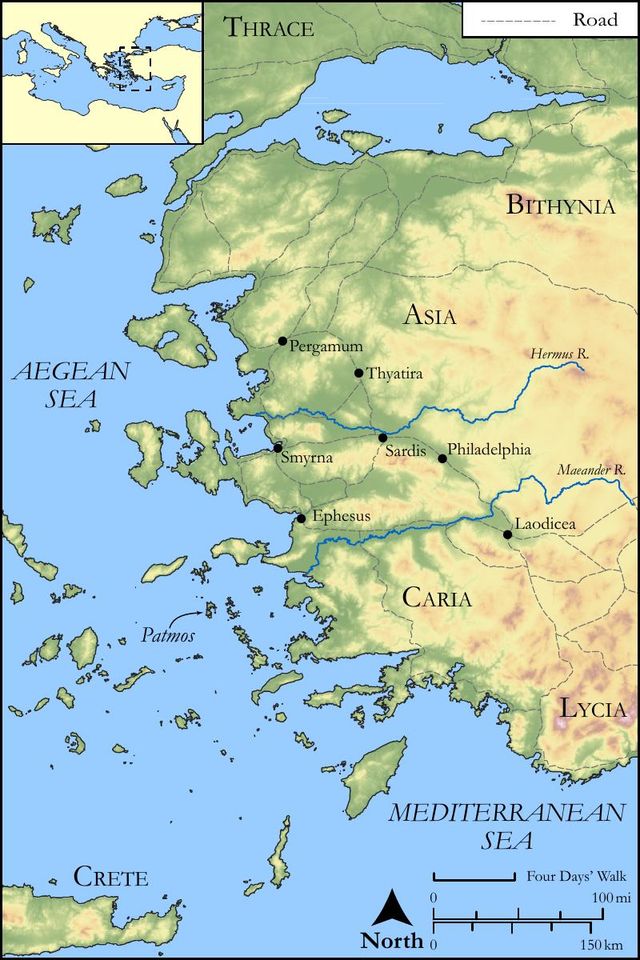
See on the biblical-era maps

Study this verse
Public-domain commentary
Matthew Henry
From his Commentary on the Whole Bible. Henry comments on passages, not single verses — this entry covers Revelation 22:20–21. His two-level outline is real structure in the source text, so it is rendered as structure.
We have now come to the conclusion of the whole, and that in three things: -
I.Christ's farewell to his church.
He seems now, after he has been discovering these things to his people on earth, to take leave of them, and return to heaven; but he parts with them in great kindness, and assures them it shall not be long before he comes again to them: Behold, I come quickly. As when he ascended into heaven, after his resurrection, he parted with a promise of his gracious presence, so here he parts with a promise of a speedy return. If any say, "Where is the promise of his coming, when so many ages have passed since this was written?" let them know he is not slack to his people, but long-suffering to his enemies: his coming will be sooner than they are aware, sooner than they are prepared, sooner than they desire; and to his people it will be seasonable. The vision is for an appointed time, and will not tarry. He will come quickly; let this word be always sounding in our ear, and let us give all diligence that we may be found of him in peace, without spot and blameless.
II.The church's hearty echo to Christ's promise,
1.Declaring her firm belief of it: Amen, so it is, so it shall be.
2.Expressing her earnest desire of it: Even so, come, Lord Jesus; make hast, my beloved, and be thou like a roe, or like a young hart on the mountain of spices. Thus beats the pulse of the church, thus breathes that gracious Spirit which actuates and informs the mystical body of Christ; and we should never be satisfied till we find such a spirit breathing in us, and causing us to look for the blessed hope, and glorious appearance of the great God and our Saviour Jesus Christ. This is the language of the church of the first-born, and we should join with them, often putting ourselves in mind of his promise. What comes from heaven in a promise should be sent back to heaven in a prayer, "Come, Lord Jesus, put an end to this state of sin, sorrow, and temptation; gather thy people out of this present evil world, and take them up to heaven, that state of perfect purity, peace, and joy, and so finish thy great design, and fulfil all that word in which thou hast caused thy people to hope."
Historical interpretation
Four Centuries of Reception
6 surviving comments on this verse. Each one is dated, so this reads as a timeline rather than a list.
Select a marker to jump to its quote. Markers stagger vertically where authors wrote within a few decades of each other.
Let us pray that the Lord Jesus Christ deign to come to us according to his promise and through his mercy free us from the prison of this world and for the sake of his compassion lead us to his blessedness. With the Father and the Holy Spirit he lives and reigns into all eternity. Amen.
The selfsame Christ who gave his testimony announces to the church that he is coming. And to him the church devoutly responds in the manner of the Song of Songs, “Amen, Come, Lord Jesus Christ.” And when the church prays, it says, “Your kingdom come!” and “in the way that is blameless, when you will come to me.”
“He who testifies to these things says,” that is, the very same Lord Jesus Christ who commanded me to write these things, “Surely, I am coming soon.” He makes known the certainty and the quickness of his coming. And already certain of his own blessedness, this saint fervently declares, “Come, Lord Jesus!” May the almighty Jesus Christ grant to us that as we earnestly await his coming we might, with his protection, keep ourselves from every grave sin, and that when our desire is fulfilled, he find nothing in us worthy of punishment. But should there be anything to pardon, may he nevertheless have mercy upon the accused and not condemn the sinner. May he with whom the blessed One lives and reigns forever grant this. Amen.
Also I who am speaking these things say to you, who are Life, “I am coming.” And you yourself also come, O Lord. Or perhaps he is saying this in the person of Christ, “I who witness to these things,” clearly the one who is testifying, “I am coming.” Then what follows is said in the person of the apostle, “Come, Lord Jesus Christ.” For the coming of Christ is much desired by the saints, since he will recompense those who have labored with a manifold reward. Therefore, this present book is holy and inspired by God and leads those who read it to their blessed end and inheritance.
He who testifies to these things says, "Surely, I am coming quickly." The same Christ testifies, who announces to the Church that he will come. To which, in the manner of the Song of Songs, the Church devoutly responds:
Which Paul made when he said, "for I am already being poured out, and the time of my departure has come" (2 Tim. 4:6); this he himself now says also, he who teaches these things, I say and bear witness in them, and so I am from now at the ends of the present life, that the word may be left in suspicion by no one.
For who would choose among those who happen to be, if not then John so great, to devise words as from God, insofar as he was not yet about to undergo common death, and to depart into the hands of God more obviously than those who were formerly still living? I therefore write these things, saying alone to the one who calls me Christ regarding my departure, Yes: I come quickly.
Since in the cases that have occurred the prophetic Spirit said to him, and the hearer says, "Tell the Lord, 'Come,'" obeying the things revealed to him, he says, "Amen: Come, Lord Jesus"; therefore he used to say, "Yes, Master Christ, hasten for us your salvation and your second coming."
Continue studying Revelation 22:20 across the web’s major study libraries — every link below opens this exact verse, chapter, or book on the destination site.
Read & Compare
 BibleGatewayThis verse in more than 200 translations and 70 languages.
 Bible.comThe YouVersion reader — hundreds of translations, reading plans, and highlights.
 ESV.orgCrossway's official English Standard Version reader.
 NET BibleThe NET translation with 60,000+ translators' notes on every rendering decision.
 STEP BibleTyndale House's free study tool — original text, vocabulary, and scholarly resources.
 BibliaLogos Bible Software's free web reader.
 USCCBThe New American Bible (Revised Edition) with the U.S. bishops' study notes.
Commentaries
 BibleHub CommentariesDozens of classic commentaries on this verse, gathered on one page.
 StudyLightMore than 100 commentary sets — the largest collection on the web.
 BibleRefPlain-English commentary on what this verse means, verse by verse.
 Enduring WordDavid Guzik's free commentary on this chapter, widely used by Bible teachers.
 Bible Study ToolsVerse commentary alongside Greek and Hebrew study aids.
Original Language & Research
- BibleHub InterlinearThe verse word by word — original language, transliteration, and English.
- BibleHub LexiconEvery word's original-language definition and Strong's entry.
 Blue Letter BibleDeep-study tools — Strong's numbers, concordance, and word studies.
 CNTR CollationThe earliest Greek manuscripts of this verse, collated letter by letter.
Sermons, Hymns & Audio


TrulyRandomVerse is not affiliated with these sites and doesn’t control their content. They’re linked because they’re genuinely useful.
Summary
Revelation 22:20 stands at the climax of the Bible's prophetic narrative, one verse from its close, capturing both the divine assurance of Jesus Christ's imminent return and the fervent, longing prayer of the Apostle John, representing the universal Church. It encapsulates the ultimate hope of believers across generations, affirming the certainty of Christ's second advent and inviting a resounding "Amen" from all who await His glorious appearing and the full establishment of His eternal kingdom.
Context
ShowHideLiterary Context
This verse stands as the penultimate statement in the entire biblical canon, nestled within the final chapter of the book of Revelation. Following the grand unveiling of the new heaven and new earth and the New Jerusalem in Revelation 21, the narrative shifts to a series of final admonitions, blessings, and, critically, declarations regarding Christ's return. This verse is the third of three "I am coming soon" statements by Jesus in this concluding chapter (Revelation 22:7, Revelation 22:12), forming a powerful crescendo that culminates in John's heartfelt response. It acts as a divine promise and a human plea, sealing the book's overarching message of hope in Christ's ultimate victory and reign.
Historical & Cultural Context
The book of Revelation was written by John during a period of intense persecution under the Roman Emperor Domitian, likely around A.D. 95. Believers were facing immense pressure to conform to imperial cult worship, leading to suffering and martyrdom. In this context, the message of Christ's return offered profound encouragement, hope, and vindication. The early church lived with a keen sense of eschatological expectation, often expressed in the Aramaic prayer "Maranatha" (Our Lord, come!), as seen in 1 Corinthians 16:22. This cultural backdrop underscores the urgency and comfort embedded in Jesus' promise and John's immediate, passionate response, providing solace and perseverance for a persecuted community.
Key Themes
ShowHideRevelation 22:20 powerfully reinforces several core themes central to the book and the broader biblical narrative. Firstly, it highlights The Certainty of Christ's Return, emphasizing that Jesus' "Surely I come quickly" is an unshakeable divine promise, not a mere possibility. Secondly, the phrase "I come quickly" underscores the Imminence and Urgency of His return, signifying not necessarily a short chronological timeframe, but rather a sudden, decisive, and unexpected arrival, demanding constant spiritual preparedness, as also implied in Revelation 3:11. Thirdly, John's "Even so, come, Lord Jesus" embodies The Church's Earnest Expectation and Longing, reflecting the collective desire of believers throughout history for the consummation of God's redemptive plan. Finally, the interplay of Jesus' "Amen" and John's "Even so" (which carries an "Amen" connotation) illustrates the theme of Divine and Human Affirmation, a harmonious agreement between the divine promise and the human longing for its fulfillment.
Exposition and Analysis
ShowHideKey Word Analysis
ShowHideThis verb signifies movement towards a destination, implying both arrival and presence. In the context of Christ's return, it denotes His personal, physical advent. The use of the present tense, "I am coming," emphasizes the certainty and ongoing nature of this divine intention, rather than a mere future possibility. It is an active, determined coming.
This adverb does not primarily denote a short period of time, but rather the swiftness, suddenness, or unexpectedness of an event once it begins. It conveys the idea that when Christ returns, it will be without delay, decisively, and perhaps surprising to many. It calls for vigilance and readiness, as the timing remains unknown, but the event itself will be rapid.
Of Hebrew origin, this word means "firm," "trustworthy," or "so be it." It is an emphatic affirmation of truth and certainty. When Jesus uses it, He is confirming the absolute reliability and truthfulness of His promise to return quickly. When John uses it (implied in "Even so"), it is a profound expression of agreement, desire, and faith in the fulfillment of that divine promise.
Verse Breakdown
ShowHide"He which testifieth these things saith"
This opening clause identifies the speaker as Jesus Christ, the faithful and true witness (Revelation 1:5). The phrase "these things" refers to the entire prophetic revelation contained within the book of Revelation, particularly the promises of His return and the establishment of His kingdom. This emphasizes the divine authority and veracity behind the declaration that follows.
"Surely I come quickly."
This is the direct, authoritative declaration from Jesus Himself. "Surely" (Greek nai) reinforces the absolute certainty of His coming. "I come quickly" (Greek érchomai tachý) signifies that His return is both definite and will occur with suddenness and decisiveness when the appointed time arrives. It is a promise of His personal, physical, and swift return.
"Amen."
This is Jesus' own affirmation of His preceding statement. By adding "Amen," He stamps His divine seal of truth and certainty on the promise of His swift return. It underscores the unchangeable nature of His word and the reliability of His prophecy.
"Even so, come, Lord Jesus."
This is the fervent, longing response of the Apostle John, representing the collective cry of the Church throughout history. "Even so" (Greek nai again) echoes Jesus' "Surely," signifying John's absolute agreement and desire for the fulfillment of the promise. It is a heartfelt prayer, a passionate plea for the Lord Jesus to return, expressing the deep yearning of believers for the consummation of all things in Christ.
Literary Devices
ShowHideRevelation 22:20 masterfully employs several literary devices to convey its profound message. The most prominent is Dialogue, presenting a direct exchange between the divine speaker (Jesus) and the human respondent (John), which encapsulates the entire biblical narrative's trajectory towards its eschatological climax. This dialogue is characterized by Affirmation and Call and Response: Jesus' declaration, "Surely I come quickly. Amen," is met with John's echoing "Even so, come, Lord Jesus." The repetition of "Amen" (implied in John's "Even so") functions as a powerful Echo or Resonance, underscoring the certainty of the divine promise and the heartfelt agreement of humanity. The phrase "I come quickly" is a form of Prophetic Imminence, a recurring motif in Revelation that emphasizes the readiness and suddenness of the event rather than a specific timeline. Finally, the verse serves as a powerful Climax to the entire book of Revelation and, in a sense, to the entire biblical narrative, bringing the grand prophetic visions to a personal, urgent, and hopeful conclusion.
Theological and Thematic Connections
ShowHideRevelation 22:20 stands as a foundational text for Christian eschatology, serving as the ultimate expression of the believer's hope. It encapsulates the very purpose of Christ's redemptive work: to establish His eternal kingdom and reign over all creation. The longing for Jesus' return is not merely an anticipation of future events but a deep spiritual yearning for the full realization of God's justice, peace, and perfect fellowship with humanity. This verse affirms the personal, visible, and triumphant return of Christ, which will mark the end of suffering, evil, and death, ushering in the new heavens and new earth. It reminds believers that history is moving towards a definite, glorious climax orchestrated by God, providing profound comfort and motivation for steadfastness in the present.
Reflection and Application
ShowHideRevelation 22:20 beckons believers to live with an active, confident hope in the Lord's return, transforming our present reality. It is a call to vigilance and preparedness, not out of fear, but out of eager expectation for the One we love. This hope should shape our priorities, encouraging us to live lives of holiness, obedience, and fervent prayer, knowing that our labor in the Lord is not in vain as we await His glorious appearing (1 Corinthians 15:58). The "Maranatha" cry of the Church is not a passive wish but an active yearning that fuels our mission to share the gospel, promote justice, and embody Christ's love until He comes. It reminds us that our ultimate citizenship is in heaven, from which we eagerly await our Savior, the Lord Jesus Christ, who will transform our lowly body to be like His glorious body (Philippians 3:20-21).
Questions for Reflection
ShowHideFAQ
ShowHideWhat does "quickly" mean in "Surely I come quickly"?
ShowHideThe Greek word translated "quickly" (G5035, tachý) does not imply a short chronological timeframe, but rather that when Jesus does return, His arrival will be swift, sudden, and decisive. It emphasizes the unexpected nature of the event and the speed with which it will unfold once it begins, rather than indicating that it will happen soon in human terms. This calls for constant readiness and vigilance, as the exact timing remains unknown, but the event itself will be rapid and without delay. Other passages like Revelation 3:11 and Revelation 2:16 use the same word to convey this sense of decisive, sudden action.
Why does John respond, "Even so, come, Lord Jesus"?
ShowHideJohn's response is a heartfelt, Spirit-inspired prayer that encapsulates the longing of the entire Church for the consummation of God's plan. It is an "Amen" from humanity, agreeing with and eagerly desiring the fulfillment of Jesus' promise to return. This echoes the ancient Aramaic prayer "Maranatha" (Our Lord, come!) found in 1 Corinthians 16:22. It signifies not only a desire for the end of suffering and the establishment of God's perfect kingdom but also a deep personal affection and yearning for the presence of the Lord Jesus Himself.
Christ-Centered Fulfillment
ShowHideRevelation 22:20, with its climactic declaration and fervent plea, finds its ultimate Christ-centered fulfillment in the person and work of Jesus Christ Himself. His promise, "Surely I come quickly," is the culmination of all biblical prophecy, signifying the triumphant return of the One who first came as a humble servant to redeem humanity. The longing for "Lord Jesus" to "come" is a yearning for the full realization of the kingdom He inaugurated through His first advent, His atoning death, and His glorious resurrection. He is the Alpha and the Omega, the beginning and the end, and His return will complete the redemptive narrative, bringing to fruition the salvation He secured on the cross. The "coming" spoken of here is the visible, glorious return of the Son of Man on the clouds, as prophesied in Matthew 24:30 and affirmed in Revelation 1:7. It is the moment when every promise He made—to prepare a place for us (John 14:3) and to appear a second time, not to deal with sin but to save those who are eagerly waiting for Him (Hebrews 9:28)—will be perfectly fulfilled. Thus, this verse is not just about a future event, but about the sovereign Lord Jesus Christ, who is faithful to His word and will bring all things to their perfect and glorious conclusion in Himself.