


2 Timothy 4:8
Bible text: King James Version (1769 Blayney text) · Public domain
Bible text: King James Version with Strong's numbers · Public domain
Bible text: Berean Standard Bible · Public domain
Bible text: American Standard Version (1901) · Public domain
Bible text: World English Bible, Messianic edition · Public domain
Bible text: Geneva Bible (1599) · Public domain
Bible text: Young's Literal Translation · Public domain
- λοιπὸνloiponFrom now onG3063A-ASNAdjective Accusative Singular Neuter
- ἀπόκειταίapokeitaiis laid upG606V-PNI-3SVerb Present Middle Or Passive Deponent Indicative 3rd Singular
- μοιmoifor meG3165P-1DSPersonal pronoun Dative 1st Singular
- ὁhotheG3588T-NSMDefinite article Nominative Singular Masculine
- τῆςtēs<the>G3588T-GSFDefinite article Genitive Singular Feminine
- δικαιοσύνηςdikaiosunēsof righteousnessG1343N-GSFNoun Genitive Singular Feminine
- στέφανοςstephanoscrownG4735N-NSMNoun Nominative Singular Masculine
- ὃνhonwhichG3739R-ASMRelative pronoun Accusative Singular Masculine
- ἀποδώσειapodōseiwill awardG591V-FAI-3SVerb Future Active Indicative 3rd Singular
- μοιmoito meG3165P-1DSPersonal pronoun Dative 1st Singular
- ὁhotheG3588T-NSMDefinite article Nominative Singular Masculine
- κύριοςkuriosLordG2962N-NSM-TNoun Nominative Singular Masculine Title
- ἐνeninG1722PREPPreposition
- ἐκείνῃekeinēthat [very]G1565D-DSFDemonstrative pronoun Dative Singular Feminine
- τῇtēa<the>G3588T-DSFDefinite article Dative Singular Feminine
- ἡμέρᾳhēmeradayG2250N-DSFNoun Dative Singular Feminine
- ὁhotheG3588T-NSMDefinite article Nominative Singular Masculine
- δίκαιοςdikaiosrighteousG1342A-NSMAdjective Nominative Singular Masculine
- κριτής·kritēsjudgeG2923N-NSMNoun Nominative Singular Masculine
- οὐounotG3756PRT-NNegative Particle Negative
- μόνονmonononlyG3441A-ASNAdjective Accusative Singular Neuter
- δὲdehoweverG1161CONJConjunction
- ἐμοίemoito me myselfG1473P-1DSPersonal pronoun Dative 1st Singular
- ἀλλὰallabutG235CONJConjunction
- καὶkaialsoG2532CONJConjunction
- πᾶσινpasinto allG3956A-DPMAdjective Dative Plural Masculine
- τοῖςtoisthoseG3588T-DPMDefinite article Dative Plural Masculine
- ἠγαπηκόσινēgapēkosinalready lovingG25V-RAP-DPMVerb Perfect Active Participle Dative Plural Masculine
- τὴνtēntheG3588T-ASFDefinite article Accusative Singular Feminine
- ἐπιφάνειανepiphaneianappearingG2015N-ASFNoun Accusative Singular Feminine
- αὐτοῦautouof HimG846P-GSMPersonal pronoun Genitive Singular Masculine
English is a literal word-by-word gloss of the Greek, not the KJV's wording. Why?
This is the original text the KJV's translators worked from — each Greek word with its own literal English meaning in this verse, prepared by scholars at Tyndale House, Cambridge. The KJV translates whole sentences, not word by word, so its wording differs: one Greek word can become several English words, and the KJV may choose “charity” where the gloss reads “love”. Both are faithful — they answer different questions. For the KJV's own rendering, switch to the KJV text.
Details
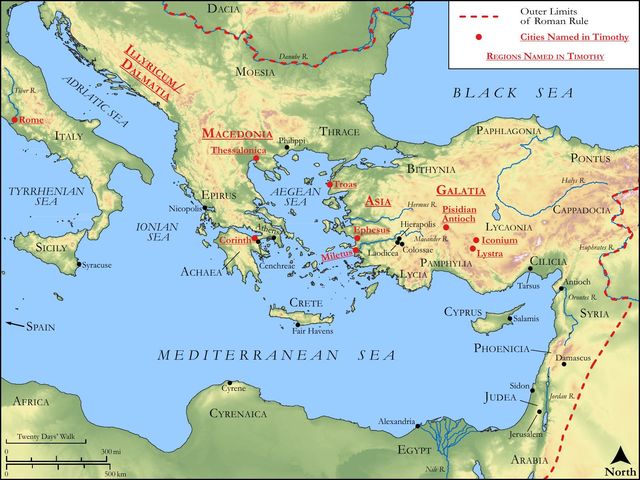
See on the biblical-era maps

Study this verse
Public-domain commentary
Matthew Henry
From his Commentary on the Whole Bible. Henry comments on passages, not single verses — this entry covers 2 Timothy 4:1–8. His four-level outline is real structure in the source text, so it is rendered as structure.
Observe, I. How awfully this charge is introduced (Ti2 4:1): I charge thee before God, and the Lord Jesus Christ, who shall judge the quick and the dead at his appearing and his kingdom. Observe, The best of men have need to be awed into the discharge of their duty. The work of a minister is not an indifferent thing, but absolutely necessary. Woe be to him if he preach not the gospel, Co1 9:16. To induce him to faithfulness, he must consider, 1. That the eye of God and Jesus Christ was upon him: I charge thee before God and the Lord Jesus Christ; that is, "as thou tenderest the favour of God and Jesus Christ; as thou wilt approve thyself to God and Jesus Christ, by the obligations both of natural and revealed religion; as thou wilt make due returns to the God who made thee and the Lord Jesus Christ who redeemed thee." 2. He charges him as he will answer it at the great day, reminding him of the judgment to come, which is committed to the Lord Jesus. He shall judge the quick and the dead at his appearing and his kingdom, that is, when he appears in his kingdom. It concerns all, both ministers and people, seriously to consider the account that they must shortly give to Jesus Christ of all the trusts reposed in them. Christ shall judge the quick and the dead, that is, those that at the last day shall be found alive, and those who shall be raised to life out of the grave. Note, (1.) The Lord Jesus Christ shall judge the quick and the dead. God hath committed all judgment unto the Son, and hath appointed him the Judge of quick and dead, Act 10:42. (2.) He will appear; he will come the second time, and it will be a glorious appearance, as the word epiphaniea signifies. (3.) Then his kingdom shall appear in its glory: At his appearing and kingdom; for he will then appear in his kingdom, sitting on a throne, to judge the world.
II.What is the matter of the charge, Ti2 4:2-5. He is charged,
1.To preach the word. This is ministers' business; a dispensation is committed to them. It is not their own notions and fancies that they are to preach, but the pure plain word of God; and they must not corrupt it, but as of sincerity, but as of God, in the sight of God, they speak in Christ, Co2 2:17.
2.To urge what he preached, and to press it with all earnestness upon his hearers: "Be instant in season and out of season, reprove, rebuke, exhort; do this work with all fervency of spirit. Call upon those under thy charge to take heed of sin, to do their duty: call upon them to repent, and believe, and live a holy life, and this both in season and out of season. In season, when they are at leisure to hear thee, when some special opportunity offers itself of speaking to them with advantage. Nay, do it out of season, even when there is not that apparent probability of fastening something upon them, because thou dost not know but the Spirit of God may fasten upon them; for the wind bloweth where it listeth; and in the morning we must sow our seed, and in the evening not withhold our hand," Ecc 11:6. We must do it in season, that is, let slip no opportunity; and do it out of season, that is, not shift off the duty, under pretence that it is out of season.
3.He must tell people of their faults: "Reprove them, rebuke them. Convince wicked people of the evil and danger of their wicked courses. Endeavour, by dealing plainly with them, to bring them to repentance. Rebuke them with gravity and authority, in Christ's name, that they may take thy displeasure against them as an indication of God's displeasure."
4.He must direct, encourage, and quicken those who began well. "Exhort them (persuade them to hold on, and endure to the end) and this with all long-suffering and doctrine." (1.) He must do it very patiently: With all long-suffering. "If thou do not see the effect of thy labours presently, yet do not therefore give up the cause; be not weary of speaking to them." While God shows to them all long-suffering, let ministers exhort with all long-suffering. (2.) He must do it rationally, not with passion, but with doctrine, that is, "In order to the reducing of them to good practices, instil into them good principles. Teach them the truth as it is in Jesus, reduce them to a firm belief of it, and this will be a means both to reclaim them from evil and to bring them to good." Observe, [1.] A minister's work has various parts: he is to preach the word, to reprove, rebuke, and exhort. [2.] He is to be very diligent and careful; he must be instant in season and out of season; he must spare no pains nor labour, but must be urgent with them to take care of their souls and their eternal concerns.
5.He must watch in all things. "Seek an opportunity of doing them a kindness; let no fair occasion slip, through thy negligence. Watch to thy work; watch against the temptations of Satan, by which thou mayest be diverted from it; watch over the souls of those who are committed to thy charge."
6.He must count upon afflictions, and endure them, make the best of them. Kakopathēson, endure patiently. "Be not discouraged by the difficulties thou meetest with, but bear them with an evenness of spirit. Inure thyself to hardships."
7.He must remember his office, and discharge its duties: Do the work of an evangelist. The office of the evangelist was, as the apostles' deputies, to water the churches that they planted. They were not settled pastors, but for some time resided in, and presided over, the churches that the apostles had planted, till they were settled under a standing ministry. This was Timothy's work.
8.He must fulfil his ministry: Make full proof of it. It was a great trust that was reposed in him, and therefore he must answer it, and perform all the parts of his office with diligence and care. Observe,
(1.)A minister must expect afflictions in the faithful discharge of his duty.
(2.)He must endure them patiently, like a Christian hero.
(3.)These must not discourage him in his work, for he must do his work, and fulfil his ministry.
(4.)The best way to make full proof of our ministry is to fulfil it, to fill it up in all its parts with proper work.
III.The reasons to enforce the charge.
1.Because errors and heresies were likely to creep into the church, by which the minds of many professing Christians would be corrupted (Ti2 4:3, Ti2 4:4): "For the time will come when they will not endure sound doctrine. Therefore improve the present time, when they will endure it. Be busy now, for it is seedtime; when the fields are white unto the harvest, put in the sickle, for the present gale of opportunity will be soon over. They will not endure sound doctrine. There will be those who will heap to themselves corrupt teachers, and will turn away their ears from the truth; and therefore secure as many as thou canst, that, when these storms and tempests do arise, they may be well fixed, and their apostasy may be prevented." People must hear, and ministers must preach, for the time to come, and guard against the mischiefs that are likely to arise hereafter, though they do not yet arise. They will turn away their ears from the truth; they will grow weary of the old plain gospel of Christ, and then they will be greedy of fables, and take pleasure in them, and God will give them up to those strong delusions, because they received not the truth in the love of it, Th2 2:11, Th2 2:12. Observe,
(1.)These teachers were of their own heaping up, and not of God's sending; but they chose them, to gratify their lusts, and to please their itching ears.
(2.)People do so when they will not endure sound doctrine, that preaching which is searching, plain, and to the purpose; then they will have teachers of their own.
(3.)There is a wide difference between the word of God and the word of such teachers; the one is sound doctrine, the word of truth, the other is only fables.
(4.)Those that are turned unto fables first turn away their ears from the truth, for they cannot hear and mind both, any more than they can serve two masters. Nay, further, it is said, They shall be turned unto fables. God justly suffers those to turn to fables who grow weary of the truth, and gives them up to be led aside from the truth by fables.
2.Because Paul for his part had almost done his work: Do thou make full proof of thy ministry, for I am now ready to be offered, Ti2 4:6. And,
(1.)"Therefore there will be the more occasion for thee." When labourers are removed out of the vineyard, it is no time for those to loiter that are left behind, but to double their diligence. The fewer hands there are to work the more industrious those hands must be that are at work.
(2.)"I have done the work of my day and generation; do thou in like manner do the work of thy day and generation."
(3.)The comfort and cheerfulness of Paul, in the prospect of his approaching departure, might encourage Timothy to the utmost industry, and diligence, and seriousness in his work. Paul was an old soldier of Jesus Christ, Timothy was but newly enlisted. "Come," says Paul, "I have found our Master kind and the cause good; I can look back upon my warfare with a great deal of pleasure and satisfaction; and therefore be not afraid of the difficulties thou must meet with. The crown of life is as sure to thee as if it were already upon thy head; and therefore endure afflictions, and make full proof of thy ministry." The courage and comfort of dying saints and ministers, and especially dying martyrs, are a great confirmation of the truth of the Christian religion, and a great encouragement to living saints and ministers in their work. Here the apostle looks forward, upon his death approaching: I am now ready to be offered. The Holy Ghost witnessed in every city that bonds and afflictions did abide him, Act 20:23. He was now at Rome, and it is probable that he had particular intimations from the Spirit that there he should seal the truth with his blood; and he looks upon it now as near at hand: I am already poured out; so it is in the original, ēdē spendomai; that is, I am already a martyr in affection. It alludes to the pouring out of the drink-offerings; for the blood of the martyrs, though it was not a sacrifice of atonement, was a sacrifice of acknowledgment to the honour of the grace of God and his truths. Observe,
[1.]With what pleasure he speaks of dying. He calls it his departure; though it is probable that he foresaw he must die a violent bloody death, yet he calls it his departure, or his release. Death to a good man is his release from the imprisonment of this world and his departure to the enjoyments of another world; he does not cease to be, but is only removed from one world to another.
[2.]With what pleasure he looks back upon the life he had lived (Ti2 4:7): I have fought a good fight, I have finished my course, etc. He did not fear death, because he had the testimony of his conscience that by the grace of God he had in some measure answered the ends of living. As a Christian, as a minister, he had fought a good fight. He had done the service, gone through the difficulties of his warfare, and had been instrumental in carrying on the glorious victories of the exalted Redeemer over the powers of darkness. His life was a course, and he had now finished it; as his warfare was accomplished, so his race was run. "I have kept the faith. I have kept the doctrines of the gospel, and never betrayed any of them." Note, First, The life of a Christian, but especially of a minister, is a warfare and a race, sometimes compared to the one in the scripture, and sometimes to the other. Secondly, It is a good fight, a good warfare; the cause is good, and the victory is sure, if we continue faithful and courageous. Thirdly, We must fight this good fight; we must fight it out, and finish our course; we must not give over till we are made more than conquerors through him who hath loved us, Rom 8:37. Fourthly, It is a great comfort to a dying saint, when he can look back upon his past life and say with our apostle, "I have fought, etc. I have kept the faith, the doctrine of faith and the grace of faith." Towards the end of our days to be able to speak in this manner, what comfort, unspeakable comfort, will it afford! Let it then be our constant endeavour, by the grace of God, that we may finish our course with joy, Act 20:24.
[3.]With what pleasure he looks forward to the life he was to live hereafter (Ti2 4:8): Henceforth there is laid up for me a crown of righteousness, etc. He had lost for Christ, but he was sure he should not lose by him, Phi 3:8. Let this encourage Timothy to endure hardness as a good soldier of Jesus Christ that there is a crown of life before us, the glory and joy of which will abundantly recompense all the hardships and toils of our present warfare. Observe, It is called a crown of righteousness, because it will be the recompence of our services, which God is not unrighteous to forget; and because our holiness and righteousness will there be perfected, and will be our crown. God will give it as a righteous Judge, who will let none love by him. And yet this crown of righteousness was not peculiar to Paul, as if it belonged only to apostles and eminent ministers and martyrs, but to all those also that love his appearing. Observe, It is the character of all the saints that they love the appearing of Jesus Christ: they loved his first appearing, when he appeared to take away sin by the sacrifice of himself (Heb 9:26); they love to think of it; they love his second appearing at the great day; love it, and long for it: and, with respect to those who love the appearing of Jesus Christ, he shall appear to their joy; there is a crown of righteousness reserved for them, which shall then be given them, Heb 9:28. We learn hence, First, The Lord is the righteous Judge, for his judgment is according to truth. Secondly, The crown of believers is a crown of righteousness, purchased by the righteousness of Christ, and bestowed as the reward of the saints' righteousness. Thirdly, This crown, which believers shall wear, is laid up for them; they have it not at present, for here they are but heirs; they have it not in possession, and yet it is sure, for it is laid up for them. Fourthly, The righteous Judge will give it to all who love, prepare, and long for his appearing. Surely I come quickly. Amen, even so come, Lord Jesus.
Historical interpretation
Nine Centuries of Reception
11 surviving comments on this verse. Each one is dated, so this reads as a timeline rather than a list.
Select a marker to jump to its quote. Markers stagger vertically where authors wrote within a few decades of each other.
But not to dwell upon ancient examples, let us come to the most recent spiritual heroes. Let us take the noble examples furnished in our own generation. Through envy and jealousy the greatest and most righteous pillars [of the church] have been persecuted and put to death. Let us set before our eyes the illustrious apostles... Owing to envy, Paul also obtained the reward of patient endurance, after being seven times thrown into captivity, compelled to flee, and stoned. After preaching both in the east and west, he gained the illustrious reputation due to his faith, having taught righteousness to the whole world, and come to the extreme limit of the west, and suffered martyrdom under the prefects. Thus was he removed from the world, and went into the holy place, having proved himself a striking example of patience.
Be you, too, faithful unto death, and fight you, too, the good fight, whose crown the apostle feels so justly confident has been laid up for him.
And if he had wished to have his children also restored, he might again have been called father; but he preferred to have them restored him "in that day." Such joy as that-secure so entirely concerning the Lord-he deferred; meantime he endured a voluntary bereavement, that he might not live without some (exercise of) patience.
These words I address to you as if alive, and with propriety. For ye hold already the crown of life and immortality which is laid up for you in heaven.
While we await the fullness of time, the souls await their due reward. Some await punishment and others glory. And yet in the meantime the one group is not without harm nor the other without gain. For the former will be dismayed upon seeing that the reward of glory has been stored up for those who keep the law of God, that the chambers of those souls are being preserved by the angels, that shame and ruin will be the punishments of their negligence and rebellion, so that they may gaze on the glory of the Most High and blush to come into his sight, for they have profaned his commandments.
The martyr's own struggles surpass our mortal nature. The prizes they won go beyond our powers and understanding. They laughed at the life lived on earth. They trampled underfoot the punishment of the rack. They scorned death and took wing to heaven. They escaped from the storms of temporal things and sailed into a calm harbor. They brought with them no gold or silver or expensive garments. They carried along no treasure which could be plundered but the riches of patience, courage and love. Now they belong to Paul's choral band while they still await their crowns, because they have escaped henceforth the uncertainty of the future.
"Henceforth there is laid up for me a crown of righteousness." Here again he calls virtue in general righteousness. Thou shouldest not grieve that I shall depart, to be invested with that crown which will by Christ be placed upon my head. But if I continued here, truly thou mightest rather grieve, and fear lest I should fail and perish. "Which the Lord, the righteous Judge, shall give me at that day, and not to me only, but to all that love His appearing." Here also he raises his mind. If "to all," much more to Timothy. But he did not say, "and to thee," but "to all"; meaning, if to all, much more to him. But how, it may be asked, is one to "love the appearing" of Christ? By rejoicing at His coming; and he who rejoices at His coming, will perform works worthy of His joy; he will throw away his substance if need be, and even his life, so that he may obtain future blessings, that he may be thought worthy to behold that second coming in a fitting state, in confidence, in brightness and glory. This is to "love His appearing." He who loves His appearing will do everything to ensure, before His general coming, a particular coming to himself. And how, you will say, is this possible? Hear from Christ, who says, "If a man love Me, he will keep My words, and My Father and I will come unto him, and make Our abode with him." (John xiv. 23.)
I have received the letter of your Reverence in which you urge on us the great good of loving and longing for the coming of our Savior. In this you act like the good servant of the master of the household who is eager for his lord’s gain and who wishes to have many sharers in the love which burns so brightly and constantly in you. Examining, therefore, the passage you quoted from the apostle where he said that the Lord would render a crown of justice not only to him but to all who love his coming, we live as uprightly as he and we pass through this world as pilgrims while our heart constantly expands with this love, and whether he comes sooner or later than he is expected, his coming is loved with faithful charity and longed for with pious affection.
He calls the “crown of righteousness” that which has been prepared for the righteous, which is given by a just sentence. When? On that day. By whom? By the just judge. I have known him as just; I have known him as the judge. I trust in his judgment. I look for a sentence. In this way Paul offers consolation to all children of faith.
The holy man demands judgment because he is certain of the Lord’s mercy. As Paul has it: “As to the rest, there is laid up for me a crown of justice, which the Lord, the just Judge, will render to me in that day.” He walks in his innocence because … he puts his trust in the Lord. The presumption he shows is not in his own powers but in God’s generosity.
From now there is laid up for me the crown of righteousness, which the Lord, the righteous Judge, will award to me on that day—and not only to me, but also to all who love his appearance.
From now there is laid up for me the crown of righteousness. Then Paul also comforts Timothy from his sufferings. For who would grieve over one receiving a crown? And of righteousness, as if it were the universal virtue.
which the Lord, the righteous Judge, will award to me on that day. For do not tell me here about temporary things, for I seek those there. But see how the obligation demands it from him, through the phrase, "will award to me," but he did not say, "He will give"; this is also indicated by, "the righteous Judge."
not only to me. Here he also appointed Timothy, saying that he will repay you as well.
For if he gives a crown to all who love his appearance, much more to you. But who loves his appearance? Those who do good deeds and are rewarded by the good.
Continue studying 2 Timothy 4:8 across the web’s major study libraries — every link below opens this exact verse, chapter, or book on the destination site.
Read & Compare
 BibleGatewayThis verse in more than 200 translations and 70 languages.
 Bible.comThe YouVersion reader — hundreds of translations, reading plans, and highlights.
 ESV.orgCrossway's official English Standard Version reader.
 NET BibleThe NET translation with 60,000+ translators' notes on every rendering decision.
 STEP BibleTyndale House's free study tool — original text, vocabulary, and scholarly resources.
 BibliaLogos Bible Software's free web reader.
 USCCBThe New American Bible (Revised Edition) with the U.S. bishops' study notes.
Commentaries
 BibleHub CommentariesDozens of classic commentaries on this verse, gathered on one page.
 StudyLightMore than 100 commentary sets — the largest collection on the web.
 BibleRefPlain-English commentary on what this verse means, verse by verse.
 Enduring WordDavid Guzik's free commentary on this chapter, widely used by Bible teachers.
 Bible Study ToolsVerse commentary alongside Greek and Hebrew study aids.
Original Language & Research
- BibleHub InterlinearThe verse word by word — original language, transliteration, and English.
- BibleHub LexiconEvery word's original-language definition and Strong's entry.
 Blue Letter BibleDeep-study tools — Strong's numbers, concordance, and word studies.
 CNTR CollationThe earliest Greek manuscripts of this verse, collated letter by letter.
Sermons, Hymns & Audio


TrulyRandomVerse is not affiliated with these sites and doesn’t control their content. They’re linked because they’re genuinely useful.
Summary
In 2 Timothy 4:8, the Apostle Paul, facing imminent martyrdom, articulates a profound declaration of eschatological hope and divine justice. He expresses unwavering confidence in receiving a "crown of righteousness" from the Lord, whom he identifies as the righteous judge, at the appointed day of ultimate recompense. Crucially, Paul extends this promise beyond himself, assuring that this same eternal reward is reserved for all believers who eagerly anticipate and genuinely love the glorious appearing of Christ.
Context
ShowHideLiterary Context
This verse serves as a climactic declaration within Paul's final, intensely personal letter to his spiritual son, Timothy. It immediately follows Paul's poignant summary of his faithful ministry in 2 Timothy 4:7, where he states, "I have fought a good fight, I have finished my course, I have kept the faith." Verse 8, therefore, functions as the anticipated reward for the faithfulness described in the preceding verse, transitioning from Paul's earthly struggle and perseverance to his heavenly inheritance. The broader context of 2 Timothy 4 is Paul's charge to Timothy to preach the word, be ready in season and out of season, and endure hardship, making Paul's own example of steadfastness and the promise of future reward a powerful encouragement.
Historical & Cultural Context
Paul wrote 2 Timothy from a Roman prison, likely during his second imprisonment under Emperor Nero, around 66-67 AD. This was a period of intense persecution for Christians in Rome. Paul knew his death was near, as indicated by his words in 2 Timothy 4:6, "For I am now ready to be offered, and the time of my departure is at hand." The imagery of a "crown" (Greek: stephanos) would have resonated deeply with a Roman audience, who were familiar with the laurel wreaths awarded to victorious athletes in the Olympic and Isthmian Games, or to conquering generals. This cultural understanding underscores the idea of a prize for faithful endurance and triumph.
Key Themes
ShowHideSeveral significant themes converge in this verse. Firstly, Divine Justice and Reward is prominent, emphasizing God's faithfulness to recompense those who serve Him, a concept seen throughout Scripture (e.g., Hebrews 11:6). Secondly, the theme of Eschatological Hope is central, as "that day" points to the future return of Christ and the ultimate consummation of God's redemptive plan. This hope is not merely passive expectation but a dynamic force that shapes present living. Thirdly, Perseverance in Faith is implied, as the crown is for those who have "fought a good fight" and "kept the faith," highlighting the necessity of enduring to the end. Finally, the theme of The Blessed Hope of Christ's Appearing is explicitly stated, linking the reward directly to a genuine love and longing for the Second Coming, a hope that purifies and motivates believers, as described in Titus 2:13.
Exposition and Analysis
ShowHideKey Word Analysis
ShowHideRefers to a victor's wreath or garland, typically made of leaves or flowers, awarded in ancient athletic contests or as a symbol of honor. It signifies triumph, honor, and reward for achievement, distinct from a royal diadem (diadema). Paul uses this imagery to portray the Christian life as a spiritual race or contest where faithfulness leads to a glorious prize.
Denotes equity of character or act, and in a Christian context, specifically refers to justification—the state of being declared righteous by God—and the practical righteousness that flows from a transformed life lived in conformity to God's will. The "crown of righteousness" can thus be understood as a reward for a righteous life, or as the very consummation of righteousness itself.
Literally means a manifestation or a glorious appearing. In the New Testament, this term is consistently used to refer to the Second Coming of Christ, emphasizing its visible, glorious, and decisive nature. It signifies the culmination of God's redemptive plan and the ultimate revelation of Christ's glory.
Verse Breakdown
ShowHide"Henceforth there is laid up for me a crown of righteousness,"
Paul confidently declares that an eternal reward awaits him. The phrase "laid up" (Greek: apókeimai) implies something reserved and secure, stored away for a future time. This reward is a "crown of righteousness," signifying a victor's prize for a life lived in faith and obedience, a life marked by God's imputed righteousness and practical godliness.
"which the Lord, the righteous judge, shall give me at that day:"
The source of this reward is "the Lord," identified specifically as "the righteous judge." This title underscores God's perfect justice and His unwavering faithfulness to His promises. The reward is not arbitrary but a just recompense for faithful service. "At that day" refers to a specific, future eschatological event—the day of Christ's return, the judgment, and the distribution of eternal rewards.
"and not to me only, but unto all them also that love his appearing."
This crucial extension broadens the promise of the crown beyond Paul to all believers. The condition for receiving this crown is a deep, active "love" (Greek: agapáō) for Christ's "appearing" (Greek: epipháneia). This is more than mere intellectual assent; it signifies an eager longing, an affectionate anticipation, and a life shaped by the hope of Christ's glorious return. It implies a readiness and a desire for His coming that impacts present conduct.
Literary Devices
ShowHidePaul masterfully employs several literary devices in this verse. The central Metaphor of the "crown of righteousness" likens the eternal reward for faithful Christian living to the wreath awarded to victorious athletes in ancient games. This imagery conveys themes of perseverance, struggle, and ultimate triumph. The phrase "the righteous judge" is an example of Apposition, where a noun or phrase is placed next to another to explain or identify it, emphasizing a key attribute of the Lord. The structure of the verse itself demonstrates Antithesis and Universal Reach, contrasting Paul's individual expectation ("not to me only") with the universal promise ("but unto all them also"), thereby extending the hope and challenge to all believers. This serves to broaden the scope of the promise, making it deeply personal yet universally applicable.
Theological and Thematic Connections
ShowHideThis verse powerfully encapsulates the Christian hope in future glory and divine recompense. It underscores the biblical truth that God is a just God who rewards faithfulness, not out of obligation, but out of His righteous character and covenant promises. The "crown of righteousness" is not earned by human merit in a legalistic sense, but is the just reward given to those who, through faith in Christ, have been made righteous and have lived out that righteousness in their lives, eagerly anticipating His return. This hope serves as a powerful motivator for perseverance and holy living in the present age.
Reflection and Application
ShowHide2 Timothy 4:8 offers profound encouragement and a clear call to intentional living for every believer. Paul's confidence in his impending reward, even in the face of death, reminds us that our labor in the Lord is never in vain. This verse challenges us to examine our own lives: Are we fighting the good fight, finishing our course, and keeping the faith as Paul did? Do we truly "love His appearing"? This love is not a passive sentiment but an active longing that shapes our priorities, purifies our conduct, and fuels our perseverance. It compels us to live with an eternal perspective, knowing that a just and faithful God will ultimately reward those who have lived for Him and eagerly await the glorious return of His Son. Let this promise ignite within us a deeper devotion and a more fervent anticipation of that glorious day.
Questions for Reflection
ShowHideFAQ
ShowHideWhat is the "crown of righteousness" mentioned in this verse?
ShowHideThe "crown of righteousness" (Greek: stéphanos dikaiosýnēs) is a metaphorical reward promised to faithful believers. The term stéphanos refers to a victor's wreath, like those given to triumphant athletes in ancient games, symbolizing honor, victory, and recognition. It is not a royal diadem (diadema), but a prize for successful completion of a spiritual contest. The "righteousness" associated with it signifies that it is a reward for a life lived in conformity to God's will and by His grace, or perhaps that the crown itself is the consummation of righteousness in the believer's life. It represents the ultimate vindication and glorification of those who have been justified by faith and have pursued practical righteousness.
What does it mean to "love his appearing"?
ShowHideTo "love his appearing" (Greek: agapáō epipháneia) signifies a deep, affectionate longing and eager anticipation for the Second Coming of Christ. It's more than just intellectual belief in the doctrine of His return; it's a heartfelt desire for His glorious manifestation. This love for His appearing is a purifying hope, as 1 John 3:2-3 states, "we know that, when he shall appear, we shall be like him... And every man that hath this hope in him purifieth himself, even as he is pure." It motivates believers to live holy lives, to persevere through trials, and to faithfully serve God, knowing that their ultimate reward and redemption are tied to His return. It reflects a readiness and eagerness for Christ to come and set all things right.
Christ-Centered Fulfillment
ShowHideWhile 2 Timothy 4:8 speaks of a crown of righteousness given to believers, its ultimate fulfillment and foundation are found in Christ Himself. The "righteous judge" who bestows this crown is none other than the Lord Jesus Christ, to whom all judgment has been committed by the Father (John 5:22). The "crown of righteousness" is not earned by human merit, but is entirely dependent on the imputed righteousness of Christ, which is granted to believers through faith (Romans 3:21-22). Our ability to "fight a good fight" and "keep the faith" is empowered by His Spirit, and our perseverance is sustained by His grace. Furthermore, the "appearing" we love and long for is the glorious Second Coming of Christ, when He will return not as a suffering servant, but as the triumphant King and Judge (Revelation 19:11-16). Our hope for a future reward is inextricably linked to His past work on the cross, His present intercession, and His future return, making Him the central figure and the very essence of our promised inheritance.