


Revelation 2:10
Bible text: King James Version (1769 Blayney text) · Public domain
Bible text: King James Version with Strong's numbers · Public domain
Bible text: Berean Standard Bible · Public domain
Bible text: American Standard Version (1901) · Public domain
Bible text: World English Bible, Messianic edition · Public domain
Bible text: Geneva Bible (1599) · Public domain
Bible text: Young's Literal Translation · Public domain
- μηδὲνmēdennothingG3367A-ASN-NAdjective Accusative Singular Neuter Negative
- φοβοῦphoboudo fearG5399V-PNM-2SVerb Present Middle Or Passive Deponent Imperative 2nd Singular
- ἃhawhatG3739R-APNRelative pronoun Accusative Plural Neuter
- μέλλειςmelleisyou are aboutG3195V-PAI-2SVerb Present Active Indicative 2nd Singular
- πάσχειν·pascheinto sufferG3958V-PANVerb Present Active Infinitive
- ἰδοὺidouBeholdG2400INJInterjection
- μέλλειmelleiis aboutG3195V-PAI-3SVerb Present Active Indicative 3rd Singular
- βάλλεινballeinto castG906V-PANVerb Present Active Infinitive
- ὁhotheG3588T-NSMDefinite article Nominative Singular Masculine
- διάβολοςdiabolosdevilG1228A-NSMAdjective Nominative Singular Masculine
- ἐξex[some] ofG1537PREPPreposition
- ὑμῶνhumōnyouG4771P-2GPPersonal pronoun Genitive 2nd Plural
- εἰςeisintoG1519PREPPreposition
- φυλακὴνphulakēnprisonG5438N-ASFNoun Accusative Singular Feminine
- ἵναinaso thatG2443CONJConjunction
- πειρασθῆτεpeirasthēteyou may be testedG3985V-APS-2PVerb Aorist Passive Subjunctive 2nd Plural
- καὶkaiandG2532CONJConjunction
- ἕξετεhexeteyou will haveG2192V-FAI-2PVerb Future Active Indicative 2nd Plural
- θλῖψινthlipsintribulationG2347N-ASFNoun Accusative Singular Feminine
- ἡμερῶνhēmerōnfor daysG2250N-GPFNoun Genitive Plural Feminine
- δέκαdekatenG1176A-NUIAdjective
- γίνουginoudo beG1096V-PNM-2SVerb Present Middle Or Passive Deponent Imperative 2nd Singular
- πιστὸςpistosfaithfulG4103A-NSMAdjective Nominative Singular Masculine
- ἄχριachriuntoG891PREPPreposition
- θανάτουthanatoudeathG2288N-GSMNoun Genitive Singular Masculine
- καὶkaiandG2532CONJConjunction
- δώσωdōsōI will giveG1325V-FAI-1SVerb Future Active Indicative 1st Singular
- σοιsoito youG4771P-2DSPersonal pronoun Dative 2nd Singular
- τὸνtontheG3588T-ASMDefinite article Accusative Singular Masculine
- στέφανονstephanoncrownG4735N-ASMNoun Accusative Singular Masculine
- τῆςtēs<the>G3588T-GSFDefinite article Genitive Singular Feminine
- ζωῆςzōēsof lifeG2222N-GSFNoun Genitive Singular Feminine
English is a literal word-by-word gloss of the Greek, not the KJV's wording. Why?
This is the original text the KJV's translators worked from — each Greek word with its own literal English meaning in this verse, prepared by scholars at Tyndale House, Cambridge. The KJV translates whole sentences, not word by word, so its wording differs: one Greek word can become several English words, and the KJV may choose “charity” where the gloss reads “love”. Both are faithful — they answer different questions. For the KJV's own rendering, switch to the KJV text.
Details
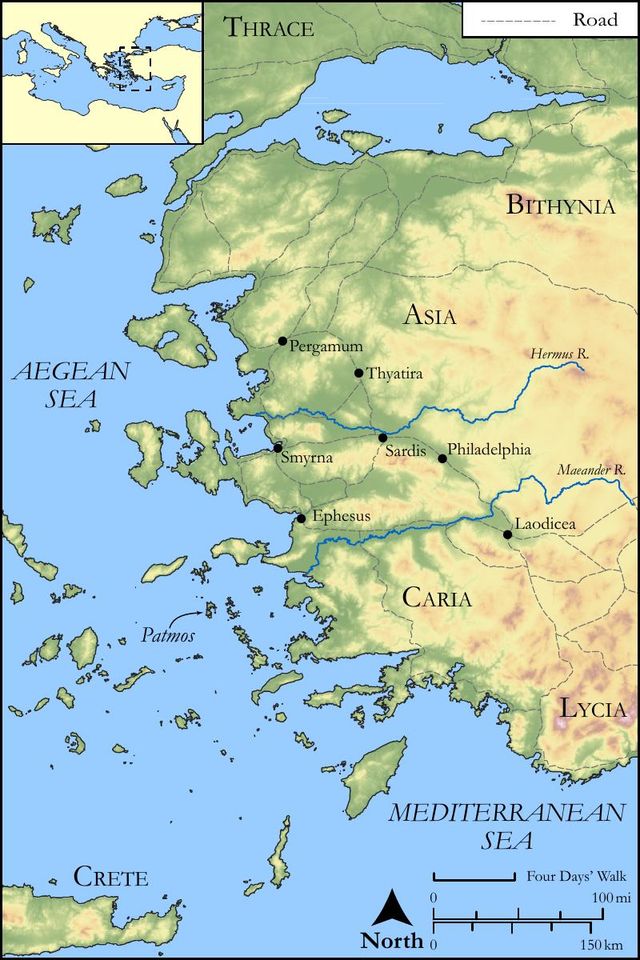
See on the biblical-era maps

Study this verse
Public-domain commentary
Matthew Henry
From his Commentary on the Whole Bible. Henry comments on passages, not single verses — this entry covers Revelation 2:8–11. His four-level outline is real structure in the source text, so it is rendered as structure.
We now proceed to the second epistle sent to another of the Asian churches, where, as before, observe,
I.The preface or inscription in both parts.
1.The superscription, telling us to whom it was more expressly and immediately directed: To the angel of the church in Smyrna, a place well known at this day by our merchants, a city of great trade and wealth, perhaps the only city of all the seven that is still known by the same name, now however no longer distinguished for its Christian church being overrun by Mahomedism.
2.The subscription, containing another of the glorious titles of our Lord Jesus, the first and the last, he that was dead and is alive, taken out of Rev 1:17, Rev 1:18.
(1.)Jesus Christ is the first and the last. It is but a little scantling of time that is allowed to us in this world, but our Redeemer is the first and the last. He is the first, for by him all things were made, and he was before all things with God and was God himself. he is the last, for all things are made for him, and he will be the Judge of all. This surely is the title of God, from everlasting and to everlasting, and it is the title of one that is an unchangeable Mediator between God and man, Jesus, the same yesterday, today, and for ever. He was the first, for by him the foundation of the church was laid in the patriarchal state; and he is the last, for by him the top-stone will be brought forth and laid in the end of time.
(2.)He was dead and is alive. He was dead, and died for our sins; he is alive, for he rose again for our justification, and he ever lives to make intercession for us. He was dead, and by dying purchased salvation for us; he is alive, and by his life applies this salvation to us. And if, when we were enemies, we were reconciled by his death, much more, being reconciled, we shall be saved by his life. His death we commemorate every sacrament day; his resurrection and life every sabbath day.
II.The subject-matter of this epistle to Smyrna, where, after the common declaration of Christ's omniscience, and the perfect cognizance he has of all the works of men and especially of his churches, he takes notice,
1.Of the improvement they had made in their spiritual state. This comes in in a short parentheses; yet it is very emphatic: But thou art rich (Rev 2:10), poor in temporals, but rich in spirituals - poor in spirit, and yet rich in grace. Their spiritual riches are set off by their outward poverty. Many who are rich in temporals are poor in spirituals. Thus it was with the church of Laodicea. Some who are poor outwardly are inwardly rich, rich in faith and in good works, rich in privileges, rich in bonds and deeds of gift, rich in hope, rich in reversion. Spiritual riches are usually the reward of great diligence; the diligent hand makes rich. Where there is spiritual plenty, outward poverty may be better borne; and when God's people are impoverished in temporals, for the sake of Christ and a good conscience, he makes all up to them in spiritual riches, which are much more satisfying and enduring.
2.Of their sufferings: I know thy tribulation and thy poverty - the persecution they underwent, even to the spoiling of their goods. Those who will be faithful to Christ must expect to go through many tribulations; but Jesus Christ takes particular notice of all their troubles. In all their afflictions, he is afflicted, and he will recompense tribulation to those who trouble them, but to those that are troubled rest with himself.
3.He knows the wickedness and the falsehood of their enemies: I know the blasphemy of those that say they are Jews, but are not; that is, of those who pretend to be the only peculiar covenant-people of God, as the Jews boasted themselves to be, even after God had rejected them; or of those who would be setting up the Jewish rites and ceremonies, which were now not only antiquated, but abrogated; these may say that they only are the church of God in the world, when indeed they are the synagogue of Satan. Observe,
(1.)As Christ has a church in the world, the spiritual Israel of God, so the devil has his synagogue. Those assemblies which are set up in opposition to the truths of the gospel, and which promote and propagate damnable errors, - those which are set up in opposition to the purity and spirituality of gospel worship, and which promote and propagate the vain inventions of men and rites and ceremonies which never entered into the thoughts of God, - these are all synagogues of Satan: he presides over them, he works in them, his interests are served by them, and he receives a horrid homage and honour from them.
(2.)For the synagogues of Satan to give themselves out to be the church or Israel of God is no less than blasphemy. God is greatly dishonoured when his name is made use of to promote and patronize the interests of Satan; and he has a high resentment of this blasphemy, and will take a just revenge on those who persist in it.
4.He foreknows the future trials of his people, and forewarns them of them, and fore-arms them against them.
(1.)He forewarns them of future trials: The devil shall cast some of you into prison, and you shall have tribulation, Rev 2:10. The people of God must look for a series and succession of troubles in this world, and their troubles usually rise higher. They had been impoverished by their tribulations before; now they must be imprisoned. Observe, It is the devil that stirs up his instruments, wicked men, to persecute the people of God; tyrants and persecutors are the devil's tools, though they gratify their own sinful malignity, and know not that they are actuated by a diabolical malice.
(2.)Christ fore-arms them against these approaching troubles,
[1.]By his counsel: Fear none of these things. This is not only a word of command, but of efficacy, no, only forbidding slavish fear, but subduing it and furnishing the soul with strength and courage.
[2.]By showing them how their sufferings would be alleviated and limited. First, They should not be universal. It would be some of them, not all, who should be cast into prison, those who were best able to bear it and might expect to be visited and comforted by the rest. Secondly, They were not to be perpetual, but for a set time, and a short time: Ten days. It should not be everlasting tribulation, the time should be shortened for the elect's sake. Thirdly, It should be to try them, not to destroy them, that their faith, and patience, and courage, might be proved and improved, and be found to honour and glory.
[3.]By proposing and promising a glorious reward to their fidelity: Be thou faithful to death, and I will give thee a crown of life. Observe, First, The sureness of the reward: I will give thee. He has said it that is able to do it; and he has undertaken that he will do it. They shall have the reward from his own hand, and none of their enemies shall be able to wrest it out of his hand, or to pull it from their heads. Secondly, The suitableness of it. 1. A crown, to reward their poverty, their fidelity, and their conflict. 2. A crown of life, to reward those who are faithful even unto death, who are faithful till they die, and who part with life itself in fidelity to Christ. The life so worn out in his service, or laid down in his cause, shall be rewarded with another and a much better life that shall be eternal.
III.The conclusion of this message, and that, as before,
1.With a call to universal attention, that all men, all the world, should hear what passes between Christ and his churches - how he commends them, how he comforts them, how he reproves their failures, how he rewards their fidelity. It concerns all the inhabitants of the world to observe God's dealings with his own people; all the world may learn instruction and wisdom thereby.
2.With a gracious promise to the conquering Christian: He that overcometh shall not be hurt of the second death, Rev 2:11. Observe,
(1.)There is not only a first, but a second death, a death after the body is dead.
(2.)This second death is unspeakably worse than the first death, both in the dying pangs and agonies of it (which are the agonies of the soul, without any mixture of support) and in the duration; it is eternal death, dying the death, to die and to be always dying. This is hurtful indeed, fatally hurtful, to all who fall under it.
(3.)From this hurtful, this destructive death, Christ will save all his faithful servants; the second death shall have no power over those who are partakers of the first resurrection: the first death shall not hurt them, and the second death shall have no power over them.
Historical interpretation
Eight Centuries of Reception
17 surviving comments on this verse. Each one is dated, so this reads as a timeline rather than a list.
Select a marker to jump to its quote. Markers stagger vertically where authors wrote within a few decades of each other.
Nay, then, He does even choose. He calls us to it. To him who conquers He says, "I will give a crown Of life." Be you, too, faithful unto death, and fight you, too, the good fight, whose crown the apostle feels so justly confident has been laid up for him.
What fear would it be better to understand (as here meant), than that which gives rise to denial? What love does he assert to be perfect, but that which puts fear to flight, and gives courage to confess? What penalty will he appoint as the punishment of fear, but that which he who denies is about to pay, who has to be slain, body and soul, in hell? And if he teaches that we must die for the brethren, how much more for the Lord,-he being sufficiently prepared, by his own Revelation too, forgiving such advice! For indeed the Spirit had sent the injunction to the angel of the church in Smyrna: "Behold, the devil shall cast some of you into prison, that ye may be tried ten days. Be thou faithful unto death, and I will give thee a crown of life." Also to the angel of the church in Pergamus (mention was made) of Antipas, the very faithful martyr, who was slain where Satan dwelleth.
Of the benefits of martyrdom. In the Proverbs of Solomon: "The faithful martyr delivers his soul from evils." Also in the same place: "Then shall the righteous stand in great boldness against them who have afflicted them, and who took away their labours. When they see them, they shall be disturbed with a horrible fear; and they shall wonder at the suddenness of their unhoped-for salvation, saying among themselves, repenting and groaning with distress of spirit, These are they whom some time we had in derision, and in the likeness of a proverb; we fools counted their life madness, and their end without honour. How are they reckoned among the children of God, and their lot among the saints! Therefore we have wandered from the way of truth, and the light of righteousness has not shined upon us, and the sun has not risen upon us. We have been wearied in the way of iniquity and of perdition, and we have walked through difficult solitudes; but we have not known the way of the Lord. What hath pride profited us? or what hath the boasting of riches brought to us? All these things have passed away as a shadow." Of this same thing in the cxvth Psalm: "Precious in the sight of the Lord is the death of His saints." Also in the cxxvth Psalm: "They who sow in tears shall reap in joy. Walking they walked, and wept as they cast their seeds; but coming they shall come in joy, raising up their laps." Of this same thing in the Gospel according to John: "He who loveth his life shall lose it; and he that hateth his life in this world shall find it to life eternal." Also in the same place: "But when they shall deliver you up, take no thought what ye shall speak; for it is not ye who speak, but the Spirit of your Father which speaketh in you." Also in the same place: "The hour shall come, that every one that killeth you shall think he doeth service to God l but they shall do this also because they have not known the Father nor me." Of this same matter, according to Matthew: "Blessed are they which shall suffer persecution for righteousness' sake; for theirs is the kingdom of heaven." Also in the same place: "Fear not them which kill the body, but are not able to kill the soul; but rather fear Him which is able to kill the soul and body in Gehenna." Also in the same place: "Whosoever shall confess me before men, him also will I confess before my Father which is in heaven; but he who shall deny me before men, him also will I deny before my Father which is in heaven. And he that shall endure to the end, the same shall be saved." Of this same thing, according to Luke: "Blessed shall ye be when men shall hate you, and shall separate you (from their company), and shall drive you out, and shall speak evil of your name, as wicked, for the Son of man's sake. Rejoice in that day, and exult; for, lo, your reward is great in heaven." Also in the same place: "Verily I say unto you, There is no man that leaveth house, or parents, or brethren, or wife, or children, for the sake of the kingdom of God, and does not receive seven times as much in this present time, but in the world to come life everlasting." Of this same thing in the Apocalypse: "And when he had opened the fifth seal, I saw under the altar of God the souls of them that were slain on account of the word of God and His testimony. And they cried with a loud voice, saying, How long, O Lord, holy and true, dost Thou not judge and avenge our blood on them that dwell on the earth? And unto every one of them were given white robes; and it was said to them, that they should rest still for a short time, until the number of their fellow-servants, and of their brethren, should be fulfilled, and they who shall afterwards be slain, after their example." Also in the same place: "After these things I saw a great crowd, which no one among them could number, from every nation, and from every tribe, and from every people and tongue, standing before the throne and before the Lamb; and they were clothed with white robes, and palms were in their hands. And they said with a loud voice, Salvation to our God, that sitteth upon the throne, and to the Lamb. And one of the elders answered and said to me, What are these which are clothed with white robes? who are they, and whence have they come? And I said unto him, My lord, thou knowest. And he said unto me, These are they who have come out of great tribulation, and have washed their robes, and made them white in the blood of the Lamb. Therefore they are before the throne of God, and serve Him day and night in His temple; and He who sitteth upon the throne shall dwell among them. They shall neither hunger nor thirst ever; and neither shall the sun fall upon them, nor shall they suffer any heat: for the Lamb who is in the midst of the throne shall protect them, and shall lead them to the fountains of the waters of life; and God shall wipe away every tear from their eyes." Also in the same place: "He who shall overcome I will give him to eat of the tree of life, which as in the paradise of my God." Also in the same place: "Be thou faithful even unto death, and I will give thee a crown of life." Also in the same place: "Blessed shall they be who shall watch, and shall keep their garments, lest they walk naked, and they see their shame." Of this same thing, Paul in the second Epistle to Timothy: "I am now offered up, and the time of my assumption is at hand. I have fought a good fight, I have finished my course, I have kept the faith. There now remains for me a crown of righteousness, which the Lord, the righteous Judge, will give me in that day; and not only to me, but to all also who love His appearing." Of this same thing to the Romans: "We are the sons of God: but if sons and heirs of God, we are also joint-heirs with Christ; if we suffer together, that we may also be magnified together." Of this same thing in the cxviiith Psalm: "Blessed are they who are undefiled in the way, and walk in the law of the Lord. Blessed are they who search into His testimonies."
That injuries and penalties of persecutions are not to be feared by us, because greater is the Lord to protect than the devil to assault. John, in his epistle, proves this, saying: "Greater is He who is in you than he that is in the world."70 Also in the cxviith Psalm: "I will not fear what man can do unto me; the Lord is my helper."71 And again: "These in chariots, and those in horses; bat we will glory in the name of the Lord our God. They themselves are bound,72 and they have fallen; but we have risen up, and stand upright."73 And even more strongly the Holy Spirit, teaching and showing that the army of the devil is not to be feared, and that, if the foe should declare war against us, our hope consists rather in that war itself; and that by that conflict the righteous attain to the reward of the divine abode and eternal salvation,-lays down in the twenty-sixth Psalm, and says: "Though an host should be arrayed against me, my heart shall not fear; though war should rise up against me, in that will I put my hope. One hope have I sought of the Lord, this will I require; that I may dwell in the house of the Lord all the days of my life."74 Also in Exodus, the Holy Scripture declares that we are rather multiplied and increased by afflictions, saying: "And the more they afflicted them, so much the more they became greater, and waxed stronger."75 And in the Apocalypse, divine protection is promised to our sufferings. "Fear nothing of these things," it says, "which thou shalt suffer."76 Nor does any one else promise to us security and protection, than He who also speaks by Isaiah the prophet, saying: "Fear not; for I have redeemed thee, and called thee by thy name: thou art mine. And if thou passest through the water, I am with thee, and the rivers shall not overflow thee. And if thou passest through the fire, thou shalt not be burned, and77 the flame shall not burn thee; for I, the Lord thy God, the Holy One of Israel, am He who maketh thee safe."78 Who also promises in the Gospel that divine help shall not be wanting to God's servants in persecutions, saying: "But when they shall deliver you up, take no thought how or what ye shall speak. For it shall be given you in that hour what ye shall speak. For it is not ye who speak, but the Spirit of your Father who speaketh in you."79 And again: "Settle it in your hearts not to meditate before how to answer. For I will give you a mouth and wisdom, which your adversaries shall not be able to resist."80 As in Exodus God speaks to Moses when he delayed and trembled to go to the people, saying: "Who hath given a mouth to man? and who hath made the stammerer? and who the deaf man? and who the seeing, and the blind man? Have not I, the Lord God? And now go, and I will open thy mouth, and will instruct thee what thou shall say."81 Nor is it difficult for God to open the mouth of a man devoted to Himself, and to inspire constancy and confidence in speech to His confessor; since in the book of Numbers He made even a she-ass to speak against the prophet Balaam.82 Wherefore in persecutions let no one think what danger the devil is bringing in, but let him indeed consider what help God affords; nor let human mischief overpower the mind, but let divine protection strengthen the faith; since every one, according to the Lord's promises and the deservings of his faith, receives so much from God's help as he thinks that he receives. Nor is there anything which the Almighty is not able to grant, unless the failing faith. of the receiver be deficient and give way.
Although I know, dearest brethren, that you have frequently been admonished in my letters to manifest all care for those who with a glorious voice have confessed the Lord, and are confined in prison; yet, again and again, I urge it upon you, that no consideration be wanting to them to whose glory there is nothing wanting. And I wish that the circumstances of the place and of my station would permit me to present myself at this time with them; promptly and gladly would I fulfil all the duties of love towards our most courageous brethren in my appointed ministry. But I beseech you, let your diligence be the representative of my duty, and do all those things which behove to be done in respect of those whom the divine condescension has rendered illustrious in such merits of their faith and virtue. Let there be also a more zealous watchfulness and care bestowed upon the bodies of all those who, although they were not tortured in prison, yet depart thence by the glorious exit of death. For neither is their virtue nor their honour too little for them also to be allied with theblessed martyrs. As far as they could, they bore whatever they were prepared and equipped to bear. He who under the eyes of God has offered himself to tortures and to death, has suffered whatever he was willing to suffer; for it was not he that was wanting to the tortures, but the tortures that were wanting to him. "Whosoever shall confess me before men, him will I also confess before my Father which is in heaven,"2 saith the Lord. They have confessed Him "He that endureth to the end, the same shall be saved,"3 saith the Lord. They have endured and have carried the uncorrupted and unstained merits of their virtues through, even unto the end. And, again, it is written, "Be thou faithful unto death, and I will give thee a crown of life."4 They have persevered in their faithfulness, and stedfastness, and invincibleness, even unto death. When to the willingness and the confession of the name in prison and in chains is added also the conclusion of dying, the glory of the martyr is consummated.
The following epistle unfolds the mode of life and habit of another order which follows. He proceeds to say:-
"I know thy tribulation and thy poverty, but thou art rich." For He knows that with such men there are riches hidden with Him, and that they deny the blasphemy of the Jews, who say that they are Jews and are not; but they are the synagogue of Satan, since they are gathered together by Antichrist; and to them He says:-
"Be thou faithful unto death." That they should continue to be faithful even unto death.
"He that shall overcome, shall not be hurt by the second death." That is, he shalt not be chastised in hell.
These words pertain to the entire church. For also the apostle teaches this when he speaks of Adam and says, “Adam was not deceived, but the woman was deceived and became a transgressor.” And thereupon he indicated the church by moving to figurative speech, saying, “She will be saved through the bearing of sons, if she continues in faith and love and holiness with modesty.” No one believes that this is spoken of a woman who is dead, and not rather of the church of Christ.
“Behold, the devil is about to throw some of you into prison, that you may be tested, and for ten days you will have tribulation.” These words are fitting for the universal church, against whom the devil is always waging war with unavoidable hostilities. And for this reason the course of the present life is signified by the ten days, since in the Decalogue there exists in brief form a summary of the law. For here are the required divine commandments where there is need for continence. For this reason also the Lord said, “Agree with your accuser,” that is, the law, “while you are with him in the way of this age.” In this way he indicates the entire time when, with the law instructing you, there is conflict against the manifold allurements of desire, so that when the five physical senses are subdued through the grace of God, victory is achieved. And when duplicated on account of the twofold sexes, the five senses become ten.I also think that the ten days may be interpreted as the total course of this life in which there will never fail to be a threefold temptation for the faithful. For “the life of man upon the earth is a trial,” and this is so as the seven days pass by and continue to pass by until the whole time of the present life is unfolded. The devil was permitted to bring this temptation even upon our Lord Jesus Christ as the head of the church. This spiritual battle of the church of Christ is further indicated in the figure of a woman who is in struggle. For the Lord said to the serpent, “I will put enmity between you and the woman. She will watch your head, and you will lie in wait for her heel.” It is, therefore, clearly recognized that in this age, which is completed in the course of seven days, the church of Christ is subjected to various trials. These receive their most powerful and principal expression in the three sins, in the passion of fleshly desire and the unrestrained gluttony of forbidden excesses.
The enemy attempted to deceive the Lord by way of bread, as though he were a second Adam, since he had given the first Adam a draught of death when he persuaded him to taste what was forbidden to humankind. And so by rendering the first Adam a captive to the belly, he intended to bind him in addiction also to other desires of the flesh. And the enemy was also allowed to attack the Lord with the temptation to vainglory when he exhorted him to throw himself headlong from the pinnacle of the temple, adding the witness of the psalm which says, “He has given his angels charge over you” and the following. And just as the enemy had deceived the first man with the suggestion, “You shall be like gods knowing good and evil,” so he exhorted the Lord to throw himself down incautiously out of the desire to display the deity which he had laid aside. And the enemy tempts also a third time through which it is indicated that greed for the glory of earthly kingdoms and the pomp of worldly wealth must be condemned. When this threefold temptation is added to the times of this life, which are indicated by the seven days, the number ten is fulfilled, and for this reason it is said, “for ten days you will have tribulation.”
But he says, “You will have tribulation for ten days.” This is to say, should you consider the present evils which you suffer in comparison to the perpetuity of the future blessedness, you will regard these without doubt as small and as quickly transient as though of ten days duration. And therefore, the apostle said: “I consider that the sufferings of this present time are not worth comparing with the glory that is to be revealed to us.”
He speaks of those future trials and evils which will come upon them from the impious, and he comforts his faithful, that they not be fearful of the tortures of the persecutors. And he indicates what they would be strong enough to suffer and what the enemy would be able to do.… For, just as in the early period of the catholic church, after the banishment of the apostle, whose sayings these are, the sufferings continued and many tribulations were inflicted upon the church, so we know that also in the future more [sufferings] will be inflicted when the antichrist arrives, although even now the church often sustains many sufferings in various places and regions from heretics and from native populations.
Be faithful unto death, etc. He shows to what extent the ten days reach, advising to keep the faith unto death.
Behold, the devil is about to throw some of you into prison, that you may be tested. These words apply to the universal Church, against which the devil always exercises inextricable enmities.
And you will have tribulation ten days. This signifies the whole time in which the necessary commandments of the Decalogue are present. For as long as you follow the light of the divine word, it is necessary to endure the prison of the adversarial enemy. Some understand the ten persecutions of the nations from Caesar Nero to Diocletian to be signified.
Fear none of those things which thou shalt suffer. According to this saying of the Gospel: Fear ye not them that kill the body, and are not able to kill the soul. [Matt. 10:28] Behold, the devil will cast some of you into prison that you may be tried: and you shall have tribulation ten days. Here it is clearly shown that he is addressing several people in one angel: for while he first said Fear none of those things which thou shalt suffer in the singular, he said some of you in the plural, as well as that you may be tried; but he did not say either “that they may be tried” or “they shall have,” but that you may be tried and you shall have: he did so in order to let us know by saying this that many are standing together in one. So it is all the straits of oppressions that he indicated by the name of prison. When he says not “you” but some of you, he wants us to understand by this those who emerge victorious from the tribulations inflicted on them. Now what does it mean that he confines the tribulation of the Church to a number of ten days, if not that the Church is doing battle against the various sufferings of persecutions and diverse enticements of desires while submitting to the commandments of the Decalogue? Be thou faithful until death: and I will give thee the crown of life. This is said to the whole Church generally, and to every one of the faithful specifically. Hence the Lord in the Gospel: He that shall persevere unto the end, he shall be saved. [Ibid. 22]
QUESTION: What is meant by and you shall have tribulation ten days? ANSWER: It means the whole time during which the commandments of the Decalogue are necessary; for, as long as you follow the light of the divine Word, you are bound to suffer the prison of the opposing enemy.
Be faithful until death, and I will give you the crown of life. This is true: for it has been said, "He who endures to the end will be saved," (Matt. 10:22) but not the one who throws their shield [ῥίψασπις] and, having grown weak, turns away from the struggles.
Do not fear anything, he says, of what you are about to suffer. behold, the Devil is about to throw some of you into prison, so that you may be tested; and you will have a trial for ten days. For indeed by the power of the Devil, men do evil to the godly. But God consents, testing them more thoroughly through trials. But take heart, he says, your suffering is brief and short-lived.
Continue studying Revelation 2:10 across the web’s major study libraries — every link below opens this exact verse, chapter, or book on the destination site.
Read & Compare
 BibleGatewayThis verse in more than 200 translations and 70 languages.
 Bible.comThe YouVersion reader — hundreds of translations, reading plans, and highlights.
 ESV.orgCrossway's official English Standard Version reader.
 NET BibleThe NET translation with 60,000+ translators' notes on every rendering decision.
 STEP BibleTyndale House's free study tool — original text, vocabulary, and scholarly resources.
 BibliaLogos Bible Software's free web reader.
 USCCBThe New American Bible (Revised Edition) with the U.S. bishops' study notes.
Commentaries
 BibleHub CommentariesDozens of classic commentaries on this verse, gathered on one page.
 StudyLightMore than 100 commentary sets — the largest collection on the web.
 BibleRefPlain-English commentary on what this verse means, verse by verse.
 Enduring WordDavid Guzik's free commentary on this chapter, widely used by Bible teachers.
 Bible Study ToolsVerse commentary alongside Greek and Hebrew study aids.
Original Language & Research
- BibleHub InterlinearThe verse word by word — original language, transliteration, and English.
- BibleHub LexiconEvery word's original-language definition and Strong's entry.
 Blue Letter BibleDeep-study tools — Strong's numbers, concordance, and word studies.
 CNTR CollationThe earliest Greek manuscripts of this verse, collated letter by letter.
Sermons, Hymns & Audio


TrulyRandomVerse is not affiliated with these sites and doesn’t control their content. They’re linked because they’re genuinely useful.
Summary
Revelation 2:10 delivers a profound message from Jesus Christ to the persecuted church in Smyrna, offering both a prophetic warning and a glorious promise. It acknowledges the imminent and intense suffering, including imprisonment and tribulation instigated by the devil, yet commands believers to cast off fear. The core of the message is a call to unwavering faithfulness, even to the point of death, with the assurance that such perseverance will be eternally rewarded with the "crown of life." This verse encapsulates the themes of divine sovereignty over evil, the refining purpose of trials, and the ultimate triumph of faithful endurance.
Context
ShowHideLiterary Context
Revelation 2:10 is part of the second of seven letters dictated by the resurrected Christ to the churches in Asia Minor, specifically addressed to the church in Smyrna. Each letter follows a similar pattern: an address to the angel (messenger) of the church, a self-description of Christ, commendation, rebuke (Smyrna receives none), warning, exhortation, and a promise to the overcomer. Unlike other churches that receive both praise and critique, Smyrna is unique in receiving only commendation, highlighting their spiritual purity amidst severe external pressure. The immediate verses preceding this (Revelation 2:8-9) introduce Christ as "the First and the Last, who was dead, and is alive," a powerful affirmation to a church facing martyrdom, and acknowledge their poverty (materially) and wealth (spiritually), along with the slander from "those who say they are Jews and are not, but are a synagogue of Satan." This sets the stage for the specific warning about further tribulation.
Historical & Cultural Context
Smyrna was a prominent and wealthy port city in Asia Minor, known for its beauty, loyalty to Rome, and particularly for its fervent emperor worship. It boasted a temple dedicated to Tiberius and later to Hadrian, making participation in the imperial cult a civic duty. Christians, by refusing to worship the emperor, were seen as disloyal and atheistic, leading to severe social, economic, and legal persecution. They faced ostracism, confiscation of property, and imprisonment, often culminating in martyrdom. The city had a significant Jewish population, some of whom were hostile to Christians, as implied by Christ's words about the "synagogue of Satan" in Revelation 2:9. This historical backdrop makes Christ's warning about imprisonment and tribulation not a vague threat, but a precise prophecy of the trials already being experienced and soon to intensify, as exemplified by the later martyrdom of Polycarp, bishop of Smyrna.
Key Themes
ShowHideThis verse powerfully contributes to several overarching themes within Revelation and the broader New Testament. It underscores the theme of Endurance in Suffering, emphasizing that faithfulness is tested and proven through adversity, a concept echoed in James 1:2-4. It highlights the Sovereignty of God over Evil, even when the devil is the immediate agent of suffering, God permits and uses these trials for a divine purpose: "that ye may be tried." This aligns with the understanding that God works all things for good for those who love Him, as articulated in Romans 8:28. The promise of the "crown of life" reinforces the theme of Eternal Reward for Faithfulness, contrasting temporal suffering with everlasting glory, a hope that permeates the New Testament, especially in passages like 1 Peter 5:4. Finally, it speaks to the Reality of Spiritual Warfare, acknowledging the devil as a real adversary who actively seeks to destroy believers, as seen throughout the biblical narrative from Genesis 3 to the ultimate defeat of Satan in Revelation 20.
Exposition and Analysis
ShowHideKey Word Analysis
ShowHideThis word, translated "devil," literally means "traducer," "slanderer," or "false accuser." It is derived from a verb meaning "to throw across" or "to slander." In the context of Revelation 2:10, it identifies the ultimate spiritual instigator behind the persecution faced by the church in Smyrna. While human agents carry out the imprisonment and tribulation, the underlying malevolent force is Satan, who seeks to destroy faith through suffering and accusation. This highlights the spiritual dimension of the believers' struggle.
Translated "tribulation," this term literally means "pressure," "compression," or "affliction." It describes a state of distress, trouble, or anguish, often caused by external circumstances. In the New Testament, thlîpsis frequently refers to the persecutions and hardships faced by Christians for their faith. Here, it denotes the intense and oppressive suffering the Smyrnan believers were experiencing and would continue to endure, emphasizing the crushing weight of their trials.
This word, rendered "crown," refers specifically to a victor's wreath or garland, as opposed to a royal diadem (diadēma). Such wreaths were awarded to athletes who won contests in the ancient games, or given as a mark of honor, civic achievement, or military triumph. In this verse, the "crown of life" is a powerful symbol of the ultimate victory and honor bestowed upon those who remain faithful to Christ, even through martyrdom. It signifies not earthly royalty, but eternal life and triumphant vindication in God's presence.
Verse Breakdown
ShowHide"Fear none of those things which thou shalt suffer:"
This is a direct imperative, a command from Christ to banish fear in the face of impending and certain suffering. It acknowledges the reality and severity of the coming trials ("those things which thou shalt suffer") but calls for a courageous, faith-filled response, reminding believers that their ultimate security rests in Christ, not in avoiding hardship.
"behold, the devil shall cast [some] of you into prison, that ye may be tried;"
The interjection "behold" (Greek: idoú) draws immediate attention to a significant revelation. Christ reveals the specific nature of the suffering—imprisonment—and identifies the ultimate orchestrator: "the devil." This clarifies that while human authorities might be the instruments, the spiritual adversary is the true enemy. Crucially, the suffering is not random but has a divine purpose: "that ye may be tried" (Greek: peirazō), meaning to be tested, proven, or refined. This implies God's permissive will and redemptive purpose even in satanically instigated trials.
"and ye shall have tribulation ten days:"
This phrase specifies the duration of the intense suffering. While "ten days" could be interpreted literally, it is more commonly understood symbolically within apocalyptic literature to signify a limited, definite, and relatively short period of severe tribulation, rather than an indefinite or eternal one. This offers a powerful message of hope: the suffering, though intense, has an appointed end.
"be thou faithful unto death,"
This is a profound and challenging command. "Faithful" (Greek: pistós) implies trustworthiness, loyalty, and steadfastness. The phrase "unto death" signifies the ultimate degree of faithfulness required – a willingness to endure even martyrdom rather than deny Christ. It is a call to absolute perseverance, reflecting the highest commitment of discipleship.
"and I will give thee a crown of life."
This is the glorious promise, the divine incentive for unwavering faithfulness. The "crown of life" (Greek: stéphanos zōēs) signifies the victor's wreath, symbolizing triumph over death and suffering, and the gift of eternal life itself. It is the ultimate reward from Christ, contrasting the temporary pain of persecution with the everlasting joy and honor of God's presence.
Literary Devices
ShowHideRevelation 2:10 employs several potent Literary Devices to convey its urgent and encouraging message. The immediate Imperative "Fear none of those things" sets a tone of divine authority and courage. The use of Symbolism is evident in "ten days," which is widely interpreted as a limited, intense period of suffering rather than a literal duration, offering hope amidst tribulation. The phrase "the devil shall cast some of you into prison" uses Personification to attribute agency to Satan, highlighting the spiritual battle underlying physical persecution. The "crown of life" is a powerful Metaphor and Symbol, representing not earthly royalty but the victor's wreath awarded in ancient games, signifying triumph, honor, and eternal life as the ultimate prize for faithfulness. The entire verse functions as a Prophecy and Exhortation, warning of future suffering while simultaneously commanding steadfastness and promising a glorious reward, thereby employing a structure of Conditional Promise based on the believer's perseverance.
Theological and Thematic Connections
ShowHideRevelation 2:10 profoundly articulates the New Testament understanding of suffering and divine sovereignty. It teaches that even when evil forces, personified by "the devil," instigate hardship, such trials are ultimately permitted and purposed by God "that ye may be tried." This perspective transforms suffering from a meaningless ordeal into a crucible for refining faith, proving steadfastness, and drawing believers closer to Christ. The command to be "faithful unto death" underscores the radical commitment demanded by discipleship, while the promise of "a crown of life" elevates the eternal reward above any temporal loss or pain. This passage assures believers that their perseverance in the face of persecution is not in vain but is seen and honored by Christ, leading to an ultimate, glorious vindication and eternal life.
Reflection and Application
ShowHideRevelation 2:10 serves as a timeless anchor for believers navigating adversity in any age. It calls us to confront our fears head-on, recognizing that suffering, while painful and often instigated by spiritual opposition, is not outside of God's sovereign plan. The "ten days" of tribulation, whether literal or symbolic, remind us that our trials, no matter how intense, have a definite end. This perspective cultivates resilience, shifting our focus from the duration of the pain to the certainty of its conclusion and the glory of the promised reward. The command to be "faithful unto death" challenges us to evaluate the depth of our commitment to Christ. Are we willing to prioritize our allegiance to Him above comfort, reputation, or even life itself? This doesn't necessarily mean physical martyrdom for all, but a daily, unwavering dedication to Christ's truth and way, even when it costs us dearly in a world often hostile to biblical values. The "crown of life" is the ultimate motivator, reminding us that our present sufferings are incomparable to the eternal weight of glory awaiting those who persevere. It encourages us to live with an eternal perspective, valuing Christ's commendation above fleeting earthly accolades.
Questions for Reflection
ShowHideFAQ
ShowHideIs the "ten days" of tribulation in Revelation 2:10 a literal period, or does it have a symbolic meaning?
ShowHideWhile a literal interpretation is possible, the phrase "ten days" in Revelation 2:10 is generally understood symbolically within the context of apocalyptic literature. It signifies a limited, definite, and often intense period of tribulation, rather than a precise literal duration. This interpretation offers comfort, assuring the persecuted believers that their suffering, though severe, would not be endless but would have a divinely appointed conclusion. It contrasts with indefinite or eternal suffering, providing a horizon of hope for those enduring hardship.
Who is "the devil" mentioned in this verse, and what is his role in the suffering of believers?
ShowHide"The devil" (Greek: diábolos) refers to Satan, the arch-enemy of God and humanity. He is depicted throughout Scripture as a slanderer, accuser, and deceiver (e.g., Revelation 12:9-10). In Revelation 2:10, he is identified as the ultimate spiritual instigator behind the persecution faced by the church in Smyrna. While human agents (like Roman authorities or hostile Jewish factions) would carry out the physical imprisonment and tribulation, the verse reveals that Satan is the malevolent force orchestrating these trials with the aim of causing believers to deny Christ and fall away from their faith. However, the verse also implies God's sovereignty, as the suffering is permitted "that ye may be tried," indicating a divine purpose even in satanically instigated adversity.
What is the significance of the "crown of life" promised to those who are faithful unto death?
ShowHideThe "crown of life" (Greek: stéphanos zōēs) is a profound symbol of eternal reward and triumph. The Greek word stéphanos refers to a victor's wreath, like those awarded to athletes in ancient games or to civic heroes, rather than a royal diadem. This signifies that the "crown of life" is a prize for those who have successfully competed in the race of faith, enduring trials and remaining steadfast. It represents not only the gift of eternal life itself but also the honor, vindication, and joyous recognition bestowed by Christ upon those who have proven their faithfulness, even to the point of martyrdom. It underscores the ultimate value of spiritual perseverance over temporal comfort or even life. This promise is echoed in James 1:12, which states, "Blessed is the man who remains steadfast under trial, for when he has stood the test he will receive the crown of life, which God has promised to those who love him."
Christ-Centered Fulfillment
ShowHideRevelation 2:10 finds its ultimate fulfillment and deepest meaning in the person and work of Jesus Christ. He is the one who stands as the "First and the Last, who was dead, and is alive" (Revelation 2:8), perfectly embodying the triumph over death that He calls His followers to emulate. Christ Himself "suffered" (Hebrews 2:18) and was "tried" by the devil (Matthew 4:1-11), yet remained perfectly "faithful unto death," even the death of the cross (Philippians 2:8). His resurrection is the ultimate "crown of life" for humanity, demonstrating His victory over sin, death, and the devil (Colossians 2:15). He is not merely the one who promises the crown, but the one who has already won it and now bestows it upon those who follow in His footsteps of suffering and faithfulness. Thus, the call to "be thou faithful unto death" is not a call to a hopeless sacrifice, but an invitation to participate in Christ's own victorious journey, knowing that the "crown of life" is secured by His finished work and generously given by His hand. He is the living assurance that faithfulness in suffering leads to eternal life and glory, just as it did for Him.