


Revelation 3:10
- ὅτιhotiBecauseG3754CONJConjunction
- ἐτήρησαςetērēsasyou have keptG5083V-AAI-2SVerb Aorist Active Indicative 2nd Singular
- τὸνtontheG3588T-ASMDefinite article Accusative Singular Masculine
- λόγονlogonwordG3056N-ASMNoun Accusative Singular Masculine
- τῆςtēsof theG3588T-GSFDefinite article Genitive Singular Feminine
- ὑπομονῆςhupomonēspatient enduranceG5281N-GSFNoun Genitive Singular Feminine
- μουmouof MineG3165P-1GSPersonal pronoun Genitive 1st Singular
- κἀγώkagōI myself alsoG2532P-1NS + G2532=CONJ
- σεseyouG4771P-2ASPersonal pronoun Accusative 2nd Singular
- τηρήσωtērēsōwill keepG5083V-FAI-1SVerb Future Active Indicative 1st Singular
- ἐκekout ofG1537PREPPreposition
- τῆςtēstheG3588T-GSFDefinite article Genitive Singular Feminine
- ὥραςhōrashourG5610N-GSFNoun Genitive Singular Feminine
- τοῦtouof theG3588T-GSMDefinite article Genitive Singular Masculine
- πειρασμοῦpeirasmoutrialG3986N-GSMNoun Genitive Singular Masculine
- τῆςtēswhichG3588T-GSFDefinite article Genitive Singular Feminine
- μελλούσηςmellousēsis being aboutG3195V-PAP-GSFVerb Present Active Participle Genitive Singular Feminine
- ἔρχεσθαιerchesthaito comeG2064V-PNNVerb Present Middle Or Passive Deponent Infinitive
- ἐπὶepiuponG1909PREPPreposition
- τῆςtēstheG3588T-GSFDefinite article Genitive Singular Feminine
- οἰκουμένηςoikoumenēsinhabited worldG3625N-GSFNoun Genitive Singular Feminine
- ὅληςholēswholeG3650A-GSFAdjective Genitive Singular Feminine
- πειράσαιpeirasaito tryG3985V-AANVerb Aorist Active Infinitive
- τοὺςtousthoseG3588T-APMDefinite article Accusative Plural Masculine
- κατοικοῦνταςkatoikountasdwellingG2730V-PAP-APMVerb Present Active Participle Accusative Plural Masculine
- ἐπὶepiuponG1909PREPPreposition
- τῆςtēstheG3588T-GSFDefinite article Genitive Singular Feminine
- γῆςgēsearthG1093N-GSFNoun Genitive Singular Feminine
English is a literal word-by-word gloss of the Greek, not the KJV's wording. Why?
This is the original text the KJV's translators worked from — each Greek word with its own literal English meaning in this verse, prepared by scholars at Tyndale House, Cambridge. The KJV translates whole sentences, not word by word, so its wording differs: one Greek word can become several English words, and the KJV may choose “charity” where the gloss reads “love”. Both are faithful — they answer different questions. For the KJV's own rendering, switch to the KJV text.
Details
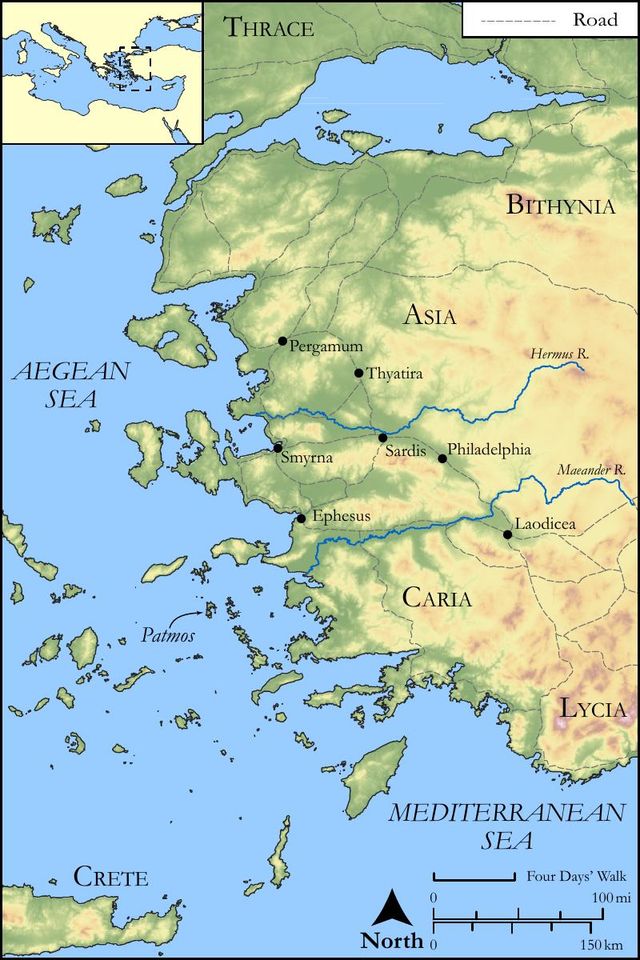
See on the biblical-era map

Study this verse
Public-domain commentary
Matthew Henry
From his Commentary on the Whole Bible. Henry comments on passages, not single verses — this entry covers Revelation 3:7–13. His four-level outline is real structure in the source text, so it is rendered as structure.
We have now come to the sixth letter, sent to one of the Asian churches, where observe,
I.The inscription, showing,
1.For whom it was more immediately designed: The angel of the church of Philadelphia; this also was a city in Asia Minor, seated upon the borders of Mysia and Lydia, and had its name from that brotherly love for which it was eminent. We can hardly suppose that this name was given to it after it received the Christian religion, and that it was so called from that Christian affection that all believers have, and should have, one for another, as the children of one Father and the brethren of Christ; but rather that it was its ancient name, on account of the love and kindness which the citizens had and showed to each other as a civil fraternity. This was an excellent spirit, and, when sanctified by the grace of the gospel, would render them an excellent church, as indeed they were, for here is no one fault found with this church, and yet, doubtless, there were faults in it of common infirmity; but love covers such faults.
2.By whom this letter was signed; even by the same Jesus who is alone the universal head of all the churches; and here observe by what title he chooses to represent himself to this church: He that is holy, he that is true, he that hath the key of David, etc. You have his personal character: He that is holy and he that is true, holy in his nature, and therefore he cannot but be true to his word, for he hath spoken in his holiness; and you have also his political character: He hath the key of David, he openeth, and no man shutteth; he hath the key of the house of David, the key of government and authority in and over the church. Observe,
(1.)The acts of his government.
[1.]He opens. He opens a door of opportunity to his churches; he opens a door of utterance to his ministers; he opens a door of entrance, opens the heart; he opens a door of admission into the visible church, laying down the terms of communion; and he opens the door of admission into the church triumphant, according to the terms of salvation fixed by him.
[2.]He shuts the door. When he pleases, he shuts the door of opportunity and the door of utterance, and leaves obstinate sinners shut up in the hardness of their hearts; he shuts the door of church-fellowship against unbelievers and profane persons; and he shuts the door of heaven against the foolish virgins who have slept away their day of grace, and against the workers of iniquity, how vain and confident soever they may be.
(2.)The way and manner in which he performs these acts, and that is absolute sovereignty, independent upon the will of men, and irresistible by the power of men: He openeth, and no man shutteth; he shutteth, and no man openeth; he works to will and to do, and, when he works, none can hinder. These were proper characters for him, when speaking to a church that had endeavoured to be conformed to Christ in holiness and truth, and that had enjoyed a wide door of liberty and opportunity under his care and government.
II.The subject-matter of this epistle, where,
1.Christ puts them in mind of what he had done for them: I have set before thee an open door, and no man can shut it, Rev 3:8. I have set it open, and kept it open, though there be many adversaries. Learn here,
(1.)Christ is to be acknowledged as the author of all the liberty and opportunity his churches enjoy.
(2.)He takes notice and keeps account, how long he has preserved their spiritual liberties and privileges for them.
(3.)Wicked men envy the people of God their door of liberty, and would be glad to shut it against them.
(4.)If we do not provoke Christ to shut this door against us, men cannot do it.
2.This church is commended: Thou hast a little strength, and hast kept my word, and hast not denied my name, Rev 3:8. In this there seems to be couched a gentle reproof: "Thou hast a little strength, a little grace, which, though it be not proportionate to the wide door of opportunity which I have opened to thee, yet is true grace, and has kept thee faithful." True grace, though weak, has the divine approbation; but, though Christ accepts a little strength, yet believers should not rest satisfied in a little, but should strive to grow in grace, to be strong in faith, giving glory to God. True grace, though weak, will do more than the greatest gifts or highest degrees of common grace, for it will enable the Christian to keep the word of Christ, and not to deny his name. Obedience, fidelity, and a free confession of the name of Christ, are the fruits of true grace, and are pleasing to Christ as such.
3.Here is a promise of the great favour God would bestow on this church, Rev 3:9, Rev 3:10. This favour consists in two things: -
(1.)Christ would make this church's enemies subject to her.
[1.]Those enemies are described to be such as said they were Jews, but lied in saying so - pretended to be the only and peculiar people of God, but were really the synagogue of Satan. Assemblies that worship God in spirit and in truth are the Israel of God; assemblies that either worship false gods, or the true God in a false manner, are the synagogues of Satan: though they may profess to be the only people of God, their profession is a lie.
[2.]Their subjection to the church is described: They shall worship at thy feet; not pay a religious and divine honour to the church itself, nor to the ministry of it, but shall be convinced that they have been in the wrong, that this church is in the right and is beloved of Christ, and they shall desire to be taken into communion with her and that they may worship the same God after the same manner. How shall this great change be wrought? By the power of God upon the hearts of his enemies, and by signal discoveries of his peculiar favour to his church: They shall know that I have loved thee. Observe, First, The greatest honour and happiness any church can enjoy consist in the peculiar love and favour of Christ. Secondly, Christ can discover this his favour to his people in such a manner that their very enemies shall see it, and be forced to acknowledge it. Thirdly, This will, by the grace of Christ, soften the hearts of their enemies, and make them desirous to be admitted into communion with them.
(2.)Another instance of favour that Christ promises to this church is persevering grace in the most trying times (Rev 3:10), and this as the reward of their past fidelity. To him that hath shall be given. Here observe,
[1.]The gospel of Christ is the word of his patience. It is the fruit of the patience of God to a sinful world; it sets before men the exemplary patience of Christ in all his sufferings for men; it calls those that receive it to the exercise of patience in conformity to Christ.
[2.]This gospel should be carefully kept by all that enjoy it; they must keep up to the faith, and practice, and worship prescribed in the gospel.
[3.]After a day of patience we must expect an hour of temptation; a day of gospel peace and liberty is a day of God's patience, and it is seldom so well improved as it should be and therefore it is often followed by an hour of trial and temptation.
[4.]Sometimes the trial is more general and universal; it comes upon all the world, and, when it is so general, it is usually the shorter.
[5.]Those who keep the gospel in a time of peace shall be kept by Christ in an hour of temptation. By keeping the gospel they are prepared for the trial; and the same divine grace that has made them fruitful in times of peace will make them faithful in times of persecution.
4.Christ calls the church to that duty which he before promised he would enable her to do, and that is, to persevere, to hold fast that which she had. (1.) The duty itself: "Hold fast that which thou hast, that faith, that truth, that strength of grace, that zeal, that love to the brethren; thou hast been possessed of this excellent treasure, hold it fast." (2.) The motives, taken from the speedy appearance of Christ: "Behold, I come quickly. See, I am just a coming to relieve them under the trial, to reward their fidelity, and to punish those who fall away; they shall lose that crown which they once seemed to have a right to, which they hoped for, and pleased themselves with the thoughts of. The persevering Christian shall win the prize from backsliding professors, who once stood fair for it."
III.The conclusion of this epistle, Rev 3:12, Rev 3:13. Here,
1.After his usual manner, our Saviour promises a glorious reward to the victorious believer, in two things: - (1.) He shall be a monumental pillar in the temple of God; not a pillar to support the temple (heaven needs no such props), but a monument of the free and powerful grace of God, a monument that shall never be defaced nor removed, as many stately pillars erected in honour to the Roman emperors and generals have been. (2.) On this monumental pillar there shall be an honourable inscription, as in those cases is usual. [1.] The name of God, in whose cause he engaged, whom he served, and for whom he suffered in this warfare; and the name of the city of God, the church of God, the new Jerusalem, which came down from heaven. On this pillar shall be recorded all the services the believer did to the church of God, how he asserted her rights, enlarged her borders, maintained her purity and honour; this will be a greater name than Asiaticus, or Africanus; a soldier under God in the wars of the church. And then another part of the inscription is, [2.] The new name of Christ, the Mediator, the Redeemer, the captain of our salvation; by this it will appear under whose banner this conquering believer had enlisted, under whose conduct he acted, by whose example he was encouraged, and under whose influence he fought the good fight, and came off victorious.
2.The epistle is closed up with the demand of attention: He that hath an ear, let him hear what the Spirit saith unto the churches, how Christ loves and values his faithful people, how he commends, and how he will crown their fidelity.
Historical interpretation
Eight Centuries of Reception
7 surviving comments on this verse. Each one is dated, so this reads as a timeline rather than a list.
Select a marker to jump to its quote. Markers stagger vertically where authors wrote within a few decades of each other.
" Also to the angel of the church in Pergamus (mention was made) of Antipas, the very faithful martyr, who was slain where Satan dwelleth. Also to the angel of the church in Philadelphia (it was signified) that he who had not denied the name of the Lord was delivered from the last trial.
The sixth class is the mode of life of the best election. The habit of saints is set forth; of those, to wit, who are lowly in the world, and unskilled in the Scriptures, and who hold the faith immoveably, and are not at all broken down by any chance, or withdrawn from the faith by any fear. Therefore He says to them:-
"I have set before thee an open door, because thou hast kept the word of my patience." In such little strength.
"And I will keep thee from the hour of temptation." That they may know His glory to be of this kind, that they are not indeed permitted to be given over to temptation.
"He that overcometh shall be made a pillar in the temple of God." For even as a pillar is an ornament of the building, so he who perseveres shall obtain a nobility in the Church.
Although the church is constantly put to the test by both internal and external conflict, and either individuals partially or the whole generally are attacked by various temptations, yet the hour of temptation may also refer to the time of the antichrist who will come in the future. From this hour Christ the Lord promises that he will free every church that remains firm in his [commandments], so that the temptation to ruin might be recognized to be a deception.
By the “hour of trial” he speaks either of the persecution against the Christians which occurred almost immediately by those who ruled Rome at that time, from which he promised that the church would be freed, or he speaks of the universal coming of the antichrist against the faithful at the end of time. From this coming he pledges to free those who are zealous, for they will beforehand be seized upward by a departure from there, lest they be tempted beyond what they are able [to endure].
Because you have kept my word of patience, etc. Because you have kept my example in enduring adversities, I will in turn keep you from imminent tribulations; not indeed that you will not be tempted, but that you will not be overcome by adversities. And although the Church is always exercised by adversities, here the hour of temptation and the humiliation of the Jews under the time of Antichrist can be signified, so that as in the following in the sixth order often, so also here in the sixth angel the final persecution is designated. In which indeed the evil Jews, deceiving and being deceived, but others, by the teachings of the great prophet Elijah, understanding the law spiritually and incorporated into the members of the Church, are believed to be strongly victorious over the enemy.
Because thou hast kept the word of my patience, etc. The word of patience is what the Lord showed in example when he prayed on the cross for his persecutors, [Luke 23:34] and taught in words, saying, In your patience you shall possess your souls. [Luke 21:19] As for what follows, I will also keep thee from the hour of the temptation, which shall come upon the whole world to try them that dwell upon the earth, it should be taken as referring to the times of the Antichrist, under whom there will be so great a tribulation as has never been from the beginning of the world. [Matt. 24:21] For bodily wounds will be hard, but more grievous will be the miracles of the enemies. But the saints will be preserved from the trial of deception, because they will not be provoked to the negation of Christ.
Because you have kept the word of My patience, I also will keep you from the hour of trial. He speaks of the persecution of Christians that occurred under Emperor Domitian, who was the second persecutor after Nero, as Eusebius records in both his Ecclesiastical History and his Chronicon Canon. It was during this time that the divine evangelist was condemned to live on Patmos, a small and deserted island.
Continue studying Revelation 3:10 across the web’s major study libraries — every link below opens this exact verse, chapter, or book on the destination site.
Read & Compare
 BibleGatewayThis verse in more than 200 translations and 70 languages.
 Bible.comThe YouVersion reader — hundreds of translations, reading plans, and highlights.
 ESV.orgCrossway's official English Standard Version reader.
 NET BibleThe NET translation with 60,000+ translators' notes on every rendering decision.
 STEP BibleTyndale House's free study tool — original text, vocabulary, and scholarly resources.
 BibliaLogos Bible Software's free web reader.
 USCCBThe New American Bible (Revised Edition) with the U.S. bishops' study notes.
Commentaries
 BibleHub CommentariesDozens of classic commentaries on this verse, gathered on one page.
 StudyLightMore than 100 commentary sets — the largest collection on the web.
 BibleRefPlain-English commentary on what this verse means, verse by verse.
 Enduring WordDavid Guzik's free commentary on this chapter, widely used by Bible teachers.
 Bible Study ToolsVerse commentary alongside Greek and Hebrew study aids.
Original Language & Research
- BibleHub InterlinearThe verse word by word — original language, transliteration, and English.
- BibleHub LexiconEvery word's original-language definition and Strong's entry.
 Blue Letter BibleDeep-study tools — Strong's numbers, concordance, and word studies.
 CNTR CollationThe earliest Greek manuscripts of this verse, collated letter by letter.
Sermons, Hymns & Audio


TrulyRandomVerse is not affiliated with these sites and doesn’t control their content. They’re linked because they’re genuinely useful.
Summary
Revelation 3:10 is a pivotal promise from Jesus Christ to the faithful church in Philadelphia, assuring them of divine preservation from a future global period of intense testing. This assurance is a direct consequence of their steadfast endurance and faithfulness in keeping Christ's word, particularly His call to patient perseverance amidst tribulation. The verse highlights the Lord's intimate knowledge of His church's struggles and His commitment to protect those who remain true to Him during a time of universal trial designed to expose the hearts of all who are fixated on earthly concerns.
Context
ShowHideLiterary Context
This verse is embedded within the letter to the church in Philadelphia, one of the seven churches addressed in Revelation chapters 2 and 3. Unlike most of the other churches, Philadelphia receives no rebuke, only commendation and promises. The preceding verses (Revelation 3:7-9) praise the Philadelphian believers for their "little strength" yet their faithfulness in keeping Christ's word and not denying His name, even when faced with opposition from those who falsely claimed to be God's people. Verse 10 builds directly on this commendation, presenting a specific promise of preservation as a reward for their patient endurance, setting the stage for further promises of future blessing and stability in Revelation 3:11-13. The immediate context underscores the importance of perseverance and loyalty to Christ in the face of adversity.
Historical & Cultural Context
The seven churches of Asia Minor were real congregations existing in the Roman province of Asia during the late first century AD. Philadelphia, located in a seismically active region, was prone to earthquakes, which might have contributed to a cultural understanding of instability and the need for endurance. The city was also a center for the imperial cult and various pagan religions, creating an environment where Christians faced pressure to conform and potentially deny their faith. The "synagogue of Satan" mentioned in Revelation 3:9 likely refers to a Jewish community that was hostile to Christians, perhaps even persecuting them, adding to the trials faced by the Philadelphian believers. The concept of "keeping" a word or command was deeply significant in both Jewish and Roman cultures, signifying loyalty and obedience, which would resonate strongly with the original audience.
Key Themes
ShowHideThe overarching theme of the letter to Philadelphia, and specifically Revelation 3:10, is divine faithfulness met with human perseverance. Christ acknowledges their "little strength" but commends their steadfastness, emphasizing that true strength lies in adherence to His word, as seen in Revelation 3:8. This leads to the theme of divine preservation and protection, where Christ promises to "keep" them from a future global trial. This "hour of temptation" introduces the theme of eschatological tribulation, a period of intense testing that will affect "all the world" and serve to "try them that dwell upon the earth." This contrasts sharply with the heavenly citizenship of believers, a concept articulated in Philippians 3:20, highlighting the distinction between those whose focus is earthly and those whose hope is in Christ.
Exposition and Analysis
ShowHideKey Word Analysis
ShowHideThis verb appears twice in the verse, first describing the Philadelphians' faithfulness ("thou hast kept the word of my patience") and then Christ's reciprocal promise ("I also will keep thee"). From G5083, tēréō means "to guard (from loss or injury, properly, by keeping the eye upon)" or "to preserve." It implies active watchfulness and diligent adherence. In the first instance, it signifies the church's careful observance and preservation of Christ's teachings and example of endurance. In the second, it denotes Christ's active protection and preservation of His faithful ones.
hypomonḗ refers to "cheerful (or hopeful) endurance, constancy." It is not passive waiting but active, steadfast perseverance under trial, often with an expectation of a positive outcome. It encapsulates the idea of remaining firm and unyielding in faith despite suffering or opposition. The "word of my patience" refers to Christ's own example of endurance (e.g., in His suffering) and His command to His followers to likewise endure.
peirasmós denotes "a putting to proof (by experiment (of good), experience (of evil), solicitation, discipline or provocation); by implication, adversity." It can mean both "temptation" (an enticement to evil) and "trial" or "testing" (a proving of character). In this context, it refers to a period of intense global tribulation and testing, designed to reveal the true spiritual state of humanity.
Verse Breakdown
ShowHide"Because thou hast kept the word of my patience"
This clause establishes the ground for Christ's promise. The Philadelphian church demonstrated faithfulness not merely by passive waiting, but by actively holding fast to Christ's teaching and example of patient endurance in the face of tribulation. This "word of patience" embodies both Christ's command to persevere and His own steadfast character, which they emulated.
"I also will keep thee from the hour of temptation"
This is the core promise. Christ pledges to protect the Philadelphian believers. The verb "keep" (tēréō) suggests active preservation. The crucial preposition "from" (Greek, ek, G1537) typically means "out of" or "from within," implying a removal or separation from the sphere of the "hour of temptation," rather than merely preservation through it. This phrase is central to eschatological discussions regarding the timing of the church's removal before or during the Great Tribulation.
"which shall come upon all the world"
This specifies the scope and nature of the "hour of temptation." It is not a localized event but a universal, global phenomenon, affecting "all the world" (Greek, oikouménē, G3625, referring to the inhabited earth, often implying the Roman Empire but here clearly global in scope). The phrase "shall come" (Greek, méllō érchomai, G3195, G2064) indicates a definite future event that is about to happen.
"to try them that dwell upon the earth"
This clause reveals the purpose and target of this global trial. The verb "to try" (Greek, peirázō, G3985) means "to test" or "to prove." The trial's specific target is "them that dwell upon the earth" (Greek, katoikéō epí gē, G2730, G1909, G1093). This phrase, used elsewhere in Revelation, often describes those whose allegiance and focus are entirely earthly, in contrast to believers whose citizenship is heavenly. The purpose of the trial is to expose the true nature and allegiance of these earth-dwellers, revealing their spiritual bankruptcy.
Literary Devices
ShowHideRevelation 3:10 employs several significant literary devices. The most prominent is Conditional Promise, where Christ's assurance of preservation is directly linked to the Philadelphians' prior faithfulness ("Because thou hast kept... I also will keep thee"). This highlights the reciprocal nature of the divine-human relationship. There is also a clear Contrast established between those who "keep the word of my patience" and "them that dwell upon the earth." This distinction sets apart the faithful, heaven-focused believers from the unfaithful, earth-bound inhabitants, emphasizing different allegiances and destinies. Furthermore, the phrase "the hour of temptation" functions as Metonymy, where "hour" stands for a specific period or season of intense trial, rather than a literal 60-minute duration. The entire verse also serves as a powerful Exhortation by example, encouraging other churches and believers throughout history to emulate the Philadelphians' steadfastness.
Theological and Thematic Connections
ShowHideRevelation 3:10 is a profound statement on divine sovereignty, human faithfulness, and eschatological promise. It underscores the Lord's intimate knowledge of His people's struggles and His commitment to protect those who remain steadfast in their faith. The "word of my patience" points to Christ's own example of endurance and His call for His followers to persevere through trials, trusting in His ultimate victory. The promise to "keep thee from the hour of temptation" has been a cornerstone for various eschatological interpretations, particularly regarding the timing of the church's removal in relation to the Great Tribulation. Regardless of specific timing, the verse unequivocally teaches that God will provide a unique form of preservation for His faithful church during a period of unprecedented global testing, distinguishing them from those whose lives are solely defined by earthly pursuits. This divine protection is not earned but is a gracious response to obedient endurance, demonstrating God's faithfulness to His covenant people.
Reflection and Application
ShowHideRevelation 3:10 offers profound encouragement and a call to steadfastness for believers in every generation. It reminds us that our faithfulness, even when we feel we have "little strength," is deeply valued by Christ. The "word of His patience" is not just a historical command but an ongoing invitation to embody His resilient character in our own lives, especially when facing opposition, suffering, or the pressures of a world increasingly hostile to Christian values. This verse challenges us to consider where our true allegiance lies: are we among those whose focus is "upon the earth," or are our hearts set on heavenly things, eagerly awaiting Christ's return? The promise of divine preservation should motivate us to live with an eternal perspective, knowing that our endurance is not in vain. It assures us that God is actively watching over His own, and He will fulfill His promise to protect them in His perfect timing and way. This should inspire both hope and a renewed commitment to hold fast to His word, knowing that our perseverance is intrinsically linked to His protective hand.
Questions for Reflection
ShowHideFAQ
ShowHideWhat is the "hour of temptation" mentioned in Revelation 3:10?
ShowHideThe "hour of temptation" (Greek: hṓra peirasmós) refers to a specific, intense, and universal period of tribulation and testing that will "come upon all the world." While its exact nature and timing are debated among eschatological viewpoints, it is generally understood to be a time of unprecedented global distress designed to "try them that dwell upon the earth"—that is, to expose the true spiritual allegiance of all humanity, particularly those whose lives are solely focused on earthly matters. It is a time of divine judgment and purification, distinguishing between genuine faith and mere profession. This period is often identified with the Great Tribulation described in Matthew 24:21 and various passages throughout the book of Revelation, such as Revelation 7:14.
Christ-Centered Fulfillment
ShowHideRevelation 3:10 finds its ultimate fulfillment and deepest meaning in the person and work of Jesus Christ. He is the very embodiment of the "word of my patience," having perfectly endured the cross "for the joy that was set before Him," despising its shame (Hebrews 12:2). His steadfastness in suffering, His unwavering obedience to the Father's will even unto death, provides the supreme example of the "patience" that His followers are called to emulate. Furthermore, Christ is the faithful and true witness, the one who holds the keys of David, opening doors that no one can shut and shutting doors that no one can open (Revelation 3:7). It is His power and authority that enable Him to "keep" His church from the coming "hour of temptation." This promise of preservation is a direct outflow of His atoning work and His ongoing intercession for believers (Romans 8:34). Just as He conquered sin and death through His own trial, He now stands as the protector and deliverer of His people, ensuring that those who remain faithful to Him will be preserved from the ultimate testing that will befall the ungodly. His return, often referred to as the "blessed hope" (Titus 2:13), is the ultimate expression of this keeping, as He will gather His elect to Himself before or during the climactic events of the end times, fulfilling His promise to be with them always, even to the end of the age (Matthew 28:20).