


Galatians 3:7
- γινώσκετεginōsketedo knowG1097V-PAM-2PVerb Present Active Imperative 2nd Plural
- ἄραarathenG686CONJConjunction
- ὅτιhotithatG3754CONJConjunction
- οἱhoithoseG3588T-NPMDefinite article Nominative Plural Masculine
- ἐκekofG1537PREPPreposition
- πίστεωςpisteōsfaithG4102N-GSFNoun Genitive Singular Feminine
- οὗτοιhoutoitheseG3778D-NPMDemonstrative pronoun Nominative Plural Masculine
- υἱοίhuioisonsG5207N-NPMNoun Nominative Plural Masculine
- εἰσινeisinareG1510V-PAI-3PVerb Present Active Indicative 3rd Plural
- ἈβραάμAbraamof AbrahamG11N-GSM-PNoun Genitive Singular Masculine Individual
English is a literal word-by-word gloss of the Greek, not the KJV's wording. Why?
This is the original text the KJV's translators worked from — each Greek word with its own literal English meaning in this verse, prepared by scholars at Tyndale House, Cambridge. The KJV translates whole sentences, not word by word, so its wording differs: one Greek word can become several English words, and the KJV may choose “charity” where the gloss reads “love”. Both are faithful — they answer different questions. For the KJV's own rendering, switch to the KJV text.
Details
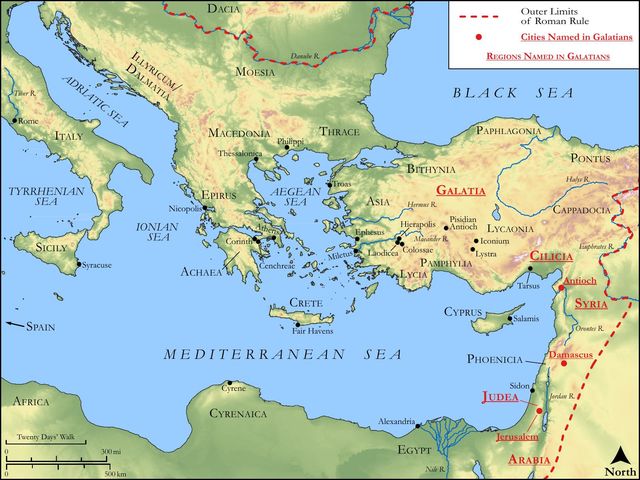
See on the biblical-era maps

Study this verse
Public-domain commentary
Matthew Henry
From his Commentary on the Whole Bible. Henry comments on passages, not single verses — this entry covers Galatians 3:6–18. His two-level outline is real structure in the source text, so it is rendered as structure.
The apostle having reproved the Galatians for not obeying the truth, and endeavoured to impress them with a sense of their folly herein, in these verses he largely proves the doctrine which he had reproved them for rejecting, namely, that of justification by faith without the works of the law. This he does several ways.
I.From the example of Abraham's justification.
This argument the apostle uses, Rom. 4. Abraham believed God, and that was accounted to him for righteousness (Gal 3:6); that is, his faith fastened upon the word and promise of God, and upon his believing he was owned and accepted of God as a righteous man: as on this account he is represented as the father of the faithful, so the apostle would have us to know that those who are of faith are the children of Abraham (Gal 3:7), not according to the flesh, but according to the promise; and, consequently, that they are justified in the same way that he was. Abraham was justified by faith, and so are they. To confirm this, the apostle acquaints us that the promise made to Abraham (Gen 12:3), In thee shall all nations be blessed, had a reference hereunto, Gal 3:8. The scripture is said to foresee, because he that indited the scripture did foresee, that God would justify the heathen world in the way of faith; and therefore in Abraham, that is, in the seed of Abraham, which is Christ, not the Jews only, but the Gentiles also, should be blessed; not only blessed in the seed of Abraham, but blessed as Abraham was, being justified as he was. This the apostle calls preaching the gospel to Abraham; and thence infers (Gal 3:9) that those who are of faith, that is, true believers, of what nation soever they are, are blessed with faithful Abraham. They are blessed with Abraham the father of the faithful, by the promise made to him, and therefore by faith as he was. It was through faith in the promise of God that he was blessed, and it is only in the same way that others obtain this privilege.
II.He shows that we cannot be justified but by faith fastening on the gospel, because the law condemns us.
If we put ourselves upon trial in that court, and stand to the sentence of it, we are certainly cast, and lost, and undone; for as many as are of the works of the law are under the curse, as many as depend upon the merit of their own works as their righteousness, as plead not guilty, and insist upon their own justification, the cause will certainly go against them; for it is written, Cursed is every one that continueth not in all things which are written in the book of the law, to do them, Gal 3:10, and Deu 27:26. The condition of life, by the law, is perfect, personal, and perpetual, obedience; the language of it is, Do this and live; or, as Gal 3:12, The man that doeth them shall live in them: and for every failure herein the law denounces a curse. Unless our obedience be universal, continuing in all things that are written in the book of the law, and unless it be perpetual too (if in any instance at any time we fail and come short), we fall under the curse of the law. The curse is wrath revealed, and ruin threatened: it is a separation unto all evil, and this is in full force, power, and virtue, against all sinners, and therefore against all men; for all have sinned and become guilty before God: and if, as transgressors of the law, we are under the curse of it, it must be a vain thing to look for justification by it. But, though this is not to be expected from the law, yet the apostle afterwards acquaints us that there is a way open to our escaping this curse, and regaining the favour of God, namely, through faith in Christ, who (as he says, Gal 3:13) hath redeemed us from the curse of the law, etc. A strange method it was which Christ took to redeem us from the curse of the law; it was by his being himself made a curse for us. Being made sin for us, he was made a curse for us; not separated from God, but laid for the present under that infamous token of the divine displeasure upon which the law of Moses had put a particular brand, Deu 21:23. The design of this was that the blessing of Abraham might come on the Gentiles through Jesus Christ - that all who believed on Christ, whether Jews or Gentiles, might become heirs of Abraham's blessing, and particularly of that great promise of the Spirit, which was peculiarly reserved for the times of the gospel. Hence it appeared that it was not by putting themselves under the law, but by faith in Christ, that they become the people of God and heirs of the promise. Here note,
1.The misery which as sinners we are sunk into - we are under the curse and condemnation of the law.
2.The love and grace of our Lord Jesus Christ towards us - he has submitted to be made a curse for us, that he might redeem us from the curse of the law.
3.The happy prospect which we now have through him, not only of escaping the curse, but of inheriting the blessing. And,
4.That it is only through faith in him that we can hope to obtain this favour.
III.To prove that justification is by faith, and not by the works of the law, the apostle alleges the express testimony of the Old Testament, Gal 3:11. The place referred to is Hab 2:4, where it is said, The just shall live by faith; it is again quoted, Rom 1:17, and Heb 10:38. The design of it is to show that those only are just or righteous who do truly live, who are freed from death and wrath, and restored into a state of life in the favour of God; and that it is only through faith that persons become righteous, and as such obtain this life and happiness - that they are accepted of God, and enabled to live to him now, and are entitled to an eternal life in the enjoyment of him hereafter. Hence the apostle says, It is evident that no man is justified by the law in the sight of God. Whatever he may be in the account of others, yet he is not so in the sight of God; for the law is not of faith - that says nothing concerning faith in the business of justification, nor does it give life to those who believe; but the language of it is, The man that doeth them shall live in them, as Lev 18:5. It requires perfect obedience as the condition of life, and therefore now can by no means be the rule of our justification. This argument of the apostle's may give us occasion to remark that justification by faith is no new doctrine, but what was established and taught in the church of God long before the times of the gospel. Yea, it is the only way wherein any sinners ever were, or can be, justified.
IV.To this purpose the apostle urges the stability of the covenant which God made with Abraham, which was not vacated nor disannulled by the giving of the law to Moses, Gal 3:15, etc. Faith had the precedence of the law, for Abraham was justified by faith. It was a promise that he built upon, and promises are the proper objects of faith. God entered into covenant with Abraham (Gal 3:8), and this covenant was firm and steady; even men's covenants are so, and therefore much more his. When a deed is executed, or articles of agreement are sealed, both parties are bound, and it is too late then to settle things otherwise; and therefore it is not to be supposed that by the subsequent law the covenant of God should be vacated. The original word diathēkē signifies both a covenant and a testament. Now the promise made to Abraham was rather a testament than a covenant. When a testament has become of force by the death of the testator, it is not capable of being altered; and therefore, the promise that was given to Abraham being of the nature of a testament, it remains firm and unalterable. But, if it should be said that a grant or testament may be defeated for want of persons to claim the benefit of it (Gal 3:16), he shows that there is no danger of that in this case. Abraham is dead, and the prophets are dead, but the covenant is made with Abraham and his seed. And he gives us a very surprising exposition of this. We should have thought it had been meant only of the people of the Jews. "Nay," says the apostle, "it is in the singular number, and points at a single person - that seed is Christ," So that the covenant is still in force; for Christ abideth for ever in his person, and in his spiritual seed, who are his by faith. And if it be objected that the law which was given by Moses did disannul this covenant, because that insisted so much upon works, and there was so little in it of faith or of the promised Messiah, he answers that the subsequent law could not disannul the previous covenant or promise (Gal 3:18): If the inheritance be of the law, it is no more of promise; but, says he, God gave it to Abraham by promise, and therefore it would be inconsistent with his holiness, wisdom, and faithfulness, by any subsequent act to set aside the promise, and so alter the way of justification which he had thus established. If the inheritance was given to Abraham by promise, and thereby entailed upon his spiritual seed, we may be sure that God would not retract that promise; for he is not a man that he should repent.
Historical interpretation
Two Centuries of Reception
6 surviving comments on this verse. Each one is dated, so this reads as a timeline rather than a list.
Select a marker to jump to its quote. Markers stagger vertically where authors wrote within a few decades of each other.
For albeit it is subsequently that he is called "a father of many nations," still it is of those (nations) who, as the fruit of the "faith" which precedes digamy, had to be accounted "sons of Abraham."
For ye are all the children of faith," it becomes dear that what the heretic's industry erased was the mention of Abraham's name; for by faith the apostle declares us to be "children of Abraham," and after mentioning him he expressly called us "children of faith" also. But how are we children of faith? and of whose faith, if not Abraham's? For since "Abraham believed God, and it was accounted to him for righteousness; " since, also, he deserved for that reason to be called "the father of many nations," whilst we, who are even more like him in believing in God, are thereby justified as Abraham was, and thereby also obtain life-since the just lives by his faith,-it therefore happens that, as he in the previous passage called us "sons of Abraham," since he is in faith our (common) father, so here also he named us "children of faith," for it was owing to his faith that it was promised that Abraham should be the father of (many) nations.
For if" faith" is the source whence we are reckoned to Abraham as his "sons" (as the apostle teaches, saying to the Galatians, "You know, consequently, that (they) who are of faith, these are sons of Abraham" ), when did Abraham "believe God and it was accounted to him for righteousness? "I suppose when still in monogamy, since (he was) not yet in circumcision.
Every mystery which is enacted by our Lord Jesus Christ asks only for faith. The mystery was enacted at that time for our sake and aimed at our resurrection and liberation, should we have faith in the mystery of Christ and in Christ. For the patriarchs prefigured and foretold that man would be justified from faith. Therefore, just as it was reckoned as righteousness to Abraham that he had faith, so we too, if we have faith in Christ and every mystery of his, will be sons of Abraham. Our whole life will be accounted as righteous.
Which he proves by ancient testimony thus:
(V.7) So you know, those who are of faith, these are the children of Abraham. He discusses more fully in the letter to the Romans that faith was reckoned to Abraham as righteousness, not in circumcision but in uncircumcision (Rom. 4). And carefully observing, he teaches that those who believed with this mindset are the children of Abraham, just as Abraham believed when he was uncircumcised, who rejoiced to see the day of the Lord, and saw it and was glad (John 8). And it is also said to the unbelieving Jews: If you were children of Abraham, you would do the works of Abraham (Ibid. 39). But what other works was the Lord seeking from them at that time when these things were said, except faith in the Son of God, whom the Father had sent to speak: Whoever believes in me, does not believe in me, but in him who sent me (John XII, 44)? And in another place, when they were clapping and boasting about their ancient and noble lineage, the response is given: And do not say, 'We have Abraham as our father.' For God is able to raise up children to Abraham from these stones (Matth. III, 9). By these stones, no one doubts that the hardened hearts of the Gentiles are signified, which were later softened and received the seal of faith. Enumerate the virtues of Abraham in which he pleased God before circumcision, diligent reader, and wherever you find them in a similar work, say that they are the children of Abraham, justified in the foreskin, who received circumcision not because of the merit of works, but as a sign of prior faith. For indeed Christ was to be born from his seed (in whom the blessing of all nations was promised, and from Abraham until Christ many centuries were to pass), God foreseen that the children of beloved Abraham might mix with other nations, and gradually his family would become uncertain, he marked the Israelite flock with a certain circumcision seal, so that they would be distinguished by this sign while living among the Egyptians, Assyrians, Babylonians, and Chaldeans. Finally, for forty years in the desert, no one was circumcised: for they alone lived without the mixture of another nation. As soon as the people crossed the banks of the Jordan and poured themselves into the land of Palestine, the circumcision, necessary for the future mix of nations, guarded against error. And that which is written a second time about the circumcised people (Joshua 5) signifies that the circumcision ceased in the desert, which was reasonably practiced in Egypt; and that believers are to be cleansed by the spiritual circumcision of the Lord Jesus Christ.
Continue studying Galatians 3:7 across the web’s major study libraries — every link below opens this exact verse, chapter, or book on the destination site.
Read & Compare
 BibleGatewayThis verse in more than 200 translations and 70 languages.
 Bible.comThe YouVersion reader — hundreds of translations, reading plans, and highlights.
 ESV.orgCrossway's official English Standard Version reader.
 NET BibleThe NET translation with 60,000+ translators' notes on every rendering decision.
 STEP BibleTyndale House's free study tool — original text, vocabulary, and scholarly resources.
 BibliaLogos Bible Software's free web reader.
 USCCBThe New American Bible (Revised Edition) with the U.S. bishops' study notes.
Commentaries
 BibleHub CommentariesDozens of classic commentaries on this verse, gathered on one page.
 StudyLightMore than 100 commentary sets — the largest collection on the web.
 BibleRefPlain-English commentary on what this verse means, verse by verse.
 Enduring WordDavid Guzik's free commentary on this chapter, widely used by Bible teachers.
 Bible Study ToolsVerse commentary alongside Greek and Hebrew study aids.
Original Language & Research
- BibleHub InterlinearThe verse word by word — original language, transliteration, and English.
- BibleHub LexiconEvery word's original-language definition and Strong's entry.
 Blue Letter BibleDeep-study tools — Strong's numbers, concordance, and word studies.
 CNTR CollationThe earliest Greek manuscripts of this verse, collated letter by letter.
Sermons, Hymns & Audio


TrulyRandomVerse is not affiliated with these sites and doesn’t control their content. They’re linked because they’re genuinely useful.
Summary
Galatians 3:7 serves as a pivotal declaration in Paul's argument for justification by faith, asserting that true spiritual lineage to Abraham is not determined by physical descent or adherence to the Mosaic Law, but by a shared characteristic of faith. This verse underscores the universal reach of the Gospel, revealing that all who believe in Christ are counted as Abraham's spiritual heirs, thereby receiving the promises and blessings originally given to the patriarch.
Context
ShowHideLiterary Context
This verse is situated within the broader theological argument of Galatians 3, where Paul passionately defends the doctrine of justification by faith against the legalistic teachings of the Judaizers. Having just challenged the Galatians by asking how they received the Spirit—by works of the Law or by hearing with faith (Galatians 3:2), and reminding them of their initial experience of faith (Galatians 3:3-5), Paul immediately turns to the foundational example of Abraham. He quotes Genesis 15:6 in Galatians 3:6 to establish that Abraham's righteousness was credited to him through faith, not through works or circumcision (which came later). Verse 7 then draws the logical conclusion from this premise, defining the true "children of Abraham."
Historical & Cultural Context
The churches in Galatia, comprised of both Jewish and Gentile converts, were facing severe theological pressure from "Judaizers"—Jewish Christians who insisted that Gentile believers must be circumcised and observe other aspects of the Mosaic Law to be truly saved and fully part of God's covenant people. This teaching directly contradicted the Gospel Paul preached, which emphasized salvation by grace through faith alone. For Jewish people, descent from Abraham was a source of immense pride and a sign of covenant privilege. Paul's radical redefinition of "children of Abraham" would have been shocking and highly controversial, challenging deeply ingrained ethnic and religious identities. His argument aims to dismantle the exclusivity of a works-based righteousness and establish a new, inclusive identity in Christ.
Key Themes
ShowHideGalatians 3 is rich with themes central to Paul's theology. Justification by Faith is paramount; Paul argues that right standing with God is achieved solely through belief in Christ, mirroring Abraham's experience. This directly contrasts with Justification by Works of the Law, which Paul vehemently refutes as a means of salvation. The concept of the Spiritual Lineage of Abraham is redefined, moving beyond physical descent to include all who share Abraham's faith, whether Jew or Gentile. This redefinition underpins the Unity of Believers in Christ, breaking down the dividing wall between Jew and Gentile (Ephesians 2:14). Finally, the chapter emphasizes the Continuity of God's Plan of Salvation, showing that the Gospel preached to Abraham (Galatians 3:8) is the same Gospel now revealed in Christ, demonstrating God's consistent method of relating to humanity through faith.
Exposition and Analysis
ShowHideKey Word Analysis
ShowHideThis word signifies a deep, experiential knowledge, not merely intellectual assent. Paul is not asking the Galatians to simply acknowledge a fact, but to grasp and internalize a profound theological truth that should reshape their understanding of salvation and identity. It implies a call to understand fully the implications of Abraham's example for their own faith.
This preposition is crucial, denoting origin, source, or means. When Paul says "they which are of faith," he is emphasizing that faith is the very wellspring or originating principle of their spiritual identity and standing before God. It's not just that they have faith, but that their very being as God's children proceeds from or by means of faith. This highlights faith as the exclusive basis, excluding works.
This term encompasses persuasion, credence, and moral conviction, especially reliance upon Christ for salvation. It signifies trust, belief, and faithfulness. In this context, pístis is presented as the singular means by which one enters into a right relationship with God and becomes a spiritual descendant of Abraham, contrasting sharply with adherence to legalistic requirements.
Verse Breakdown
ShowHide"Know ye therefore"
Paul employs a logical connector ("therefore," ára) to draw a decisive conclusion from the preceding argument, particularly the example of Abraham's faith being counted as righteousness in Galatians 3:6. This phrase serves as an imperative, urging the Galatians to grasp the profound implication of what he has just stated. It's a call to understand and accept this foundational truth.
"that they which are of faith"
This clause identifies the true spiritual lineage. The Greek preposition ek ("of" or "out of") signifies that faith is the origin or defining characteristic of these individuals. It's not about ethnic background, physical descent, or adherence to the Law, but about a disposition of trust and reliance on God. This phrase sets up a direct contrast with those who rely on works of the Law for their standing.
"the same are the children of Abraham."
This is the climactic assertion. Paul redefines "children of Abraham" from a biological or ethnic designation to a spiritual one. Those who share Abraham's characteristic of faith are his true heirs, inheriting the promises made to him. This statement radically broadens the scope of God's covenant people to include Gentiles who believe, dismantling the exclusive claims of the Judaizers and affirming the universal reach of the Gospel.
Literary Devices
ShowHidePaul's argument in Galatians 3:7 masterfully employs several literary devices. The most prominent is Redefinition, where Paul takes the culturally significant and ethnically charged term "children of Abraham" and reinterprets its meaning. He shifts its primary referent from physical descent to spiritual affinity, specifically faith. This redefinition is central to his argument against the Judaizers, as it undermines their claim that Gentiles must become Jewish (through circumcision and Law-observance) to be fully part of God's people. This redefinition also implies a strong Contrast between those who rely on physical lineage or works of the Law and those who rely on faith. Furthermore, the verse functions as a Logical Conclusion (indicated by "therefore"), drawing a necessary inference from the preceding premise of Abraham's justification by faith. This rhetorical strategy aims to persuade the Galatians by demonstrating the logical consistency of salvation by faith alone, rooted in the very history of Israel's patriarch.
Theological and Thematic Connections
ShowHideGalatians 3:7 is a theological linchpin, asserting that the true "children of Abraham" are those who share his faith, not merely his physical lineage. This radical redefinition dismantles the notion that salvation or covenant membership is based on ethnic identity or legalistic observance, firmly establishing faith as the sole criterion. It underscores the profound truth that God's method of justification has always been consistent, from Abraham to Christ: righteousness is imputed by grace through faith. This verse thus serves as a powerful declaration of the universal reach of the Gospel, demonstrating that the blessings promised to Abraham are now extended to all nations through Christ, uniting Jew and Gentile into one spiritual family.
Reflection and Application
ShowHideGalatians 3:7 offers profound liberation and a call to humble dependence. It frees us from the burden of trying to earn God's favor through our performance, religious rituals, or adherence to external rules. Our identity and standing before God are not based on what we do, but on what Christ has done and our simple, profound trust in Him. This truth fosters deep assurance, reminding us that we are fully accepted and beloved children of God, not because of our merits, but because we share the same faith that Abraham exercised. This spiritual kinship with Abraham unites believers across all cultures, ethnicities, and backgrounds, creating a global family bound by a common faith in Jesus Christ. It challenges any form of spiritual elitism and calls us to embrace a gospel that is truly for all people.
Questions for Reflection
ShowHideFAQ
ShowHideWhat does Paul mean by "children of Abraham" in this verse?
ShowHidePaul radically redefines "children of Abraham" from a purely physical or ethnic lineage to a spiritual one. He means that those who share Abraham's faith—his trust and belief in God's promises—are his true descendants in God's eyes, regardless of their physical heritage. This is a pivotal point in his argument that salvation comes through faith in Christ, not through adherence to the Mosaic Law or physical descent from Abraham. This spiritual lineage includes both Jews and Gentiles who believe, fulfilling God's promise to Abraham that "in you all the families of the earth shall be blessed" (Genesis 12:3).
Why is Abraham so central to Paul's argument in Galatians?
ShowHideAbraham is central because he predates the Mosaic Law by centuries, and his righteousness was explicitly attributed to his faith, as stated in Genesis 15:6. Paul uses Abraham as the ultimate biblical example to demonstrate that God's method of justification has always been through faith, not through works of the Law. By showing that even the revered patriarch of the Jewish people was justified by faith, Paul powerfully counters the Judaizers' insistence that Gentile believers must observe the Law to be saved, proving that the Law was not the original or ultimate means of salvation. He further argues that the blessing promised to Abraham was for all nations through faith (Galatians 3:8-9).
Christ-Centered Fulfillment
ShowHideGalatians 3:7 finds its ultimate Christ-centered fulfillment in the person and work of Jesus Christ, who is the true "seed" of Abraham through whom all the promises are realized. Paul explicitly states in Galatians 3:16 that the promise was made "to Abraham and to his seed," and that "He does not say, 'And to seeds,' as referring to many, but rather to one, 'And to your seed,' that is, Christ." Therefore, to be "of faith" and thus "children of Abraham" means to be united to Christ by faith. It is through faith in Christ's atoning sacrifice and resurrection that believers, both Jew and Gentile, are grafted into the spiritual lineage of Abraham and become recipients of the Abrahamic covenant's blessings, specifically the promise of the Spirit (Galatians 3:14). Christ is the one in whom Abraham's faith finds its perfect object and its ultimate vindication, making all who believe in Him true heirs of God's grace and co-heirs with Christ (Romans 8:17).