


Romans 4:16
Bible text: King James Version (1769 Blayney text) · Public domain
Bible text: King James Version with Strong's numbers · Public domain
Bible text: Berean Standard Bible · Public domain
Bible text: American Standard Version (1901) · Public domain
Bible text: World English Bible, Messianic edition · Public domain
Bible text: Geneva Bible (1599) · Public domain
Bible text: Young's Literal Translation · Public domain
- διὰdiaThereforeG1223PREPPreposition
- τοῦτοtoutoit [is]G3778D-ASNDemonstrative pronoun Accusative Singular Neuter
- ἐκekofG1537PREPPreposition
- πίστεωςpisteōsfaithG4102N-GSFNoun Genitive Singular Feminine
- ἵναinathat [it may be]G2443CONJConjunction
- κατὰkataaccording toG2596PREPPreposition
- χάρινcharingraceG5485N-ASFNoun Accusative Singular Feminine
- εἰςeisforG1519PREPPreposition
- τὸto<the>G3588T-ASNDefinite article Accusative Singular Neuter
- εἶναιeinaito beG1511V-PANVerb Present Active Infinitive
- βεβαίανbebaiansureG949A-ASFAdjective Accusative Singular Feminine
- τὴνtēntheG3588T-ASFDefinite article Accusative Singular Feminine
- ἐπαγγελίανepangelianpromiseG1860N-ASFNoun Accusative Singular Feminine
- παντὶpantito allG3956A-DSNAdjective Dative Singular Neuter
- τῷtōtheG3588T-DSNDefinite article Dative Singular Neuter
- σπέρματιspermatiseedG4690N-DSNNoun Dative Singular Neuter
- οὐounotG3756PRT-NNegative Particle Negative
- τῷtōto thatG3588T-DSNDefinite article Dative Singular Neuter
- ἐκekofG1537PREPPreposition
- τοῦtoutheG3588T-GSMDefinite article Genitive Singular Masculine
- νόμουnomoulawG3551N-GSMNoun Genitive Singular Masculine
- μόνονmonononlyG3441A-ASNAdjective Accusative Singular Neuter
- ἀλλὰallabutG235CONJConjunction
- καὶkaialsoG2532CONJConjunction
- τῷtōto thatG3588T-DSNDefinite article Dative Singular Neuter
- ἐκekof [the]G1537PREPPreposition
- πίστεωςpisteōsfaithG4102N-GSFNoun Genitive Singular Feminine
- ἈβραάμAbraamof AbrahamG11N-GSM-PNoun Genitive Singular Masculine Individual
- ὅςhoswhoG3739R-NSMRelative pronoun Nominative Singular Masculine
- ἐστινestinisG1510V-PAI-3SVerb Present Active Indicative 3rd Singular
- πατὴρpatēr[the] fatherG3962N-NSMNoun Nominative Singular Masculine
- πάντωνpantōnof allG3956A-GPMAdjective Genitive Plural Masculine
- ἡμῶνhēmōnof us —G3165P-1GPPersonal pronoun Genitive 1st Plural
English is a literal word-by-word gloss of the Greek, not the KJV's wording. Why?
This is the original text the KJV's translators worked from — each Greek word with its own literal English meaning in this verse, prepared by scholars at Tyndale House, Cambridge. The KJV translates whole sentences, not word by word, so its wording differs: one Greek word can become several English words, and the KJV may choose “charity” where the gloss reads “love”. Both are faithful — they answer different questions. For the KJV's own rendering, switch to the KJV text.
Details
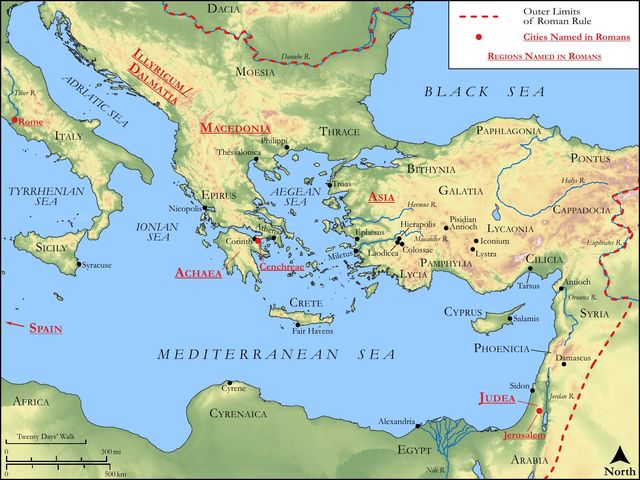
See on the biblical-era maps

Study this verse
Public-domain commentary
Matthew Henry
From his Commentary on the Whole Bible. Henry comments on passages, not single verses — this entry covers Romans 4:9–16. His four-level outline is real structure in the source text, so it is rendered as structure.
St. Paul observes in this paragraph when and why Abraham was thus justified; for he has several things to remark upon that. It was before he was circumcised, and before the giving of the law; and there was a reason for both.
I.It was before he was circumcised, Rom 4:10.
His faith was counted to him for righteousness while he was in uncircumcision. It was imputed, Gen 15:6, and he was not circumcised till ch. 17. Abraham is expressly said to be justified by faith fourteen years, some say twenty-five years, before he was circumcised. Now this the apostle takes notice of in answer to the question (Rom 4:9), Cometh this blessedness then on the circumcision only, or on the uncircumcision also? Abraham was pardoned and accepted in uncircumcision, a circumstance which, as it might silence the fears of the poor uncircumcised Gentiles, so it might lower the pride and conceitedness of the Jews, who gloried in their circumcision, as if they had the monopoly of all happiness. Here are two reasons why Abraham was justified by faith in uncircumcision: -
1.That circumcision might be a seal of the righteousness of faith, Rom 4:11. The tenour of the covenants must first be settled before the seal can be annexed. Sealing supposes a previous bargain, which is confirmed and ratified by that ceremony. After Abraham's justification by faith had continued several years only a grant by parole, for the confirmation of Abraham's faith God was pleased to appoint a sealing ordinance, and Abraham received it; though it was a bloody ordinance, yet he submitted to it, and even received it as a special favour, the sign of circumcision, etc. Now we may hence observe,
(1.)The nature of sacraments in general: they are signs and seals - signs to represent and instruct, seals to ratify and confirm. They are signs of absolute grace and favour; they are seals of the conditional promises; nay, they are mutual seals: God does in the sacraments seal to us to be to us a God, and we do therein seal to him to be to him a people.
(2.)The nature of circumcision in particular: it was the initiating sacrament of the Old Testament; and it is here said to be,
[1.]A sign - a sign of that original corruption which we are all born with, and which is cut off by spiritual circumcision, - a commemorating sign of God's covenant with Abraham, - a distinguishing sign between Jews and Gentiles, - a sign of admission into the visible church, - a sign prefiguring baptism, which comes in the room of circumcision, now under the gospel, when (the blood of Christ being shed) all bloody ordinances are abolished; it was an outward and sensible sign of an inward and spiritual grace signified thereby.
[2.]A seal of the righteousness of the faith. In general, it was a seal of the covenant of grace, particularly of justification by faith - the covenant of grace, called the righteousness which is of faith (Rom 10:6), and it refers to an Old Testament promise, Deu 30:12. Now if infants were then capable of receiving a seal of the covenant of grace, which proves that they then were within the verge of that covenant, how they come to be now cast out of the covenant and incapable of the seal, and by what severe sentence they were thus rejected and incapacitated, those are concerned to make out that not only reject, but nullify and reproach, the baptism of the seed of believers.
2.That he might be the father of all those that believe. Not but that there were those that were justified by faith before Abraham; but of Abraham first it is particularly observed, and in him commenced a much clearer and fuller dispensation of the covenant of grace than any that had been before extant; and there he is called the father of all that believe, because he was so eminent a believer, and so eminently justified by faith, as Jabal was the father of shepherds and Jubal of musicians, Gen 4:20, Gen 4:21. The father of all those that believe; that is, a standing pattern of faith, as parents are examples to their children; and a standing precedent of justification by faith, as the liberties, privileges, honours, and estates, of the fathers descend to their children. Abraham was the father of believers, because to him particularly the magna charta was renewed.
(1.)The father of believing Gentiles, though they be not circumcised. Zaccheus, a publican, if he believe, is reckoned a son of Abraham, Luk 19:9. Abraham being himself uncircumcised when he was justified by faith, uncircumcision can never be a bar. Thus were the doubts and fears of the poor Gentiles anticipated and no room left to question but that righteousness might be imputed to them also, Col 3:11; Gal 5:6.
(2.)The father of believing Jews, not merely as circumcised, and of the seed of Abraham according to the flesh, but because believers, because they are not of the circumcision only (that is, are not only circumcised), but walk in the steps of that faith - have not only the sign, but the thing signified - not only are of Abraham's family, but follow the example of Abraham's faith. See here who are the genuine children and lawful successors of those that were the church's fathers: not those that sit in their chairs, and bear their names, but those that tread in their steps; this is the line of succession, which holds, notwithstanding interruptions. It seems, then, those were most loud and forward to call Abraham father that had least title to the honours and privileges of his children. Thus those have most reason to call Christ Father, not that bear his name in being Christians in profession, but that tread in his steps.
II.It was before the giving of the law, Rom 4:13-16.
The former observation is levelled against those that confined justification to the circumcision, this against those that expected it by the law; now the promise was made to Abraham long before the law. Compare Gal 3:17, Gal 3:18. Now observe,
1.What that promise was - that he should be the heir of the world, that is, of the land of Canaan, the choicest spot of ground in the world, - or the father of many nations of the world, who sprang from him, besides the Israelites, - or the heir of the comforts of the life which now is. The meek are said to inherit the earth, and the world is theirs. Though Abraham had so little of the world in possession, yet he was heir of it all. Or, rather, it points at Christ, the seed here mentioned; compare Gal 3:16, To thy seed, which is Christ. Now Christ is the heir of the world, the ends of the earth are his possession, and it is in him that Abraham was so. And it refers to that promise (Gen 12:3), In thee shall all the families of the earth be blessed.
2.How it was made to him: Not through the law, but through the righteousness of faith. Not through the law, for that was not yet given: but it was upon that believing which was counted to him for righteousness; it was upon his trusting God, in his leaving his own country when God commanded him, Heb 11:8. Now, being by faith, it could not be by the law, which he proves by the opposition there is between them (Rom 4:14, Rom 4:15): If those who are of the law be heirs; that is, those, and those only, and they by virtue of the law (the Jews did, and still do, boast that they are the rightful heirs of the world, because to them the law was given), then faith is made void; for, if it were requisite to an interest in the promise that there should be a perfect performance of the whole law, then the promise can never take its effect, nor is it to any purpose for us to depend upon it, since the way to life by perfect obedience to the law, and spotless sinless innocency, is wholly blocked up, and the law in itself opens no other way. This he proves, Rom 4:15. The law worketh wrath - wrath in us to God; it irritates and provokes that carnal mind which is enmity to God, as the damming up of a stream makes it swell - wrath in God against us. It works this, that is, it discovers it, or our breach of the law works it. Now it is certain that we can never expect the inheritance by a law that worketh wrath. How the law works wrath he shows very concisely in the latter part of the verse: Where no law is there is no transgression, an acknowledged maxim, which implies, Where there is a law there is transgression and that transgression is provoking, and so the law worketh wrath.
3.Why the promise was made to him by faith; for three reasons, Rom 4:16.
(1.)That it might be by grace, that grace might have the honour of it; by grace, and not by the law; by grace, and not of debt, nor of merit; that Grace, grace, might be cried to every stone, especially to the top-stone, in this building. Faith hath particular reference to grace granting, as grace hath reference to faith receiving. By grace, and therefore through faith, Eph 2:8. For God will have every crown thrown at the feet of grace, free grace, and every song in heaven sung to that tune, Not unto us, O Lord, not unto us, but unto thy name be the praise.
(2.)That the promise might be sure. The first covenant, being a covenant of works, was not sure: but, through man's failure, the benefits designed by it were cut off; and therefore, the more effectually to ascertain and ensure the conveyance of the new covenant, there is another way found out, not by works (were it so, the promise would not be sure, because of the continual frailty and infirmity of the flesh), but by faith, which receives all from Christ, and acts in a continual dependence upon him, as the great trustee of our salvation, and in whose keeping it is safe. The covenant is therefore sure, because it is so well ordered in all things, Sa2 23:5.
(3.)That it might be sure to all the seed. If it had been by the law, it had been limited to the Jews, to whom pertained the glory, and the covenants, and the giving of the law (Rom 9:4); but therefore it was by faith that Gentiles as well as Jews might become interested in it, the spiritual as well as the natural seed of faithful Abraham. God would contrive the promise in such a way as might make it most extensive, to comprehend all true believers, that circumcision and uncircumcision might break no squares; and for this (Rom 4:17) he refers us to Gen 17:5, where the reason of the change of his name from Abram - a high father, to Abraham - the high father of a multitude, is thus rendered: For a father of many nations have I made thee; that is, all believers, both before and since the coming of Christ in the flesh, should take Abraham for their pattern, and call him father. The Jews say Abraham was the father of all proselytes to the Jewish religion. Behold, he is the father of all the world, which are gathered under the wings of the Divine Majesty. - Maimonides.
Historical interpretation
Ten Centuries of Reception
6 surviving comments on this verse. Each one is dated, so this reads as a timeline rather than a list.
Select a marker to jump to its quote. Markers stagger vertically where authors wrote within a few decades of each other.
It might appear from this that faith is not a free gift of God but that it must first be offered to him by man in order for grace to be given in return. But consider what the apostle teaches about this elsewhere. For when he lists the gifts of the Spirit, which he says are given to believers according to the measure of faith, there among the rest he asserts that the gift of faith is also given. Therefore faith is given by grace.…If the promise rested on works, it would not be guaranteed. But now it is guaranteed because it rests on grace, not on works. I think this can be understood to mean that the things of the law are external to us, but the things of grace are internal … and therefore they have a firmer foundation.
The promise could not be certain to every offspring, that is, to everyone from every nation, unless it was by faith. The source of the promise is faith and not the law, because those who are under the law are guilty, and the promise cannot be given to those who are guilty. For this reason they must first be purified by faith, so that they may become worthy to be called the children of God, so that the promise may be certain. For if they say they are children of God when they are still guilty (that is to say, under the law), then the promise is not certain. First the children of God must be set free from sin. So those who are under the law must be rescued from the law in order to deserve to receive the promise, which is all the greater because it is apart from the law.
You see that it is not the Law only that faith establisheth, but the promise of God also that it will not allow to fall to the ground. But the Law, on the other hand, by being kept to unseasonably, makes even the faith of none effect, and hindereth the promise. By this he shows that faith, so far from being superfluous, is even necessary to that degree, that without it there is no being saved. For the Law worketh wrath, as all have transgressed it. But this doth not even suffer wrath to arise at all: for "where no Law is," he says, "there is no transgression." Do you see how he not only does away with sin after it has existed, but does not even allow it to be produced? And this is why he says "by grace." For what end? Not with a view to their being put to shame, but to the end that the promise might be sure to all the seed. Here he lays down two blessings, both that the things given are sure, and also that they are to all the seed, so gathering in those of the Gentiles, and showing that the Jews are without, if they contend against the faith.
The law does not forgive sins but condemns them, and therefore it cannot make all nations children of Abraham, because in the end all must be punished since all are found under sin. But faith makes all believers children of Abraham, because their sins have been forgiven by grace.
Paul humbled the pride of the Jews by calling all those who imitated Abraham’s faith “the seed of Abraham,” even if they were of a different race. For if the law punishes those who break it, grace gives forgiveness of sins and confirms the promise of God, giving a blessing to the Gentiles.
After showing that the promise made to Abraham and his seed was not to be fulfilled through the Law [n. 354], the Apostle now shows that it is to be fulfilled through faith. In regard to this he does three things: first, he shows through what such a promise is to be fulfilled; secondly, in whom it is to be fulfilled, there [v. 16b; n. 361] at to all the seed; 185 thirdly, by whom it is to be fulfilled, there [v. 17b; n. 364] at who gives life to the dead. 360. First, therefore, he concludes to his proposition, as it were by division. For it seems necessary that the promise be fulfilled either by faith or by the Law; but not by the Law, because the promise would be abolished. Hence, he concludes, that is why it depends on faith, if we are to attain the promise of being heirs of the world: "This is the victory that overcomes the world, our faith" (1 Jn 5:4). Then he confirms this with a middle term contrary to the one he used above. For it was stated that if justice were from the Law, the promise would be abolished; but if it be from faith, the promise remains solid in virtue of the power of divine grace justifying man through faith. And that is what he says, in order that the promise may be guaranteed and rest not on actions, which can fall short, but on grace, which is infallible: "My grace is sufficient for you" (2 Cor 12:9); "For all the promises of God find their Yes in him," namely, Christ, i.e., they are true (2 Cor 1:20). 361. Then when he says to all the seed (v.16b) he shows in whom this promise is fulfilled. First, he proposes what he intends and says that this promise, which is to be thus fulfilled through faith, is guaranteed by grace to all the seed, i.e., to every man who would be in any way descended from Abraham: "Their prosperity will remain with their descendants, and their inheritance to their children’s children" (Si 44:11). 362. Secondly, at not only, he explains what be meant by all the seed. For there is a bodily descendant, as is referred to in Jn (8:33): "We are the descendants of Abraham," and there is a spiritual descendant, as is referred to in Mt (3:9): 186 "God is able from these stones," i.e., from the Gentiles, "to raise up children to Abraham." Only the bodily descendants of Abraham kept the Law, but the spiritual descendants also imitate his faith. Thus, if the promise were solely through the Law, it would be fulfilled not in all the descendants but only in the bodily ones. But because it is fulfilled through faith, which is common to all, it is plain that it is fulfilled in all his descendants. 363. Thirdly, at he is the father, he proves something he had presupposed, namely, that the descendants of Abraham are not only the children of the Law but also the children of faith. He proves this with a text from Scripture. First, he gives its sense, saying, he, name1y, Abraham, is the father of us all, i.e., of all believers, Jew or Gentile: "The purpose was to make him father of all who believe" (Rom 4:11); "Look to Abraham, your father" (Is 51:2). Secondly, he cites the text, saying, as it is written (Gen 17:4), ‘I have made you the father of many nations,’ Another version has, I have appointed you. But it does not change the sense. "Abraham was the great father of a multitude of nations" (Si 44:19). Thirdly, at in the presence of God, he explains what he had said. For "I have made you" seems to imply that something destined to be fulfilled in the distant future had already come to pass. However, things that are future in themselves are present in God’s providence: "Before the universe was created, it was known to him; so it was also after it was finished" (Si 23:20). Accordingly, the Apostle says that the statement, I have made you, should be understood in the presence of God, i.e., in his presence in whom he believed. For Abraham had believed God promising things to come as if he saw them 187 present, because, as is stated in Heb (11:1); "Faith is the assurance of things hoped for, the conviction of things not seen." 364. Then when he says who gives life to the dead (v. 17b) he shows by whom this promise is to be fulfilled, saying, who, namely, God, gives life to the dead, i.e., the Jews, who were dead in sin for acting against the Law; he vivifies with faith and grace to enable them to rea1ize the promise to Abraham: "As the father raises the dead and gives them life so the Son gives life to whom he will" (Jn 5:21). And calls the things that are not, i.e., he calls the Gentiles to grace as those that are, i.e., as the Jews: "Those who were not my people I will call ‘my people’" (Rom 9:25). He refers to the Gentiles as those that are not, because they were completely estranged from God, and it is stated in 1 Cor (13:2): "If I do not have charity, I am nothing." Consequently, through this call the promise to Abraham is fulfilled even in the Gentiles. 365. Or he calls those that are not refers not to one’s temporal calling but to the call of eternal predestination, because even those who are not, are called and chosen as if they were: "He chose us in him before the foundation of the world" (Eph 1:4). Concerning this call it is stated below (9:11): "Not because of works but because of his call she was told, ‘The elder will serve the younger.’" Or he is calling God’s simple knowledge a call, or the knowledge by which he knows the future as present. This is the way it is taken in Ps 147 (v.4): "He calls the stars by their names." According to this sense, what is said here is mentioned on account of an earlier statement (v.17): in the presence of God in whom he believed. 188 Two things seem to militate against what was said: I have made you the father of many nations. One of these was that Abraham was as good as dead from old age. Against this he says, who gives life to the dead. The other is that those many nations did not exist yet. Against this he says: He calls into existence the things that do not exist. 367. Then [v.18; cf. n. 323] he commends Abraham’s faith. First, he shows the greatness of his faith; secondly, its efficacy or fruit, there [v. 22; n. 377] at This is why it was reckoned. In regard to the first he does two things: first, he shows the greatness of Abraham’s faith as far as the promise of multiplying his descendants is concerned; secondly, in regard to the promise to exalt his descendants, there [v. 20; n. 374] at No distrust made him waver. In regard to the first he does two things: first, he shows that his faith was great; secondly, that it was solid, there [v. 19; n. 370] at He was not weak in faith. 368. In regard to the first he does two things: first, he mentions the greatness of Abraham’s faith, saying, In hope he, namely, Abraham, believed that he should become the father of many nations, but against another hope. Here it should be noted that hope implies a certain expectation of a future good, the certainty being based sometimes on a human or natural cause as in 1 Cor (9:10): "The plowman should plow in hope," or on a divine cause as in Ps 31 (v.1): "In thee, 0 Lord, have I hoped." 189 Therefore, in regard to this good of becoming the father of many nations Abraham had certainty on the part of God promising, but the contrary appeared on the part of natural or human causes. Hence, he says, against the hope of natural and human causes he believed in hope of the divine promise. 369. Secondly, this promise is set out when he says, as he had been told, namely, in Gen (22:17): So shall your descendants be as the stars of heaven and as the sand on the seashore. Both of these are mentioned, because they suggest an uncountable multitude. For as to the stars it is stated in Dt (1:10): "The Lord your God has multiplied you, and you are this day as the stars of heaven for multitude"; as to the grains of sand it is stated in 1kg (4:20): "Judah and Israel were as many as the sand by the sea." Yet a difference between the two can be noted, if the just, who were of Abraham’s seed, be compared to the stars: "Those who turn many to righteousness are like the stars forever and ever" (Dan 12:3) and sinners be compared to the grains of sand, because they are overcome by the waves of the world as of a sea: "I placed the sand as the bound for the sea" (Jer 5:22). 370. Then when he says, he did not weaken, he shows Abraham’s firmness. For as temperance is shown not to be weak, because it is not overcome by strong temptations, so faith is shown not to be weak but strong, because it is not overcome by great difficulties: "Resist him, firm in your faith" (1 Pt 5:9). 371. Secondly (v.19b), he mentions the difficulties from which it is shown that his faith was not weak. 190 First, on the part of Abraham himself when he says, Neither did he consider, namely, to question the promise, his own body, now dead, namely, because the reproductive power in it was slack on account of old age; hence he says, because he was about 100 years old. For "Abraham was a hundred years old when Isaac was born to him" (Gen 21:15) and it was the year before that a son had been promised him: "The Lord said, ‘I will surely return to you in the spring, and Sarah your wife shall have a son’" (Gen l8:l0). 372. But it seems that his body was dead as far as the reproductive power was concerned, because even after Sarah died he took another wife, Keturah, who bore him a number of sons, as is recorded in Gen (25:1). Some answer that the reproductive power in him was dead as far as reproducing from an old woman was concerned, but not as far as reproducing from a young woman. For old men are wont to beget offspring from the young but not from old women, who are less fit for conception. However, it seems better to say that Abraham’s reproductive power was miraculously restored both in regard to Sarah and to all women. 373. Secondly, he mentions difficulty on the part of the wife when he says, nor the dead womb of Sarah, i.e., he does not consider it so as to question the promise. He says, dead, on account of sterility as well as old age. For "it had ceased to be with Sarah after the manner of women" (Gen 18:11). Hence in Is (51:2), where it is written: "Look to Abraham your father and to Sarah who bore you," the preceding passage says: "Look to the rock from which you were hewn and to the quarry from which you were digged," in order to show the feebleness and frigidity of both. 191 374. Then when he says, concerning the promise of God, be commends Abraham’s faith in the repeated promise that his seed would be exalted. First he mentions the firmness of faith; secondly, the cause of the firmness, there [v. 20b; n. 376] at giving glory to God. 375. First, therefore, he says: concerning the [repeated] promise of God, i.e., the promise that his seed would be exalted or that it would be multiplied, which was repeated: "Look toward heaven and number the stars…So shall your descendants be." (Gen 15:5); "You shall be the father of a multitude of nations" (Gen 17:4); "I will multiply your descendants as the stars of heaven" (Gen 22:17). Or it can refer to the exaltation of his descendants, because when he had said: "I will multiply your descendants," he added at once: "And your descendants shall possess the gates of their enemies and by your descendants shall all the nations of the earth be blessed." Concerning this promise of God no distrust made him waver, i.e., doubt the truth of the divine promise: "He who doubts is like a wave of the sea that is driven and tossed by the wind" (Jas 1:6); but he grew strong in his faith, i.e., clung firmly to his belief: "Resist him, firm in your faith" (1 Pt 5:9). 376. Then (v .20c) he gives the reason why Abraham’s faith was firm, for he grew strong in his faith as he gave glory to God by considering his omnipotence: "Great is his power" (Ps 147:5). Hence he continues: fully convinced that God was able to do what he had promised: "Thou hast power to act whenever thou dost choose" (Wis 12:18). 192 From this it is clear that whoever is not firm in faith detracts from God’s glory either in regard to his veracity or his power. 377. Then (v.22b) he commends Abraham’s faith in regard to its effect. First, he mentions the effect it had in him, saying, that is why, namely, because Abraham believed this so firmly, it was reckoned to him as righteousness: "And it was reckoned to him as righteousness" (1 Macc 2:52). 378. Secondly, he shows the effect which his faith had on others. In regard to this he does three things. First, he shows the likeness between the effect it had in him and in others, saying, But the words, ‘It was reckoned to him,’ were written not for his sake alone, so as to make us think that for Abraham alone faith was reckoned as justice, but for ours also. It, name1y, faith, will be reckoned to us as justice: "Whatever was written in former days was written for our instruction" (Rom 15:4). Therefore, it was written for him that he might be an example to us, and for us that he might raise our hope for righteousness. 379. Secondly, there at believing in him (v.24b), he shows a likeness in faith. For what was reckoned as justice was Abraham’s faith believing that his body, as good as dead, and the barren womb of Sarah could be vivified for procreating children. It will be reckoned also to us who believe in him that raised from the dead Jesus our Lord and in God the Father, to whom he says in Ps 41 (v.10): "But do thou, 0 lord, be gracious to me and raise me up." And because the power of the Father and of the Son is the same, he also rose by his own power. 193 That this faith justifies is shown below (10:9): "If you confess with your lips that Jesus is Lord and believe in your heart that God raised him from the dead, you will be saved." 380. Thirdly, (v. 24c) he assigns the cause why faith in the resurrection of Christ justifies, saying, who, namely, Christ, was put to death [was delivered over] by God the Father: "He did not spare his own Son but gave him up for us all" (Rom 8:32), by himself: "He gave himself up for us" (Eph 5:25), by Judas: "He who delivered me to you has the greater sin" (Jn 19:11) and by the Jews: "They will deliver him to the Gentiles to be mocked" (Mt 20:19). And raised for our justification, i.e., to justify us by rising: "So that as Christ was raised from the dead by the glory of the Father, we too might walk in newness of life" (Rom 6:4). That he was put to death for our sins seems plain from the fact that by his death he merited the remission of our sins, but he did not merit by rising, because in the risen state he was not a pilgrim but one who had arrived.
Continue studying Romans 4:16 across the web’s major study libraries — every link below opens this exact verse, chapter, or book on the destination site.
Read & Compare
 BibleGatewayThis verse in more than 200 translations and 70 languages.
 Bible.comThe YouVersion reader — hundreds of translations, reading plans, and highlights.
 ESV.orgCrossway's official English Standard Version reader.
 NET BibleThe NET translation with 60,000+ translators' notes on every rendering decision.
 STEP BibleTyndale House's free study tool — original text, vocabulary, and scholarly resources.
 BibliaLogos Bible Software's free web reader.
 USCCBThe New American Bible (Revised Edition) with the U.S. bishops' study notes.
Commentaries
 BibleHub CommentariesDozens of classic commentaries on this verse, gathered on one page.
 StudyLightMore than 100 commentary sets — the largest collection on the web.
 BibleRefPlain-English commentary on what this verse means, verse by verse.
 Enduring WordDavid Guzik's free commentary on this chapter, widely used by Bible teachers.
 Bible Study ToolsVerse commentary alongside Greek and Hebrew study aids.
Original Language & Research
- BibleHub InterlinearThe verse word by word — original language, transliteration, and English.
- BibleHub LexiconEvery word's original-language definition and Strong's entry.
 Blue Letter BibleDeep-study tools — Strong's numbers, concordance, and word studies.
 CNTR CollationThe earliest Greek manuscripts of this verse, collated letter by letter.
Sermons, Hymns & Audio


TrulyRandomVerse is not affiliated with these sites and doesn’t control their content. They’re linked because they’re genuinely useful.
Summary
Romans 4:16 stands as a foundational statement in Paul's exposition on justification, asserting that God's covenant promise to Abraham and his spiritual descendants is secured through faith, not human merit or adherence to the Law. This divinely orchestrated arrangement ensures the promise's unwavering certainty, extending its benefits by grace to all who share Abraham's faith, thereby establishing him as the spiritual progenitor of every believer, regardless of their ethnic or legalistic background.
Context
ShowHideLiterary Context
Romans 4:16 functions as a crucial summary and logical conclusion to Paul's argument in Romans 4, where he systematically demonstrates that Abraham, the patriarch revered by Jews, was justified by faith, not by circumcision or works of the Law. Preceding this verse, Paul cites Genesis 15:6 to prove Abraham's righteousness was credited to him before circumcision and the giving of the Mosaic Law. This verse then solidifies the implication: if Abraham was justified by faith, then all his true "seed" (descendants) must also receive the promise through faith, not through legalistic observance, thereby making the promise universally accessible by grace. It sets the stage for Paul's further exploration of the implications of justification by faith in Romans 5.
Historical & Cultural Context
Paul is writing to a diverse church in Rome, comprising both Jewish and Gentile believers. A significant tension existed between those who believed salvation required adherence to the Mosaic Law (especially circumcision) and those who understood it as a gift received by faith in Christ. For Jewish believers, Abraham was the revered father of their nation, and the Law was central to their identity. Paul's argument in Romans 4 directly challenges the prevailing Jewish understanding that lineage from Abraham or obedience to the Law was the basis for righteousness. By demonstrating that Abraham himself was justified by faith, Paul dismantles the exclusivity of the Law and opens the door for Gentiles to be included in God's covenant family on equal footing through faith. This reinterpretation of Abraham's legacy was revolutionary and essential for the unity and expansion of the early church.
Key Themes
ShowHideThis verse powerfully encapsulates several major theological themes prevalent in Romans and Paul's broader theology. It underscores the primacy of faith as the sole means of receiving God's promises, directly contrasting it with works of the Law, a theme central to Paul's argument for justification by faith. It highlights God's grace as the unmerited source of salvation, emphasizing that salvation is a gift, not an achievement, as also articulated in Ephesians 2:8-9. The concept of the surety of God's promise is vital; by grounding the promise in God's unchangeable grace received by faith, its fulfillment is guaranteed, independent of fallible human performance. Furthermore, the verse redefines Abraham's "seed" to include not just physical descendants "of the law" but all who share his faith, thereby establishing the universal scope of the gospel and the inclusion of both Jews and Gentiles into one spiritual family, a truth further expounded in Galatians 3:29.
Exposition and Analysis
ShowHideKey Word Analysis
ShowHideMeaning persuasion, credence, moral conviction, especially reliance upon Christ for salvation; abstractly, constancy in such profession; by extension, the system of religious (Gospel) truth itself. Here, it denotes the active trust and belief in God's promises that is the means by which one receives justification.
Meaning graciousness (as gratifying), of manner or act; especially the divine influence upon the heart, and its reflection in the life; including gratitude. In this context, it refers to God's unmerited favor and benevolent disposition toward humanity, which is the ultimate source of salvation and the promise.
Meaning an announcement (for information, assent or pledge; especially a divine assurance of good). This refers specifically to God's covenant pledge to Abraham and his descendants, particularly concerning the blessing of righteousness and the inheritance of the world, which finds its ultimate fulfillment in Christ.
Verse Breakdown
ShowHide"Therefore [it is] of faith, that [it might be] by grace"
This opening clause establishes the dual means and source of justification. "Of faith" (ἐκ πίστεως, ek písteōs) signifies the instrumental means by which one apprehends God's righteousness – through trust and belief. "By grace" (κατὰ χάριν, katá chárin) points to the divine origin and unmerited nature of this salvation. It is God's free gift, not something earned, received through the channel of faith.
"to the end the promise might be sure to all the seed"
This phrase reveals the divine purpose behind the "faith-grace" mechanism. By making the promise dependent on grace and received by faith, God ensures its absolute certainty and reliability ("might be sure," βέβαιος, bébaios). Human works are fallible, but God's grace is steadfast. The "seed" (σπέρμα, spérma) here refers to Abraham's spiritual descendants, those who are heirs of the promise.
"not to that only which is of the law, but to that also which is of the faith of Abraham"
This crucial distinction clarifies the scope of the "seed." The promise is not limited to those "of the law" (ἐκ νόμου, ek nómou), meaning physical descendants of Abraham who adhere to the Mosaic Law. Instead, it extends to those "of the faith of Abraham" (ἐκ πίστεως Ἀβραάμ, ek písteōs Abraám), encompassing all, both Jew and Gentile, who share Abraham's believing trust in God.
"who is the father of us all,"
This concluding statement affirms Abraham's universal spiritual fatherhood. He is not merely the father of the Jewish nation by physical descent but the spiritual father of all believers—Jew and Gentile—who walk in the same path of faith that he did. This emphasizes the unity of the church under one spiritual lineage.
Literary Devices
ShowHidePaul employs several powerful literary devices in Romans 4:16 to drive home his theological point. Contrast is prominent, as he explicitly juxtaposes "that which is of the law" with "that which is of the faith of Abraham," highlighting the fundamental difference between human effort and divine grace as the basis for salvation. This contrast underscores the Exclusivity of faith as the means and grace as the source. Furthermore, the phrase "father of us all" utilizes a profound Metaphor, transforming Abraham from a mere ethnic patriarch into a universal spiritual progenitor, uniting all believers across time and ethnicity into a single family of faith. The repetition of "all the seed" and "us all" serves as a form of Emphasis, stressing the expansive and inclusive nature of God's promise.
Theological and Thematic Connections
ShowHideRomans 4:16 is a theological cornerstone, profoundly shaping Christian understanding of salvation. It firmly establishes that justification is an act of God's unmerited favor (grace), received solely through trust (faith), rather than through human works or adherence to any legal code. This divine design ensures the promise's absolute certainty, as its fulfillment rests on God's character, not on fallible human performance. By extending Abraham's spiritual lineage to "all the seed"—those of faith, not merely those of the law—Paul dismantles ethnic and legalistic barriers, revealing the universal scope of God's redemptive plan and unifying all believers as co-heirs of the promise through Christ.
Reflection and Application
ShowHideThis verse offers profound comfort and assurance to believers. It liberates us from the crushing burden of trying to earn God's favor or secure our salvation through our own efforts, religious rituals, or moral performance. Instead, it directs our gaze entirely to God's boundless grace, received by a simple, trusting faith in Jesus Christ. This truth fosters humility, gratitude, and a deep sense of security, knowing that our standing before God is not precarious but "sure," founded on His unchanging character and gracious provision. Practically, it calls us to embrace a life of dependence on God, extending grace to others as we have received it, and recognizing all fellow believers—regardless of background—as part of the same spiritual family under our shared father, Abraham, united by the common bond of faith.
Questions for Reflection
ShowHideFAQ
ShowHideWhy does Paul emphasize that the promise is "of faith" and "by grace"?
ShowHidePaul emphasizes this to contrast the divine method of salvation with human attempts to earn it through works of the Law. By stating it is "of faith," he highlights that trust and belief are the instrumental means by which humans receive God's gift. By adding "by grace," he points to God's unmerited favor as the ultimate source and foundation of the promise. This dual emphasis ensures that salvation is entirely God's gift, making it accessible to all who believe, rather than a reward for human performance, which would inherently limit its scope and certainty. This truth is foundational to the gospel message, as seen in Ephesians 2:8-9.
Who are "all the seed" to whom the promise is sure?
ShowHide"All the seed" refers to Abraham's spiritual descendants, not merely his physical or ethnic offspring. Paul clarifies this by distinguishing between "that only which is of the law" (physical Israel under the Mosaic covenant) and "that also which is of the faith of Abraham." Therefore, "all the seed" encompasses everyone—both Jew and Gentile—who shares Abraham's faith, that is, who believes in God's promises and trusts in Him for righteousness. This expansive definition ensures the universal applicability of the gospel, making Abraham the spiritual "father of us all," as further elaborated in Galatians 3:29.
Christ-Centered Fulfillment
ShowHideRomans 4:16 finds its ultimate and glorious fulfillment in Jesus Christ. The "promise" made to Abraham, which was to be "sure to all the seed," is definitively secured and realized through Christ. He is the singular "seed" of Abraham through whom all the nations of the earth would be blessed (Galatians 3:16). By His perfect obedience, sacrificial death, and resurrection, Jesus fully satisfied the demands of the Law and perfectly embodied the faith that justifies. Thus, the "grace" by which the promise is given flows directly from His atoning work, and the "faith" by which it is received is faith in Him. Through Christ, the promise of righteousness and spiritual inheritance is extended not just to those "of the law" but to all, Jew and Gentile, who believe in Him. He is the bridge that unites all believers into one spiritual family, making Abraham truly "the father of us all" through their shared faith in the one who is Abraham's ultimate heir and the world's Redeemer (John 8:56-58). Our inclusion in God's family and our inheritance of the promises are entirely dependent on our union with Christ, the true Seed.